

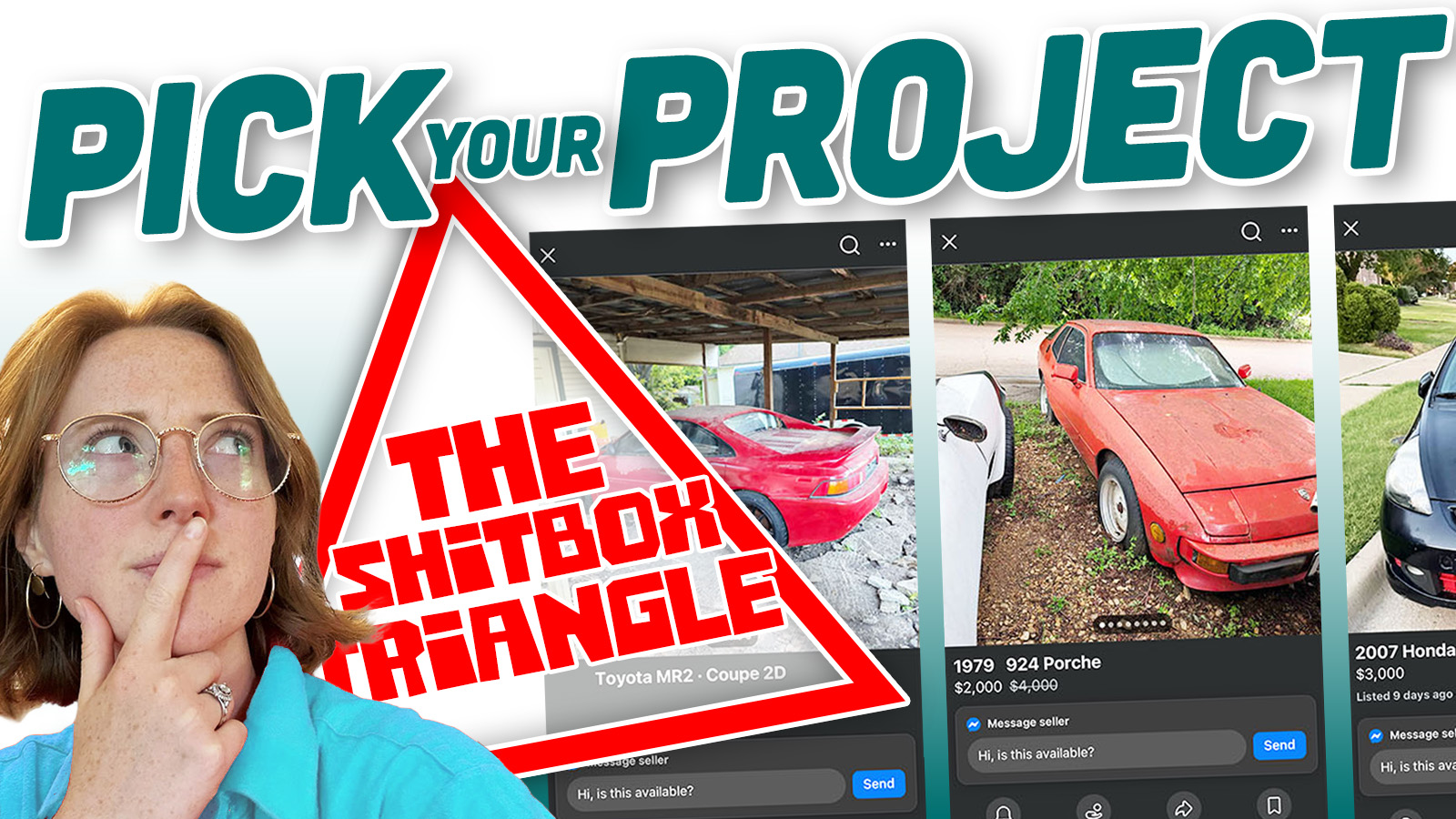
To many enthusiasts, myself included, a project car feels like an extension of your identity. Every system that makes my car run has been touched by my hands; every bolt on the interior has been dropped, lost, found, and dropped again under my watchful eye; every body panel has been kicked out of frustration at least once. The strong connection one feels with a car they’ve devoted so much time and energy to can’t easily be put into words. So, it’s natural that project-less car enthusiasts are always champing at the bit to get their hands on one of their own.
I currently own six cars, and five of them could qualify as a “project.” As a result of me being intentional, each one fills a unique place in my garage, so if one were to go away, my garage would feel incomplete — which is both a blessing and a curse.


The below guide is written to take you through the five stages of acquiring a project car — all the way from helping you pick what you want to figuring out what the heck to do with the thing once it’s in your driveway. If you already know the type of car you want, you can go ahead and skip forward to Stage two, since Stage 1 won’t be of any use to you. Although it could be a useful thought exercise to make sure that what you think you want is actually what you want.

Stage 1. Discovery
Step 1. Figure out exactly what kind of build you want.
The needs of a car built to off-road are vastly different from the needs of a car that will hit a drift course. Be as granular as you can and note it in some way. That way you have your north star to refer back to at every stage of your project. This is going to be the primary driving force behind every decision you make – second only to budget. The broader the goal, the more options you’ll have to satisfy your criteria.
For example: I want an uncommon sports car by a Japanese manufacturer from the 80’s and 90’s to build for low power, high agility street performance with an additional focus on aesthetic restoration.
Step 2. Lurk in online communities related to your desired niche.
Facebook and Reddit are treasure troves of knowledge. Simply consuming content posted in niche interest groups (like say, a local rally group in your area) is a great way to learn common platforms people use and what qualities to look for in a car or modify towards. Even better, creating connections in your desired community pays off. My primary project, a 1985 Toyota MR2, is largely running as well as it is today due to me befriending some dudes I met in an online car group.
For example: I joined multiple JDM, import, and autocross focused groups both globally and in my area. I also followed multiple retro-focused accounts on Instagram, like Radwood.
Step 3. Narrow your options
Now that you know the general qualities of what you’re looking for, try to get specific. Use the information you’ve learned from poking around online communities to make a short list of cars that pique your interest. Taking relative car availability and your budget into account, narrow your list down to a small handful. If some generations of a car are more desirable to you than others, specify generation in your list.
When narrowing your options down to your final, shorter list, it’s also important to research common issues and failure points. For example if you’re not wanting your car to be a notable fire risk, maybe an early, un-fixed Pontiac Fiero with a coolant and oil leak isn’t a good idea. Parts availability should also be top of mind, since purchasing a car with horrible parts availability can quickly cause a build to take significantly more time and cost significantly more money. Funny enough, this is a primary contributing factor behind me still not importing a first generation Renault Twingo (they just look so friendly!)
For Example: Initial list: AW11 Toyota MR2, SW20 Toyota MR2, AE86 Toyota Corolla (Coupe or Hatchback), Mazda FC RX7, A70 Toyota Supra, Mitsubishi 3000 GT
Final list: AW11 Toyota MR2, SW20 Toyota MR2, A70 Toyota Supra
Stage 2: Before You Shop
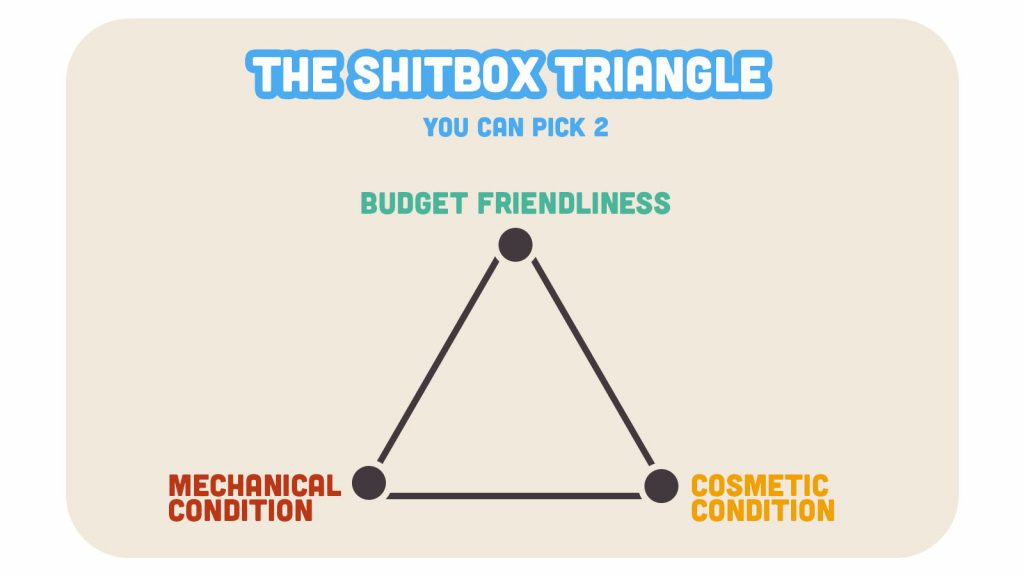
Step 1: The Shitbox Decision Triangle
Before you even consider lowballing some poor guy on Facebook Marketplace you need to be well acquainted with what work you are actually willing do. In my years of being a borderline menace on Facebook Marketplace, I’ve found that you can typically choose two qualities in any project car out of Budget-Friendliness, Mechanical Condition, and Cosmetic Condition. Yes, very rarely you may luck out and get all three [Ed Note: This is called scoring a white-hot deal. -DT]; set your expectations low, so if they’re more easily beaten. We are shopping for something ultimately to work on, of course, so it will not be perfect, but shopping smart will help you make a decision you don’t regret in a year, or even ten.
For Example: I am comfortable doing in-depth mechanical work but absolutely loathe body work and really care about staying in budget. I am going to prioritize cost and cosmetic condition above mechanical condition.
Step 2: Get even more specific
The key to getting a project car you actually love is being almost annoyingly aware of what you want and looking for exactly that. Sure, it’s fun to randomly buy a $500 shitbox you stumble across on your lunch break, but that heap of sheet metal may never fill the void – only a spot in your driveway. Try to prioritize one specific model from your list to focus your efforts so you don’t get overwhelmed. Feel free to continue looking for the others from your shortlist, but you will have better results as you get more specific.
Step 3: Familiarize yourself with the existing market
With your newfound clarity, start looking around for examples that fit most of your wants on various car buying platforms and marketplaces like Facebook Marketplace, Bring A Trailer, Cars & Bids, Hagerty Marketplace, eBay, etc. Doing this before you start formally shopping can better inform you of what the current buying and selling market looks like. Is the car you want selling quickly? Are they more expensive than you expected? Does what I want even exist on the used market? For your sake, I hope it does.
Before you move on, ask yourself these questions before starting the shopping process:
- What level of existing modifications (if any) are you comfortable with?
- Do you want a specific color or trim?
- Are there any things you specifically do NOT want?
- How long are you willing to wait for the perfect example before accepting compromises?
- How far are you willing to travel to pick up a car and/or are you willing to pay the freight cost to ship it?
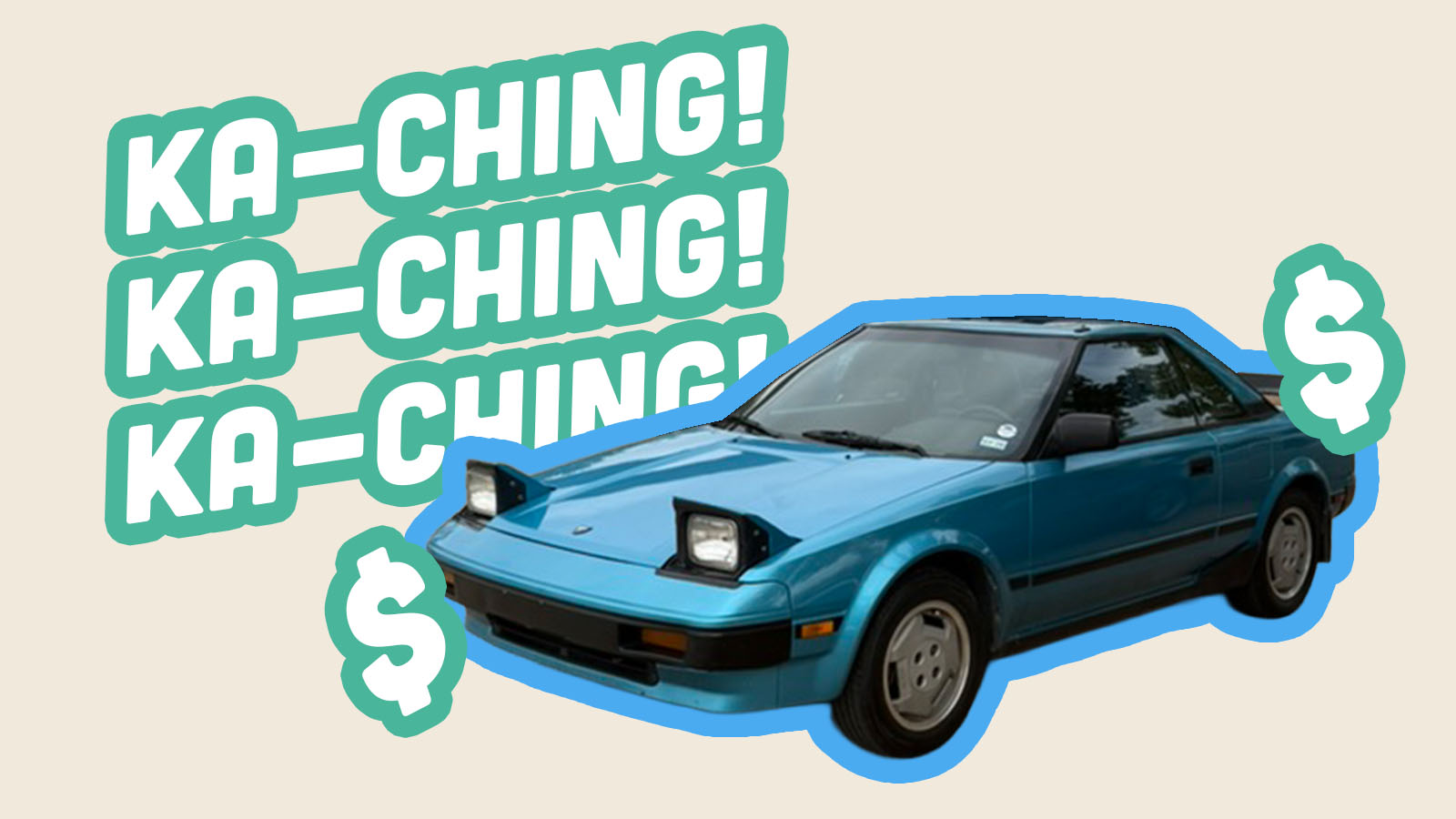
For example: I want an AW11 Toyota MR2. I would prefer a relatively unmodified car or a car that is easy to revert to stock. Preferably in 8B8 Light Blue Metallic. I do NOT want a car from rust-prone areas or significant rust. I am willing to wait 1 year before agreeing to compromises. I’m willing to search nationwide, but would pay a small premium for something local.
Stage 3. The Buying Process
This stage is less of a step-by-step, since each buying process can vary so heavily. I currently own six cars, all purchased used and none of their buying processes were the same. My 2012 6MT V6 Porsche Cayenne was purchased through a friend at auction, our 1993 NA SW20 MR2 was purchased by hounding the previous owner to sell it to us when they were ready, and our 2013 6MT Cadillac CTS-V Wagon was purchased the old fashioned way – though Facebook Marketplace. Even though the exact processes may vary heavily, there are a few key things to keep in mind when actively looking to purchase.
1. Have the money ready at any moment.
When buying my Cayenne, we were notified of it being at auction and less than 24 hours later it was auctioned off and purchased on our behalf after months of searching. Sales can often move faster than that, with initial contact with the seller to money changing hands sometimes happening in only a few hours. If you always have the money ready, you’re able to jump on any deal the moment you see it. This isn’t me telling you to have thousands of dollars in cash just hanging around – but have the money be quickly accessible so you’re not having to wait around for money to move and potentially miss out on your dream project because someone got to it first.
2. Save examples that are “almost it” as a negotiation tool
When negotiating a sale price, having relatively comparable examples (or “comps”) in your back pocket can be a powerful tool, especially if the car you’re wanting is priced above what you think it’s really worth. If you come across examples that are a color you don’t want, too far away, etc., bookmark them to reference back to. Checking for recently sold is also a good way to build up your comp library.
3. Don’t be afraid of negotiating
While this doesn’t apply to cars purchased in an auction setting, being comfortable negotiating can save you hundreds. Do not rush out and start lowballing people on Marketplace because some random woman on the internet told you to (although it can sometimes be fun). My general rule of thumb is if the car is otherwise fairly priced, to initially offer an absolute maximum of 10-15% below their initial asking. That percentage goes down the higher the price of the car gets, but few people would scoff at a $2600 offer on a car they priced at $3000 even if they don’t accept it. You miss 100% of the shots you don’t take.
If the car is overpriced for its condition/options/etc, this is where the comps I talked about earlier come in. Some sellers won’t care and will try and get their asking regardless, but every now and then they’ll at least agree to meet somewhere in the middle.
Phase 4: The first look.
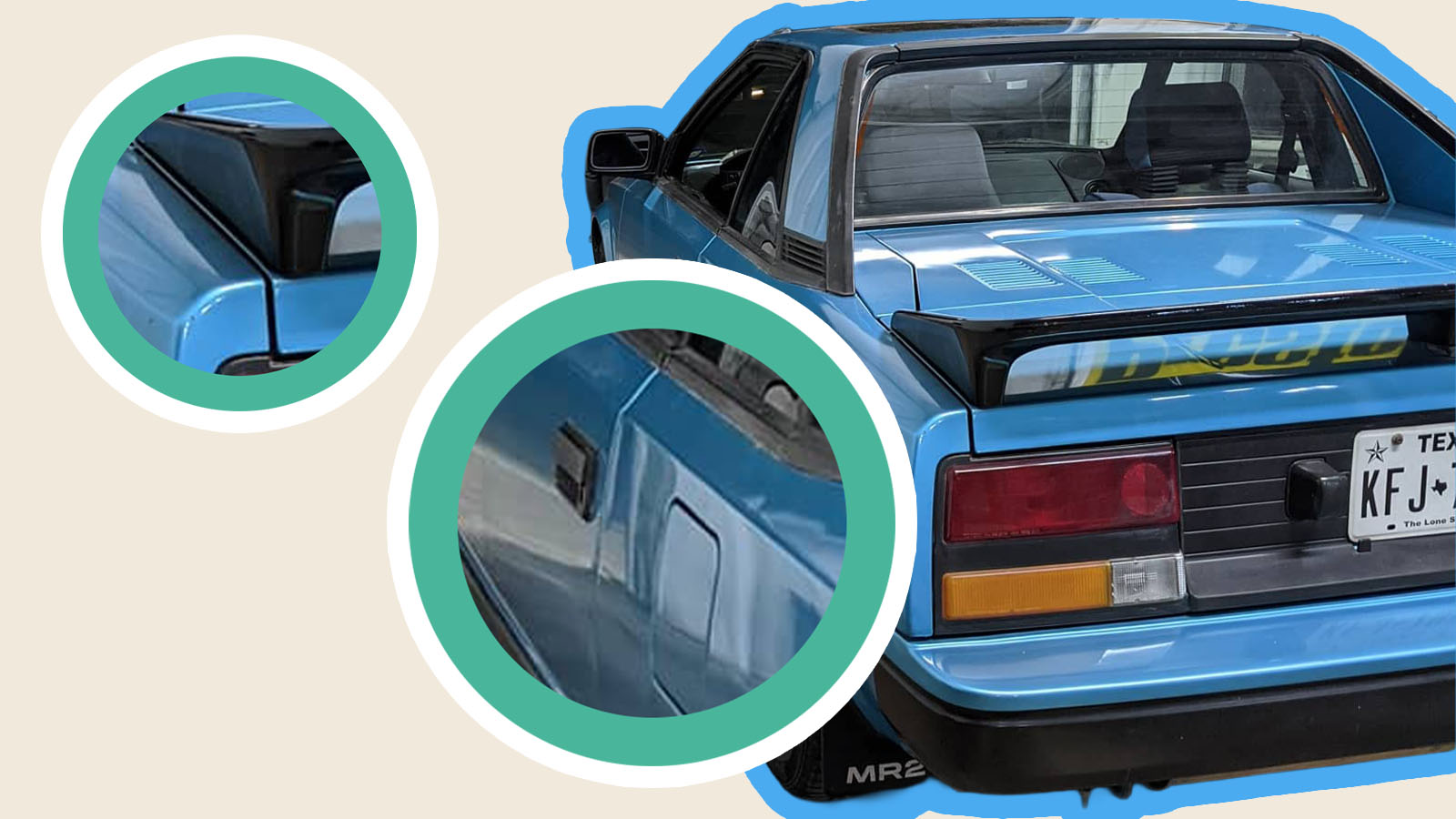
This phase, despite being the shortest, is also the most exciting. It’s getting to see the physical manifestation of your efforts for the first time, after all. I cried seeing my AW11 for the first time, but I’m also a big softie.
If you have an ounce of whimsy in your body you’re probably bubbling with excitement, as I was. As fun as this is to experience, it’s sadly a prime scenario for red flags to be overlooked, bad deals to be made, and difficult situations to be entered all due to you simply being excited about your new, multi-thousand pound, metal toy.
Remember – through rose colored glasses, all of the red flags just look like flags.
1. Bring a friend who will (at least kind of) know what they’re looking at
The earlier step of getting involved in niche communities pre-purchase can come in handy at this point if you don’t already have friends in the know. They don’t need to have knowledge of a specific model, but good enough knowledge to pick out a lemon if your judgement is clouded can prove very useful. If you can’t get someone to come with you physically to aid in inspecting it on pickup, at least share the listing to get second (or even third!) opinions.
2. If it was listed as “running and driving,” drive it.
For some reason, people love putting that a car “ran and drove great when I last started it four years ago” in a listing. This does not mean the car still runs and drives (and in this example it probably does not). Even if your listing does not have this irritating little tidbit, if it is not explicitly called a non-running car it is paramount that you get your tush behind the wheel of that car before any money changes hands. Just a quick drive down the street can quickly tell you a lot about the true health of a car. For example if a car is listed as running and driving but it releases a plume of white smoke when you step on the gas and gets stuck in 3rd gear, it’s a way bigger project than you may have anticipated.
And even if these issues don’t ultimately influence your decision to purchase the car, let me assure you, from experience, that realizing that a car is rougher than you expected before spending thousands of dollars always feels better than realizing so after.
3. To-dos before you depart with your car
- Check the keys on every door and secondary lock like on trunks and gloveboxes. If the keys provided don’t work, just ask the seller if they have missing ones.
- If the car is modified, ask the seller if they have any of the OEM parts they removed. Sometimes they may ask for more money, but it’s worth it and they may cut you an amazing deal, or even give them to you for free! We did this when purchasing our 1994 MR2 Turbo and we walked away with 2 huge boxes of original MR2 engine components and interior panels to replace the rather tacky mods he did in the early 2000s.
- If you’re driving the car home, inspect the tires. Check tread wear, air pressure, and the date code. You can’t enjoy your new car if you spin off of an overpass.
- Fill up the gas tank if you’re driving it home. You don’t know if the fuel gauge works or how old the gas is. Find the nearest gas station and fill’er up unless you want to run the risk of getting stranded.
[Ed Note: I’ll also say: You wanna make sure the title is clear and in the name of the person selling the car to you. -DT].

Stage 5: At Home With Your New Car
When I purchase a car I have a routine that I follow to make sure it’s in the best condition possible as soon as possible. Rip off the bandaid and spend a weekend acquainting yourself with your new car with some good music, a cold beverage of your choice, and some takeout.
Step 1: Download or purchase a service manual
I have a PDF of the service manual for my AW11 and it is single-handedly how I was able to yoink the swiss-cheese-spec 4AGE out of it with relative ease. It’s also useful for more basic stuff like removing internal panels, bleed valve locations, and other random bits of information that can be harder to find for older cars. I also like to have the service manual to reference diagrams for locations of hard-to-see bolts and hoses.
Step 2: Inspect the engine bay more closely and self diagnose any seller-reported issues.
If the car runs, run it sitting in your driveway for a few minutes to allow the car to get up to operating temp and get nosy. Sniff around for smells, look for oil leaks on the engine and under the car, any weird idle patterns, any weird shaking in the steering or suspension, etc. Make note of anything that just feels off and if it’s not critical, dig into the cause later.
Sellers, contrary to popular belief, are humans. Humans make mistakes. Validate any information and diagnoses they provided with your own testing. That way you don’t end up spending tons on parts and working hours in the garage for it to not solve anything.
Step 3: Inspect your consumables.
An oil change, brake inspection, coolant level inspection, and brake and clutch fluid inspections are typically some of the first things I do to a newly acquired car. Even if the oil change you do ends up not being needed, for example, you’ve reset the service interval to a precise date you’re aware of and can base your future maintenance schedules off it.
Step 4: Inspect your tires and all exterior rubber seals
If the tires mounted on your car are more than 6 years old or so, it’s a good idea to look into replacing them if you’re going to be driving it any time soon. You don’t need to immediately jump on the nicest set of Pirellis you can get in the right size. We purchased the cheapest tires we could find for our AE86 to replace its original tires that were date stamped to August of 1994. Once your car is in a stable, drivable state, spring for fancier tires.
Inspecting exterior rubber seals is an absolute necessity if your car is going to be parked outside. Spray it down with a hose or dump some large buckets of water, focusing on the seals, and immediately check the interior and trunk for water intrusion. Nothing makes a build less fun than suddenly having to deal with water damage, ask me how I know. If your seals look a bit dry, rehydrate them with gasket grease (I like Shin-Etsu). If you’re still worried, purchase a generic car cover online to protect it from the elements.
Step 5: Enjoy working on your new car.
Acquiring a project car, and working on it, is one of the most gratifying things a car enthusiast can experience. You will hit road bumps. You will get stuck. You will get angry. You will hurt yourself. You will feel in over your head. You will realize you actually have no idea what the heck you’re doing.
But none of us do, we just love our cars. So keep on wrenching, and if you have anything else to add, I look forward to reading your comments.




I’d say the relevance of the triangle is very dependent on project age and popularity of the vehicle in question. In my opinion, anything over 30 years old that wasn’t a popular model, completeness is much more important than mechanical condition. Engine and transmission wasted, who cares, just LS swap it, but if the interior is missing a bunch of trim pieces that you can only get used, that’s the real nightmare.
Another tidbit. If you see a vehicle sitting lonely and apparently underloved and it is on your list, do something. Leave a note if you can’t find the owner. There are at least three vehicles I wanted but didn’t do any of those things, to later find out that I could have had at least one of them for nothing! When someone leaves a note on my ’64 F100 coach-built crewcab, or asks me if I want to sell it, I smile and say no. If you don’t ask, you won’t get it.
This is good content!
HAHAHAHAHA!!! “Old Fashioned”. Remember Craig’s List? It was still king a decade ago.
This is also good advice if you buy a house, and can I stress that you should do this before you shut the door behind you with only one key in your pocket.
Fortunately the previous owner wasn’t far away, and found a spare key in their car.
I am ashamed to admit I don’t have a project car at this moment. It seems Belgian and European governments are cooperating to make ownership of affordable interesting cars very expensive.
I also don’t have the time or place to do justice to an interesting car. Having one wasting away outside would make me sad.
So I opted for the next best thing. A collection of more or less interesting cheap two wheelers.
The powered ones are:
Work with the tools you have, not the ones you wish for!