

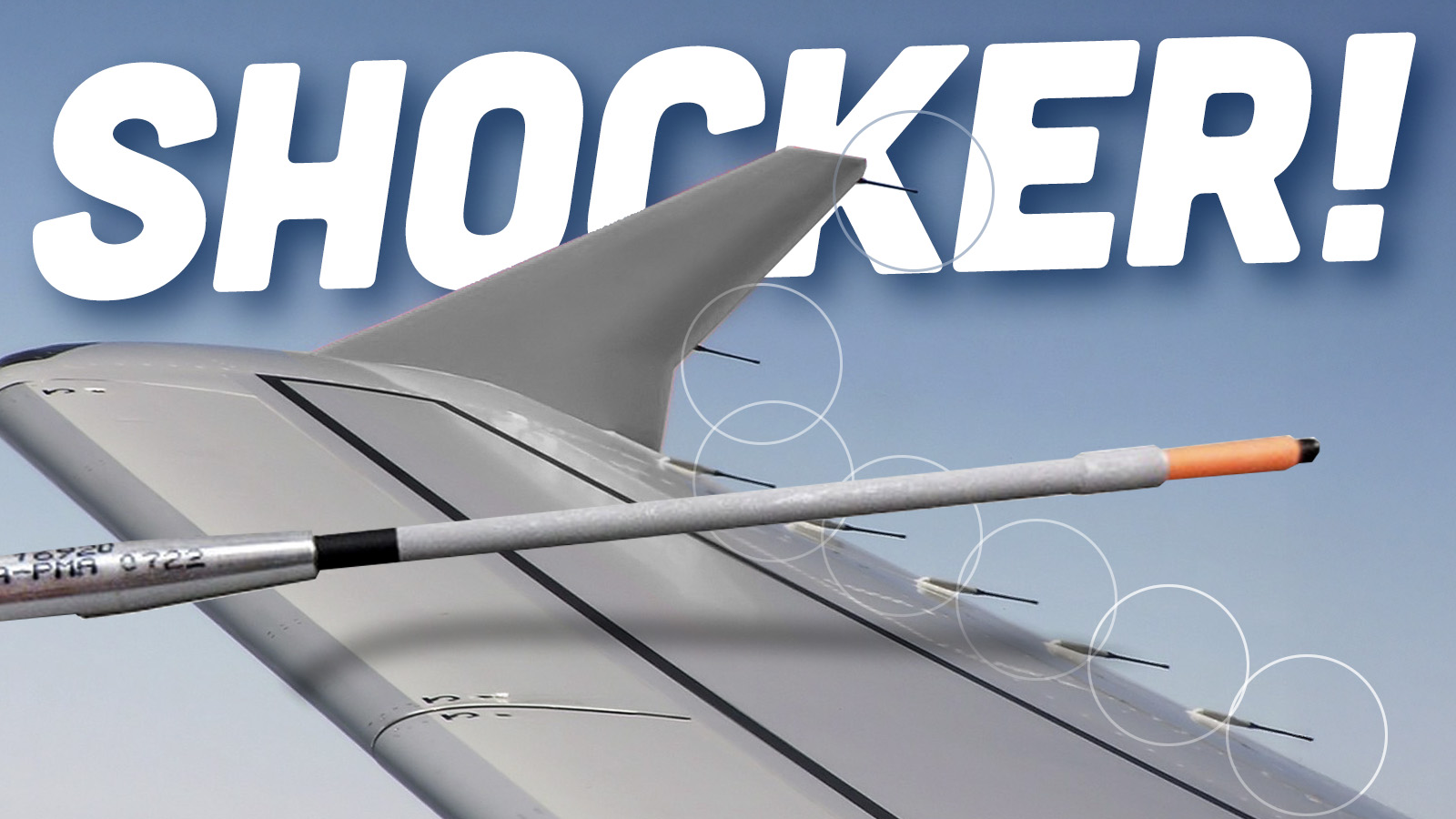
Every day, America’s airlines handle more than 28,000 flights carrying more than three million passengers. The vast majority of the time, these flights reach their destinations completely uneventfully. The impressive safety of aviation has been built over a century of regulations, engineering, and innovation. One of the contributors to aviation safety hides in plain sight. Have you ever looked out your plane window and wondered why the wings have tiny rods on their ends? They look weird, but these rods, called static dischargers, serve a great purpose in getting you to your business meeting or vacation safely.
As the Aviation Consumer writes, any time an aircraft flies through the sky, the friction of the air flowing over the aircraft’s skin causes static electricity to build up in the aircraft. When this electricity discharges, it can generate radio frequency interference (RFI) or static noise. As radio frequency interference builds, it can impact the functionality of communications and navigation radios that operate in very low frequency (VLF), high frequency (HF), and very high frequency (VHF) ranges. If you’re on the radio, you might be able to identify this interference through a hissing noise.


RFI can do more than just add to ambient noise. It can cause a radio receiver to lose reception, which adds to the workload of the pilots of the aircraft.

That’s only some of the effects. As the Aviation Safety Blog of the Naval Safety Command notes, the electrostatic discharge in a military setting can cause static shock to ground personnel, uncommanded ordnance activation, uncommanded ordnance release, or damage to aircraft subsystems.
There’s also the extreme scenario and the nightmare of many who board planes, a lightning strike. A focus of aviation safety for more than a century has been figuring out what to do with all of this electricity. The solution is a clever device commonly called the static wick or the static discharger. You may not be able to stop electricity from building up on a plane, but inventors and engineers have figured out how to dissipate the energy more safely.

Why Planes Must Deal With Static Electricity
The science behind how planes build a static discharge is a fascinating phenomenon. From the Naval Safety Command:
Static electricity is the accumulation of electric charge on an insulated body. Static electricity charges are generated by the separation of like and unlike bodies. Sources of static energy include friction, induced charged and triboelectric charge. Induced charge occurs when an object is immersed in an electric field. Triboelectric charge occurs when certain materials become electrically charged after contacting one another and are then separated (such as through rubbing).
Something as simple as high winds kicking up dust and blowing that dust into the aircraft can create a triboelectric static hazard. Electric storms can travel over an electrostatic field, resulting in large, induced charges on parked aircraft. Friction hazards can come from the clothing worn to simply fueling an aircraft. These examples can result in an electrostatic build-up that can cause severe to lethal injuries if touched, or initiate fires and explosions.
RFI can be generated from innumerable sources in the air as they make contact with aircraft surfaces. Particulates in the atmosphere, including rain, snow, fog, clouds, sand, dust, and volcanic ash, each generate RFI. As an issue of the Aviation Mechanics Bulletin from the Flight Safety Foundation writes, flying in rain generates a moderate discharge. However, a heavy discharge can occur when flying in clear air near electrically charged clouds or when penetrating through a storm.
The Flight Safety Foundation even says that an aircraft can get discharged from particles from the exhaust of its own engines. That’s why the Aviation Consumer says that if a plane is flying, it’s building up static electricity.

The Physics Classroom, a program that teaches Physics to kids, explains triboelectric charge in easy terms:
The presence of different atoms in objects provides different objects with different electrical properties. One such property is known as electron affinity. Simply put, the property of electron affinity refers to the relative amount of love that a material has for electrons. If atoms of a material have a high electron affinity, then that material will have a relatively high love for electrons. This property of electron affinity will be of utmost importance as we explore one of the most common methods of charging – triboelectric charging, also known as charging by friction or rubbing.
Suppose that a rubber balloon is rubbed with a sample of animal fur. During the rubbing process, the atoms of the rubber are forced into close proximity with the atoms of the animal fur. The electron clouds of the two types of atoms are pressed together and are brought closer to the nuclei of the other atoms. The protons in the atoms of one material begin to interact with the electrons present on the other material. Amidst the sound of crackling air, you might even be able to hear the atoms saying, “I like your electrons.” And of course, the atoms of one material – in this case, the atoms of rubber – are more serious about their claim for electrons. As such, the atoms of rubber begin to take electrons from the atoms of animal fur. When the rubbing has ceased, the two objects have become charged.
[…]
The triboelectric charging process (as well as any charging process) involves a transfer of electrons between two objects. Charge is not created from nothing. The appearance of a negative charge upon a rubber balloon is merely the result of its acquisition of electrons. And these electrons must come from somewhere; in this case, from the object it was rubbed against. Electrons are transferred in any charging process. In the case of triboelectric charging, they are transferred between the two objects being rubbed together. Prior to the charging, both objects are electrically neutral. The net charge of the system is 0 units. After the charging process, the more electron-loving object may acquire a charge of -12 units; the other object acquires a charge of +12 units. Overall, the system of two objects has a net charge of 0 units. Whenever a quantity like charge (or momentum or energy or matter) is observed to be the same prior to and after the completion of a given process, we say that the quantity is conserved. Charge is always conserved. When all objects involved are considered prior to and after a given process, we notice that the total amount of charge amidst the objects is the same before the process starts as it is after the process ends. This is referred to as the law of conservation of charge.
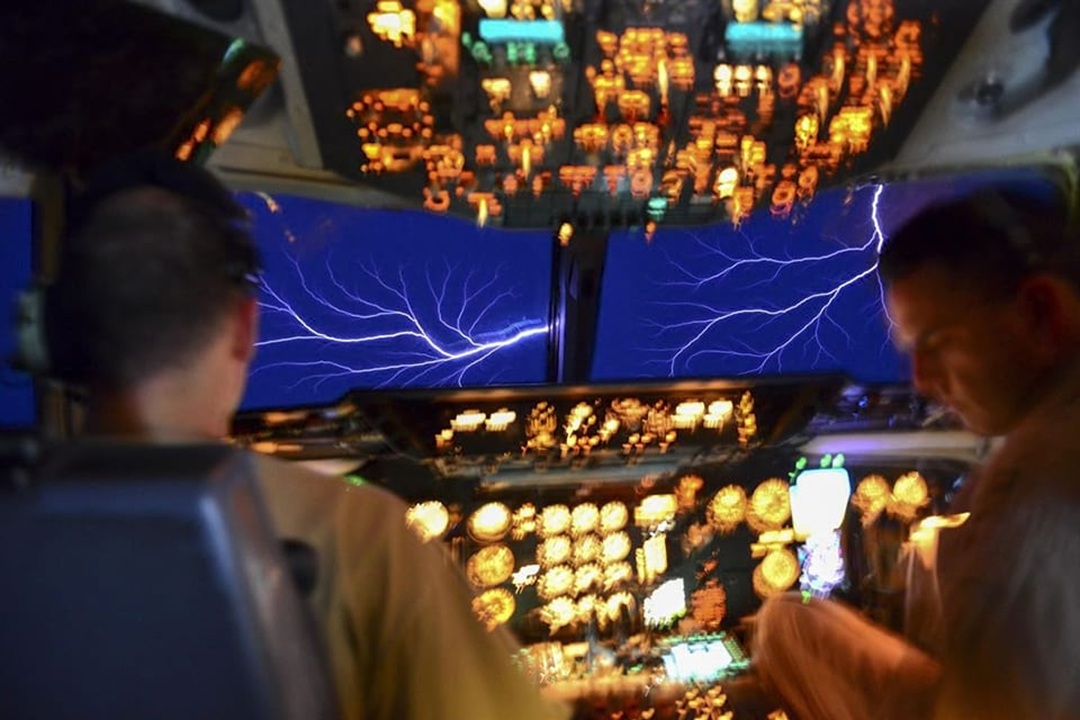
The Flight Safety Foundation writes that three types of discharges cause RFI: corona, streamering, and arcing. A corona discharge causes ionization of the air, and it can have both a luminous and an audio effect. The glow from a corona discharge on non-metallic surfaces like radomes, winglets, windshields, and propellers is known as St. Elmo’s Fire (above). The National Oceanic and Atmospheric Administration says that St. Elmo’s Fire is seen most often during thunderstorms.
A streamering discharge is a discharge that can be luminous and trail the aircraft. Arcing usually involves discharges that travel short distances – maybe an inch or so – between surfaces and can emit a glow, too.
When the charge reaches 100,000 to 200,000 volts, the electrical fields on the airplane become concentrated on its extremities, like its wingtips, tail surfaces, and other hard points. The volts are high, but the current is low, so it’s not going to cook a human. The current discharges into the air, generating RFI.
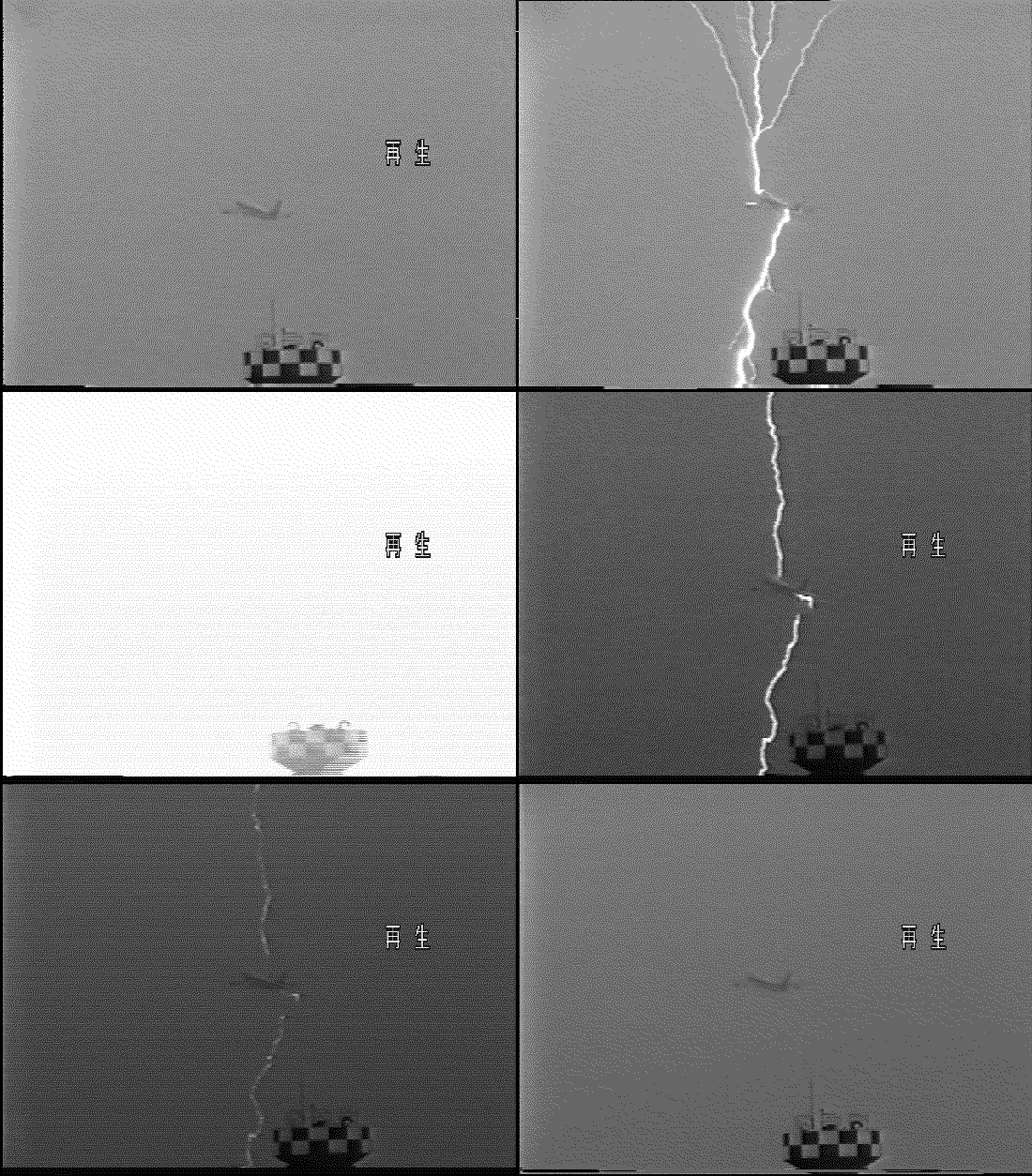
A concern of aviation engineering for more than a century has been controlling where the discharge of static electricity goes. In the past, there had been fatal airliner crashes that were suspected to have been caused by lightning strikes igniting vapors inside fuel tanks. One of the unconfirmed theories behind the explosion of the Hindenburg was static discharge.
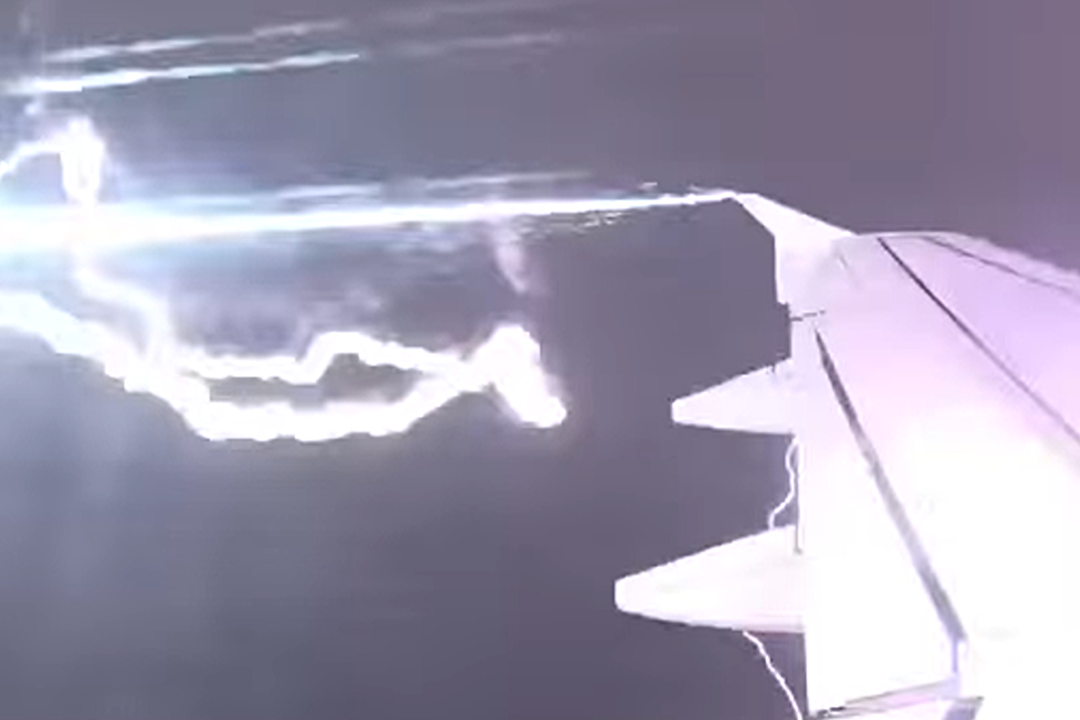
So, controlling where charges go isn’t just to keep radios working and crews safe, but it could prevent a larger incident. To be clear, even with today’s technology, static buildup and lightning strikes (gif above, click here if you cannot see it) cannot be avoided. But engineering is there to send it to safer places.
Channeling Energy

Back in 1920, Dudley B. Howard filed a patent for a static discharger. In the text of his patent, he states that static discharge is objectionable because it interferes with radios, sets aircraft on fire by creating spark that ignites fuel, and represents a ton of potential energy that’s just going to waste.
Dudley’s plan called for attracting the static discharge to a defined path that would lead the electricity to a Leyden jar capacitor. This was nominally a jar wrapped in foil inside and outside with an electrode. The second part of the invention called for linking all metal parts of an aircraft through a good electrical connection. Dudley said that a major cause of sparks from static discharge was the fact that the static would arc between metal components. So, connecting everything together was Dudley’s solution to preventing arcing.
Dudley’s invention laid the groundwork, but it would take until the 1940s for the development of the more modern solution to take shape with the static wick. These little devices bleed static discharge into the air around an aircraft at a controlled rate.
From the Flight Safety Foundation:
One of the earliest such devices was the carbon-impregnated cotton or nylon wick device that spawned the generic name “static wick.” The carbon provided a high resistance path through the wick, and the individual carbon crystals provided a multitude of small, sharp discharge points through which small individual currents could discharge into the air. As air movement and weather eroded the wick and depleted the carbon in the exposed area, the core began to turn light gray and then white. Then the outer shield was cut back, exposing a new carbon surface, and the faded portion of the wick was removed by a square cut.
There were numerous developers of static wicks in the 1940s. From 1940 to 1945, TWA used a 1937 Lockheed Electra Junior as an executive transport and an airborne research laboratory. This aircraft was used in the development of static wicks, and then was sold to the Texas Oil Company after World War II. Amazingly, the plane is still around today.
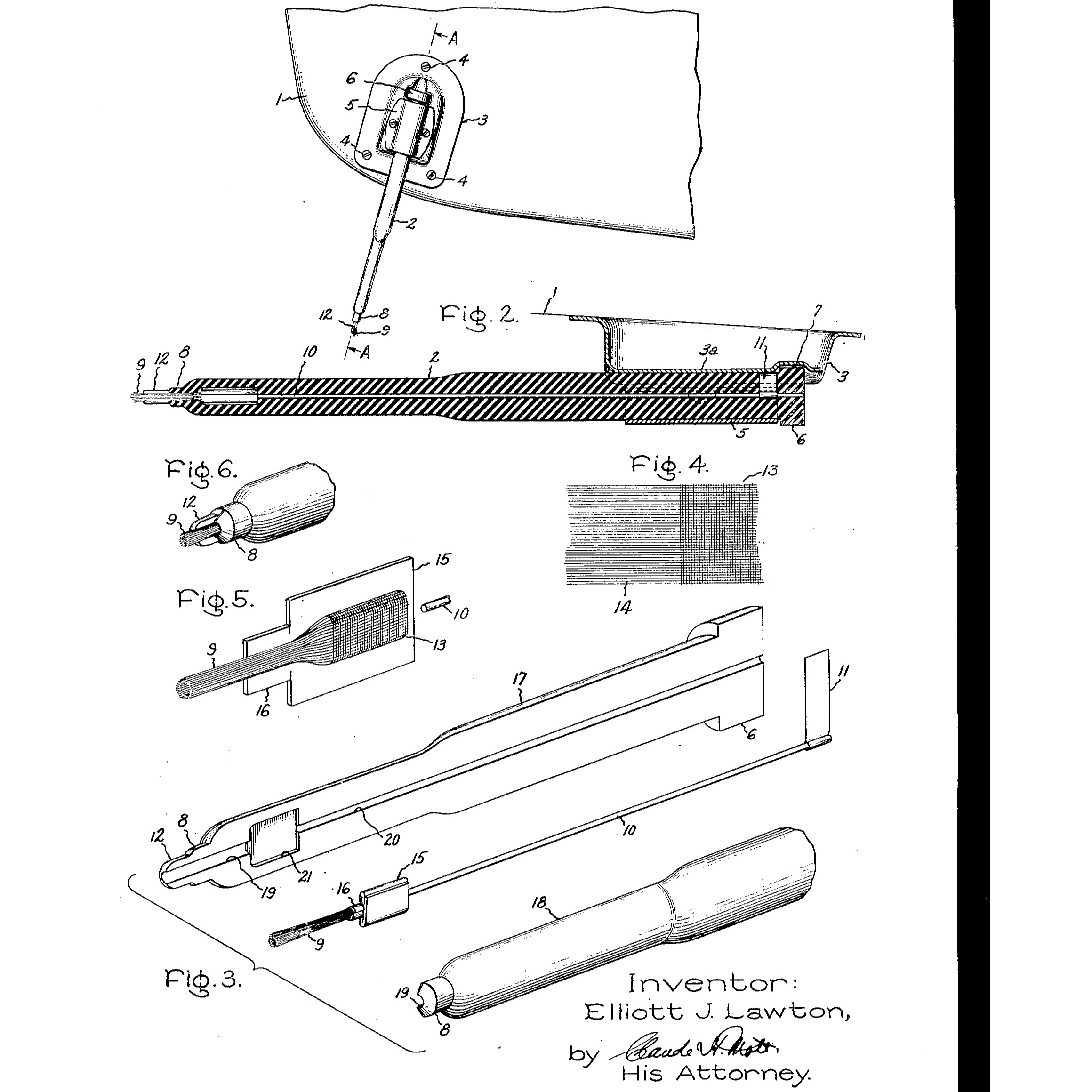
Many sources point to an invention by Mary R Sullivan, Houk Frances Rudy, and Nelson S Talbott as the creators of the modern static wick. The engineers developed the technology in the 1940s before applying for a patent in 1950, which was granted in 1953. The patent was assigned to Dayton Aircraft Products Inc. of Ford Lauderdale, Florida. Today, that company is known as Dayton-Granger.
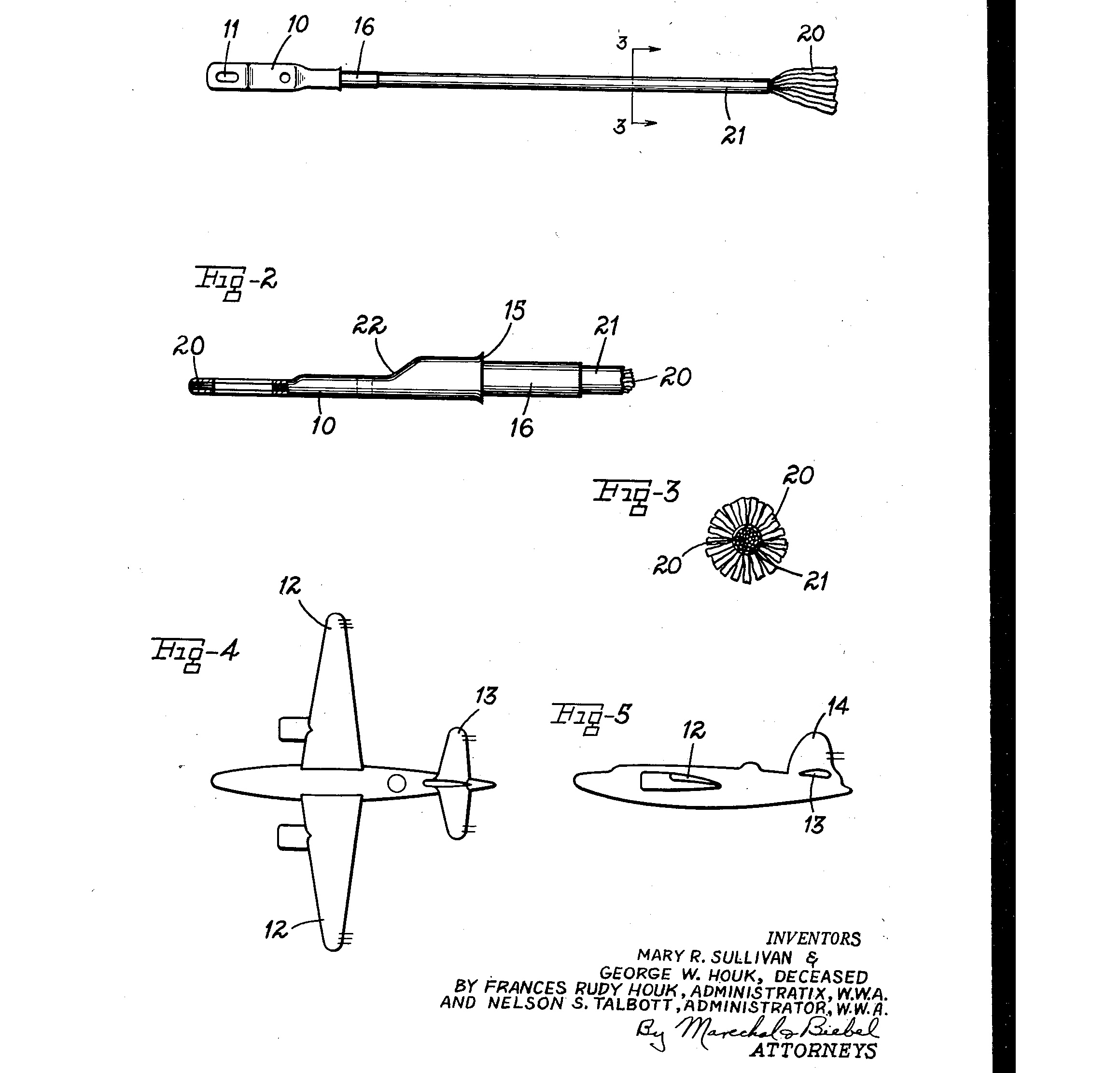
The patent mentioned that discharge wicks did exist before, but they wore out quickly and were expensive to make:
The static may be discharged by trailing a fabric or cotton wicking containing a high resistance coating, such wicks providing a large number of discharge points of small dimensions and having the capacity to cause a charge to dissipate into the surrounding air in flight, thus preventing the building up of such highly charged conditions as to cause the objectionable interference referred to. Where such wicking has been prepared by impregnating the fabric with a powdered metal such as silver, for example, not only has the process of forming the wicking been substantially involved and relatively expensive, but under the severe conditions to which the wicking is subjected in its exposure to the relative wind in flight, there has been excessive wear, abrasion and change in the resistance characteristics, causing the wicking to lose its effectiveness rapidly.
Whether the loss of effectiveness is caused by the washing or leaching out of the silver or other metal, or, as a result of oxidation of the metal, the result has been that the wicking would change its essential characteristics quite rapidly, and thus soon become of little value for the purpose. Attempts to substitute other conductive materials have not been successful because of the difficulties presented in securing such materials sufficiently firmly to the wicking to provide the proper initial resistance and to maintain the materials in place and with any substantial uniformity of characteristics under the severe conditions of use.

The inventors’ improvement was a wick that could be made inexpensively and lasted longer. From the patent:
In accordance with the present invention, a superior static discharge wick is provided which can be reliably and economically produced with desired resistance characteristics as determined to be most satisfactory, and such characteristics are maintained in-a highly reliable manner over an extended period of use, notwithstanding the severe abrasion, leaching, and other conditions to which the wick is subjected in flight. This is accomplished through the utilization of carbon in finely divided form as the high resistance conductor, the carbon being applied in the form of a dispersion of graphite, and being secured to the winding in a highly permanent manner through the use or a suitable resin binder composition. Wicks so produced as to have a predetermined resistance may be prepared relatively inexpensively, and may be used even under severe conditions of flight through rain, snow, fog and the like, and have been found to maintain their effectiveness and do not objectionably depart from the desired value of resistance, over substantially longer periods than has been possible with metal impregnated wicks.
Dayton-Granger wasn’t the only game in town. In 1947, Chelton Electrostatics Ltd. of England developed a static discharger (below) featuring tips made out of fine nichrome wires. These wires provided a path for discharge to travel.

In the late 1960s through the early 1970s, Shaw Aero Devices developed a discharger made out of crystallized carbon. The carbon of these dischargers provided resistance, while the tips of the crystals provided plenty of discharge points. Reportedly, these static dischargers worked very well and were put into service on various aircraft fleets.
One problem these early static dischargers couldn’t solve was when the aircraft had to expel a massive charge, or had a humongous charge because of a lightning strike. In these cases, existing static chargers would be destroyed, and the airframe could be damaged. The solution was adding a sacrificial metal sleeve to a carbon-based static discharger. High charges would jump to the sleeve and then bleed off into the atmosphere. In a worst-case scenario, the sleeve would melt, saving the aircraft from more severe damage.
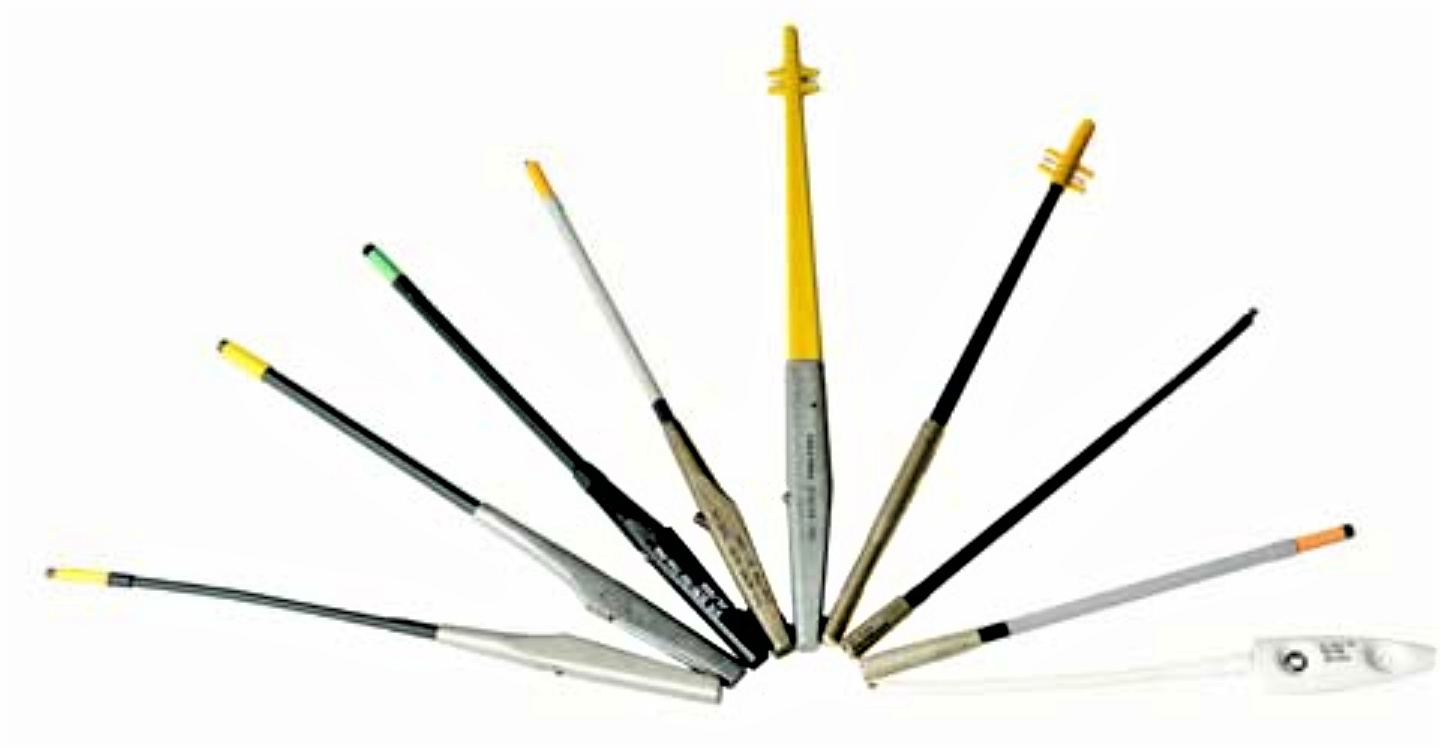
So, to bring this back around and land the plane, when static builds, it pools around the thin, sharp edges of the airframe. That’s going to be the ends of the ailerons, flaps, winglets, horizontal stabilizer, and vertical stabilizer. These sections of the airframe are where you’ll find static wicks riveted on and pointing out into the air. You’ll also find some static dischargers that have a threaded base, which permit an easier replacement.
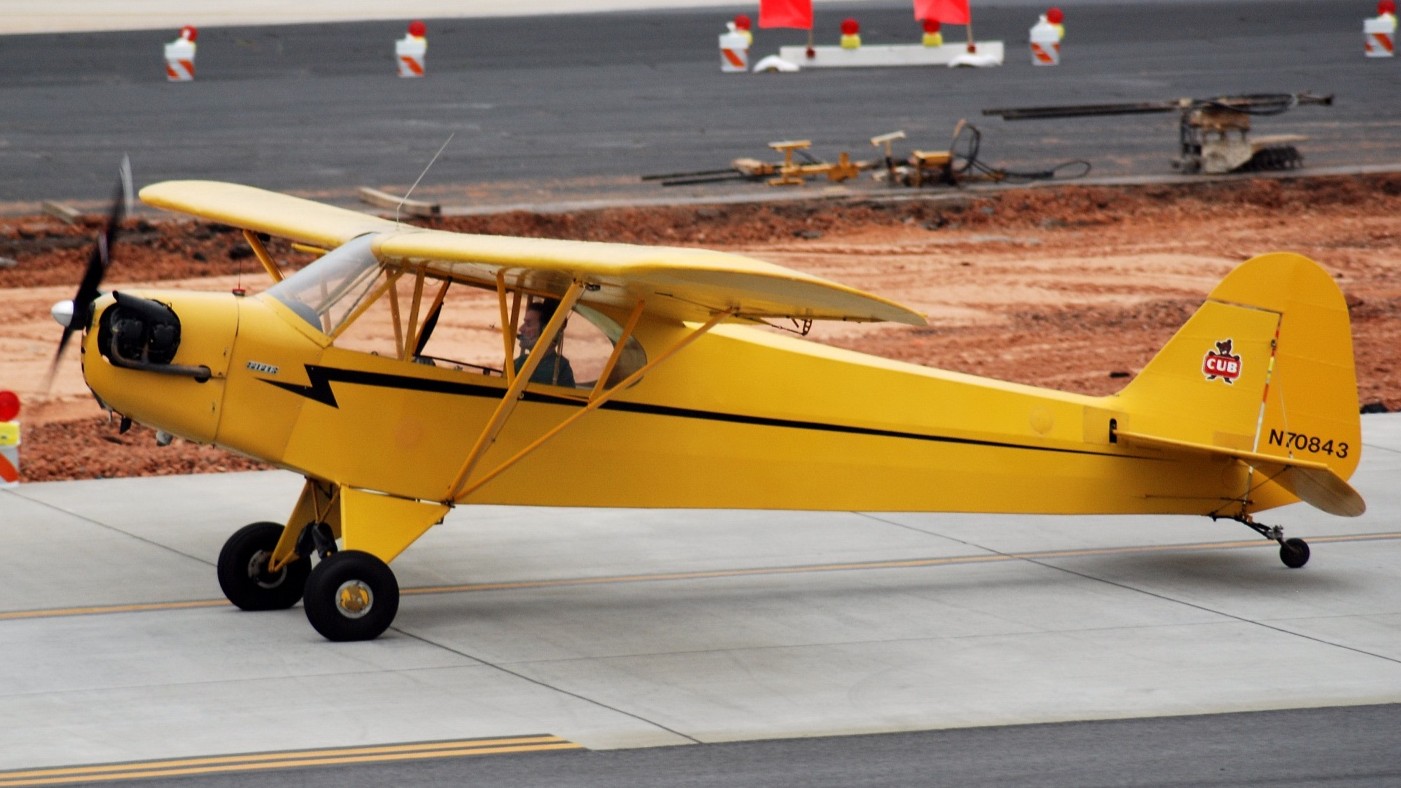
A modern wick can be made of a variety of electrically-conductive materials, usually bundled strands of carbon fiber or corrosion-resistant metal. You can find these dischargers on most aircraft, but, as Flying magazine notes, there are exceptions. If the aircraft that you’re looking at operates only under Visual Flight Rules and thus isn’t as reliant on radio equipment, you might find an absence of wicks. One example would be a Piper J-3 Cub (below).
Keeping Aviation Safer
Today’s wicks are really good at their jobs, so much so that St. Elmo’s Fire is a rarer occurrence, and today’s radios are more reliable.
As the Aviation Consumer writes, the wicks aren’t completely bulletproof. There are times when an aircraft without static wicks might encounter no interference, where one with wicks is a mess. Modern avionics help some, but they can still be hit with RFI. That doesn’t mean the wicks are ineffective, but that you cannot avoid all interference. Today’s technology has been proven to work in extreme cases, too.
The Federal Aviation Administration says that statistically, a commercial aircraft gets hit by lightning every 1,000 hours, or about once a year, on average. Yet, thanks to advancements in bleeding energy off of the aircraft, a plane continues flying after a lightning strike. Sometimes, lightning strikes do cause some control system issues, fuselage damage, or flight display blackouts, but crucially, the plane keeps flying. Once the dischargers wear out from an extreme scenario or even just regular use, the old ones can be tossed and new ones installed.
So, the next time you find yourself on a flight, and you look out of a window, look out for a static discharge wick. Those many little pointy structures help reduce your pilots’ workload and keep the flight safer. They’re just another example of how basically everything serves a purpose on a specialized vehicle like a plane.
Top graphic images: Adrian Pingstone; Dayton-Granger


I remember learning about these at Evergreen Aviation Museum outside of Portland in 2015. I’m a design junkie and find myself in places like that even though I don’t know anything about aircraft. I’ll admit, these little trailing points have found their way into a lot of my work, although in a pure aestetics fashion. I’ve got to get back out to that place, I have hundreds of photos from that day – it was very empty and the people on staff were all happy in a way that I haven’t felt in years it seems now- joyously mixing a barrage of stats, facts, war stories, and old wives tales.
I watched these static wicks really earn their pay one day. My flight was landing through some strong precipitation, likely the beginning of an electrically active storm. From the cloud ceiling down to the ground the wicks were being hit by many big arcs every second, the biggest of which were over a meter long in daylight. In a brief lull between arcs several of the wicks were glowing orange hot. Those things were dissipating a lot of energy.
I just saw “electron-loving object” play last night and they were…electrifying
“I like your electrons” Ha ha
Obligatory:
https://www.youtube.com/watch?v=-cKwBCoYrkw
Modern composite GA aircraft have a mesh embedded in the event of lightning strikes. Probably also helps with static to a degree.
So do composite airliners like the 787 and A350.
I’ve been on airplanes that were hit by lightning a few times over the years. Supposedly, on average every airliner gets hit about once a year. Only once was exciting, it tripped an electrical bus so we were in the dark on the plane for a minute while the pilots sorted it out.
Little low key jealous. I’ve been been seeking a lightening strike for years.
All it takes is a few thousand flights over 30 years, LOL.
I actually attract bad happenings on airplanes. Technically, I have been in two plane crashes (one no injuries, one minor injuries from the evacuation), the second being bad enough to write off the airplane, had a depressurization incident, and a wake vortex incident in my 30 years of flying around for a living. And got to experience pretty bad CAT. That is a LOT of bad happenings in only 3000 or so flights. Lucky me…
Nope, the bag does NOT inflate:
https://flic.kr/p/2s6PXBp
The bad ones were before cell phone cameras were a thing. Would have loved to have had a picture of the 727 sitting on it’s wing with the slides deployed after the main gear on one side collapsed. That was fun…
Though in testement to how much safer flying is today, all those incedents except the depressurization were before 2001. The o2 mask was in 2019, and it was a bit of a non-event. A slow leak that dropped the pressure such that the masks deployed, but nothing dramatic. We just turned around and went back to Philly.
Remind me to never fly on a plane with you…no offense. But possibly the worst part of that O2 mask story is being forced to go back to Philly, what a shite airport.
That Roberts is beautiful. I love light metallic blue bikes.
Bikes – Yarnallton Pike
I can’t say I blame you. Even without the incedents, I attract broken airplanes like poop attracts flies. It’s my cross to bear. 🙂
Could have been woirse, could have been Atlanta. I loathe ATL with the white hot intensity of a thousand burning suns. And the actually found us a replacement airplane and got us in the air again in a couple hours. Still arrived too late to Savanah for the nice steak dinner I had planned. Grumble, grumble. The airplane was noticably emptier on the second attempt. Chickens.
Lovely bike!
I dunno. All this flight stuff goes above my head. I guess it’s not really my bailiwick.
Sparkywick?
I have wondered about this, but never got around to looking into it. Thanks Mercedes very much for your detailed explanation. 🙂
Modern aircraft mostly being big aluminum Faraday cages is a big help. I always think of that when I’m in a Boeing 787 Dreamliner. I’m sure the fine people at Boeing have that all figured out, but I can’t help but wonder how.
I have heard some interesting stories about helicopters zapping people completing a circuit between the ground and the aircraft. Filming scenes where an actor is exiting a helicopter hovering a few inches off the ground for dramatic effect, and the actor gets seriously zapped, and the actor is understandably anxious about retakes.
I’m too lazy to look it up, buy my recollection was that Boeing built an aluminum matrix into the fuselage to allow charges to travel around the aircraft.
When I was in the service and going though survival training we had to practice being hoisted aloft by rescue helicopters. First thing we were taught was to let the rescue seat hit the ground/water before touching it to allow it to discharge static electricity.
The 787 (and likely every other airplane with a composite structure) has metal mesh woven into the fuselage and wings for this.
Gee, a lighting bolt going through a wire embedded in composite seems like a severe, borderline explosive, thermal event.
Seems to work perfectly fine. Pretty sure aerospace engineers have this pretty well covered after all these years.
Hah! You can’t fool me. Those are really canes that blind pilots deploy when they’re maneuvering the plane on the ground.
Only at LaGuardia and LAX. Everywhere else they must maintain a line of sight.
Too soon?
The aviation equivalent of curb feelers.
Nope all wrong those are Chemtrail emitters ! spraying those 5g enabled mind control drugs all over the place and affecting weather, I can protect you for the low low price of $49 per month- send transfer to ohlordiamgullible@gmail.com
Not true at all, which suggests you’re part of the disinformation campaign. These are signaling antennae for extra-terrestrial craft. Want proof? These so-called electrostatic wicks started to appear on aircraft after July 7, 1947, the date of the Roswell landing. Prove me wrong.
I’m almost certain he wasn’t serious…
MTG would like a word or two with you regarding Jewish Space Lasers.
I was testing these the other day in college! First we used a mega-ohmmeter on the 5000V range to ensure that there was a very high resistance between the tip of the wick and the airframe, and then a milli-ohmmeter between the base of the wick and the airframe, to ensure that it was properly bonded. At least, I think that’s what we did!
These are really good at stabbing you in the eye when you’re working on a tail dock.
I’ve heard an urban legend of a pilot who lost an eye after accidentally stabbing themselves with a wick during the preflight walkaround.
Not legend, I saw the pictures while working in aerospace. Gruesome. Great article Mercedes. I have designed many wick installations on commercial airliners. Some fun facts: the minimum number of wicks is determined by the wetted area of the surface (wing, horizontal and vertical stabilizer), an airplane will have close to 50% more wicks installed than are needed, so when some are lost in flight the airplane is not grounded, and they are usually aligned with the local air stream to reduce drag.