


As someone who has ridden in the not-fun part of an ambulance, I have to say that one of the things I most appreciated about the ambulance, even as hazily as I recall it, was that it was quite roomy back there. It was also reassuringly medical-looking, with gleaming stainless steel equipment and well-organized supplies stowed in cubbyholes. The whole thing just screams “you’re in competent hands.” But you know what? It’s possible to make an ambulance without any of these qualities, and people definitely did just that. Like this 1958 ZIM Ambulance, a design I’m calling the sedanbulance.
Making ambulances from passenger cars is hardly a new thing, and sometimes it works out quite well. While I think starting with a van always makes the most sense, for a number of reasons sometimes other initial platforms are chosen.


Station wagons, of course, are perhaps the next best thing to a van, and those have been used for ambulance conversions for decades:

I’m not really sure what those Rockettes (or whoever) in the background there have to do with ambulances, unless perhaps they all kick you at once, over and over. But, as you can see, that Cadillac has been pretty heavily converted into a roughly station-wagon-shaped sort of ambulance there.
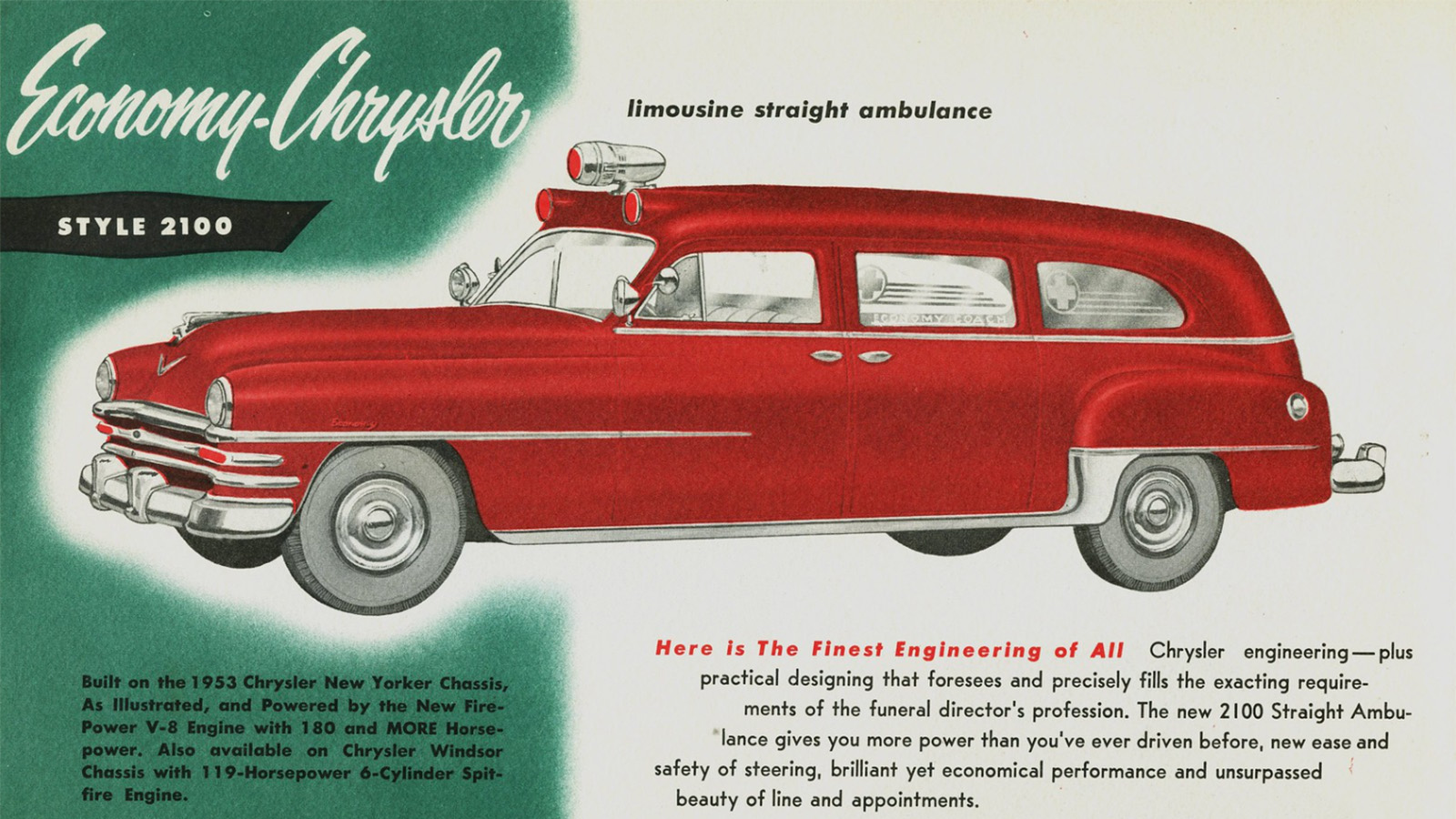
There’s another one, this time a Chrysler New Yorker, which shows a strange trend of ambulance makers of the era to pick high-end cars for their conversions. Both of these cars shared chassis with lower-spec models; I wonder why they didn’t start with, say, a Chevy or Plymouth?

In Europe, there were also station wagon-based ambulances, like this Citroën ID, which is barely modified at all from its stock form. It’s not hugely roomy as an ambulance, but it’s not bad, and the hydropneumatic suspension likely is a huge asset here, too, keeping the patient nice and comfortable and level.
Van conversions still seem to provide the best solutions, of course. This VW Krankenwagen based on a Type 2 van is small on the outside but has plenty of room inside, being essentially a big box:

Sometimes, though, circumstances necessitated less-than-ideal starting points for ambulances. Take this other Volkswagen ambulance, this one based on a Beetle:

It’s an extremely clever setup, with a rotating stretcher holder that swivels the stretcher into the car, along with a door that can open almost flat against the car. It works, but it’s hardly ideal, really. These really only made sense before VW had the Type 2 in 1950, and was certainly better than nothing.
Wartime causes lots of demands for ambulances, and a certain willingness to make do with what you have or can make quickly, easily, and cheaply. That may explain this strangely and sorta literally half-ass Land Rover-based ambulance:

That hardly seems ideal, but, again, better than nothing.
But let’s get back to our Soviet friend here, the ZIM ambulance. This one is especially odd, I think, because it’s based on a conventional three-box sort of sedan, hardly the ideal starting point for an ambulance. That Beetle is technically a sedan, too, at least according to VW, but it’s not really a three-box type, and it has a motor at the rear instead of a trunk, so it’s quite different. I’m not sure I’ve seen a sedan ambulance conversion before, and in looking at how it works, you can see why sedanbulances didn’t catch on:
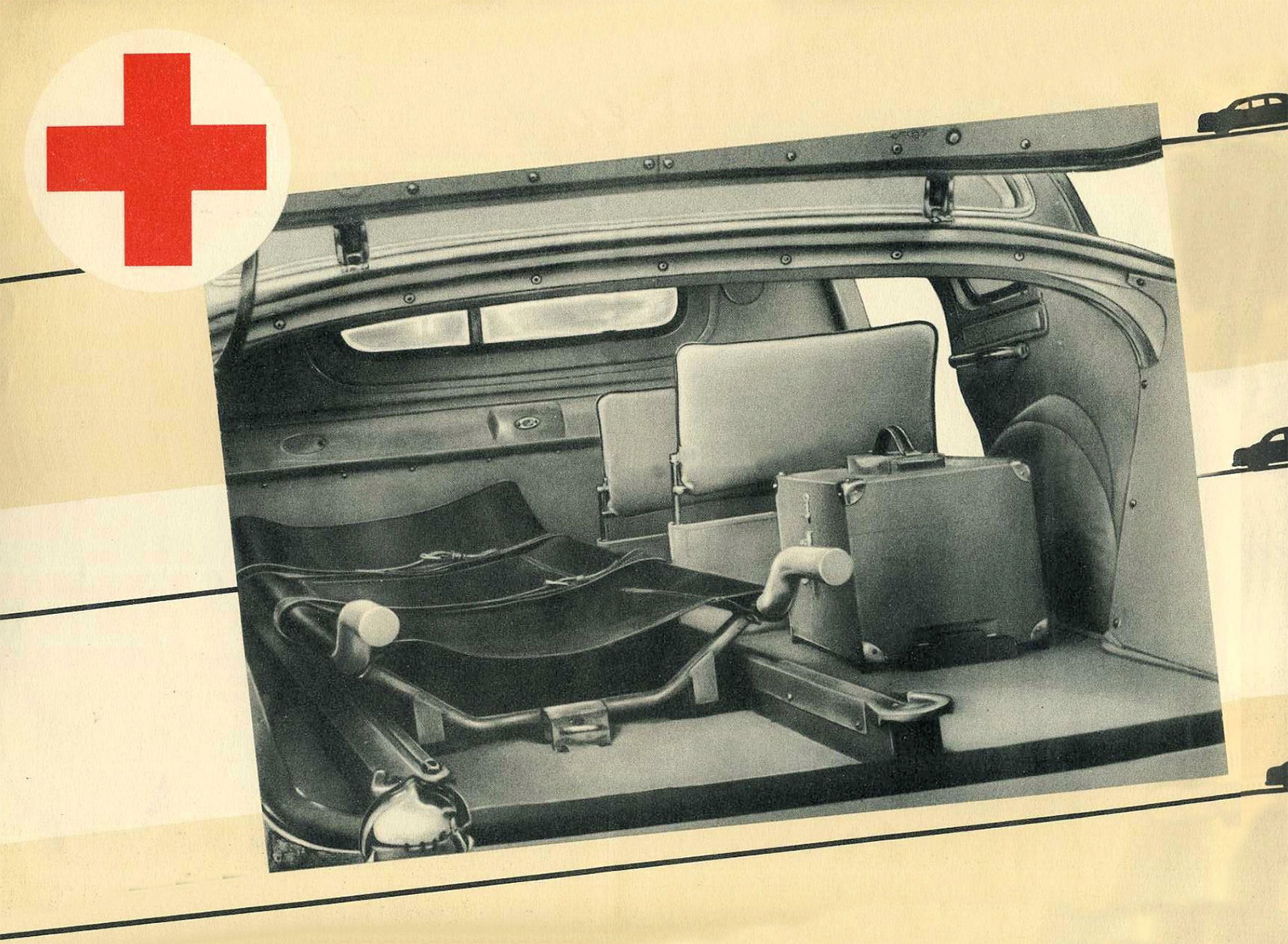
You, as an unwell person, get loaded in the back, through the trunk! While I’m sure this way makes the most sense, there’s just something, I don’t know, undignified about being shoved into a car trunk. You’re already having a lousy day, after all.
Of course, there’s not really a “trunk” as such, and you’re getting loaded into the modified interior of the car, which has two jump seats for medical professionals (or skilled amateurs) and a bulkhead between the rear and driver’s compartment. It’s functional, I guess, but I have to wonder why this exists at all when there were vans available in the Soviet Union at the time that seem like they would have been much better choices for an ambulance.
Take this 1958 UAZ-450, which shared engines with the common GAZ car, even:
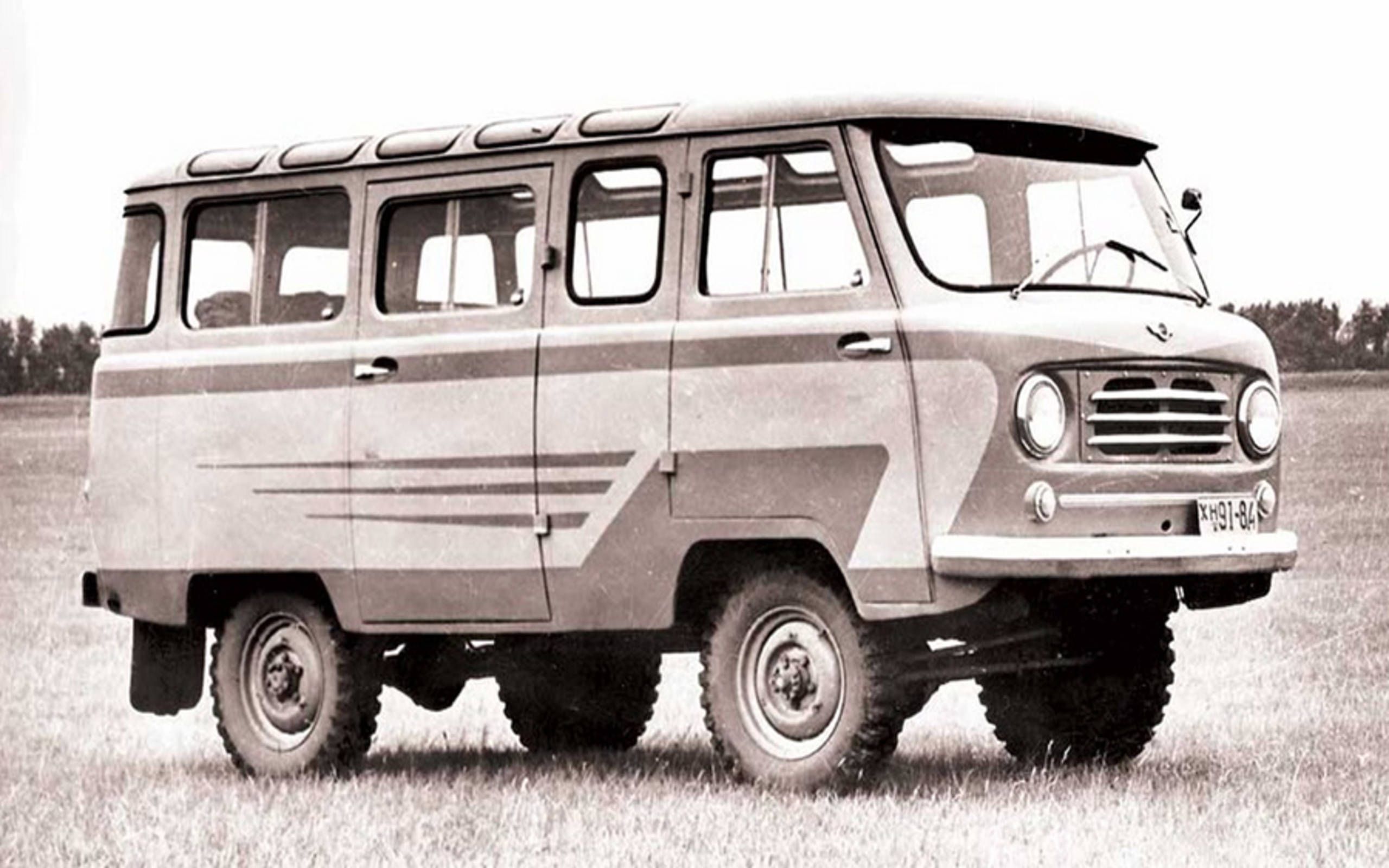
And, of course, ambulances were made from those, which just makes me wonder why these ZIM sedanbulances needed to exist at all?
The copy for this sedanbulance brochure is pretty amazing, showing a rather loose relationship with English:

This sentence for example:
“The ZIM ambulance car is designed for transporting one sick on the stretcher accompanied by three medical men.”
One sick, three medical men. Sounds good to me! I mean, I can’t speak Russian, so I should probably shut my big yapper here, anyway.
I wonder how many of these were actually made, and, again, why? It’s such an odd choice for an ambulance, especially when there were so many other options available.
Oh well. I hope none of you ever have to go anywhere in a sedanbulance.


The patient going into the Citroen looks DOA.
I have a 4th grade memory of a Cadillac wagon-based ambulance roaring down our street with its fan fully engaged. It was kind of warm day, but I thought I knew enough about cars to wonder why its fan was almost as loud as the siren. I mean, dang, my parents had an Olds 88, and I never heard it sound like that.
Many years later, on the Isle of Capri, I saw a Mercedes wagon hearse, laden with a coffin (presumably with someone inside of it) and a garden’s worth of flowers. And I’ve seen pictures of similarly proportioned Mercedes as ambulances in Europe. But more often, it seems like they went to Sprinters. And Ford Transits. Which makes total sense.
I’ve been in the back of an ambulance once, after a bad fall and destroying my left shoulder. It was a Ford F350, and I remember thinking it didn’t ride as bad as the F350 U-Haul vans I’ve driven a couple of times cross-country.
And so very sorry for your experience in one.
But anyway, unless you’re into playing with the siren, I don’t think there’s a fun part of an ambulance. I’ve seen ambulances/aid cars stuck in traffic in Manhattan and can’t imagine how stressful it is dealing with traffic and either trying to get to the patient or the hospital.
Oddly, the units here in Tacoma have shifted in the last couple of years from F350s to RAM chassis-based units. If I run into a paramedic or firefighter, I will have to ask why.
When I first moved to Cleveland, it was shocking to see all of the city’s ambulances based on mid-size IH/Navistar chassis. But maybe they held up better over the city’s Midwest pock-marked roads. I don’t know.
And yeah… a sedan-based ambulance makes negative sense. Hope your aorta is doing well.
Ok be honest, who saw the first picture of the Beetle-ulance and for a second thought the patient went in the roof box?
I did. I was thinking they going to need some strong ass medics to lift people up into that box
Weeee!
I need to learn more, looks awfully like a ’52 or so Chevy clone. Even has the same chrome trim on the back fenders. I’m amazed the autere Soviets allowed such decadance. Does it have a Stovebolt 6?
I have always found the similarity between some ambulances and hearses disconcerting. Although, I do recall seeing on the news a while back how a town on wildfire evacuation (I don’t recall which one, there’s so many) got assistance from the funeral home moving infirm patients from a long term care home. That must have been disturbing to them.
Was a time when there was disconcerting crossover between hearse and ambulance.
If you’ve ever watched the 1970s Jack Webb classic, Emergency!, you would be treated to all sorts of 1970s hearse/ambulance goodies. Plus, 1970s Los Angeles automotive culture in general. Great show.
Yeah, back in the day the local funeral parlor WAS the EMS provider for an area. So the vehicles were drafted into double-duty to save money.
This was in the 60’s, pre-EMT days. Maybe you got first aid, if the attendant had taken a Red Cross course. Probably you didn’t. Here in CA, pretty much anybody could get certified by the DMV as an attendant. “Ambulance Driver,” OTOH, was an actual qualification on your driver license—and absolutely no medical training was required.
”Emergency!” was a revelation. I credit it with inspiring my time as a paramedic, followed by a career as an ER physician assistant. It hit the TV just as I was a ‘tween, and when a chance to become a real, honest-to-Sweet Tea EMT came up in High School, I took it. I graduated in 1981 a with still-wet EMT certificate to boot. Paramedics came not long after, adding advanced medical skills, but 80% of being a good paramedic was and is still being a great EMT, first.
(I rankle at “Ambulance Driver” being thrown around by the ignorant. Bless the drivers because they stuck around for a long time, and a good person at the wheel is essential for safe transport. But EMT’s are so much more.)
I am old enough to have actually run real, 911 calls in a Cadillac hearse-style “rig.” Just a few, for my earliest experience, but I take a lot of pride in those days. I recall having to duck my head a lot, sitting next to my patient. Lots of windows—which is a HIPPAA violation nowadays! And a surprisingly mushy ride. None of my patients made it to the hospital without filling a paper sack with their lunch. Again, not ideal.
The first paramedics in my area were mostly in the fire department, so when advanced life support was needed, we called them. We worked together on the basics, they did the advanced stuff. But they always came to the scene in an engine or truck, sometimes just a utility-bed pickup, and the patient rode to the hospital in my rig so I could get paid for the call. But none of those guys had experience in a hearse so they were always highly amused for the chance.
Those hearses were retired by 1983 or 1984, so when I went to paramedic school in 1985-86 it just wasn’t something still available; everything had gone to converted vans, or box rigs. But I did it, by gum! back in the day.
So cool. Thanks for taking the time to write that out, I learned something new today!
It’s my pleasure, truly. Thanks right back!
I still can’t get my head around why here in Toronto (and maybe other jurisdictions) EMT calls require an entire fire truck to also respond. Something to do with the only vehicles allowed to carry oxygen. Just nuts. Slower response time, especially in tight traffic/roads and a big waste. Maybe it’s a union thing, or it gives them one more pizza run..
The US city I’m in, a 911 call gets both an ambulance AND a fire engine. Which is good, because when I had a broken hip, the EMTs were slender 20-somethings of assorted sex, and I was a 300-lb old fart. It was the fire guys who were built like football linebackers and could manhandle me down twisty stairs and out to the ambulance. Fire stations are also scattered around more than places where ambulances hang out, so they may be sometimes quicker with an EMT on board, and most of the time they’ve got people who aren’t out on fires. My understanding is that the cost isn’t the vehicle but the people, anyhow.
It was about response times. A patient under CPR—whose heart has stopped—had about 4 minutes they could be kept “viable” by chest compression and 8 minutes until a shock to the heart could no longer restart it.
Fire suppression requires similarly-quick response times; little ones are WAY easier to put out than big ones. But they don’t happen very often so it’s not a leap for local authorities to say, “let’s use these fire guys for medical response, too, and get something for what we’re paying them.” Fire stations are deliberately placed to minimize response times—usually under 4 minutes—for a whole local area, so it’s not a bad idea.
This is how fire departments ended up doing a lot of EMS. And once local politics are involved, anything goes. I’ve seen two, adjacent fire departments look at their budgets and simultaneously one will buy vans or pickups for their medics while the other retires their vans in favor of putting the medics on the engine or truck. (Fire Engines squirt water. Fire Trucks carry ladders, rescue gear, and other specialized equipment. I’ve suggested a Mercedes deep-dive, but had to admit I was asking a lot!)
Okay, now we have the fire department coming to start CPR within 4 minutes. The paramedics, being more expensive and single-purpose, can be fewer and farther between but still get there within 8 minutes to apply the electrons to the pectron. Where and when I worked, the divide between public service (the fire department) and private (the ambulance) happened between these steps. This was the 80’s, remember. And again, once local politics and local egos get involved anything goes.
More politics: if the fire department makes the city council mad, the council has a powerful couple of opponents; the union and the department hierarchy itself. If a private contractor ambulance service makes the city council mad, their contract could be cancelled with 30 days notice. A lot of energy and personnel decisions were made to protect that contract over all else.
[Local politics probably explains why Toronto has the restrictions on carrying oxygen in a vehicle; something bad happened with an oxygen tank, so there was pressure on the local government to “do something.” What they did, did not have to make sense or be practical or cheaper or anything. Just feed the voters.]
Since then, the science of CPR and resuscitation has advanced. Now, having and using an automated defibrillator as soon as possible is the standard. What restarts a stopped heart is electricity. Period. The sooner the better. Compressions just keep the patient “on hold” for a few minutes. That’s why defibrillators are everywhere and using them is now part of the most basic CPR class. Heck, they’re designed so that someone with no training at all can use one successfully just by listening to it and following some very simple voice commands.
My friends, I love writing these “explainers.” It gives an old fart a willing audience for him to reminisce to. So, thanks to those who appreciate them. And, they’re automotive-related! So I’m even on-topic for a non-car-person!
I appreciate your write up, I learned a lot of interesting things from it!
I grew up directly across the street from a hospital’s emergency-room entrance. My father liked to say “you arrive in a white Cadillac and leave in a black one.”
Many years later, I saw a Cadillac-based ambulance for sale (gold, not white). Early ’70s, 492 ci engine, two batteries. Room for a gurney and two EMTs in back, with facing jumpseats. I was tempted, but it didn’t have AC and I live in a hot part of the country.
The strongest impression from my one ride in the back of an ambulance was that it felt like the suspension was built from solid steel girders and was riding on concrete-filled tires. I’d have happily accepted getting shoved into the trunk if it meant a smoother ride!
I took a ride in my FDs ambulance from a fire scene to the hospital with an injury from fighting a fire. (Took a tumble down some steps and dislocated my shoulder, very painful!) I am in the back on the ambulance getting tossed around, I looked out the window thinking we are close to the hospital. Well, we where just getting on the highway for a 10 minute ride to the hospital, I was so disappointed. I totally agree, the ride SUCKS! (This coming from a guy who used to ride on the tailboard of fire trucks, now that was a ride!)
That was probably a Baltimore paddy wagon.
My 14y.o. daughter was just mentioning yesterday that Ambulances shouldn’t be red – rather, they should be neon yellow/chartreuse. Made us wonder why they’re red in the first place; why are some vehicles marked “ambulance” look like a plumber’s van; why did Europe move to different colors…she would fit in here if she cared more about cars overall.
FREEDUMB!!!
So the blood doesn’t show? Works for deadpool
Somewhere around here I have a brochure for Miller-Meteor’s 1958 line of Cadillac ambulances. One is medium-blue with Country Squire-like woodgrain paneling. The others are equally wild two-tone rides. Wish I could find it.
There was a fad for neon yellow fire and EMS rigs for a couple of decades. Your daughter is right—they are a little more visible. But fire/EMS in the US is “250 years of tradition unimproved by experience.”
Red = fire.
Fire = danger.
Fighting danger = manly.
QED.
As for the private services, they’re a patchwork of small companies, started by entrepreneurial-types after quitting their last EMT job, or getting out of fire, or whatever. At that stage, livery equals vanity, and all bets are off.
Oh, and they’re marked “ECNALUBMA,” not Ambulance (YMMV) because look in your rear-view mirror. My family wouldn’t let me name my boat “Ecnalubma,” which is a shame, I think.
And don’t get me wrong, if I give the impression of not loving firefighters. I was a volunteer fish fighter during the time I was a working EMT/medic. But there’s a little sibling rivalry thing. Same with fire/police, and the different branches of the military. They can be brutal with each other, but definitely close ranks against “civilians.”
“Fish fighter?” Dangit! I put effort into my writing when I do a longer post, here. It rankles to have missed one—but I gotta admit it’s a funny image, so I’ll acknowledge it but let it stay.
In the US, they’re often white, though there doesn’t seem to be any standardization except that it’s usually a high-visibility color.
Which would be worse, bing shoved into the trunk of a sedambulance in 1958 Russia, or being shoved into the trunk of a Lincoln in 1958 New York?
It was highly unlikely you’d be shoved into the trunk of a Lincoln in 1958.
Because the mafia never drove Lincolns or Fords (according to Frank Sinatra)
Fuhgeddaboutit, the Cadilliac has more power, more performance, better handling.
How can you say that a Lincoln is better than a Cadillac?!
Likely same end result, give me the less pain option. The Mafia was at least gracious unless they wanted to make a statement.
“I wonder why they didn’t start with, say, a Chevy or Plymouth?”
Because upper-line models had more powerful engines which would mean greater speed, but also smoother driving at low speeds – and generally better build quality overall.
Plus – when one is sick, dying or dead – one doesn’t want to be shoved in the back of a Ford Mainline, Chevrolet Fleetmaster or a Plymouth Deluxe like so many bags of used baby diapers or crates of eggs.
One wants to go out in style!
And it made sense because these conversions were similar to Funeral car conversions – so it was easy to paint the ambulances white and the funeral cars black and just have a few interior changes for their similar purposes.
I would argue that when one is sick enough to be put in an ambulance or dying, one doesn’t care much whether it’s a shitbox or a Rolls Royce. The rest of your comment makes a lot of sense to me.
This, the convertors already had the tooling for the identical hearse.
There were Ford, Chevy and even Studebaker ambulances but those sales were mainly directed toward small town sheriffs. The big players (Wayne, Superior, Miller-Meteor, etc) had a line of Pontiac/Oldsmobile ambulances/hearses. Cadillacs and Packards already had extended wheelbase cars for use as limousines and those were easily adapted to commercial uses. Chrysler appears to have made an attempt to get into the market but didn’t succeed.
I never saw a Lincoln hearse until the 1980s after all the luxo-barges had downsized. Almost everyone transitioned to vans as ambulances in the mid 1970s. Mostly Chevy/GMC, occasionally Dodges, but again never a Ford.
The only Dodge ambulance I’ve ever seen was the one on Cannonball Run
However the most famous EMT truck on TV was a Dodge (on “Emergency!”
I have to find watch some of these episodes. They were slightly before my time being born in 76.. They would have been something in syndicated reruns by the time I was of paying attention to TV show age. Cannonball Run, meanwhile, was a cable TV staple and always got the stop everything and watch treatment when I was young
Apparently that very Dodge was used in an actual Cannonball attempt prior to the movie!
“a Chicagoan would rather die in style than be saved in the back of a panel truck.”
– Robert Quinn, Chicago Fire Commissioner in the era.
(the “link” icon doesn’t seem to work)
https://chicagoandcookcountycemeteries.com/2022/08/04/dying-in-style-chicagos-cadillac-fire-ambulances/
Style?
Check this
https://www.sfgate.com/cars/article/1964-Pontiac-Bonneville-hearse-is-a-killer-ride-3212137.php
Reminds me of the ’63 Pontiac Bonneville ambulance used to carry JFK from Air Force One to Bethesda Naval Hospital
If loaded into an ambulance through the back, does that make the patient junk in the trunk?
“I’m not really sure what those Rockettes (or whoever) in the background there have to do with ambulances, unless perhaps they all kick you at once, over and over.”
That’s a common point of confusion, and a lucky guess! Those aren’t the Rockettes, they’re the famous Shockettes. In the days before defibrillators were commonly available, they would hold heart attack patients upright as they walked them down the line of the Shockettes, who would administer rhythmic kicks to the chest to restart their heart. It was surprisingly effective for the time! The Rockettes were just a soothing reminder of this life-saving technique that was worked into vaudeville shows later on.
It ia not t ll confidence inspiring that the Economy Chrysler Limousine Straight Ambulance features “practical designing that foresees and precisely fills the exacting requirements of the funeral director’s profession.” Sounds like they expect to make an alternative dropoff of the patient.
I’m sorry, WHERE does the patient fit in a Beetle Ambulance??
A very uncomfortable place. Like the back of a Volkswagen.
Does Clarkson’s Rambulance count as a sub-type of Sedanbulance, or do we need another new word?
We literally just watched that episode last week!
Whoa, Black Betty, Sedanbulance.
Wouldn’t that be a BambalamSedanbulance?
I’ll sing my headcanon how I want and you do the same.
Maybe the sedan had better suspension and speed potential than the almost tractor like 4WD UAZ van, so if you could do without some space above your legs, you could get to the hospital in time and not all shaken to pieces…
Circa 1965 the small Wisconsin town in which I lived (population 1000) had a powder blue Country Squire with a stretcher in the back. That was it. I once was taken to a hospital about 30 minutes away in it.
““You think you hate it now, but wait’ll you d̶r̶i̶v̶e̶ lay dying it.” Ha ha
Could it just be a speed thing? Maybe a sedan-based Ambulance can move someone a lot faster than a van?
Good morning!
Everybody keeps looking for a way to make these choices make sense, but frankly they don’t. “Ambulance Joe” starts a one-rig company, and buys a Cadillac because ‘prestige.’ It’s got the chrome wheels and everything!
Then the company grows and they buy another one for uniformity and branding. Oh, but then…”hey, let’s all become paramedics!” And suddenly there’s too much junk to carry to make the limo-style rigs work. Also, now you’re really doing things for the patient during the trip: a limo rig just lets you sit there, with most of the gear and a lot of the patient inaccessible. So, the boss starts buying van conversions.
Back in the 80’s, my favorite was a Dodge. It was compact (for traffic) and quick. But it wasn’t comfortable. The places I worked had an assortment of Ford and Chevy conversions. I’ve worked in small van conversions, big box rigs, on fire engines, and had a couple of unplanned helo transports. (Nobody really calls them “choppers.”)
Oh! There was also this converted GMC RV at one company. You know the one; Mercedes has written about them. Low to the ground, double-axle at the rear, pretty aerodynamic for the time. We had it set up for critical-care transport, where an RN would come with the medic and provide ICU-level care from one hospital to another. (You didn’t use these for 911 calls!) This one could also be rigged to handle TWO isolettes—incubator-style resuscitation beds for critically-ill newborns—at the same time. That was a pretty niche use case, but there was a prominent children’s hospital in our area, and we had a contract.
Heh. I recall that the livery was pretty basic. Plain white, with a red stripe around the belt line. We called it “the Tylenol.”
At least it is not a hearse based ambulance.
I always suspected those guys were less in a hurry to get to the hospital than their ambulance-only counterparts would have been.
Quick and easy double billing.
Sorry
An interesting ambulance-adjacent sedan that not a lot of people know about was the Checker Medicar – with a raised rear roof and wheelchair ramp. Saw one in a Pick and Pull a decade or so ago. https://www.youtube.com/watch?v=ga3MDg8a6Es
I always thought the reason the Chrysler and Cadillac fancy cars were the ambulances was because they used the same sheet metal as the limousines. The reason they didn’t start with a Chevy or Plymouth as because nobody was going to buy a Chevy or Plymouth limo.
Also hearse. In some smaller places, the ambulance and the hearse were the same vehicle.
Bigger engines too at that time.
Would that make this an…Indignator ZIM?
Better tint the windows on that Krankenwagen.
I love that Ambulance in German is “Krankenwagen,” and they say Germans have no sense of humor. I’d be plenty Kranken in the Type 1 based Wagen.
“Ja, she be Kranken on mein Vagon until I (insert 480-character German compound word here)”
Welcome to Sprockets. I have traveled here in my Krankenwagen.
Now I’m wondering if der Krankenwagen is based on ein Abschlepwagen (tow truck, one of the first words we learned in junior high German).
Whoever that is that they’re loading into the Citroen, don’t bother. In my esteemed judgement, it’s already too late for them.
I too was wondering about what they were loading in there. Looks like they have been dismembering a giant and the Citroen gets the idolized left foot
It is the fabled French bigfoot!
Don’t worry, I will show myself out.
My best guess is that it’s a prefab ankle cast for said giant.
If that’s the patient, who has been bent at the waist and encased head-to-toe in mummy wrap, things don’t bode well.
The gaffer’s tape is a nice touch.
Patient:
Paramedic: “I think we g̶o̶t̶ ̶o̶f̶f̶ ̶o̶n̶ cut off the wrong foot”
I thought that was a model put to use in Egypt, but I guess there’s really no rush in transporting mummies.
I dunno. My EMT friend said it was policy that anything short of decapitation, you still need to try.
Richard Scarry’s Lowly Worm has put on some weight and broke his everything.