


It was four years ago that I decided I was going to do a little experiment. My in-laws moved to Michigan, and it was suddenly borderline reasonable to make the 14-hour drive there for Christmas, as opposed to being at the whim of the weather and airlines. Since I’d be making approximately the same trip, why not try driving every vehicle in a class?
Obviously, subcompact crossovers were out, as there are so many of them that I’d never be able to stay within the window of refreshes. Muscle cars would be fun, but that’s a dwindling list. Given that these trips involved schlepping presents and carrying cousins and uncles and grandmas to various events, the minivan made perfect sense.


I have now driven the four main minivans for sale in the United States, all of which are basically within the same generation: the Chrysler Pacifica, the Kia Carnival, the Honda Odyssey, and now the Toyota Sienna.
Even though it’s not the most popular van in America, the Sienna is the most well-regarded, and its huge positive swing in year-over-year sales proves it. If you ask anyone who hasn’t driven any minivan what the best minivan is, they’ll probably say it’s the Toyota. Are the made-up people I’ve deputized into my argument correct?
Yes.
The Sienna isn’t the sportiest, the nicest, the most attractive, the most comfortable, or technically even the most efficient van for sale. It’s not the one I think I’d buy if I were buying a minivan. It is the most Toyota of vans, though, offering an incredible amount of stuff in an unbelievable package. I could make an argument for any van in this class, but I can’t argue with anyone who thinks this is the best.
[Full Disclosure: Toyota was game for my little project, and lent me a Sienna Platinum AWD for a few more miles and a few more days than usual.]
The Basics

Engine: 2.5-liter inline-four
Electric Motor: Three A/C motors
Combined Output: 245 HP (combined), 178 lb-ft of torque
Battery: Nickel-metal hydride, 1.5 kWh size
Transmission: eCVT
Drive: AWD (rear electric motor)
Fuel Economy: 35 mpg combined, 34 mpg city, 36 mpg highway
Body Style: Minivan
Base Price: $39,185
Price As Tested: $60,470 (Platinum)
Why This Exists
Minivans were once a requirement for automakers, serving both as a natural purchase for families and a sort of status symbol. As has been decried many times, SUVs subsumed all the suburban street cred, and minivans became the thing you rented at Disney World. If you have a family of a certain size, that rental will remind you of how wonderful and capable vans are.
In my past life as a sort of Kirkland-brand automotive filmmaker, I drove minivans nearly every month for years, and my appreciation never waned. The best choice then was the oldest Grand Caravan I could find, given that we’d strap all manner of cameras to it and relied on the permisiveness of its rudimentary safety systems to do so. A Sienna was always a nice treat, though, especially when they went all hybrid in 2021.
These days, the camera gear has been replaced with skates, scooters, tablets, and the ephemera of childhood. Permissiveness is no longer so desired.
As most of you probably know, the Sienna isn’t the first attempt made by Toyota at selling a van here. The original Toyota minivan was the perplexing mid-engined Toyota Previa. For a nerd like myself, the Previa marks the high point of vans in America. For everyone else, the Previa was just a little too weird. Toyota quickly rectified this with the Sienna and has been elbow deep in Placenta ever since.
In its stubbornly persistent Toyota way, the company has improved the Sienna with each iteration, and now sells the only all-hybrid van, the only AWD hybrid van, and one of only two vans available with AWD at all (I’m excluding the ID.Buzz). When I look at all Toyota has done with its van, and how long it’s taken for everyone to catch up, I sort of feel like Jesse Pinkman screaming out that they can’t keep getting away with this.
They do, and they have.
How Does It look?

So as to prove that I actually drove this to Michigan, the best photos I got of it were in front of the Gerald R. Ford Presidential Museum. I love presidential museums, and the Ford Museum does a good job of making the most of a challenging presidency (I’m not sure I agree with the pardoning of his predecessor, but he did name the first shuttle after a craft from Star Trek, which is pretty cool).
The Sienna is a North American product and therefore gets a North American design. Toyota did more than make the most of a challenging bodystyle. It did everything you could visually do to a minivan. It’s maximalist in the extreme. That doesn’t make it bad, necessarily, but I wouldn’t say it makes it good.
It’s as if there’s a normal, attractive minivan underneath, and it’s been covered with one of the tackier Veilside bodykits. I keep trying to find an angle I love or can even comprehend, which is a bit like trying to enjoy an LMFAO song by listening to each track separately.
In profile, the front of the greenhouse slopes downwards towards the front arch with a smooth boomerang of chrome, only to smoothly kink back towards a much harder-edged line. I sort of like the swoosh of a bodyline formed by the aggressive rear fender, but then you turn to the rear 3/4 and see how it’s formed.
Why are there so many curves? How would you describe the rear lights? This may be the first minivan built for the creatures of the planet Zebes.
And the front. The front! Six blades! Everything happening all at once! The best I can say for it is that you won’t mistake it for anything else on the road.
What’s It Like On The Inside?

A minivan interior doesn’t need to be beautiful. It doesn’t need to be elegant. More than anything, it needs to be usable. The Sienna is the standard by which minivan usability should be measured, because I haven’t experienced anything quite as good.

Right up front, literally, it has these things called buttons. When you’re screaming at your child to stop shoving the bright red, Christmas-themed M&M up their nose, you don’t want to also have to fumble with a touch-capacitive screen. Or any screen. You want a button. Simple, in this case, is good.
You know what’s also simple and yet deeply satisfying? The not-quite-t-handle shifter. It’s just an automatic, but there’s such a wonderful th-thunk when you angle it into gear that it almost feels like you’re involved in the driving process.
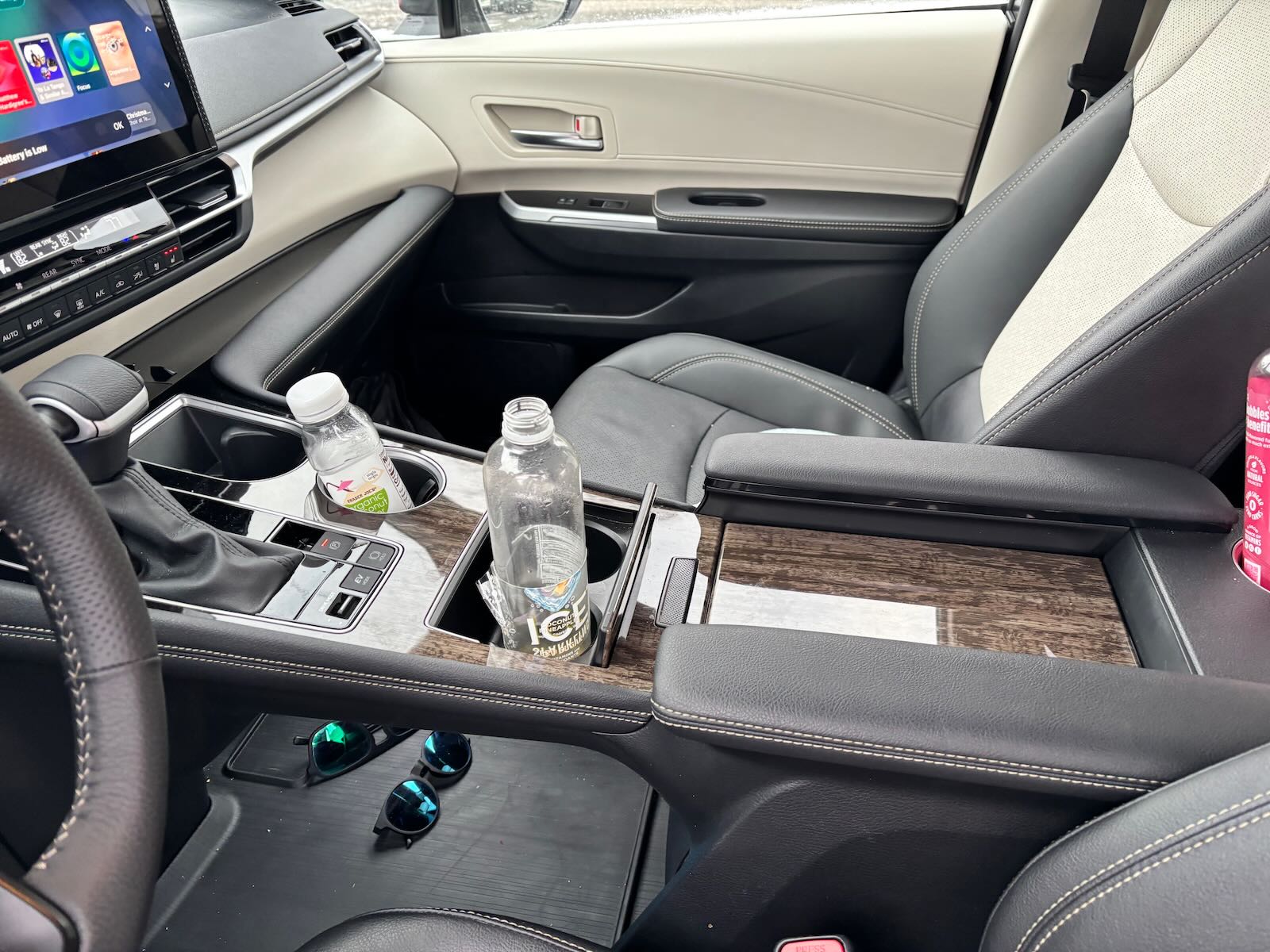
There’s also a huge flat section between the driver and front passenger, with six (yes, six!) cupholders of various sizes. I’d love one of those cupholders to be giant, because I like a huge water bottle on a trip, but that’s a minor complaint. The flat section with storage underneath is the winner here, as you can eat an entire Burger King meal on the road on it without issue.
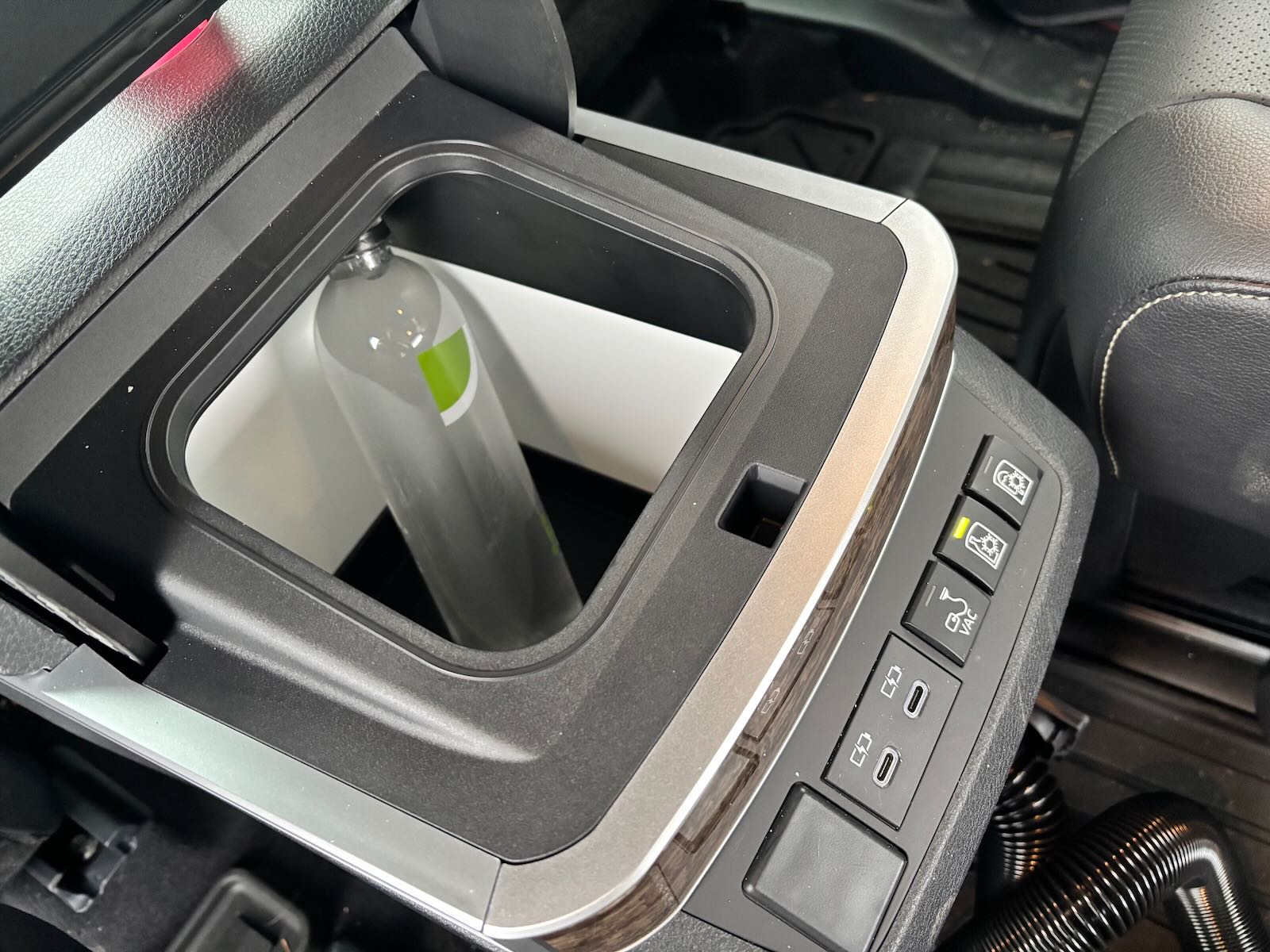
While not the first car to feature a little fridge in the back, this one has the option for either a cold drink or a frozen treat. I love the idea of chucking a bunch of popsicles on a long trip to keep the kids (and parents) busy. If it hadn’t been 10 degrees during this trip, I’d have been tempted to put some Yasso bars back there.
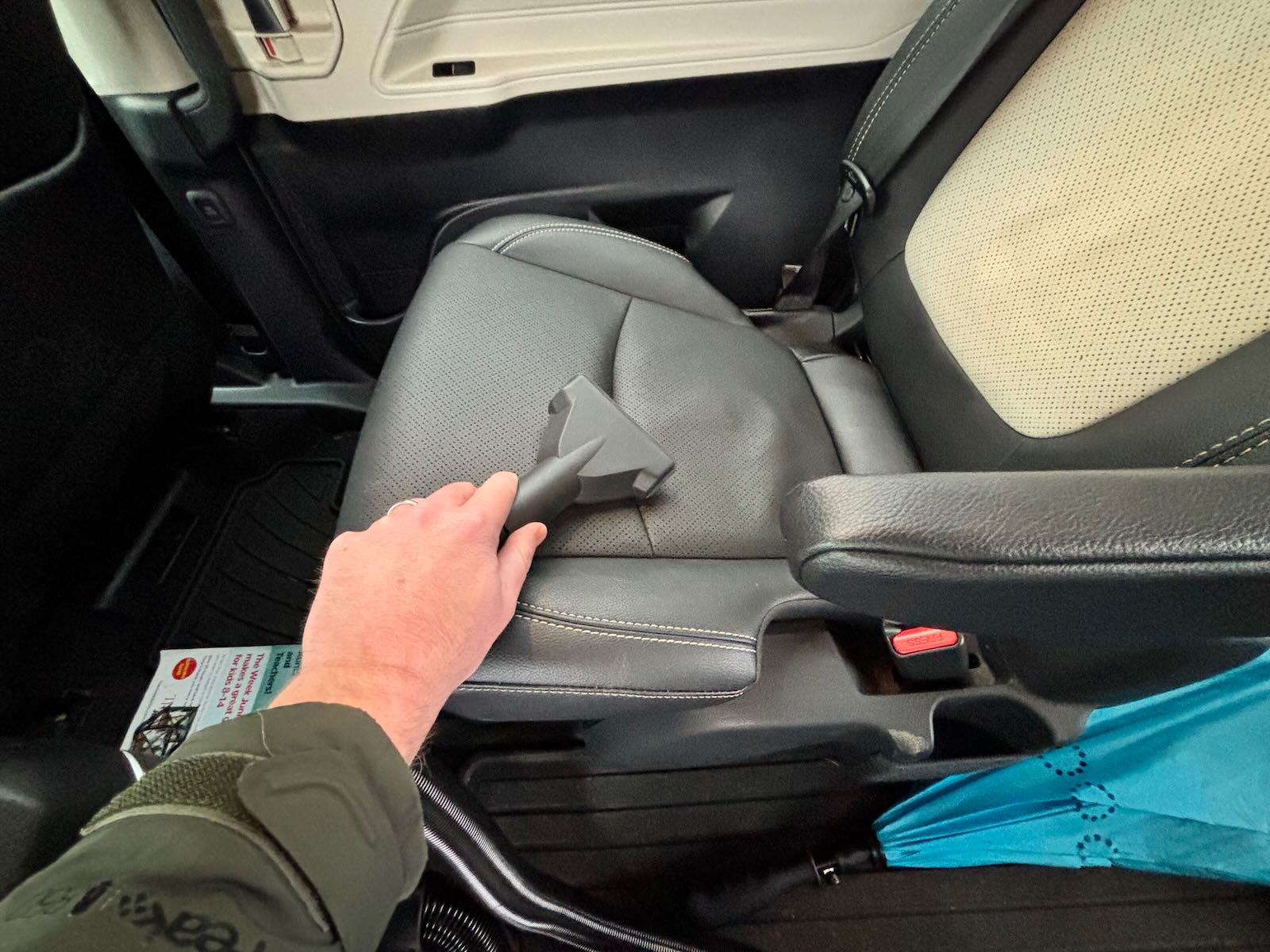
Honda gets credit for, I think, the first built-in vacuum in a minivan in North America. It’s taken a while, but Toyota now has an integrated vacuum, and it works quite well for small spills.
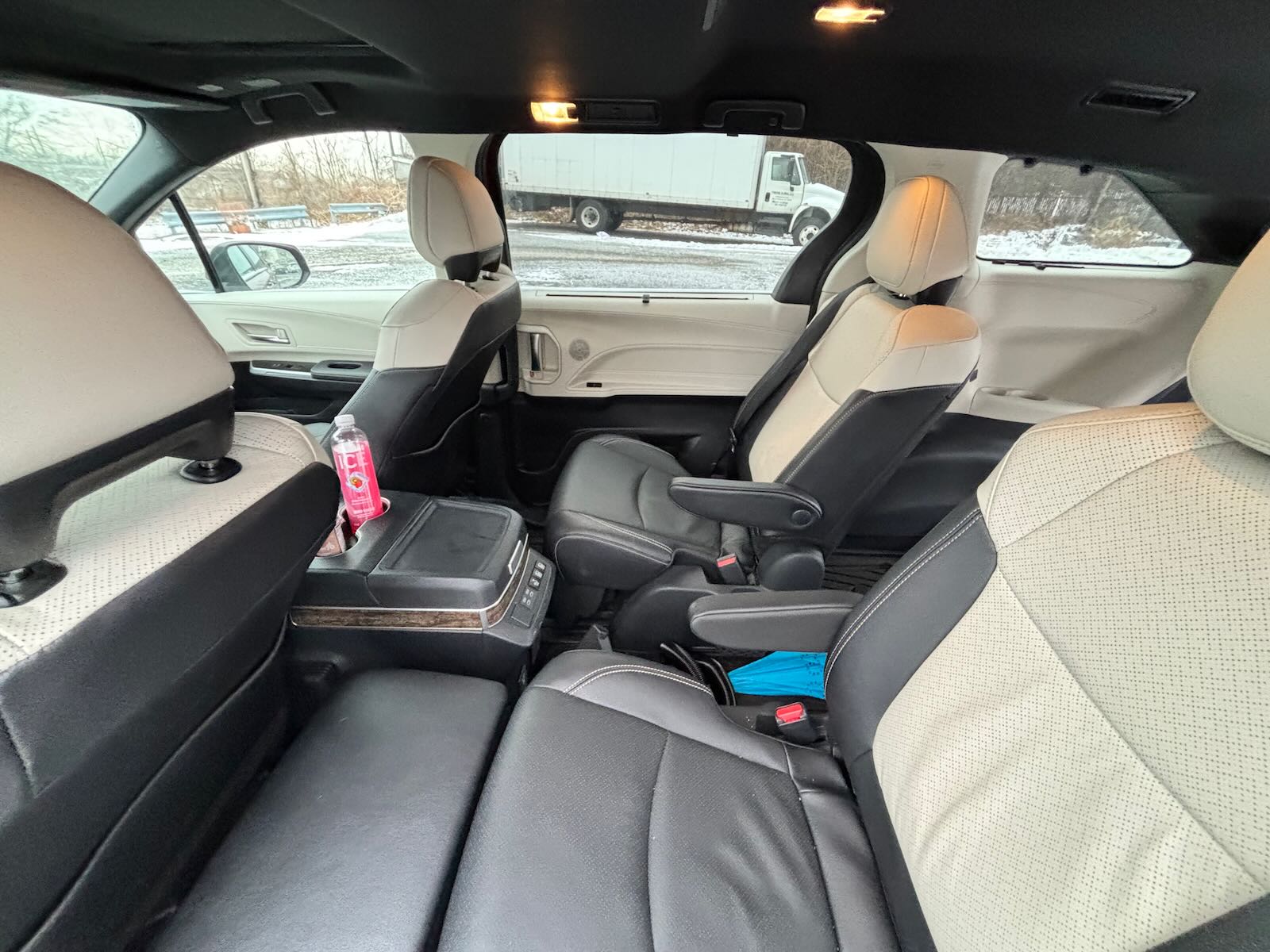
The Carnival has more comfortable seats in the higher trim, and the Chrsyler van/s have the only true stow’n’go seats (a middle row that folds flat), so it’s not perfect, but it’s the best overall interior on the market.
In this Platinum grade, you can see the designers did the very smart thing of making the upper sections a light color, and any place a kid is likely to touch a dark color, so that you can have the benefit of a bright interior without worrying about it all the time.
How Does It Drive?

I put a lot of miles on this thing. Some of these were not easy miles. There was snow, ice, fog, and rain. At least once, I experienced all of the above within a 30-minute period.
Driving back to New York, my plan was to do a short, half-day drive to Cleveland, followed by a full-day march across Pennsylvania and New Jersey. About an hour out of Ann Arbor, I pulled up the weather and realized the only way we were getting home was to just make it one, long 13-hour drive.
Thinking you’re going to drive four hours and then suddenly tacking on three times that much driving sucks. It’s terrible. If the van was something really uncomfortable, I’m not sure I could have pulled it off, but with the trusty Sienna, I knew I’d be comfortable enough to make the journey.
It used to be that 245 horsepower was a lot of horsepower. That’s not true anymore, and this doesn’t pull like an Odyssey. It’s enough, though, and there weren’t many situations where I felt like I was about to be let down by the Sienna. As with most hybrids, if you put strain on the 2.5-liter inline-four by slamming the skinny pedal, you will be rewarded with grudging acceleration and punished by the sound.
Other than a Pacifica PHEV that you plug in and only drive short distances, nothing can claim better fuel economy than the Sienna. The fact that the driving is mostly forgettable is more than made up for by the fact that the fuel economy isn’t. Toyota offers an EPA 35 MPG combined for the AWD version, which conforms to my experience.
That’s great. That’s 3 MPG better than the Carnival Hybrid, which can’t be had in AWD.
Why Is This The Most Minivan?

I’m going to use another post to do a full comparison between the four major minivans, because I think there’s a slightly different buyer for each one. If you’re not sure which van you want, you probably want the Sienna.
The Sienna already wins for being the only minivan offered where every version is a hybrid. It’s hard to argue that a vehicle like a minivan, which is basically a school bus for most families, shouldn’t always be a hybrid. The Sienna also has the option of all-wheel drive, which is important to some people. The starting price is even slightly lower than the Kia, which is the only non-PHEV competitor.
Ultimately, though, a minivan is a place to be. To exist. To pass countless mornings on the way to kindergarten, and endless hours driving to grandma’s 80th birthday party. There’s very little gimmick to the Sienna. Its main gimmick is that it’ll be a comfortable environment for trips long and short, while returning more than reasonable fuel economy. It’ll even do it at a good price.
That’s hard to beat.
All photos by Matt Hardigree unless otherwise noted




Of course I admire their practicality, and I’ve been tending towards bigger vehicles as I get older, so I do stipulate the practicality of minivans. And of course, the Toyota minivan will be the most Toyota. But jeez, the exterior styling is more than just a bit much. Maybe a dark color would be easier on the eyes.
“Fuck everything, we’re doing Six Blades”
Still better than the Tundra front end, so I’m cool with it.
What happened to the Sienna that David drove down from the midwest to Jason a few years back when all Jasons fleet were out of action?
I’m seeing grimacing jowls up front
I own a Pacifica PHEV and compared to my friend Toyota Sienna, same as this article, the Pacifica PHEV drives like a Lexus compared to the Toyota. What a shame Stellantis stopped producing the PHEV version and instead of improving the reliability, just shut down the whole PHEV models.
I get on average 30MPG on gas mode with the power of a V6, and 70MPGe on EV mode as long you dont press the gas pedal more than 50% to avoid turning on the engine.
The difference is that the Toyota will last forever.
I have an friend who works for Toyota and got a standard Pacifica for family duties because he liked how it drove and it had all features he wanted at a better price than his discount could provide. He does drive a prius to daily though because of his long commute. Says he gets some strange reactions from his coworkers when he tells them what van he drives.
I know the Japanese love hunting whales, but Toyota’s unbridled love of the Baleen Whale grill, particularly on Lexus is terrible.
Considering the whole Watergate affair was basically the entrapment of a US President by our intelligence services, I think a pardon was very reasonable.
Base Price: $39,185
Price As Tested: $60,470 (Platinum)
This is an insane jump in price.
And they are still hard to find. So that is part of the issue as well.
It is an ugly bastard but sure is functional. Why can’t they make a van look good?
That exterior rear corner photo made me think that maybe Matt had gotten in a wreck. What happened to Toyota? When did their design team quit? Is this what AI has wrought?
Yeah man, my coworker has a new 4runner and it looks like it has been in a wreck but it hasn’t. I really hate their new truck designs. Toyota has gotten really ugly.
That rear corner is pretty busy with all those shapes.
The market is really missing the cavernous bargain car.
When I was growing up it was the families with young children that needed inexpensive transportation. Cost-per-seat, so to say – but large enough to hold all the crap.
When I was very young: those were the used station wagons. As I grew up, it became the cheap minivan, and then was carried by the Dodge Journey.
Nothing has really filled that void.
I suppose the lesson is that you need to be wealthier than previous generations to have kids, folks.
Mitsubishi Outlander?
Not only does the second row lack a stow and go feature, but it’s also a PITA to remove.
Also they should ditch the center console for a passthrough and or middle seat instead.
Since it’s made in the US they should make a cargo van version of it as well.
That would be amazing, since the first thing I do when I get a new minivan is pull out all the rear seats and put them in my basement, where they sit until I sell the thing. 🙂
Which requires trickery for this van. Toyota officially calls the middle seats non-removable. You can, but then you need to wire up the correct resistance to trick the van into thinking the seats are still there.
Yeah, I’ve seen the procedure since I’m looking to get a newer Sienna in order to get the hybrid. It’s not too bad to do, but you certainly wouldn’t want to be taking them out and putting them back in regularly. (Which thankfully wouldn’t be a problem for me.)
The hybrid powertrain is awesome though… compared to my old V6 sienna that gets about 15MPG.
There may be a few tweaks Toyota could give it to make it better, but for the most part the thing they need to add is another shift at the factory.
Toyota limits everything to keep prices high and incentives low. It’s good to be King. You don’t need to dump buckets of money on the hood to move your inferior products.
Edit: Inferior meaning Toyota’s competitors, even if Toyota quality isn’t what it used to be. They have decades of brand equity to carry them for a while.
Dig this van, it does have a very refined nature and the hybrid system makes sense, but I think they missed on some key things with it. The non removable second row prevents it from actually being a van if you need one. I pull second row seats out of my Odyssey regularly for camping with gear and bikes. The magic slide seats make different configurations possible with different gear and human payloads. I have also slept solo in it, something afforded by removable seats.
This Sienna is great for people moving but if you need it to do van things the Odyssey is better and it drives better than the other options too.
The styling, lack of power, and lack of availability makes me miss the last gen.
My local dealer has zero on the lot. Only (9) listed on their website, all “In Production” and every single one of them 50k+. The estimated availability (if that’s even remotely accurate)… mid to late April.
They’ll sell every single one of them before they’re even in transit.
Some dealers are telling people to order one once their first kid is born, so that it shows up just before their second kid is born. Bananas.
Lol, this is like how we called our daycare provider while my wife was still staring at the pregnancy test to reserve a spot for our second child. It was a good thing we called, as she had an appointment for someone else to tour the next day.
We didn’t tell anyone else my wife was pregnant till 2-3 months later, lol.
There was a Toyota minivan before the Previa, the plain ’84-’89 Toyota Van – https://en.wheelsage.org/toyota/van/r20/pictures/ypgi0r
I came here to say the same thing.
Awesome car. Low inventory. Often astronomical pricing. And yes, not being able to remove the seats is huge. When the salesman told me that, I literally blurted out, “What the fuck?” I used that feature in my Grand Caravan ALL the time
I know people will be in here complaining about the non-removable middle seats, and when this van was announced, I was among them.
The longer I’ve owned my 2020 (last year of the previous generation Sienna) though, the less I’ve missed that feature. I’ve never removed the middle seats ever. And I expect most families with kids won’t either. If you need to do that often, you should be buying the Chrysler with Stow and Go anyways.
The one thing I really don’t like and won’t get over is how hard they made it to go from the passenger seat to the rear seats. That giant console is a real pain, and there are plenty of times my wife has to jump back to help someone with something on a road trip. Easy in the last Sienna, near impossible now.
Yeah my wife is jumping over that console in our Odyssey all the time, it’s impossible in the Sienna.
As a Chrysler owner, yeah, the non-removable 2nd row bums me out. We use the Stow N’ Go feature quite a lot. Could I live without it though? Yeah probably, especially as I finally seem to be done with projects that involve buying large sheet goods (for now at least).
You make a good point about the center console. We find it annoying that the relatively small one in the Chrysler is hard to climb over, as my wife often stretches back there to pick things up for kids, deploy sun shades, etc. There’s no freaking chance she’s doing that in this new Sienna with that sort of monster console. Does Toyota probably want you to be doing that anyway? No. But I still don’t like it, and putting a massive chunk of plastic in between the front seats sort of defeats one of the purposes of having a huge interior with a flat floor.
I still stand behind the Chrysler purchase, but with the transmission making some harder than natural shifts and the fuel economy being sort of shit, I can see the value of the Sienna, even with those shortcomings. Especially in green.
That green is excellent.
I’m a sucker for green in general. And that green is a very good green.
I’ll give Toyota some credit here, even though the lower trims are exceptionally hard to find around here, they haven’t kept the good colors hidden within the highest trims. It is possible to get an LE in green, blue and red.