

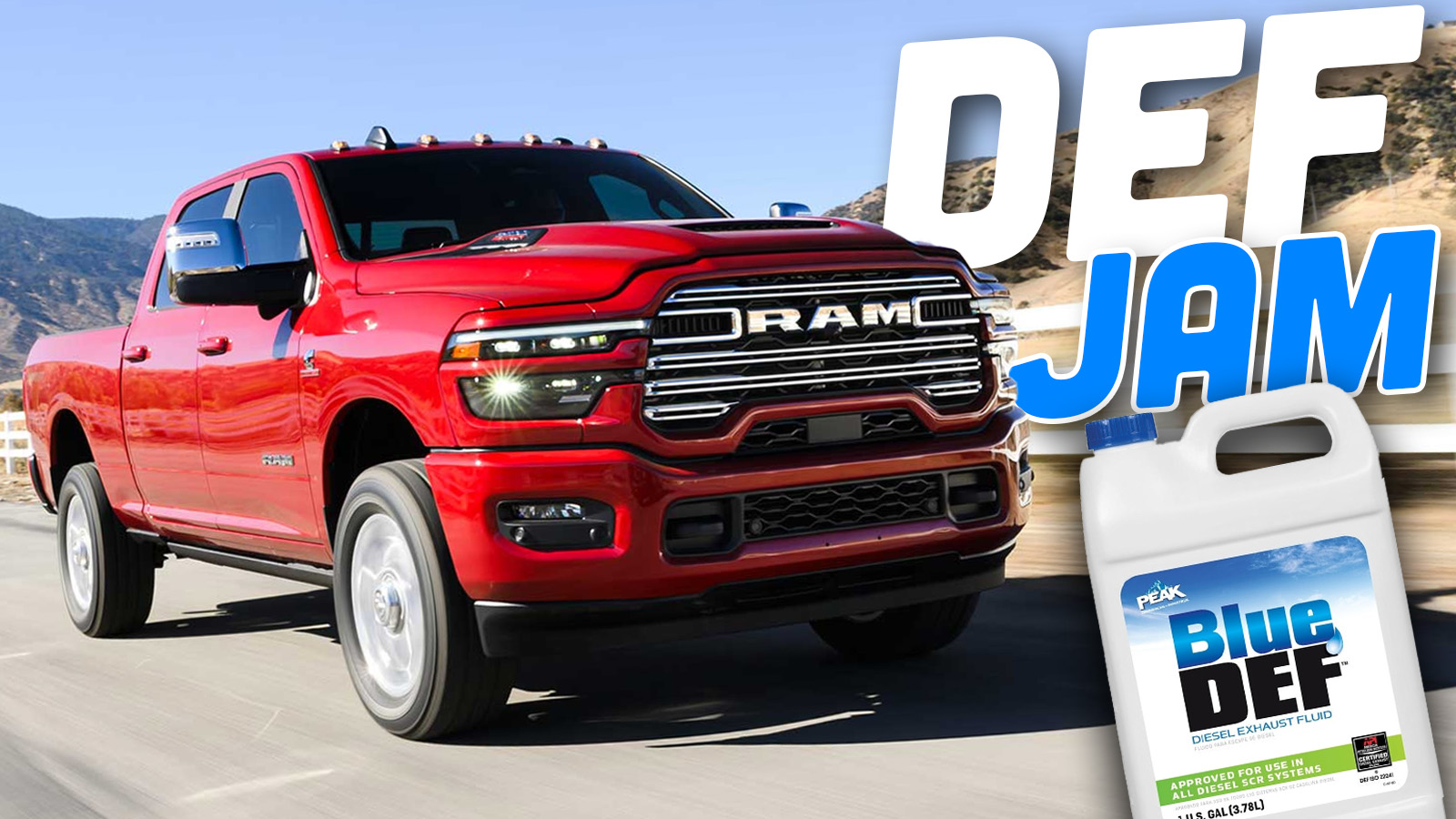
Today’s diesel trucks are marvels of engineering. You can waltz down to your local Ford dealer and drive away with a truck that produces 500 horsepower, 1,200 lb-ft of torque, and can pull up to 40,000 pounds. This modern power comes with some modern responsibilities. Today’s trucks use a bevy of emissions systems to clean up their exhaust, and one of them is Diesel Exhaust Fluid. When you run out of DEF or the sensor fails, your truck may derate or go into a full limp mode. In a reversal from past regulations, the United States Environmental Agency is considering getting rid of the derating requirement entirely.
The current administration has been reversing the federal government’s stances on many issues, including how the U.S. Environmental Protection Agency (EPA) and the Department of Justice (DOJ) enforce the Clean Air Act. In the past, the federal government pursued shops that performed emissions equipment deletes on diesel trucks. Last month, we reported how the Justice Department has decided that it will no longer pursue criminal charges under the Clean Air Act for allegedly tampering with emissions devices.


EPA Administrator Lee Zeldin has spent part of his tenure making deregulation a focus of the department. One area of EPA deregulation has been easing rules for what should happen when a truck either runs out of Diesel Exhaust Fluid or the DEF equipment otherwise fails. EPA Administrator Lee Zeldin had previously ordered truck makers to stop forcing trucks into immediate limp modes due to low DEF. Now, as first pointed out by the Drive, the EPA is considering eliminating the requirement for limp mode entirely. It also wants manufacturers to report on their experiences with equipment failures. It’s a move that could make a large impact.
What Is DEF?
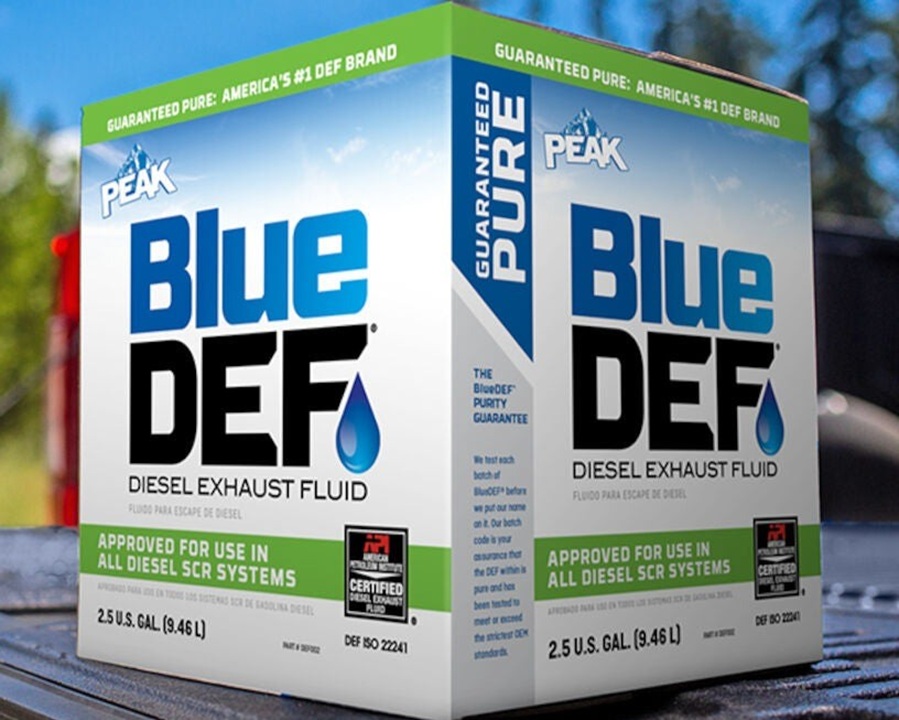
If you own a modern diesel car, SUV, or truck, you’re already well acquainted with DEF, and I wouldn’t be surprised if you have a jug of the stuff in your trunk or bed right now. But why do modern diesels use DEF, and why is derating these diesels when they run out a big deal?
According to Diesel Power magazine, the implementation of diesel emissions equipment was gradual. Back in the 2000s, buyers of trucks found an Exhaust Gas Recirculation (EGR) system in their engine bays. EGR systems reduce emissions by recirculating a portion of an engine’s exhaust back into the intake. Even your modern gasoline-fueled car has an EGR system. Next came the Diesel Particulate Filter (DPF), which is an exhaust aftertreatment system designed to trap particulate matter before it leaves the vehicle.
As emissions requirements demanded diesels to run even cleaner, emissions equipment evolved. The Selective Catalytic Reduction (SCR) was an important advancement in diesel emissions reduction technology. 2010 model year heavy diesels have SCR to meet the EPA’s strict regulations. Any light-duty diesel that didn’t already use SCR phased in its use during the early 2010s.

Selective Catalytic Reduction utilizes a catalyst in conjunction with Diesel Exhaust Fluid to clean the exhaust stream of a diesel vehicle. From Diesel Power magazine:
Selective catalytic reduction technology uses ammonia to break down NOx emissions produced during diesel combustion into nitrogen and water. SCR has become the technology of choice for a majority of truck and engine manufacturers to meet the stringent 2010 emissions standards set by the EPA for heavy-duty trucks. The biggest benefit of SCR for the vehicle owner is in the fuel savings the technology provides. Because SCR deals with NOx outside the engine, manufacturers are once again able to tune their engines to run more efficiently and produce more power. The increase in engine efficiency also leads to a reduction in particulate matter, resulting in less frequent regeneration of the DPF and adding to the increased fuel economy.
SCR works by first routing exhaust gases through an oxidation catalyst, which removes hydrocarbons and converts a small amount of NOx to NO2. The next step requires an injection of an aqueous urea solution, DEF, into the exhaust stream at a precise dosing rate. Exhaust fluid is converted into ammonia, which reacts with the remaining NOx in the SCR catalyst to produce harmless nitrogen and water. A final catalyst is sometimes installed downstream of the SCR catalyst, which is designed to remove any remaining ammonia from the vehicle’s exhaust.
Diesel exhaust fluid is a mixture of synthetic, high-purity, automotive-grade urea and deionized water. This liquid is clear, nontoxic, nonflammable, non-explosive, and generally nonhazardous. Additionally, DEF is classified as a minimum risk for transportation. The fluid is mixed at a ratio of 32.5 percent formaldehyde-free low biuret urea and 67.5 percent deionized water. Heavier than diesel, exhaust fluid weighs 9.1 pounds per gallon, and while it will freeze at 12 degrees, its composition and quality are not affected by freeze or thaw.
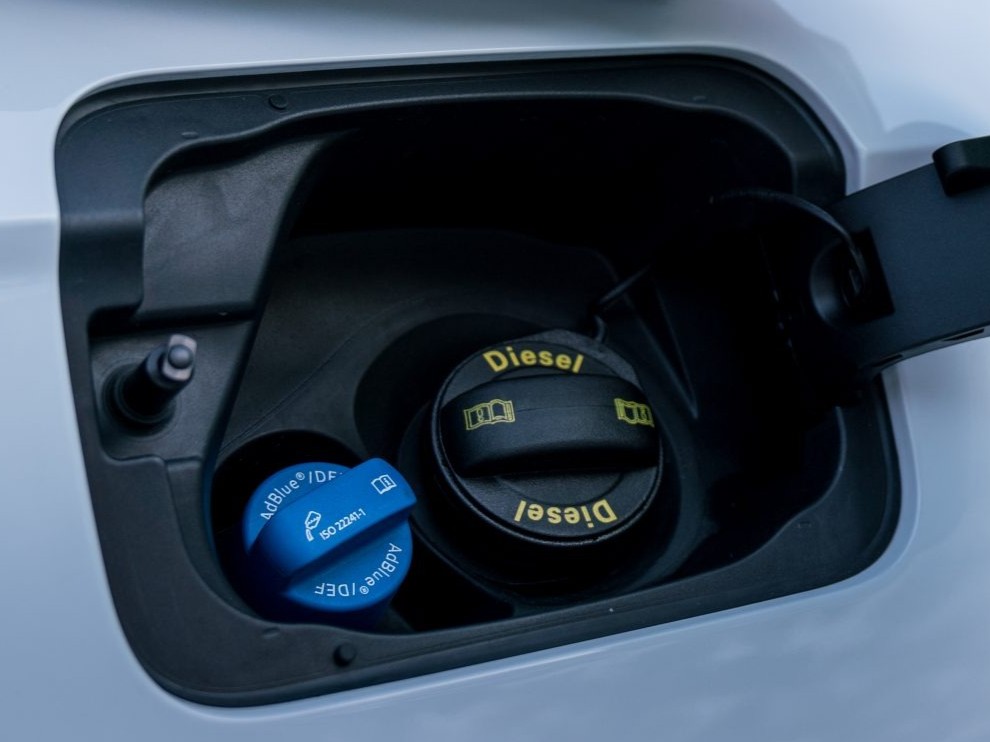
SCR is highly effective and can reduce nitrogen oxide (NOx) emissions by as much as 90 percent or so. These systems also allow manufacturers to pump out diesel engines with huge power numbers while remaining legal.
Semi-tractors often have DEF tanks capable of holding more than 20 gallons of the fluid. Depending on the model and driving situations, that fluid may last 3,000 miles to 5,000 miles or so before needing to be refilled. Mileage varies, of course.
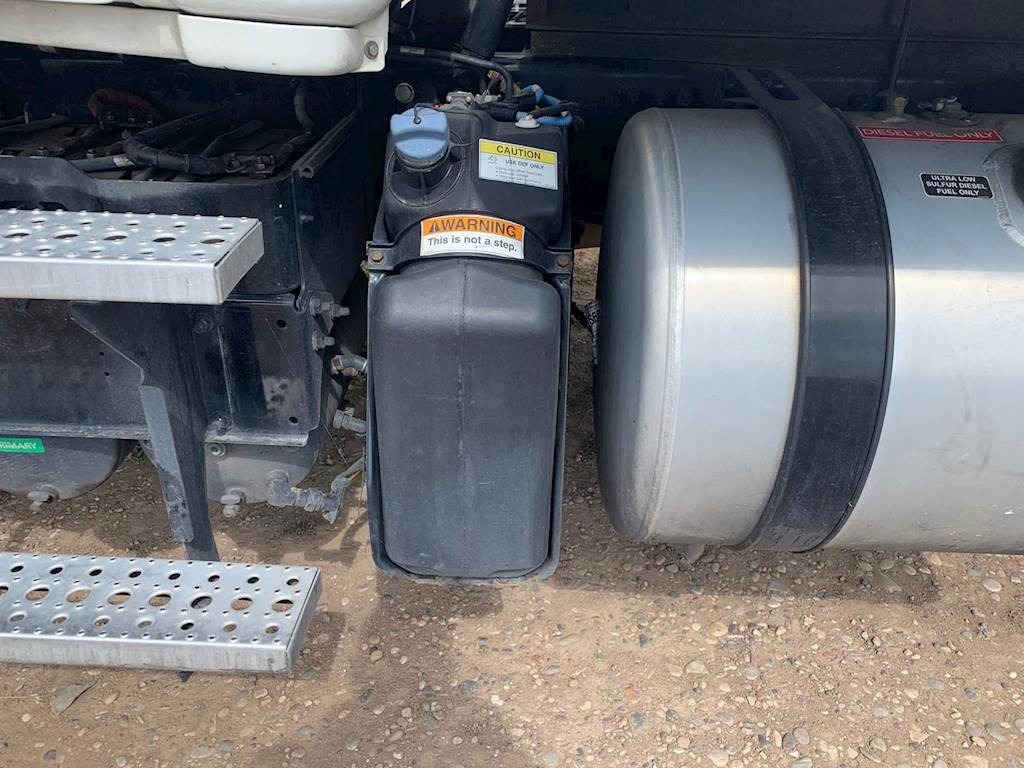
The math changes a little for diesel pickup trucks, but the concept is the same. For example, a current-generation Ford Super Duty has a 7.5-gallon DEF tank and, depending on use case, may go roughly 3,500 miles or so between DEF refills. Older Super Duty trucks were known for going longer between DEF fills. Towing heavy, blocky trailers reduces DEF range.
It’s also common for passenger cars with diesel engines to travel several thousand miles before needing their DEF tanks refilled.
What Happens When You Run Out Of DEF

These vehicles will warn their drivers about depleting reserves, with these warnings ranging from visual reminders to audible alarms. If you fail to replenish the DEF, or the DEF system isn’t working as designed, the truck may immediately derate or enter limp mode until the issue is resolved. To use Ford as an example here, the truck may warn that it will enter limp mode in a certain number of miles, and then slow the truck down to 50 mph once the mileage threshold is crossed. If the truck believes the issue is severe, it may eventually limit the engine to idle. Other trucks have a similar system.
Many diesel owners carry spare jugs of DEF so that they can refill anywhere when needed. I always buy extra DEF whenever I test diesel trucks because I don’t know if I will run into a fuel station that doesn’t have DEF, or run into a station that does have DEF, but the price of it is absurd.
DEF systems do have an aggravating quirk, and it’s that the derates and limp modes still occur even when a part of the system fails. Unfortunately, some manufacturers and models struggle with emissions equipment reliability more than others. One infamously unreliable diesel truck is the Nissan Titan XD Cummins, which you can read my story about by clicking here. The cruel twist is that you could have a full DEF tank, but get stuck during a road trip because of a sensor or other system failure.
The EPA Rolls Back Requirements

Back in August 2025, the EPA decided to address the issue of diesel vehicles derating after either running out of DEF or a system failure. This is what the EPA announced:
Starting with model year 2027, EPA requirements state that all new diesel on-road trucks must be engineered to avoid sudden and severe power loss after running out of DEF. To fix the problem for vehicles already in use, EPA’s new guidance, developed in collaboration with manufacturers, will work to ensure that the necessary software changes can be made on the existing fleet. In addition to providing certainty to manufacturers about how EPA wants this issue resolved, the agency is not requiring separate approvals beyond that provided in EPA’s guidance. This ensures that bureaucratic steps do not delay manufacturers’ ability to put solutions into the field.
[…]
When DEF runs out or a system sensor fails, current systems can force a vehicle to drastically reduce speed or become inoperable. In many cases, vehicles are limited to as little as five miles per hour within hours of a DEF-related fault, causing significant disruptions in logistics, agriculture, and construction. Although this derate strategy was intended to ensure compliance with EPA’s Tier 4 Emissions Standards, it has caused needless frustration, operational delays, and real economic hardship for countless farmers, truckers, and equipment operators.

The EPA did not completely eliminate derates and limp modes. Instead, the new rules called for a grace period. A semi-tractor operating under the new rules would be able to drive 650 miles or 10 hours before a 15 percent reduction in torque. If the DEF issue is not resolved, a 30 percent torque reduction occurs at 4,200 miles or 80 hours past the beginning of the issue. Top speed doesn’t get limited until 8,400 miles or 160 hours, and only then will the truck slow to 25 mph. If you continue to ignore the issue with the truck in 25 mph limp mode, it’ll finally derate to 5 mph.
The timing is different for other diesel vehicles. If you have a heavy-duty diesel pickup or a diesel car, the vehicle will enter limp mode 4,200 miles or 80 hours after the detection of an issue. Limp mode top speed will be 45 mph. If that’s ignored, top speed drops to 5 mph.
Many diesel owners considered this a win. Basically, the new rules mean that if a DEF system takes a dump during a road trip, there’s enough buffer to get the vehicle back to home base to get it fixed. A grace period seems like a good idea, if only so you don’t get stuck in the middle of nowhere with a broken truck and whatever you’re towing.
Conversely, the EPA’s grace period doesn’t make a distinction between a system failure and simply running out of fluid. That implies that you might be able to intentionally drive around with an empty tank for a while.
EPA Takes It Further

Yesterday, the EPA announced further changes designed to complement the August rules. Specifically, the agency suggests that it wants to hold manufacturers accountable for DEF system failures. From the EPA:
The issue facing farmers, truck drivers, and equipment operators remains clear to the agency. Sudden speed losses and shutdowns caused by DEF system failures compromise safety and productivity. The Trump EPA’s guidance, which significantly reversed deratements, called on manufacturers to revise DEF system software in existing fleets to prevent these sudden shutdowns and give operators more time to repair faults. EPA recognizes that to improve systems, the product designs and materials for these systems must also be the highest quality possible. With today’s action, EPA is taking another step to address any potential insufficiencies with system parts to better advance future rulemaking and reduce system failures.
Under Section 208(a) of the Clean Air Act, EPA is authorized to require manufacturers to provide information needed to assess whether emission control systems are functioning properly and whether manufacturers are meeting their obligations to identify and fix defects. EPA is demanding information from the top 14 on-road and nonroad manufacturers that account for over 80 percent of all products used in DEF systems. Specifically, EPA is requiring data on warranty claims, failure rates, and repair information for Model Years (MY) 2016, 2019 and 2023 emission control products to determine whether ongoing DEF system failures are related to a specific generation of products. Manufacturers will have 30 days to provide the requested information; failure may result in additional inquiries or penalties.
What’s most interesting about the press release is a short statement that was tacked on the end, which says, emphasis mine:
EPA is actively working on its proposal for the reconsideration of the 2022 Heavy-Duty Engine and Vehicle NOx rule. It is being thoroughly assessed whether derates may no longer be necessary for compliance.
If the EPA were to decide that derates are no longer relevant, it would be a major change in how diesels are run in America. There’s no shortage of diesel owners who complain about the complexity and reliability of emissions systems. Many of these people simply delete their emissions systems, and many of those who leave their systems intact do so only begrudgingly.

If the EPA said that derates and limp modes were no longer needed to be in compliance, I suspect there would be quite a few trucks rolling around on empty DEF tanks. For some diesel owners, the only reason to fill the DEF tank is to prevent limp mode. Unfortunately, the EPA has not provided any further clarity for what that future could look like.
Regardless of what happens, I will be keeping my diesels stock. I have accepted that the emissions equipment is part of the diesel ownership experience. Besides, I like the fact that I can still enjoy diesel power, but that diesel exhaust doesn’t stink and has gone through some heavy cleaning.
We await hearing more about how the EPA plans to change diesel regulations, as we may be entering a new era for diesel emissions. We will continue to watch the EPA’s developments and write updates as they come.
Topshot graphic images: Ram/BlueDEF





I like the idea of a grace period. When I had my baby Dmax Canyon I never ran out of DEF, but it did cause some occasional anxiety if I hadn’t kept my eye on where it was at.
I’m not at all enthused about the idea of getting rid of emissions regulations.
I think a lot of commenters here have never had to deal with a modern diesel emissions system.
They are so problematic, they are only required a 5 year/50K warranty…..gas emissions are 8 year/80K miles minimum. (Federal Mandates) Many states require much longer for gas, but not diesel. They know the systems are flawed….
Vehicles produced for military use do not have these emission systems. Reason? They cause the vehicles to be unreliable, and the military cannot have that……
Factory extended warranties specifically EXCLUDE DEF and DPF systems……
My 2019 RAM has been in the shop repeatedly for excessive regeneration frequency. (Regen every 100 miles or less. On a RAM, this leads to excessive fuel in the oil. Not good.)
They have “fixed” it enough to get it out of warranty without replacing the $4K DPF. Now that I am out of warranty (by time, not miles, truck only has 44K miles on it) I am told the fix is a new DPF to the tune of almost $6K parts and labor……
I actually use my truck. When it is running, it is pulling a large RV. Hence the low miles. I don’t daily the truck. If it is running, it is towing or hauling something.
I would have no issue with emissions if they were reliable.
I am now faced with a decision…..$6K for a possible fix or $1,500 for a definite fix with emissions removal and no further problems. No EGR has been proven to extend engine life as well.I want to remain compliant, but at the same time, this is a hard pill for an owner to swallow……
I’ve been doing some work at a factory that makes wind turbine blades here and there and one of the things the maintenance people have to deal with is the Christmas break. And by that I mean, when the factory closes for the break all the resins and hardeners and paint and etc etc freeze up inside of the machines meant do dispense and distribute it when they aren’t doing the dispensing or distributing.
I suppose this is the case for these DEF systems? I don’t actually know. Either way, while I imagine Johnny-Trump-bumper-sticker is taking this as a win, I can also imagine a future where there are two tiers of these vehicles for sale on the used market: with and without frozen up DEF systems.
Dirty deeds, done dirt cheap.
This is tricky. In most cases ignoring vehicle maintenance has built-in consequences. Don’t get fuel – car doesn’t run. No oil change – engine fails. Emissions systems for the most part fail and the car… keeps going, just pollutes more. So, an artificial consequence may be the only option.
One could point out the alternative is to outlaw diesel engines, but that logical argument is probably a non-starter. One could also point out the introduction of DEF systems allowed for more powerful diesel engines that still meet emissions requirements, but that is also too logical to make an impact with some.
There is zero chance of developing a system that punishes 100% of people who deserve it, and avoids unfair punishment for 100% of people who don’t. So what’s the best compromise? I would suggest having a grace period applied to any malfunctioning diesel emissions system – x miles and then the vehicle goes into a severe limp mode, and no grace period for running out of DEF – that is a solvable problem, especially when the vehicle gives warnings in advance of running out.
Beyond that, maybe a strong marketing campaign by a non-Trump EPA pointing out that we could just outlaw diesels entirely if DEF is such a hassle?
One of the problems with DEF systems it the nature of the DEF itself, it can freeze and is prone to crystallization in the system. Even a sensor failure will drop a vehicle in the limp mode; which isn’t really an issue in town, but I have a midsize diesel pickup I take to very remote areas. A DEF failure out there would cost me many thousands in recovery costs because you just can’t limp that far over that terrain. It’s happened to other owners, full DEF tank but a sensor in the system failed leaving them stranded and paying huge towing and off road recovery fees (good luck using roadside assistance in that situation).
Even if you do get to a garage, you probably need a dealership for a newer vehicle and they are booked out weeks, sometimes months. I’ve known owners who had to abandon their vehicles in another state where it sat parked for 5+ weeks before even getting into a bay, and another 3 weeks for the repair, then time off and travel expenses to go retrieve it. The added cost was absurd and all because a heater element failed or a sensor misbehaved.
I’m very pro-clean-air, but in the short time I’ve had a modern diesel, I kind of understand why people take the risk of a delete kit when keeping all the emissions controls costs you as much as another car on top of your regular maintenance costs.
Before people have a knee jerk reaction to this, consider several real life scenarios I experienced selling parts out in farm country: DEF heaters would fail…during summer, causing the limp home timer to come on in the middle of nowhere eastern Washington. Minor valve issues or other small DEF related issues would strand people, forcing an extremely expensive tow and repair at an eager dealership. I don’t think thats right. I actually don’t mind the limp timer when the tank runs dry, as DEF was and is available absolutely anywhere, but imagine if your car suddenly became a paperweight because your EVAP solenoid failed.
It’s definitely true that failures of such a complex system cause unnecessary hardship for operators, but this is not the solution.
Manufacturers should have been more accountable from the beginning. We used to have mandatory emissions warranties for gasoline cars in Ontario that would cover 120,000 kilometers. That’s a big part of the reason those systems are so reliable today.
If Manufacturers were simply forced to warranty these systems for a much longer period, there would actually be incentive to produce a reliable product. Right now they are incentivised to sell junk and rake in the repair money.
I’ve been working on these systems for 16 years, and there has been little improvement in reliability.
Idiots that let their def tank run out will be the same idiots stuck at the side of the road after their 4000 mile grace period ends. The only difference will be that they have spewed 4000 miles worth of extra Nox into the atmosphere.
The ironic thing is the CARB waiver that the current administration is attempting to repeal requires both much larger warranties on emission components and longer useful life for emission testing.
I guess it’s pretty clear that this current EPA initiative has nothing to do with environmental protection.
I have mixed thoughts on this.
On the one hand, this is typical right-wing bullshit where they want laws and regulations to be toothless so they can be easily circumvented. Everything is pro-business with them, and to hell with the environment and anything else.
On the other hand, I understand that most of these vehicles are used in extreme conditions doing heavy duty work. Nothing more infuriating than having your equipment be sidelined for artificial reasons. If you blew a gasket or you are having transmission issues that is one thing, but knowing you are in a limp mode for what is a fairly minor issue can be maddening when on a job site 100 miles from no where. I feel that this is the kind of environmental over-reach bullshit that the left pushes that does far more harm than good. It turns off people from your cause because your implementation of these rules are so in-your-face it drives people up the wall. No vehicle should get into a “limp mode” for something as minor as running out of DEF.
Wow holy crap a both-sides critical comment that has bite and is actually fair. This deserves more smiles.
We go through this cycle all the time. The Left pushes an environmental policy that’s good on paper but tends to have some pretty negative real-world repercussions.
Then the Right rolls them back focusing on rhetoric rather than addressing the real issue because politics and owning the libs.
At the end of the day nothing changes because politics is a cyclical game of tug-of-war that predominantly exists to keep Americans at one anothers’ throats.
One side is well-meaning, but naive and clueless, and the other side is just plain evil, vindictive and illogical.
I would typically fall on the left on most of these issues, but as an engineer I understand that the real world is far, far different than the world of these bureaucrats. Its quite easy to write a law demanding that X happen, but Cleatus out on the farm is enraged when his equipment shits the bed for a seemingly minor issue.
This type of crap happens over and over again and its so frustrating to watch it play out. It was a little more predictable years ago when these right wing assholes were all about the money, but in more recent times, even the money comes secondary to “owning the libs”.
“One side is well-meaning, but naive and clueless, and the other side is just plain evil, vindictive and illogical.”
Oddly, the first side you mention openly calls for the assassination of people they don’t agree with. The very definition of being well meaning and naive!
Oooo are we turning this even more political? So which side is the side that openly calls for the assassination of people they don’t agree with? Just need some clarify here.
“The first side you mention”…
We’re just playing games now?
I have better things to do then.
If modern diesels didn’t go into limp mode after the DEF tank went dry most people would never fill the DEF tank.
I have a Bank iDash guage on my Duramax and one of the things I monitor is NOX ppm in and out of the aftertreatment. It is not uncommon to see 300 ppm in and 10 out. DEF MASSIVELY reduces the pollution coming out of the tailpipe of a diesel.
DEF also allows the emission system on a diesel to be much smaller than it would need to be if we had to stick with just catalytic converters. The trade-off is that you actually have to fill the tank.
No one is saying we should get rid of it. But limp mode is a draconian measure to take for equipment that is often used in remote locations or extreme conditions and for commercial purposes. There should be multiple stages of warnings. If you get a low fuel warning on your car, you still typically have many miles before you actually run out of gas. Similar deal with newer cars and their “change oil” warnings.
This is especially true for a fluid which has only been around since 2010 – with how long diesels are supposed to last, there are many owners where this is their first DEF vehicle. People are used to carrying an extra jug of oil or washer fluid or coolant because that goes back many decades. But with DEF you might have a 1st generation owner out 100 miles from a service station and what is in their minds is some DC bureaucrat just threw their truck into limp home mode and they got a 5000 lb load in their bed and they feel screwed. The optics of the situation are terrible.
There are multiple stages of warning lights before DEF runs out. If someone is going into limp mode because of no DEF, it’s because they are incompetent.
I am literally reading now in another tab how someone is having DEF issues on their truck, possibly caused by the cold weather (it freezes at just 12F). Went into a limp-home mode before a multi-hour trip even though the truck was fine otherwise.
Most people have zero patience for a poorly thought-out system imposed by bureaucrats that hampers their ability to get shit done. I put this issue on-par with BMW installing heated seats and a steering wheel on cars, but demanding a subscription to enable the feature. The equipment is fine, but these are artificial problems that exist not because something is broken or went wrong, but rather some “higher power” decides to make it into a problem for a lowly owner.
DEF heaters are a thing.
Stock diesels have heaters in the tank and lines that operate when the vehicle is running. There is a grace period after startup when temperatures are cold enough to freeze DEF for those heaters to thaw the DEF.
If you live in a cold enough climate you can add a plug in heater just like diesel owners have done for years with engine block heaters so that their diesel will start when it is cold. Not close to a plug – there are also diesel fueled DEF heaters.
The option is doing what is required to make your diesel work – or outside of a few use cases – get a gas vehicle that doesn’t have the issues that come with a modern diesel vehicle that meets modern emission requirements.
Diesels only go into limp mode if something is wrong. (Speaking as someone that actually owns a 2011 Duramax that has had its share of emission related issues.)
People that buy diesels tend to expect a dead reliable engine – getting high miles is one of their calling cards. Adding DEF and the related components is one more thing that can go wrong on an engine that historically has been more simple than its gasoline counterpart. You are introducing one more failure-point. And claiming that they ONLY go into limp mode when something is “wrong” is disingenuous because frozen DEF or simply running out of it at an unfortunate time is technically something going “wrong” but that isn’t something that should otherwise sandbag your equipment.
People aren’t dumb. They understand the difference between something ACTUALLY wrong with their truck and artificial problems.
Particulate filters have been a reality for 20 years and DEF for more than 15. The days of simple mechanical diesels blowing black smoke out of the exhaust are well in the past.
Running out of DEF is no different than running out of diesel. It should never happen – if it does happen that is operator error.
Diesel gels at about 15F. Those of us that drive diesels do things to prevent that gelling in the winter and have for decades.
Habits have to change. People used to leave diesels idling and never shut them off. Excessive idling plugs the DPF on a modern diesel and causes excessive regens and premature DPF failure. Owners have to use the correct engine oil. Using an old oil meant for pre-2010 engines will plug the DPF on a modern diesel.
Deal with it or buy something else. Massively polluting to avoid inconvenience is not an option. Air pollution is an ACTUAL problem.
The option today is to deal with diesel aftertreatment or buy a gas vehicle. For almost all light duty applications and many medium duty applications the reality is that gas is the better option today.
15 yrs is not a particularly long time. Especially for Diesel buyers. When the average new car is on the road for a dozen years, I can only assume diesels are typically well over that – thus my comment that DEF could very well be a new thing for an owner – their old truck might be 20+ years old which predated DEF and this is not something they are familiar dealing with.
Concerning “habits have to change” – well good luck dude. I am not disagreeing with you, but you still have folks who believe some of the myths about cars from 50 years ago.
Of course air pollution is a problem, but is isn’t a problem that should strand someone. Modern diesels are already considerably clearer than ones from years ago – and that is even without DEF. So let’s not over-state the issue.
Again: “It is not uncommon to see 300 ppm in and 10 out. DEF MASSIVELY reduces the pollution coming out of the tailpipe of a diesel.”
I believe we might be seeing this differently coming from two very different places. You are talking about farms. If you are on a farm in Kansas, with low population density and steady winds to blow the pollution away I can understand the mentality pre-aftertreatment diesel worked fine so why make them more complicated to lower emissions. I didn’t think about emissions much at all when I lived in Michigan because it was dead flat and we never had bad air days because our pollution blew into Canada.
For almost the last two decades I’ve lived in metro areas over 1 million people with mountains that catch the pollution and hold it. There have plenty of days that we can see the air. There are days my wife can’t go outside and do normal activities because the air quality is bad enough her asthma kicks in and she can’t breath.
So no, I’m not willing to let people massively pollute more because they want to drive a diesel but don’t want to do the maintenance. I have a diesel – yes, the emission system can be a pain – but it is absolutely necessary.
“People aren’t dumb”
That’s probably the most untrue statement I’ll read this week lol
Also, it’s been a very long time since the days of smoke spewing, mechanical on-road diesels.
Modern diesels can run for a long time, but owners should expect high maintenance costs and high cost of ownership with any on-road diesel from this century.
Meh. I mean I know where you are doing with this, but people do tend to wise up to being sold a ton of BS eventually. Outside of a cult environment (something rather powerful these days in the US), folks can tell the difference between a made-up failure due to some overzealous emissions programming, and a real failure like a broken transmission.
The things causing these systems to go down are real failures, because the systems are themselves unreliable.
All I’m saying is that’s the problem we need to solve.
These aren’t made up failures, emissions components and the work that they do are very, very real.
I’m simply trying to explain to you the mindset of the type of folks who would be caught in these issues. They are thinking we didn’t have this DEF stuff growing up on the farm and things are fine. And driving a few miles without DEF is no big deal.
And I find of agree with them.
Time after time consumers have been sold some green-washing bullshit, only then to hear how these billionaires are flying around in their private jets which might pollute more in one flight than most pollute in a whole year. Or the endless data center and their energy usage for AI that no one wants.
People have had it up to here with this nonsense.
A few miles driving their rig without DEF isn’t adding anything to our pollution problem and I’m sick of pretending otherwise. Most people are not against emissions equipment, but holy crap folks out here are at their breaking point with stuff. Pushing too hard, too fast create a blowback which turns people off of causes who would otherwise support this stuff.
DEF has been around for 16 years.
I’m sorry things on the farm will never again be like they were in what you consider “The good old days.”
I’ve totally heard the angry mob mentality before, and I wholeheartedly disagree with it.
We’re talking about thousands of miles here, not “just a few miles.”
The environmental impact will be felt. It will take a short time to undo what every other first world country on earth has worked so hard to accomplish.
Today, you’re angry. I hope that at the very least this regressive environmental policy from your President will make you happy inside. But let’s face it, it won’t.
Your stubbornness is exactly the problem that makes things far worse, not better. Good job in working against your interests. This type of mentality in treating Farmer Joe like a child instead of trying to understand his legitimate concerns is exactly why so many of these regulations are hated by average Joes and why they will fight them tooth and nail.
These regulations are not hated by the average Joe. The average Joe needs clean air to breath.
Farmer Joe needs a clean exhaust pipe and reliable equipment, not gross pollution caused by a policy that allows him to operate with disabled emissions equipment.
It’s a little ignorant that you would think all farmers are against environmental policy.
Farmers are generally smart people.
I was talking specifically about limp mode due to neglecting to fill the tank. If you can’t do that, even with the multiple warnings, you’re incompetent.
Obviously, DEF systems are designed to deal with frozen fluid as a routine operation. An electrical fault in the heating system would cause the issues you described.
That situation sounds like someone ignored the warning lamp for a long time, then decided it would be fine to head out on a long trip. I agree that the system certainly needs to be more reliable, but even so, a lot of testimonials you read will be issues caused by the user’s own stupidity.
Disabling the system altogether will not fix this issue. The same idiots will still ignore all the warning lamps and end up at the side of the road, after having spewed and extra 5,000 miles of toxic smog into your neighborhood.
DEF systems are essential to keeping diesel power as a viable technology. Emissions standards don’t exist just to please bureaucrats. They were created to protect human life and health.
The problem is caused by poor implementation. Weak government policy has allowed manufacturers to use these emissions technologies as a cash grab.
Manufacturers must be forced to create more reliable DEF systems, and this is only possible with legislation that holds them accountable.
Like Pappa P said – anyone that goes into limp mode because they ran out of DEF is incompetent. My 2011 Duramax give the first warning at 1,000 miles before empty. Later model Duramax have a countdown just like miles to empty for gas for hundreds of miles.
I’m fine with giving some grace for an equipment failure like a bad sensor but not for running around with a empty DEF tank. Even then 4,000 miles with a failed aftertreatment system is way too long.
You will get people that game the system. Disconnect a sensor, run for 4,000 miles, reconnect and run to the store, disconnect, run for another 4,000 miles…..
I replied to Pappa P with an example that I was just reading about. I agree that these systems need to exist, but you aren’t going to win an argument with a farmer, for example, when they need to get shit done and frozen DEF is hampering their work. Draconian implementations of these rules is just the kind of thing that sends otherwise rational people into a rage. And I can’t blame them.
The poor implementation of DEF systems does nothing to help their effectiveness of doing their job to remove harmful pollutants, and it also clearly does nothing to help the end user.
So we all lose, humans who breath air and farmers alike.
It won’t help a farmer to breath in an extra 5000 miles worth of harmful Nox emissions, and it won’t help our food being dusted with these toxic substances.
Really the only winners are the manufacturers, (Until they realize that they too breath air). This is why they lobby politicians to create weak policy that won’t hold them accountable.
You are not one of the billionaires that will benefit from slashing emissions legislation. The increase in pollution will harm you just like it does the rest of us.
When the pollution directly affects someone in control of making the rules by making them or their families ill they will declare it to be a national emergency.
Till then those with the most money to buy a politician to change laws will get what they want and you will learn to like it or else.
Make the the top officials( and wives,children, families )in a oil refinery,or other polluting industries live directly in the area they are polluting that will cause harm to their health and watch the regulations change.
Take mining for example, make the executive in charge live downstream in a area affected by runoff and watch what happens to the regulations then.
Actions have consequences and until the executive in charge has his own skin in the game nothing will change regarding pollution.
I think the CEL should not come on as well until about 10,000 miles later so people have a chance to delay their maintenance until they sell their car.
I hope all the utopian commenters on this article don’t also subscribe to the “cheapest shitbox that runs” mantra that this site likes to preach… Because a Christmas tree dashboard also impacts emissions.
Pot please meet kettle
It would be interesting to see the emissions numbers of a 1970 jeep whatever and a 2025 diesel without urea. But the first thing is totally fine, and the second thing is instant screaming death on a stick
The Nox that the urea treats are what cause smog. Nox emissions are much higher due to the heat produced by the DPF, which of course removes hydrocarbon (soot) emissions.
So, the old jeep would likely produce higher hydrocarbon emissions, while the 2025 diesel would have higher Nox emissions than a 1970 diesel.
The 2025 diesel would be much worse than the 1970 jeep, because there’s like 100,000 2025 diesels for every jeep on the road.
One of the justifications of driving a big, he-man diesel vehicles is to haul crap, right? So how about hauling a spare Jerrycan or two of DEF?
Problem solved!
Unless a sensor fails, or the operator doesn’t follow the instructions to the letter, or the jug of DEF is frozen, or…
So don’t buy a diesel.
There are many applications where gasoline power is an insufficient substitute for diesel. In some cases battery power is even preferable.
If battery works buy a BEV, PHEV, EREV or HEV. Or figure out a way to do the job using gasoline, with lower gearing, bigger displacement, a longer stroke, powered trailer, whatever. Or find something else to do.
I dare you to go to a BNSF or Union-Pacific office and tell them to stop using diesel right away and switch to gas/hybrid/EV. Video it, I’m sure at least one of the writers here would get a kick out of it.
Heck, expand your whirlwind tour to Caterpillar, John Deere, Case, Oshkosh, Grumman, etc. while you’re at it. Be the voice of the change you want to see.
Diesel trucks are the topic being discussed, not locomotives, tractors, earthmovers, bulldozers, aircraft or rockets.
If it’s too challenging for you to pour fluid into a tank every 3000 miles, life is going to be very hard on you.
Indeed.
Could they mandate that running out of fuel or oil would be consequence free too? It’s only fair.
Around the time DEF was being implemented into diesels (I think ?), I was driving a circa 2012 F-350 for a company I worked for at the time. From what I recall, you’d get the low DEF warning and then if you neglected to refill the tank to an absolutely full reading, in order to reset the system, the trucks electronics would still read as low and you’d still go into limp eventually. Having never really heard of this new fluid, I ended up going into the same gas station 3 separate times to buy more, whilst reading up via Google in the Parking lot in between DEF purchases. Talk about the most annoying shit I’ve ever experienced on the open road.
So you didn’t understand the vehicle’s operational requirements then. Got it.
Probably also puts 5 gal in the fuel tank every time, too. It’s cheaper that way!
Sounds more like a bad implementation by Ford. Granted, my vehicle is 10 years newer but I rarely fully fill my DEF tank and have no issues like that.
When I read the title I was going to be mad. But allowing you some leeway to get a fix before dropping to 5mph… Yea this isn’t as bad as I thought, most people don’t ignore a warning light long.
I love the idea of forcing the manufacturers to warranty their Def systems. If it was up to me I would make them warranty them for 15 years 160k miles.
My coworker who ignored her TPMS light until her tire was down to 5 PSI would like a word with you.
Most people absolutely ignore warning lights! I agree that allowing more leeway is a good thing in this case, but I bet most diesel owners will ignore the warning light until their vehicle derates, and only then fill up.
There already is leeway. My Duramax starts warning me 1,000 miles before the DEF tank goes dry.
The CARB waiver that the Trump administration is trying to kill required manufacturers to warranty their emission systems for 110K, 150K or 350K miles depending on vehicle class for MY 2022 to 2026. For 2027 – 2031 that jumped to 150K, 220K, and 450K. 2032 and beyond that goes to 210K, 280K, and 600K miles for the emission warranty.
Your right some vehicles do have a good amount of leeway already. But all should.
Wow 600k! Nice. that will seriously get manufacturers thinking about durability although I must admit it seems slightly excessive, I think 300k would be fine, very few cars make it that far.
I would love to see filters apply to non passenger desiels, like farming equipment and construction equipment. Alot of the companies I work with run equipment that is worse than any highway truck I have ever seen.
Every diesel with DEF gives hundreds of miles of warning before it goes into limp mode for the DEF tank going empty. This is not a problem – just an excuse to let diesel owners drive for thousands of miles massively polluting with an empty DEF tank instead off filling it back up.
The limits vary based on vehicle class. That 600K miles is for Class 8 trucks that do more than 1 million miles in their useful life.
Particulate filters are required for new off-highway equipment. Some require DEF depending on the manufacturer’s decisions. It is still possible to make off-highway engines meet Tier 4 standards without DEF with careful engine management and reasonable power expectations.
Someone running low on DEF has no excuse. Someone’s Def system breaking spontaneously or “thinking” it broke (sensor failure) should get thousands of miles of grace.
I don’t know of the best way to tell the difference between the two, maybe roadside smog spotters? That’s already a thing here and annual inspections. So if someone’s filter system is working but faulted they have until they inspection comes up.
So we are going to spend millions on roadside smog spotters so someone doesn’t have to go get their car fixed? Sorry but no.
1,000 miles is plenty to get to a shop and get the vehicle fixed.
This whole thing is really a nonissue. The after treatment system is like any other part of any machine. If you take care of it, it works as intended and there are minimal problems.
I personally know a larger number of people who run small fleets of diesel trucks and I think I’ve heard of someone going into derate and being stuck or something like that maybe once out of millions of road miles. This is also on trucks that idle frequently and are not maintained by dedicated mechanics.
This is just pandering to people who think that the epa is somehow stepping on their “freedom” to drive dirty vehicles.
Even my dad, who runs a trucking company with a fleet or ~40 trucks hasn’t complained about DEF or after treatment for about 10 years now.
I was recently talking to a long-haul bulk tanker driver, he was telling me that checking for an extra jug of DEF was part of his pre-drive inspection. I didn’t know about the limp more till then, I agree that a “grace” period would make sense rather than just bricking a truck.
Then again, if there’s a warning light, how does one run out? Must be the same type of drivers that try to go just a little further with the low fuel light on and run out. I’ve been driving since the start of this century and have not once run out of gas, even when I’ve owned a number of vehicles with non-working fuel gauges.
Because many emissions related warning lights on vehicles mean absolutely nothing about the driveability of a vehicle and thus for people on limited budgets mean nothing. Then because the light is on all the time, when something that actually requires immediate attention pops up, they don’t know because the light is always on. I’ll give 2 examples – catalytic converter efficiency below threshold and minor evap leak. People only fix these if they can’t get their car to pass inspection and are thus blocked form registering their car.
Diesel have a specific message that pops up and tells the driver that the vehicle will derate in x number of miles unless the DEF tank is filled. It is VERY clear.
My Duramax starts the warnings at 1,000 miles before derate.
Depends on use case. If you live in city traffic, lots of problems. Long haul rarely has issues.
I’ve been in the fixin diesels industry for 20 years, and aftertreatment issues are the most common problem we fix.
My family owns a trucking company, they do Long haul and rarely have issues.
I work in public transit, our buses have constant aftertreatment issues because they’re always in stop & go traffic with lots of idle time.
Stop and go traffic is a horrible use case for a diesel. People are starting to learn that and the medium duty market is steadily moving from diesel to gasoline.
Can’t speak directly to transit but school buses are going back to gas.
For transit buses a gas / electric hybrid would likely be the ticket.
Unfortunately, our buses average 2-3MPG on diesel. Switching them to a gas engine with enough grunt will likely mean we don’t have enough fuel to last the day.
There’s a reason Class 8 is still all diesel. Above a certain size, gas just doesn’t work.
You can match diesel fuel economy with a hybrid.
Class 8s are mostly still diesel because of inertia and because it is still possible to meet emission regulations with diesel. You should see the aftertreatment required for EPA 2027 though. They are huge, expensive, and a new level of complex.
The medium duty segment (Class 4 – 7) is moving back to gas. It is only a matter of time before Class 8 follows them.
(Although for long haul on-highway a diesel still makes sense as the aftertreatment lives a lot longer because they don’t require nearly the number of regens)
The jump from class 7 to 8 is SIGNIFICANT. That’s not a chasm that can be jumped easily. Fuel cost is the #1 consideration of freight companies.
In transit, literal torque output is the issue. You’re moving a ton of weight from a stop regularly, and running a bunch of high draw accessories.
For example: A New Flyer 60ft articulated bus weighs just under 42,000lbs just sitting there. That’s 9000lbs more than the GVWR of a class 7.
The rated capacity of a 60ft (in our fleet) is 100 people. For argument’s sake, let’s use the rough average of 180lbs per person.
Now the in-service bus weighs 60,000lbs. And is stopping/accelerating in some cases multiple times in a single mile.
“Oh but we can move that weight with gas”
Now we add accessories. Our articulated bus uses a Thermo King X640 compressor for the A/C. It uses it’s own double-ribbed V belt. I can’t find a specific number, but I was told we lose 50hp to turning it. Which makes sense cause it has 6 cylinders and weighs several hundred pounds.
The bus is also filled with electronics, which require a ton of power to operate.
For this, we use an EMP P535 alternator. Named as such because it can output a peak of 535A @28V. That’s a peak power output of nearly 15kW.
Some rough math says you want at least 24hp to turn that.
All these HP numbers assume diesel engines, because it’s tractor math.
Now add in an Air compressor, power steering/hydraulic pump, and the fuel consumption of the auxiliary heater.
You’re gonna have a gallons per mile bus, not a miles per gallon.
And you’re likely going to be spinning that gas engine pretty high with short gearing.
How about a CNG electric hybrid? All the electric torque for the frequent starts, all the regen goodness for the frequent stops, a pretty efficient and clean engine running at constant speed, and since you know the route, you can put a fuel stop where you want it.
Batteries would probably be better for all the same reasons in the long run, but as a transition tech, CNG hybrid would work.
They make diesel hybrids, which is my preferred setup. We’re already configured for diesel and electric, and there’s fewer aftertreatment issues when you run a steady-state generator setup.
I agree. Transit buses are ideal for a series hybrid system with just enough batteries to convert captured braking energy and idling time to accelerating torque. Since it’s on a route that includes a garage and fueling station, maintaining a treatment system should be easy.
Typically, Transit buses are fueled on a “return to base” system, as they use a specific fueling setup called a PosiLock. This allows us to put up to 500L of fuel into a bus in roughly 3 minutes.
They’re not filled on route and (at least in our agency) aren’t filled by the drivers.
The only fueling system that’s feasible on route is pantograph charging. Which could be used with a hybrid system easily. Top up the batteries at main stations to maximize EV range and minimize engine usage.
Sorry, I was thinking of the base as being part of the route, as in the path of the bus over time, not the fare route.
I have fond memories of the San Francisco pantograph busses and trolleys.
The wires , not so much.
In my future vision the gasoline engine isn’t spinning anything besides a generator to charge batteries.
The problem with diesel electric hybrids is they still require aftertreatment – although they run at a more steady state and don’t have the idling issues that come up with a straight diesel vehicle.
In any case – I doubt there is a long future for pure diesel bus. (Or semi for that matter)
Again, for the power we’re looking to generate, the gasoline engine is sorely lacking. Unless we’re bringing back some rather large displacements.
A Tesla Model 3 averages about 8km per kWh
A Nova LFSe+ 40ft EV bus averages 2kWh per km. That’s while using a diesel fired auxiliary heater for cabin heat to maximize range.
You’re gonna need a HELL of a gas generator to keep up with that demand.
The vast majority of the extra fuel economy of a diesel comes from the increased fuel density of gasoline vs diesel. If you can produce the power with a diesel or a CNG generator you can do it with gas but you will need a fuel bigger tank.
The problem with diesel is the aftertreatment. Both the complexity and the cost. Have you seen the aftertreatments required for EPA 2027? I have.
Yes I have, and Scania has already met them with fewer components by re-thinking the strategy from scratch. (International is using it for their S13 engine in the North American market).
The emissions can be met. Gasoline is still a terrible choice for the class 8 market, as you’ll lose more in fuel than you’ll ever save in aftertreatment at that level.
Interesting – I look forward to testing one.
Yet again VW says they can meet new diesel emission requirements without the tech used by the rest of the industry. We know how the first time worked out.
Scania just stopped trying to control cylinder temps and focused on NOx post-combustion. The result is there isn’t an ash load to deal with, and the EGR has nearly no duty cycle.
Take that, asthma sufferers! We’ve had enough of you slowing our trucks down just so you can breathe!
The other side of the coin.
https://pickuptrucktalk.com/2026/02/epa-moves-to-force-engine-makers-to-fix-notoriously-faulty-diesel-def-systems-citing-major-savings-for-farmers/
Don’t try to inject any reason into the conversation.
It’ll go right over the rabid mob’s collective heads
Reading some of the deranged comments, you’d think the one thing standing in the way of sunshine and unicorns is that diesels stop running when they run out of def.
Many seem to lack enough intelligence to understand that DEF can be coded out in around 20 seconds, and that the people who want to roll coal already have it coded out.
For normal diesel pickup drivers, the new rule will be the same as the gas pickup driver who sees a secondary O2 sensor fault and corresponding check engine light. They’re annoying to see and most people will address the issue just to not hear the annoying gong and have a light on the dashboard.
Also, before some Mensa member tells me coding emissions on diesels used to be super duper pants-on-fire illegal, please consider US legislation only covers the US. Anyone who wanted this coded out was doing it anyway, remotely, with tuners outside of the US.
Operating a road vehicle that exceeds EPA emissions standards that were in place for the model year for which it certified, is illegal. It doesn’t matter whether your area is requiring you to prove compliance (i.e., emissions testing). Where the coding originated is of little consequence. All that does is insulate the coders.
All of the above was true at least before tRump gutted the EPA and all its rules. Enforcement was of course spotty to nonexistent, witness the proliferation of coal rollers and dipshit cat-delete straight-pipe pop-and-bang tunes. But by the letter of the law, your vehicle cannot exceed designated emissions standards.
I have no idea where you see in my posts the thought process that modifying emissions is legal.
Whether something is illegal or not isn’t something I’m debating. Whether something should disable your vehicle is. For the hard of hearing, and the hard of understanding, obviously tampering with emissions is illegal. Thank you Captain obvious.
I am concerned your reading comprehension skills are not very good. Please try again.
This website has had a very nice comment section for the entire time it has existed. Please do not ruin that with your insults.
Last week, a frequent poster repeatedly wished death on a politician.
I don’t recall you mentioning anything then…
They did upon Hitler as well. That wasn’t justified for all the pain and suffering he caused?
When your plan is to kill the people you disagree with, you have already lost the moral high ground.
Not mentioned because the TDS is a real thing, its incredible
Why don’t you piss off back to Twitter.
“by the letter of the law” how many products does your NAPA store sell that aren’t federally and/or 50 state compliant? I’m sure it’s more than zero
It might be more than zero, I have a small amount of Mr. Gasket vavle cover breathers and an open element air cleaner on the wall. But I don’t sell tuners, or cat delete pipes. In fact, if I knowingly assist you in bypassing a catalytic converter using bulk pipe or whatnot, I open myself up to fines.
those stupid coal rollers were around long before trump and will be around long after he’s gone
If only folks would read that before freaking out… if only. Thanks for adding that context
You’re welcome
I can definitely understand trying to force/encourage automakers to make the limp mode more forgiving, but removing the requirement entirely is just political pandering to the truck nuts crowd.
I thought it just extended the miles/time in the story
You get warnings about DEF fluid well in advanced. On my little VW, it’d start warning you like 2,000 miles in advanced or something like that. Even at my somewhat high mileage I was doing at the time, it was nearly a month warning. I’d just swing by an autoparts store, buy a box of DEF, dump it in, and I’d be good for another 9-12 months (that was pretty long, because this was cheating VW diesel, so it used less DEF).
No muss, no fuss.
Some larger gas stations and truck stops even sell it out of a gas-pump-style thing, and you could fill it that way too if you wanted.
Forcing it into limp mode is a bit unforgiving, but only if you’re a complete idiot.
Running out isn’t a big deal, it’s when the DEF system itself fails that things turn shitty. There were a number of stories around the pandemic times where people (especially RV owners who were trying to enjoy the great outdoors for once) would have DEF system failures that would send the vehicle into limp mode either immediately or before replacement parts could be sourced, leaving them basically f’ed.
Which is fair, but without things like knowing failure rates, what mileage they typically fail at, and all that, it’s not exactly a point that deserves a ton of weight.
And just because part of your car is broken, doesn’t mean you get to pollute freely. Yes, I understand “stranding” someone is drastic, so clearly there’s improvement to be made, but I don’t think the correct answer is basically letting it be broken.
Yes, I agree. Removing the limp mode entirely is just going to give people an open invitation to de-DEF their coal rollers.
EPA and the Orange Turd DGAF about our world.
My dogs have better morals, and better brains than the dumb ass dictator or his weasel administration.
Fuck them.
It’s all one huge fucking grift…
Maybe you should run for office and get elected instead of pissing and moaning on an auto blog about things you don’t understand
No, they are 100% correct. It is you who needs to find a mirror.
What do you understand that we do not?
thanks for the laugh…
so why don’t you educate the rest of us?
I understand shit when I see it…what’s your excuse?
I agree. More folks should run for elections and participate in politics. Adult citizens should be proud to do their civic duties. The crop of candidates that both garbage bipartisan parties have foisted upon the United States for decades are unacceptable.
Arguing behind keyboards does little more than generate ad revenue.
Preach!!
Good. It’s crazy your car/truck/whatever won’t run without it.
We still have emissions during annual inspections in most of the USA.
The equivalent in a gas car would be a secondary O2 efficiency error shutting the car down. Why?
Believe it or not, it is possible to simultaneously want to breathe clean air and also think the current DEF rules are draconian.
And for the record, I have never owned and will probably never own a diesel pickup. And personally think people who roll coal are stupid.
The “why” is because unlike an emissions system failure on a gas car which can directly impact your fuel efficiency, engine power, cat converter lifetime, etc, the only noticeable (if you can call it that) effect of running out of DEF is increased tailpipe emissions. That means that a vehicle operator/owner has no direct incentive to continue filling up with DEF, which would lead to literally nobody ever refilling, and the entire system would be useless.
You seem to have trouble understanding how O2 sensors work.
These are very similar situations.
You can literally cut out the secondary O2 sensors and your car will keep working, basically exactly the same as it was before. Except you have a check engine light.
If you don’t refill DEF you can’t pass emissions, which are usually required. And you have a CEL.
A secondary cat efficiency code doesn’t do anything to the engine. You can continue to run forever like that, except pass emissions.
You could have an error due to you cutting the cats out. But you could also have a malfunction. But your car keeps working.
I agree with what you’re saying, but I’ll add that not all states require emissions on F-250+/2500+ model trucks given their size. Smaller diesels like the Europeans’ offerings, the 3.0L diesels in half-ton trucks and their SUV derivatives, and more niche models like the CX-5 diesel and diesel equinox and crude and similar would indeed be subject to emissions testing.
Good point
Fair correction, there are some car emissions system failures that don’t result in a performance or efficiency reduction. I was more thinking of things like a primary O2 sensor failure, which will kill your economy, power, etc while belching a ton of extra pollution out the tailpipe.
Most of us have gas engines so we never have to face our car not starting because a sensor went haywire.
I’ve had O2 and evap errors in my cars despite not removing cats or modifying the equipment. It happens. Fortunately as all my cars are gas, so I never have to worry about being stranded away from home.
Let’s just hope your cam position sensor never fails!
Hallmark of this administration is “F@$& you and your health.” To hell with air quality and affordable healthcare. EPA is becoming the environmental abuse agency.
EPA recently announced that it is no longer looking at the economic effects on human health when evaluating the cost-benefit of air pollution regs.
This is going to be unpopular, but I’m just not that sympathetic. Why should my lungs bear the cost of your luxury product? I struggle to think of a consumer application where a gas truck doesn’t achieve the same end result. And for the work trucks, DEF isn’t something new; it’s been worked into the price of goods for years now. It’s just the cost of doing business. There are solutions to these problems, but the solution is not spewing diesel fumes back into the air we breathe.
Not unpopular with me, I agree 100%.
A little sympathy is in order for owners who experience a sensor failure through no fault of their own. The grace period lets them get home or to the nearest shop to get it fixed (as Mercedes describes very well).
I’m with you, no sympathy for drivers who ignored all the warnings and ran out of DEF. The low DEF warnings start popping up early and often!
Any change of this will be challenged in court and hopefully put back on the onus of the owners, not the rest of the public near them. Bootstraps and all that stuff.
I also just think why are you making your executive function problems *my* problem? Sorry you can’t plan ahead for having or obtaining DEF…maybe you should have a gas truck instead.
The affected diesels aren’t just in pickup trucks. They’re in medium and heavy equipment, too, where there is no gasoline equivalent. Do you know how expensive a towing bill can be for a combine harvester the size of a modest single family home? Or what a service call to an oil field or remote quarry costs? Or the logistics of recovering an F-450 (or similar, doesn’t matter) and a crew of workers and their trailer full of equipment “in the middle of nowhere” dozens if not hundreds of miles away from the nearest place selling DEF?