


No kid-aged auto enthusiast ever saw their bicycle as just a bike. It was the only transportation device we were allowed to have, so you can be damn sure we were going to add lights, speedometers, STP decals, and anything else to make it seem more like a car or motorcycle.
Bike manufacturers seemed to know that, and so they did their best to make their products aspirational things that took on the qualities of automobiles our pre-driver’s-license selves dreamed of. That dream car changed over the years, but for 1985 Raleigh had their finger on the pulse of Colecovision and Tron-watching youth; and boy, did they deliver an over-the-top product for them.


Knight Rider Knockoff
Last week, Pete recalled how kids of the sixties and seventies wanted bikes that looked like dragsters or motorcycles ridden by the Bad Element of society. The Schwinn Sting Ray started the trend in 1963, followed by such fancifully named versions as the Orange Krate and Lemon Peeler.

The coolest “muscle bike” of them all to me, however, was released across the pond in England for 1969: the Raleigh Chopper.
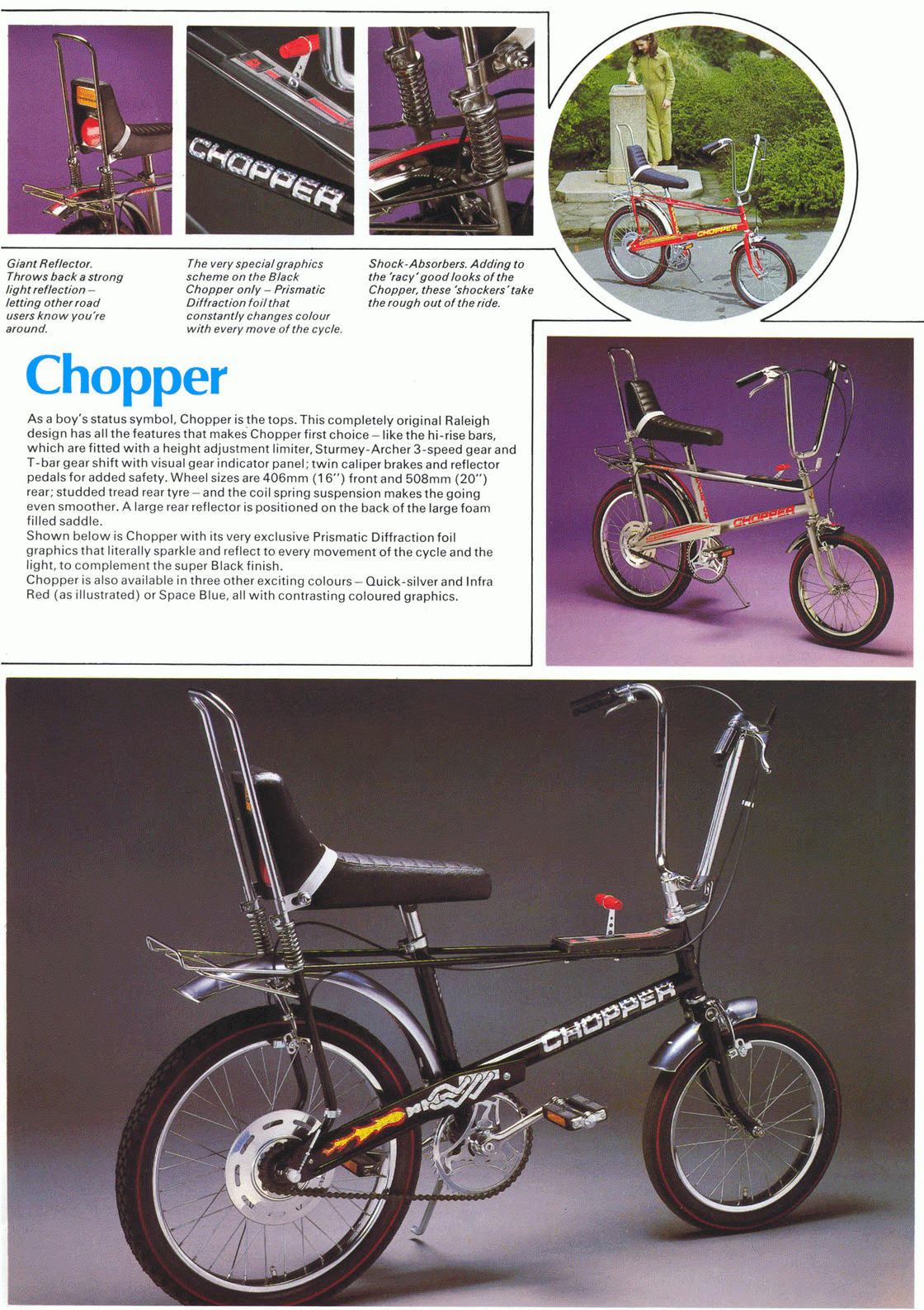
Designed by the firm Ogle (who also penned the Bond Bug and Reliant Scimitar cars), the Chopper featured a dramatic, angular frame design and a gear selector mounted to a console-like perch on the crossbar:

This was the ultimate in cool at the time, but times naturally change. By the early eighties, most of us kids wouldn’t even know what Easy Rider was, but a 14-inch Sony at home pumped our brains full of vehicles that screamed “space age technology.” This was stuff from the future, like the year 2000.
We needed to be calmed down in a dark, quiet room after seeing the commercial for the new 1984 C4 Corvette dodging lasers with its Millennium Falcon instruments:
The C4 was like a real-life manifestation of the 1982 Trans Am in Knight Rider, minus the bulletproof skin and The Hoff’s chest hair.
Seemingly always late to the party or wasting time on After School Specials we didn’t care about, the ABC network took three years to answer for K.I.T.T. with a television show called Street Hawk.

This one had actor and one-hit-wonder pop star Rex Smith as a loner on a computerized dirt bike that gets missions assigned to him by the dude from Murphy Brown (Joe Regalbuto).
Here’s the voiceover during the opening credits:
This is Jesse Mach, an ex-motorcycle cop, injured in the line of duty. Now a police troubleshooter, he’s been recruited for a top secret government mission to ride Street Hawk — an all-terrain attack motorcycle designed to fight urban crime, capable of incredible speeds up to three hundred miles an hour, and immense firepower. Only one man, federal agent Norman Tuttle, knows Jesse Mach’s true identity. The man…the machine…Street Hawk.
So, yeah, it’s about a Knight Industries Two Thousand minus two wheels that doesn’t talk. The bikes were based on a 1983 Honda XL500 trail bike and later a 1984 XR500 with electric-start engines from Honda’s Ascot, making the Streethawks possibly the first electric-start dual-sport bikes ever. A high-tech bike that goes 300 mph can’t have a kick-starter, right? Reportedly, the stuck-on bodywork was a constant problem for the production crews as the parts continually flew off, especially during stunt work.
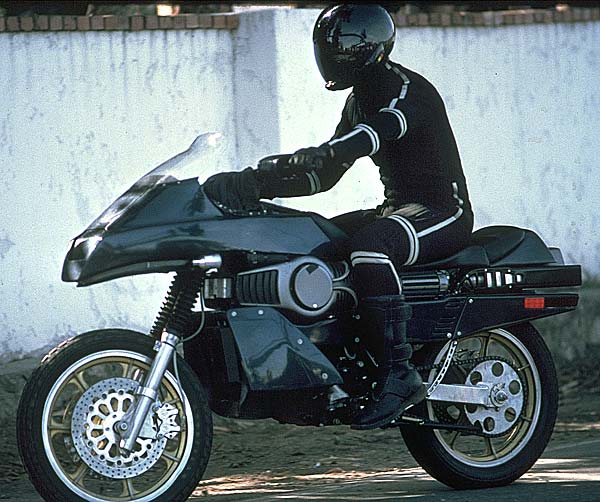
It’s hard to believe the show lasted for a whole season of 13 episodes, but if you were under the age of 13 at the time, you probably thought it was Godfather-level drama. You also imagined the Street Hawk had a lot more in common with the Schwinn you rode to school each day than it did with Michael Knight’s Pontiac. A company with some savvy marketing people would have seen that as well; surprisingly, it wasn’t a company in the United States that did.
Digital Overground
The Raleigh Chopper had obviously fallen out of favor with kids by the early eighties, but the British firm was continually developing new products. For 1982, they launched the Burner series of BMX bikes.

With distinctive gusseted frames and pad sets, they were easily the most successful products of the genre in the UK, selling over 500,000 examples in the first two years they were available.

Still, a BMX bike is a BMX bike; Raleigh really wanted something to totally wow the public like the cutting-edge Chopper had a decade earlier. Thankfully, someone must have caught a bit of American television programming and had a fever dream of what the Average Kid would find irresistible. Management gave the go-ahead to develop what was essentially going to be the “Chopper for the eighties,” a project that ultimately cost a reported 500,000 UK pounds (or around $650,000 in 1985, which would be about just over $2,000,000 today).
Raleigh named the new 1985 model “Vektar.” It was built on a Burner frame and fork with “5 Spoke I.C.I. AMX9 Mag Wheels,” which makes them sound considerably more high-tech than the simple Skyway knock-offs they were. The bike was kitted out with “unbreakable” polyurethane mudguards and brutally angular trim pieces that looked like pieces of a Star Wars stormtrooper’s armor.
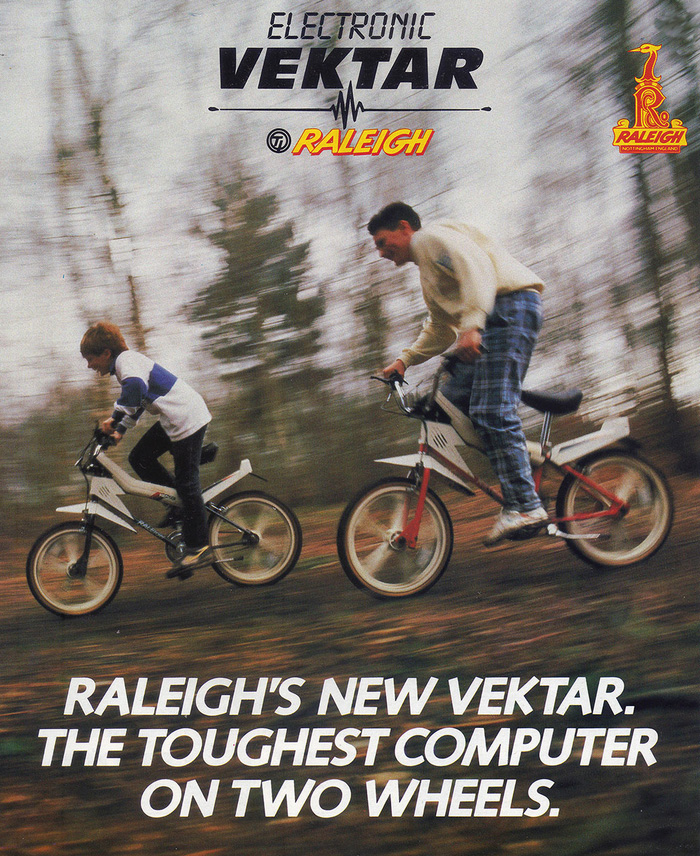
If anyone asks you, “what was eighties design like?” you can show them a picture of the Vektar. It’s just glorious; you can hear Tangerine Dream music just looking at it. I love those metal band letters and that spelling – they obviously didn’t want Vector Motor’s Gerry Weigert suing them (and he absolutely would).

Ah, but that’s just the base-model Vektar. The real party trick was the loaded Vektar, which Raliegh dubbed the “World’s First Computer Bike.” Oh yeah. What you got was a big, heavy console on the upper frame, not totally unlike the earlier Chopper, but instead of a cable-pulling lever, the Vektar’s console was packed with electronic goodies. Mainly useless goodies, but electronic.

You got an LCD speedometer at the top of what was jokingly called a “heads down” display with a bar graph for speed under a MPH/KMPH bar display. With a touch of a membrane-style button, you could switch to elapsed time or distance. Geez, even your mum’s Ford didn’t have this sh*t.
It’s totally pointless and cheesy. Also, I need to get one of these right away.

Below the digital display was an “audio system,” essentially an AM radio with three preset stations above a control panel for the “sound generator.” It even came with a whip antenna you could install on the back of your Vektar.

The sound system offered eight cheesy sound effects, activated by a rocker level next to the handgrips. Raleigh even provided a blank space for “any new device” in the future. Sadly, I don’t see that any “new devices” were ever available, and the Vektar itself doesn’t seem to have lasted very long on the market either. What happened?
@boysandgirlsofknocka In 1985 The ‘Vektar’ is the world’s first high-technology bike, developed at a cost of more than £500,000 and the successor to the best selling ‘Chopper’. Revolutionary features include a radio boasting three channels, a sound synthesiser programmed with eight re-set high-tech sounds and a computer equipped to calculate speed, distance and time of journeys#ireland#bike#1985 fyp#fypシ #fypシ゚viral #foryou #foryoupage #follow#nostolgia
The Future Was Expensive
Exact sales figures are not available, but estimates are that only 50,000 to 100,000 Vektars were made before Raleigh pulled the plug sometime around 1987. Sadly, the Vektar never made it across the Atlantic to sell here in America.
While Raleigh’s Chopper was significantly different from the other bikes of the time, it was rather obvious that the Vektar was a dressed-up Burner BMXer with not a lot to differentiate it besides the silly details and dubious tech. What’s worse is Raleigh asked a relatively small fortune for this thing in an attempt to recoup development costs. The “base” Vektar started at around 200 UK pounds, while adding the center console with all of its trickery pushed the price to nearly 300 (that’s around $400 in 1985, or a whopping $1,200 in today’s money). That’s a big chunk of change for what amounts to a rather silly toy with a bunch of battery-powered junk on it.

But what junk! It’s no wonder that surviving examples are prized by collectors today; one perfect example reportedly sold in Australia for the equivalent of $4000 US dollars. The Vektar was a glorious example of eighties design, the “cassette era futurism” of seven-segment displays and grids over stylized gradient sunsets. With a Vektar, you could have been the Street Hawk of the suburban streets, at least until dinner or homework time.
Top graphic images: Raleigh




Holy crap did Street Hawk rule.
Before Street Hawk, before even Knight Rider was Battlestar Galactica 1980 with the Turbine bikes:
https://www.motorious.com/articles/features-3/battlestar-galactica-turbine-bikes/
(If you never saw it, don’t. It’s painful, especially when we find out they could have taken out the Cylons with microwave ovens.)
As a British kid of this era, about 50% of boys had a Raleigh Burner but I never saw a Vektar in real life,
“…at least by dinner or homework time”.
Here it was “when the streetlights come on”
Funny enough all these functions exist on most Garmin bike computers
Of course the Garmin also has GPS and maps. You can buy a $400 Garmin Edge 550 and strap it to a $100 craigslist BMX bike and get roughly the same experience! Minus the cyberpunk plastics, but maybe you could 3d print those.
That’s pretty cool. I’m from the generation just after, born in the mid 80s and a kid in the 90s. For me it was motocykes, bikes that look like motocycles! I wanted one so bad but never got it. I did get a regular bike that I loved though and I found this thing at Walmart you strapped to the bike that had an alarm, horn sounds, I think speed and a few other features. I loved it cause it felt like the future lol. Now I have an ebike and it’s honestly the same situation except I’m 40. Also I watched Viper instead of Knightrider.
EDIT: OMG I just tried searching for it and I found it!! It was the Milton Bradley Bike Max!!!