

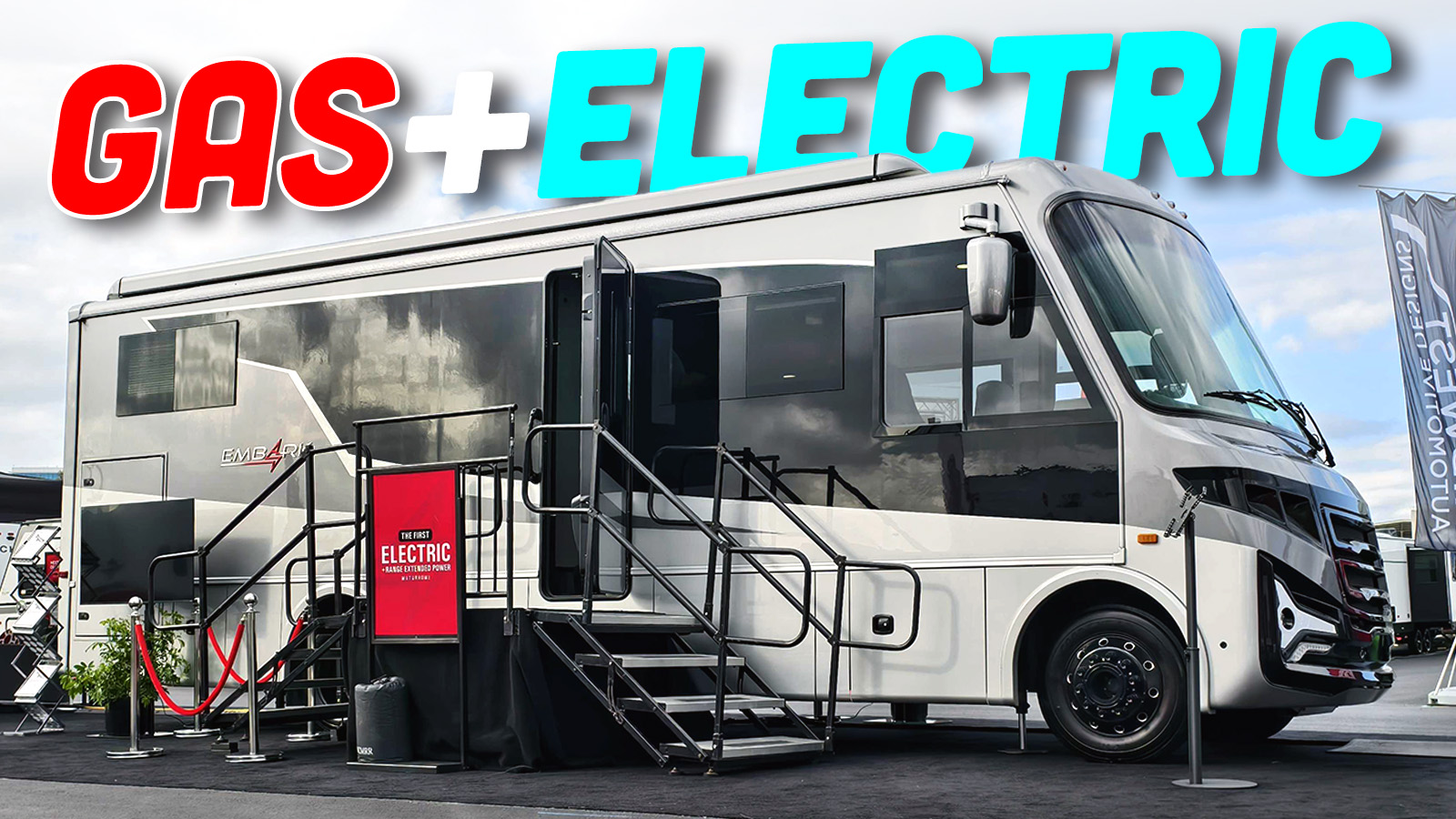
The mainstream RV industry has long felt like it has gone stale. For years, the greatest “innovations” offered by some of America’s largest brands have been placing a toilet in a different place, or replacing swoopy graphics with geometric shapes. Thor Industries, one of the largest RV conglomerates in America, is coming out with a genuine technological leap forward. The Entegra Embark 29V1 is an electric motorhome that has just enough all-electric range for local camping trips, but a gas engine for long-distance trips. It sounds like the best of both worlds, with only a few caveats.
The motorhome blueprint has not changed dramatically over the course of several decades. RV manufacturers usually source a chassis from another company, like Ford, Freightliner, or Spartan, and then slap a body on top. These coaches generally have massive gasoline or diesel engines that consume tons of fuel. I’m talking single-digit mpg for large Class A coaches and low teens for small motorhomes. Granted, these coaches often cost more than $500,000 and easily rise well into seven figures, so fuel costs aren’t that big of a deal in the grand scheme of things. But if you’re the kind of person who doesn’t like burning gas, the market just didn’t really have something for you out there.


A core part of the problem stems from the fact that RV manufacturers usually get their chassis from other companies. So, if those other companies don’t have EV platforms, their RV manufacturer clients won’t, either. Or, if a company kills a model, as GM did with the BrightDrop, it sort of sets the industry back.

Thor Industries, which takes the crown of America’s largest RV conglomerate in most years, has what it thinks is the solution. This is the Entegra Embark 29V1, and it’s 30 feet and 9 inches of innovation. Using technology by Harbinger, this motorhome sports a large lithium battery and enough electric-only range for trips near home. But when you decide to go far, a gasoline engine spins up and acts like a generator, allowing this motorhome to drive anywhere. It’s technology from cars that has finally trickled down into motorhomes.
From The Minds Of Harbinger
I first covered the Embark back in early September 2025 when the coach was known as the Jayco Embark. Since then, the motorhome has been given Embark branding, and Thor Industries has been sending a complete prototype around to RV shows. I finally got to see it with my own eyes at the 2026 Florida RV Show, and to say that I was impressed was an understatement.
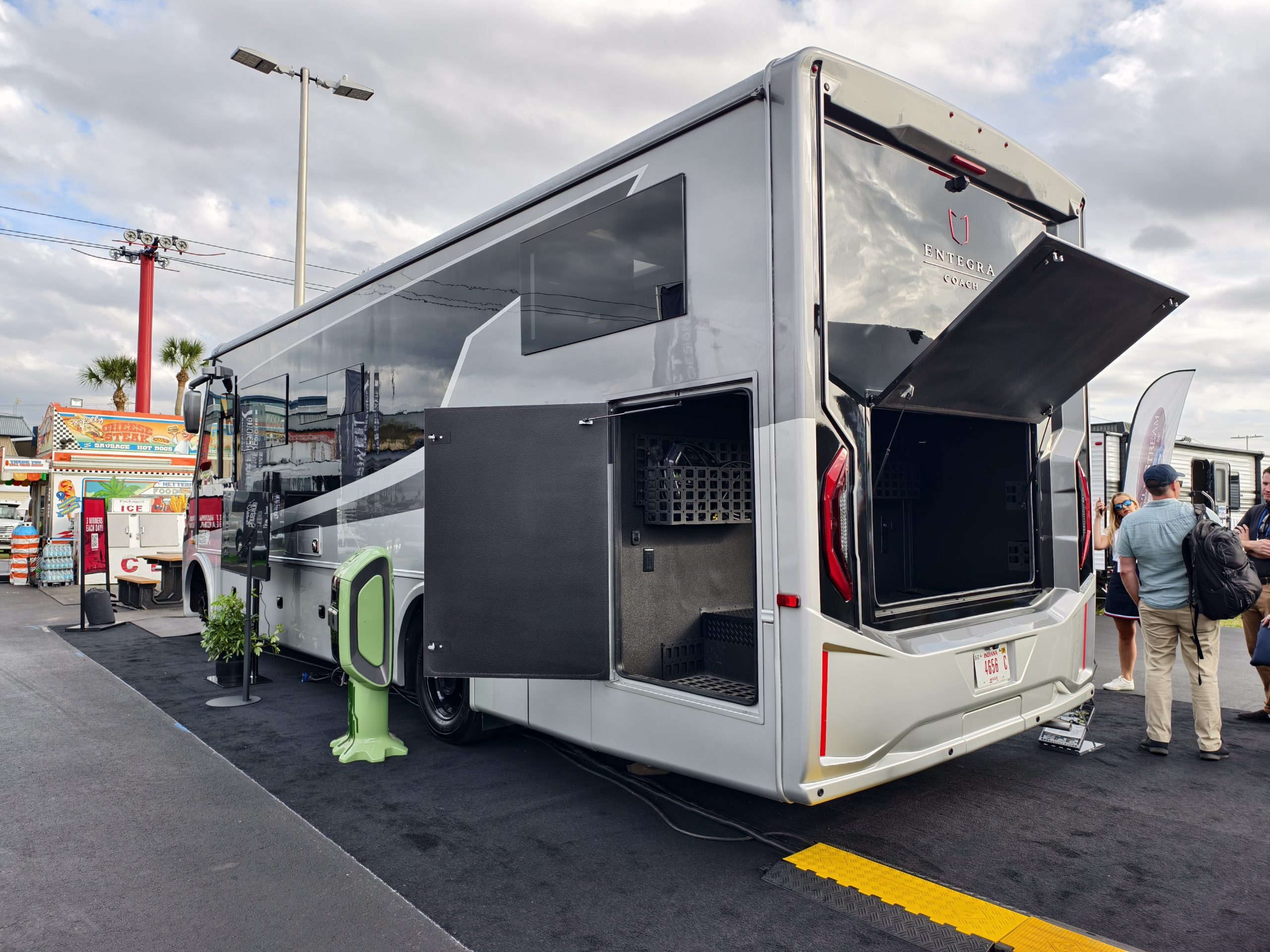
On the surface, the Entegra Embark doesn’t seem all that impressive. It’s only 30 feet, nine inches long and looks like any other Euro-inspired motorhome, only blacked out. The real innovation is what’s going on under the skin.
Back in 2023, I wrote about how Thor Industries and Harbinger wanted to change how American motorhome buyers go camping. Harbinger, which was founded in 2021, first gained the spotlight for its scalable stripped chassis commercial truck platform, which was shipped around the auto show circuit in 2022.

Harbinger’s extended-range electric RV platform is based on the company’s medium-duty commercial truck. Here’s what I wrote concerning the engineering at work here:
Harbinger’s batteries use [cobalt-aluminum-oxide] 2170 cylindrical cells and the cells are packed into large aluminum cases offering up to 35 kWh of power and 40 miles of range each. This 800-volt architecture is scalable, so if you want more range, just toss in more of the 35 kWh packs. These trucks need to last 20 years and 450,000 miles, so Harbinger took a look at what aged EVs look like and decided to go a different direction. When [Harbinger CEO and co-founder John] Harris spoke with Ars Technica, he mentioned that old Tesla batteries would have good cells, but enclosures that rusted out from over a decade of exposure. This is because, as Harris says, typical EV car packs are constructed from stamped steel components that are sealed together with body sealer. Harbinger uses a casting press to encase its batteries in single-piece aluminum boxes. This eliminates those aforementioned failure points.
Going with 800 V isn’t really for fast charging, either. After all, many of these trucks will be charging overnight at depots. Instead, it’s for efficiency and weight. Harbinger doesn’t need to use as much copper and the motor can be much smaller as well. However, Harbinger does note that the trucks could fast charge in about an hour.

At first, Thor and Harbinger were marketing a future with a Class A motorhome that would go 250 miles on a charge. However, the pair pivoted to a better idea and decided to add a gas-powered generator to the mix.
The platform is powered by an internal permanent magnet electric motor making 440 HP and 1,140 lb-ft, which drives a two-stage single-speed transmission. The eAxle unit is sprung and can move independently from the rear wheels. The gear up front is pretty nifty, too, and consists of an independent double wishbone front suspension with forged arms.

Harbinger’s all-electric prototype platform included a true steer-by-wire system, and while that’s still the plan sometime in the future, the Entegra EREV platform currently features a more traditional steering shaft.
Anyway, the Entegra Embark 29V1 currently features 140 kWh of Harbinger’s batteries (four 35 kWh packs), plus a 1.4-liter German-built GETEC gasoline four-cylinder engine. This engine doesn’t ever drive the motorhome. Instead, its job is to drive a generator. It’s a true range-extended EV. Thor says that the gas tank is 50 gallons and that the coach should be able to go 450 miles to 500 miles on both a charge and gasoline. The electric-only range is stated to be about 105 miles. The engine can also charge the battery while you’re boondocking. In theory, the Embark can stay off-grid for as long as you keep refilling the tank.
Do the math, and that translates to the gas engine getting about 7 mpg to 7.9 mpg when it’s fired up. That’s assuming you can get it to go 500 miles. That’s roughly the same as a 30-foot modern Class A motorhome that’s powered by a gas engine, or worse than a diesel. The good news, at least, is that a quarter of that first run would be EV only.
How The Prototype Drives

Here’s what Jason said about the driving experience:
So what does it feel like to drive? Well, I should qualify first that I didn’t get to drive it on real streets, just a little track delineated by traffic cones in a parking lot. I was a little disappointed by this, but I did find that the key elements of what this hybrid RV is like to drive still came out even on this tiny track.
The first thing you notice is the acceleration, which is shockingly decent considering the massive bulk of everything. It’s not whip-your-head-back sports car fast, but it’s still surprisingly quick, given the context. You’re just not used to a whole furnished apartment moving with such urgency. The bigger difference, though, has to do with weight, or, really, where the weight is. Electrified vehicles are always heavy, because batteries are heavy as hell, and while RVs are already absurdly heavy, in the case of the THOR Test Vehicle, the bulk of that weight is in dense packs of batteries way down low, in the chassis.
This changes the dynamic of how these big beasts drive, because the unsettling top heaviness, that always makes driving a motorhome feel like running with a stack of books or a large vase full of chili on your head, is pretty much eliminated. The hybrid motorhome felt planted, I could take sharp turns without encustardizing my pants, and overall the driving experience was significantly and viscerally better.
The big question I’ve had all of this time is how the Entegra Embark would be in person? Sure, the technology is fantastic, but what about the rest of it? I finally have the answer to that question after being able to get an extensive peek at the prototype in person.
Blacked Out, Euro Style

The outside of the Embark is pretty snazzy. Thor says it designed the Embark as a nod to European RVs. That’s a whole new trend in the American RV industry. Buyers want the forbidden fruit that Europeans drive. Some companies are quenching that thirst by importing European RVs. Others are just making American RVs look like they’re European.
The Entegra Embark follows the same lines established by the likes of the Coachmen Euro. It has roof-mounted mirrors, rounded edges, flush windows, glossy paint, a little garage in the back, and a floorplan that feels like a camper van that was scaled up in an editing program.

Materials appear to be decent here. I’m told the coach body has an aluminum structure with fiberglass exterior panels. The Harbinger frame is hot-dip galvanized, and the platform is designed to last 20 years or 450,000 miles. I have no real notes about the exterior. It’s not covered in obnoxious LEDs and isn’t very “loud.” An Embark probably isn’t going to stand out in a campground, and for many folks, that’s a good thing.
The interior made me audibly say “wow.”

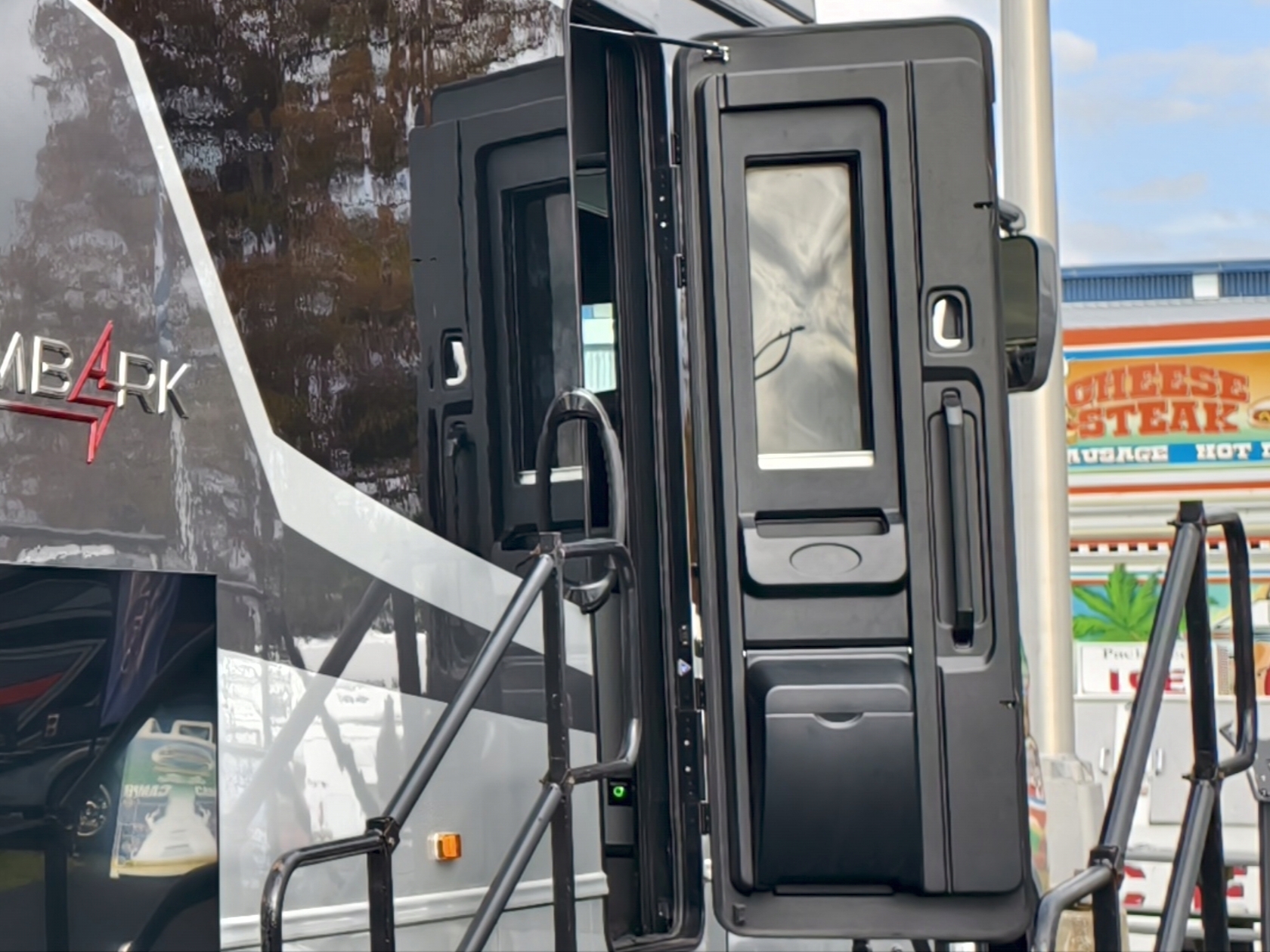
Admittedly, my very first impression was that of skepticism because the entry door is a sea of rough, unsightly plastic.
I was informed that this prototype is not exactly production spec, and the interior will see quality changes on the way to production. That’s good!
Moving through the door, there’s a lot to like here. We’ll start up front, where the driving business happens.
The driver sits behind a dashboard that looks like a command center with a digital instrument cluster, a Harbinger system information screen to the left, and a large infotainment display in the center. The surfaces here feel as rough as they look in pictures. Yes, that is a sea of piano black plastic.

The passenger seat is a bit less busy, and they get a table that deploys from the dash. This setup isn’t much different from what you’d find in other motorhomes. I’m told the dashboard is one of the elements that is being improved for the production version.

Aside from new materials, the new cab will have a better seating position, better visibility, and an overall lower dash. I loved hearing that, because I thought the dash didn’t really match how nice the rest of the interior was.

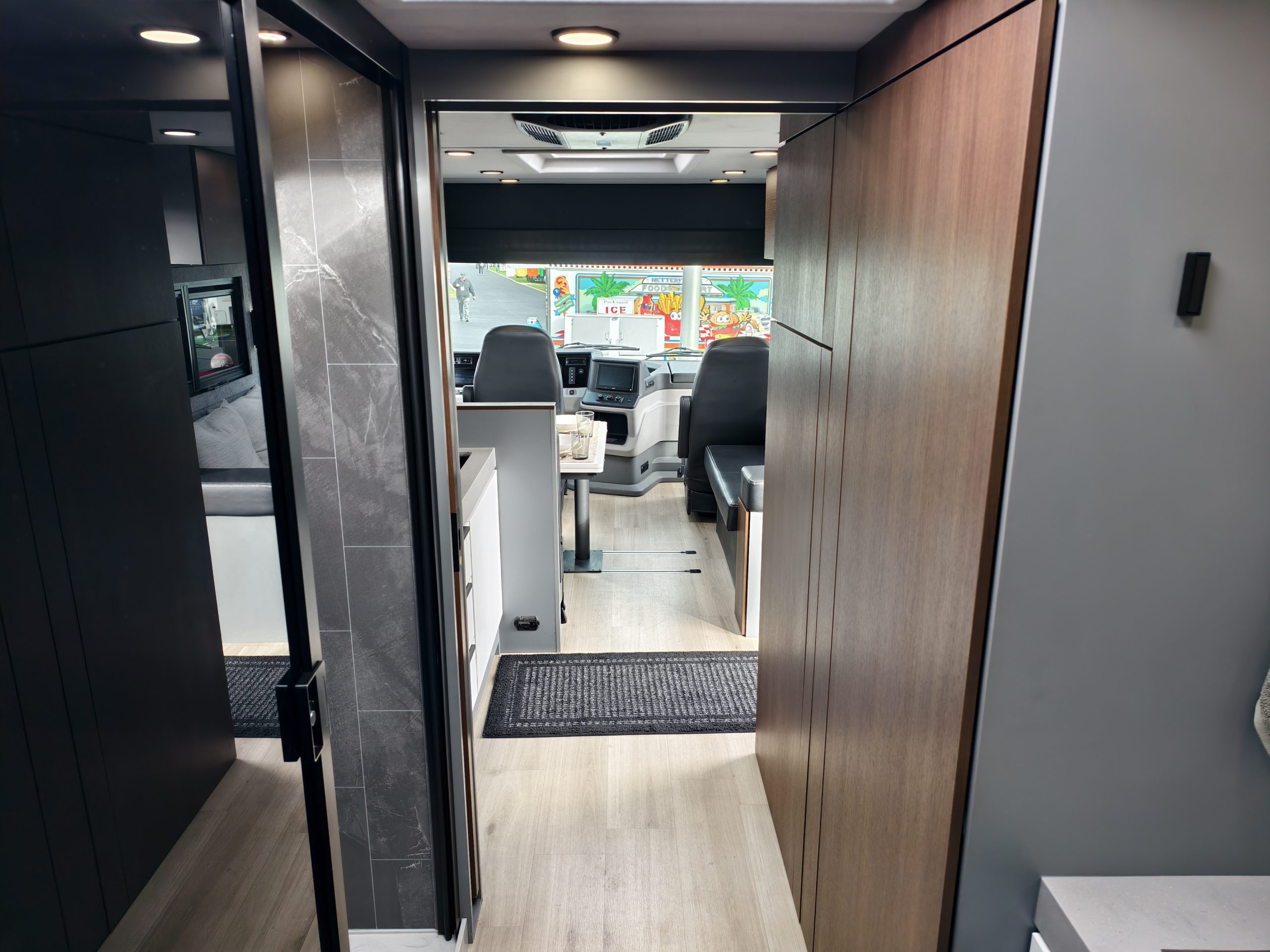
Behind the driving cab area is a pair of sofas that has a folding table between them that rides on a track. This area is flexible and can function as a lounge, a workspace, a dining room, or a bedroom. The sofas had seatbelts, and there were also four JBL speakers in the living room area, too.

Behind that is the kitchen. What I adored about the kitchen was that everything I touched felt great. I also loved the look of the cabinetry and the sort of heft that the doors and drawers had. I often complain about Thor’s RVs feeling cheap inside, but that is not the case here.

The blacked-out theming of the coach is continued here with glossy black trim contrasting gray walls, white cabinets, and wood. This is definitely an acquired taste, and I have no doubt that shiny trim will suck to keep clean, but I’m into it.
One interesting note about the main kitchen area is that the stove has both an electric and a propane burner. Thor’s engineers told me that they wanted to go all-electric. After all, they have a huge battery under this motorhome. However, market research revealed that Thor’s customers were divided on this issue. Lots of people want electric appliances, and lots of people still like propane. So, Thor’s just going to give them both.

Moving back from the main kitchen, I spotted a row of large wood panels. Upon pressing them, the refrigerator and convection microwave revealed themselves.

The doors opened in opposite directions, which is weird. I’m told that this oddity is just for the prototype. The production version will update this design. The wood door will become the refrigerator’s door, rather than the door to get to the refrigerator door, and the doors will open in the same direction.
Behind there is the dry bath, and the weirdness continues here.

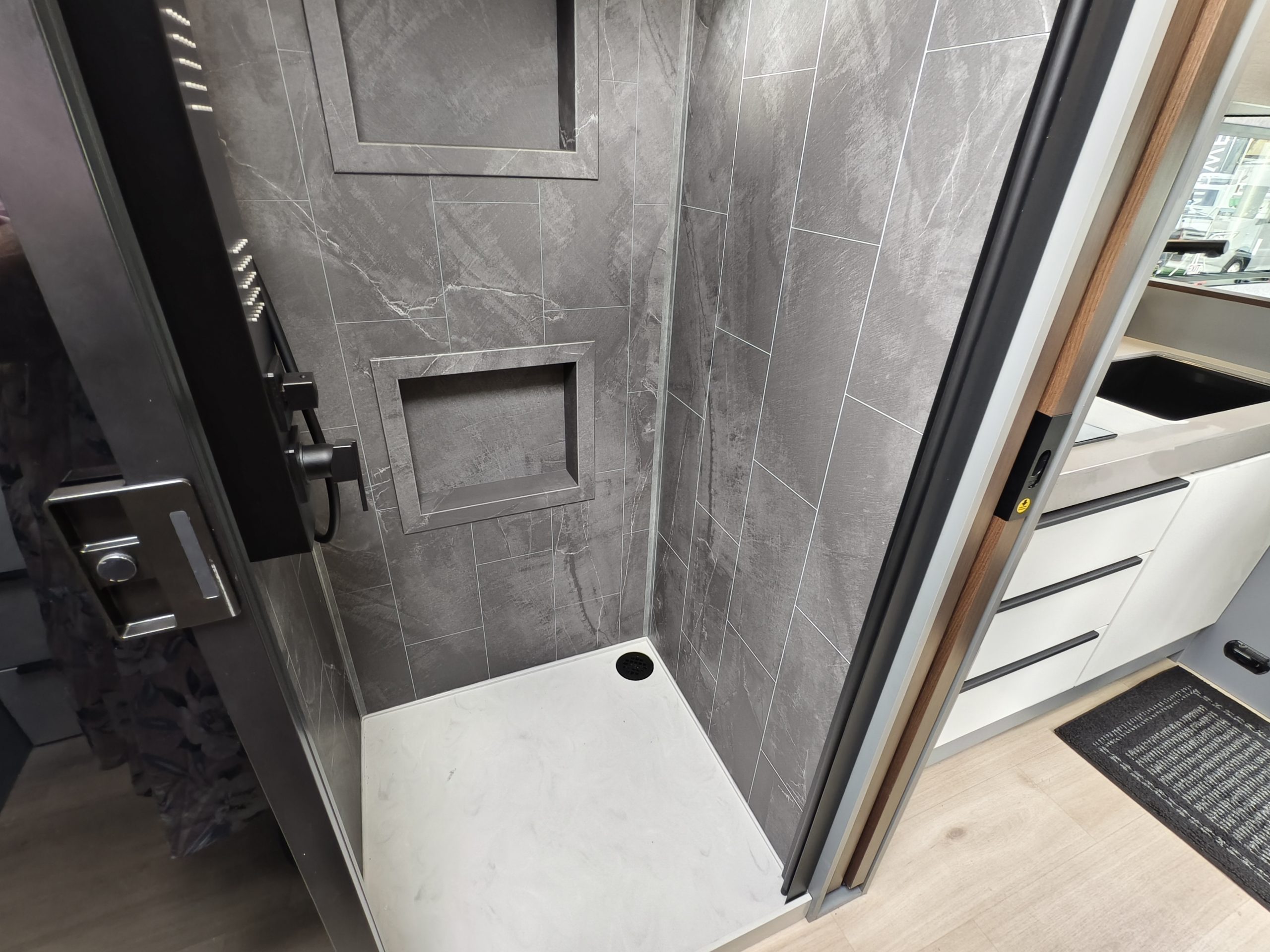
On one side is the sink. On the other side is the toilet and the shower, which are closed off from the main cabin with a funky blacked-out sliding door that reveals or hides these small rooms. As for the shower, it wasn’t the biggest I stood in, but it didn’t make me feel like I’d be fighting to get clean, either. It feels just about right. The shower itself didn’t feel like the cheapest plastic thrown into a box, either, which is another big plus to me.
In terms of holding tanks, there’s a 53-gallon tank for fresh water, 40 gallons for gray water, and another 40 gallons for waste.
Finally, the coach ends with the bedroom, which has a step-up platform and a king bed. The nightstands looked and felt sturdy, and I loved the continuation of the beautiful wood.

The interior also has acoustical wall panels so that the noise of the engine and outside environment doesn’t sink in as much. The walls felt weird, almost like they were made out of recycled newspaper. That’s not a bad thing! Just different.
Add it all up, and I think this interior is pretty great. It shows that the Embark isn’t just a technology demonstration. Thor’s engineers really worked to make this a neat place to travel in.
The Catch

I think that’s also reflected in how Thor wants to roll the coach out. Commercial production begins in the middle of this year, and at first, people who want to try the Embark will be able to rent one from THL. Sadly, there will be only a dozen of them in rental service, and they’ll all be in California. Consumer sales are expected to launch in late 2026 or in 2027, and Entegra is expecting a price range between $300,000 and $400,000.
The pricing isn’t set in stone yet because Thor and Entegra want to take the feedback from rental customers to change the final design before the coach is actually put on sale. Smart. Harbinger also has more work to do, as it wants to fine-tune the platform to have different driving modes, one-pedal driving, stronger acceleration, stronger regenerative braking, and eventually reach the milestone of steer-by-wire.
The biggest question of all will be how the market responds.
Entegra’s pricing target might be hard for some buyers to swallow. The brand currently sells the Vision 29F as part of its gas-engine Class A motorhome lineup. It’s the same length as the Embark and has a luxurious interior, but with a far lower starting price of $210,760 before discounts. It also has a Ford F-53 chassis and a 7.3-liter Godzilla V8. The slightly larger Vision XL 31UL has an MSRP of $231,647 before oh so common dealer discounts.

That being said, none of Entegra’s other coaches have European style, and none of the others have Harbinger’s drive system. So, people will have to ask themselves if the style and the drivetrain are worth paying potentially $100,000 or $200,000 more for. I think Entegra’s best bet would be to land on the low end of its pricing estimate for the Embark. $400,000 buys a lot of motorhome if you don’t really care about EREVs.
Pricing aside, I think the Harbinger and Thor teams did a rather good job here. Harbinger’s tech has great potential to do good things in the RV industry, and I always like seeing a well-built RV. The Entegra Embark has both. This is the world’s first EREV motorhome, and that’s incredible. It wasn’t made by some Silicon Valley startup, either, but one of the biggest names in RVs. My only hope is that the industry keeps it up and keeps trying to do new things.
Top graphic image: Mercedes Streeter





It says there’s a garage in back, but no pictures. Are we talking Topolino small, or 500 small?
Also, I’m a bit of an EREV skeptic, but this use case makes sense to me vs an actual EV.
One side benefit of this setup is it completely eliminates the need for the generator separate from the propulsion powertrain. So while the new setup isn’t simpler from an engineering standpoint, now you only have one internal combustion engine you need to take car of instead of 2.
The 8-9mpg on the freeway of something this large makes sense.. and I would hope that’s assuming the generator is running all the time wide open to keep up with the battery drain.
being an electric propulsion.. this will be able to recoup some energy as well going down hills and down mountains where modern RVs are only able to coast and use less fuel.. this RV would be able to possibly turn the genet off for a while.
This… like many EVs…. seems like a product that the marketing is really failing on.
Ehhhh, To me EV, Hybrid, or Range Extended RVs would only make sense if you wee full time and traveled often.
EVs are great for daily drivers that charge over night.
What issue is this thing trying to solve?
Mileage is still terrible. You are not going stop every 100 miles or less on a trip to charge. Expensive batteries sitting unused most of the year for a weekend warrior.
Hopefully, they can at least make it so this thing can be used for backup power for a home. But, that doesn’t help the huge numbers of these things that sit in a storage lot waiting to be used 4-5 times a year or less.
I’ve said it before and I will say it until I am blue in the face…..everything doesn’t need to be an EV…..
EV, hybrid or range extend the daily drivers. That is where it makes sense.
You want a really out there perspective?
Just in time delivery of everything powered by diesel truck needs to end.
Invest in rail. EV the last mile delivery from the depot.
There is no reason dog food, toilet paper, etc. needs to be shipped on a just-in-time model. Bulk goods by train. EV delivery from the depot.
still smarting from the Brightline conversion being clobbered by GM. This is nice for some people but I’ll wait for a pure EV.
As an aside: puzzling to me that my Silverado EV has more battery than this giant thing.
I’m very curious about the battery pack. An older Ars Technica article about the Harbinger says ““No welds, no sealer, no multi material joint” for the battery, but you can’t really press something into a hollow (or filled with fragile material) box, and aluminum casting means temperatures far too spicy for the batteries. The photos I can find look more like an upper and lower clamshell bolted or screwed together. Which makes more sense, but definitely isn’t a “single-piece box”.
Why is this $100k more expensive than a traditional drivetrain? A 140 kWh battery certainly doesn’t cost that much. Hell, you can buy an entire EV truck for less than that. Are they just subsidizing all of the R&D costs in the early adopters, and if so how is that not going to just kill the desirability of the early units?
Which is a shame because the specs on this seem great. 100 miles of range is enough to get to a lot of local campgrounds, and the ability to road trip it is a nice bonus. You have to really want the hybrid to pay that much more though.
adding the range extender does a lot to complicate things. Is it worth the price increase? No. But I’m sort of assuming they are just upcharging for those who want this sort of thing, which is a shame.
Like most things, economies of scale. Toyota or Hyundai can build 40k PHEVs and the per-unit price drops dramatically. A brand new “bespoke” setup is expensive at first.
This type of First Range-Extended Electric Motorhome is going to fail.
American consumers aren’t into the idea of paying more to get less. Tesla succeeded where the Volt failed because Tesla vehicles were objectively faster, arguably better looking, had better tech and stereos and were priced similar to if not better than competitive ICE luxury sedans. This type of EV motorhome costs more but delivers less of everything except maybe straight line performance.
The massive battery is not only heavy and expensive. A battery twice as big as a typical EV battery takes twice as large to charge. A typical level 2 home charger might take 2 days to charge. It will take hours on a typical Tesla supercharger. You can read articles about practical use of the EV hummers with overly big batteries to see this problem in action.
Other than maybe the color scheme, I see nothing nice or new about this RV interior. There is no mention of interesting new RV tech. The couches look like 2 pieces of plywood with cheap rectangle foam cushions. Just looking at them hurts my back. The inappropriately heavy looking cabinets have so many sharp corners – inappropriate for the tight interior of an RV. Hiding the microwave and refrigerator behind heavy doors might look nice in photos, but this concept adds an annoying step to every access. Are you supposed to load your food into the microwave, start it, then close the cabinet door? Or are you going to have an open cabinet door in your way whenever your microwave is running? These features are designed by somebody that has never used them. The shower has a typical fiberglass pan that will creak and crack from day one. I wonder if the “lots of people” that “like” a propane burner were informed that they would have to deal with 3 different fuels for this one RV to use it.
The microwave door would make more sense to me if it was hinged on the top and lifted up to open, so that it wasn’t in the way when using the microwave. (Of course, that would require a counterweight, springs, or latch on the ceiling to hold it open.) You can’t really do that with the fridge door, but you’re not going to have that open except when actually accessing the fridge. Or leave the doors off (custom escutcheons to improve the appliance appearance probably wouldn’t cost much).
I don’t think the slow L2 charge time as an issue here at all. If it’s plugged in at home, it’s probably between trips and will be there for days or weeks. If it’s during a trip, it’ll be plugged into a 50A@240V RV outlet (~15hrs). If the battery’s low and all you have around are household outlets and you’re in a hurry.. just run the ICE for a bit.
The battery’s not all that big. On an 800V-charger, it should see 200-300KW, so comfortably under an hour. Even if it’s longer, you’re in an RV – good time to grab lunch and/or a nap. Really, unless you’re stopping for some reason anyways there’s no need to charge on the road – that’s the nice thing about the range extender.
I think Thor’s big enough to weather this model selling poorly. If they sell at even a modest per-unit profit they’re benefiting from it in the long run.
The interior design definitely does need some revision. The layout is awkward, with a split-up bathroom/hallway, and there’s basically zero usable counter space. Hopefully since it’s a prototype they’ll improve it in the meantime.
We will have to disagree that 2 days overnight charging at home, 15 hours using 100% of a 50A@240V RV outlet to charge (assuming you aren’t running an A/C or heat pump), or that there will be enough 800V 200KW chargers available along a typical road trip to make this a realistic option any time soon. IMO, the battery is 2X what is reasonable for anything other than a commercial vehicle that can rely on dedicated, high speed overnight charging. One day 800V 350KW charging will be widely available and this size battery will start to make slightly more sense, but it will still weigh and cost 2X as much. If you aren’t using the battery on the road, what is the point of this vehicle? If the battery is only for house power, then stick with ICE powertrain and install a big but not gigantic house battery. A 26kwh battery will run a nice DC rooftop A/C for 3 days off grid. The more I look at the layout the more weird usability issues I see.
It’s the same size battery as a F-150 Lightning, Rivian, slightly bigger than a Lucid, and much, much smaller than the largest GM truck batteries. It’s a large battery, but it’s nothing unusual. And, a 26kWh would only run one 1-ton A/C for 3 days if temps were very mild. Add direct sun, high temps, and that battery’ll be gone in a day. A 1-ton inverter will use over 1kW per hour at full blast – this has two of those, and I’d bet it needs them if you can’t park it in the shade.
The F-150 Lightning was canceled by Ford for lack of demand, even with Ford reportedly losing $36,000 to $100,000 per vehicle. Rivian may have lost the most money of any company in history propping up demand by selling their vehicles below cost for years. Lucid has yet to achieve positive gross margins meaning they lose money on every vehicle they sell. So, of the 3 examples you provided, none demonstrate that this is a reasonable battery size on an economic basis.
Now let’s discuss how long the largest battery versions of these vehicles would take to charge on an actual road trip where Tesla superchargers are the only real game in town: “Using this solution, the [Lucid] Air can charge at up to 50 kW and gain up to 200 miles of range per hour of charging.” 200 miles in 1 hour for the most kw/mile efficient production vehicle. This RV is going to be charging at more like 50 miles per hour, woo hoo! One day 800V 350KW charging will be widely available and this size battery will start to make slightly more sense, but it will still weigh and cost 2X as much.
I would guess the EV driving experience of this RV would be similar or worse than this trip in a Rivian: https://www.youtube.com/watch?v=La2i1YmCYEM: “It’s totally possible, it just sucks”.
The reason I was able to quote 3 days for 26kwh is because I build and use these systems every day. Here is a company that ran a nice test using a camper van sized heat chamber heated to 100F: https://upfitterswholesale.com/blogs/news/heat-chamber-testing-results-dc-powered-rooftop-a-c-units. As you can see, the top performing unit, the Dometic RTX 2000, can pull the 100F heat chamber down into the 70s. Mathematically (and matching the vendor test results), our 26kwh battery can run the RTX at full blast for over 40 hours. In practice, it runs for about 3 days.
It’s time to get out and touch some grass.
It’s time for you to admit that you were wrong.
A good looking unit, but unless this chassis/powertrain gets some volume sales in the commercial truck/bus market, I’d be nervous about warranty and service repair. It’s a pretty complex package for the RV dealer to tackle.
If there’s a market for $200k EV trailers, then there’s a market for this. The tech has to start somewhere.
There was a time when EFI was a massive cost, now it comes on snowblowers and lawn tractors.
I’m happy to see this tech expanding. I hope it does well enough to justify further development and economies of scale.
I think the jury is still out on whether there’s a market for such expensive trailers. I would love an EV trailer…at a lower price point.
What is “trips near home” when you live in a RV? Try and say that out loud without sounding like Jerry Seinfeld.
I’m all for EVs as soon as possible but it seems like RVs are used for infrequent long trips which seems like the least effective use case for an EV
Do people make short trips returning to a charging station in RVs?
Lots of people around me travel 100 miles or so for a weekend trip.
Some of this might be an effect of location. I’m in New England and a quick long-weekend jaunt up to the mountians is a couple hundred miles. Slide over to Montana, and it’s a couple hundred miles just to Walmart.
But generally with RVing, you try and keep the length of the trips between stops reasonble so the range is likely acceptable. Some of this is likely dependent on if campgrounds will balk at people charging their RVs at the campgrounds.
An RV like this would be ideal weekender for me and the Mrs, until you factor in the price.
There’s like 4 provincial parks within a 140 mile range of my house. Depends on what experiences you’re trying to do.
Most of the people around me with RVs or 5th wheels take them on short trips. Then again, I’m in SoCal, so driving any farther than, say, Paso Robles, makes no sense.
I’m going away this weekend for a Super Bowl Boys Trip. About 45 miles or so to Lake Casitas near Ojai. About four campers. Happy to be invited for the social aspect, but once a year is about all I can handle living out of an RV.
Is there no market for low end RV:s in US? I mean in my side of the pond is filled (pun in tended) with sub 100k RV:s. And cool ones too like VW California (<70k) and Gran California (<90k).
I really hope that engine is turbocharged, or you’re gonna have a bad time at high altitudes where the air’s thin. Right now I’m driving the Silk Road (the chinese section) in my EREV, and hit 3800m/12500ft on some mountain passes; some routes even go up to 5000m/16400ft. My engine’s a 1.5L NA unit and it was wheezing all the way up the pass, hitting almost 5000 rpm while making only 50-70% of the power at sea level. It was barely sufficient, yet my car only weighs 1.8 tons.
Never been to the US, but I’d imagine this RV would have trouble climbing interstates at high altitudes (Colorado? Pikes Peak? though that’s not a highway), especially if fully loaded with people, liquids and fuels with a drained battery.
That just comes down to programming and always keeping a minimum SoC for hills. Most people aren’t tackling the Donner pass every weekend with a flat battery.
A good example for the US would be the eastbound I-70 climb up to the Eisenhower tunnel. It’s around 8 miles long, so as long as the battery starts out above 20% (or maybe even 10%), it should manage just fine. The Volt has a similar setup, and a “mountain mode” that maintains 20% charge. Hopefully this will have something similar, or at least a way to manually toggle the ICE on ahead of time.
Do the math, and that translates to the gas engine getting about 7 mpg to 7.9 mpg when it’s fired up. That’s assuming you can get it to go 500 miles. That’s roughly the same as a 30-foot modern Class A motorhome that’s powered by a gas engine, or worse than a diesel.
Christ that sucks balls for a hybrid! Did someone forget to release the parking brake or put air in the tires? Were they driving up hill both ways?
Please tell me this thing at least uses the waste heat from the generator for hot water and/or cabin heating. And that its tri fuel compatible so it can at least run on house gas and heat/power the house while sitting in the driveway during an emergency.
Edit: some quick back of the envelope maths says the REX is (VERY roughly) ~23% thermally efficient. If that is true they have a LOT of room for improvement.
I’d assume that with such a large interior volume it would be way more efficient to use engine heat rather than separate electric heat, though my EREV sedan (with its relatively tiny cabin) gets by with only resistive heating. It gets up to 3kW at full blast, then once temps rise it only takes 0.5-1kw to maintain, which is a really mild efficiency hit (from 40 to 38mpg in the dead of winter). If this RV didn’t have a heater core for the genset they should at the very least add in a heat pump, especially at this price point.
Agreed a heat pump should absolutely be part of the setup since it’s essentially just the A/C unit running in reverse. Of course it’d be way more efficient to get the majority of the heat from the REX if its already on since otherwise that heat literally being thrown out the (thermal) window.
It’s also potentially a good reason to use an iron engine rather than aluminum. The weight penalty for an engine that small may not offset the cost, thermal and strength benefits of iron. I recall Ford made that argument for their 1.0 I3. If not at least put some kind of a blanket on the engine to retain heat.
A Prius engine running on all cylinders puts out enough waste heat to keep a 1600 sqft house toasty in a Minnesota winter so I’m pretty sure this engine, even if set up to run in stationary generator mode on a single cylinder/hit and miss operation is more than up to the task.
I applaud Thor for moving in this direction but it’s going to be a very hard sell when they’re not doing better than the status quo. Generator efficiency is about much more than MPG, its how long you can stay put before you have to refill the tank. I’d rather make that trip once a month rather than once a week.
You’re burning fuel to push air no matter what and 7-8 MPG seems pretty good for the weight and aerodynamics. On the freeway, hybrid cars get slightly better MPG only because they have better aero.
Lets do the math together.
35 kWh of power and 40 miles of range each. That works out to 1.14 miles/kWh That is the amount of energy needed to “push air”.
Thor says that the gas tank is 50 gallons and that the coach should be able to go 450 miles to 500 miles on both a charge and gasoline.
Using the standard conversion of one gallon of gasoline to 33.4 kWh of energy this works out to 0.269 kWh/mile. Which means the REX only converts about 23.5% of the energy contained in the gasoline into electricity. That’s about as efficient as engines were 50 years ago. but far lower than the 40%+ efficiency of a modern hybrid.
Lets say they were to replace that relatively inefficient ICE with something better, say another Chinese unit from Donfeng:
https://carnewschina.com/2025/12/10/dongfengs-1-5t-hybrid-engine-outperforms-toyotas-and-byds-with-48-09-thermal-efficiency/
Donfeng claims a TE of 48% and for the sake of argument lets take them at their word and that because this is a REX it can operate at its peak efficiency at all times. Even assuming some minor loss between the flywheel and the battery you’re still looking at double as many kWh per gallon getting into the battery as before.
So lets do the math again:
35 kWh of power and 40 miles of range each. That works out to 1.14 miles/kWh That is the amount of energy needed to push air and remains unchanged
Since the engine only needs half the gallons to make the same amount of electricity the tank only needs to be half the size to go the same distance on gas so 25 miles get you 500 miles on both gas and electricity:
400-450 miles on 25 gallons = 16-18 MPG. Which is *checks notes* way, WAY better than before.
This is great, and they will sell a few to early adopters. RV park owners will need to be compensated for the additional juice used.
But what I really need is an electric helper motor replacing part of the driveshaft, a mild hybrid retrofit that boosts mileage from 8 up to 12 mpg. Like a Geardrivers auxiliary transmission, but electric, to get the big box moving.
A device like that would be great to retrofit on old RWD cars. I can think of all sorts of use cases.
Maybe one of those Belt Starter Generator alternator/ motors that are on mild hybrids to assist the engine and provide start/stop functionality?
In my imaginary workshop, using one of those to give low end torque and reverse to a bike engine car is in the running
There’s literally an article on this very site about this.
https://www.theautopian.com/the-rise-and-fall-of-coca-colas-custom-hybrid-van-supplier/
Thanks! Too bad the article doesn’t have a happier ending.
You’re not going to see anything like that kind of improvement for highway miles from a hybrid motor home. At best, it’ll help a little on rolling hills and allow Atkinson cycle for a bit better thermal efficiency. I’d expect 1-2mpg extra in something really optimized for efficiency.
“Just because you can does not mean that you should!” A buyer will NEVER save enough on fuel to even come close to covering the $50K-$100K price premium. And, if your goal is to “save the environment”, driving ANY sort of Class A or C motorhome ain’t the way to do it. If a Class B won’t cut it, you need to either explore glamping, find a resort (or timeshare) that works, or just switch to cruise ships.
There might be some buyers out there who prefer the acceleration & quiet (for those first 100 miles…). Your point stands that it’s difficult to justify economically or environmentally.
I don’t think that there is an economic case to be made for buying a new RV outside of using if for a business like film production, or a civil engineering field office or something.
The homeless tend to buy used from what I understand.
When switching to a cruse ship is the environmentalist’s choice you know something is very very wrong.
If it is truly single-piece, it also eliminates servicing the battery cells within the boxes. That’s a shame as many “failed” Leaf and Tesla battery packs are found to only have a few bad cells out of an otherwise healthy pack. Dealerships won’t take on that liability and just swap the full pack, but plenty of 3rd party smaller shops can revive “dead” packs.
If it’s truly single piece, getting the batteries into the box after casting will be a problem. Casting aluminum around the batteries in place would be exciting to see from a safe distance.
I think maybe they mean two really big pieces, or a big piece with a lid bolted on.
My neighbor rebuilds Prius packs as a hobby.
I keep eying cheap Leaf packs to pull apart and build a 48v Solar/electrical system for an RV. A lot of “bang for your buck” to be had if DIY-ing.
Yeah, I see a lot of Leaf parts cars for <$1000 or sometimes even free on FB marketplace. Lots of useful components to be gleaned without too much effort. I’ve thought about harvesting an old pack myself for home battery backup, but I’m leery of having something unrelated cause a house fire and insurance using a DIY battery as some excuse for denying all coverage.
That’s why my desires are for travel trailers. I’ll spend the money for a UL recognised unit for my house.
I was thinking they might press and weld or otherwise permanently bond two halves around the batteries so it’s still one inseparable unit. I don’t see how they could cast molten aluminum around the batteries either.
I’m torn.
Positive: The Harbinger subsystem seems well considered, though time will tell if it’s built correctly and implemented properly by the RV manufacturer. I like the idea of a relatively large traction and house battery, and a purpose-built internal-combustion engine. There are use cases I can imagine — such as full-timers who boondock frequently — where such a system would pencil-out financially (not that RVs are anywhere close to an investment).
Negative: Oh, Thor, you have such a headwind to fight here in terms of quality. Thor is not Toyota, and getting this model right would do a lot for the company’s reputation. As for the price delta, buyers who use their RV once a month would be wise to look elsewhere.
That sentence made my day.
Glad I am not alone
We need a Torch word of the day calendar.
I love this idea.
I do have a question about the generator, though. Does it put out enough juice to move this beast with completely drained batteries? I can’t imagine someone putting a gasoline I4 as the only motive power in a 30′ RV. I assume you probably want to get to a charging station well before seeing the end of that 500 mile range.
I bet the built-in generator is much smoother and quieter than what’s usually installed on these, and with its integration it can probably turn itself on to top off the batteries. I don’t know if that’s enough benefit to get me to pay almost double for this, Euro styling or not.
The gas engine will have been tuned to make peak power at the RPM it’s set to run at, and the electric motor can produce full torque at 0 RPM. It’ll likely be better at pulling away from a standstill than most ICE powered vehicles.
It has a charge mode, so just run the engine and watch a movie.
I never considered that. Yeah, it’s not like getting ‘stuck’ in this thing is a bad situation.
The bed looks pretty nice too. The important thing is if it is quiet enough to sleep when the generator is at full output.
If it works like the BMW i3 did, the generator will kick in well before the batteries are depleted for exactly that reason. The ICE can’t handle the full RV load by itself, but can add charge in-between high load demands, which usually aren’t all that long.
The big exception is really long, steep grades like mountain passes. If it operates like our PHEV does, it might have a mode that tries to maintain a pre-set state of charge (Our Mazda lets you set 10-90%). If you knew a long grade was coming, you’d set it to hold that 90% charge to attack the hill, lose a fair amount of charge as the load outstrips the ICE power output, then turn it off the generator at the top and coast on regen on the way back down.
I know that engine is going to be tuned for efficiency with the generator, but even with it running full-time it’s not going to offset the draining battery pushing this down the highway.
A refuel stop is most likely going to require a fast charge instead of just gas-and-go.
I am glad they haven’t committed to any battery / generator operation strategy. I assume they will tweak that when they get feedback from people using these.
I still think this is really, really cool, and I’m glad you’re keeping up with its progress. I’m assuming 140kWh is enough to provide house power for several typical days, at least? That would be a big benefit of this – boondocking with full power, but no pesky generator noise. Run the generator for a few hours every few days, and enjoy the rest of the time in silence.
Hoping they give the users the option of controlling the battery level. I’m sure it defaults to using the battery first, It’d be nice to have the option to hold some charge, in case you’re going to sleep immediately after you arrive, and don’t want to have the generator pop on in the middle of the night.
Two questions – any word on towing capacity, and will this be able to export large amounts of power? Car hobbyists always want to know if something can drag their crap around, and it would be nice to use that massive generator for any number of things – power several campers/RVs at a time, backup power for your house, welders and other tools on the go, stuff like that.
140 kWh for several days? Absolutely. I have two Powerwalls, which is 27 kWh, and if I don’t run the air conditioner, I’m good for at least three days. Of course the solar pumps them right back up by noon.
I thought that sounded like a lot of power, but, don’t really have a frame of reference. Seems like this would be a great application for a solar roof. The rooftop A/C units are pretty chintzy at the price this is likely to come in at anyway.
Yeah, 140kWh is a LOT of battery. Our monthly kWh usage for our single family home works out to about 46 kWh per day, and that’s factoring in EV charging, AC, fridge, microwave, etc. I’ll bet a parked RV could easily go a week on a full charge, especially since it has the propane stove option, and if any solar was added.