


You know what one of the most pleasant trends in auto design of the past decade or two has been? The rise of the panorama roof. There’s other names for these, but essentially what I’m talking about is pretty simple: a large glass panel inset into the roof, so you can see the sky above, stars and clouds and comets and trees, birds and bird poop and leaves and rain and airplanes, all that.
Sure, those glass panels are heavy, and they can leak, and if your car doesn’t have a sliding cover for that roof on the inside of the car can get kind of hot, but even knowing all that, I have to admit I still like these glass roofs. There’s just something so airy and pleasant feeling about a car with a big window on top. These roofs are a far cry from the small, cramped sunroofs of yore.


While this feature has become nearly ubiquitous in recent times, the concept is older than you might guess. In fact, while I was in LA for the Galpin Car Show a month or so ago, one of the cars on display was a Ford from 1946 that was sporting a pretty novel feature: an all-clear roof.

Holy crap, look at that! It’s even better than the panorama roofs we have today, because it’s the whole damn roof! It’s not separate windows inset into an opaque framework, it’s an entire roof made of beautiful, clear plexiglass.
So what’s going on here? Were these actual factory cars? Was this just a one off? Tell me, dammit?
Okay, settle down, me, I’m going to tell you all I know! First, it should be noted that the cars these tops were designed for already had pretty incredible upward visibility, as they were based on the Ford Convertible Club Coupé:

It seems that these tops were an option one could order for your Ford convertible right from the dealer, for a cost of $235, which would be about $4200 today. So it wasn’t a cheap option, but, damn, it does seem cool:
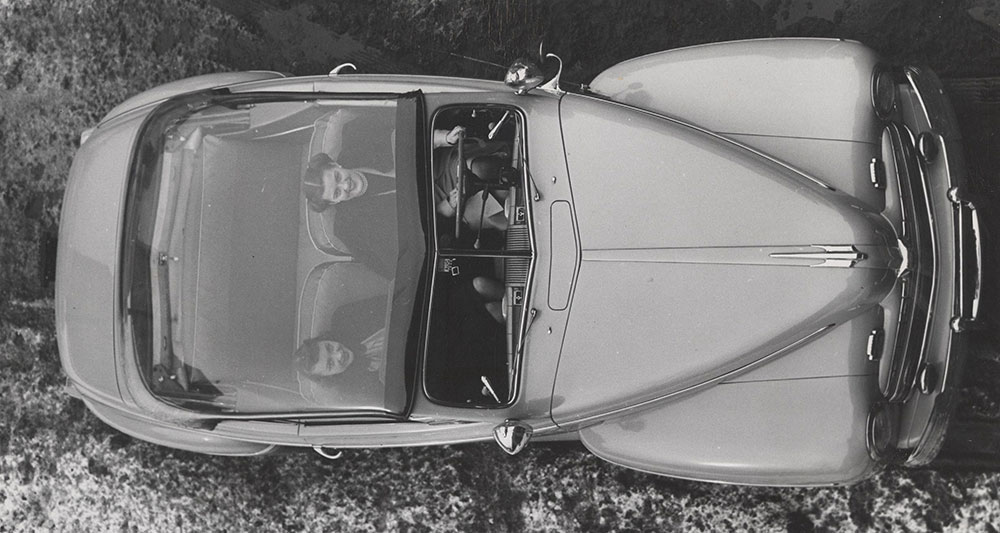
Built by the Fabri-Form company of Ohio, the company still seems to have a website, but all the copy is that lorem ipsum greeked text, so I’m not sure how great a source of information it is. The company seems to have been formed in 1943, so it wasn’t especially old by the time Ford started to source plexiglass tops from them just after the war. It’s likely that the company got their experience forming plexiglass dome-like shapes for aircraft during the war.

Look at those delighted people in there, enjoying all of the visual delight of a convertible without having to deal with all that pesky weather or wind.

The windows still have frames, but beyond that, look at that glorious unbroken view of the outside! Or, in this particular picture, the inside of the building. But you get the idea.

Speaking of inside, I’d just like to point out how much the heater in this car looks like an appliance of some sort, like a tiny refrigerator or something. So many little doors and flaps!

Since I’ve already gotten off track and started talking about details, let’s enjoy a look at the taillight setup on this ’46 Ford. The taillights aren’t integrated into the fenders, instead being proud wide units that jut out from the fender and are adorned with a rounded chrome rim and a little fork of chrome on top.
The lens has an integrated reflector and one of those inset blue jewels for that “blue dot” look, which was likely an aftermarket addition. One day I’ll try and dig into the history of the whole blue dot thing, because I’ve always found it curious.
Oh, and look at that huge reversing lamp! That thing is sweet. Think how well you could dispel the darkness behind you with that baby!

Back to that plexi bubble top, though; not many of these were sold, because, while conceptually cool, they were thermally quite hot, and in a car with no air conditioning, driving something like this in an LA summer would be like driving around in a greenhouse. And, since plants tend not to be liquid enough to afford cars, they didn’t sell so well.
Still, I think they’re pretty fascinating, and it was a treat to see this one in person!


