

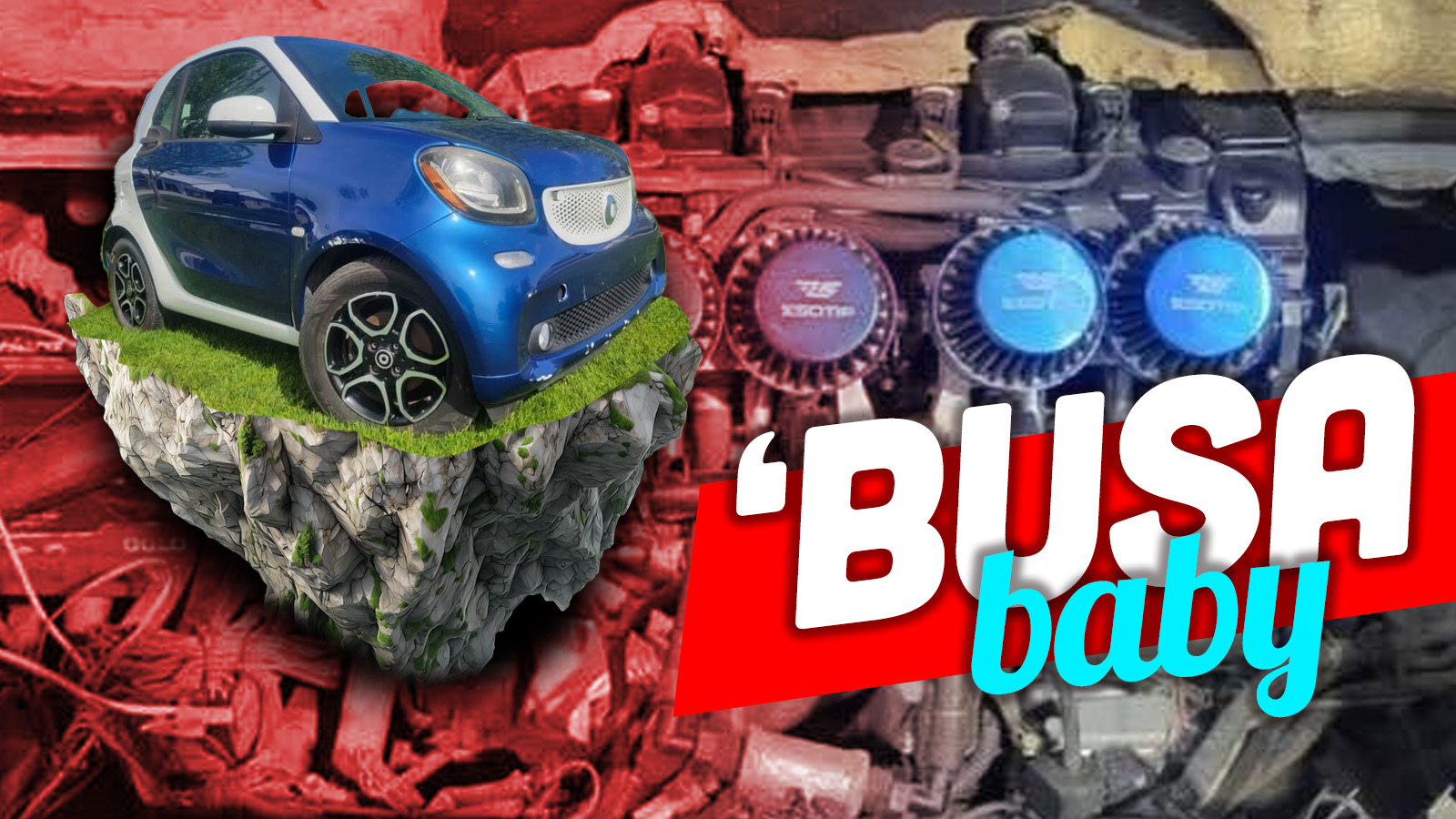
The Smart Fortwo is not usually a car that Americans think of fondly. Most Americans didn’t really see the point in buying a two-seat city car with a controversial transmission. But I think I found a Smart that a whole lot of people would want to play around with. This 2016 Smart Fortwo sports the entire drivetrain from a 2012 Suzuki GSX 1300R Hayabusa. That means a whopping 194 horsepower, or well more than double the 89 ponies that this car shipped with when new. It’s also only $5,000, which is almost “screw it” money. There’s a reason why it’s so cheap, but you might want this so much you might not care.
The Smart Fortwo left the American market in 2019 not with a bang, but with a whimper. Smart was successful in America for only a year, 2008, and all sorts of efforts were tried to pump up sales that ultimately faltered. In fairness to the little car, nearly every other city car eventually failed in America, too. Have you checked the sales of the Fiat 500e, lately? They’re pretty sad.


One complaint from reviewers and the buying public was that the American market Smarts were slow. I mean, until 2016, they were measurably slower than a Toyota Prius. But our friends in Europe had already figured out the solution to that. If you strap a high-powered motorcycle engine into a Smart, you can get a car that burns rubber, does Cheerios instead of donuts, and goes fast enough to make your heart skip a beat. Just watch this:
Smart Hayabusa conversions are pretty rare in America, so my heart stopped when I opened up Facebook and saw this little 2016 for sale. It’s an honest “Smartbusa” or “Smartuki” conversion, and I almost bought it the second I saw the listing.
A Weird Marriage
The idea of boosting a Smart with a motorcycle engine is actually old news. Skip across the Atlantic, and you’ll find that Europeans have been obsessed with making Smarts faster since the early 2000s.
One of the early companies to embark on the challenge of making a motorcycle-powered Smart was Z Cars LTD. in the United Kingdom. Z Cars was the workshop of grass-track racer Chris Allanson, and his whole deal was mounting bike engines in Minis and kit cars. Chris would branch out into Smarts at the request of Pete Ballantine, who wanted to soup up his MCC Smart City Coupe (the Fortwo’s former name). The moto-engine Smart project was such a smashing success that Chris put a kit into production and distributed it under Smarts-R-Us, which was then a premier Smart tuner.
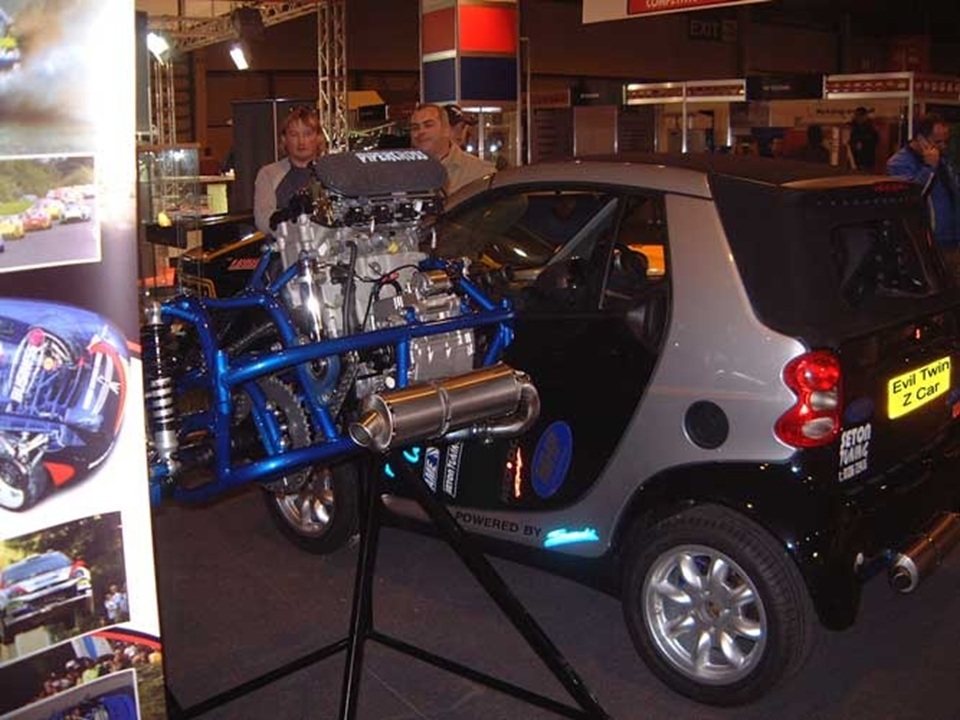
The “Evil Twin Z Cars,” as they were called, featured the heart from a Suzuki GSX-R1000. This engine was cranked up to 180 HP, and Z Cars promised a 60 mph acceleration in under six seconds and a top speed of 120 mph. In those days, a stock gasoline-powered Smart took as long as 15 seconds to reach 60 mph, so the gains advertised by Z Cars were insane.
The Evil Twin Z Cars featured the bike engine and transmission built into its own custom-fabricated engine cradle and subframe. When installed, the Smart looked stock. But the cars weren’t great at hiding their firepower, as it’s hard to miss the sound of a sportbike emanating from a car. The neat part was that, because the Smart Roadster used the Smart Fortwo’s platform, the Evil Twin kit was available for Smart’s short-lived sports car, too. Z Cars even figured out the problem with the donor motorcycle drivetrain not having a reverse gear, and designed a reverse gear just for the kit.
It’s unclear if Z Cars invented the motorcycle-powered Smart, but it certainly was one of the major players in popularizing the concept. Soon enough, all sorts of these projects appeared all over the web.
The addiction even reached America. Smart launched in America in 2008, and it was only a year later when Michigan-based fabricator Matt Boesch turned a Fortwo into a pocket rocket with a bike engine kit. Boesch planned to sell a kit, too, but sadly, his plan didn’t work out, and he built only one car, the iconic SmartBusa.
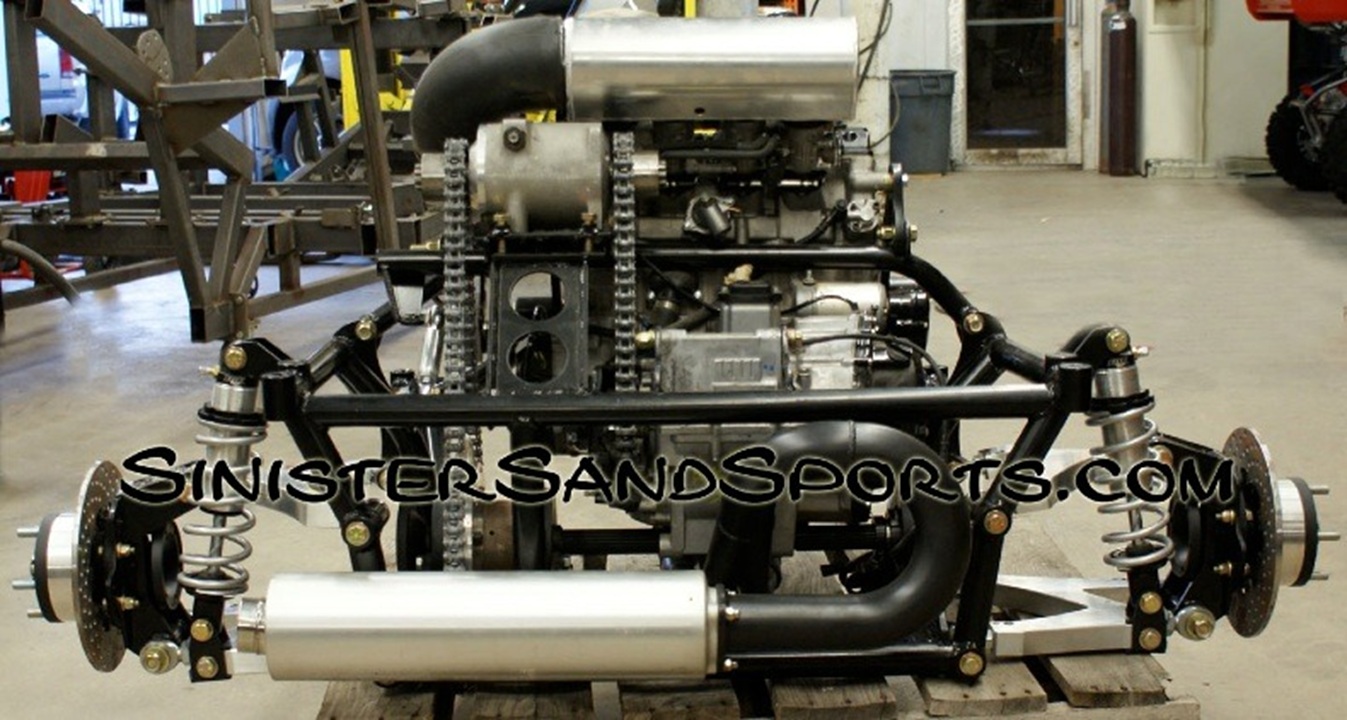
To my knowledge, there’s only one company in America that sells a Smart Hayabusa kit, Sinister Sand Sports, and that company’s kit will cost you $22,999 for most of the major parts that you’ll need to create your own Smart Hayabusa. However, you’re still left with actually putting it together.
It seems that most builders just do their own concoction. That’s what you’re getting today with this build.
This Smart Hayabusa

The seller, Cole, started with an interesting donor car. The body is a 2016 Smart Fortwo Prime. I have never seen a third-generation Fortwo given a motorcycle engine treatment before. These cars tend to be more expensive than older Fortwos, and are actually decently quick from the factory thanks to their turbocharged 89 HP engines and DCTs.
This car started life as a Prime trim level. This was one of the top trim levels in America, and featured an interior with leather and heated seats. In other words, this was a really nice car to turn into a little hot rod.
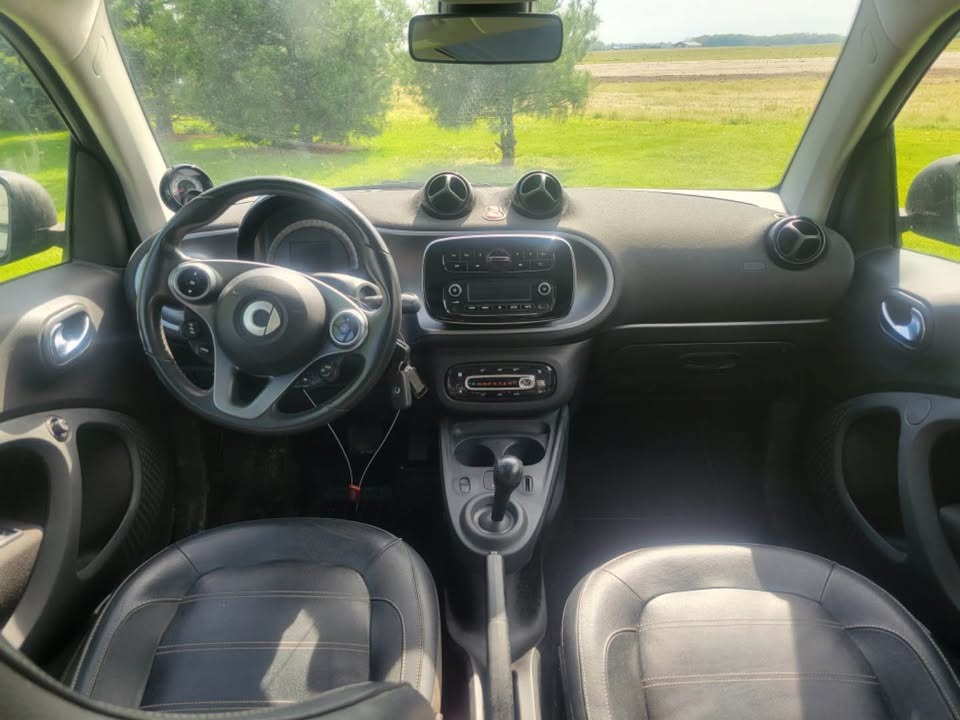
I’ve been on a nationwide hunt for a Smart with a manual transmission for under $6,000. Yes, some Smarts came with an honest three-pedal manual transmission! Manual Smarts are a rare breed in America, as they were sold in only 2016 and 2017, and an overwhelming majority of buyers got the automatic. By my count, there are maybe a dozen for sale in America right now. Many of them are over $10,000, and most of the others are too expensive in my opinion. Given the time these cars have been on the market, I don’t think my analysis is that far off.
Anyway, during the weekend, I found another manual for sale, and this one was in Indiana. The twist was that this is no normal Smart, as it has the engine from a 2012 Suzuki GSX 1300R Hayabusa. I reached out to the seller before I could even catch my breath.
He told me that he custom-built the car, fabricating a custom engine cradle out of steel square tubing, and mounting up the bike’s transmission.
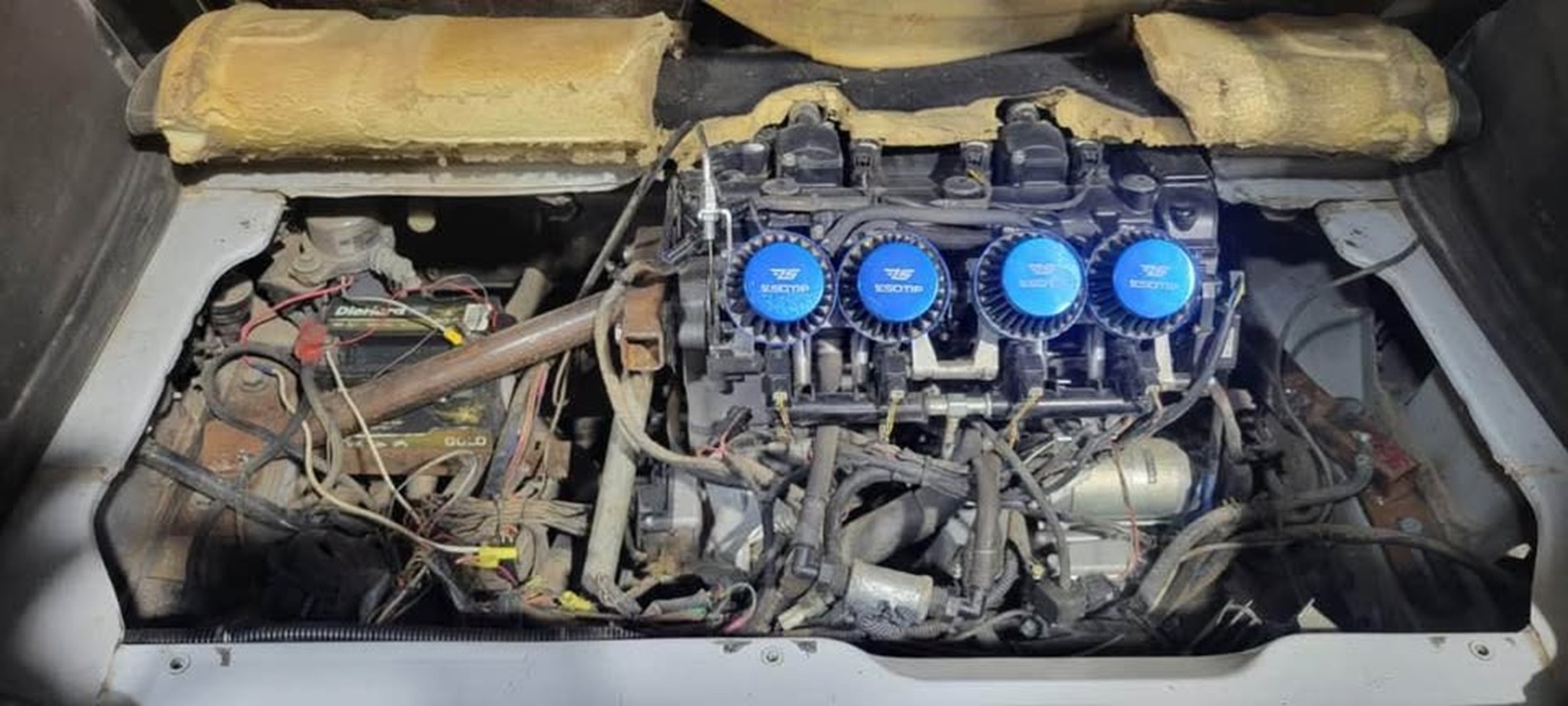
In our short conversation, the seller sent me this photo. It looks like his custom engine cradle is shored up using a modified version of the vehicle’s factory rear crash bar. The photos also suggest that he’s had to do a lot of cutting of the vehicle’s Tridion Safety Cell (the unibody) to fit the bike engine in there.
As for the motorcycle engine, the 2012 Suzuki GSX 1300R Hayabusa. Official specifications are as high as 194 horsepower and 115 lb-ft of torque. U.S. magazines have found that the ‘Zuki makes about 170 HP at the rear wheel. The Smart came stock with a 0.9-liter inline-three rated for 89 HP and 100 lb-ft of torque. So, the bike has double the horsepower, but not much more torque. This has been more or less the case with every Smart Hayabusa build.
One of the benefits of using a donor car from the newest Smart generation is that these newer cars are wider. A second-generation Smart — that’s 2008 to 2015 for Americans — has a track width of 50.5 inches up front and 54.5 inches in the rear. The third gens have a track width of 57.8 inches and 56.3 inches, respectively. A lot of Smart Hayabusa builders like to widen their cars by at least a few inches, and, in theory, you might get away with not doing that here.
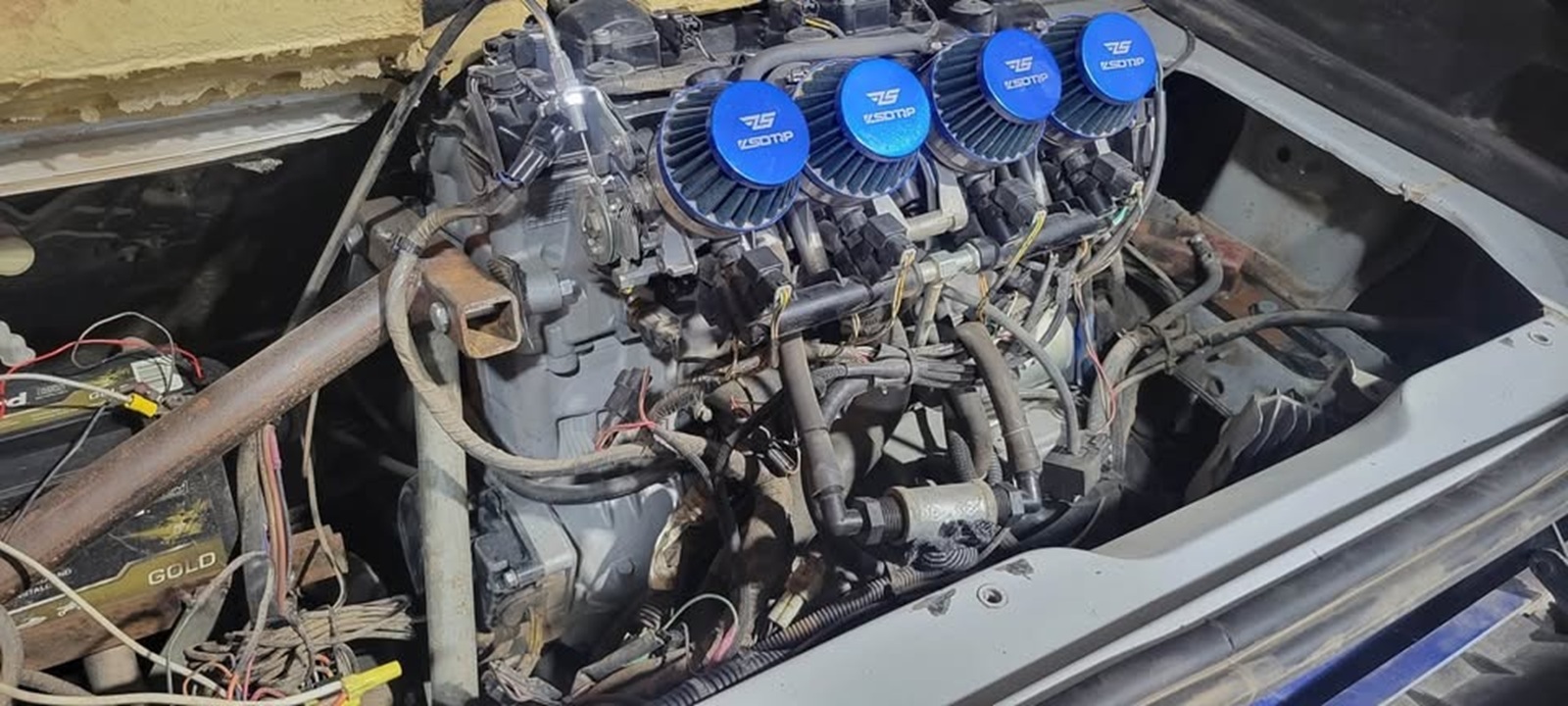
That’s all in theory, anyway, because now I must get to the bad parts.
The Possible Downsides Of ‘Busa Conversions
The seller told me that the engine runs great and the car is stupid fun and fast. However, the engine has a knack for twisting driveshafts. I asked the seller quite bluntly if the car would make the three-hour drive from Indiana back to my home in Illinois. The seller told me, quote: “No way! I didn’t do a very good job on the drive system.” I adore brutal honesty like that. He could have just told me it’ll make it, took my money, and then let me find out for myself.
So, at minimum, you’ll have to find and rectify the problems with this build.
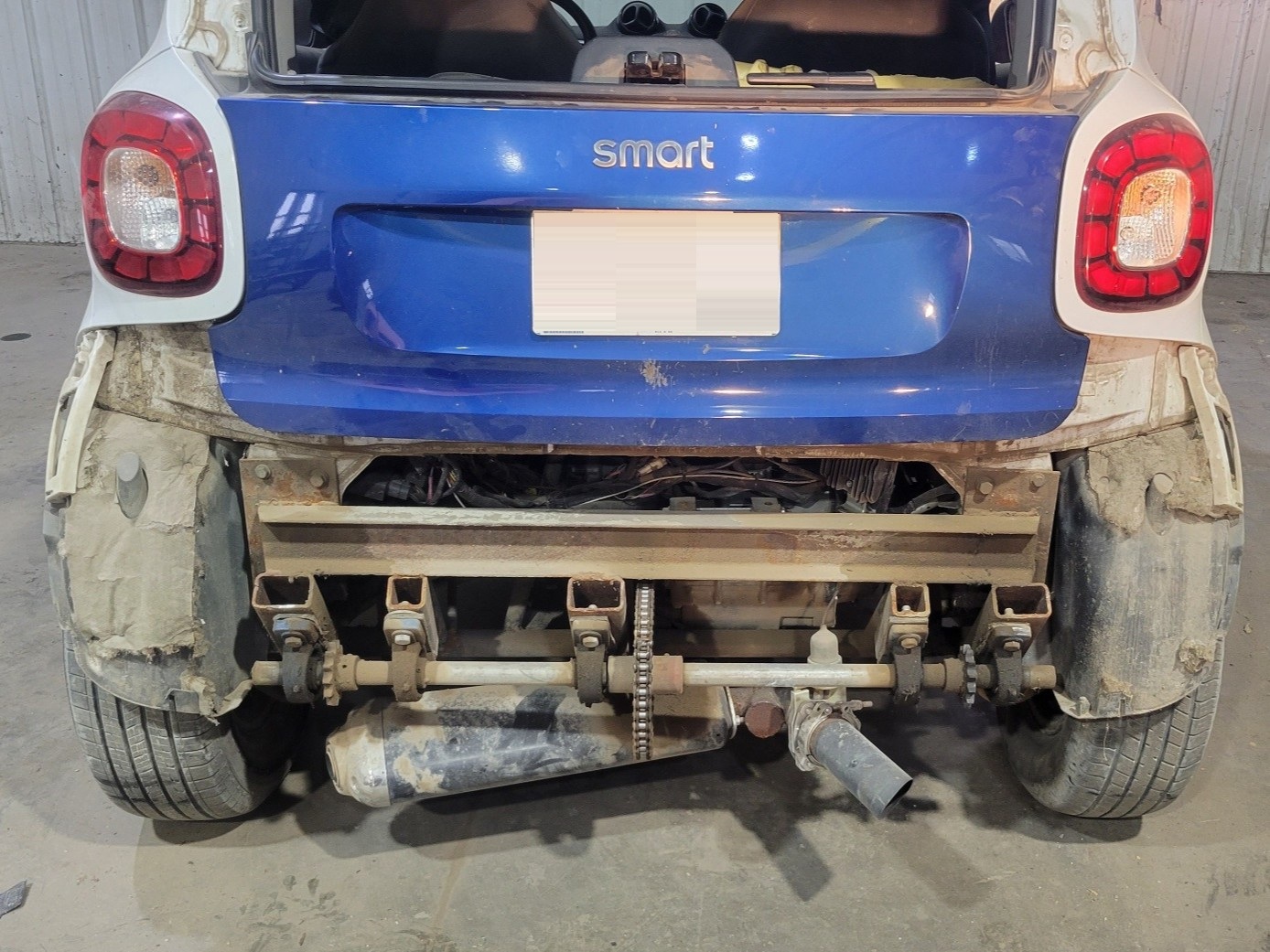
Then you’ll have to deal with a bunch of potential unknowns. In my experience from nearly two decades in the Smart community, one of the most common reported issues with Hayabusa builds is that these cars actually suck at doing anything other than burnouts, drifts, Cheerios, and drag races.
Some of this is because, depending on the quality of the build, you may have to slip the clutch a lot or even just dump the clutch at a high RPM in order to get the car moving without stalling. But there’s more to it, too, like the fact that the interior is going to be loud from the bike engine right behind your ears. Also, you probably are not going to have air-conditioning or heat, either. Oh, and if something breaks, you’re entirely on your own for fixing it. Here’s another glorious video from the past:
You should also consider that a 2012 Hayabusa weighs 573 pounds wet. A 2016 Smart weighs 1,984 pounds. Even when you subtract the engine, the motorcycle drivetrain has to move more than a thousand pounds more than it was designed to. The engine is up to the task, sure, but what about the rest of it? As the seller readily admitted to me, his build constantly pretzels driveshafts.
Then there’s the fact that you’ve melded a motorcycle powertrain with a car, which means that you now have a sequential transmission, and maybe no reverse gear. Of course, given the metal cut out to get everything to fit, there’s also no knowing what would happen if someone rear-ended you.
A lot of Smart builders are moving away from motorcycle engines for these reasons and more. Instead, a lot of folks are outfitting their Smarts with Honda K engines, GM Ecotec engines, and even Toyota engines. By using car engines and car transmissions, those Smarts achieve better horsepower numbers, better torque, and better drivability.
Still Fun, Probably
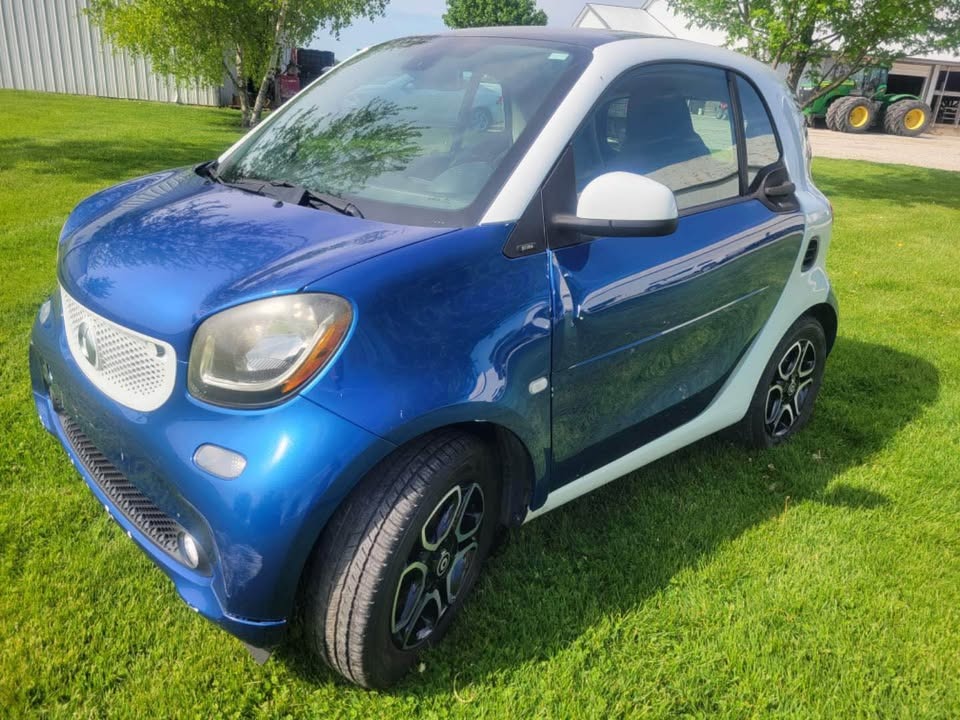
But for many, the Hayabusa conversion is still alluring. Honestly, it is for me, too, which is why I tried to buy this one! There’s just something that sounds so fun about a Smart that sounds like a Suzuki and spends most of its time converting tires into smoke. But, honestly, I know my limits. I don’t have the tools, the skills, or the time to reengineer someone else’s project. So, with a heavy heart, I passed on this one.
Maybe you’re crazier or better-skilled than I am. That’s why I say this thing is the best and dumbest way to spend $5,000. It’s a car that can’t even carry its own weight without nuking driveshafts, and one that the builder says isn’t even put together well enough to make a basic highway drive. That’s so bad. But it’s also so good, in a silly, sort of irresistible way. This car is sort of like the intrusive thoughts in my brain in physical form.
But I am not the buyer for this car. If you think you are, contact the seller and pick the car up in Wakarusa, Indiana. Once you sort out the driveshaft situation, please let me drive it! Otherwise, if you’re reading this and you have a wildly souped-up Smart, contact me at mercedes@theautopian.com. I want to drive it!


That was some Ken Block level hooning in the first video. Now I will go back and read the rest of the article.
The rest of the article was a good read, but no, I will not be flying to South Bend, Indiana, genuflecting before Touchdown Jesus and departing with $5,000 less in my wallet.
I hadn’t thought about the lack of a reverse gear until you mentioned it. That seems like kind of a big problem. I had a Gold Wing that did have a reverse gear but driven by the starter motor. And given its weight, it was appreciated.
Anyway, like almost always, the rabbit holes you go down are fun to read about.
Motorcycle gearing doesn’t play well with low-end torque.
First gear on a Hayabusa goes past 70mph/120kmh and has very tight gear spacing. It’s transmission is likely up to task for abuse, but the gearing is entirely inappropriate for transplanting into a car – even if you used the chain-drive to step it down.
AUGGGGGH! Now I’m wondering about an engine swap, Hayabusa or otherwise, for my neglected little Suzuki SX4. If I wasn’t broke, I fear my lack of wrenching knowledge wouldn’t stop me from attempting it.
I went to the Grassroots Motorsports $2K Challenge in 2017, and someone had an old Subaru van that had a Busa swap. I had never heard of this or what the engine sounded like. It sounded brutally quick even when it wasn’t moving. I remember he had clutch issues trying to get it going on it’s own.
It still looked/sounded fun. This thing is almost 4hrs away. Good.
My dream motor in a car would be a flat 6 goldwing motor. It would not be wild but it would be cool in something.
JT Built It on Youtube has a couple videos on his Goldwing Beetle build and it’s awesome!
I remember seeing that one thanks for reminding me.
in a Subaru?
It really is an amazing engine. I had an ’06 and above 5 mph, it was a great bike. (Below that, it did feel heavy.)
Sounded like a 911 when you twisted the grip. The ~6,000 rpm fuel cutoff was a bummer. But I’m sure Honda had its reasons. Now, I ride one of their ADV 160s. It’s fun, light, economical (88 mpg average so far) and can do 70 mph, given enough time and level roadway. It doesn’t ride as smoothly over bad pavement as my old V-Strom. That thing actually handled pavement imperfections better than the Goldwing. Both were a lot of fun. But so is the scooter. Fun is where you find it.
Do all the Busa builds keep the chain drive like this one? It looks like it eliminates any differential so any turns, especially tight ones, are going to bind up that chain shaft.
For $22k+ from an engineered kit I’d hope there was a better power transfer solution then the one shown here!
It reminded me of the little homebrew go-cart my buddy had as kids. A lot of those just drive a single wheel but this one had a solid steel axle shaft connecting both rear wheels. It would regularly toss the drive chain, but that was no big deal since mainly we were just using it to drift around the cul-de-sac.
The real issue was when we caught the old cushioned kitchen chair that acted as the driver’s seat on fire from the hot exhaust.
A go kart drive system is exactly what I envisioned too. Makes sense with the chain, but hardly makes it a usable vehicle on the road.
I would have to look at it, but like most of us that have heard of the ability to fit one of those in these cars, I always want one, just to say I had one.
Everyone I ever actually saw had the motor in the passenger seat space. this seemed off to me always, but there is not much space otherwise, I am sure if a K motor can fit behind the seats or something that is also why that is a better option.
However a 1340 CC screaming Japanese crotch rocket 4 is probably viscerally more satisfying.
My question is, can we import the roadsters from Canada? Or do I still have to wait a year and change to get this one from Canada? https://www.classic.com/veh/2003-smart-roadster-wme4523341l014112-n8j9VRp/
And does it have the room in the rear to fit a Hayabusa motor there instead.
the Honda k series are pretty rev happy, and high redline engines too.
A K24/K20 swap might be the small car version of an LS swap, but it’s common because it make sense.
I’ve always wanted to build a motorcycle engined car.
Me too. Cyclekarts look like fun, but I want a cycleCAR.
Hard pass for me. Short wheelbase, too much power, what could go wrong. I like Superfast Matt’s solution to the Smart problem.
A quick check of Ebay tells me that the Hyabusa engine alone is worth $3k+. If you like solving problems that other people have created, this seems like a good deal.
BUY IT!!! Then rip it around the parking lot for 6 mos and sell it!
Superfast Matt broke the record by jumping his Smartcar and blowing it up with dynamite. Best use of a Smartcar I’ve seen.
https://www.youtube.com/watch?v=ztb6SsxJOwI
That’s awesome. Way too long but easily skipped to the exciting bits. Thanks for sharing!
I think the sheer impracticality and uselessness as transportation is a big point in its favor. That way you will be close to home when it breaks, and if you have a mishap breaking the scenery, the folks who come to collect you won’t be strangers.
Just think of how much more trouble it would be to do that a couple hundred miles from home.
I would definitely buy this if I were not about to move from one coast to the other. On the other hand the new place will be about 15 miles from Lime Rock, so there’s that.
Good thing for the builder’s honesty. If not for that, I would be suspicious that this thing could be what is known in spycraft as a honeytrap, specifically targeted to compromise one particular automotive journalist.
Now I’m picturing people leaving out Smart cars to catch Mercedes the same way cardboard boxes catch housecats.
I don’t have the time or the space, otherwise this would be highly tempting. Mid-engined, lightweight car that can readily destroy its tires and lose traction under hard accelerations? That is my kind of car. I’d rather have the Smart Roadster-Coupe, but still this is awesome.
It’s pretty small, you might have the space. Finding time to waste on it would be the key.
Still trying to get time to get my custom velomobile converted into an AWD quad. A 100-120 lb vehicle with PMDC hub motors in each front wheel and a PMDC mid drive motor plus pedal drivetrain sending power through a positrac differential to the rear wheels, each motor independently controlled with its own controller with slip detection, with a combined 30+ horsepower and 300+ lb-ft torque, in an aerodynamic vehicle designed to only need 6 horsepower at the wheels to hold 100 mph on flat ground.
It will still be functional as a “bicycle” with the electric drive system disabled. It will be pedalable to 35+ mph on flat ground without electric assistance in a sprint and maintain 20+ mph rolling averages ridden by a fit rider.
Using the motors, I want to bait Hellcats with it.
indeed, that would be hilarious. Hell, the little gets plenty of people honking at a stop light because she is on here bike waiting for the light as instructed, but then leaves them slack jawed when she is pushing 30 while pedalling before she gets through the intersection. Just an old cheap China Electrohub on a freewheeler is surprisingly effective.