

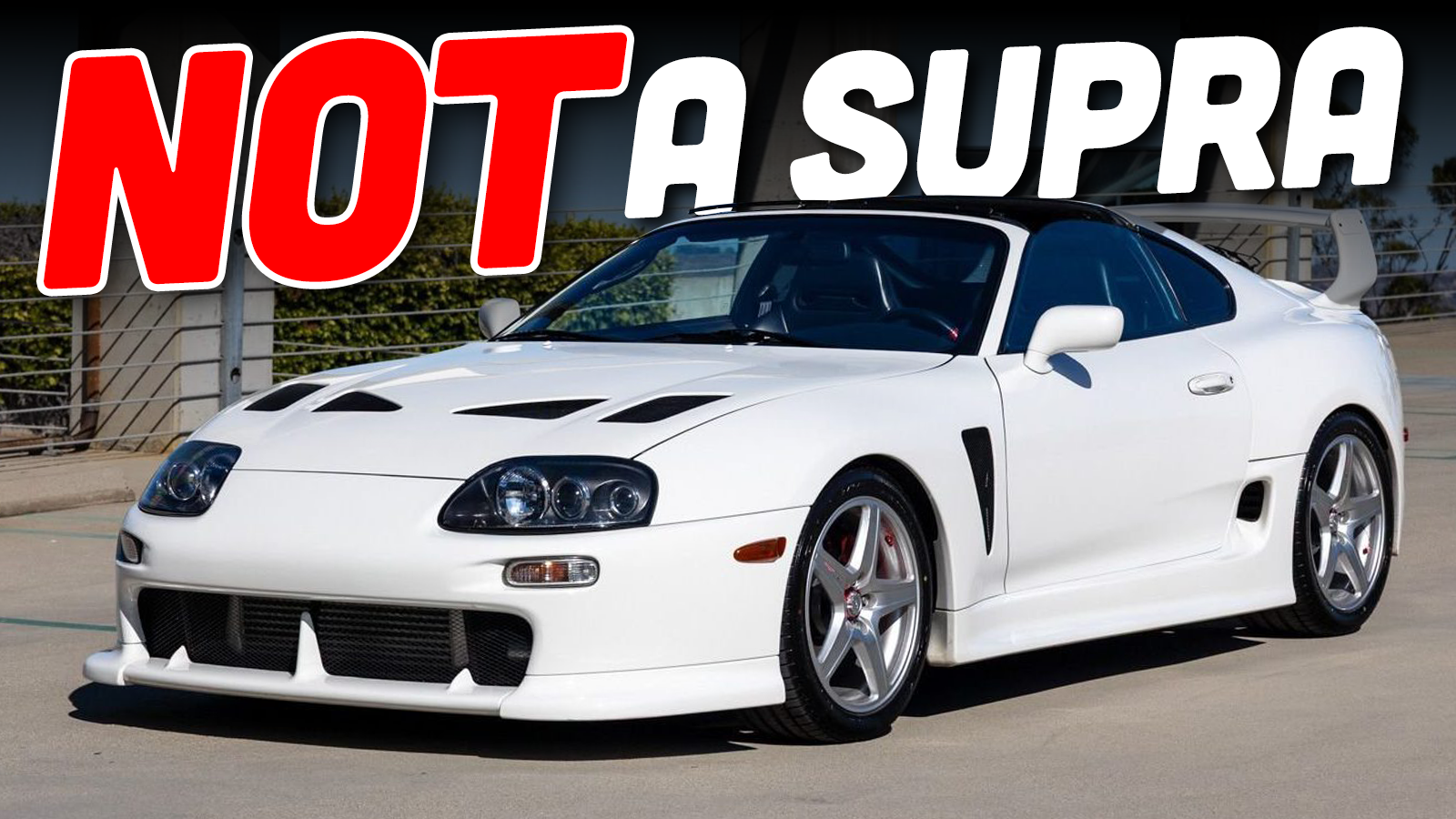
Broad Arrow is bringing a jewel of Japanese automotive culture to its The Quail Auction next month, with an ultra-rare factory-tuned special that could break the record for a Mk4 Supra in a public sale – even if it isn’t technically a Toyota Supra at all.
Although the car does look quite a lot like a Mk4 Supra, it’s actually a TRD 3000GT built by Toyota’s in-house tuning department of the day – Toyota Racing Development – partly as a promotional machine to highlight the Supra’s official factory entry into the new All Japan Grand Touring Championship (JGTC).


It wasn’t something specifically required by any homologation rules, but Toyota went ahead with creating a version of the Supra that looked like it could pull off the road, get some stickers on, and head right out onto the track. The TRD 3000GT made its debut at the Tokyo Auto Salon in January 1994, ahead of that first season later the same year.

Although there are some physical differences between the factory-entered SARD Supra GT1 and the TRD 3000GT, the similarities are pretty clear. The road car featured the same front end as the race car, with the enhanced splitter and dedicated ducting for a larger intercooler, radiator, and optional oil cooler.

TRD’s new bodywork gave the 3000GT wider arches – 60mm at the front, 50mm at the rear – to fit wider wheels, in a more flowing manner than the GT1’s bolt-on style, but the wheel wells were tied together with similar, squared-off side skirts, and both cars had a vent behind the front wheels.

At the back, the cars sported similar large wings, even if the race car’s was a bit taller and wider, although there was a rarely seen, optional, three-support “Type-R” item for the road car too. Then there’s that four-vented hood, which is a key part of the car’s unique look but has been widely copied – including by Toyota itself when it recreated the 3000GT on an A90 Supra for SEMA in 2019 – and found fame elsewhere…

Of course the road car kept its interior, with a few flourishes, and one area where the 3000GT wasn’t touched was the twin-turbocharged 2JZ-GTE. Officially, this still made the famous 276hp of the “gentleman’s agreement” era.
The car wasn’t a one-off either. TRD manufactured all of the components, so buyers could modify their own Supras to match, but there were also 35 examples planned as factory-built cars made by TRD itself at the Shibaura facility, with unique VINs to distinguish them from the regular Supras.

With most 3000GTs reportedly remaining in Japan, it’s not a car that makes it onto too many radars, especially given potential confusion with a Mitsubishi of the same name in certain markets. However, it did have a surprising star turn in a racing game.
The very first Gran Turismo title featured the TRD 3000GT, but you’d need to be extremely good at the game to ever own one, as it was only awarded to players who beat the gold standard lap time in every one of the “A” licence tests. It also appeared in the second game, where it was much easier to acquire as a possible prize for a regular race series.
It’s not entirely clear how many of the 35 were made, as shown by the TRD 3000GT under Broad Arrow. This was a car originally made as a US-market Aero Top and delivered to the California Environmental Engineering testing facility in Santa Ana in 1993.

It was somehow spotted by a Japanese tourist, who bought it and took it back to Japan – despite being a left-hand drive car – in 1994. Thereafter, in 2001, the owner took it to TRD for conversion to 3000GT spec, with the Supra becoming #21 and the only known US-origin example.

From there it moved to Europe in 2007, before making its way back home – the USA – earlier this year, having rolled up just over 33,000 miles across its two lives. It’s also received some period-typical upgrades that include gentle engine work to bump power to 500hp, Recaro seats, and a new audio center. But all the original TRD touches remain.

Broad Arrow’s estimate for this rarity is an eye-watering $500,000-$800,000, and that would comfortably set a record for a regular, roadgoing Supra at auction, which currently stands just over $200,000. There’s one Supra that sold for more, a stunt car from the first Fast & Furious movie – sporting the same four-vented hood – driven by Paul Walker in the film. It fetched $550,000 back in 2024. This TRD 3000GT could eclipse even that.
Top graphic image: Broad Arrow


“Broad Arrow’s estimate for this rarity is an eye-watering $500,000-$800,000, “
Crack pipe.
It’s just a Supra in drag.
SUPRA
SUPRA
SUPRA
Who’s gonna stop me from calling this a glorified Supra? Eh?
It’s just a lame, overpriced, glorified SUPRA SUPRA SUPRA.
Is this a regular US market Supra that someone brought to Japan to have a body kit added?
Ok Supra
Don’t call it a comeback. It’s been here for years.
Link
Just curious, how come nobody bores out JDM engines?
I assume Japanese engineering theory wasn’t as overbuilt or understressed as our truck-derived, abundance-focused American V8, but 2Js and RBs are notorious for holding a ton of power on stock blocks so there has to be SOME leeway for sleeving bigger pistons, right? I’d love to see how big the displacement goes.
People do, but it’s not really necessary for most applications. The RB28 and the SR22 are the first two examples that come to mind, but there are plenty of others too.
Japanese engineering traditionally has been all about making the most with the least and with utmost precision.
It’s a cultural thing which goes back to the 17th Century with the development of Karakui Ningyo (mechanical puppets)
It’s a mindset very much unlike American engineering.
Those are both turbocharged engines, so you’re on a different path to power. To increase power, increase the boost (and the engine’s ability to handle boost).
They’re also smaller engines with fewer cylinders. Overboring the cylinders doesn’t really add that much displacement. It will usually produce better results to increase boost instead.
2JZs and others are frequently bored in the US, but really only when you’ve run out of boost efficiency. I’ve only seen it in the drag racing world, where you’re well north 1000hp already.
Another aspect is Japanese engines historically aren’t designed with larger bore variants in mind unlike American truck blocks. 2JZs can only really support 87mm bores, plus slightly longer stroke, for a max displacement of 3.2-3.4 L on a factory block.
Similarly, you can’t gain much displacement with a 7.0L Vette LS7, it’s already near the limits of the block design.
Why would Toyota/TRD rename a Supra a Mitsubishi?
To confuse the Mitsubishi team on the racetrack. Of course Mitsubishi called the 3000GT the GTO in Japan, so they were not confused. But Pontiac was.
It’s a Supra 😛
At least it’s not a BMW LOL
No Supra was ever a BMW, they built one from a BMW model kit but they kitbashed the whole thing
I don’t think I understand the history of the car here. It sounds like you could buy all the parts and build it yourself from a pre-existing car, or Toyota built (or was only planning to build?) 35 at the factory with unique VINs.
But somehow this car was delivered in 1993 before the concept was even shown, then driven for a bit as a regular Supra before being converted to TRD 3000GT at the factory in 2001, but only as #21? So were there 14 other cars built after this one? And were the rest of the 34 built from cars that were brought back and just converted at the factory, or were there any that were built this way from the start? Did this one get a new VIN when it was swapped over?
It’s an awesome car, and it seems like there’s some interesting provenance here, but I don’t get it.
Nobody told me there was going to be a quiz.
*Insert confused math lady meme*
It’s murky but not an entirely unusual situation for Japan either, as NISMO built all of the R34 Z-Tunes – specifically not called a Skyline – from used examples of the Skyline GT-R V-Spec because production had ended three years earlier. NISMO bought back 20 cars from customers to do it, though the changes were a lot more in-depth.
To my understanding of it, all of the TRD 3000GTs were official conversions of customer cars too. I guess if they only reached 21 in seven years, uptake was slow but if I’m reading the price list right it would have been about $22,500 for the conversion…
I’ve never seen a finished example with the Type-R wing either, but the Type-S was adjustable to six positions and people like adjustable wings.
You will never convince me that fat 5-spoke aluminum wheels aren’t the best. To heck with all of the spindly black and machine faced garbage today.
Preach good sir, preach!
Nope. Deep dish snowflakes are the best wheels, but fat spokes are a very close second!
Im sorry, but this isn’t a Supra in the same way that guys used to argue their SRT4 wasn’t a Neon. Suuuuure looks like one to me..
“It’s a totally different car under the skin, brah!”
They ALL argued it, too haha!
Oh wow, core memory unlocked. I remember a guy on a forum who got real cross about “Dodge Neon SRT4” back in 2006/7!
I understand why Toyota is now using GR (or TGR sometimes, it’s all so confusing) instead of TRD on their racing programs and cars, as TRD will always unfortunately read as TuRD
But TRD still exist, there’s the TRD Pro trucks.
Yeah but only for the trucks, and they are coming out with the turd hammers soon too
My father ran over a turd with a lawnmower once, but he never hit one with a hammer.
it’s not difficult to think of the blade on a rotary lawnmower as a fan, so it’s not surprising the occasional turd would hit it.
Agreed, although when you hear that GR stands for “Gazoo Racing” it also elicits a bit of a chuckle.
Reminds me of one of the prehistoric-Jump-The-MegaShark moments in TV.
I wonder if there’s any association with the Great Gazoo character that debuted on The Flintstones back in 1965?