


If you’ve spent as much time hanging around in taillight bars as I have, I’m pretty sure you’ve encountered these two phrases: “vega’d” and “teecee’d.” They both mean pretty much the same thing, though the former term is more popular among older taillight enthusiasts, and the latter by the youths. The reason they both mean the same thing is because they reference the same deadly sin, a callous victory of perfidy over performance, of cheapness over quality, as expressed in two very different taillights. The common meaning for both terms is something like being lied to, perhaps “gaslit,” or sometimes just a lie in general. The terms come from the Chevy Vega and Scion tC, respectively. Let’s dig into why this is the case.
The reason these cars have lent their names to terms about lies or lying in the Taillight Community is pretty straightforward: both had taillights that, well, lied. Perhaps “lied” isn’t exactly the right word; these taillights were deceptive, let’s say. They both appeared to be things they actually weren’t, and in the case of one, the reason was pretty simple: cheapness. In the case of the other, it’s kind of a mystery.


Let’s start with the older car, the Chevy Vega. I’ve actually written about this before, how the Vega’s 1976 taillight redesign, which had such promise and hope with its amber rear indicators, proved to be a miserable fraud. Yes, the taillight lenses had amber sections that one would reasonably think were for the indicators, when in reality they were just inert dummy sections, without even a provision for a bulb:

Dear lord, that is just shameful. GM’s bean counters couldn’t even spring for two extra bulbs and sockets for the car, a decision they seem to have made well after the taillights were designed. There’s a reason these taillights became synonymous with lies!
Of course, it didn’t take long for most of the remaining Vegas to rust themselves off of the roads and highways, so for younger members of the taillight community, the reference to Vegas when talking about being “vega’d” just didn’t really click, with most of them never having even seen a Vega, let alone its lying rear indicators. The concept of the term was good, but it really needed a new point of reference.
Enter the Scion tC.
Yes, Scion stepped up here, with their attractive little sporty coupé. Built from 2004 to 2016, these appealing little cars were certainly well-known in the Taillight Community, and they had a trait similar to the Vega: a lying taillight.
Now, in the case of the tC, it was just one, not both lights, but that was enough to make the term work. The tC’s lie was in its right-side reverse lamp:
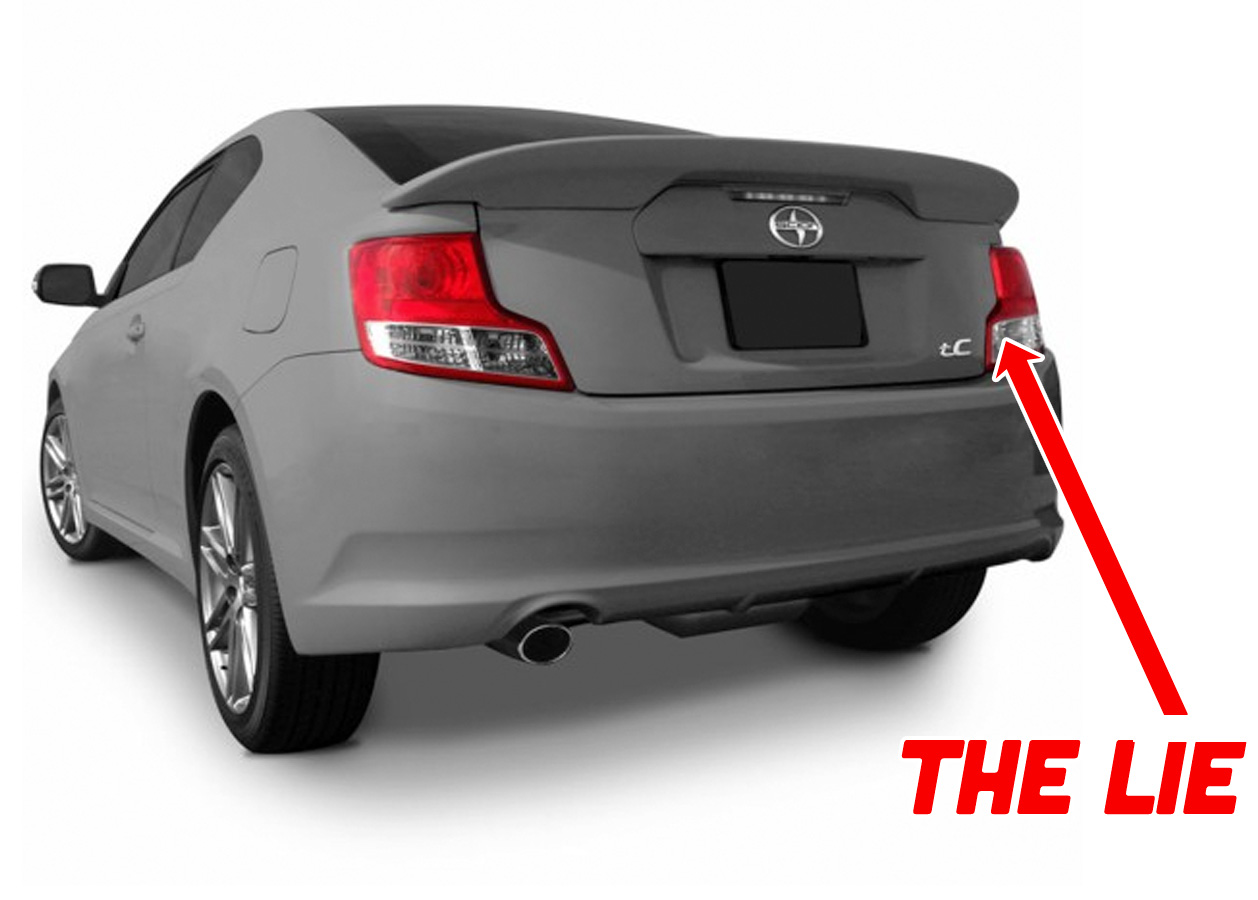
Yes, even though it looked from the outside just like the left side, for some reason Scion decided to cheap out and not include a bulb or socket in the right side reverse light housing. If you don’t believe me or the various confused owners on forums wondering where the hell their other back-up light is, perhaps you’ll believe Scion’s own owner’s manual:
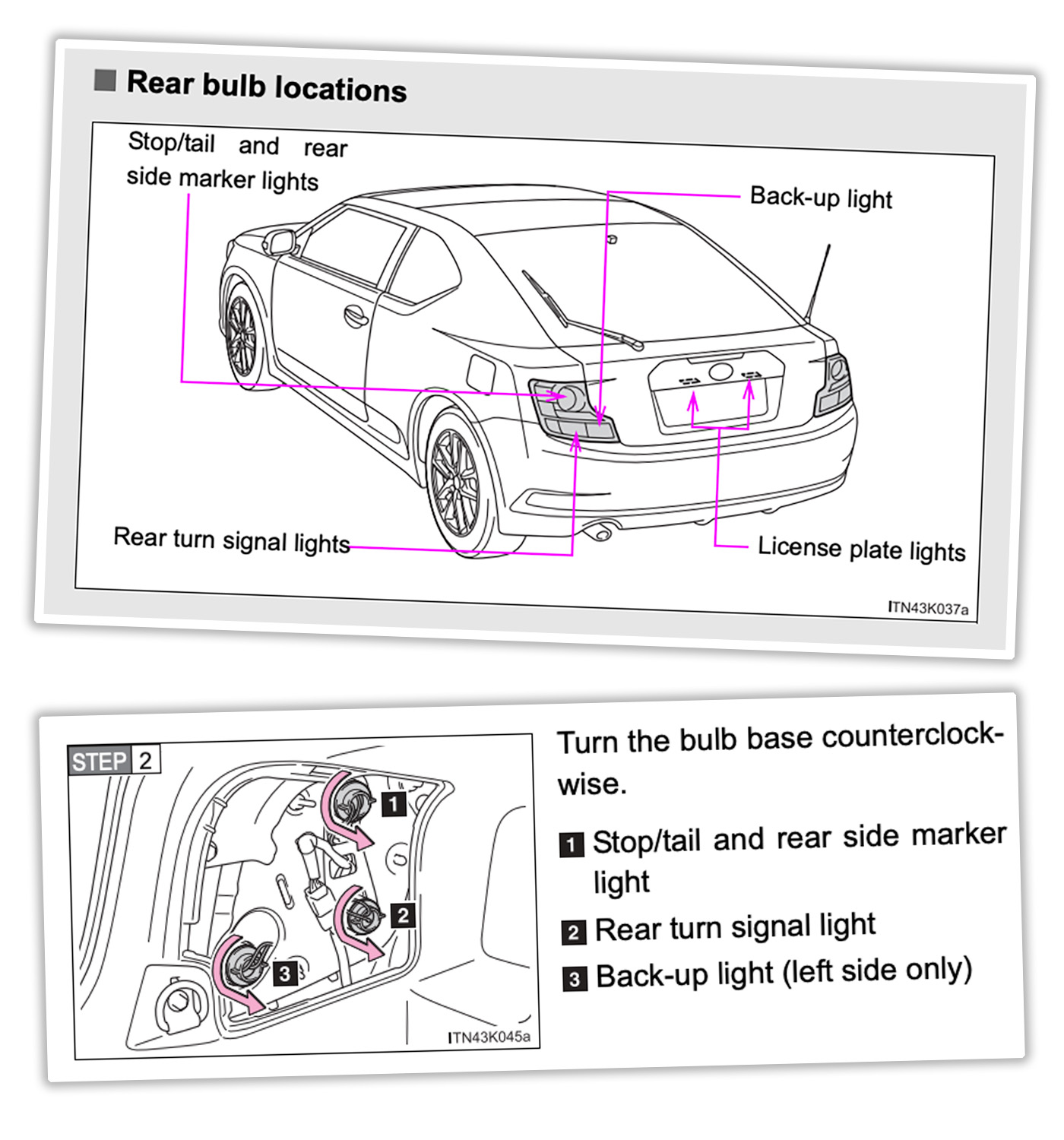
Look at that: note the pointedly singular use of “light” in the upper diagram, then the full-on (if parenthetical) admission of “(left side only)” gives away the whole game. Just one back-up light. Now, this is actually perfectly legal under US law, as the Federal Motor Vehicle Safety Standards No. 108 only requires one white-light reverse/backup lamp:

…and Scion had availed themselves to this mono-lamp requirement before, on the second-gen xB, though they did it then with a great deal more honesty:
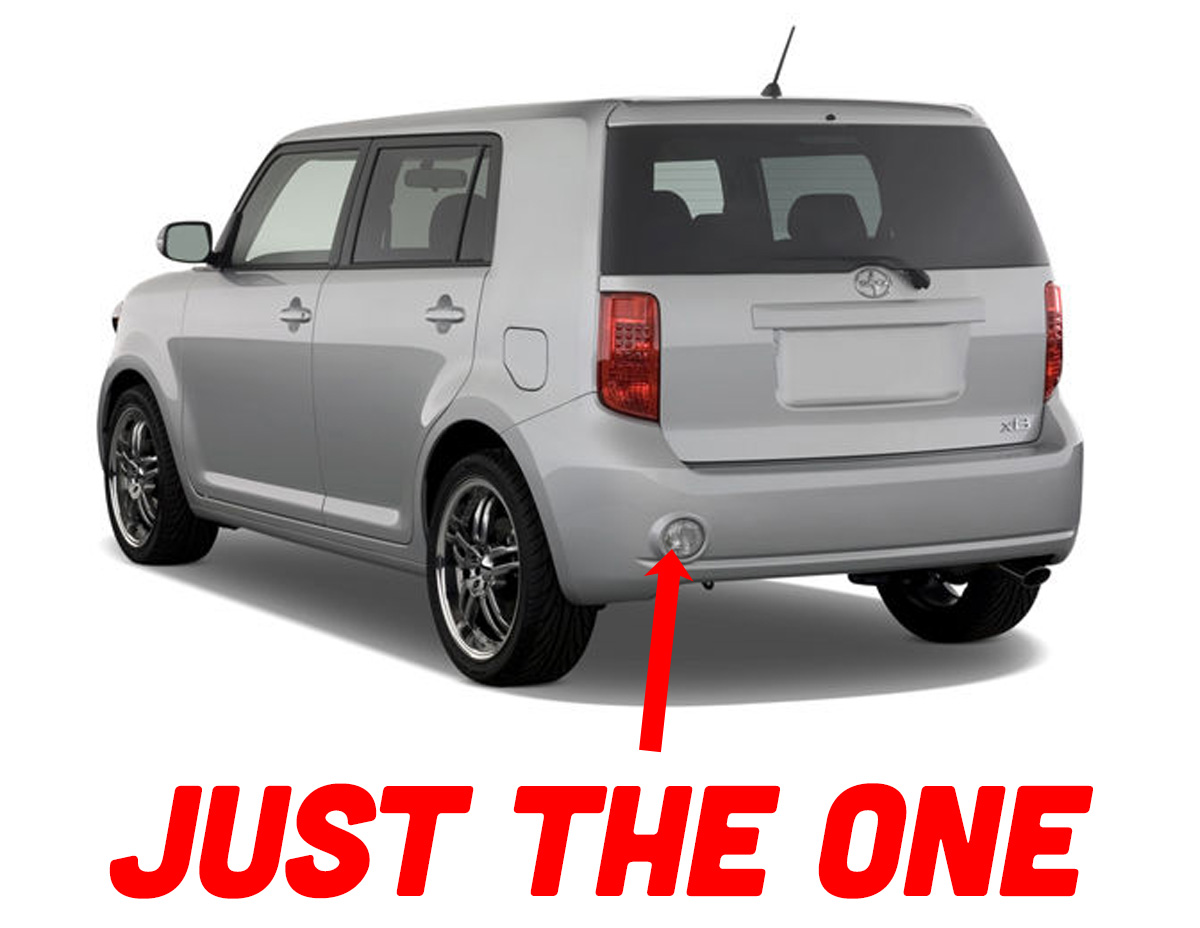
See, at least with the xB, there’s no attempt at obfuscation; it’s very clearly just one functional reverse lamp, and there are no confusing other clear sections of taillight that look like they should be reverse lamps, but aren’t, as is the case with the tC.
So the tC’s left taillight is absolutely a liar. I just can’t figure out why.
Was this all just cost-savings? If so, even that doesn’t make sense. There were cheaper Toyotas of the era that somehow managed to have two reverse lights; even the cheapest Scion at the time, the xD, managed to be generous enough to allow for a lavish two bulbs when reversing. So why did the tC only get one? Especially when the taillights looked like they were designed to have one per side?
I thought maybe in European markets, that right side section was used for a rear fog lamp, fitted with a high-intensity red bulb? Maybe, though I’ve yet to confirm that. And, later updates of the tC did include what looked to be a central rear foglamp lens:
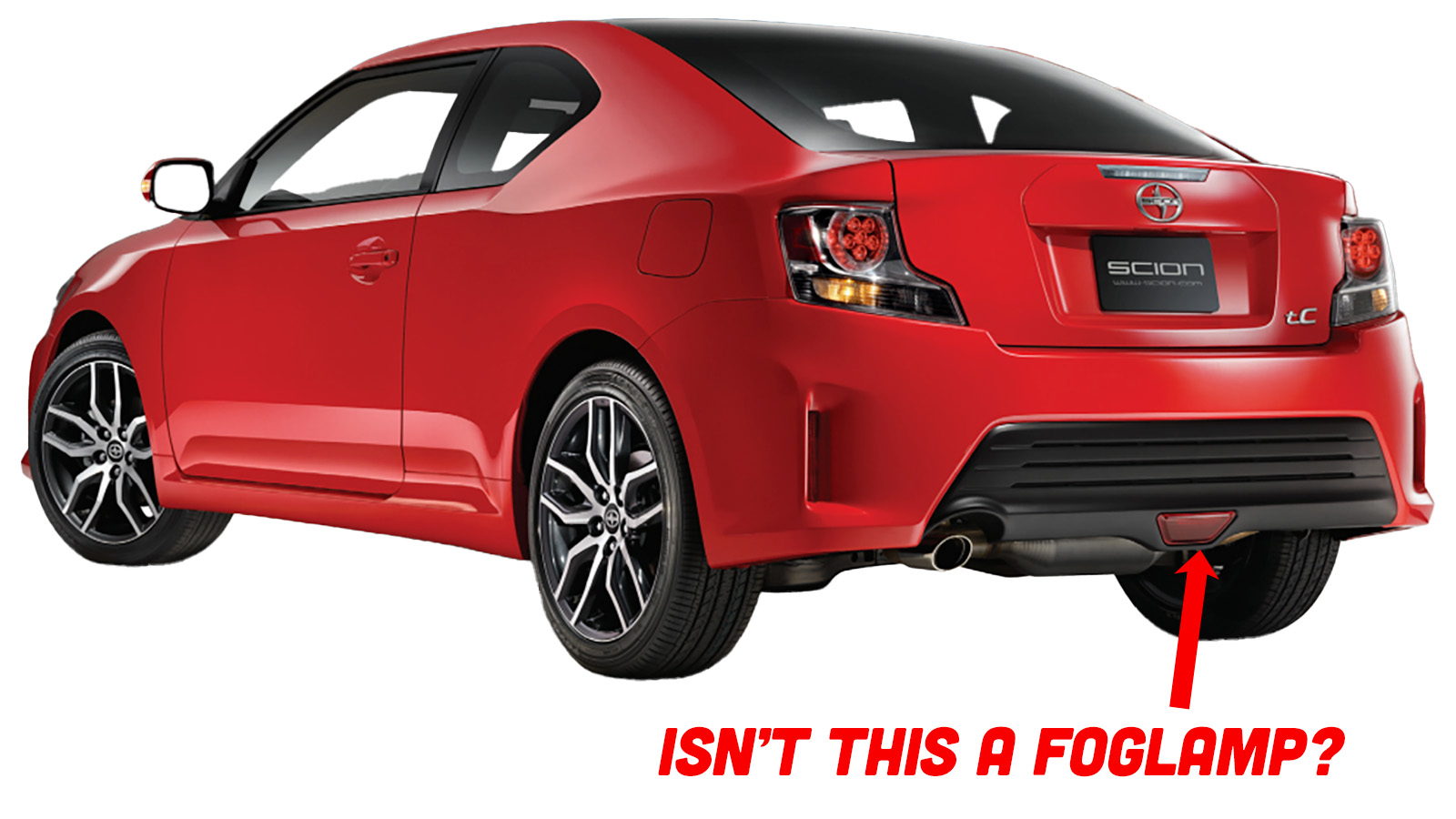
…but, from what I have seen online, at least in America this was just a lens and plastic housing (not even a retroreflector) that could have had a bulb socket and bulb, but didn’t. There are instructions on how to actually make it functional, though, if you’re interested.
I guess this will just have to remain one of the great taillight mysteries, but I do think that the Scion tC’s fate as having lying taillights is well-established, and we’ll be hearing about how untrustworthy people have been teeceeing people for years to come.
That’s what you get for being so cheap with your taillights, Toyota.


“I thought maybe in European markets, that right side section was used for a rear fog lamp, fitted with a high-intensity red bulb?”
Yes, however, the rear red fog lamp has to be on the same side as driver’s like this VW Polo taillamps. It is reversed for the left-hand rule-of-road in the UK and elsewhere.
This Vega wasn’t only one. Dodge Spirit is also guilty party, too, using the amber stripe. It’s matter of saving a few cents on separate cables for amber turn signal indicators per car. Changing colour to red would require the NHTSA to approve, which added cost and time…
I had a 1st gen xB back around 2008 until 2013, loved that thing. Met a bunch of nice people because of it at a Quaker Steak dinner when a lady mentioned there was an import meet that night & a bunch of Scion people. I’m still friends with most of them today.
But I remember someone bought an early 2nd gen with that backup light and said he couldn’t see $^&@. Didn’t know about eh tC issue.
To my knowledge, the Scion tC was never available in Europe, so the foglight theory wouldn’t hold.
I think you mean right taillight. Right? The right has it all wrong.
I had a Ford Focus which had just one reversing lamp, and it was mounted low down under the rear bumper
https://ultimatestyling.co.uk/car-parts-uk/wp-content/uploads/2022/06/ford-focus-passenger-rear-reverse-light.jpg
(It’s on the left because it was a RHD car, I’m in the UK)
Reversing that thing at night, in the rain, was a fucking nightmare.
Hey car makers! The reversing light is also there so that the driver can see things!
Seems like headlamps are blinding, but everything else is getting dimmer.
I was going to use hella work lamps, but surface mounted LEDs or side diffracting fiber seems like the way to go now.
I want rear lamps and especially on the passenger side about a meter from the back.
With the Vega could the amber light not having a bulb just be a US spec thing to save money? In the EU they require to have amber rear turn signals while in the US we obliviously do not and have have our brake light blink. When some swedes I work with came over state side they were talking about how the blinking red lights vs amber would confuse the hell out of them.
I’d be surprised if the Vega was ever sold on this side of the pond.
Yeah I would be too but seeing how GM shares parts across multiple cars especially back then wonder if they used the same taillights on some Euro market car?
No, none of the Opel and Vauxhall models ever used any Vega parts…
..and here I am in Sweden, driving a US spec BMW F48 X1 with the all red rear brakelight, turnlight and taillights. Amber? What’s that? ???? Not sure how drivers behind me react. Probably shocked as I actually use the turn signals!
I wasn’t aware bmws even have turn signals!
Probably wonder what’s going on with the brake lights.
The Vega is offensive because it has all the drawbacks of amber indicators (the ugly orange breaking up the design) with none of the benefits.
I find single reverse lamps very off-putting for some reason. It bothers me to no end that those cars aren’t symmetrical. I was surprised to find out it’s legal in the US (when I first saw an xB) because you almost never see it here – it’s far more common in Europe.
The Euro cars with white on one side and red on the other for the reverse and fog lamps respectively look utterly stupid.
I’ve had cars with a single reverse, but they should be on the side away from the driver.
Luckily most of them are. Especially on cars where one side has the fog light, and the other the reverse; I believe the fog lights are required to be on the side which is closer to the middle of the road. Leaving the back-up light on the other side.
Although, after checking a couple of cars, might be wrong.
Am I the only one that got some serious early to mid 80s Celica vibes from the TC, and liked the car as a result?
No, I owned both the first and second generations and you’re not wrong. Just like those 80s to early 90s Celicas they were practical, comfortable daily drivers that had a little bit of sport (but not hot hatch), a little bit of comfort (but not personal luxury coupe), and a little bit of economy (but not really a gas miser). As a daily they were almost perfect. It’s only when you started thinking they were something they were not based upon looks or marketing that you might be disappointed. The first generation in particular was a lot of car in 2006 for $15,300 that I paid for it.
Growing up my brother had an ’85 Celica GTS. Being loaded that thing was pretty swank with power everything, A/C, sunroof, and sport seats with upgraded fabric.
I never understood why, when Toyota killed Scion in 2016, they didn’t just continue to manufacture the tC and rebrand it as the Toyota Celica. They may have experienced an uptick in sales if they did that
the current gen at that point was pretty old? and wasn’t that competitive for the price by then either.
Ya, I drive a 23 4cyl GR Supra, I consider my car the latest Celica GTS
I’ve wondered if cost cutting is involved with these odd turn signal decisions. First gen Ford Focuses and Dodge Calibers began life with separate turn signal bulbs (red for the Focus and amber for the Caliber) before they decided to combine them with the brake lights a couple model years in without making any design changes to the light housings.
Then there’s the second gen Chevy Cruze. Both the sedan and hatchback had similar taillight designs with space for separate turn signals, but only the hatchback actually had separate, amber turn signals. The sedan’s turn signal housings were dummies and the turn signal was with the brake lights.
A number of German cars in the US have taillights that were designed for the Euro market to have space for an amber turn signal, but in US spec, that space is either used for nothing (W205 C-Class, W212 E-Class, MK6 Jettas with the LED taillights), or become part of the brake light (Golf Alltrak, F15 X5, MK8 Golf)
It’s almost always cost cutting. Honestly there’s so many examples that Jason could probably fill 2 or 3 more articles just with examples of cars that had amber turn signals decontented out mid-generation.
Base model Dodge Journeys and ALL Jeep Patriots got the treatment after a model year or two. Classic pre bankruptcy Chrysler desperately cutting costs anywhere they can. Don’t think stellantis has learned much because they have eradicated amber turn signals from their entire USA lineup at this point.
Ford is another big offender. The last generation Econoline vans launched in the early 1990s with amber signals – cut shortly after and then red for the remainder of its life. When that was finally replaced with the Transit, of course the amber tail lights everywhere else gets went in the trash (despite still being included on the smaller and cheaper Transit Connect!) They also removed amber signals from multiple generations of Taurus and every(!!!) generation of Escape (most inexplicably the 2019 model for just one year before it was replaced)
The Germans (all European brands actually) are just as bad if not worse than American brands these days. They can’t even use the size excuse because plenty of cars have been sold in America with very thin and small LED amber signals (many Teslas, most new Mazdas and Acuras, and several recent Toyota and Lexus models come to mind). Yet BMW, MB, Audi, Porsche, and most other luxury brands decide to use the brake light despite their original amber signals being much larger than those other designs that have successfully been DOT certified.
Aerostar dropping amber signals in its final model year comes to mind on Ford too.
Speaking of Taurus – though 2nd gens never offered amber signals (at least did have a separate indicator bulb), they went through the trouble of a separate lens unit with what appears to be an inboard amber indicator in some markets like Brazil.
The link doesn’t seem to work…
Do you mean this one for Japanese and other markets?
Weird, it still works for me – but yes that is the one! Thanks for adding it.
As long as the amber colour isn’t mandated in the US for the rear turn signal indicators, the manufacturers are free to do whatever they want.
Actually, the FMVSS specifies the minimum size for amber turn signal indicators to be total 1,250 square mm (about two square inches) for the vehicles no wider than 2,032 mm (80 inches): 49 CFR § 571.108, S6.4.3(a).
Dodge did the same thing with the 4th Gen Caravan. In 2002-2003, they had separate bulb then switched to one bulb for both function in 2004.
2002-2003 : https://www.amazon.com/Chrysler-Country-Passenger-Taillamp-Replacement/dp/B07ZP89ZDL?th=1
2004 and up: https://www.amazon.ca/Evan-Fischer-EVA15672022302-Light-Caravan-Assembly/dp/B009DJSML8
That era of GM was the worst with the fake turn signal lenses. The Equinox and Malibu had the same tail light design as the Cruze sedan.
The 2013 Ford Fiesta sedan also has fake turn signals. The clear section in the middle of the fender-mounted lens looks like it should be a turn signal but it does nothing. It even has a fake bulb inside.
Thankfully it’s a functional turn signal on all Fiesta sedans that were sold in civilized countries.
Ha! To be fair, the turn signals were the least of that car’s problems thanks to the PowerShit transmission!
We’re all doomed! Doomed to enjoy the Scion TC!
their ads got weird lol
Weird that this would be legal. Over here there is a general rule, that a device fitted must work, even if it is not legally required to be fitted in the first place (like a second tail fog light).
In this case, there is no device fitted, just a lens that could potentially cover a device if it were there
The lens would be considered a ‘device’; it could be mistaken for a functioning signal. Same goes for the reversing light, which is considered a signal.
DOT enforces that in at least one state and yes, they can pull you and your non commercial trailer over and fine you for lamps that aren’t working.
I’m betting they would write fake lamps if they find them.
Going in the other direction, the Porsche 924 (I think 944 used the same cluster) had a parabolic reflector and bulb behind all of the segments, even the reflector. I don’t think that last was wired from the factory, but it wouldn’t have been hard to do.
Biggest problem I see with the Scion is that in a state with inspections you have to show the inspector the owners manual because they may not be Federally mandated but the state guidelines say “all installed lights must work”. I know someone who got their car with inop factory fog lights through it by covering them with duct tape though.
I bought my ’67 VW squareback in 1978 as non-op and had to get inspected (in CA!) to be licensed. I could NOT figure out how the back up lights worked. I could not find the switch either. So, I removed them from the bumper, fabbed a T that bolted to the bumper in the holes for the lights. They are kayak tie downs! If they aren’t there, they can’t be inspected! It worked, and those Ts are still attached to the bumper, and I still have the back up lights.
Scion was a repeat offender. Remember the CHMSL on the first-gen tC? Looks like a long bar, only a few bulbs in the center light up.
repeat offender Magnifique!
On the Toyota it makes sense it saves money. On the Vega it doesn’t make sense to make the taillights uglier with the orange but not use it. Note it would take more than just sockets and bulbs to make it functional as it would require extra wire and a new switch too.
Have the Scion xB with the single back up light. Such bullshit.
Other than that, one of the best cars I ever owned.
There are plenty of cars that have “fake” dummy lights. Sometimes because of market regulations, sometimes out of laziness. The BMW E39 has (or more accurately: doesn’t have) fake rear fog lights in the US. Adding them is a common retrofit: https://www.youtube.com/watch?v=ibGFor5Yg88
The 2nd gen (J90) Land Cruiser Prado had two sets of tail lights in some markets, on the quarter panels and the bumper. The quarter panel lights were mostly fake and only the reverse light (one side) was wired. Turn signals and parking/brake lights are in the bumper: https://www.carspecsguru.com/img/cars_catalog/7371/5dd98986d10e1_1_big.jpg
The BMW G30 LCI tail lights have LED amber turn signals, but in the US, the main big red parking section of the light is what flashes and the amber LED strip remains unused: https://www.carbonaccents.co.uk/cdn/shop/products/3_png_fcfb1092-e454-405d-b9df-3ed994a3cb33.png?v=1761034183&width=1214
Some cars have the whole trunk lid (or hatch) section of the tail lights doing nothing, it’s just there for show, only the outer (quarter panel) tail lights are functional. The 3rd gen Kia Sportage has these fake sections in some markets (e.g UK): https://images.clickdealer.co.uk/vehicles/4476/4476072/large1/100512223.jpg
Clearly, you’re a member of the taillight community.
I am well versed in the tail light discipline. When I realized other people like me existed I felt validated. Thanks, Torch.
Add the Volvo 240 and 740. The US got an unpopulated taillight cell in the spot where Europe got a rear fog light.
The J90 LC got the bumper lights to meet an Australian regulation that rear lights must be viewable from 45 degrees off-axis. Because of the external spare tire carrier, the lights in the quarter panels couldn’t be seen off-axis.
Super interesting fact about the J90, thanks. I didn’t know the “why” until now.
My 240 fog lamps all work.
I feel unsafe without them.
Great observations! I just have one correction regarding the BMW G30. The amber signal strip isn’t unused on the US tail lights, it is just dumbed down to be red and double as brake/signal.
Just yesterday, my MiL was backing her Polo, registered in 2013, out of a parking space in a European capital, and as I got in, I told her that her right backup light was out.
What? That’s just a blank lens?
Even I was scandalized, and I have a TRO that keeps me 100 feet from any taillight bar.
I know what I did. When I go over the events, I still see amber.
We may add the Jaguar XK to this list:
https://www.jaguarforums.com/forum/xk-xkr-x150-33/07-xk-only-one-reverse-light-dealer-says-normal-i-cant-believe-74289/
Over $80K new, later worth $14 and an expired Chipotle coupon.
Interestingly, early Chevettes did have amber rear blinkers. Also, Jason, was that the very last article you wrote on the old site?
Chevy did something similar with the gen 2 Cruze sedan and just-replaced Equinox. Those had distinct from the backup lights (if clear) outboard sections that looked like turn signals but aren’t. Only Cruze hatchbacks had functional amber rear signals.
So what you’re saying is that the tC refutes the saying that what happens in Vegas stays in Vegas?
Is this completely stupid?
Yes.
Is this worse than black plastic faux windows?
I don’t believe so.
Well as ugly as the faux windows may be, they don’t have the same potential to cause accidents as bad lighting design. So this is definitely worse.
If a faux window blocks a view of other cars – Thats accident potential too. Possibly more so.
Reminds me of the gone but not lamented Ford Ecosport and its weird silver colored taillight inserts, just so one of them could be the hatch handle.
Always liked the tC; felt it was Toyota finally getting the Celica right for most people again.
Is that what that is? First few I saw, I remember wondering if the owners both got the same crummy Pep Boys accessory for their tails or if it came like that. Then I saw more and realized it was the latter and assume that whoever had the misfortune of being put on that design project at Ford just decided to make it extra stupid looking with a “chrome” middle finger of protest. And now I know one of them is actually a handle and the other is there for visual balance.
I believe the 1993-95 Dodge Spirit had similarly duplicitous amber rear turn signals. Still not over that.
Yes, and Ford Escort sedans at around the same time. Only sedans though – hatchbacks and wagons had functional amber rear signals for the entire 1991-96 generation.
You both named the ones that jumped to my mind. The Escort sedan got the faux amber in I think 1994 with a minor refresh, before it was a black strip. But – IIRC it also had a separate bulb for the indicator all along, so there was a separate red signal the whole time like the Taurus sedan had.
The equivalent Laser sedan from Down Under/other markets that spawned that Escort did have a separate amber signal though.
A single reverse light is fine, but…why not put it in the middle, where it would be visible to more fellow drivers?
And give the driver equal vision on both sides. My car has a single backup light and it is in the center where it makes sense.
It should be on the side away from the driver, where they need more light.
Yeah if you are only going to have it on one side the opposite side would be a little more useful.
Interesting point about the reverse signal also notifying other drivers.
When I changed to 50 watt reverse lamps, other cars would stop when I reversed in daylight.