

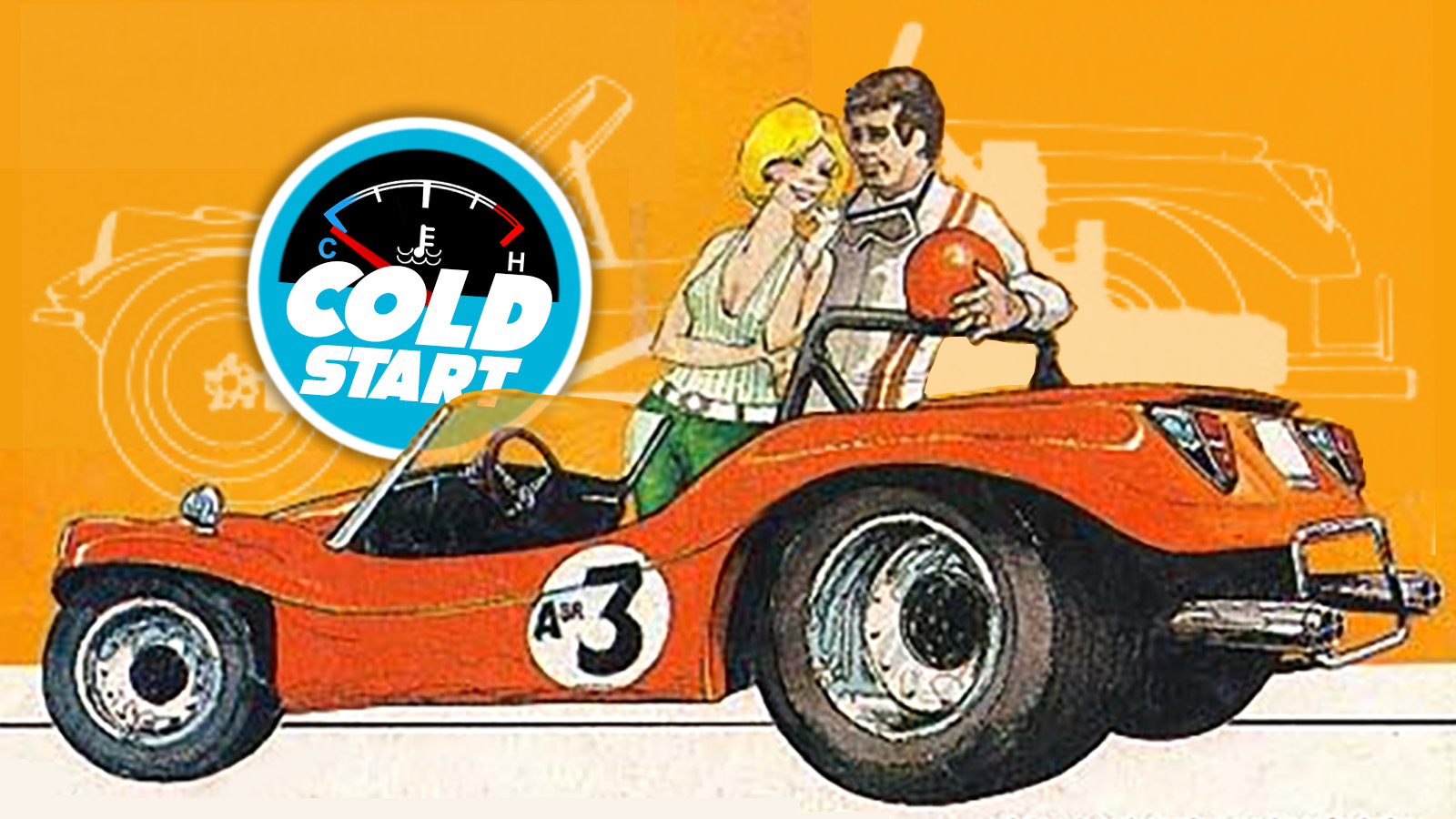
We’ve talked about the legendary Meyers Manx here before, and how it sparked a whole revolution by starting not just the whole dune buggy industry, but the backyard-built VW-based kit car industry as well. Unfortunately for Bruce Meyers, this also meant that his iconic dune buggy design was soon ripped off by countless imitators, ranging from small companies working out of garages to colossuses like Sears & Roebuck. Not all of these Manx knockoffs were the same, though; in fact some took the dune buggy concept to some very unexpected places. Like autocrossing.
Yes, the dune buggy I want to tell you about today wasn’t really a dune buggy at all, even if it looked like one. It was a car designed for street and racing use, but it just happened to accomplish these goals using the same fundamental design as a dune buggy, just with some crucial changes. I’m talking about the Deserter GS.


The Deserter GS was built by a company called Dearborn Automobile Company, which was a sort of spin-off company called Autodynamics, who built single-seat open-wheel Formula Vee cars.

In case you’ve not been introduced to Formula Vee, this was a cheap-to-get-into (for racing, at least) racing series using open-wheel cars with fiberglass bodies based on Volkswagen Beetle mechanicals. A VW 1200cc engine was used, flipped 180° from its usual orientation, making it a mid-engine car, and VW front axles, suspension, brakes, and so on were used to create a capable and fun – if not wildly fast – race car. It was a great way to get into wheel-to-wheel racing.
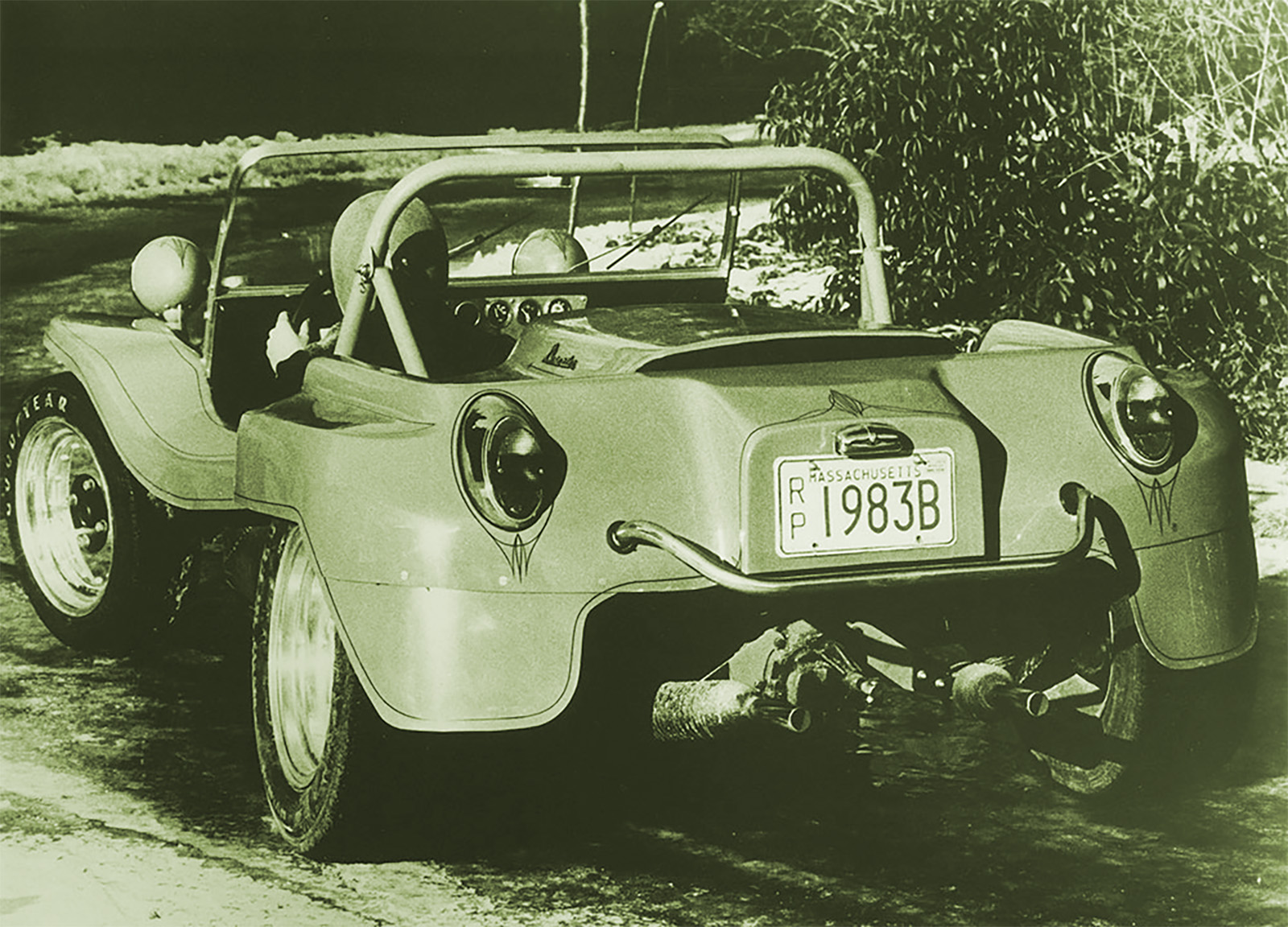
Alex Dearborn owned Autodynamics, and had an idea sometime around 1968: what if you could take the mid-engined Formula Vee concept and adapt it to be a two-seater street car? That’d be fun, right? Of course it would. So how to do that? Well, Dearborn also owned the Dearborn Automobile Company, as many of you quick-witted folks may have inferred, and that company built VW chassis-based dune buggy kits (which were actually licensed from Manx, not stolen). They had two: the Deserter, which was a traditional-style Manx buggy, and the Deserter GT, which was lower and sleeker and a bit less like a traditional dune buggy:
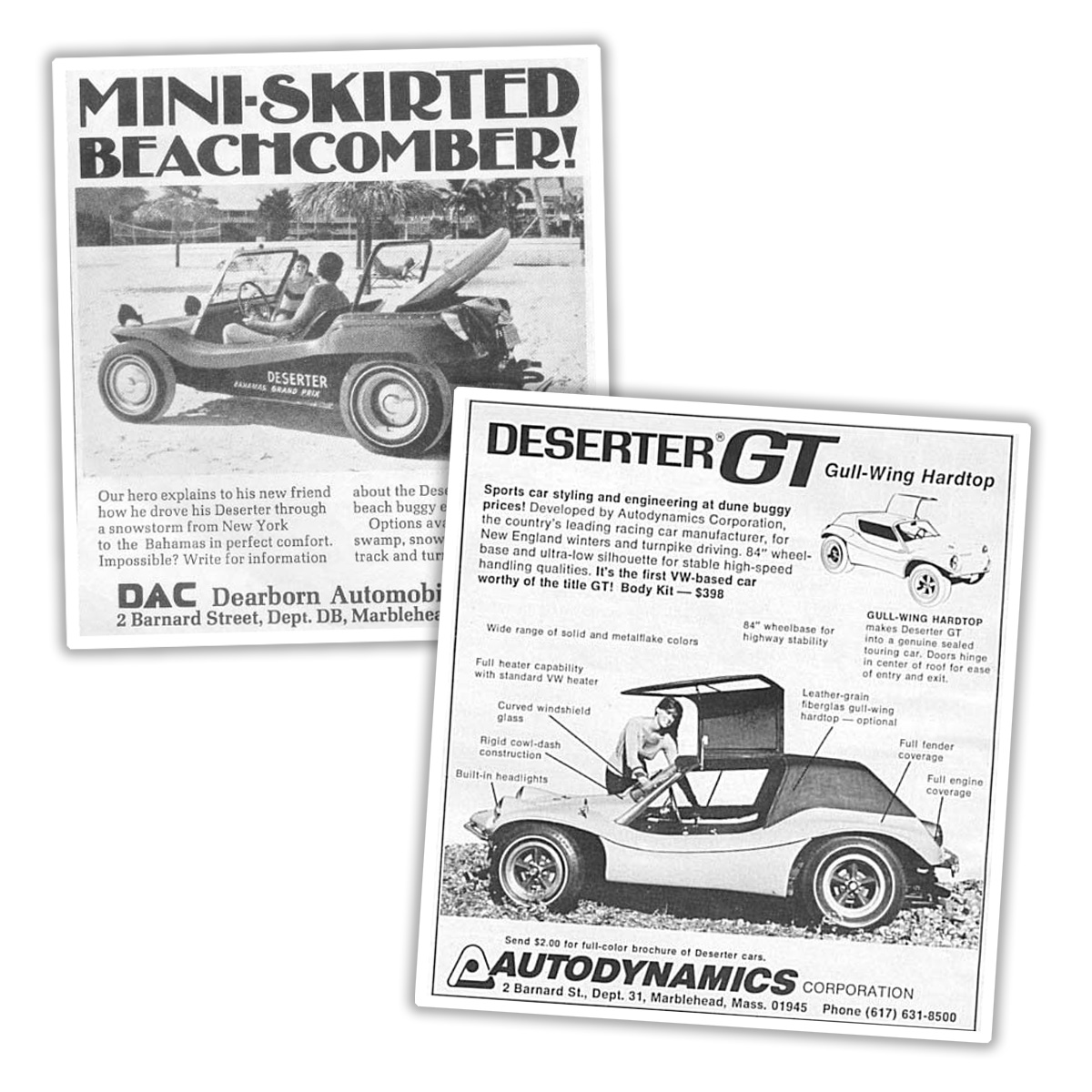
These bodies were lightweight and could work well for this new project. They were actually a bit longer than most Manx-type buggies, cutting down the stock VW wheelbase of 94.5″ to 84″, when most Manx-type buggies went down to 80″.
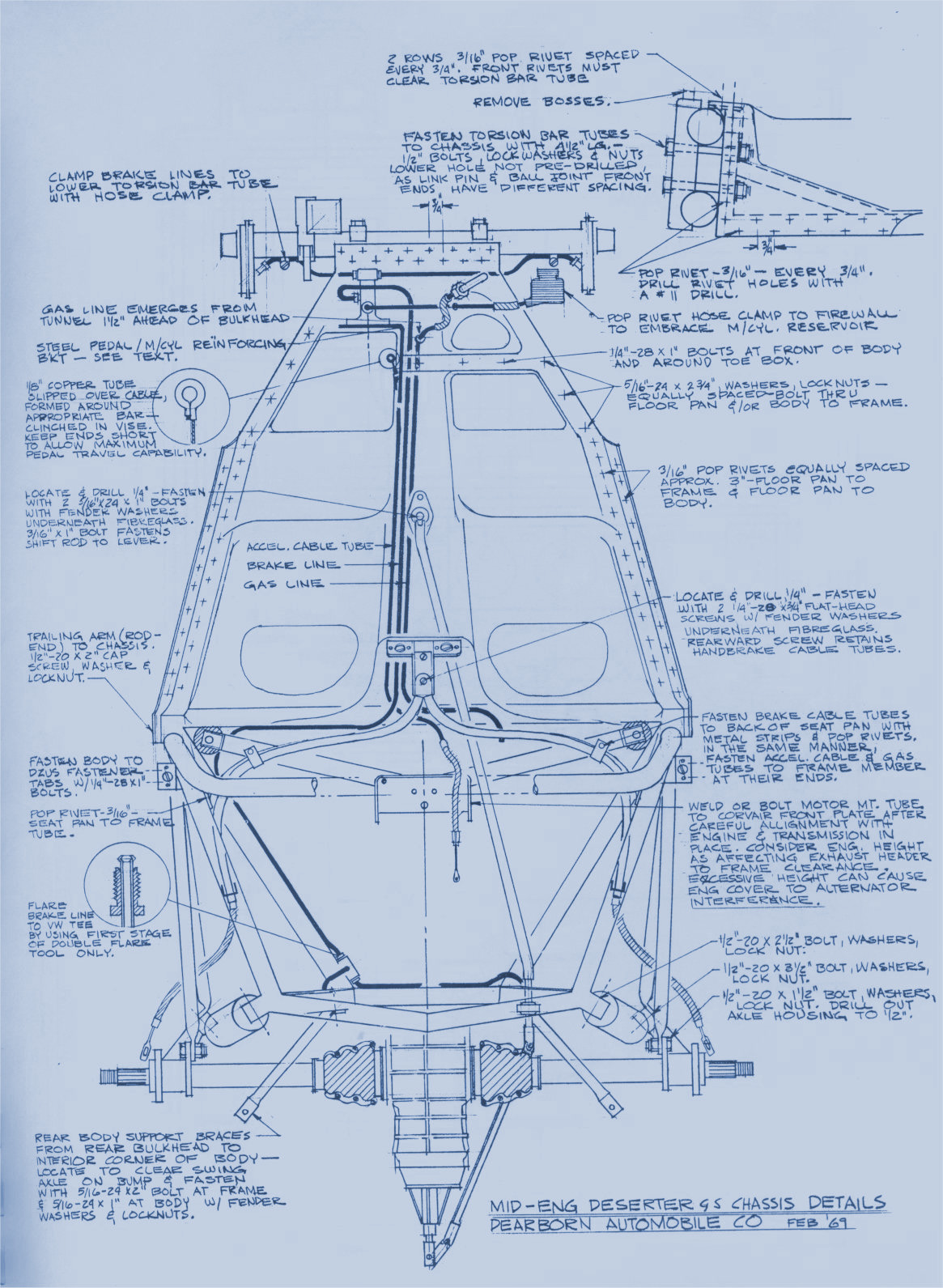
Technically the Deserter GS chassis/spaceframe could fit either of these dune buggy bodies, but most used the lower GT body. The Deserter GS chassis was also designed to have a mid-mounted engine, like a Formula Vee:
Look at that! You can see the Formula Vee heritage easily in that chassis. The original VW pan was clearly the root source, but it’s very different, tube framed and with molded-in low seats and an integral roll bar as well.
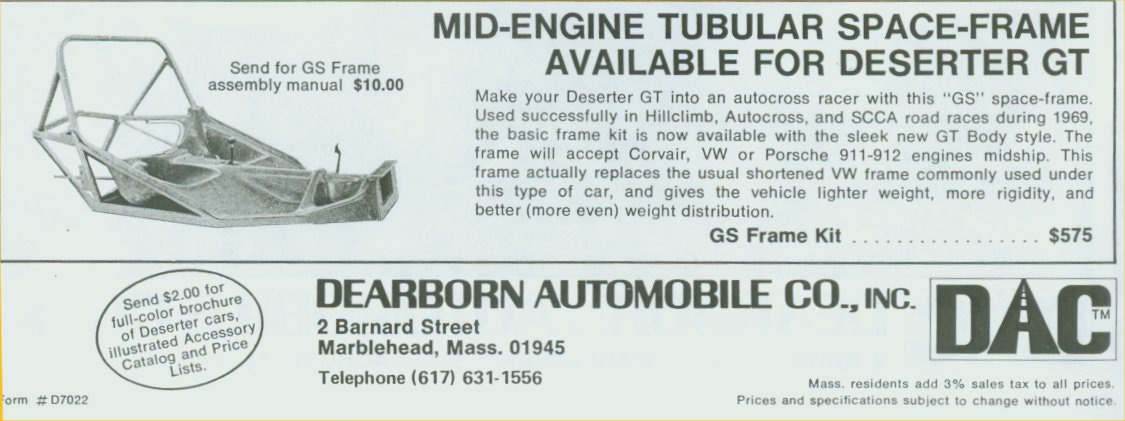
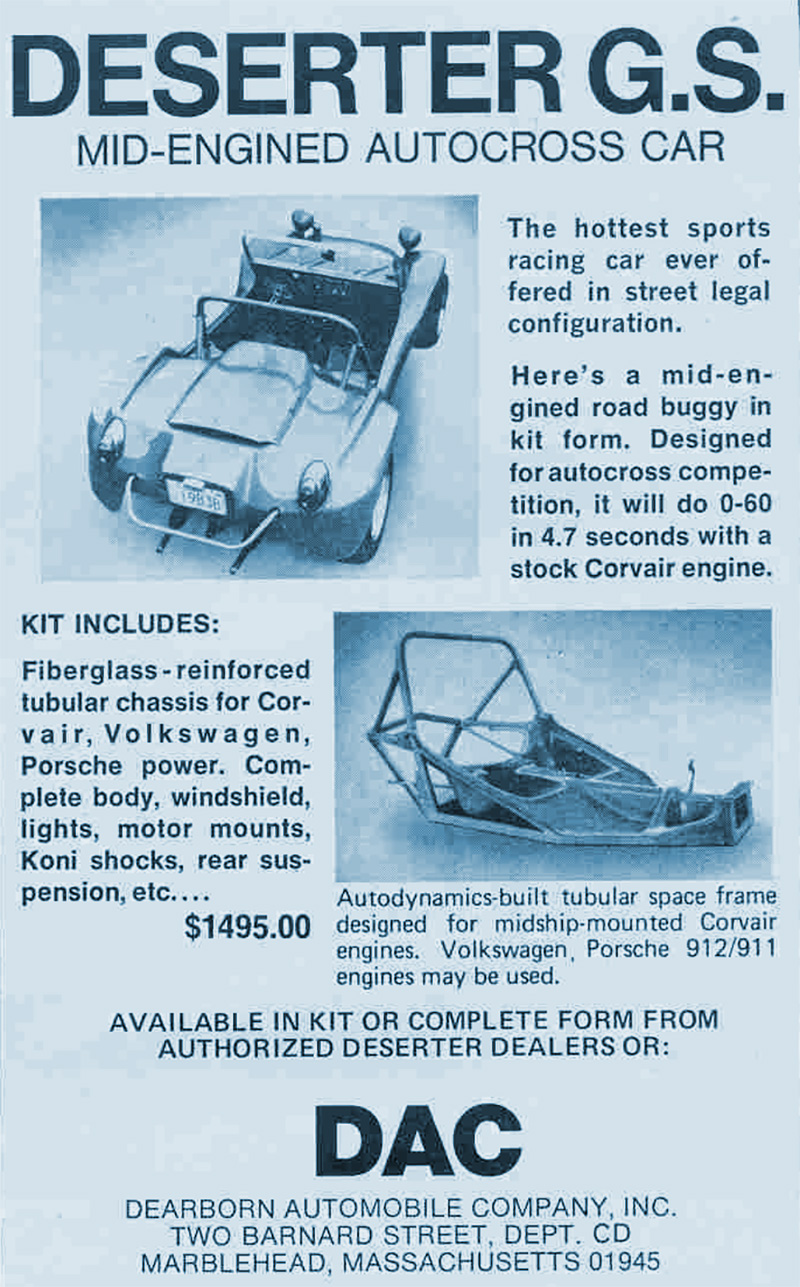
The space-frame was designed to take, mated to a stock VW swing-axle transaxle, any of the great trinity of midcentury air-cooled engines: VW engines, Porsche 911/912 engines, or Chevy Corvair engines. The flat-six from the Corvair was an especially popular choice, being powerful and relatively cheap.
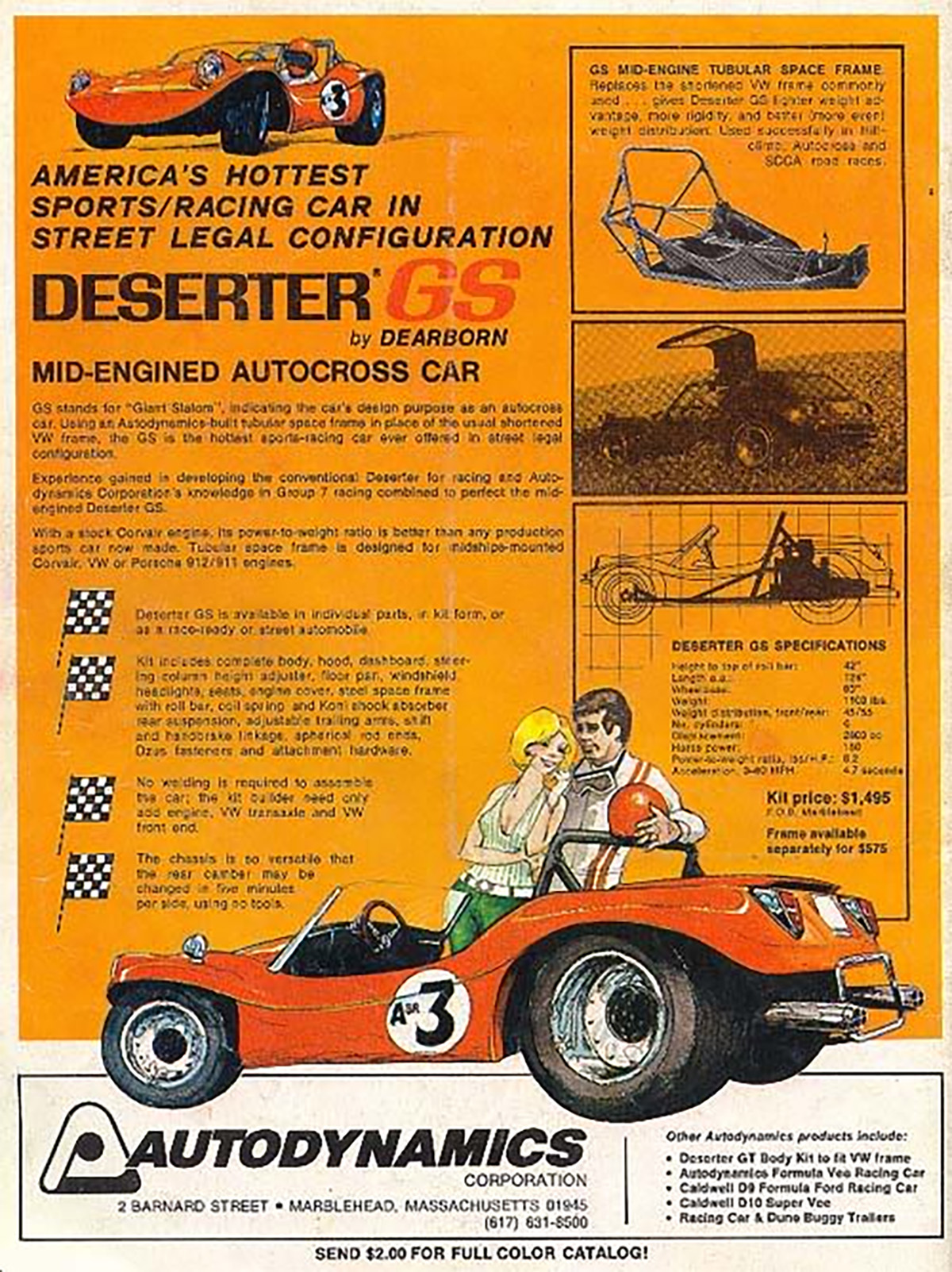
The resulting Deserter GS was sold as a “mid-engine autocross car” and despite the body similarities, really wasn’t a dune buggy at all. It was low, with low ground clearance, rode generally on street tires, and was designed for handling and some speed. In a lot of ways, it was like a cheap way to get into a Porsche 550 Spyder, but often with even more power, thanks to those cheap Corvair engines.
Only about 138 Deserter GSen were built, but the ones that were seemed to be extremely competitive in SCCA racing events, setting autocross records and beating bigger, fancier, and more expensive cars.
The name is funny to me, though; “deserter” made sense when these were dune buggies, designed to blast across the desert, but for a street/track car? Then it just sounds like the word used for someone who, say, ghosts on their position in the army or something.
Name aside, these are incredible cars, and I love the concept of something like a Formula Vee being adapted for street use. I’ve never seen one in person yet, but maybe I’ll get lucky one day.





To be fair, I can’t remember if I have ever seen a Manx on off-road tires. I probably have, but the vast majority of them are set up for street use. That said, I bet someone has made a body that resembles a Can-Am car…
A friend’s dad was huge into Mark I Cortinas. He had two, including a Lotus Cortina. Then he bought a Formula Ford and wrenched on that for a while. I got to drive the Lotus Cortina around the block but never got to even sit in the Formula Ford. I may have been too tall for it anyway and my friend was even taller.
Very cool and I liked the video. I can’t remember the last time I saw a California Car Duster.
Drop by my garage, there are four of them. They get used daily. Some for paint, some for wheels.
Seems like a good shortcut instead of buying a street car and stripping everything out of it. Back when 60’s English roadsters were common-enough, one wouldn’t think too hard about how little crash protection there is.
“Only about 138 Deserter GSen…”
I see what you did there. I’ll tell my boxen full of moosen and oxen about this one
Great post. Reminds me of my beach days on Padre Island. Before they were outlawed you would occasionally see them. Mostly redone VW’s. The permanent coastal protection supplied by the sand dunes outweighed the momentary thrill of driving across one. Keep Torch’n!
I used to see a dark green one parked on the street in Park Slope Brooklyn near the Gowanus. I never saw anyone driving it though. It may still be in the neighborhood, I’m not.
I would definitely get one if it were available.
There was something tricky about running Corvair engines in them. Saginaw transaxles didn’t work without heavy modifications (blame the Pontiac Tempest) , I think you had to run the Corvair engines backwards and use the VW transmission.
That’s exactly what they did!
I’m impressed that the guy in the brochure drawing in the topshot actually has a helmet. I guess on-brand for a racecar, but weirdly out of place for ads or the street–or picking up halter-top blondes.
–Maybe it’s so his toupé doesn’t fly off, when he’s trying to impress the blonde with a little street racing?
I’ve heard it once, 20+ years ago and have forgotten it, but what do you need to do to a VW gearbox, to not get 4 reverses and one forward, when you flip it 180 degrees?
Because center engined air cooled are just so … cool!
The 914, the 550, the incredibly beautiful 904.
Even the Boxster, but I guess a lot changed from the old times to 1996.
You just flip the ring gear to the other side of the pinion gear. Or, enjoy 4 reverse speeds!
Sounds simple enough, thanks JT 🙂
Commence Project 904 Replica, when I have the *cough* “time” 😉
Just mount the driver seat 180 degrees from normal
Great idea. They probably figured the person interested in the most performance for the money don’t car that much what it looks like – especially if it’s going to be an autox car.
I’ve never really associated Marblehead with kit cars. It’s more of a sailboat place. I don’t mean sailing, but merely owning and maintaining a sailboat to visit in the harbor once or twice per year.
Speed Buggy?
My thoughts exactly
Never thought I’d see a write up on the Deserter in the Autopian!
I fell down the rabbit hole of these a decade ago. Great little car.
Imo this one is easily the nicest.
https://m.youtube.com/watch?v=oD0TuAW4I3k&ra=m
270 hp Corvair engine. Tasteful mods, hmmm goodness. There are a few vids of him autocrossing it.
Thanks Jason!
I went down that rabbit hole about 10 years ago too when I kept seeing one street parked near my stop on the subway.
I saw what looked to be someone’s old Formula Vee racer for sale on FB Marketplace a while back. It wasn’t expensive, and I seriously wondered if it could have been registered for street use.
Then I realized I would probably be killed immediately by someone in a Suburban who never even knew I was there.
Some years back I was in a fender bender with a Chrysler Aspen (rebadged Durango) that ran a stop sign. Granted, her sight line wasn’t great as I was coming up a steep hill from her right, but what got me was her excuse: she didn’t see my “little car.” I was driving a 626.
In high school, my sister and I shared a Triumph GT6+. One time, I took it through a drive through, made my order, and pulled up to the window.
Nothing.
After a few minutes, the window opened and the girl working it looked out. But instead of looking down at me, she looked over to her right, which was behind me.
She startled, then looked down. She said she saw the roof of the Triumph and though it was the hood of the car and was wondering why I wasn’t pulling all the way up to the window.
Honestly, this thought is in the back of my mind every time I sit in my Miata but at least the Miata has door beams, airbags and some other nods to modern crash standards. It’s this thought that has so far kept me from slipping to far down the Caterham rabbithole as well. I’ve wanted one since I was a kid but I don’t know if I’d ever really be comfortable driving it on public roads.
Exact same thought process as me. Have wanted a Caterham for 20 years, ended up with an NB Miata instead which I love. But I’ll always wonder what Caterhams are like. At any rate, Miatas are at least much cheaper!
For the first week after I had my Miata, I was nervous driving it because I felt like I was doing something wrong / illegal by driving it on public streets.
I was already accustomed to fearing collisions with larger vehicles because I had mostly owned / driven small cars while the traffic around me inflated at an alarming rate.
I used to notice how many parking brakes seem to be in disrepair on pickups when I drove my 914. It’s a 1970 six, so the doors are mostly wind resistant. A step up in safety from my TR3 I guess.
I cringe at the lifted pickup trucks with trailer hitches at closer to eye level than bumper level. What’s the point of a bumper when this is the norm?
The 914 must feel like driving around in a bank vault compared to the TR3!
Yeah, the difference between getting hit riding a bicycle and driving the TR3 is that on the bike you won’t be lacerated by bits of metal and wooden splinters, then catch fire.