

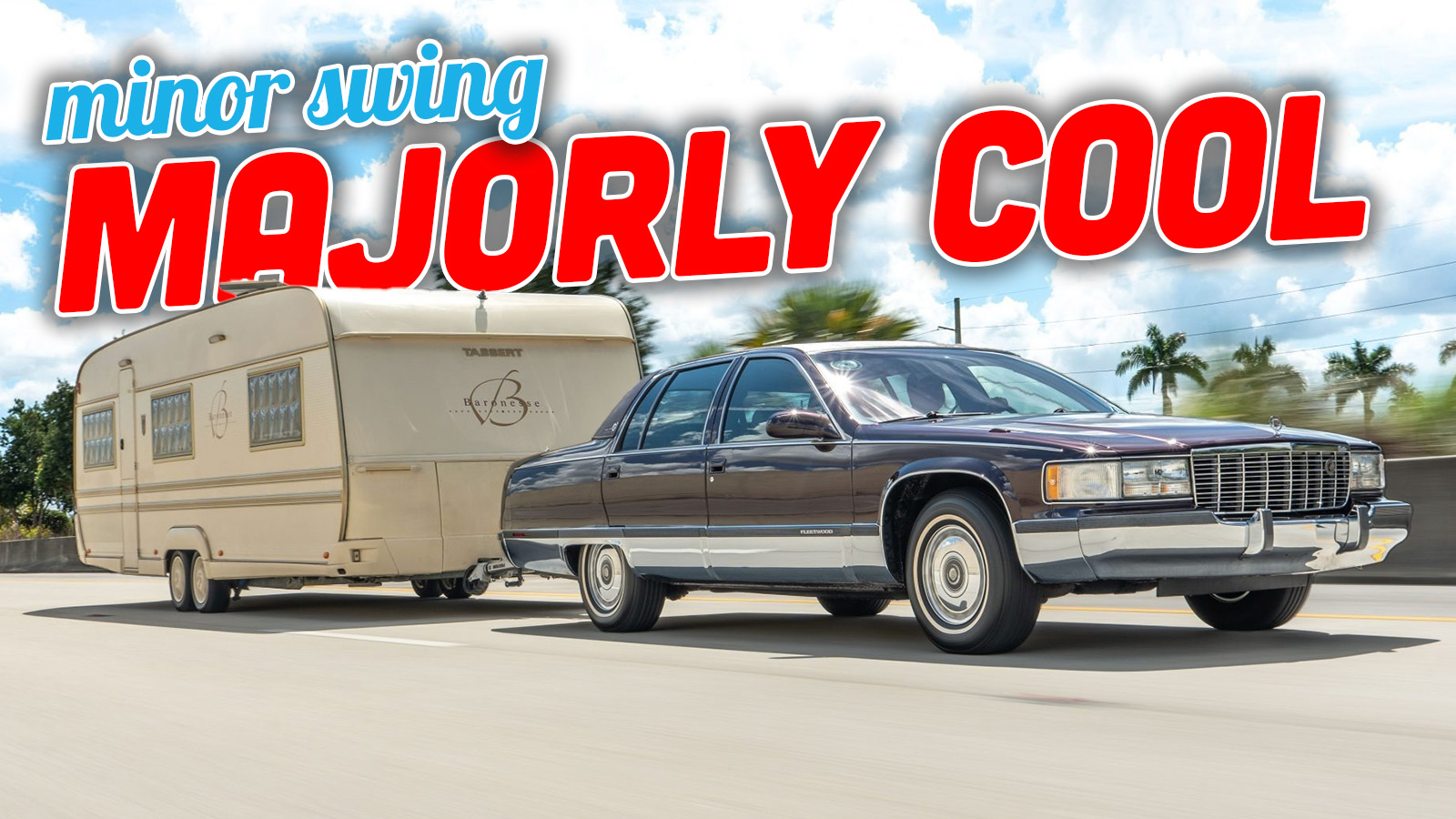
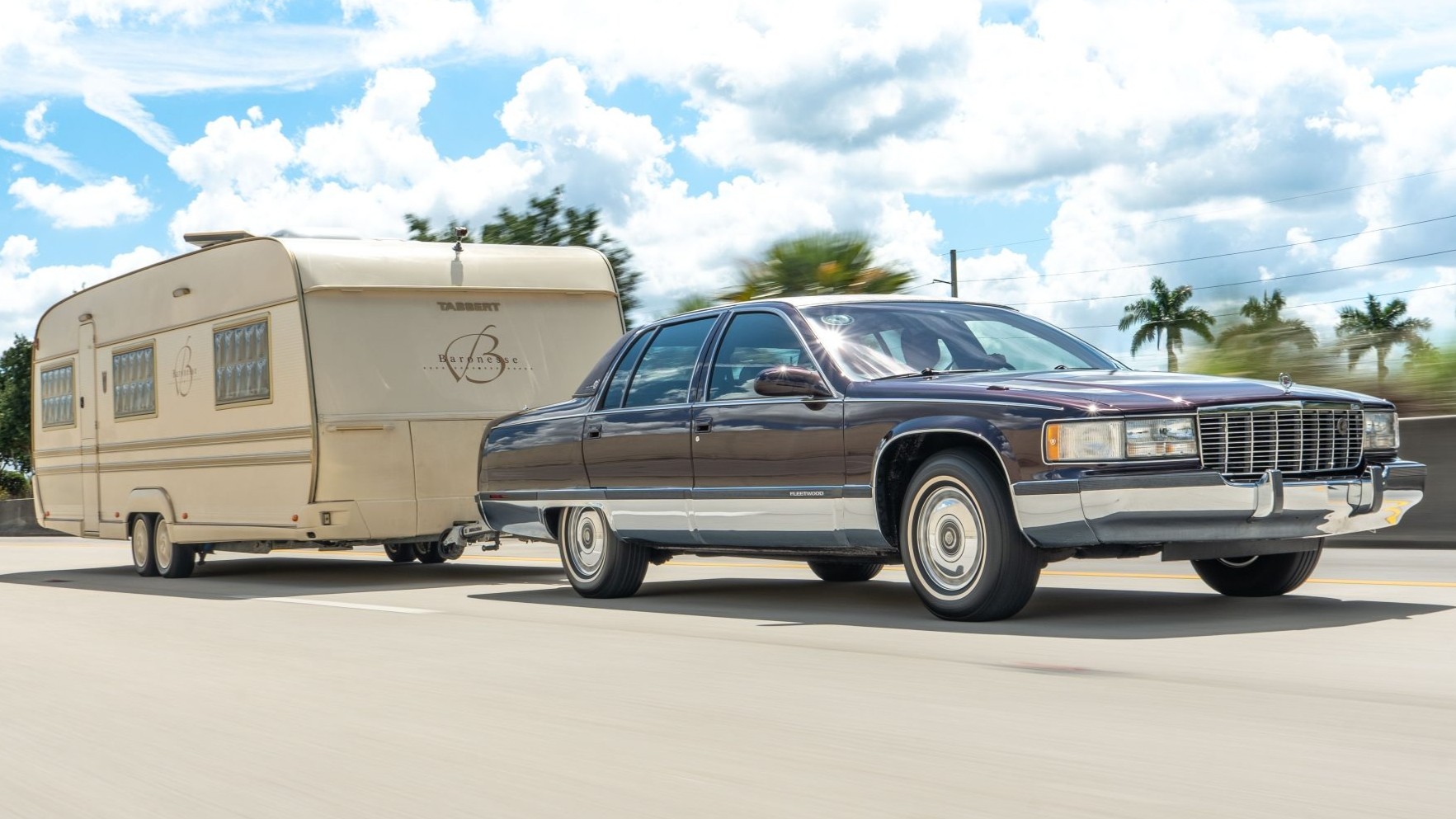
One of the hard parts about going camping in a travel trailer is choosing the right rig to tow your trailer and, honestly, choosing the right trailer for your rig. Well, if you’ve been looking into camping, someone has concocted a pretty awesome combination. Up for grabs in America right now is a weird 2002 Tabbert Baronesse 740 Caravan from Germany, and it comes with a minty fresh 1995 Cadillac Fleetwood Brougham. What a wild pairing, and the camper part of the equation might even be the most interesting part. But pump the brakes before you get excited.
There are some pretty big differences between European and American campers. Yes, one of those differences is that Europeans call their campers “caravans,” but it goes way deeper than that. One big difference, and this is something that you might have noticed already, is that axle placement is very different. Here in America, we like to load our trailers down so that 10 percent to 15 percent of the total trailer weight is on the tongue. Typical tongue weight percentages in Europe are about half of what American trailers are, and a lot of that has to do with the more centrally-located axles that European trailers have.


The general practical difference here is that Europeans can tow big trailers with small-ish cars, but they also tow campers at slow speeds for safety. Americans can tow huge trailers at fast speeds, but require bigger vehicles to do the job safely.

Thus, what you’re looking at here is an interesting interpretation. The Tabbert Baronesse 740 Caravan is a German camper that wasn’t made for the American market, but it’s being towed by one of the coolest American Cadillacs of the 1990s, which is armed with 5.7-liter GM LT1 V8 power.
Tabbert
The camper portion here comes from the famous German brand of caravans, Tabbert. The company offers a nice history speed-run:
1908
By the time Henry Ford started producing the legendary T-model, which was the top-selling car in the world until 1972, Alfred Tabbert was born.1923-27
The whole world is crazy about mobility – and so is Alfred Tabbert. Thus he learned the trade of car body manufacturing at the Siemens-Automobilwerken in Berlin, where he also passed his examination for the master’s certificate.1934
Only a few years after his graduation, Alfred Tabbert founded his first own company in Schweinfurt: “Karosseriebau Alfred Tabbert”.1946
As the company was destroyed by a bombing raid, Alfred Tabbert had to start anew. Together with approximately 80 employees nearly 12 pushcarts and agricultural platform lorries were produced every day. In 1948 a conflagration blasted the factory and valuable stocks. Hence, Alfred Tabbert took the chance and founded a new company “Fränkische Fahrzeug- und Möbelwerke”, comprising of 120 employees and a new production hall for single axle trailers and furniture.
1953
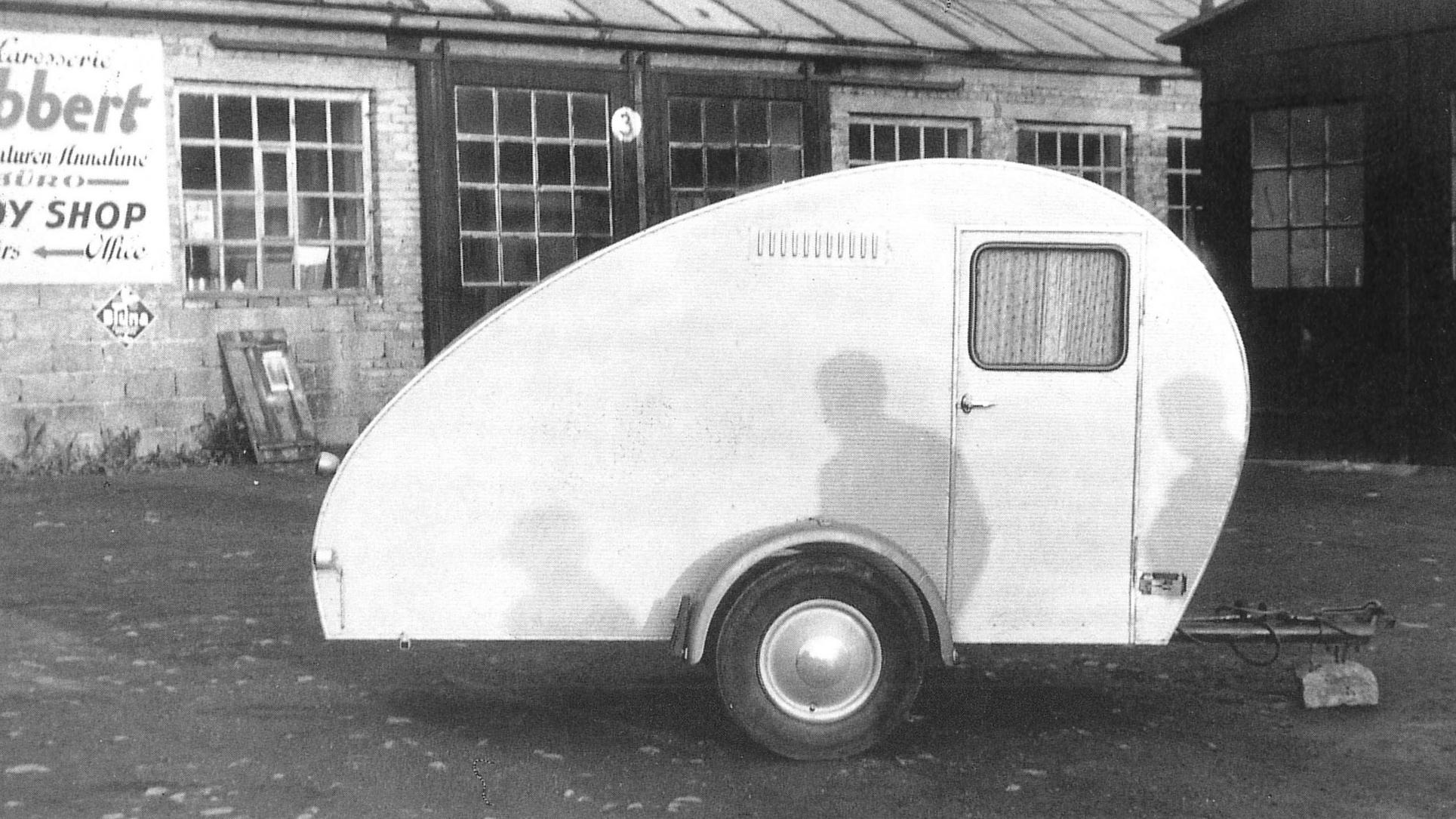
At the age of 45 caravanning pioneer Alfred Tabbert produced his first caravans with 120 employees. Only two years later the first Ideal caravan is produced in series. The first production series of caravans was started only a few years later, followed by the first awning in the early 60ties.
Sadly, I have not found much on the origins of the Baronesse. From what I could find, the trailers rose to popularity in the early 1970s as Tabbert’s flagship line of caravans. What made the Baronesse stand out was the fact that it was custom-ordered to the exacting specifications of the buyer. Apparently, this made them quite popular among wealthy Romani traveling communities.
Here in America, Tabbert is perhaps most famous for its T@b series of teardrop campers, which are built by nuCamp.
This Tabbert Baronesse 740
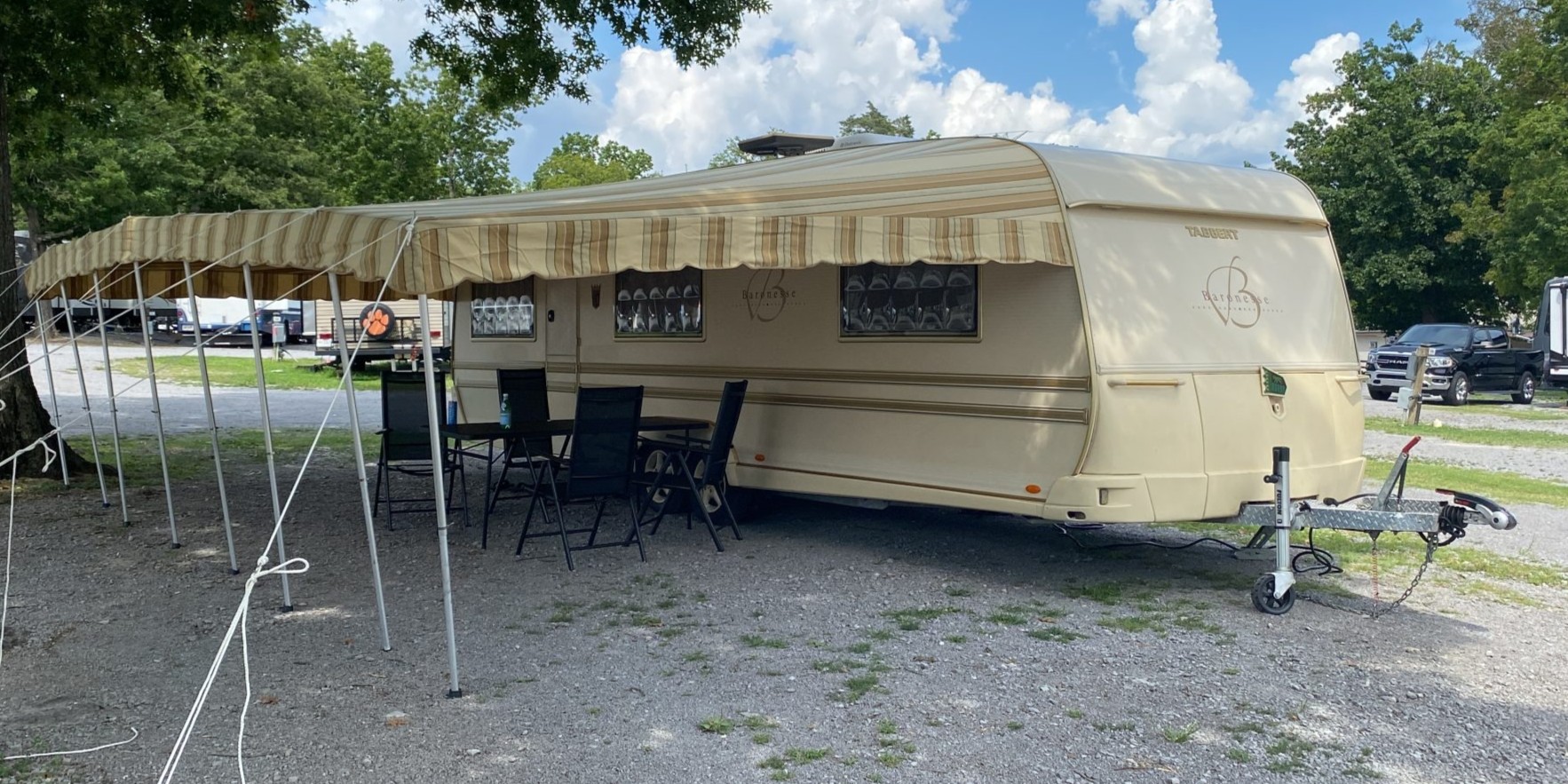
Anyway, the previous owner of this camper, a Romani musician themselves, wants to tell a story about this camper, from another listing:
From the late 1980s onward, the Tabbert Baronesse and Comptesse became synonymous with “the” Gypsy camper in Europe. Tabbert even began refining their designs to suit the aesthetic preferences of Roma and Manouche families.
This 2002 model represents the final and most refined generation of the Baronesse line. It features upgraded cabinetry, upholstery, and trim, and was among the last units built before Tabbert was acquired and restructured into a company now focused solely on luxury tourist caravans.
[…]
As is typical with Gypsy-owned campers, this Baronesse was custom ordered:
Re-upholstered in genuine white leather by the Reinhardt family.
Decorated with elegant custom draperies and valances, reflecting traditional cultural aesthetics.
This camper isn’t just a vehicle—it’s a piece of musical history.
In the 1930s, Belgian-born Manouche Gypsy Django Reinhardt revolutionized jazz guitar despite a tragic accident that left two fingers on his fretting hand crippled. He developed a unique playing style using primarily two fingers, becoming one of the first to solo jazz on guitar. Django toured with jazz greats like Duke Ellington and Louis Armstrong, and his legacy lives on in the global “Gypsy Jazz” movement, also known as Jazz Manouche. Rediscovered in the 1970s, Django’s music provided new opportunities for Gypsy families across Europe, many of whom formed bands and toured the world. Prominent modern descendants include David Reinhardt, Ismael Reinhardt, and the Rosenberg Trio. Today, Gypsy Jazz is played worldwide, with festivals on every continent.
The most famous is held in Samois-sur-Seine, France—where Django spent his final years. This very camper has attended that festival multiple times.
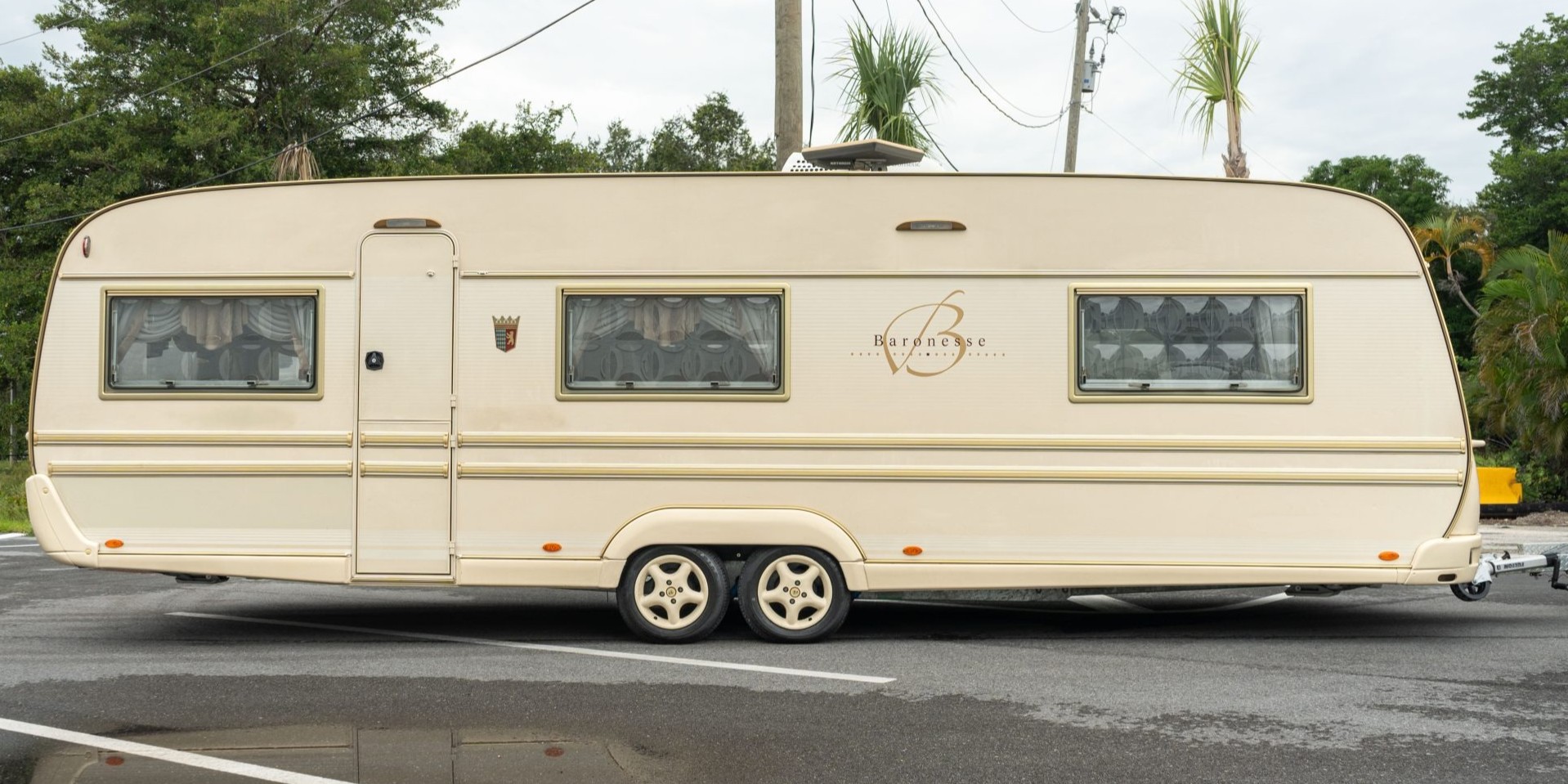
The above story of Romani families loving trailers like the Tabbert Baronesse is backed up by the book ‘Gypsy Jazz’ by Michael Dregni, which appears to be an in-depth look into the Reinhardt story. Coincidentally, I wrote about another Romani trailer earlier this month! As for this specific trailer, the seller states that they purchased the trailer from a member of the Reinhardt family in Germany and then imported it into America. It has appeared for sale on different websites by Bullet Motorsports, but now it has arrived on Bring A Trailer.
The 2002 Tabbert Baronesse 740 being offered for sale today is claimed to be one of the only examples in America. It’s also said to be one of the largest of the Baronesse line.
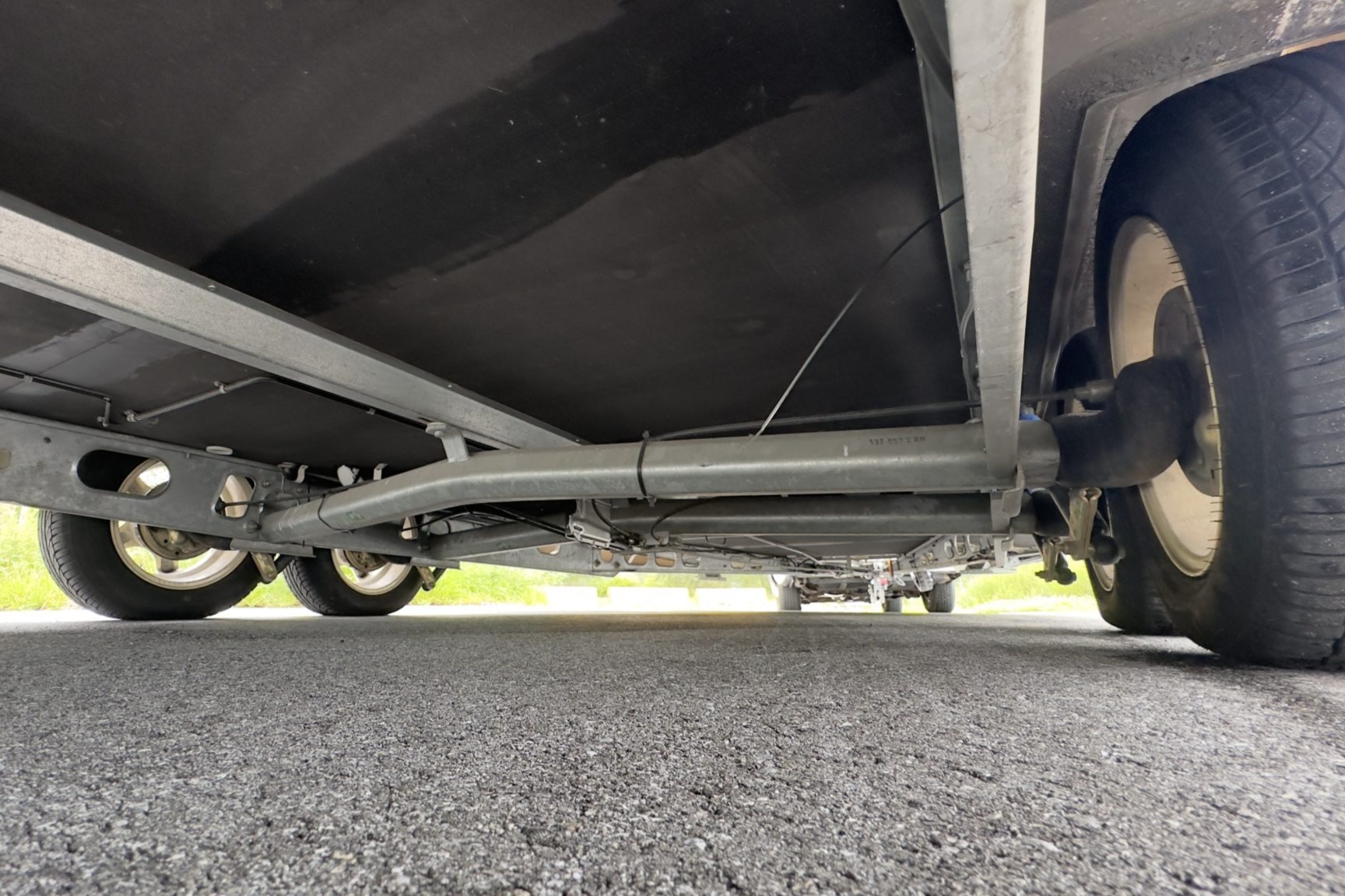
Sadly, due to the rather poor documentation out there about this trailer, I have not been able to find specifics about its build. But I did find a few interesting details. These trailers have AL-KO semi-trailing arm axles, hot-dip galvanized frames, aluminum siding, and were fitted standard with a PVC floor with a felt backing. Electricity was handled with a 220-volt system with a 12-volt secondary system.
On the outside, you’re looking at a surprisingly classic design for something from 2002, and it’s painted beige and trimmed in gold. It’s about the opposite of the Vickers Morecambe that I recently wrote about, in that it’s not absurdly flashy. The gold is a bit extra compared to a typical camper, but that’s about it.
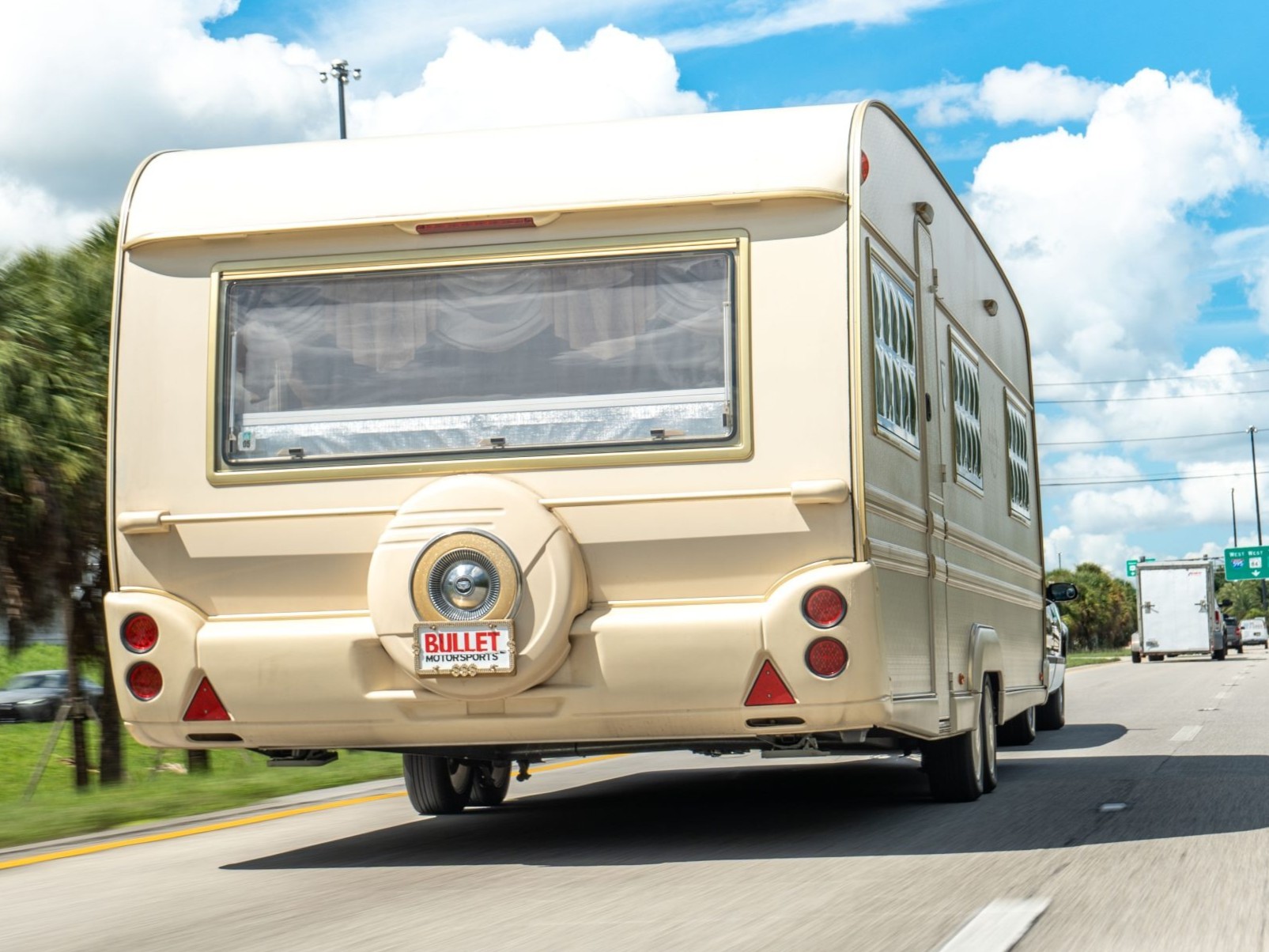
The seller states that many of the features of the camper were changed to comply with U.S. standards:
The camper was professionally shipped from Hamburg to Brunswick, GA, cleared through customs, and adapted to meet U.S. DOT regulations:
Gas lines removed, as they could not be certified under U.S. standards.
Electric furnace installed in place of the gas heater.
Electrical system converted from 220V to 110V.
Tail lights updated to U.S. specifications.
12V battery system added, allowing lighting to function both on- and off-grid.
Fridge retained, powered via an included 110/220V transformer and switchable to 12V when towing.Note: Most Manouche Gypsies traditionally do not cook inside their campers, preferring outdoor cooking under an awning. As such, the kitchen and appliances were seldom used.
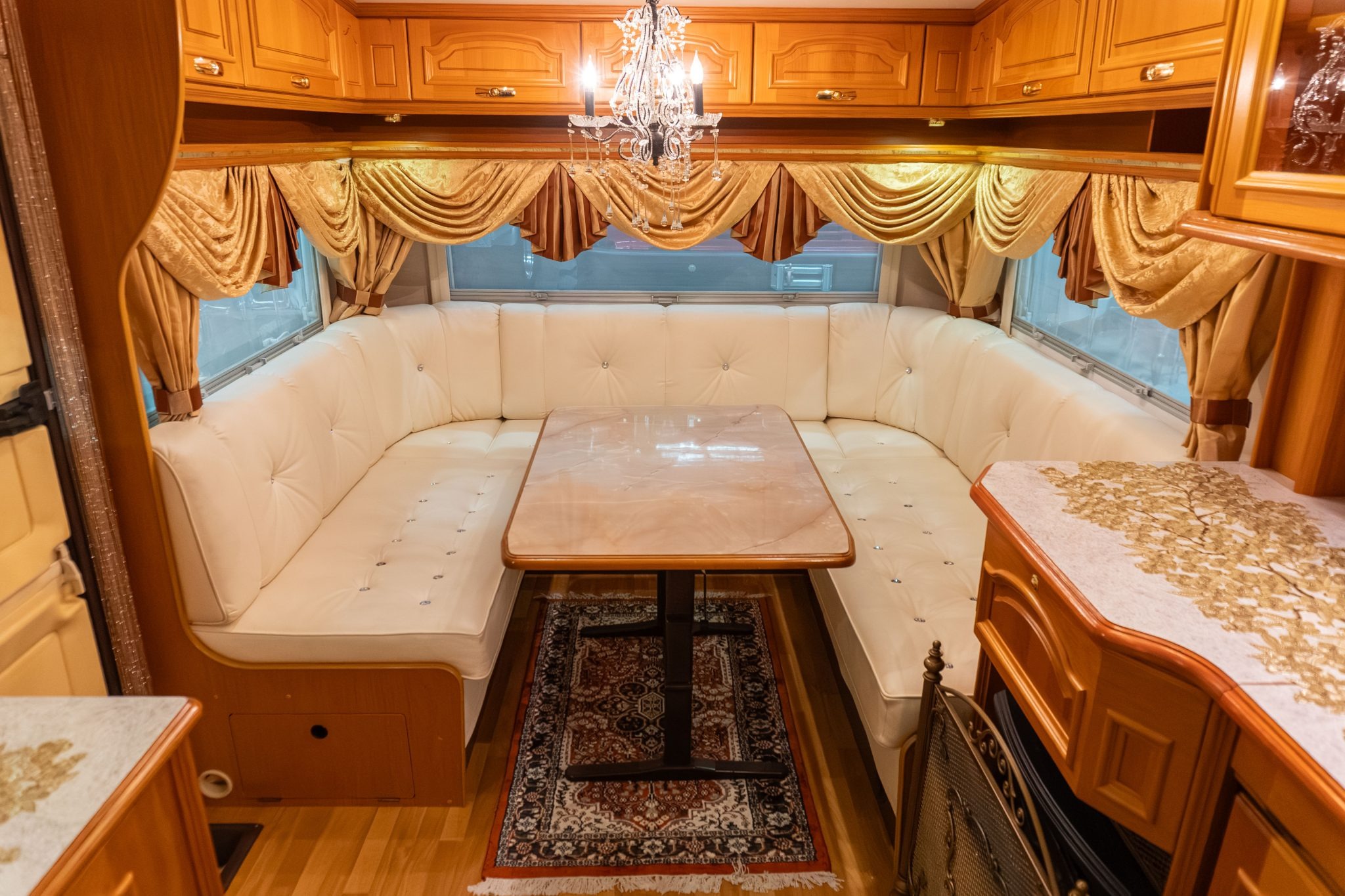
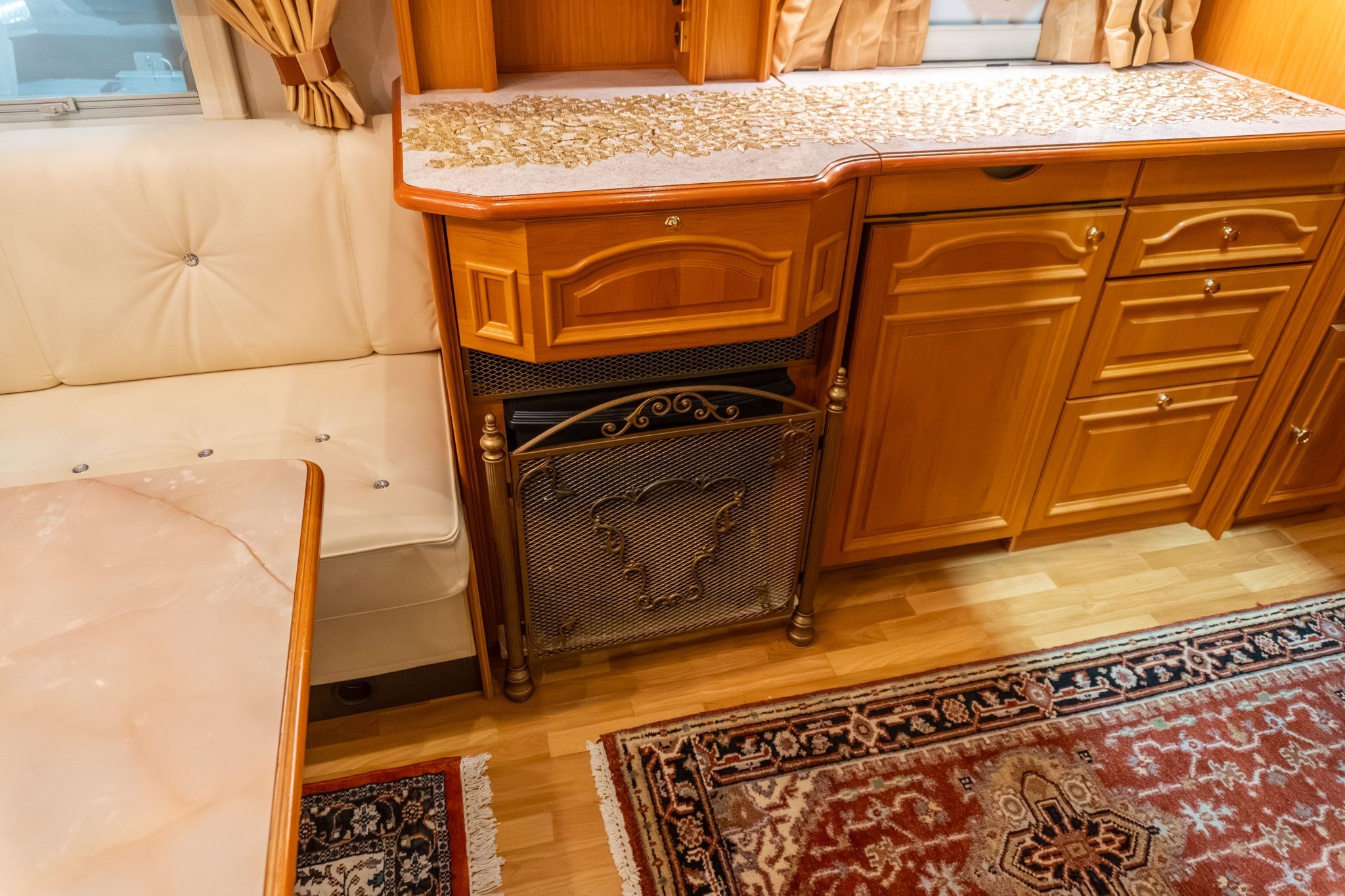
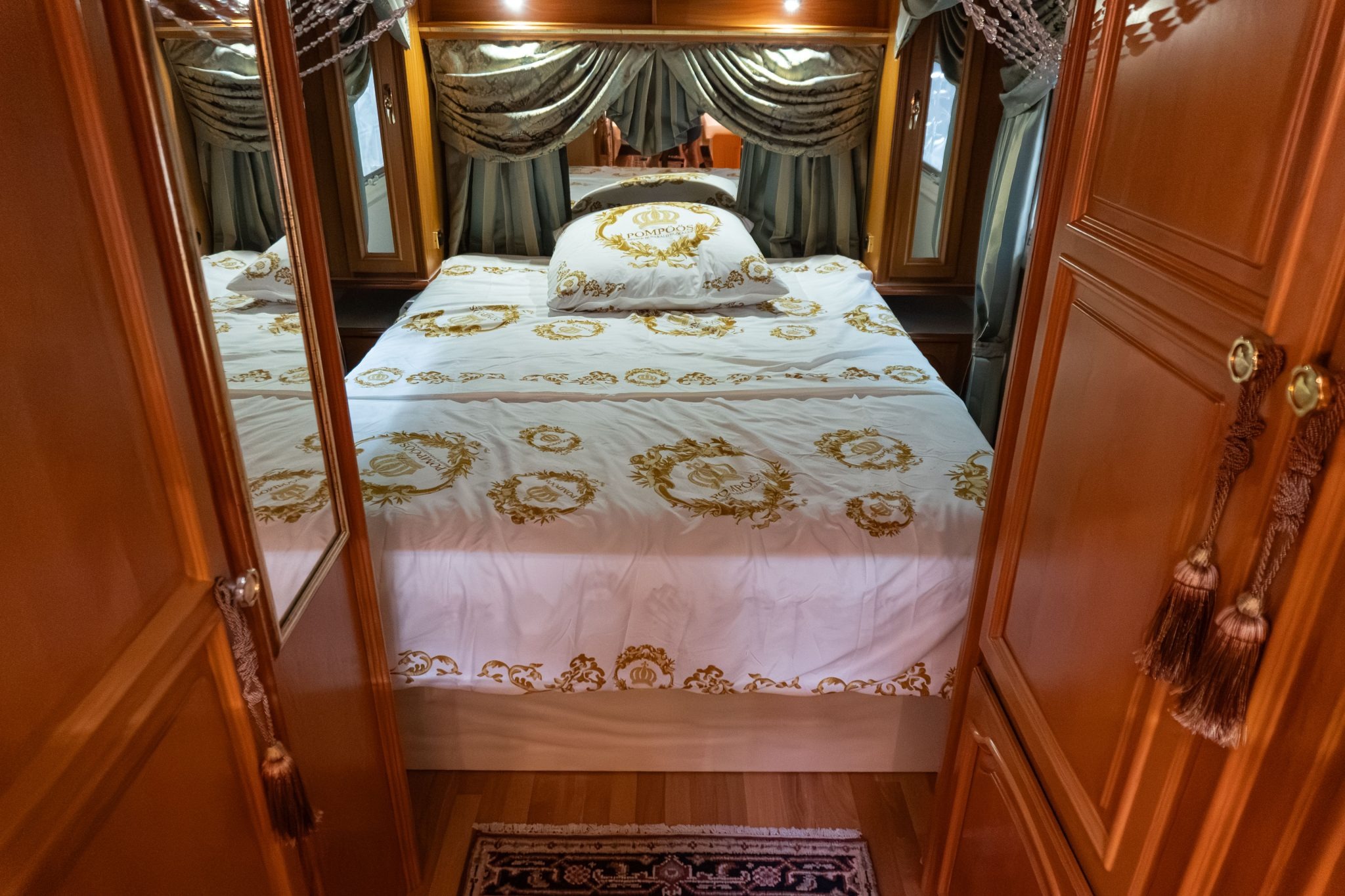
The interior is where things get pretty crazy here:
The trailer is laid out with a U-shaped convertible dinette at the front and a bedroom at the rear with a galley and a storage-converted lavatory in between. Amenities include an electric fireplace with a brass-effect decorative grille as well as a Dometic air-conditioner/heater, rooftop vents, and panoramic front windows.
Premium features consistent with Tabbert campers include raised-panel cabinetry, hardwood flooring, and custom touches such as swagged draperies, beaded door curtains, Persian-style area rugs, white leather upholstery, a marble tabletop, and a crystal chandelier.
Wood sliding doors with upper glass panes close off a rear bedroom with a queen-size bed as well as overhead and bed-side storage cabinets. The mirrored headboard, side windows, and ceiling feature swagged drapery treatments, the latter of which includes decorative brocade and crystal accents.
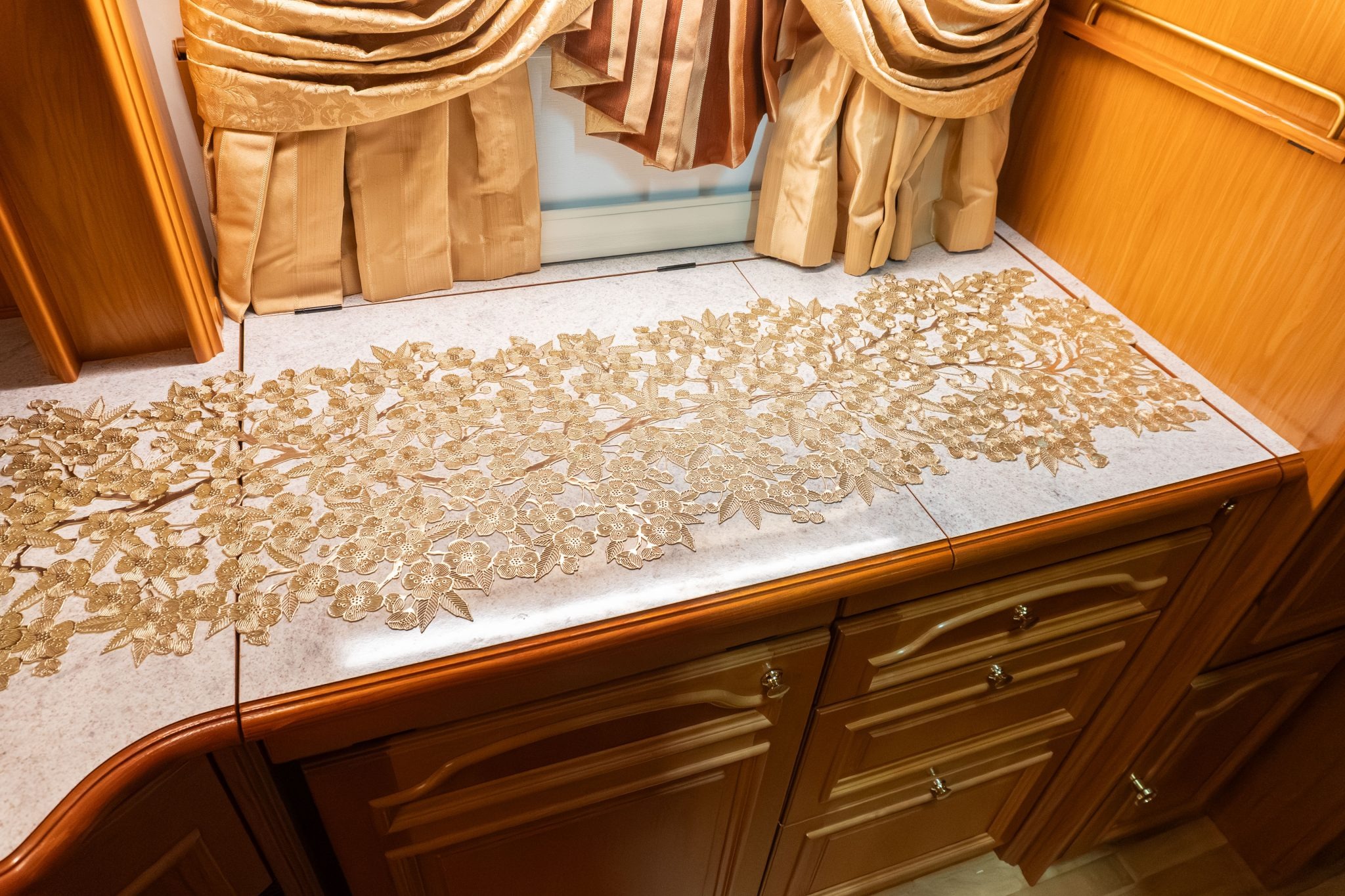
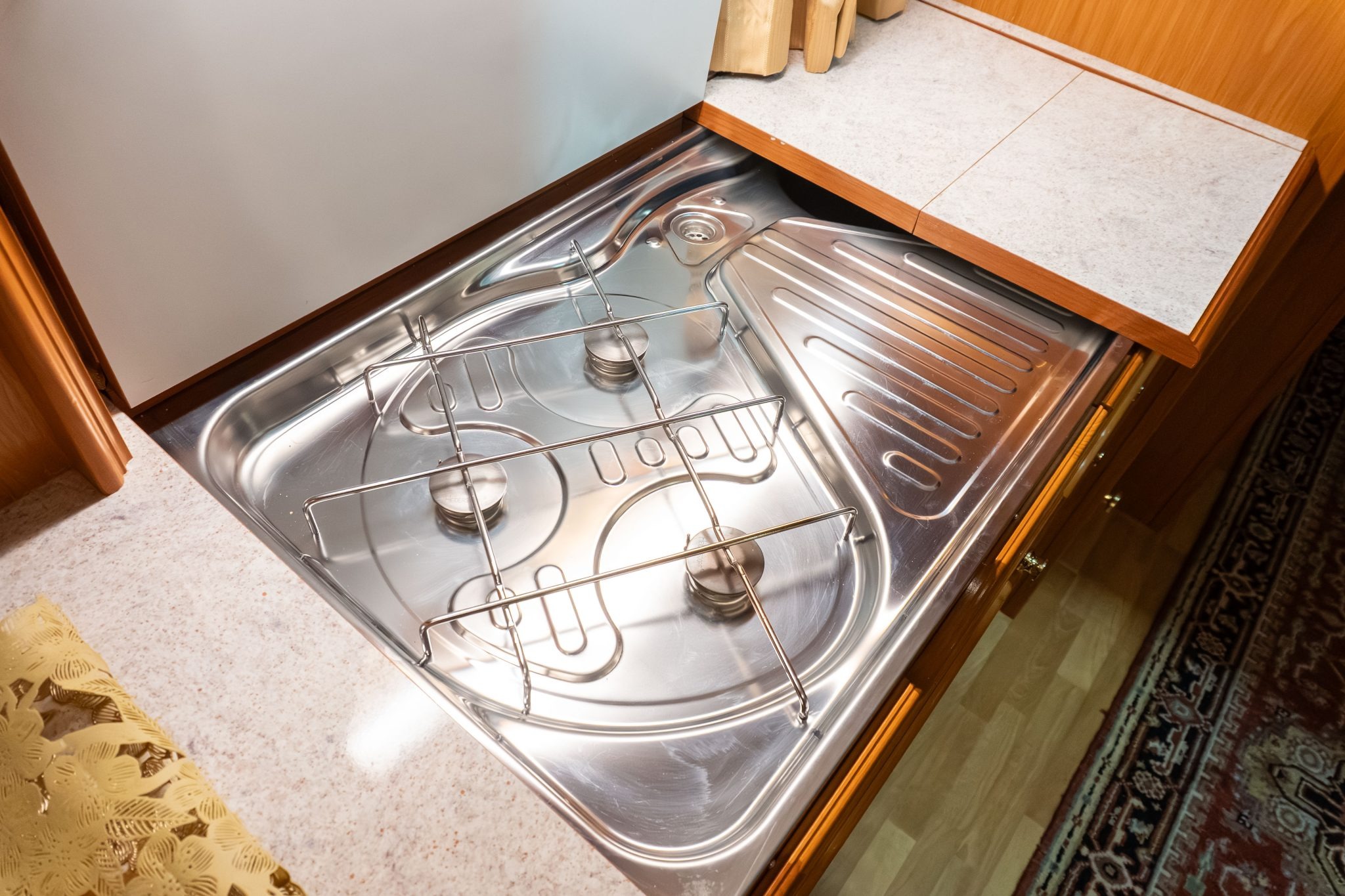
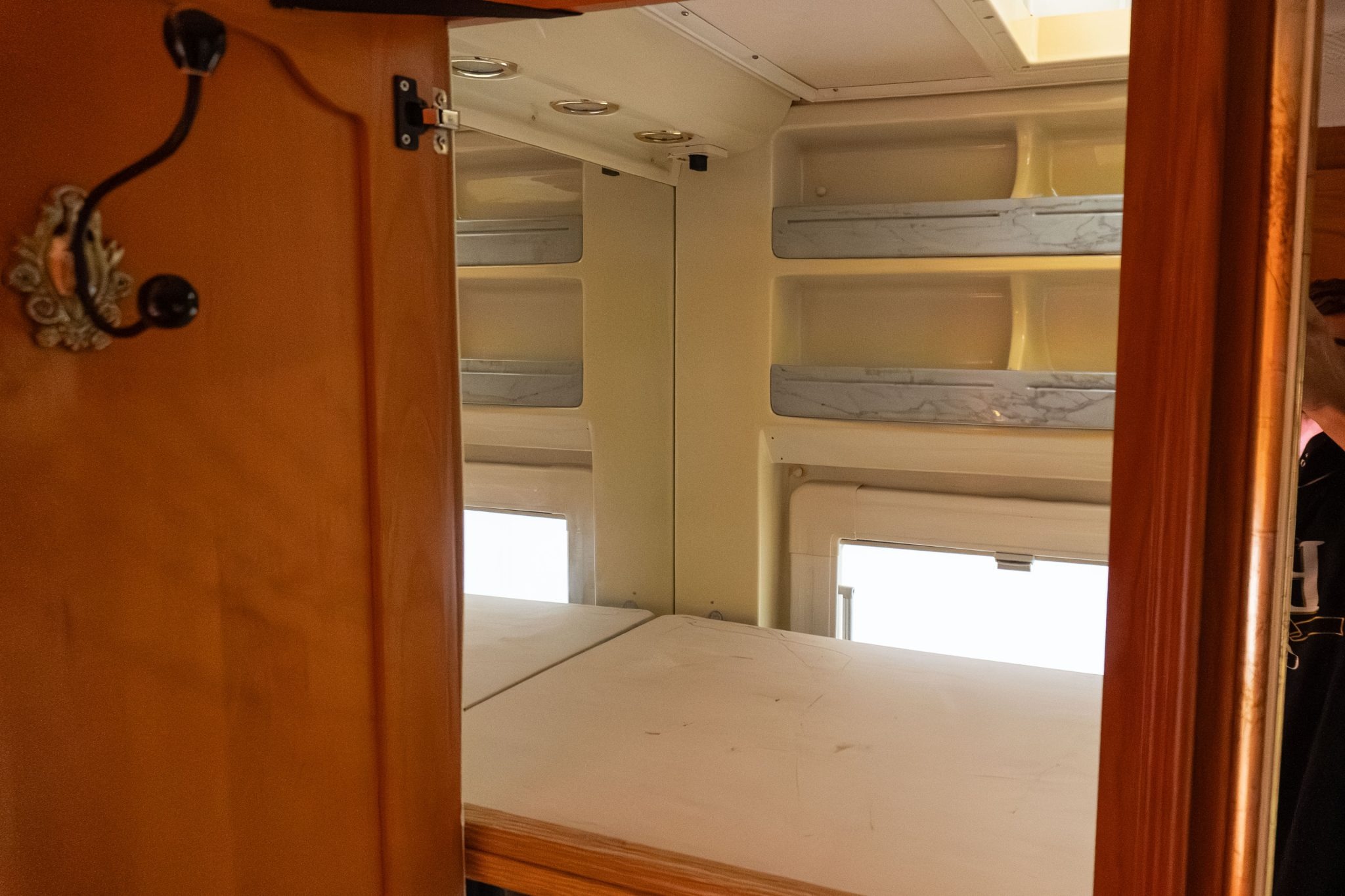
It’s noted that the Reinhardts apparently converted the wet bathroom into a storage closet (shown above). Likewise, it’s said that the Reinhardts likely didn’t use the interior cooking appliances much as, per tradition, they would likely cook outside. This is why the last Romani trailer that I featured didn’t even really have a proper kitchen.
The good news is that the appliances are present and can be activated for use. Likewise, the wet bath is intact under the storage shelving, so you can turn it back into a bathroom if you want to. Unfortunately, this trailer has no tanks of any kind. It’s designed to be parked at a place with shore power and a place to drain gray water. Honestly, it wouldn’t be too hard to fit your own tanks through DIY.
The trailer is said to weigh in the ballpark of 4,400 pounds, and it measures 30 feet long. Now, we get to the hauler.
The Car
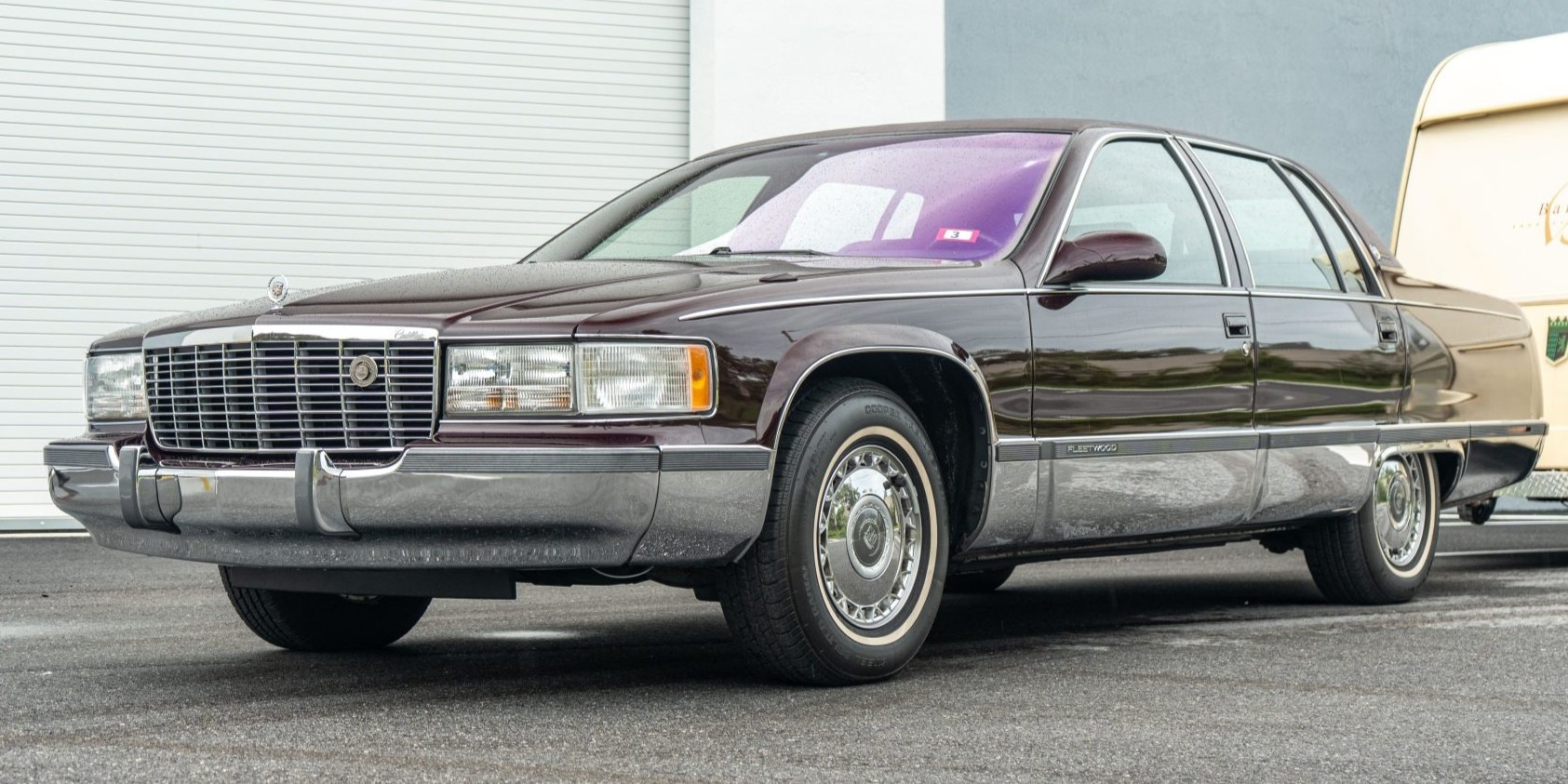
Hitched to the front of the camper is a 1995 Cadillac Fleetwood Brougham. This is a weird choice because it’s nothing like the kind of car that would have hauled this thing in Germany. Yet, I can’t help but find myself amused at this thing. This version of Cadillac’s full-size luxury land yacht is based on the General Motors D-body, and its relatives include the Buick Roadmaster, the Oldsmobile Custom Cruiser, the Chevy Caprice, and Chevy Impala. The Fleetwood is notable for being Cadillac’s last big body-on-frame rear-wheel-drive sedan.
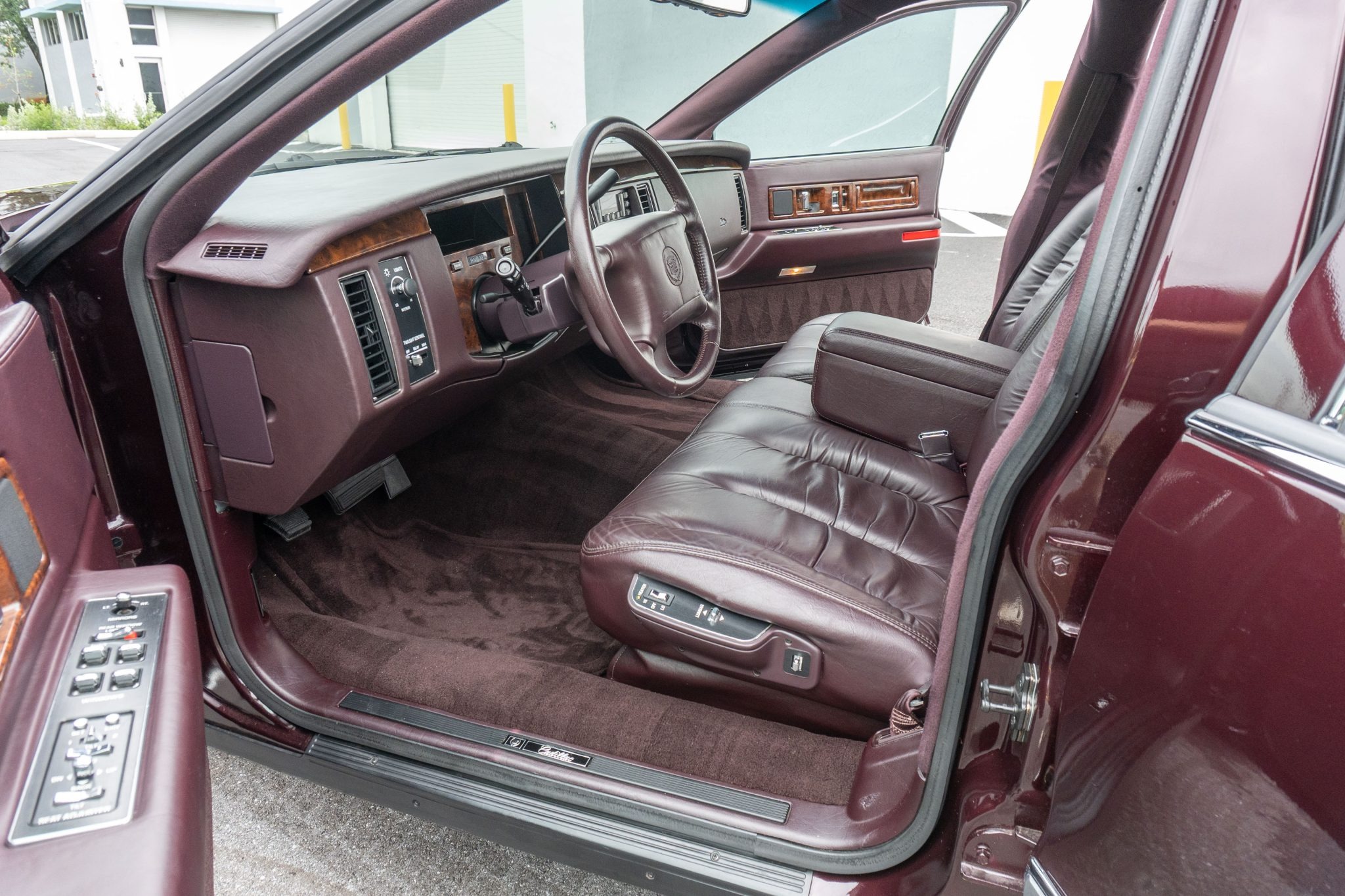
The inside of the Fleetwood is pretty great with maroon leather bench seats, power everything, and fake wood. It’s prime 1990s General Motors in there, and I dig it.
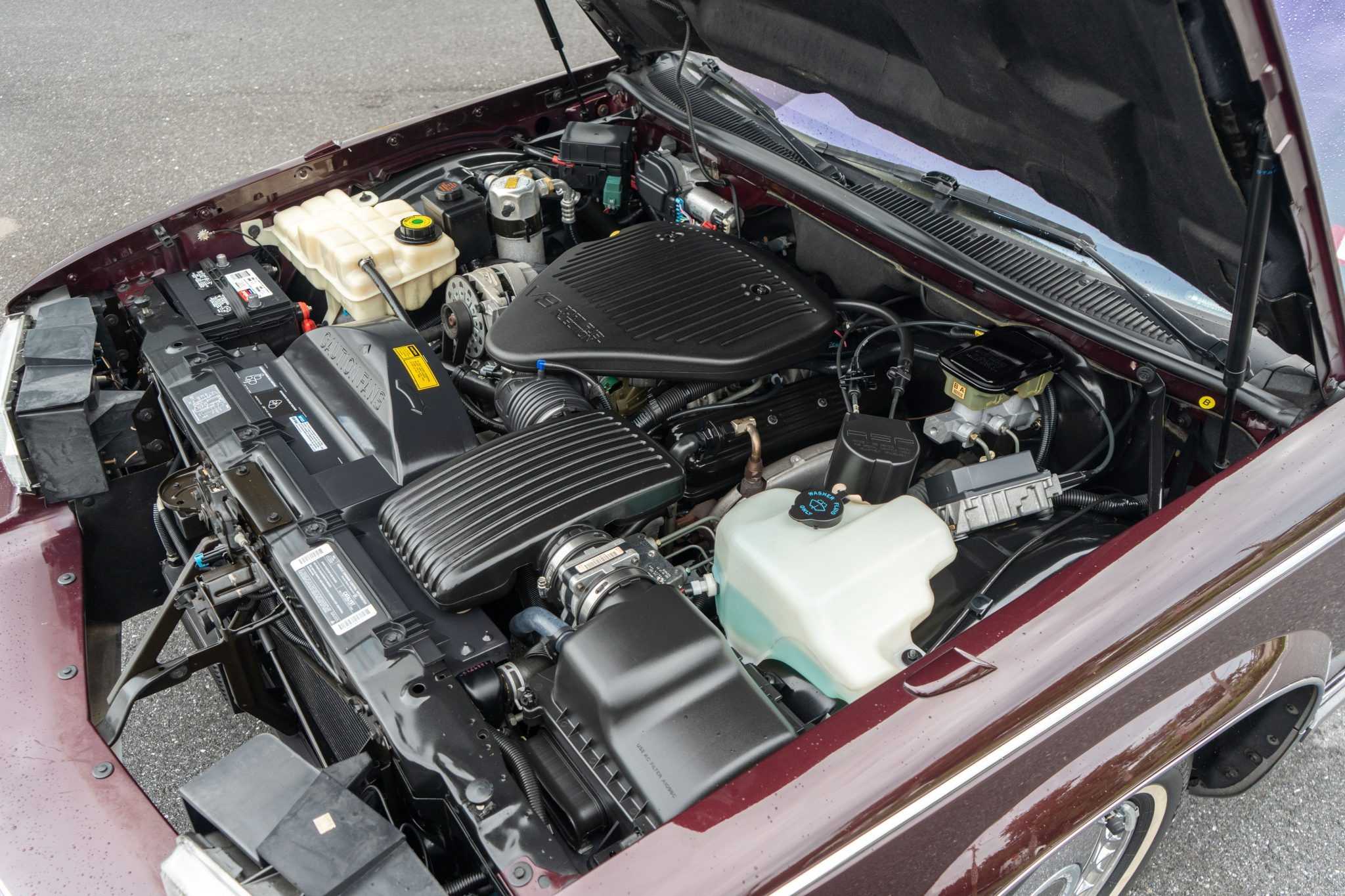
Perched under the hood of this one is an all-iron 5.7-liter LT1 V8 engine, a variant of a powerplant perhaps more famous for its inclusion in the Chevrolet Corvette. You’re looking at 260 horsepower and 330 lb-ft of torque here, and delivered with the smooth ride these old boats were known for. Power reaches the ground through a 4L60-E four-speed automatic.
What’s neat about this Fleetwood is that it was supposedly ordered new with the optional trailering package (RPO V4P), which included an upgraded primary radiator fan, a secondary fan, a beefed-up radiator, upgraded suspension, and new gearing. This pumps towing capacity up to 7,000 pounds. But here’s where things get weird.
European trailers also have a different, more unfortunate-looking towbar than Americans have. To hitch the camper to the Cadillac, the Cadillac has a European-style tow ball slid into the American trailer hitch. Then, the wiring just hooks right up.
The Catch
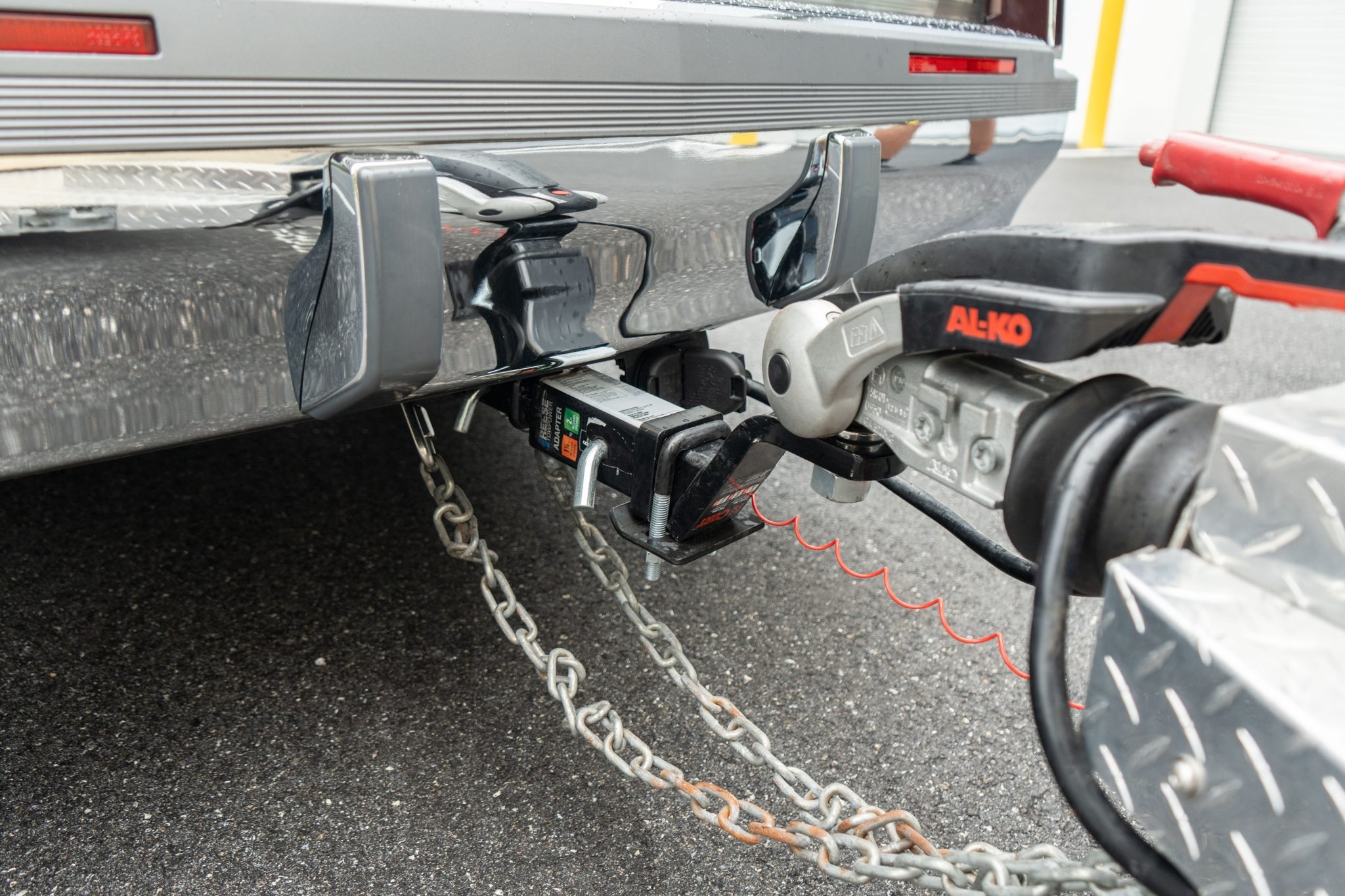
While I was admiring the hitch setup, I noticed that the trailer hitch has a 1-1/4-inch to 2-inch adaptor on it. This doesn’t make sense to me because if this is equipped to tow 7,000 pounds, then it should have a two-inch hitch receiver. If you look deep into the photos, you’ll notice two things. The first is that the car has a mechanical radiator fan, which is a component of the factory trailering package that isn’t a component of the standard car.
But then, you’ll look at photo 499 (below) and see an aftermarket Curt Class 2 hitch on there with a weight limit of 3,500 pounds and a tongue weight of 350 pounds. So, this car does have the upgraded towing package, which puts its limit at 7,000 pounds, but it can’t actually tow the weight because someone installed an undersized trailer hitch.
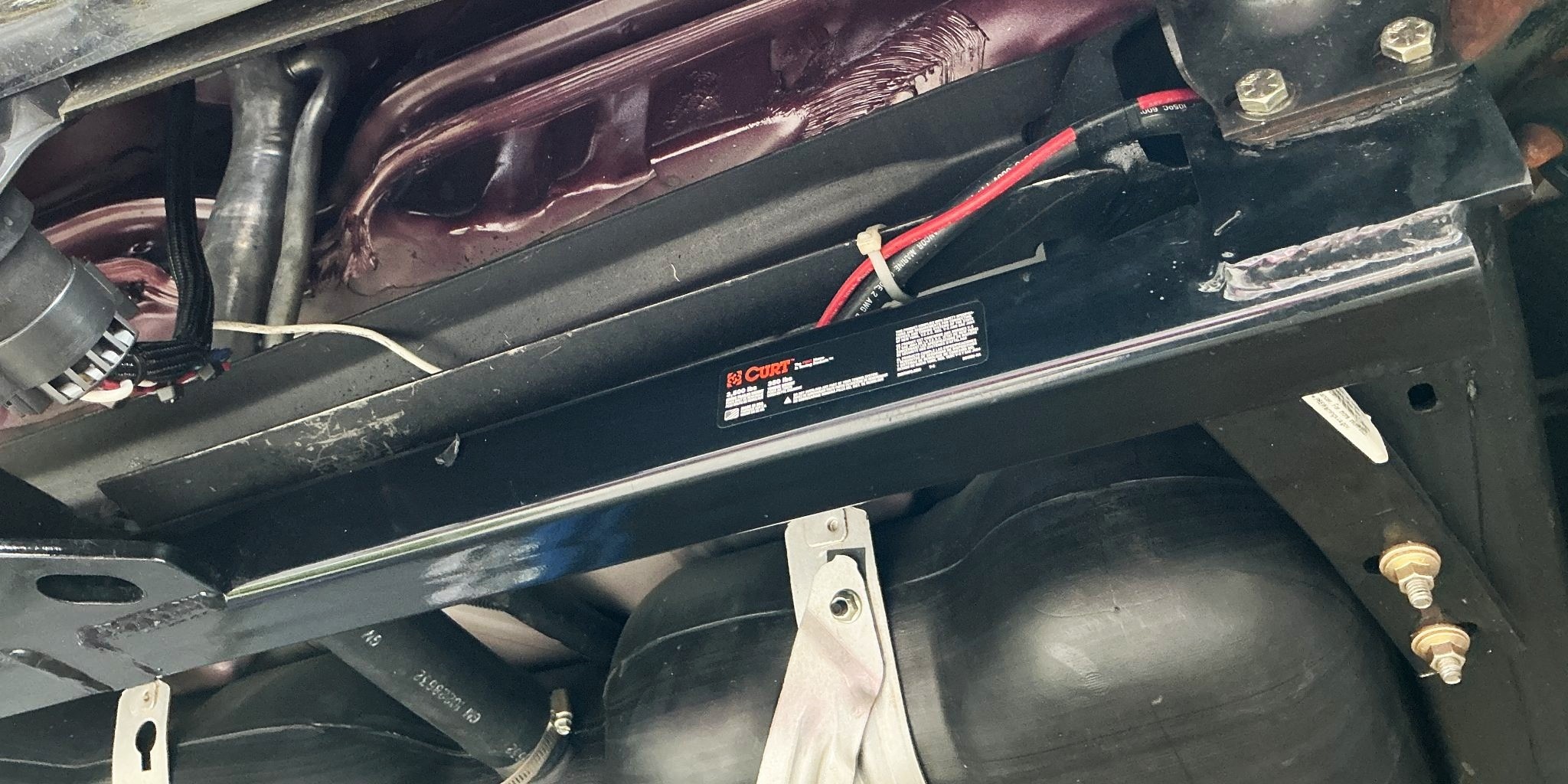
This is important because the base weight of this trailer is around 1,700 kg, or 3,747 pounds. This is based on other examples of the Baronesse 740 that I found for sale in Europe. That means this trailer hitch could be overloaded by 200 pounds with nothing in the trailer. Now, deleting the propane system has removed some weight. So, let’s be generous and say that it weighs 3,500 pounds. That would mean the hitch is exactly at its limit and overloaded the second you put anything in the trailer. The gross weight of these trailers is 2,000 kg, or 4,409 pounds, which is 900 pounds over this hitch’s limit.
But these are guesses at best, since the only true way to determine trailer weight is by going to a scale.
Thankfully, due to the weight distribution of European campers, this setup is within tongue weight ratings of the hitch. However, you should not be overweight on even one metric when it comes to towing.
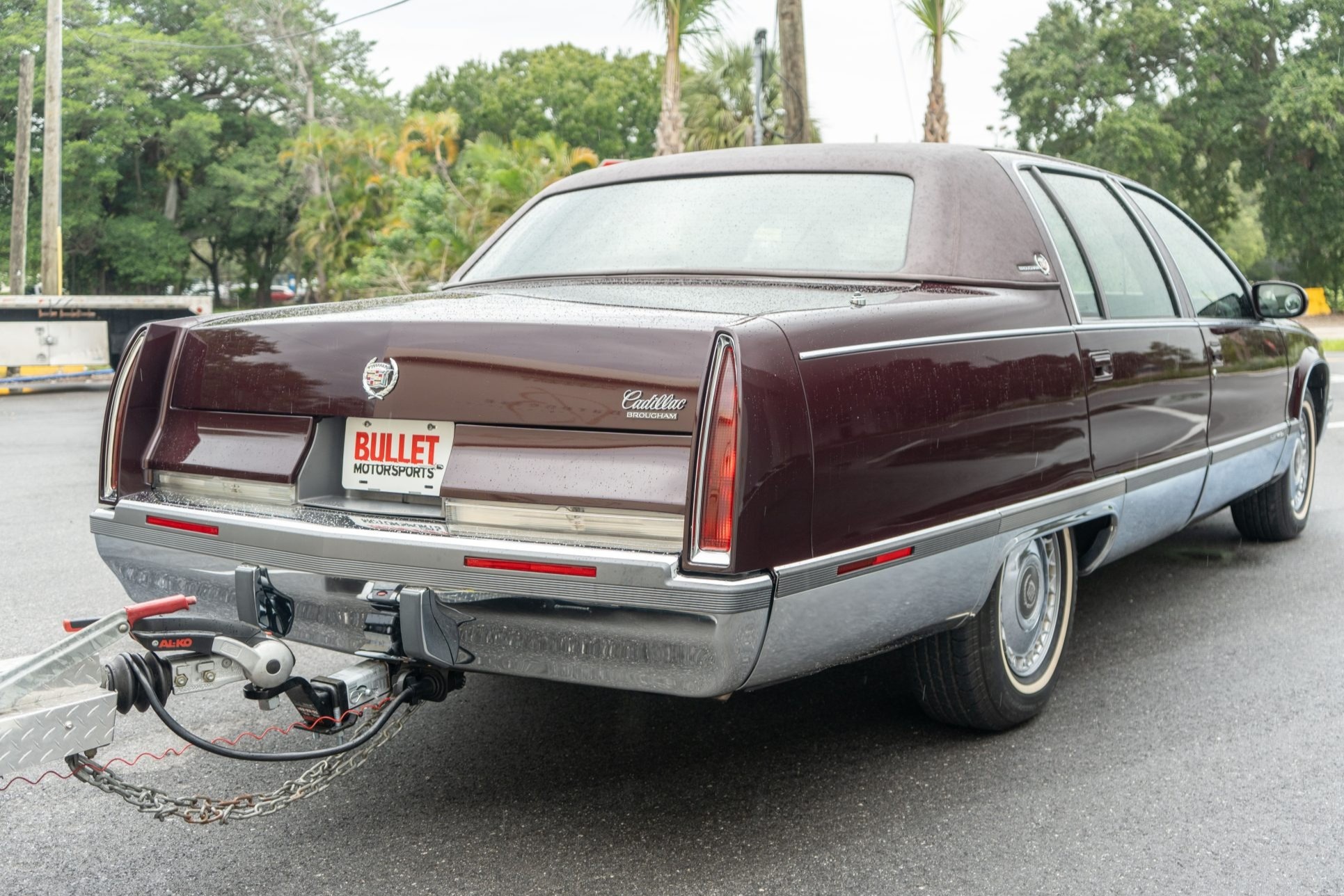
When I asked the selling dealership about this, my question was countered with the explanation that the car has towed the trailer for 5,000 miles like this. Admittedly, I’m not at all a fan of that answer, so I’ll give you a better one. If you buy this, the first thing you should do is dump that underrated hitch. That’s an easy fix for my complaint.
Okay, now let’s get back to the fun stuff.
One big highlight is that the car has only 11,000 miles on its odometer, which is pretty neat! It’s said that the trailer and the Cadillac have driven about 5,000 miles together, including one trip to Nashville, Tennessee. So the big Caddy isn’t just for show!
A Fun Way To Ride
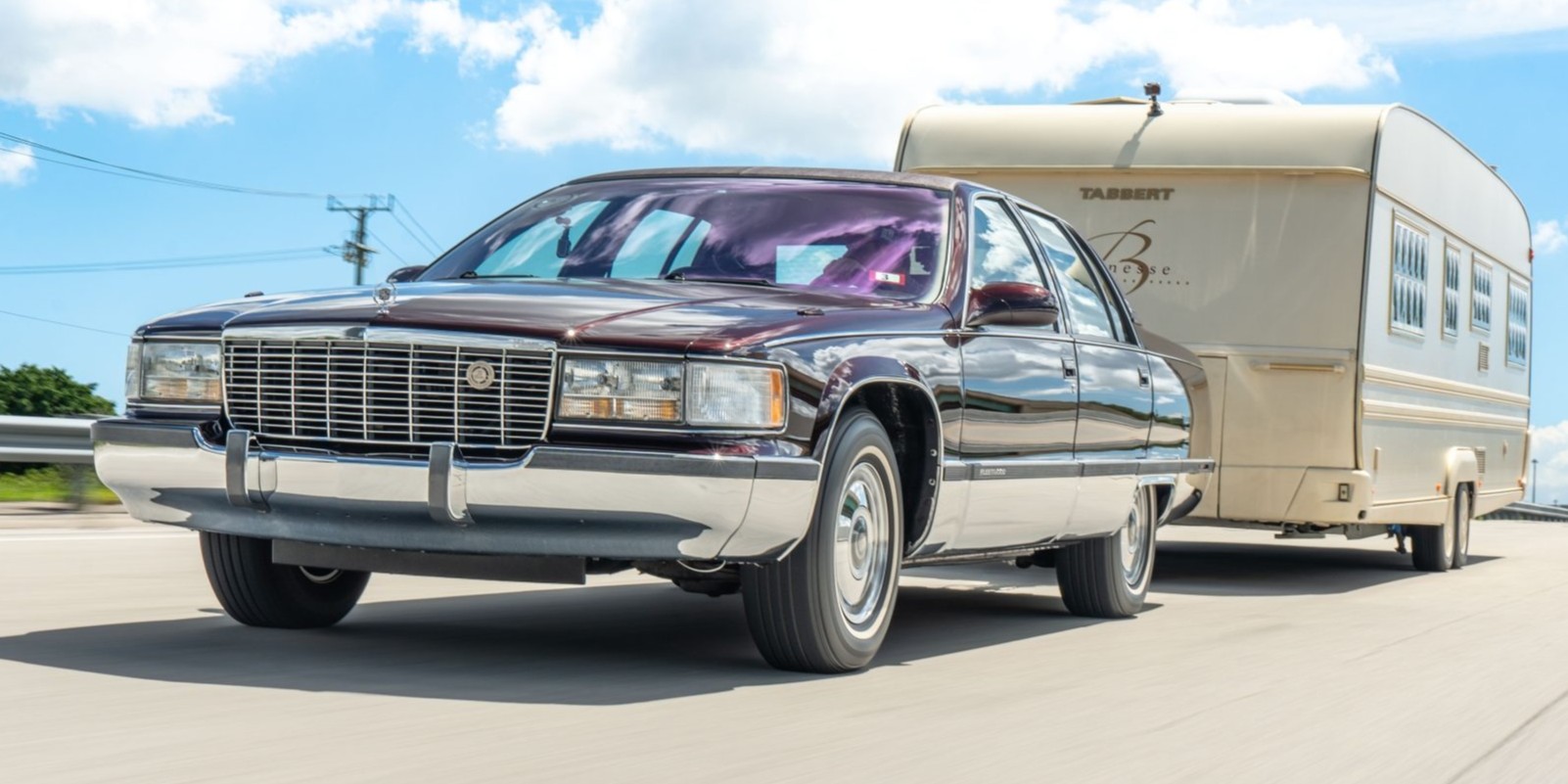
This is honestly a weird pairing. The camper looks like something out of the 1970s or the 1980s, but it was actually built in 2002. That makes it younger than the car towing it. I’m not even sure what would be the proper car to hitch up to this trailer, but the visuals of a big Caddy towing a German camper are pretty awesome to me.
Sadly, if you’re looking for just the Cadillac or just the camper, you’re out of luck. They’re being sold as a pair. As of publishing, the listing is at $7,600 with four days to go on Bring A Trailer.
I love how this pairing tickles two of my soft spots. I absolutely adore this era of General Motors, when it built massive cruise liners of cars with huge V8 engines and benches as comfortable as a sofa. Likewise, I love looking at and learning about weird campers, and this is definitely a weird camper. I hope whoever wins this auction keeps the two together, because what a wild sight it must be to see this going down the road.
Top photo: Bullet Motorsports via BAT





If towed as this trailer needs to be lest the tail start wagging the dog, aka at less than 60mph, that setup is perfectly fine. Because Americans are idiots behind the wheel, American hitches are ridiculously underrated and overbuilt.
I sure hope this dealership stresses to the buyer how differently designed this trailer is to anything American in terms of how fast you can go dragging it around.
I like the car and the trailer is quite wonderful if that fits your style.
For my tastes I’d look at the trailer as a rolling shell and start again on the interior.
This may seem like sacrilege to some, but geez.
This really makes me
Miss gas cars.
The standout to me is how rust free that trailer is underneath.
Because it wasn’t made in the US.
Want quality? Buy foreign.
So if you call that a camper, what do you call a camper trailer? e.g. something like this https://www.austrackcampers.com.au/product/simpson-x-rooftop-tent-camper-trailer/?_gl=1*6jnixa*_up*MQ..*_gs*MQ..&gclid=Cj0KCQjwgKjHBhChARIsAPJR3xfje5hqE5vLUKqWECW6XW_0JwZ06TlYv5ReYL73Bq4M5PQOOvm72vkaAp92EALw_wcB&gbraid=0AAAAADNHgXXxONxt5grnjS90KKeIFGofQ
If I was gonna tow anything behind a Cad, it would have to be a Bounder.
Maroon?
I see a chocolate brown interior. A super cozy chocolate brown interior.
A reminder that EU towbar weights are lower than ours. Typically 5-7% instead of 10-15%. At 5% of 5000 you are only looking at 250 lbs tow bar weight (sans lever arm increase from the adapter). However, low tow bar weights also mean you can’t travel as fast – which is why EU limits are far lower for towing – so while the weight wont likely be an issue, US highway speeds are certain to eventually spell disaster.
EDIT: missed this.
“Thankfully, due to the weight distribution of European campers, this setup is within tongue weight ratings of the hitch. However, you should not be overweight on even one metric when it comes to towing.”
If “Former Soviet Bloc” were a style, that trailer interior is it
It seems odd to sell such a hitch in 1.25″ for a vehicle with that much space and capability. I have a 2″ on my GR86 for a bike rack and small utility trailer. I had a 1.25″ for the bike rack on my Focus ST only because it had to be small to fit between the bottom of the bumper cover and the stupid center exhaust and the rack moved a lot more than it does on the 2″. I get that torque is different to vertical load, but it’s still a large difference in strength.
I hate having to have a 1.25″ hitch for my bike rack, never mind actually towing anything.
A truly entertaining find. These old Caddy’s never got the best gas mileage on their own. I wonder how many feet/meters it gets per gallon/liter?
I had a 1996 model all during college and for a few years after, it would do a good 25 mpg in sustained highway cruising, but around town was more like 15 or 16
That sounds about right. I had a 1990 with a 350 (black with grey velour) and it got about that mileage.
IIRC, only the Fleetwood has this higher tow rating, supposedly due to the longer wheelbase than the B-bodies. I had a Roadmaster wagon, and even with the tow package, 5,000 lbs was the limit, and that was the case for the sedans, too.
If I had RV parking (it’s bad enough owning such a depreciating asset – I simply will not pay even more for RV storage, which is expensive locally. A fellow Burner I know, who was a millionaire, stored his RV all the way out in Lancaster. I am NOT doing that.
“Apparently, this made them quite popular among wealthy Romani traveling communities.”
If Brad Pitt’s character in Snatch had ordered this for his mom, it’d be periwinkle blue.
I’ve never understood cooking in a camper. We always cooked outside when camping as a kid. The only time we used the stove was one particular trip where it ended up raining almost constantly for a whole week, and that was only after we ran out of bread to make sandwiches. That one time we used it, it made a real mess.
I get having a spacious, quiet, cool/warm place to sleep. I even get having a microwave if you want to warm something up that you precooked. But the last thing I want to do when camping is cook inside. Even at Burning Man in 100 degree heat, cooking outside is so much nicer – in fact, when I redo my back patio, I’m considering putting a small kitchen out there with a couple bar stools instead of just the grill that’s there now. That grill is already plumbed into the gas line and I’ve got electrical on the pergola a few feet away.
Living in SoCal, I pre-cool my house during super off-peak and off-peak hours so I can not run the A/C downstairs between 2pm and 10pm. (We have a separate unit for the upstairs, which is where I moved my parents to, and they do usually have to run it during peak times unless there’s a nice breeze blowing, but they keep it set at like 78 anyway.). That usually is fine, unless we do some cooking in the kitchen – then that whole side of the downstairs gets unpleasant if we do that.
If we’re eating something I can grill, that’s fine, but usually people want to eat some side dishes – though frankly if I’m eating an 8-10 oz piece of meat, I don’t really want anything else – thank you compounded semaglutide! But if I could cook everything outside, I wouldn’t cook inside in the summer at all.
I would love to see you cook shower spaghetti on a grill. Go ahead I double dog dare you. Lol
I mean, the garden hose is long enough and I could hang the nozzle from the pergola…
Do I want to know what “shower spaghetti” is? Hopefully not literally spaghetti cooked in a shower stall, because yuck.
The first few google results were, uh, disturbing.
That was a great read, Mercedes. I then fell down a rabbit hole in Wikipedia and read up on the Roma diaspora. Over 1 million in our country. Fascinating to read about the caravans. They are not considered RVs by any stretch. Thanks!
Jospeh Mitchell’s “Up in the Old Hotel”, a collection of his long-form magazine articles from the early 20th century, goes into great detail on the Roma, their culture and practises during that time. Fascinating reading.
So the interior is, shall we say, “taste specific.” I’ll at least give it credit for being unique. I do love the nice big awning that goes across the entire side.
As I type this the bid is up to $8,888 which I feel like is worth it just for the car alone. That thing really is a time machine.
“My Cadillac has a Corvette engine!”
Calm down.
It’s just the same GM small block as every other big RWD GM sedan, wagon and mullet-mobile from that era.
If your engine doesn’t have the four-bolt main caps – and you didn’t swap it in after the car was built – you got nothing special.
As far as an unusual tow setup – Not even.
My Grandpa was towing his 28′ Airstream with his 1971 LTD Brougham hardtop sedan – just like 95% of the other trailer towing people back then using their everyday RWD sedans and wagons to tow.
This would really be sweet with a 6.2 DI LT and a 10 speed auto.
Back before everyone thought they needed a gigantic pickup truck to tow a utility trailer.
My grandfather used to have my uncle tow his 30ft wooden CrisCraft to the marina and back every year to be put in and hauled out with his Series Land Rover. At about 5mph in low range. That was a tad extreme, but you use what you have.
It does seem strange that the Caddy would have such low miles and a replacement engine. (I will not make any jokes about getting gypped…)
The windows on that caravan are quite trippy looking. Am I the only one seeing the bubbly texture? 3d windows, interesting.
I thought they were glass block! The pics unfortunately don’t show you what they look like from inside.
Like most European trailers, they’re plexiglass or “Perspex”. Most are bubbled out at the edges with a gently curved main area. (Sometimes you’ll see these on various ultra-light trailers in the US now, usually teardrops and the like.) These just have a pattern of square sections formed into them for a different appearance.
I’d rock this for a sub $10k price point for sure.
That gilded trailer conjures up a mobile Oval Office.
Glad I wasn’t the only one thinking the interior design looks like it was done by the grifter in chief.
Mobile-Mar-a-Largo.
I had an old ’74 Caprice wagon with the trailering package, and it was basically a truck chassis underneath. Huge stacks of leaf springs, a monster diff, massive trans cooler, and a 454 straight out of a C30.
Too bad trailering with a car is pretty much passe now.
I would love to replace my wife’s QX56 with something exactly like that for a tow rig for our camper.
Best of all, so would she. Now all I have to do is figure out how to find one and buy one.
Check out the Vista Cruiser in the auction Mercedes wrote about this week.
https://www.theautopian.com/a-cardboard-magnate-spent-decades-overpaying-for-cars-to-help-people-in-need-now-hes-selling-all-1300-of-them/
Oh, I did. It’s at the top of the list on the page. It’s the only car I showed my wife, like a dummy. LOL
Eventually she woulda found out.
Leaf springs were standard equipment on big body on frame American sedans and wagons back then.
So were big diffs – and your “Turbo-Jet” 454 was a regular factory option for Caprice, Impala and Bel Air. Yes, you needed the heavy duty suspension, alternator and cooling systems to handle the biggest loads – but that wasn’t totally unusual back then.
Here’s the 1973 Trailering Guide which shows all that – Nothing much changed for ’74. You could literally order your car equipped from the factory with most equipment you needed – and you dealer would add the rest of the little bits – such as hitch, mirrors, wiring harness and compass – from the parts department. It’s interesting to see that BelAir/Impala/Caprice sedans and coupes had higher max tow ratings because they would be equipped with dual exhausts – Something your wagon couldn’t fit due to the clamshell tailgate.
https://www.lov2xlr8.no/brochures/chevy/73chev/73chev.html
I remember those giant chrome trailering side mirrors that were for temporary use only.
The towing package on those Fleetwoods, and on their slightly shorter Caprice and Roadmaster cousins, included cooling upgrades, suspension improvements, and a different rear axle ratio, but NOT a hitch receiver. To actually tow something, a buyer would have to get the receiver from a third party. Ones that are Class III and fit have been out of production for years, but were not all that common 30 years ago, so are fairly rare. But you can still buy brand new Class II receivers for D or B body GM cars. I suspect that whoever put the hitch on the Caddy probably did it fairly recently, after the more capable hardware was long gone.
That is the strangest option. Everything you need to tow, but you can’t tow.
Ironically, my Roadmaster without the tow package has a Class III receiver, and the one with the tow package hasn’t ever had a hitch.
Trucks of that era were the same way. My dad bought a ’95 Chevy K-1500 with the tow package, and then took it to a trailer shop to have a hitch installed.
You always had to get the hitch installed by the parts department – nothing changed over time.
It depends on vehicle. The Z82 tow package on the same year C/K truck included a hitch receiver and trailer wiring connector. Those have GM part numbers. But those are strictly aftermarket for B/D bodies.
Trucks clearly had different options availability from passenger cars.
For example – you also had to specify a rear bumper for trucks either from the factory or from the parts department – but not cars.
And for light duty you could usually just install a ball receiver on your truck’s rear bumper in front of the license plate on what would have been the rear step – but not cars.
Most folks understood these things at the time.
Interdasting. My dad’s ’95 K-1500 with a tow package, did not come with a hitch. I remember going with him to the trailer shop to get one installed.
This is correct, my Fleetwood had the full towing package, but no hitch.
I do have a Curt Class III on my Crown Victoria right now that was put on a couple of years ago, I wonder if that would fit? You’d have to drill holes in the frame to attach, but the Panthers require that, too
Nope. I put one of those onto my Country Squire. It’s totally different bracketry and different proportions. The wagon installation is slightly different than sedans, but the receiver is the same part for all Panthers, all years.
Also those receivers are still being sold new (cops could still buy CVPIs, many of which needed receivers for doing cop stuff, for a decade and a half after the final B body rolled off the line. And Ann Richards was no longer in the same position to extort GM…”, so I would think that if the manufacturers could sell more products by adding another entry to their fitment guide, they would have done it by now.
Fun fact: Panther frames were substantially the same for all three generations across the model run. Horsepower increased during that timespan. So why did the tow capacity rating drop during that time? Because Ford wanted to sell more trucks.
I’ve towed overweight, and I’ve installed hitches on vehicles with no factory tow rating. I was younger and dumber then.
Now I’m older and wiser. If something bad happens with this rig, the lawyer for the injured/deceased is going to make a beeline for that hitch. While there is no off-the-shelf hitch for this application that is rated over 3500/350, there are specialists who can build one and certify it. Do that.
No problem just got to go to the handymans secret weapon. Duct tape. I’m pretty sure a couple of layers of it would solve the issue. I am wondering how exactly these campers are set up when camping, white leather yikes, so that they don’t tip when you move past the wheel base.
There are likely jacks at all 4 corners.
Have some music links;
https://www.youtube.com/watch?v=6UCEA_ls89M
https://www.youtube.com/watch?v=0llCy0p_rB0
There is more but my computer is being astoundingly annoying, my broadband provider has fixed things, and remotely broken them!
https://www.youtube.com/watch?v=o6jwvS0mHwo
https://www.youtube.com/watch?v=O2FY8bhNRfk
https://www.youtube.com/watch?v=bOHdYA0XvAY
The caravan/car combo cannot be driven without this!
I thought “Gypsy” was a slur now.
It’s not that simple. Much like our indigenous folks here in the states, there’s historical and legal reasons why one might choose to use “Gypsy” or “Indian” for themselves, yet still not at all be enthusiastic about you saying it about them.
I think Mercedes shows outstanding craft in her writing here—when it’s her voice it’s Roma or Manouche, but she’s not taking words out of, or putting them into, others’ mouthes. The right way to do things with love and respect.
+1 for calling out how well the writing handles it. It’s an easy minefield to walk into, but I think she avoided stepping on anything.
So we have the N word the I word the G word…
I think I’ll stop right there.
“Now”? Nope, it’s *always* been a problematic label, just that there’s greater awareness thereof today, people just weren’t listening back in the day.
Like Spopepro said, it’s not that simple. And, yeah, seconding what Spopepro said, especially about how Mercedes wrote the article.
It’s hard to have sympathy for people who make a living preying on that sympathy:
https://www.europarl.europa.eu/doceo/document/B-9-2022-0120_EN.html
https://www.cbsnews.com/sanfrancisco/news/bart-panhandlers-begging-roma/
https://www.bbc.co.uk/panorama/hi/front_page/newsid_9618000/9618038.stm
Not all Roma (or travelers) are Gypsies. That moniker is earned.
Uhh, that’s rather tarring everyone with the same brush…
How? As I said the moniker is earned, not given.
Hate to break it to you but, if you’re talking about the “gypsy” moniker, saying “the moniker is earned, not given” is just another way of saying slurs are “justified” for those who “deserve” it.
I’m sure by now I’ve earned my own derogatory moniker in your eyes. If so my point has been proven.
Guess how I can tell who in this thread has never been unfortunate enough to have to conduct any sort of business with a gypsy.
Stereotypes don’t just come out of thin air. And no one knows that better than a white southerner like me. As I always say, I may not be the stereotype, but if you want to see what it looks like, come to a family reunion with me sometime.
No those stereotypes do not come out of thin air. And my point is only those individuals who do those bad things should earn the moniker, not everyone who happens to be of that group.
I have had numerous experiences with Romani people, and they have been with them asking for money, “borrowing” your Sam’s Club card to “activate” their pump because their card isn’t working (and charging their tank of gas to the sucker’s card), playing awful amplified violin music for money, “blessing” people’s money and then leaving town, or swindling tourists. With all due respect to the honest members of their ethnic group, their reputation is well-earned.
The honest members are Romani. The ones you are talking about are Gypsies.
Never mind “tramps” and “thieves”
And “Bums”. I think “Hobo” is not though. Why? Because:
“A hobo is a migrant worker in the United States. Hoboes, tramps, and bums are generally regarded as related, but distinct: a hobo travels and is willing to work; a tramp travels, but avoids work if possible; a bum neither travels nor works.”
https://en.wikipedia.org/wiki/Hobo
I do fear you missed my joke, if you are unfamiliar with the workings of the great lyricist Cher.
It’s getting a little bit heavy in the comments below and I have zero desire to wade into it.
Cher isn’t on my play list.
‘Gypsies, Tramps and Thieves’ is a song of hers from 1971. There was no such thing as a play list.
Anyway, I was only trying to lighten the mood, but I will stand down.
No problem. I was only saying that I have David Tracy level unfamiliarity with Cher’s music, save for one or two songs that were absolutely omnipresent in the 80’s and 90’s which I still sometimes hear in grocery stores and elevators to this day. Had the topic been time travel to the past I’m sure a Cher reference would have needed no explanation.
I’m pretty sure Gypsies, Tramps and Thieves is one of the handful of Cher songs that’s constantly piped into grocery stores these days, its maybe one of 2 or 3 that I can name, anyway. I’m not exactly a fan, but some things are so omnipresent in the culture that you pick them up through osmosis
Maybe. If so I haven’t noticed.
You are missing out. She is quite talented.
No doubt.
To the gypsy that remains
Faces freedom with a little fear
I have no fear, I have only love…
Depends where you are in the world. Here’s how confusing it is in Devon, UK.
https://www.devon.gov.uk/support-schools-settings/inclusion/ethnically-diverse-education-achievement-service/gypsy-roma-traveller-showmen/grts-one-minute-guides/example-grts-omg/
In my experience “Gypsy” is the same no matter where you are:
Shortly after I moved to San Diego in the 1990s the local news put out a PSA that two major Gypsy families were returning to their historical winter camps in town and to be on the lookout for roofing scams. That particular “Gypsy” behavior was to prey on older folks by knocking on the door and offering their services as roofers at a low price. They’d take the deposit, rip off the old roof then ask for another payment and materials costs. Once paid they’d abandon the project, leaving the elderly homeowner with no roof and winter approaching.
Of course that was the only time I heard such a warning. After that year no such announcements were made. Why? I doubt it was because those families had a change of heart.
Another example I am familiar with was an old man in Sacramento living alone targeted by a young “gypsy” woman. She wormed her way into his heart, then his home and brought her entire extended family with her. They pressured him into remaking his will to leave everything, including the house to them instead of his biological children. IIRC there were local news reports about the ongoing legal battle but AFAIK the woman and her family eventually won. It sounded like a very messy situation. I remember driving by the house and marveling at how incredibly tacky and run down it looked. It was as if they had made the house gross on purpose.
And then there are the numerous reports I have seen over the years like the one I posted above detailing the organized begging here in the SFBA with the beggers living a far more lavish lifestyle than those they beg money of are lead to believe. A BBC report claimed gypsys in Britain went so far as to have excess children to milk the benefits system. Those kids are then used as props for begging rather than being sent them to school. Most of the money begged is sent back to the family estate in eastern europe.
In Paris I was warned to stay well away from the kids begging in front of Notre Dame. There the kids would approach you holding trinkets on cardboard sheets. They’d press into you and use the cardboard to cover their hands as they picked your pockets. I heard of that also happening in Barcelona.
I’m aware there were other reports denying this and I see how this polarized view reflects the political climate. A similar situation happened in Sweden where I saw the begging with my own eyes, heard the experiences from my relatives there, their frustration at how the government of Sweden adamantly denied any such problem existed (because they were responsible for opening the floodgates) even acting to suppress reports of problems till the situation spiraled out of control. That situation was complicated by the influx being not just Roma and the labor policies giving immigrants fewer opportunities for honest work. Still it was Roma I saw begging, not Syrians, not Somali.
Everyone should thank engineers for adding in a factor-of-safety.
Should be about 3 for this type of application.