


Unpainted aluminum is a deeply underrated material to cover the exterior of a camper with. Aside from standout companies like Airstream or Bowlus, most companies hide the beauty of aluminum under layers of paint. Usually, if you want the beauty of shining aluminum, you usually have to buy something like an Airstream. But here’s a weird alternative. This is the Sport King Coach, and it’s a surprisingly nice example of what truck bed slide-in campers looked like in the 1950s. Not only does it have a polished aluminum exterior, but it won’t even cost you $10,000.
For the first few decades of the 20th century, the RV industry was young, experimental, and highly regional. As Hemmings writes, there were only 48 registered RV builders in America in 1930, and most of them were regional builders that cranked out small handfuls of campers. There were house cars, camper trailers, and tent trailers back then, and they were often weird and quirky because there really weren’t any standards in those days.


The Great Depression became a great boon for the fledgling RV industry. Countless Americans looking for work either purchased a camper or built their own and hit the road, looking for work. The Covered Wagon Company, often noted by RV historians for creating America’s first mass-produced camper in 1929, spent the 1930s cranking out about 10,000 units a year.

Another RV industry wave rushed in after World War II. Americans with cash to spend, ever-expanding roads to drive on, and cars in their driveways started buying campers to experience the open road. It was in the decades immediately following the war when brands like Shasta, Winnebago, Airstream, Silver Streak, Serro Scotty, Spartan, and others cut their teeth and became American icons.
This post-war rush also led to the development of many “portable camp coaches,” or what we’d call truck campers today. This Sport King Coach is an example of what truck campers looked like when the category was in its absolute infancy. Campers like this answered the question about what would happen if you combined a travel trailer with a pickup truck.
From A Pioneer In Truck Campers
Pinpointing the exact first truck camper is difficult; however, most literature seems to point to two manufacturers born in the mid-1940s. Over in Michigan was Howard Cree. In the mid-1940s, he owned the Cree’s Log Cabin and Trailer Court RV campground as well as a trailer dealership near Detroit.

After World War II, Cree owned a Ford dealership and wanted to capitalize on America’s newfound desire to go camping. Inspired by some of the custom builds that he saw at his campground, he cooked up an idea to make a new kind of camper by combining a pickup truck with a camper trailer. The Cree Pick-Up Truck Coach was born and displayed at the Navy Pier in Chicago in 1945.
Technically, Walter King of California beat Cree to the punch. As the book ‘Mobile Mansions: Taking “Home Sweet Home” On The Road‘ by Douglas Keister notes, King grew up in Boys Town, Nebraska, and then ventured his way to California in the late 1930s. It was out there in the Golden State where King fell in love with the outdoors. Like many back then, King decided to hit the road by car and did so by building his own teardrop camper.

The event that would change his life happened in late 1944 when King and a couple of his friends hitched the teardrop camper to a pickup truck. The truck hauled the teardrop out to Montana, where the men enjoyed a hunting adventure. It was during this trip that the friends encountered an issue. The teardrop was a bit too tight for three men, their gear, and cooking materials. King looked at the truck and thought that there was a wasted opportunity. What if the truck became a part of the camper?
When he returned to California, King drew up a camper that would sit in the bed of a pickup truck. Sadly, as Mobile Mansions writes, King had to wait until the end of World War II’s hostilities due to the materials shortages. In just weeks after the war ended, King acquired supplies and built his first truck camper.
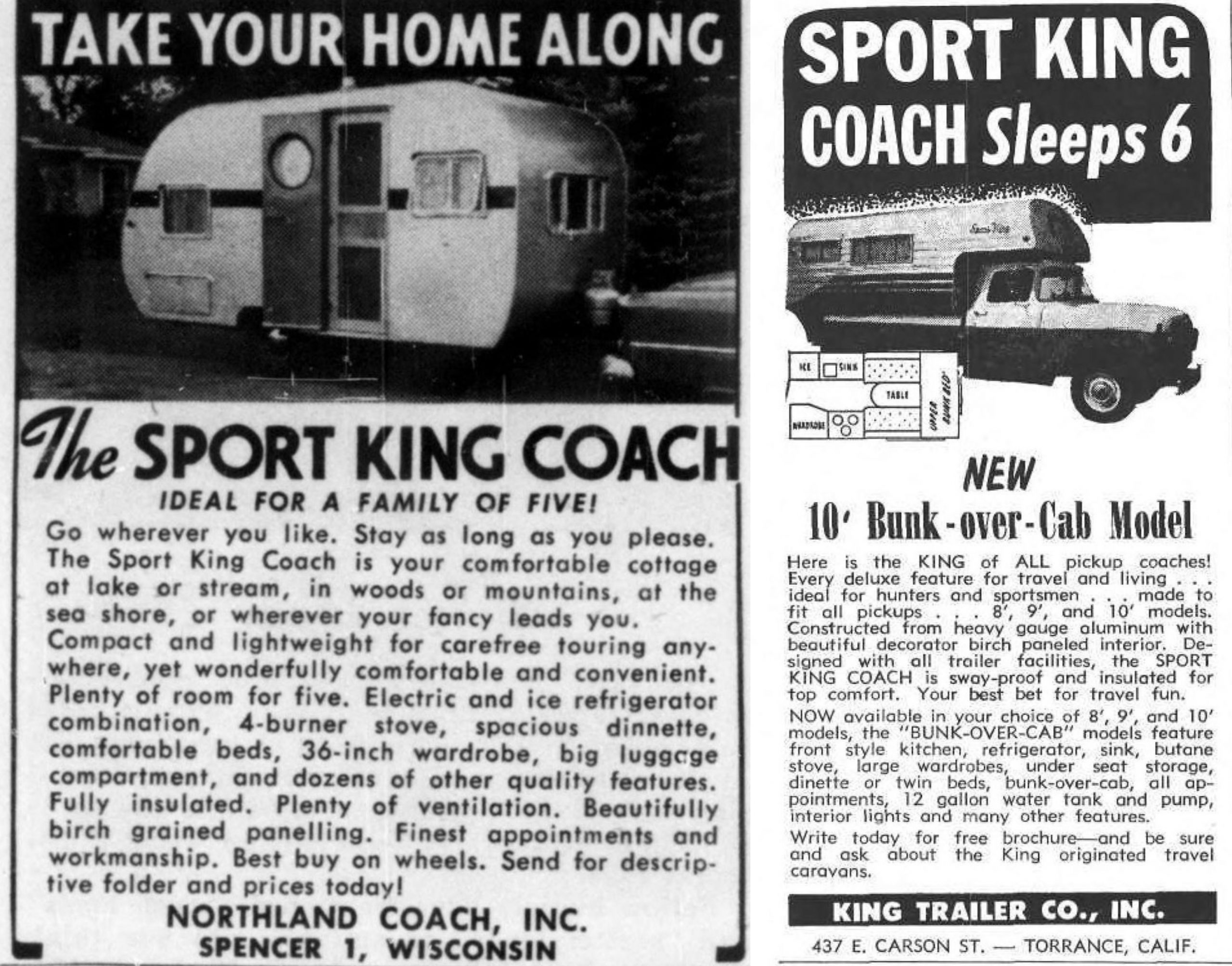
In building a camper on a pickup truck, King was able to create so much interior room that he and his wife were able to cook and sleep in a kind of comfort that the old teardrop just couldn’t match. During King’s first trip with this new camper, he and his wife crossed paths with a sheepherder who was so in love with the camper that he ordered five of them for a deposit of $500. Suddenly, King’s little homebrew camper became a whole business.
King would set up a production line to build these campers, and within a few months, the sheepherder and four of his pals paid the rest of the money before driving away with campers in the beds of their pickup trucks. As the five men traveled across America, so did the word of mouth about these new campers. Suddenly, King was inundated with orders to build more. King would also take his campers to an outdoor hobby trade show, where someone suggested that he could make his campers even bigger by building a portion of the camper over the cab of the pickup truck. King made it so.

It’s because of these events that many sources call Walter King “the father of the pickup camper.” He may or may not have been the first to build a truck camper, but he was one of the pioneers who made it popular.
King’s early campers were branded as Sport King Coach and were made by his firm, King Manufacturing. In the 1950s, the company’s line grew to include travel trailers. In the 1970s, Sport King grew further with motorhomes. The company would eventually go out of business in 1987, but it did manage to go out with a bang. In 1986, Sport King got the idea to make a camper for land and water. The result was the tubular Sport King Boaterhome, which you can read my story about by clicking here.
This Sport King

This Sport King Coach represents one of King’s early efforts before the Boaterhome, before the travel trailers, and before truck campers caught on as a category.
Period advertising said that Sport King Coaches were built out of heavy-gauge aluminum with birch-grain paneling inside and insulation sandwiched in between. In the 1950s, the Sport King Coach sold in lengths of eight feet, nine feet, and 10 feet, plus “Bunk-Over-Cab” models (which are similar to today’s truck campers) in the same lengths.

Features included a refrigerator or icebox, sink, butane stove, dinette or twin beds, 12-gallon water tank, a water pump, and an electrical system. That’s it. These campers were short on luxuries, but that was also sort of the point. King marketed these campers as being sturdier than a tent and roomier than a teardrop. But these weren’t exactly supposed to be glamping.
This particular example is an eight-foot model with a dinette. It’s otherwise incredibly minimalist inside with an icebox, but no stove or much else. According to the Instagram handle that I found in the camper, it had a previous life as the mobile taste-testing unit of the Boulevard Brewing Company of Kansas City, Missouri.

The camper was a part of the “BLVD Road Trip” of 2016 and 2017, where the brewing company drove thousands of miles across several states for taste-testing events. Prior to using this Sport King, Boulevard’s previous rig was a Volkswagen Bus. Imagery from that event shows that the aluminum was polished to a mirror-like shine. Today, nine years later, the camper still has a shine, but maybe a little less than a mirror.
Leftover bits from the camper’s beer tour include the display window on the outside and what appears to be two picture frames inside.
A Vintage Blank Canvas

What I like about this camper is that it’s a blank slate. The hard work has already been done for you. It wouldn’t be very hard to add a cooking surface, a basic water system, and even HVAC.
The seller, who is located in Kansas City, Kansas, wants only $6,900 for the camper, too. Sure, you could buy a fully-equipped used RV for less than this. However, this camper is a neat piece of history, one that looks rather smashing. It’s around 70 years old or older, and it looks better than many campers that are far younger!
The coolest part about this camper is that it’s sort of a time capsule into where today’s truck campers came from. The dinette up at the front and the facilities at the rear are still largely the template for truck campers today! It’s incredible that such a neat unit has survived until today. Now the big question is, what kind of truck would you put this camper in?
Top graphic image: Facebook listing


I’m a livin’ in a box, I’m a livin’ in a car.. aluminum box!
I like it. Throw some Tank 7 in the icebox and enjoy a weekend in the woods.
Makes me think of John Steinbeck’s Rocinante, probably the wrong year truck and not a 3/4 ton, but close enough for me!
It looks like the kind of thing with a wood stove for heat.
This would look perfect on my ’63 Ford Wrongbed.
Is it weird that I really want a Boaterhome?
There’s a feature on this Sport King drop in that really says something about the thought that went into their design. Over the windows and door is a sill that means rain runs around the cutout rather than over.
This is so cool.
I would love to put it in a restomodded Jeep j3000.
OR
I would put in a new 8ft box regular cab 4×4 v-8 f-150 if I could find one at a dealership or find a dealership that would order me one.
This would look out of place in anything but a regular cab truck.