

If I spend enough time on TikTok or Instagram, I’ll eventually get to one of those videos from the United Kingdom that shows people attempting to cross a flooded piece of road in their very normal, unequipped vehicles, only for their engines to suck in water and hydrolock, causing thousands in damage.
The tragedy of hydrolocking occurs because, unlike air, water can’t be compressed as easily by a combustion engine. The result, usually, is bent or snapped connecting rods within seconds of water entering the cylinder. Most of the time, that means complete and utter internal destruction, with an engine rebuild or replacement engine required.


If you’re lucky enough to have never witnessed a vehicle experience a hydrolocking incident, let me change that right now. The Bengregers YouTube channel is among the most popular of those documenting U.K. drivers’ bravery, leading to clip upon clip of hydrolocking sadness:
There are two ways to avoid hydrolocking your engine: The first, and most obvious, is simply not to drive in water. All of these drivers didn’t make it to their destination because they submerged their engine’s air intake—where the engine sucks in the air it needs to run—in water. With no air available, the engines aspirated H2O, leading to their demise.
The second, and only slightly less obvious, is to make sure your vehicle’s intake is above the water line. This can be done by having a vehicle that’s tall enough to ford the water without submerging the stock airbox (like a tall SUV or pickup truck) or by having a “snorkel,” a sealed piece of piping that extends from the intake to the upper part of the car—usually along the A pillar—that allows the engine to breathe air at a higher point. You’ll see this as an aftermarket upgrade on a lot of off-roaders, though some manufacturers offer it as an optional add-on. You can even spot one on this Toyota Land Cruiser in the above video:

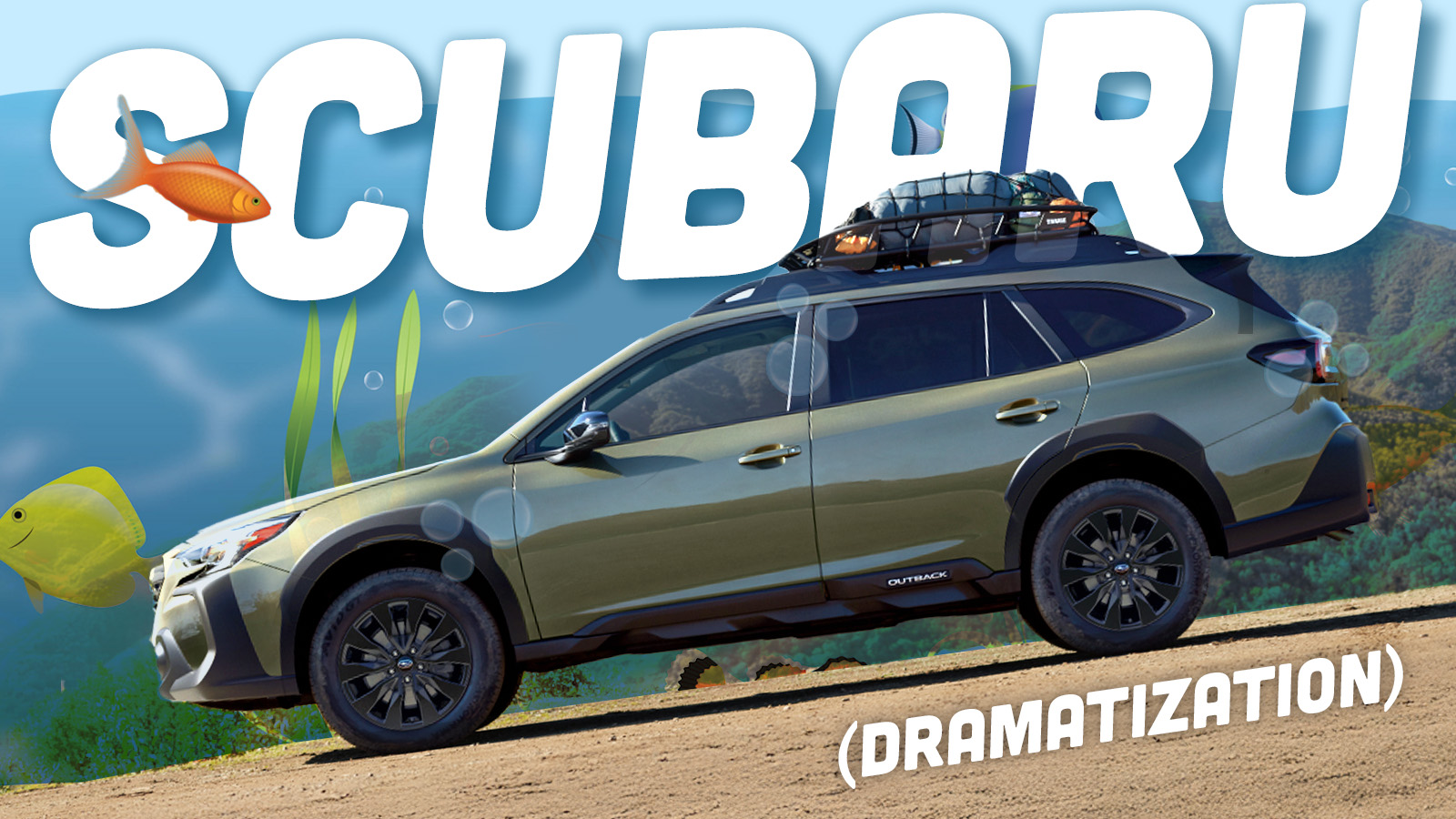
This brings us to this video I saw on the r/Subaru Subreddit. It shows what appears to be an entirely unmodified last-generation Subaru Outback fording a particularly deep (for an Outback) section of water in a grassy field.
What scares me most about this video isn’t the depth of the water—the Outback should actually have no problem fording water that deep, thanks to the location of its intake (more on that in a second). It’s the initial approach that frightens me.
The Outback comes in at a severe angle, dipping its entire nose, about halfway up the hood, into the water. The Ouback breathes through its front bumper, which means for about a second, the engine only has whatever air is trapped underwater with it to breathe, before the nose eventually comes back to the surface.

As the U.K. highlight reel above shows, it only takes a second or two of an intake being submerged for hydrolocking to occur. You also risk water intrusion into places like your transmission or differentials. Luckily for this driver, the Outback managed to drive away under its own power (until at least the end of the clip, anyway). I’ve reached out to the original publisher on Reddit to get more details, like why they’d risk something like this in the first place, and if the car truly survived unscathed.
Dipping your car’s nose into water like this won’t immediately kill the engine, obviously—if I had to guess, the engine was able to breathe in the trapped air from inside the bumper area for the split second it was under water, buying it enough time to get back to the atmosphere. My advice for anyone looking to try something like this: Just don’t! Your car might be fine, and it might look cool, but there’s an equal chance you could cause thousands in damage and strand yourself in a body of water.
Top graphic images: Subaru; DepositPhotos.com


There are underpasses in Houston where the depth of the standing water is displayed on essentially a big ruler and measured in feet. In some cases, at least six feet. Fortunately, I was never there when it was an issue. Personally, I would find an alternate route or a hotel room before going through any water that would reach the bottom of the doors.
Six feet is barely scratching the surface, lol. Some of those underpasses (that can comfortably fit 2 semis side by side) were completely full of water during hurricane Harvey.
I was in Beaumont during Harvey. I had to go out every two hours to drain water out of a saltwater pool to keep it from overflowing and killing the landscaping. We got 26 inches of rain in one day. 52″ over the week that it sat over SE TX.
My 1988 Corolla 4wd Alltrac wagon has a fairly low intake behind the drivers side headlight but also came with a purge tank in the air intake where any water that got sucked in would fall into a tank in the front wing that would drip out later while the air should go above straight into intake manifold. It was a typical Toyota overengineered invention for what was really just an economy car but gives you a few seconds of water ingress before causing hydrolock. Its why we have the Toyota Tax.
My brother drove our ’76? honda wagon through a deep puddle. The intake is in the fender. While it didn’t hydrolock, water did get in and bent at least one connecting rod. While we had that wagon our local Honda dealer (converted from motorcycles to cars) kept getting things :covered under warranty”. Head gasket, brakes, connecting rods, whatever, they just managed to cover our various “conditions”. Awesome dealer!
there was an article in BBC last week that there is a struggle in Nottinghamshire UK about whether to re-open Rufford Ford (in the video) after closing it in 2022.
The county council closed the ford after a motorcyclist broke his leg during a crossing.
It’s certainly a ruff ford.
If the arrow pointing to the intake is in the right place, it sure looks like that is at least partially submerged for most of the crossing. I think they were more lucky than good.
So, according to this video, a Model 3 tesla is just as good at fording water as a 80’s series land cruiser, Discovery 4, and other off roaders.
Interesting.
When there’s no piston engine and no air intake, it’s not super hard not to hydrolock.
I’ve done some pretty deep crossings in my BH Outback and it gets really scary when the water goes up to your hood. I do have plans for a snorkel for the future.
Man, I cringed when I saw that Subaru plunge. If I were forced to cross that I think I’d try it in reverse.
I did this in my MK1 Legacy. There was epic stopped traffic due to a rain-flooded street. I saw an Explorer go through the water and figured the depth was on the line of acceptable, so I’d roll the dice to get around the traffic seeing as the intake was in the fender, in a U shape with the intake up high, going into a box that then went into the airbox with the filter, then there was a few feet of piping to get to the manifold, which I figured would take more time for intrusion than I could make the distance across, but I was ready to kill the ignition if I heard any odd noise. Worst case, an engine was well under $1k and was several hours of work to swap. Kept a steady bow wave just at the leading edge of the hood and everything was fine. Well, almost. A year later, I had to replace the steering rack due to water intrusion. Wheel bearings lasted the life of the car, which was over 270k miles of heavy abuse. No electrical issues ever, less rust than normal (I filled the sills with rustproofing and undercoated the bottom every year). A Mitsubishi Eclipse that followed didn’t make it half way.
If the Outback is anything like my WRX, the intake goes into a sizable pocket in the wheel well that will trap the water before it gets to the air filter. It probably has a capacity of a couple liters.
I always wondered what that weird pocket was for until now.
Of course, it’s the driver’s responsibility to know if the water is too deep for their vehicle, but I think it’s pretty shitty for all these onlookers to just stand there and cheer as they watch people destroy their cars.
I wonder whether there are any signs short of the dip, “If you see water, do not attempt crossing,” or some such
It’s a ford, so there’s always some water there, but usually only a few cm.
The signs just say “Ford”, but there is a couple of depth markers so you can see how deep the water is.
Google maps view
Ok, I see. I’m not aware that we have these in the US. We put a big corrugated steel pipe across the gap and build a flat, level bridge around it across the top.
I imagine it does as others have said, act as a speed bump. Or a sleeping policeman.
I know of a couple in a state park in Illinois. But I agree, they’re exteremely rare here.
In the US I’ve heard them called “low water bridges” and see them pretty often in rural areas. They’re generally intended to be dry when the water is low enough – maybe some small culverts under them for summer water flows – but understood to be impassible or cross at your own risk when they are overtopped. (And I know directly of people getting killed trying to cross them then there is water flowing over them.)
*sees Ford sign*
*steps on brakes*
*looks around, sees nobody else*
Okay, technically this is a Subaru and not a Ford…but who’s going to report me?
*guns it*
Thanks for the link! There’s a yellow depth gauge on the edge of the water, so one could see the water depth.
I’ve watched cars kill their engine trying to ford that water years ago on a YouTube compilations reel, but didn’t dig further to see if there were depth gauge signs or folks were simply brave/careless.
“Cars? I’ve owned a few” mentions the depth gauge signs at many low lying passes below bridges in Houston. Those depth signs (like ‘rulers’) are common in Texas, per my experience, and are also found on desolate county or ‘farm to market’ (FM) roads, too.
Reminds me of the opposite at a railroad bridge, 11foot8.com
They even raised the bridge for more clearance and folks still get clipped:
https://www.youtube.com/playlist?list=PLcCSJS-W3H9pi_JqT77BgFBZIBNfQ4HFt
https://www.youtube.com/watch?v=mPUL2SQ77uQ&list=PLcCSJS-W3H9pi_JqT77BgFBZIBNfQ4HFt&index=8
Maybe the cheering’s a bit much, but I think if you see all those people there and actively decide to go through anyway then maybe you’re a bit of a knob.
I can remember water crossings in the national forests in my dad’s old early 1980s GMC S-15. Barebones truck with nearly no electronics, rubber and vinyl interior, so let the water come in the doors, we don’t care!
…nevermind that flooding can get suddenly and violently worse while you ford that innocent-looking stream across the roadway, carrying you away in your car. Flash Flooding is no joke. They keep telling us “turn around, don’t drown”…unaliving your engine or electronics isn’t the worst thing that can happen.
I don’t understand why the UK keeps their fords. They already know those places tend to flood, so why not elevate the road or build bridges? It’s not like they’re hurting for money.
Because its so damn traditional.
Cheap speed bumps?
they got most of their Fords as a company benefit instead of a higher salary
For spectator sport, entertainment value?
It’s not that it ‘tends to flood’, there’s a stream running through there.
Mostly around the country they’ve been replaced by bridges, but some routes are travelled so rarely, it’s never been a priority.
They’re also in rural areas where more people drive off-road capable vehicles, although I was always fine in my VW Polo, just got to make sure you get your entry speed right. Too fast and you’ll damage something, and send a wave over your bonnet. Too slow and water has a chance to infiltrate everything. Get it just right, and you produce a bow-wave which helps keep the engine dry-ish.
I believe this ford in particular already has a bypass route; this is only used to access various local homes and farms in the area, or if you’re too lazy to take the extra 5 minutes to divert your route and avoid ruining your car.
My take on water crossings, as a 4×4 guy, is that they are an occasionally necessary evil. Fine to do with regularity right up until you are submerging anything electrical or mechanical. i.e. below the hub. Anything past hub height is a risk and will decrease service intervals as a best case. Even with raised diff breathers, going through deep water has a good chance of letting water past seals where water ought not to be and would be hard for it to get back out. Cars = not water tight. There is precious little about any car that can actually be called water tight. I don’t put my car in water anymore than I have to these days.
I’m more or less comfortable idling through water up to the top of the tires in my old Jeep, with the air intake moved to the cowl and extended breathers, but I’m also a fool. I have been impressed that the almost 30 year old door seals will keep water out at a level several inches past the bottom of the doors, for at least 20-30 seconds of submersion.
If there aren’t immediate consequences for doing a deep dive like this, there will likely be, later. Just because one didn’t drown or hydrolock, so many bearings will show the effects later–think wheel bearings, water pump bearings, etc.
Gearbox and diffs usually have breathers on them as well so likely these parts are now being lubricated by a milkshake of oil and rust.
Oh my God, it’s a British counterpart to 11ft 8(+8). I had no idea this was a thing, and it’s beautiful.
The beauty of humanity is that we can learn from the mistakes of other members of our species without suffering ourselves.
The tragedy of humanity is that we often fail to do so, or that one member of our species gets lucky by fluke (see: most of these Tiktoks) so others will suffer trying to emulate them.
I don’t know if there has ever been a moment in modern history that illustrates more clearly that humanity has little to no ability to learn from the past.
I blame the village elders.
I would replace “elders” with “oligarchs”.
And the comedy of humanity is watching idiots in ICE cars trying to drive straight through 2-3 feet of water.
It goes without saying but water crossings are something you should avoid whenever possible.
I don’t care how nice your snorkel is, did you extend the transmission and axle vent tubes and run them up the entire length of the snorkel as well?
Because if not you could easily be driving with milkshake in your transmission and diffs without knowing it after a deep enough water crossing (which isn’t that deep).
I’m no car expert, but whenever I see some off-road YouTuber going into the drink, I always think about that one time Superfast Matt took his land speed racer to a flooded Bonneville a few years ago, before it had a body – and it absolutely covered the racer in salt and annihilated his RV.
I know, obviously, that wet, water filled Bonneville salt flats are basically the harshest possible environment for cars but still – I can’t imagine any amount of water (Even low salinity) is a good thing for a hunk of metal that needs precision to not explode.
https://youtu.be/HYIa1IZUKJk?si=c1qEr4QUv9rv26YE
So, you are saying is that the Jatco Xtronic CVT with it’s sealed for life transmission fluid is the best transmission for water crossing.
And it shines in the dry as well.
Slow and steady is the key. Snorkels are often more for dust than water (for the sane). My engineer nephew, a few years ago, called me from rural wisconsin at 9 pm, he followed his friends in trucks through a puddle in an Altima and hydrolocked it. I had little sympathy.
Slow as possible, fast as necessary.
Some certainly look like they would have been fine going slow, without creating the huge wave over the front. Then again, I think for the low slung cars, the best technique might be to go excessively fast, shut the engine off just before the water, and try to coast through with the engine off- just have to make it far enough to get the nose back up out of the water and restart the engine…
It’s an idea, but water weighs a lot and it takes a lot of power to push it out of the way. I guess it depends on the depth — what are the chances that I need to start my engine in the deepest parts?
I will truly never understand why so many people just keep doing this…
A mix of ignorance and stupidity. Some people genuinely aren’t aware that it will do anything other than possibly get some water inside their car.
There’s also the genuine “I didn’t think it was too deep”, or mindlessly following the vehicle ahead of you that made it through.
The road to hell is paved with overconfidence, usually male.
*paved with water holes
usually male. ;D
Hey almost all those cars made it long enough to get to the other side! Mission accomplished.
It’s a 5-10 minute detour. Which is probably not a good enough reason to kill your car, but I bet people would still do it if it saved them 30 seconds.