

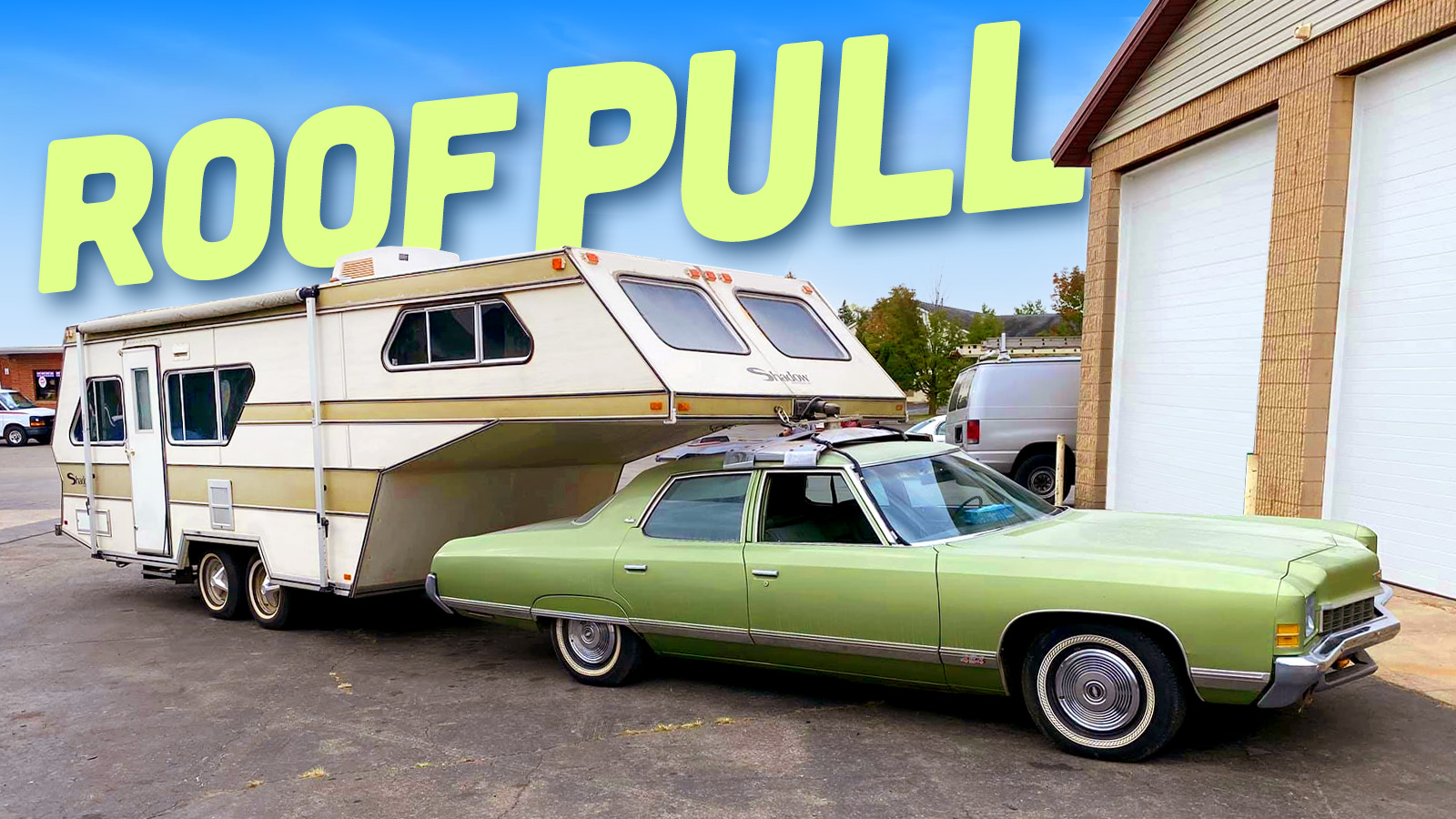
Towing a camper trailer requires a certain amount of skill that’s not taught in a typical driver’s ed course. You have to know how to keep a vehicle-trailer combination safe, allow sufficient braking distance, understand handling limits, and of course, you need to know how to back up a trailer. This is on top of having the correct vehicle for the job.
What if the family car that’s already in the driveway could tow a camper, and you didn’t need to know much about towing to haul that camper? That was the idea behind the Shadow by Harmon Industries. This bizarre 1970s camper was meant to be towed by the family sedan’s roof, and its unique hitch meant that you didn’t have to know how the intricacies of backing up a traditional trailer.


The 1960s and 70s were a fantastically weird period in RVing. Americans fell in love with the outdoors and the open road in the 1960s, leading to an RV industry boom and the birth of icons like the Winnebago motorhome and the Boler fiberglass trailer. This period was also a time of experimentation. RV producers realized that not every RV buyer wanted to drive between manicured campgrounds. Some people wanted to drive their campers out into the wilderness, leading to the development of off-road 4×4 RVs.
Many manufacturers also realized that not everyone was flush with cash, and not everyone had a truck to tow a trailer. The era saw the creation of affordable and lightweight trailers that could be hauled by downsized cars. Meanwhile, some brands figured out ways to attract more buyers. Airstream made its down-market Argosy, and even Ford tried its hand in the truck camper space.

It was also during this time period that the subject of road safety was growing in America. The cars of much of the 1970s were adorned with gigantic, unsightly bumpers in the name of safety. There were also collapsible steering columns, better braking systems, and other ideas. This wasn’t just limited to cars, either, as RV safety also became an important subject.
In 1971, Missouri-based Harmon Industries developed what it thought was the camper trailer of the future. It’s all-new Shadow was big and stable like a fifth wheel trailer. But as a twist, this trailer did not connect to a hitch in a truck bed. Instead, the Shadow connected to your car’s roof, and it was pitched as the easy and safe way to take your family camping.
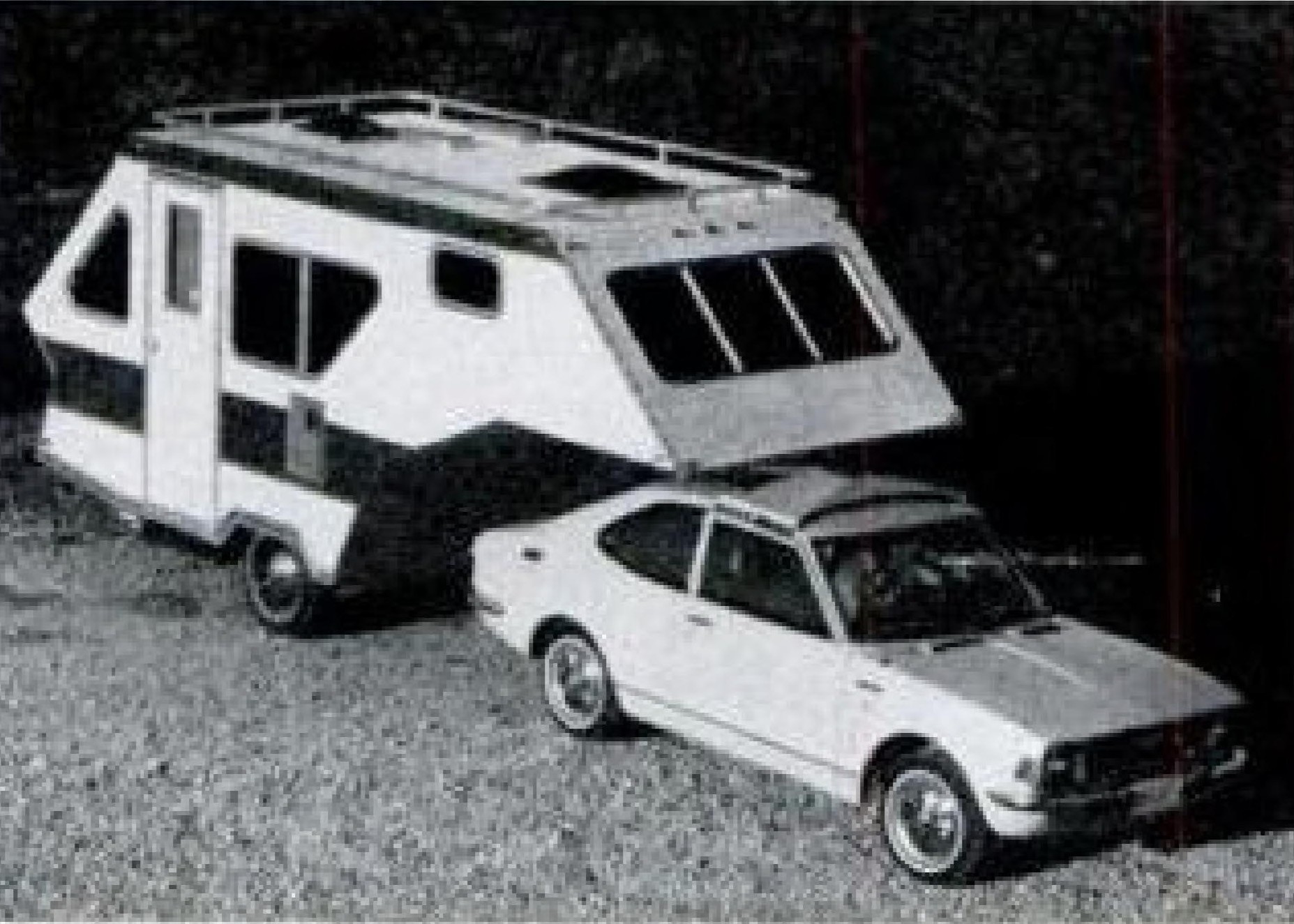
From Railroading To RVs
This story is going to have quite a few twists, and one of them comes up almost immediately. The Shadow was a product of Harmon Industries, a company that, up until that point, had nothing to do with RVs. Instead, Harmon was known for its railroading innovations.
The International Directory of Company Histories, via Encyclopedia.com, has an article about the company:
Robert C. “Bob” Harmon, the founder of Harmon Industries, first learned about radio in the 1930s while serving in the Marine Corps. Later he worked as an engineer for the Aireon Manufacturing Company in Kansas City, Kansas, that served the military during World War II. After the war ended, Aireon failed in its attempt to sell two-way radios to the civilian train market, having grown complacent with federal contracts and being generally mismanaged.
Aireon’s collapse opened a door for Bob Harmon. To provide work for himself and the many skilled individuals unemployed after the war, Harmon in September 1946 started his own firm, Harmon Electronics, as a sole proprietorship. As Aireon’s chief sales engineer, Harmon had made numerous contacts with railroad managers, so he felt he was ready to open his own business. In the company’s first two years, it made no profits and survived with the help of a bank loan.
Operating from his first office in an Independence, Missouri, upholstery shop, Harmon set his initial goal as using radio and other electronics to help railroads. For example, he found a better way to inform railroad engineers about overheated axle bearings called hotboxes, which, if ineffective, could lock up wheels and cause trains to derail. Harmon’s solution was to transmit data from hotbox detectors, trackside devices that used infrared beams to detect overheated bearings, to a central point using either power or telephone circuits already in place. Once the railroad’s central office received the information, it used radio to notify its train engineer of an impending hotbox failure.
Southern Railway was interested in Harmon’s technology and signed a contract for Harmon to make hot box detector equipment for the railroad. This was so huge for Harmon that in 1958, it had to expand into its first owned building, which was constructed on farmland next to the Harmon family home. Bob Harmon said that the Southern Railway deal was a major turning point for the company.
At first, Harmon would go all-in on trains. In 1962, Bob’s son, Robert E. “Gene” Harmon, graduated from Georgia Tech and joined the family empire. His contribution to railroading would be an electronic switch that sped up grade crossing gate timing. In the past, Grain Valley News writes, crossing gates wouldn’t trigger their open motion until a train was at least 100 feet from the crossing. Gene’s design called for crossing gates to open only two feet after, reducing traffic delays at grade crossings.
Harmon Electronics would grow and expand throughout the 1960s, and, reportedly, Bob wasn’t entirely fond of it. He liked engineering things, not managing a large business. So, in 1969, Bob passed the torch to his son and stayed in the background. In 1972, Gene took Harmon Electronics public. Later, the company would fall under the Harmon Industries holding company umbrella.
One of Gene’s concerns was that Harmon Electronics had only one major product in one industry. Like many companies of the 1970s, Harmon would attempt to diversify by branching out into industries it didn’t serve. One of the company’s ideas was a revolutionary camper.
The Shadow

At first glance, the Shadow, built by the Shadow Trailers subsidiary of Harmon, looks like a typical fifth-wheel trailer. But the moment that you dig deeper, you notice that there’s actually a lot going on here.
A Shadow starts with a surprisingly decent build for its day. Harmon wanted to build something that would last longer than a typical wood-framed camper, and so the company employed relatively thick steel for the camper’s structure. Its frame is made out of three-inch steel, and the body has one-inch and two-inch tubular steel for its structure. The walls of a Shadow are made out of a sandwich consisting of plywood, one-inch styrofoam insulation, another layer of plywood, and aluminum siding. The floor also had a steel structure, but wood and insulation on top. A neat touch is the roof, which does have wood and styrofoam like the walls, but the structure itself is steel, and the outer panel is a giant aluminum sheet.
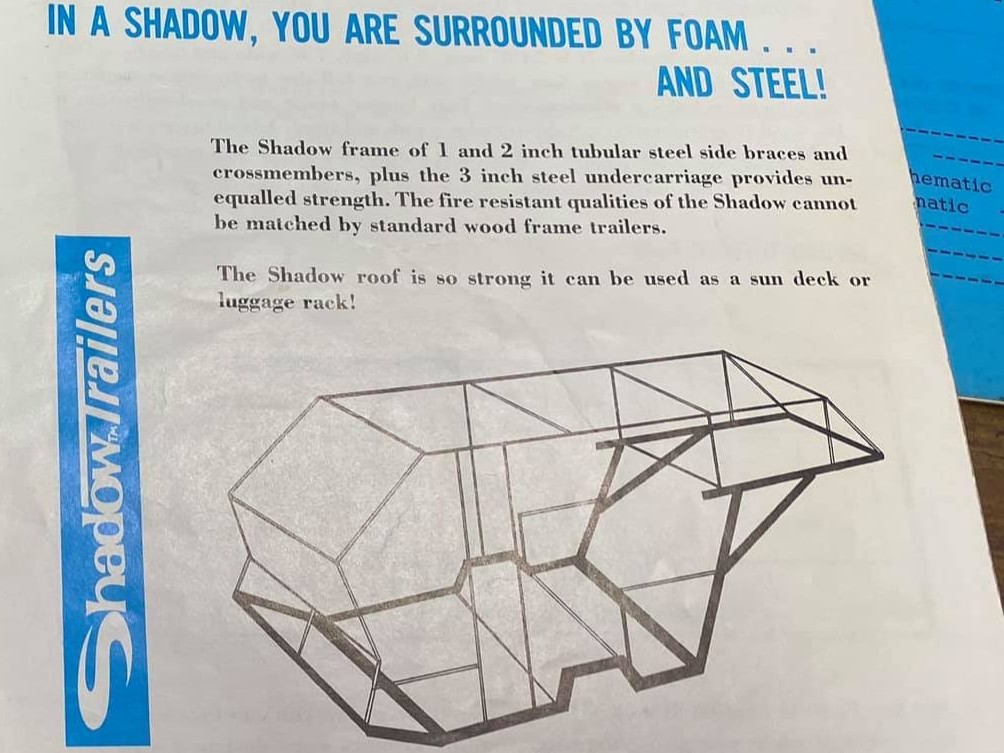
While the Shadow isn’t the most high-quality build out there – it still has lots of wood to rot – it’s actually built better than a lot of today’s campers. That’s amazing when you consider that they were a product of the early 1970s, and it sort of illustrates just how stagnant much of RV design has been over the decades.
Shadow Trailers said that its trailers were so strong that you could safely use them as sun decks or as roof racks. You’d have to, too, because the real innovation of the Shadow was what was up front.
A typical fifth wheel has a portion that hangs over the bed of the truck that’s pulling it. The Shadow was explicitly not designed to be towed by a truck. Instead, you were supposed to pull it with a car. So, the engineers of Harmon built their trailers’ overhang to curve over the back of a car and reach roughly the center of the vehicle, right on the roof.
The Shadow’s Party Trick
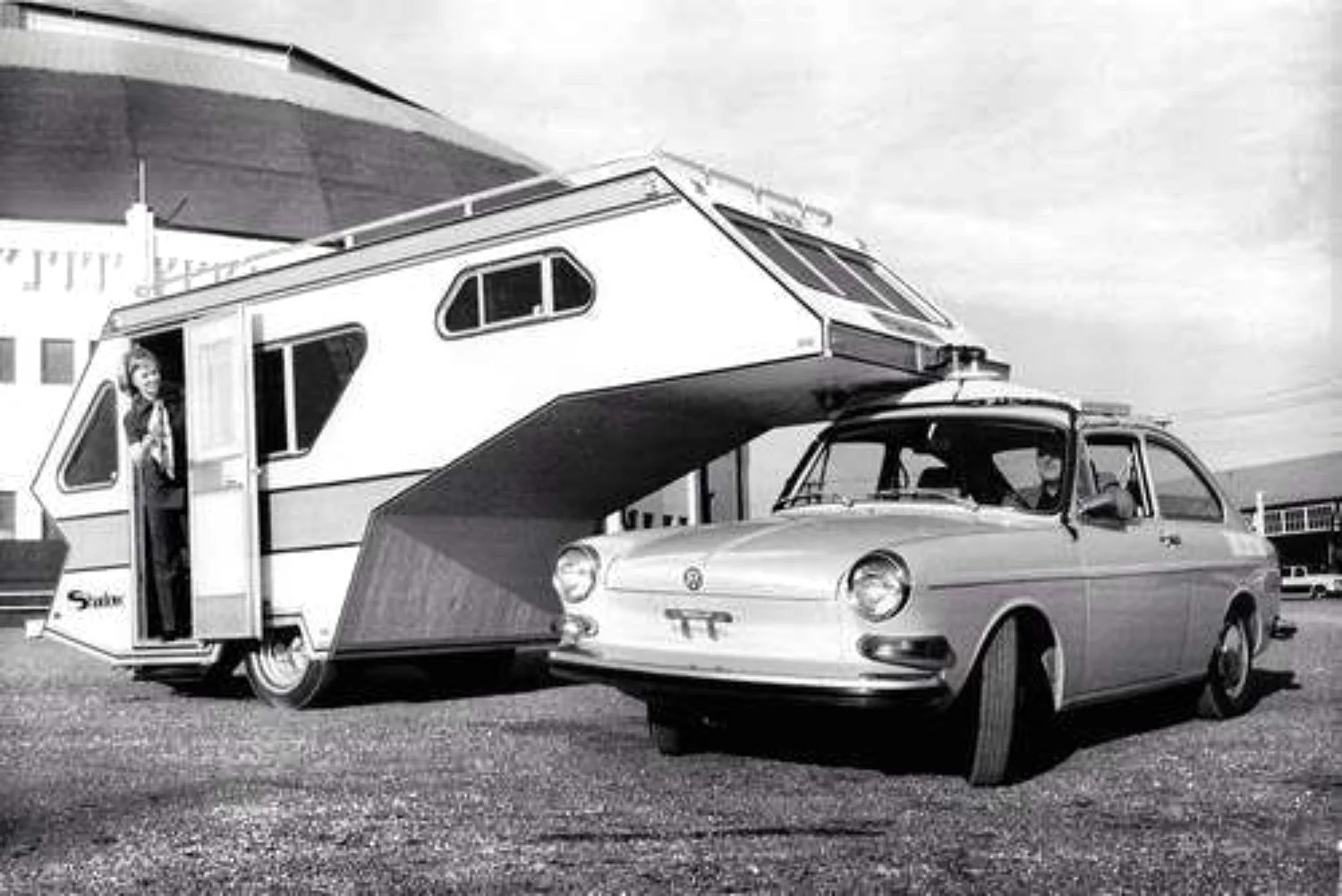
To allow its trailer to attach to a car’s roof, Harmon’s engineers cooked up a quarter-inch steel platform that attached to a car’s roof gutters with four steel brackets. These brackets were meant to be secured using rivet nuts (riv-nuts). Harmon sold the roof platform in different sizes to fit the differing widths of sedans of the era. According to Harmon, the roof plate made sense because the new cars of the 1970s had stronger roofs and could support the weight.
The Shadow was built in a handful of lengths, including a little 18-foot Shadow Mini (also sold as the Shadow III), a 23-foot Shadow II, and a 27-foot Shadow I. Sadly, the only published total weight that I could find was for the Shadow Mini, which weighed 2,400 pounds. The only published hitch weight that I could find was for the Shadow I, and the published weight was 300 pounds.

Amazingly, the Shadow was marketed as compatible with pretty much any car, from the Chevy Nova and Dodge Duster to the Toyota Corolla and Volkswagen Beetle. Of course, the idea was that you’d buy the smaller Shadow for a small car and a big Shadow for a big car. This marketing also extended to pillarless hardtop sedans, too. Harmon said that this was safe, even in a rollover crash, thanks to the strength of modern cars and the elevated design of the mounting plate.
Harmon claimed it engineered the mounting plate solution for a multitude of reasons. One advantage Harmon pitched was that attaching the trailer to the roof allowed the trailer a full 360 degrees of movement around the car, as well as ample roll movement. This meant that you could take the trailer on a severely bumpy road, and the trailer would sort of do its own thing. Here’s a video via The Price Is Right of someone absolutely beating the snot out of one of these campers:
Another benefit, Harmon said, was that you didn’t really have to back the trailer up. Instead, you could spin your car around under the trailer (there’s that 360 degrees in action), and push the trailer into position rather than backing up conventionally. This was pitched as a sort of solution for people who didn’t know how to precisely reverse a trailer into position or were less than adept at doing so.
Harmon claimed more benefits, too. Since the front of the camper was shaped like a wedge and sat only a couple of inches from your car’s roof, it was quite aerodynamic. And by placing the camper’s attachment point in the middle of your vehicle, a Harmon camper would handle better than any other rig on the market because putting the hitch weight in the middle of the roof distributed the camper’s weight more equally between the axles than a trailer mounted to a rear hitch.
The RV Press Goes Wild
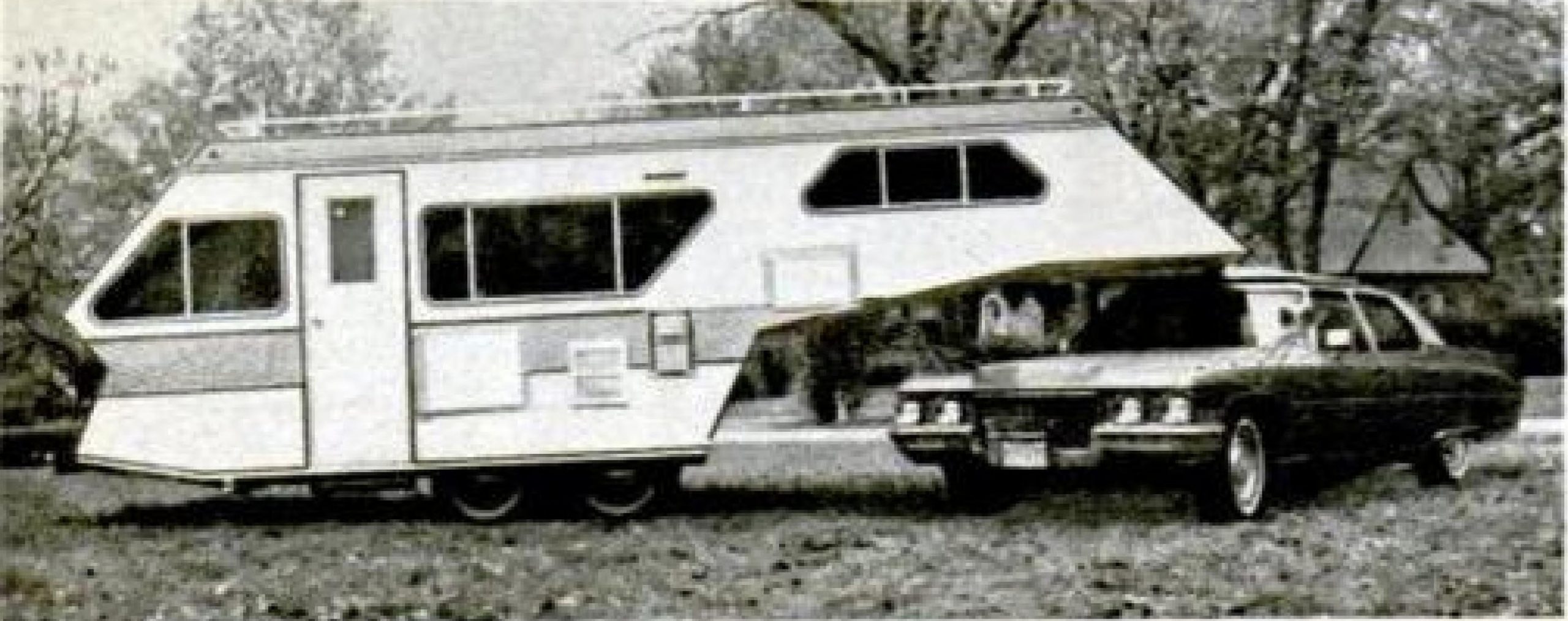
Apparently, the RV press seemed to agree. Journalist Dick Morch tested the Shadow for Woodall’s Trailer Travel magazine, and concluded: “I would have to say that the Shadow is about the best-handling trailer I have ever towed.”
Bill Estes, the Technical Editor for Trailer Life Magazine, decided to test a Shadow by doing stunts that would almost certainly result in a brutal crash while towing a typical trailer. He hitched a 27-foot Shadow up to a Cadillac and a 23-foot Shadow up to a Chevrolet. Then, he went nuts.
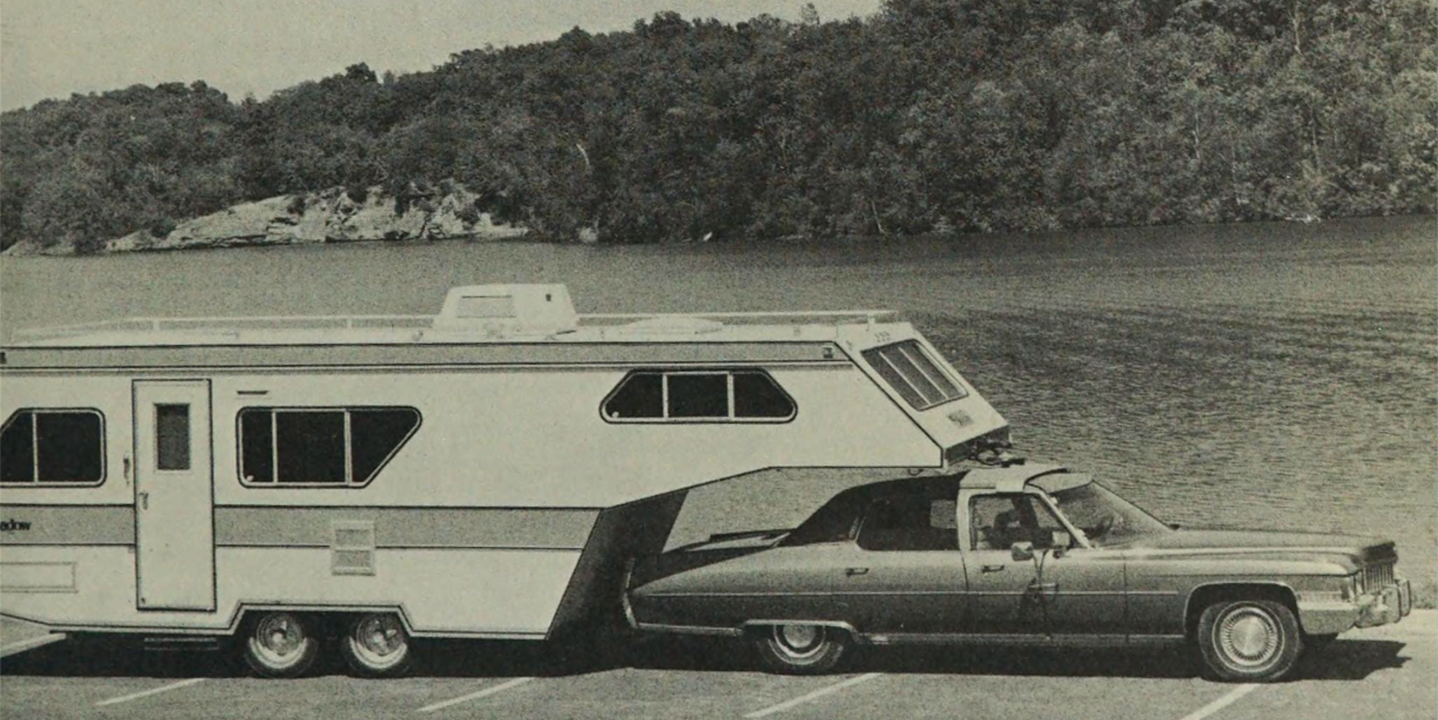
In one test, he intentionally drove off the edge of a highway at 65 mph. Normally, this would induce enough sway to cause a whole rig to tumble, but the Shadow stayed planted and stable. Bill would later try to intentionally induce fishtailing by dropping the tires off a highway and then cranking the steering wheel hard over. The Shadow swerved, but then regained its composure. The only bad mark Trailer Life gave the Shadow was its tendency to increase the tow car’s front-end dive during braking.
This was pretty big news for Shadow Trailers, because RVers of the 1970s were concerned about crashing, tipping over, or otherwise losing control. Popular Mechanics wrote about the Shadow in May 1972, and in that issue, the magazine also dedicated an entire feature to learning how to inspect and control your RV so you don’t accidentally hurt yourself.

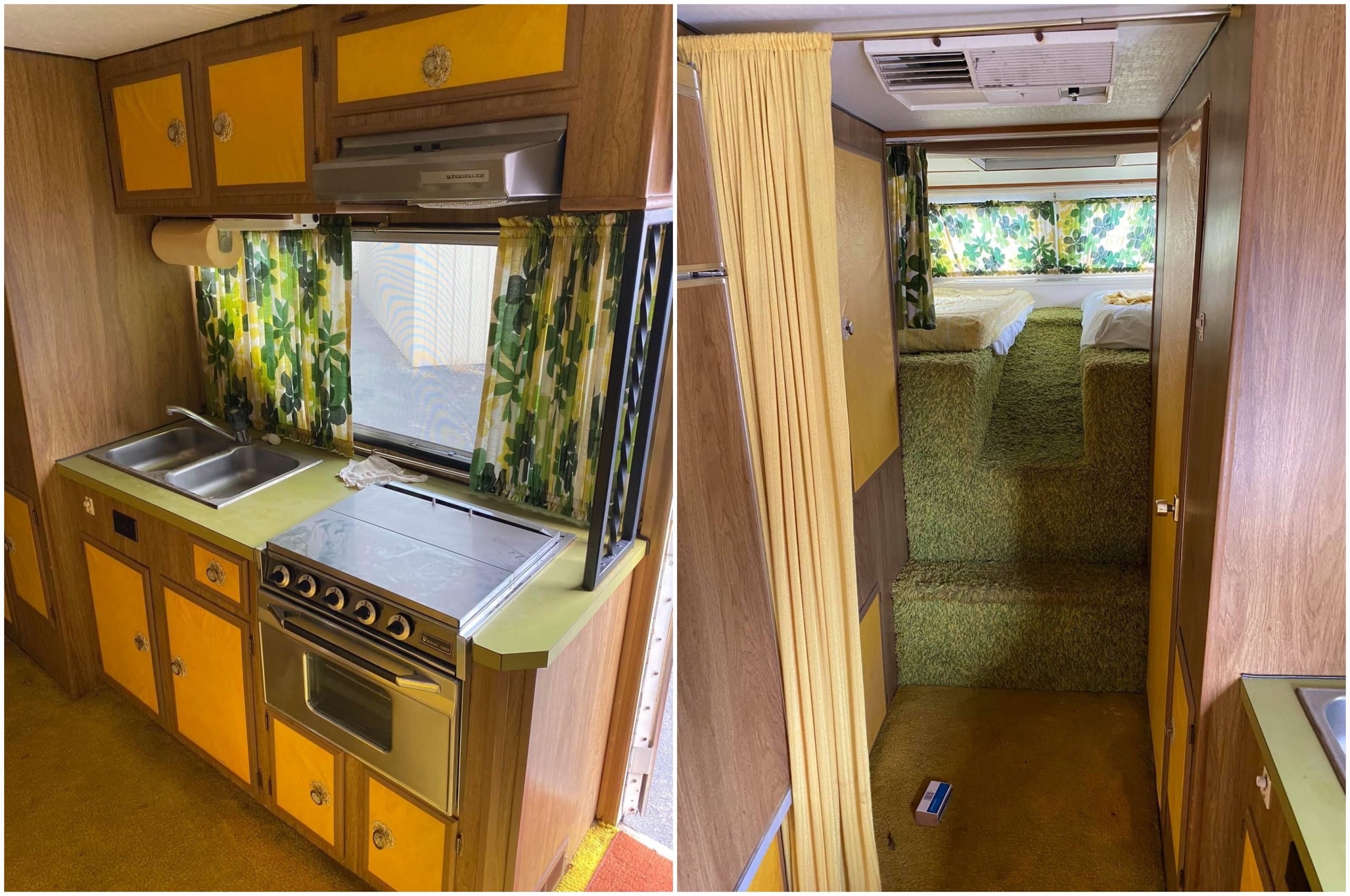
The inside of the trailer wasn’t nearly as nutty as the exterior. The Shadow trailers were well insulated and contained standard features like Formica tables and counters, wall-to-wall carpeting, thermostat-controlled heat, an oven, a four-burner stove, a bathroom, a flushing toilet, a three-way refrigerator, and more. If you got a Shadow I, you even got a king-size bed. Options included a tape deck, a stereo, a rotary telephone, a custom-designed air-conditioner, a motorcycle carrier, and more.
It’s believed that Harmon produced Shadow trailers until about the mid-1970s. Over that time, Harmon may have produced around 1,500 examples or so. Each trailer was built in Warrensburg, Missouri, and pricing ranged from $1,700 ($13,434 in 2025) for the Shadow Mini to $6,500 ($51,367 today) for the Shadow I. It’s noted that these trailers were sold as both shells for DIYers to finish themselves or as complete units. The Shadow I price is for a completed unit, while the Shadow Mini price is for a shell.
Amazingly, Harmon wasn’t the only company in the roof-pulled camper game. In 1970, engineers in Mexico filed for a U.S. patent for a fifth-wheel-style camper that can be pulled by a Volkswagen Beetle. This patent appears to have become the El Chico by International Travel Trailer, a ’70s camper that is often misidentified as a Shadow:
What Happened To The Shadow
Of course, the big question that anyone has about a project like this is how, exactly, it failed. Why isn’t something like this in production today?

Well, reportedly, there were a bunch of problems that cropped up once people actually tried living with their Shadows, one of which was hinted at by the Trailer Life comments mentioned previously. Under hard braking, the trailer caused your car’s front end to dive. Depending on the car and the suspension, the rear tires could actually lift off the ground. Harmon did not recommend any suspension upgrades, but did say that heavy-duty tires, upgraded cooling, tow-optimized rear gearing, and an uprated alternator were good ideas.
The braking issue wasn’t the only thing. Over time, owners found roof damage on their vehicles from having the camper up there, and some Shadows did tip over with their cars still attached. Reportedly, this sometimes resulted in the vehicle’s roof tearing.
I also wonder just how much of a benefit the 360-degree design was for people who weren’t experienced in towing or backing trailers. Instead of backing up, the driver now had to spin their car around. Even though the car was facing backwards, the trailer still turned the opposite direction the steering wheel went. Oh, and the driver had nothing but trailer in their face during the process.
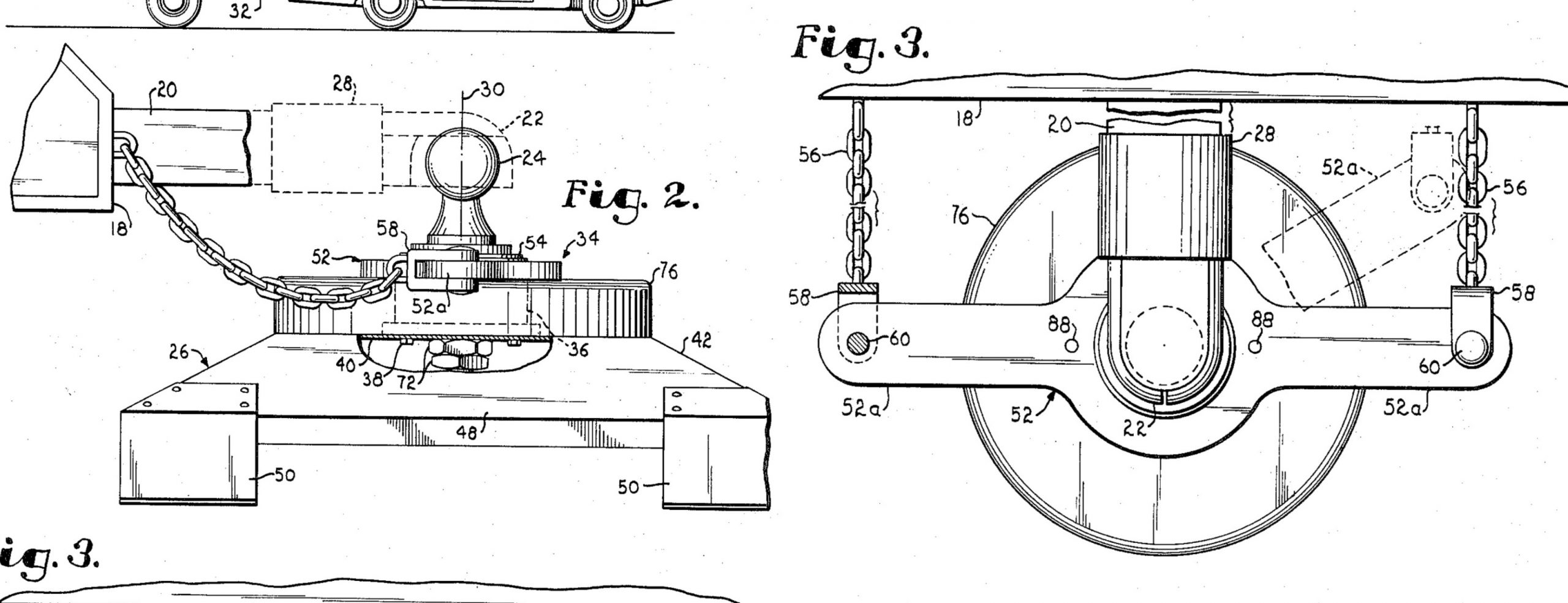
But the biggest problem probably wasn’t safety; instead, it was the hitch that enabled this whole camper to work. Harmon patented the hitch in 1973, but the hitch had two massive limitations. One was that, despite the advertising, the hitch could not be removed easily. The other problem was that, as you probably guessed by just looking at the hitch, it wasn’t adjustable. That meant that there had to be a specific hitch for each car. Harmon had to be in the business of building both the camper and several different kinds of hitches to tow it.
The oil crisis period of the 1970s certainly didn’t help, so Harmon threw in the towel and stuck to what it did best: making electronics for trains. That was a good call. Harmon is still around today and collaborates with America’s largest rail network systems.

The end of Harmon’s great experiment was not the end of the roof-tow concept, however. From the 1980s to the 2010s, two French companies and a German company created their own car-hauled campers, the Maillet Rando-Car, ClipCar Evolution, and the HEKU Fahrzeugbau Car Camp.
A Potential Holy Grail
Sadly, if you’re crazy enough to pull a camper with your car’s roof, I have bad news. Shadows are shockingly rare. Many of the photos in this article come from a Shadow that was listed for sale in 2020 for $10,000. The same owner listed it for sale again in 2022 for $35,000. I found zero examples currently for sale.
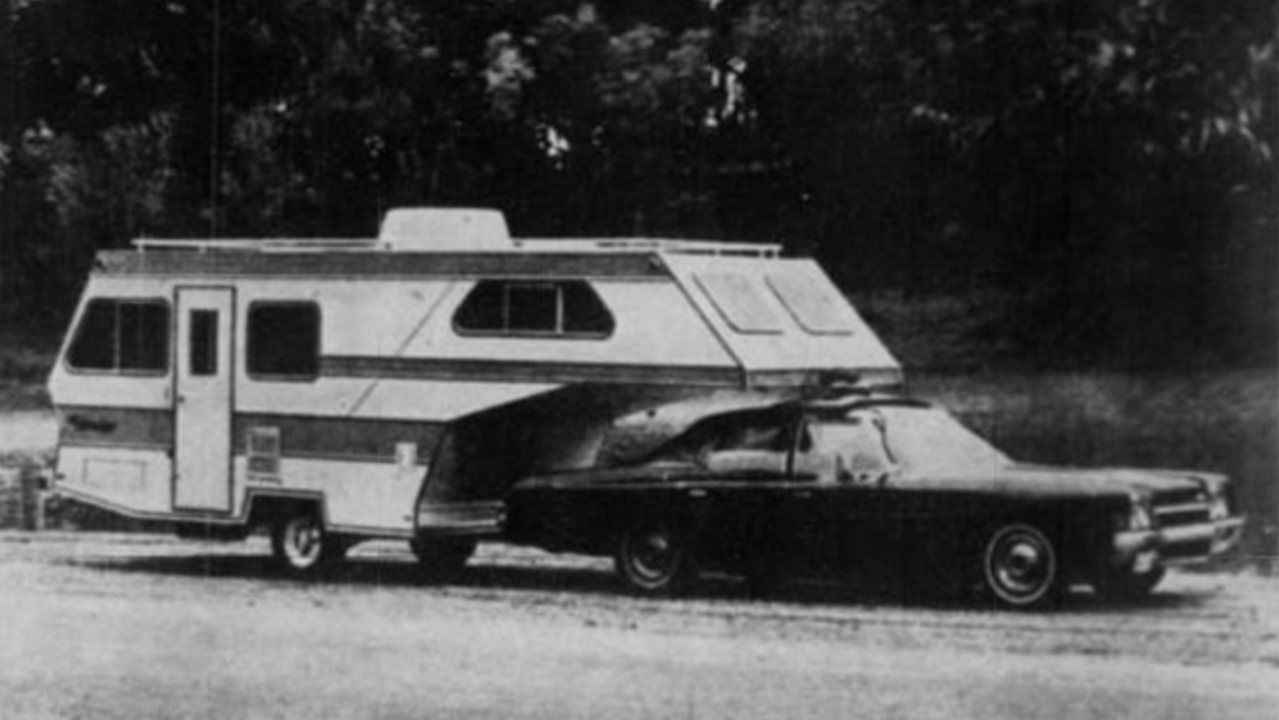
An idea like this would be so bizarre to see today, but the 1970s were so weird that there was not just one, but at least two companies with the same bonkers idea. Then other companies kept trying the concept well into the 21st century!
A part of me wonders what a Shadow would be like in 2025. What company would be the best fit to bring this trailer back? What would be the perfect tow car? I’m not sure, but it would be wild to see this concept explored once again.
Top graphic image: Colton G





I remember seeing one of these back when it would have been fairly new. It was towed by a 71-3 Cadillac. At first I thought it was someone’s home made set up, but my father assured me it was something that could be purchased. Even at my young age I didn’t think it seemed right to have the hitch attached to the body and not the frame.
If you towed one of these with a VW or Corolla it’d be super safe because you’d probably never get above 30 mph.
I recall this from the late Seventies – early Eighties
https://youtu.be/mqr2ioQTV5s?si=1yINScHNFy0kWzQT
How did they handle the wiring for the lights?
Flat 4 wire Cable connected from car to trailer
They probably did the math, but I can’t help but think a trailer like this would’ve grossly overloaded the body mounts on BOF cars.
They aren’t as strong and the body mount rubber bushings probably weren’t designed for these kinds of loads.
It’s not a coincidence tow bars are almost always attached to the frame instead of the body.
The irony of using a roof that probably couldn’t support the weight of the car in a rollover as a hitch point is strong.
Please tell me the pic of a 70’s Corolla towing a trailer using a roof mounted hitch isn’t AI generated.
wonder what would crash test look like…
For being as short as possible in overall length, it’s one way of doing things!
In Europe there’s often much higher prices on bridges, tunnels and ferries, if your vehicle is over 6 meters (20ft). That’s why you find so many compact motorhomes over here.
“Let’s Make A Deal” with co-creator and long time host Monty Hall in your clip. Bob Barker hosted The Price is Right, and never from the audience (spay and neuter your pets!).
small typo
I remember a used car place had one of these, probably circa Y2K. The tow vehicle was a Chrysler New Yorker or Olds 98 or maybe the equivalent Buick, from around 1974. I never stopped in to see it up close, but it sat on the lot for a really long time. The price for the set was on the windshield of the car, and wasn’t too much more than what I might have expected to pay for a 25 year old luxobarge without a trailer.
It seemed like an odd way to package a tow vehicle/trailer combination. If a bumper hitch had been used, that would have allowed for a lot more living space in the trailer and a much more aesthetic tow vehicle.
Surely a normal bumper hitch would give you less room? Because you’d lose the sleeping area above the tow vehicle.
I find it hard to believe that roof gutters could handle the stress. What a cool thing, though.
On malaise era American iron, no less. ????
Ka-Snap!
Thule has crossbars that are for cars without a roofrack. They are adjustable but you put in the specific make/model of your car and they pick the clamps from a finite list of options. So basically, one part number handles many different vehicles. But I don’t know how many part numbers there are.
Of course, this is for a roof rack, not a tow hitch, which is the thing of course since the max weight on a roof rack is going to be a lot lower I assume than a “tongue” (roof?) weight of a trailer.
Wild they thought that was a good idea with the roof strength (or lack of same) of a lot of cars of the time. I’m sure some of these got put on pillarless hardtop sedans, which is a frightening though. Ironically, something like this would make a lot more sense on a modern unibody car, with their low payload ratings and high roof strengths.
Mercedes…. You are the best.
Most modern vehicles with factory roof racks/rails are only rated to 100kg or so. Maybe if you made a small trailer with twin axles, you could keep the “tongue weight” down to 100kg. But I’m not sure this sort of trailer is significantly better than a bumper-pull trailer to make it worth the effort to design a modern variant.
I don’t think the tongue weight is really the issue here. I could be wrong – I dropped out of engineering school – but I’d be a lot more concerned about the forces required to start, stop, and turn all that weight. It’s all got to go through that roof, and a lot of it relies on those spindly little A-pillars. Doesn’t inspire a lot of confidence.
Though the roof pillars (A,B,C) in modern vehicles are stronger (and larger) than those of 1970s vehicles. Still, roof weights are limited, though possibly due to denting the roof and not the pillars.
I, too, am thinking it’s not the weight that’s the problem, it’s the side loads flexing the roof around.
I remember an ad from the late ‘60s from a company touting the strength of their tow hitches by attaching one to a Toronado and towing a trailer after removing the Toronado’s rear wheels. People were fearless back then.
Modern people are afraid of their own shadows is more like it.
Certainly, you don’t think people aren’t doing stupid shit in cars today…? Good sir, this is the internet, people do wacky stuff like this all the time! Corporations probably don’t advertise with stunts like this because, well, people haven’t gotten any less litigious in recent years, but the independent dumbass-with-a-camera market has done naught but flourish in recent years!