

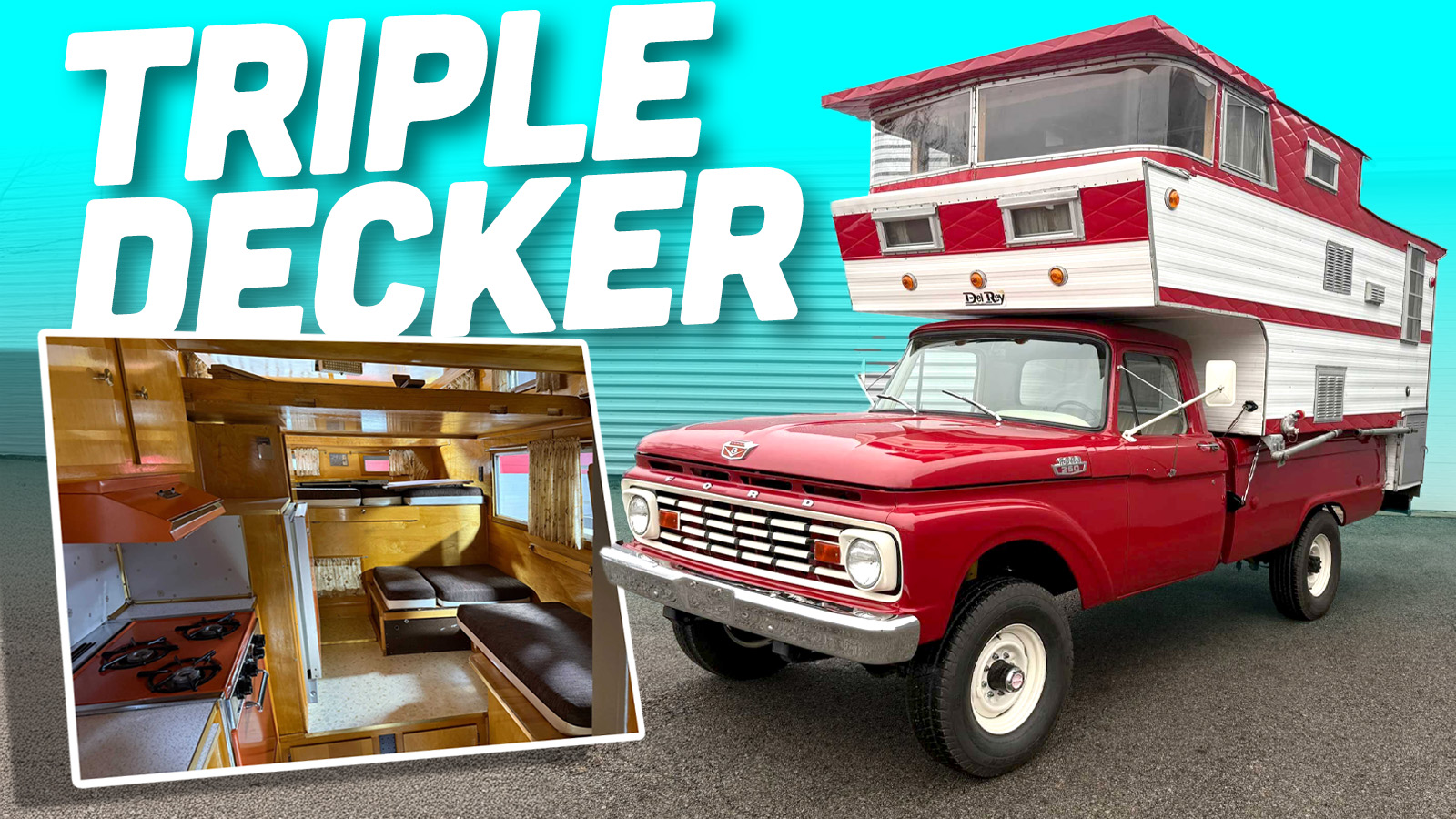
America’s most bombastic truck bed campers today are mammoth units with as much space as an apartment and weigh as much as a Tesla Model 3. Yet, there was a time when America’s truck campers were even wilder. This 1963 Del Rey Sky Lounge camper sat in the bed of an everyday pickup truck and sported three stories, an observation lounge, and a rooftop patio. When paired with a matching Ford F-100, this rig represents the pinnacle of pickup truck camping in the 1960s.
The Del Rey Sky Lounge is special because it represents a different way of thinking in truck camper history. The vast majority of truck campers throughout history were built with only one main floor, plus an over-cab bed. Historically, truck campers have been made bigger by making them longer. Some units, like the Host campers I referenced in the lede, expand on space by using slides to spread out. The Del Rey Sky Lounge represents a different, crazier approach. Instead of spreading back or out, this camper went up.


As silly as that sounds, the 1960s and the 1970s were just a different time in the RV world. Americans had cash to spend, the expansive Interstate Highway System at their disposal, powerful pickup trucks, and cheap gas. This was also a time when people began discovering outdoor sports and activities. There was a whole world of fun out there, from fishing, hunting, snowmobiling, boating, off-roading, and more. As more people answered the call of the open road, they did so with a trailer hitched to the back of their car, a camper that slid into the bed of their pickup truck, or in a motorhome.

RVs were so hot in the 1960s that companies that weren’t even tangentially related to camping got into the business. These companies included the Clark Forklift Company and Grumman, which was better known for military aircraft. Some of the famous names in RVs, like Winnebago and Boler (which led to the birth of Scamp), cut their teeth in the 1960s. You were able to buy campers that turned family wagons into motorhomes, tents that you placed on top of your Greenbrier van, and even campers that turned into boats.
One of the weirdest RV development trees was the pickup truck camper. The truck camper was a brilliant invention. It’s a living space that sits on top of a truck, turning the truck into a motorhome while retaining the truck’s ability to tow. So, you’d load up the family in the truck, hitch up the boat, and go on an adventure. If you need to, the truck camper allows you to detach the camper from the truck and drive away.

As truck campers grew in size in the years preceding the rise in popularity of the Class C camper, manufacturers had to get clever in their designs so that trucks could still carry the gargantuan creations. Some designs necessitated the addition of a tag axle, while others would swallow up the truck’s cab to get more space.
Then you have ideas like Kamp King Koaches and the Del Rey Sky Lounge, which piled to the sky. This particular Del Rey Sky Lounge and its matching 1963 Ford F-100 are a beautiful time capsule back to what camping looked like back then. It’s a big red camper on top of a big red truck with a big block of V8 power. What’s not to love?
Three Levels Of Fun

Del Rey Industries was once America’s largest producer of RVs. It was founded in 1957 as Lil’ Sport Coach in Elkhart by William Overhulser, who was famous for thrusting truck campers into the mainstream. The RV Industry Association says he was a founding member, and that his contributions to the RV world also include the early 1960s camper jack that’s still used on truck campers today, a truck camper securement device in 1969, and a travel trailer emergency braking system in 1999.
Overhulser retired in 1969, selling Del Rey Industries to Gladding Industries in the process. Gladding kept Del Rey operating for roughly another six years. Overhulser spent his retirement tinkering with RV inventions. He was also a founding member of the RV Industry Association. If you want to read more about Del Rey’s history, click here.

According to what I could find about the history of this rig, the camper on the back is a 1963 model Del Rey Sky Lounge. This camper has a relatively sturdy design for a 1960s camper, featuring a two-inch-thick all-glued wood construction, steel strips for wall reinforcement, and two-by-fours for the floor. Insulation comes from fiberglass, while the siding and the roof are made of aluminum. Del Rey advertised these campers as being four-season-capable.

Inside, the walls are made out of real hardwood, and it’s joined by anodized aluminum trim, plastic laminated countertops, a magazine holder, an intercom, and most of the comforts of home.
Del Reys had a three-burner stove with an oven, a refrigerator, and a full wet bath. There wasn’t an air-conditioner, but there was heat and ventilation. A 30-gallon water tank, a battery, and shore power connections allowed for longer stays.

Del Reys were considered to be luxury campers, and the company equated the quality of its interiors to being like fine furniture. Supposedly, you cleaned and polished the walls like you would a wood dresser or table.
What really made the Del Rey Sky Lounge special was its layout. There was a main floor down on the bottom, which had the kitchen, bathroom, dinette, and a small pass-through to the pickup truck. The dinette converted into a bed.

The second floor was an over-cab section, an area that would normally just be a bed in most other truck campers. However, in the Del Rey, there were five-inch-thick cushions, a pair of curved windows, and two vents. The idea was that your kids would sit in the observation lounge as the world passed by. Then, when it was time to go to sleep, the cushions folded flat into a second bed.

Finally, above and behind the second level was a third level, which consisted of a bedroom that lowered down from the top of the camper. That bedroom has nothing but a bed and some windows in it. Also, whoever sleeps at the top of the camper has to sneak past the people sleeping on the second level to get to the main level’s bathroom.

Del Rey marketed this layout as having three floors, and if that wasn’t cool enough, you could slap a ladder on the side of the camper, climb up, and use the roof as a patio. Amazingly, Del Rey wasn’t the only company with a crazy tri-level concept; Kamp King Koaches of the McNamee Coach Corporation also built a tri-level model, but in an even weirder way:
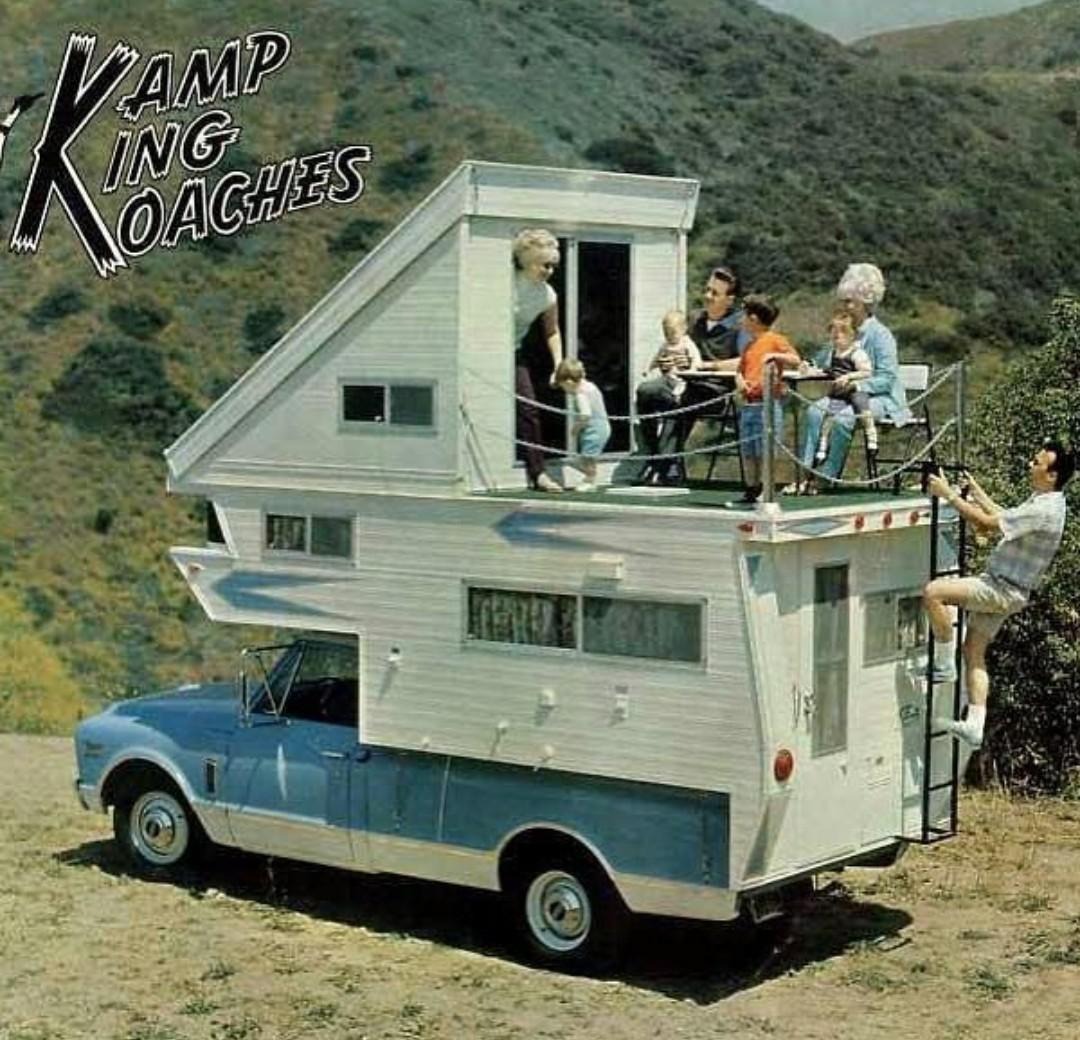
Sadly, I’ve yet to find a single surviving Kamp King Koach in my years of writing about RVs.
Anyway, something a bit deceptive about how the Del Rey Sky Lounge looks is that, despite three decks and the appearances of a skyscraper on wheels, the height of a Del Rey Sky Lounge is roughly 10.5 feet, plus maybe a few inches depending on the truck and its suspension. Some large modern truck campers are around 12 feet tall.
Ford On Ford Action
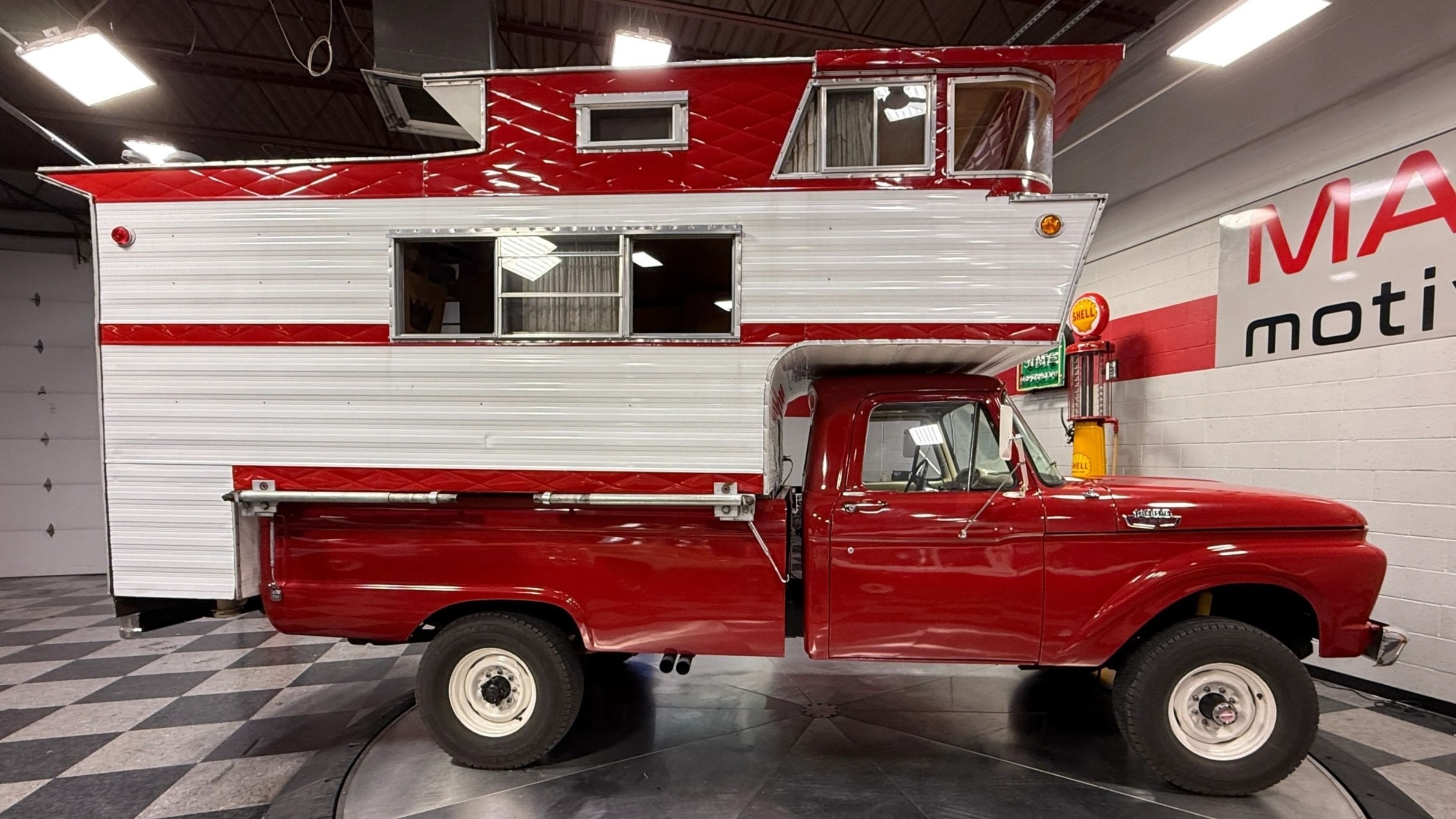
The truck was an important part of the equation, too, as Del Rey said that you needed a three-quarter-ton truck at a minimum to haul a Sky Lounge. The 1963 Ford F-100 underneath should fit the bill.
The Ford underneath comes from the fourth-generation of the F-Series, which launched in 1960 for the 1961 model year. The big deal with this generation was a cab and bed design that flowed into each other with an equal beltline. Ford also did something a bit weird with the fourth-gen F-Series by creating the so-called “integrated pickup,” which featured a bed that was welded into the back of the cab.

Now, if you’re scratching your head about why a mere F-100 is carrying a huge camper, the dealership has an explanation. Under the F-100 cab and body sits the frame of a sixth-generation 1977 Ford F-250 with a 4×4 system, a low-range gearbox, and a 460 cubic inch V8. That’s a “block of bigs,” as Derek from Vice Grip Garage would say. Before you get too excited, this is a Malaise Era engine, and it makes 220 horsepower. These engines were more for their pulling power, not speed. This mill is backed by an automatic transmission. Judging from the underbody photos, this truck’s had a bit of tinkering done to it.
This truck has spent a lot of time at dealerships. It was seen in 2024 with 90,427 miles at Classic Auto Showcase in Try, Michigan. Now, it’s at Maxmotive in Cheswick, Pennsylvania, with the same odometer reading. A price is not listed. However, Classic Auto Showcase wanted $34,700 for the RV and truck pairing in 2025, so it’s probably fair to assume that Maxmotive would want something similar. The last Del Rey camper and truck I wrote about sold for $60,000 on Bring a Trailer.

A Legend
While exact production numbers aren’t known, finding an intact Del Rey Sky Lounge is a rare occasion. Truck Camper Magazine calls the Del Rey Sky Lounge “mythical” for its rarity.

One thing is for certain, and it’s that these are fascinating beasts. They come from a time when safety wasn’t important, and aerodynamics didn’t matter. The observation deck doesn’t have padding, seatbelts, or anything of the sort. This camper also came from a time when RV companies were one-upping each other with ever more ridiculous designs.
So, sure, the truck isn’t perfectly period-correct, and who knows what this dealer wants in terms of money. But if you have the kind of cash this commands and can take care of a camper that’s more than 60 years old, you’ll have something that few others have. I love the idea of parking somewhere, climbing to the roof, and enjoying some cold ones like a queen. Maybe someone will buy this Del Rey and do the same.
Top graphic image: Maxomotive




This is amazing, just try not to turn too hard. You might flop on your side. Would love to see a newer truck with something like this that doesn’t cost $100k altogether.
We finally made it to the great wide open! Let’s huddle awkwardly on the roof of a truck!
PS, now days, they would have to have 3 point restraints for those seats and 29 minimum airbags for that observation lounge above the truck cab when this thing was in motion. God I miss the old days……
Sitting in that while so far up above an old F-100 at speed sounds absolutely diabolical.
I actually have some original brochures for these. They used some creative marketing to call them tri-level. They only achieved that feet with the top bunk folded down. Cool bed campers regardless. Glad to see some escaped the water leaks and the resulting total destruction.
It needs an A/C unit on top to make it totally undriveable under most bridges.
That oughtta bring it up to 11’9″ alright.
I spent about eight years traveling around the country during summer vacations on the bed above the cab of my Dad’s F350 stakebody. He put a regular slide-in pickup camper on the flatbed, made two wooden storage boxes for the cavities where the bed sides would be, and bolted it to the truck. We spent the summer of 1981 traveling across the country for a month, four of us in the truck, with no A/C. The 70’s were a different time, man.
Ralph Nader.
He and all of his safety nanny buddies killed all the fun.
The fun of watching your lovely children, perched in a bed atop the truck cab, become fast-moving projectiles through the safety glass that was in front of them. The fun of piloting a drum brake truck on skinny bias-ply tires, with a house on the back that became a sail when driving down the new interstate at 65mph.
This is why we can’t have fun anymore.
Hard to believe it’s only 10.5 feet tall. Looks like a mansion inside, or at least a high ceiling house. Pictures taken from a small child’s point of view? But I’m only 5’8” and 125#. Even if I had to duck in places, this thing would be super fun!
Wow, wonder why Kamp King Koaches didn’t stick around much. Why would that abbreviation sound familiar…
There was also a Krager Kustom Koach that operated into the 1970s, sometimes it really does help to maybe workshop these things a little
You tell me this now, a day before the launch of my new business venture Fantastic Ultimate Coaches & Kampers
Thinking, thinking, lets see, hmm, I think that’s in the clear, go for it
Sign me up for that! Lol
Certainly less offensive…
I suspect that this was the outcome after workshopping a little.
There is, or was, an Apple specialist computer shop chain in North East England called “Stormfront’…
Well, the brochure does feature a bunch of white people….
I wonder if they ever collaborated with the Dutch motorcycle suspension experts, White Power.
https://en.wikipedia.org/wiki/WP_Suspension
A few additions
1. If you have windows that open and don’t have screens on the 3rd floor you don’t have to sneak down past anyone to pee.
2. Kids sitting in the camper while traveling not exactly safe.
3. I’d be careful on alcohol consumption on the roof with those chain rails and awkward step ladder departure.
4. The hair on the women beehive to the max
Yep, it was an era.
My folks had camper rigs of this ilk, with Ford trucks of course, a 66′ and later a 71′, in time period, they were fun for us kids.
Dad openly drank Coors while he piloted. Here to the beach took most of a six pack.
He’d toss his empties out the window and could almost always get the rear tire to run them over. A fun game, we admired that skill.
Last time I recall him doing that was in 84′ as I was driving my Toyota pickup and he was shotgun. As usual he got that Coors Light, he’d switched over by then, smashed and good as we went down the highway.
I smiled. But I digress.
Hanging out in the cab over was the best! I used to dream of how cool it would be to have a portable TV up there to watch Gilligan’s Island and Hogan’s Hero’s as the miles went by.
Sometimes, when we got to the RV park or camp site, we’d scamper up the ladder to ride on the roof rack while dad scouted a spot.
By now the old man was pretty thoroughly sauced, which was much of the point of his vacation, so the going was jerky.
At the site he fired up the barbeque and got the steaks going while mom prepped the greens. Us kids prowled.
Soon their friends would arrive with similar rigs and similar kids. We all kidded about while the grown ups smoked and drank around the camp fire.
Nightfall the folks got the cab over and us kids had to make do with the fold down beds in the dinette.
Always was wishing I had that TV!
4 – is that marge simpson?
Since it has a F-250 chassis, it would be a F-250. Plus this truck would have started as one of the wrong bed trucks in 63, so it’s fitted with a 64-66 bed.
The Boaty McBoatface of campers.
I’d teach the kids to drive so I could hang in the “observation lounge”.
From my direct experience, as an F100 rig, it is 100% period correct. Onto our ’64 F100 coach-built crew cab dad had an extended overcab camper built for the truck. Now since our truck started as a standard longbed F100, after the second cab was grafted in, the bed was only 5 1/2 feet long and the “legal” load limit was 500 pounds. The camper weighed 3/4 tons dry. Add in 5 or 6 people (with Gram or a friend along with the 5 of us) and gear, we way-overloaded the truck (so, this rig as an F100 is period correct). And we only have the 292 V8 in there. I still have the truck and it is at 350k miles on the original drivetrain. Some additional info in this Reader’s Rides:
https://www.theautopian.com/crew-cabs-campers-a-far-traveling-phev-and-one-shamancycle-members-rides/
I read your blue truck story, fabulous! Thanks for sharing that tale and I’m happy you have the truck still and looks like someone to pass it on to.
My dad always bought F250s so the campers weren’t such a burden. I think his 66′ had that same under dash AC.
Thanks for always finding the coolest campers, Mercedes!
I really like the photo of that Kamp King one with the whole family up on the rooftop and that cool ’67 fleetside C10 underneath.
This was basically my childhood. Like you say “safety” was a bit different in the early ’80’s. Kids left outside on their own for hours, running around neighbourhoods with t-shirts that had their names on them, and hanging out in the over cab bunk while driving across country.
Old me knows that any fast stop would have flung me straight out the flimsy glass at the front of the camper, but at the time that view was the absolute best.
I love how much it looks like an old houseboat… Need to extend the controls from the cab up to the obsrevation lounge and turn it into a quasi-flying bridge.
You are Prof. Pat Pending and I claim my £5.
now that looks cool AF
*top gear challenge intensifies*
I’m weird AF and as soon as I saw that triple decker I wanted to put a drivetrain directly in it so it looks like a very deformed Winnebago O.G. Chieftain with the 5head. And drive it around that way. It wouldn’t be very useful as a bed camper any more with the driveshaft and transmission and whatnot, but it would be neat.
Pretty incredible this setup is only 10.5ft tall. The height of the pickup is probably a big factor there even with the superduty underpinnings. It would probably sit at least a foot taller on a modern F-250.
I’m not an expert on those 460s, but I know there’s a lot of parts swapping that can be done to improve power. Still, I wouldn’t want to be trying to pull this thing up even the slightest of grades. The mere thought of a crosswind at 65mph would result in a code brown.
That is right down the road from me…. Knowing that dealer, it’s gonna be expensive.