


If you’ve ever been to New York City, you’ve definitely seen a New York City taxi cab. The bright yellow paint is synonymous with Times Square and the Empire State Building, but there’s a surprising amount of variety when it comes to the cars themselves.
These days, you can see cabs on the streets of New York ranging from boring Camrys to Tesla Model 3s to Nissan’s NV200, a van once dubbed the “taxi of tomorrow,” introduced in 2012 to take over the NYC taxi scene (which didn’t exactly work out). That didn’t stop The Autopian from buying one with 375,000 miles on the clock and driving it across the country.


With the city’s mandate to have all taxis either wheelchair-accessible or all-electric by 2030, Kia and BraunAbility, an Indiana-based business that converts vans to be wheelchair-accessible, have come up with something that meets both requirements: an electric minivan with space for a wheelchair-bound passenger in the back.
A Match Perfect For NYC
If you keep a close eye on New York City traffic for long enough, you’ll inevitably start seeing yellow-painted Toyota Siennas with curiously high ride heights and awkward-looking tailgates out back. That’s because BraunAbility has modified the rear to become a deployable ramp so that people in wheelchairs can get into the car without having to get out of their seats.
Here’s a video of how it works in the Sienna, which is BraunAbility’s most popular model right now:
While the Sienna works just fine for this type of work, there’s certainly room for improvement. Enter the PV5, a five-door electric minivan introduced by Kia in 2024 and put on sale overseas last year. As it turns out, the PV5’s upright, square shape is excellent for transporting wheelchair-bound passengers, according to Jake Craig, senior national account manager for BraunAbility.
“The PV5 is an amazing platform to begin with,” Craig told me at the New York Auto Show. “It’s got vertical walls. For the driver, you’ll have a cab-over type of vision. The turning radius is very quick, [and] your breakover, departure, and approach angles are amazing.

“In New York City, sometimes you have steep driveways, so for wheelchair accessible vehicles, especially with the ramp in the rear, sometimes that can become an area that may drag. [The PV5] is actually seven inches shorter than the Sienna, which is a very popular option for New York City Taxi today. But there’s a lot of space inside, vertical walls and cab forward [design] have created more interior space.”
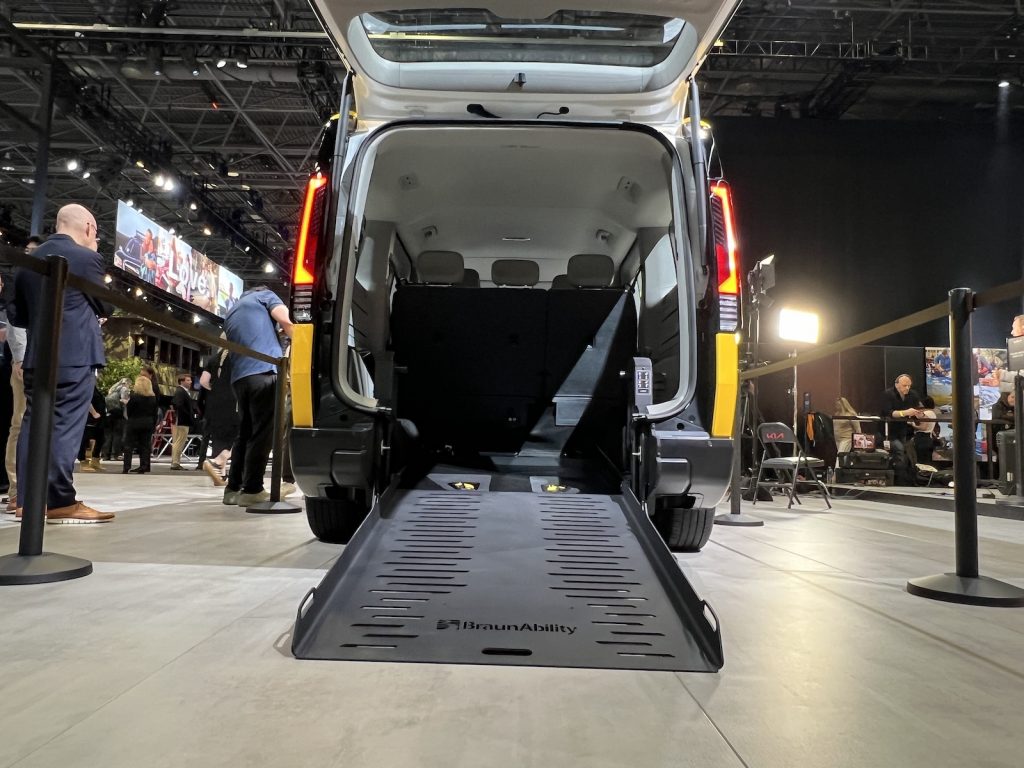
Craig went on to tell me how the converted cargo space is wider and longer than the Sienna, allowing them to install a wider ramp that can be installed flat on the floor when not in use (versus the Sienna, where the ramp stays vertical with the hatch, restricting storage space). The straps that hold the wheelchair to the car are also integrated into the floor, streamlining the process for getting wheelchaired passengers belted.
Will It Become A Reality?
Being fully electric and a Wheelchair Accessible Vehicle (WAV), this PV5 taxi concept feels like an ideal solution for New York’s taxi fleet going forward. Whether it’ll actually happen is another story.
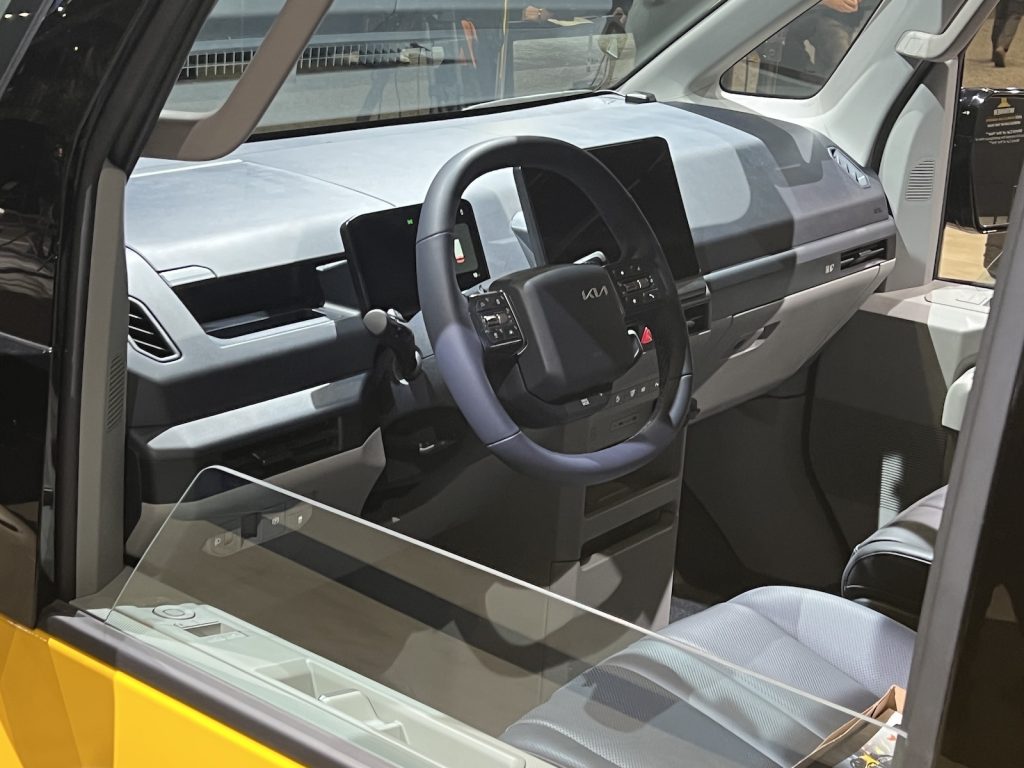
Craig told me that this concept PV5 taxi, which is fully functional as a WAV-compliant cab, was developed to gauge interest from government officials, fleets, and riders.
“We had private reviews of the vehicle, and that was to get the feedback from direct stakeholders. The disability community, the environmental advocate groups, the city, and the stakeholders who could potentially operate this vehicle,” says Craig. “So some large fleets came and looked at it.”
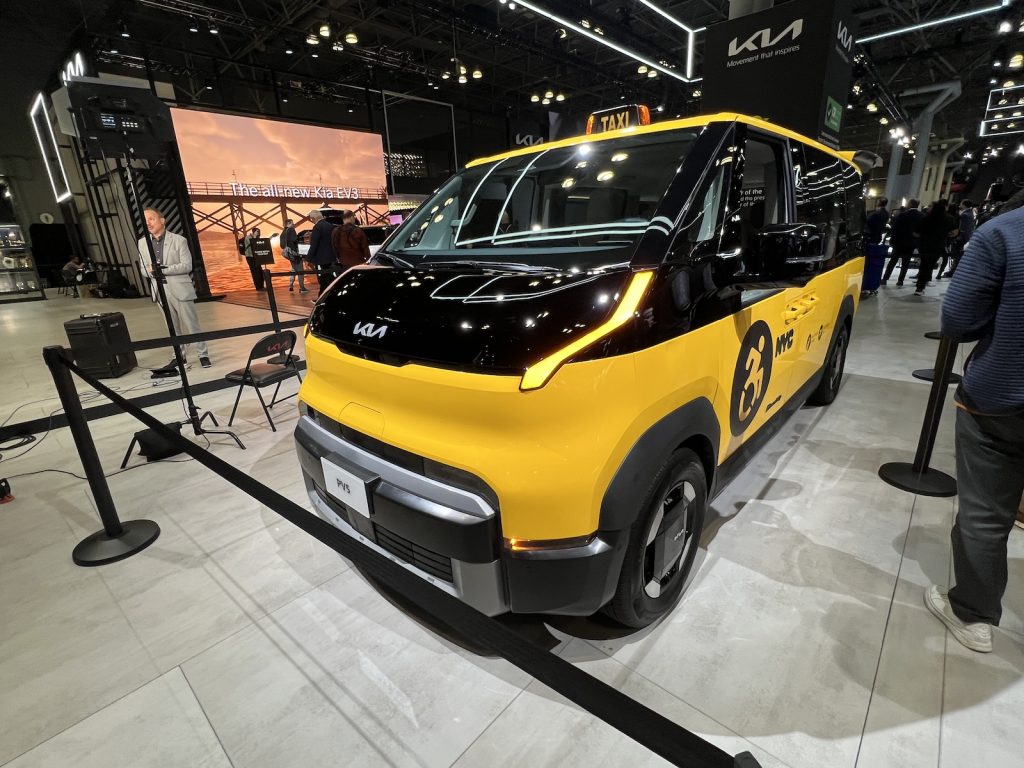
Craig told me that feedback so far has been “very, very strong,” with some fleet operators already asking if they could place orders. Not only would the PV5 taxi be compliant with NYC’s upcoming EV mandate for cabs, but the less stringent maintenance schedules afforded by EVs also appealed to buyers.
Other operators, though, still had some concerns, due mostly to charging infrastructure, not the vehicle itself. “Charging infrastructure is one that comes up,” Craig says.

Whether the PV5 taxi isn’t up to BraunAbility, of course, it’s up to Kia. It can only be made possible if the company decides to develop a version that’s compliant with U.S. roadways, which hasn’t happened yet. But there is some hope.
The concept itself showing up in New York during the Auto Show at Kia’s booth is a strong indicator that the company is at least considering importing the PV5 for American roadways. Moreover, Car and Driver spotted a PV5 test mule equipped with U.S.-spec side marker lights and reflectors driving around on Michigan roadways last month.
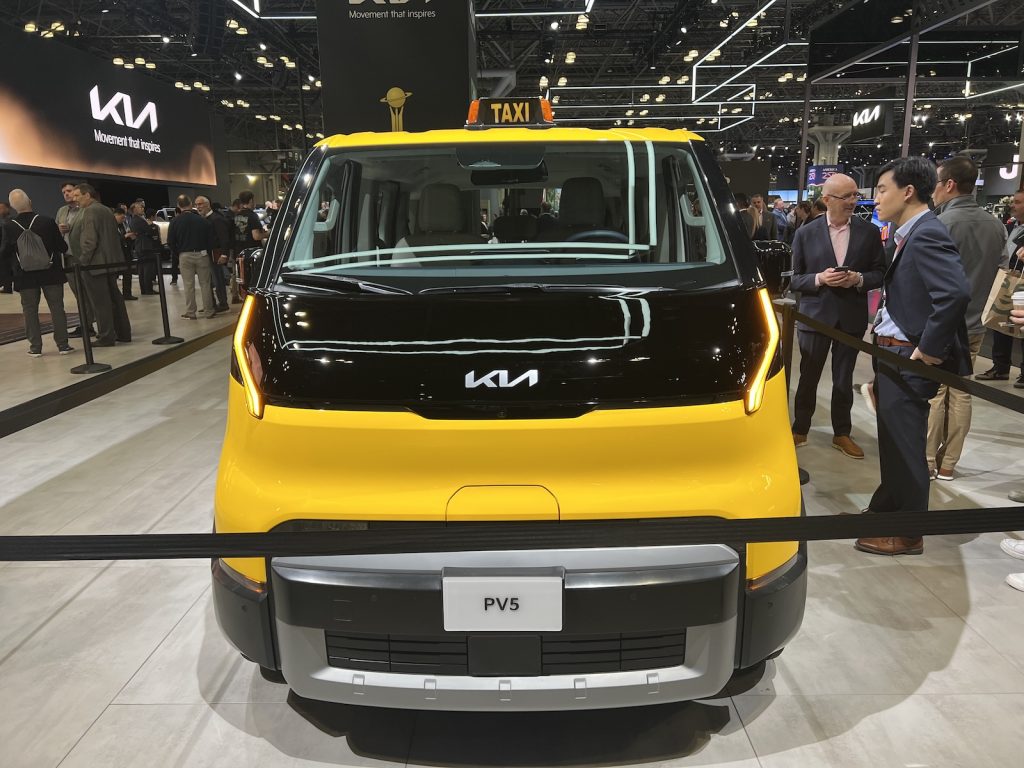
Non-U.S.-market cars are tested Stateside all the time, of course, so this isn’t conclusive evidence. It’s very likely the company is gauging interest from BraunAbility’s customers and its own buyer base to see if there’s a viable market, using the Auto Show as a stage.
As a NYC resident, I’d be very happy to see our taxis become tall, alien-looking electric Kia vans – if not only because I could buy one wholesale with 400,000 miles on the clock one day.
Top graphic images: Brian Silvestro





Love to see some more accessibility content!
Now send Mercedes to the Netherlands to review a Canta.
Please, Kia, stop with the amber DRLs.
Other than that, this factory effort looks much better than the modified Siennas which have hilarious proportions.
I LOVE the amber DRLs / marker lights! I think they do a much better job at making the vehicle visible than white light.
The wheelchair ramp should probably extend out the side, onto the sidewalk, instead of out the back, into the street. NYC parking could make the long rear ramp unusable in some situations. Upon further considerations, the ability to choose between two ramps would be the optimal setup.
It’s too bad an American company didn’t design this. Hyundai/KVI is very focused on innovative and forward-looking designs, and are progressing very rapidly as a result. (Quality control is another issue…)
Seems like a word missing here
for a while, and maybe they still do, but they had these terrible Nissan vans as yellow cabs. apparently it won something? what a horrible cab. perhaps a good delivery truck, but a bad cab. another reason why uber / lyft wins. no normal person buys those janky things. well except Autopians, for the challenge and because they are ugly. 🙂
Notice how this has REAL door handles? Just sayin’, this is for actual people to use.
China now mandates them
I need them to make an AWD variant
Yeah, those NYC streets…/s
almost like I was talking about for my own needs and not NYC’s
Hoping this makes a US market PV5 more likely. We need an EV van here…
Wouldn’t an EV van just be an EV?
Good point!
I much prefer the classic Checker cabs
Didn’t you bother us enough with that stupid taxi roadtrip that ate up way too much space that could have been used for some kind of car that was remotely interesting? I’m still sour you didn’t choose the Mercedes Camino or really, anything else.
Yes, we’re all very concerned by wasting the extremely limited screen space on the internet. There’s only so much to go around! How dare someone fritter away any of it on stuff that isn’t interesting to you!
They’re going to clog up the internet tubes with a basic text and image website!
Well, some actual human who usually writes interesting content wasted time on those articles which I found to be the least interesting things ever posted on this website, and this is the internet so we can all complain if we want to, and FWIW I’ve even complained about this in person at one of the meet-ups so it’s not like I only do this through a screen. I liked the concept of the copart car thing, but the execution! Blah! Terrible as soon as they picked out the dumb taxi.
Tesla: “We are designing the cab of the future! It has two doors and is incapable of being used by people with disabilities!”
Kia and BraunAbility: “Shhhhhh….. the grown ups are talking….”
My friend has a Braun-converted Honda Odyssey. Retail price was north of $80k. This stuff ain’t cheap, but if vans got modified in-factory, they’d be cheaper.
The number and scale of the changes required to convert the vans are such that I doubt this is true.
Or even if it is, the compromises to the “regular” van to allow it to be built on the same assembly line as the ramp van would introduce all sorts of undesirable side effects.
This x1000
Renault offers a factory wheelchair ramp on the Kangoo. Too bad they don’t sell the Kangoo over here 🙁
When we needed a wheelchair van, we bought a used Chevy Express conversion van and had a lift fitted into the side doors. This worked for us because the chair user was overall pretty short. When it came time to sell the van to another user, there was a problem because the floor was not lowered and the max opening height was about 48″. An adult with a fixed head support on the chair was not able to use it. We eventually found a family with a child who needed it so it wasn’t wasted in the end, but that floor lowering issue is more complicated than I ever thought.
We had already been through a minivan with a folding ramp out the side (very long, and often blocked by other cars) and we considered a Braun conversion. However, the cost was astronomical and a rear ramp is an issue not just when parallel parking but also in regular parking lots because you are blocking a traffic aisle when trying to load/unload. A parking garage can be dangerous in that way when other drivers don’t expect a ramp and chair to be around a bend in a limited visibility situation.
All for this.
On another note, I feel like Autopian should do an article on the accessibility conversions out there and companies (all 2 big ones at least)
Agreed. There are all sorts of issues for the disabled users that would not occur to the regular drivers out there, and it would be interesting to see the pros and cons of each design and how the various design compromises are reached.
And also include the MV-1, the only vehicle (that I know of) designed from the get go for wheelchair accessibility.
NYC taxis are a luxury for rich people too dumb to figure out the Metro.
for a wheelchair user I can see preferring a taxi over the metro. Transferring between trains while having to worry about if the elevators aren’t working would be an added level of frustration.
Taxis are also a necessity for people who find it at challenge to get to and from the nearest Metro station. Just because you can walk does not mean you can walk a 1/2 mile.
If only there were a comprehensive bus system.
Ah yes, the famously reliable and on-time bus system. Last time I was in NYC I tried to take a single bus because it was theoretically more convenient. I waited half an hour. No bus. I took the metro instead.
Not to mention that a lot of the SBS services still use high-floor buses that require slow and inconvenient wheelchair lifts that increase dwell times significantly. And the fact that a lot of the low floor buses are packed during rush hour—good luck rolling into one.
Taxis are also a necessity for people who find it at challenge to get to and from the nearest bus stop..
I guess that makes me a rich guy with an aversion to bum piss and sweaty strangers. I CAN use the subway just fine (I did when I was young and poor), I just don’t need or want to. Today I mostly just avoid the place unless it’s work nobody else in the company can do.
The NYC metro suffers from massive underfunding, not sure if there is any investment going into it but it’s loud, hot, it stinks. Last time I used it a guy peed there. Very uncivilized and that’s in one of the richest cities in the US. Compare that to Singapore or Shanghai.
I wonder what would happen in Singapore or Shanghai to the person who peed.
SG: Cases considered “annoyance to the public” (e.g., urinating in MRT stations) can fall under the Penal Code, with fines up to S$2,000 or even jail time for severe offenses.
They are about 200mm longer then a transit connect and 900mm shorter then the shortest transit so the cargo version might be a winner for replacing all many of those for fleets. Especially if you figure they sticker under $35k.
I never realized it until now but I don’t think I’ve ever seen a Sedona/Carnival as a wheelchair van. Every other brand yes but not Kia. I wonder why that is?
Likely have to sell enough to warrant Braun making the engineering investment.
The Caravan and Sienna are/were great choices because they both had maaaany model years without significant changes. Making their engineering pay dividends for over a decade in some cases without much or any revision.
Availability was where my mind went too.
It seemed like converted Siennas started popping up more later in the 2nd gen models, but Odysseys didn’t really start until the 2010s with 4th gens. I could see Toyota having pursued it more than Honda though too initially.
Braun’s primary business has been Chrysler products for many years. The extended run of the RT and RU van models were godsends for this reason.
Quite a few converted Sedonas in the UK. Brotherwood (who I think started out making milk floats in a village near my home town) made them
I once saw a first-generation Scion xB wheelchair conversion and it blew my mind. I still don’t know if it was a custom order or something one of the conversion companies series produced.
I, for one, can’t wait to hear PV5.WAV playing it’s tune on NYC streets. I’m sure it’ll bring on a Torrent of praise!
Kia can design a car, easy to argue it’s one of the best in the game right now, and has been for almost a decade at this point.
But, my short experience with the Telluride showed they have a long way to go with reliability still. That was 4-5 years ago though. Will these run as long as the current crop? I’d be buying a couple to test out if I was a cab company owner and they were for sale.
Sell the PV5 and Staria over here, including to retail customers.
Why don’t these vans have factory wheelchair points like Renault does with the Kangoo?
In 40 years robotic bodied Jason will applaud the convenience of the ramp as he embarks on his latest cross-Jasonia trek.
Domo Arigato, Mr. Roboto.
God, please. Not a second too soon.
Would need to be assembled in their us factories to have any hope of reasonable costs with all the tariff wars going onon. Importing it from Korea will not cut it even if the conversion is done stateside.
For that matter – Why couldn’t they be assembled and converted at the same factory?
Because if it’s good for NYC, it’s also good for Boston, DC, LA, SF, Chicago….
Technically the oems don’t seem to get involved with factory conversions, but there’s nothing stopping a third party like Braunability from selling their conversions anywhere that would order it.
“Technically the oems don’t seem to get involved with factory conversions…”
Toyota, Ford, Nissan, Chrysler and GM did indeed get involved w/ factory conversions – for sunroofs and T-tops in the 1970s, then for convertibles in the 1980’s with ASC – until they were either discontinued or brought entirely in-house.
I’m referring specifically to wheelchair accessible conversions in North America not in general, since this was germane to the topic at hand. Apparently Renault in Europe and Japanese manufacturers in Japan/ ROW may make accessible vehicles from the factory but not in the USA or Canada
Please. The Siennas are awful to ride in. Every time I hail one (or get a WAV assigned on ride hail apps) I groan in disappointment.
I wonder if Kia, given the amount of stakeholder input, will design the sliding doors to handle people trying to pull them properly.
Cool! But it’ll be even cooler when The Autopian staff is cross-country road tripping a 300,000 mile one by reverse charging it with a BEV that Torch or Mercedes bought on Temu…
Forward thinking in all respects, to serve society in many respects.