

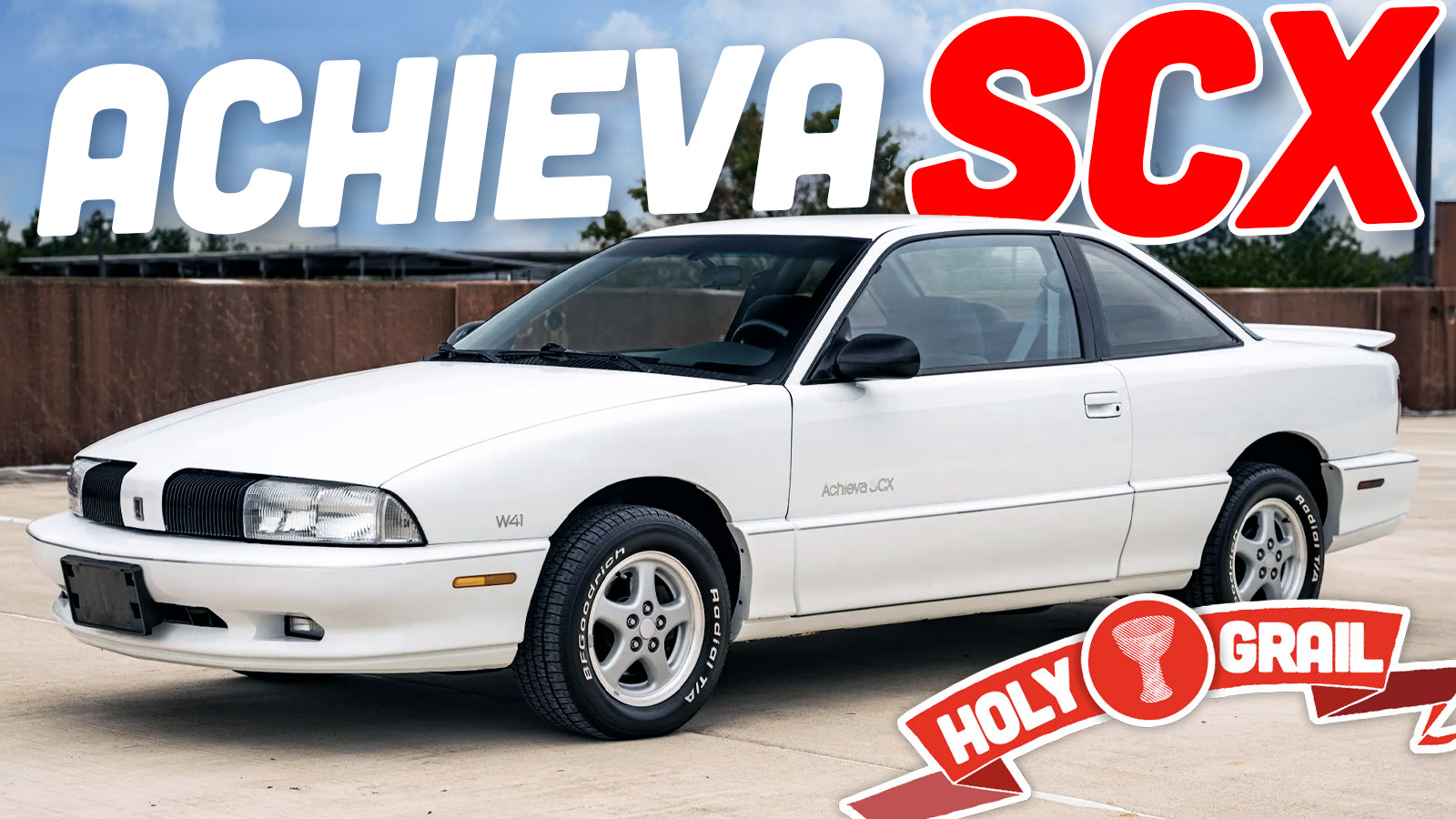
The 1990s era of General Motors isn’t always looked on fondly. Lots of the General’s fare consisted of floaty front-wheel-drive cars that ranged from the likes of the Chevrolet Cavalier to the Buick Century or failed efforts like the Cadillac Catera. But there were some bright spots, and more than one of them came from Oldsmobile. For just two years, Oldsmobile made the Achieva SCX. This sporty coupe was so good at going fast that it won the touring car championship of the SCCA World Challenge three times in a row. Oldsmobile was so serious about giving enthusiasts a quick car that you were even able to order it without comfort features.
Oldsmobile’s long life as an automaker came to an end in 2004. Founded in 1897 by Ransom E. Olds, the brand was once known as an innovator. In its early years, Oldsmobile was a pioneer in American vehicle exports, the usage of speedometers, car advertising, and even the use of automatic transmissions. Later in its life, Oldsmobile was a pioneer in mass-production front-wheel-drive American cars and a leader in technologies like head-up displays, airbags, touchscreen interfaces, and electronic engine controls. Oldsmobile even offered the first mass-produced American car with a GPS navigation system.


Oldsmobile then had a sad fall from grace. It celebrated its 100th birthday in 1997 just to ride into the sunset seven years later after selling rebadged minivans, rebadged SUVs, and forgettable sedans.

But the period right before Oldsmobile’s spiral was quite promising. The Oldsmobile of the 1990s had some high marks in it, like the futuristic Aurora and the shockingly comfortable LSS. Then there was the Achieva. Most Achievas were arguably forgettable vehicles. If it weren’t for the topshot, would you even be able to picture what an Achieva looked like? Yet, there was one version of the Achieva that was surprisingly hot, though long forgotten in this world. It’s time to shine some light on the Achieva SCX.
A New Era For Oldsmobile
The Achieva story started with another forgotten Oldsmobile coupe, the Calais. In 2024, I wrote about how the Oldsmobile Calais was largely forgettable, except for the rare Quad 442 W-41. Oldsmobile’s revived 442 didn’t look like much, but it was actually faster than the original 4-4-2 muscle car.

In one review, the Quad 442 was faster around corners than a Chevy Camaro, an Eagle Talon AWD, a Ford Mustang, and a Toyota MR2. The Quad 442 wasn’t perfect — it was known for body roll – but it was a showcase that the engineers in Detroit knew how to make a competent, fast small car. The N-body platform – meant to replace GM’s X-body cars — the Calais was based on was also a pretty big deal for General Motors. Here’s what I wrote:
The N-body cars employed tactics GM used on its smaller cars. These vehicles rode on unibodies and were propelled with smaller, more fuel-efficient engines. The suspension was also nice, but not particularly impressive with MacPherson struts up front and a twist-beam axle with trailing arms bringing up the rear.
As Curbside Classic notes, the market positioning of the N-bodies was also pretty weird. Initially, the GM-20s shipped as the Pontiac Grand Am, Oldsmobile Calais, and Buick Somerset coupes. These vehicles were placed higher up than GM’s J-cars but below the A-cars. The N-bodies were compacts for a future of expensive fuel and GM believed these cars would draw buyers away from European and Japanese imports.
In brochures, Pontiac touted its Grand Am by talking up the ribbed plastic cladding, the vehicle’s aerodynamic design, and flush windows. Oldsmobile’s marketing went for a rad jukebox sort of vibe and touted the Calais as the choice for the buyer concerned with quality and style. The brochure for the 1985 model really rams the word “quality” down your throat, perhaps echoing GM’s hundreds of millions in investment to make the GM-20 cars good enough that you’ll forget about the broken-when-new hoopties of the late 1970s.
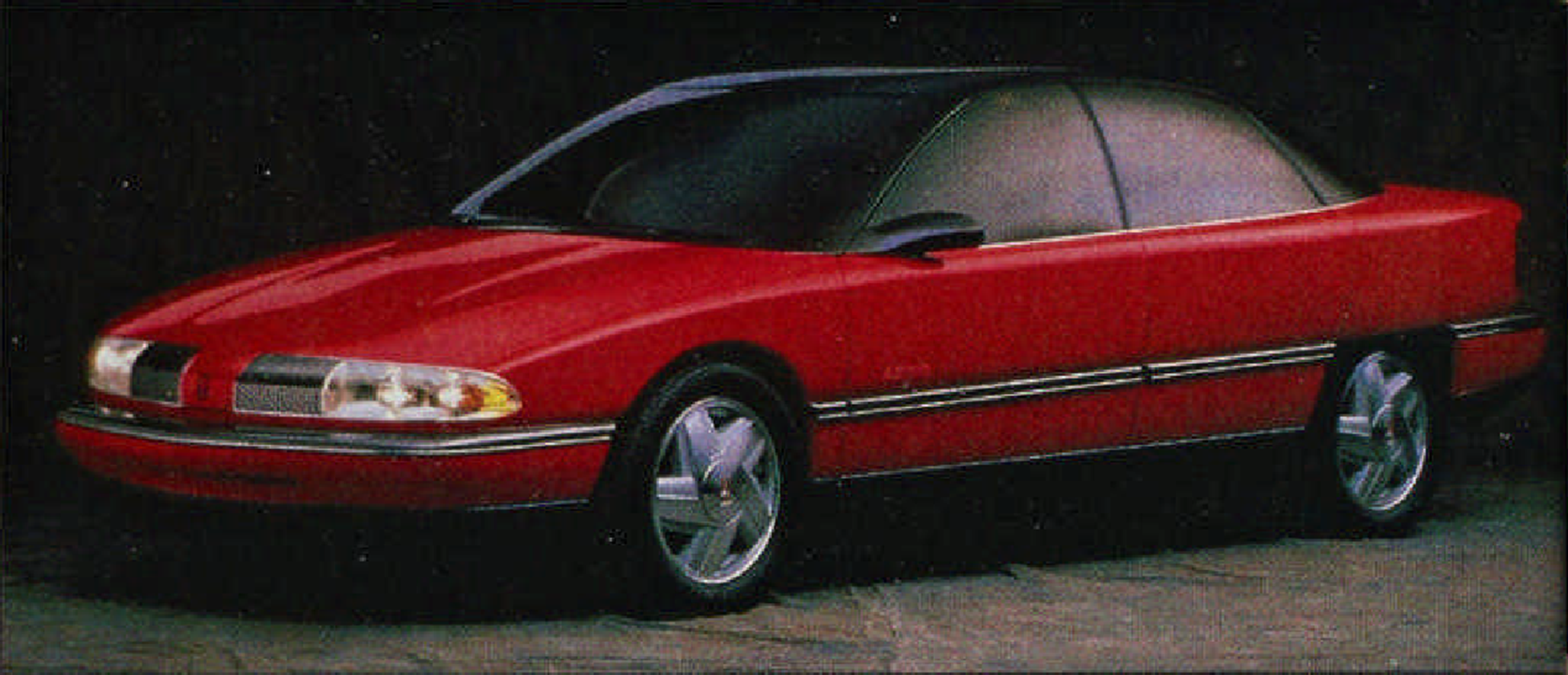
The hard part, for General Motors, at least, was figuring out just how it was going to follow the Calais up. Gary Smith, one of the designers involved in the Achieva’s development, wrote about his part in the vehicle’s design. From Dean’s Garage:
I was transferred from Buick One to Oldsmobile One Exterior Studio in late 1985. Olds One was a crazy studio even by Design Staff standards. One story comes to mind. Peggy Lee recorded a song called Is That All There Is? in the ’50s that was so depressing that it was pulled from many radio stations at the time because of an increase in the suicide rate. Well, some unscrupulous sculptor recorded the song on both sides of a 90-minute cassette and played it continually for weeks every day in the studio. Needless to say my morale didn’t exactly soar being tortured by that song over and over again. The Gestapo couldn’t have used a more effective brainwashing tool. Looking back on it though it’s pretty funny.
We were working on some platform for a sporty 2+2 car of some sort. I did sketches of proposals for that car and the other projects in the studio and hung them with the other wallpaper I continuously produced. In that studio at the time it was difficult to get anything on the car unless you were, well, running the studio. But Dave Holls, one of the directors, came through and sometimes actually looked at sketches. He seemed to see something in a couple of sketches that I did and asked me to do a full-sized airbrush rendering of the design, which I did.
At the same time, Olds Two studio was struggling coming up with a new design as a replacement for the Cutlass Calais (which would eventually be renamed Achieva). Dave looked at my airbrush and asked me to try the design again on the Calais platform, and I came up with a red rendering of a revised proposal. When the rendering was finished, someone must have liked it, because they took it out of Olds One and hung it up in Olds Two. Dave North was the Studio Chief and Ed Welburn his assistant. I remember they started to model the car but were having some trouble capturing the feeling of the rendering. I was asked to help them by drawing a 3300 section to start the body side modeling. The front and rear profiles could be taken from the full sized rendering.
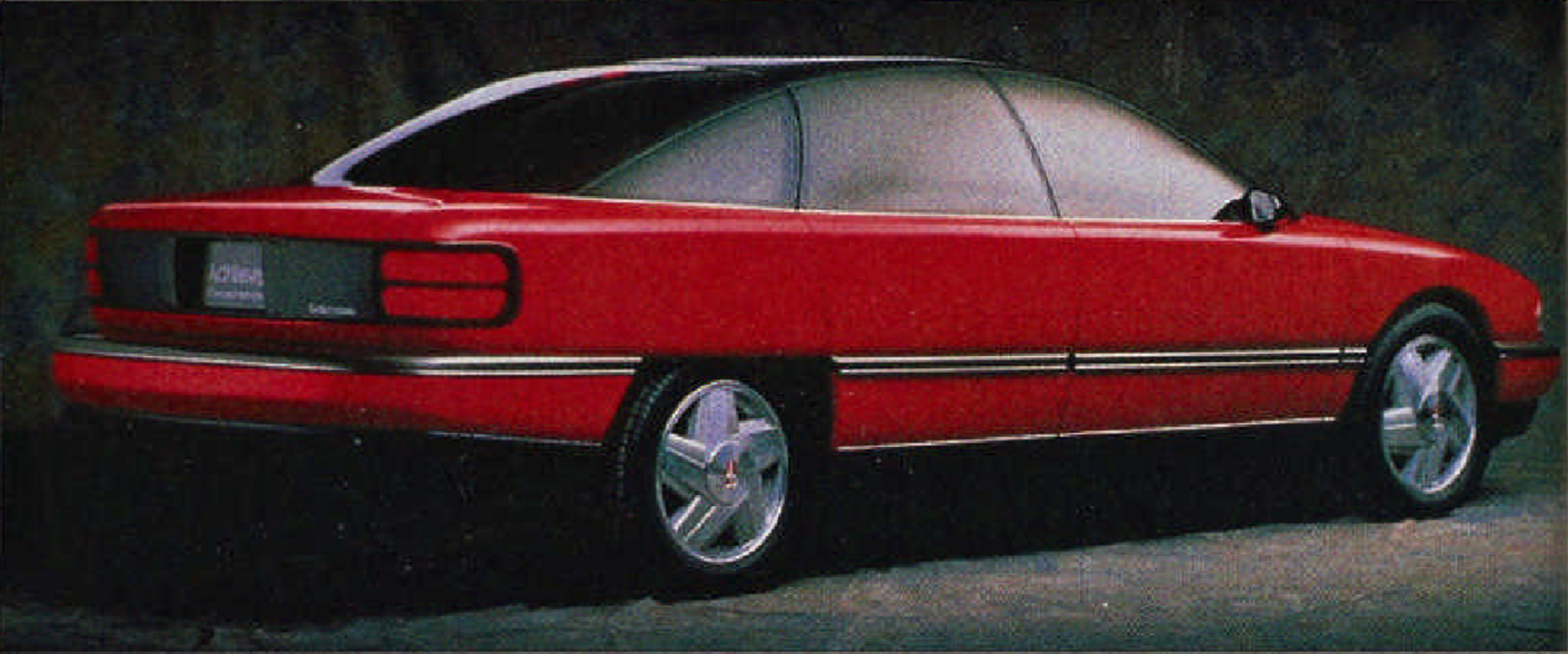
Smith further explained that once the design was coming together, Dave Hollis decided to finish the model in the basement to hide it from GM brass. A fiberglass model would later be made to freeze the design statement. Smith said that something that made the design of the Achieva unique was that the vehicle’s greenhouse sat on top of the lower part of the body when monocoque-style designs were all the rage back then.
Sadly, the Oldsmobile team didn’t see their whole design reach production. When the Achieva hit the road in 1991 for the 1992 model year, the sedan had the greenhouse of its Buick Skylark platform mate, while the coupe had the greenhouse of its Pontiac Grand Am platform mate. This is why the Achieva might look a little weird. The bottom half of the car had Olds styling, while the upper half was either Buick or Pontiac.
The Achieva

According to a May 1991 report from Motor Trend, the Achieva and its platform mates, the Buick Skylark and Pontiac Grand Am, were designed to right the wrongs of the past. Some felt that these cars’ predecessors were largely just the same car but with different badging. This time around, General Motors let the designers of each brand give each vehicle an identity. The Grand Am was supposed to be a bit sportier, while the Buick was a bit more premium. The Oldsmobile Achieva sat somewhere in the middle, sort of sporty, sort of upscale, but not fully into either category.
The Achieva name was strategic. According to Motor Trend, Oldsmobile execs became well aware that the brand had worn out the Cutlass name by slapping it on tons of cars. The Achieva was supposed to be a breath of fresh air in that regard. But even with adding the Achieva to the portfolio, Oldsmobile was still selling three variations of Cutlass: The Cutlass Ciera, the Cutlass Supreme, and the Cutlass Supreme Convertible.
Oldsmobile hinted at something great with its show car in 1991, which came equipped with a W-41-spec 2.3-liter Quad 4 making a healthy 190 HP. This engine was a carryover from the Quad 442 and was, at that time, one of the hottest naturally aspirated GM four-cylinder engines. Motor Trend reported that the Achieva was slated to enter production in the summer of 1991, with press drives and then dealership sales that December.
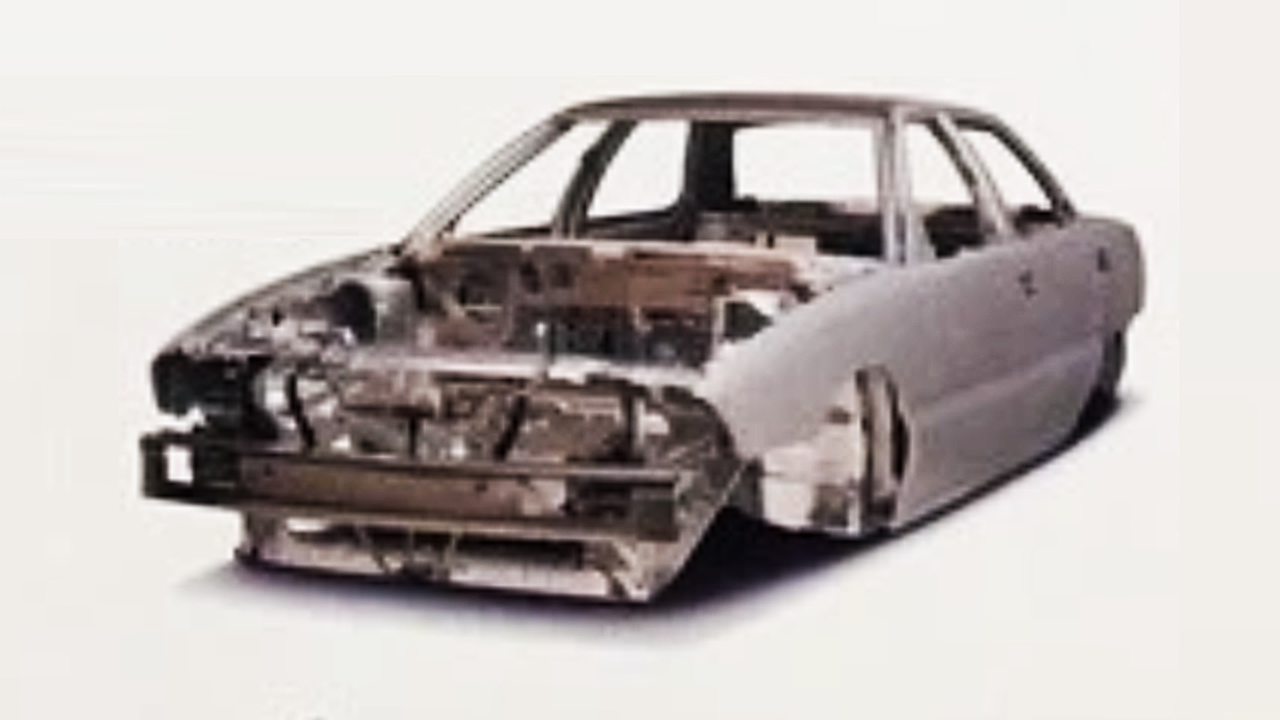
The Achieva and its platform mates were based on GM’s second-generation N-body platform. The N-body was the result of an ambitious engineering effort launched in 1982 that was called the GM-20 program. Here’s what I wrote in the past:
The GM-20 program had one core mission: To take market share back from the imports. GM launched an ambitious effort to achieve this by leaning harder on advanced technology than before. While the GM-20 cars themselves were largely unremarkable, the way they were produced was novel for GM at the time. As the Washington Post wrote in 1984, General Motors spent $250 million alone on converting and updating its plants to stop producing the GM X platform cars and start producing the N-bodies.
Where was this money going? A lot of it was sunk into automation, where the Oldsmobile and Fisher-Lansing plants would attain 219 welding and painting robots. At the time that was a big deal because no other GM operation had that many robots assembling cars. GM didn’t stop there, the robots were complemented with 185 automated guided vehicles, which automatically moved parts around the facilities without any human driver input. The guided vehicles meant that most human-operated forklifts were no longer needed.
GM put even more robots in charge of racking door panels, attaching VINs, and fitting engine serpentine belts, tasks that were once reserved for humans. Eight more welding robots were used to place 64 welds in each N-body’s unibody. All of this was implemented in an effort to achieve a level of quality not seen before. Having robots do the welding meant fewer chances for the mistakes humans would make. And to make sure the work was done properly, giant scanners were installed at the plant that looked the cars over as they went down the line, checking to see if the actual cars came close enough to matching the tens of thousands of measurements and dimensions stored in the scanner’s memory. Computers even handled some of the final quality checks that, once again, humans handled in the past.

If you want to read more about the N-body’s development, click here.
The second-generation N-body cars were longer and more distinctive, but some traits were similar, like a 103.4-inch wheelbase. Like the older N-bodies, the fresher ones had rack and pinion steering, MacPherson struts up front, and a twist-beam axle with trailing arms in the rear. Motor Trend noted that the Buick Skylark got an Adjustable Ride Control system, which controlled the firmness of the struts. Another noteworthy update to the second-generation N-bodies was Delco ABS VI.
The airbag situation was weird at first. The Chicago Tribune said that General Motors chose ABS over airbags, waiting until a 1994 update to give the GM-20s a driver airbag. Reportedly, the reasoning was that airbags aren’t used as often as ABS, which I suppose makes sense.
A Fine Enough Family Car

The N-body cars launched for the 1992 model year, and the reception for the regular cars was mixed. Motor Trend didn’t even publish a review for a regular Achieva at first. That came later when the publication had a long-term V6 model. From Motor Trend:
The 155-horsepower V-6 engine provides quick throttle response for merging or passing, yet it sips sparingly from the fuel tank. Overall, acceleration from the 3.1-liter engine left the staff uninspired, with a 9.5-second 0-60 mph time. Among owners, however, power was rated highly. An attorney from Wisconsin wrote, “I’m very glad I got the V-6 engine-it has great pickup and just purrs.” Offering five more horsepower over today’s Quad 4 four-cylinder, the V-6 shines with its higher torque rating, which is appreciated when the Achieva has a carload of passengers.
We freed our test car from its daily regimen as a Los Angeles urban commuter when we relocated it back to Detroit via a cross-country road trip. The seemingly endless highway miles flashed by. In driving extremes-the stop-and-go traffic of Southern California and traversing the great Western plains-the Achieva proved itself to be comfortable, reliable transportation, and a sufficiently stealthy (read: nearly invisible) long-range mile-eater.

However, the extended hours spent in the car left us with mixed feelings about the interior. The contoured seats proved comfortable for most body sizes, and the interior was reasonably spacious, with adequate room for back-seat passengers. There were also some nice touches (a swooping dash, plentiful storage nooks), but they were offset by some awkward features (poorly located door handles, hard-to-see gauges). It seems as if sound engineering was limited by corporate parts buying, resulting in several details that were out of place in an Oldsmobile, such as dated-looking door switches and radio face. Sadly absent was a dead pedal for resting your left foot, and wheelwell intrusion limited foot room. Owners concur, reporting a desire for more leg space, and also for more rear-seat room. On the other hand, the cavernous 14.0-cubic-foot trunk could swallow luggage and groceries, and still ask for a second helping.
While the regular Achievas seemed thoroughly whelming, Oldsmobile did not stop there.
A Hotter Oldsmobile

As Motor Trend notes, when the Achieva launched, Oldsmobile had a bit of an identity crisis. Buyers could look at any GM brand and figure out what their statements were. You knew a Pontiac was trying to be sporty, and you knew a Cadillac was flagship luxury. But what was an Oldsmobile? It sat sort of in the middle of everything. The Achieva SC was the first model to drive a line in the sand that Oldsmobile could mean performance.
As Motor Trend noted in October 1991, the base Achieva had a 2.3-liter “Quad 2” SOHC derivative of the Quad 4 that made 115 HP. Then there was the SL, which had a 155 HP Quad 4. A 3.3-liter V6 was optional, and good for 160 HP. The Achieva SC? Its twin-cam Quad 4 made 180 HP. The transaxle was a five-speed manual with “sport ratios.” Motor Trend thought that the SC had the looks, the handling, and the ride of a sports coupe, but that the Quad 4’s noise and vibration didn’t make the cut.
The Grail

In that review, Motor Trend said that Oldsmobile was working on a hotter, tighter version of the SC. According to Hot Rod magazine, Oldsmobile came out of the most successful racing season in its history with a little something for racing fans. That car was the Oldsmobile Achieva SCX, and it was the hot Oldsmobile for grassroots racers.
Oldsmobile made several changes to make the SCX the hottest car the brand could Achieva in 1992. The SCX, which replaced the Quad 442, sported a W-41 performance package, which bumped the 16-valve High Output Quad 4’s power to 190 horsepower and 160 lb-ft of torque. The engine produces this power thanks in part to a high-flow exhaust and new cams. Meanwhile, the engine block and engine cover were also improved to lower the noise that journalists complained about in the Achieva SC.

Helping the Achieva SCX get the power down was a lower 0.81 fifth gear ratio, a 1.3-inch wider rear axle, electronically adjustable dampers, twin rear stabilizer bars, and a 30mm front stabilizer bar. Wrapping it up was 14-inch wheels shod in 215 section-width tires.
Motor Trend gave a largely glowing review, saying:
True to form, the ability of our pilot-production SCX to put power to the road was appreciated. “Power is impressive, and the Quad 4 responds instantly to changes in throttle setting.” Unfortunately, this power was accompanied by uninhibited noise and vibration, especially in the 4000-5000-rpm range, which drew complaints from many judges. “This Olds packs a big performance wallop surpassed only by its noise and vibration quotient,” wrote one tester. In several judges’ notes, the SCX was praised for its tight, linear steering, quick responsiveness, controllable handling, and fun-to-drive factor. One driver wrote that, while the NVH problem is uncharacteristic of Oldsmobile cars, “the handling prowess and cornering capability is also un-Olds-like; and that’s good.”
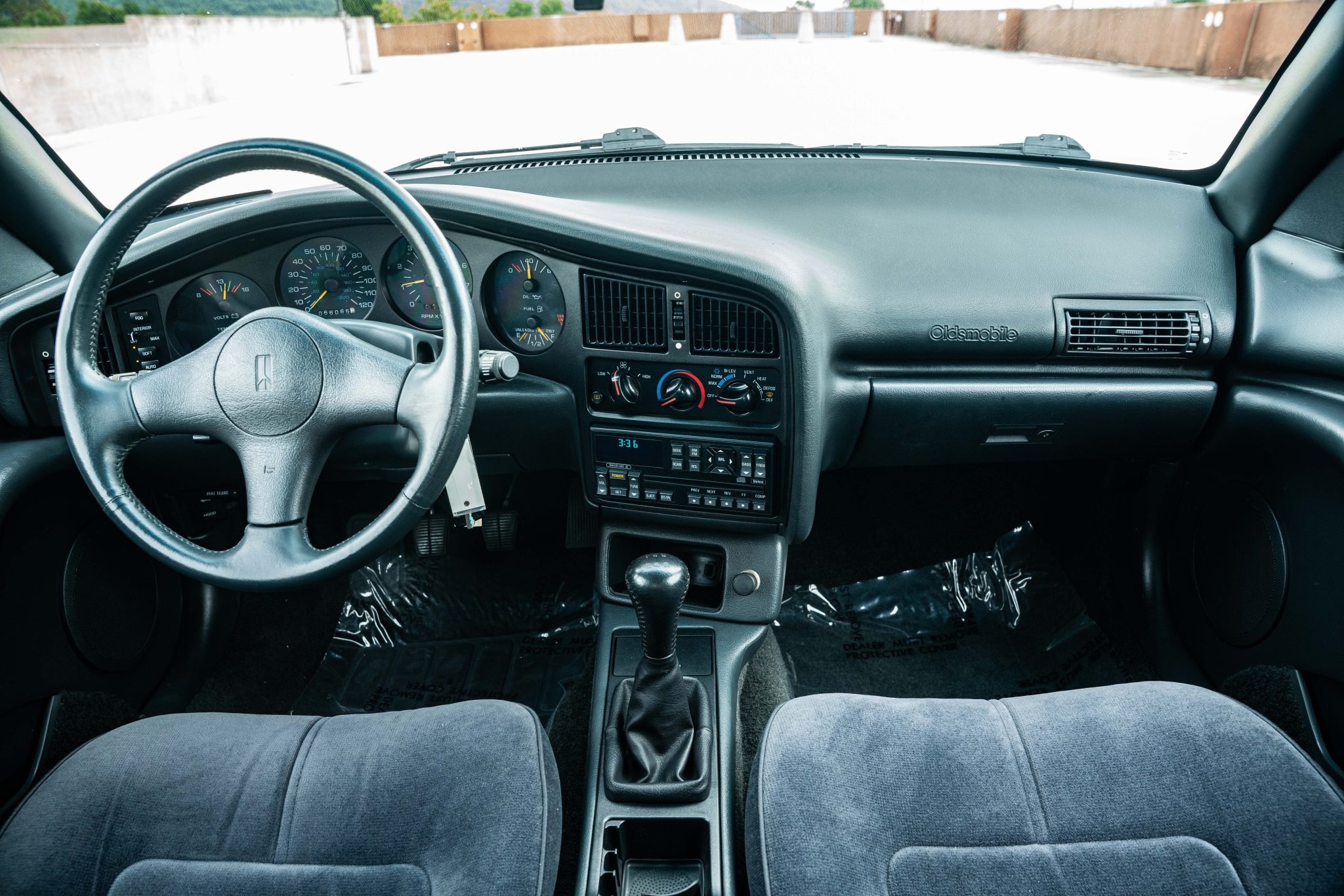
Opinions on styling were split. While one praised the “well-sculpted interior” and “BMW-ish dashboard,” another criticized the poor tactile feel and fit-and-finish, calling it “corporate parts buying without regard for Olds’ higher-priced image.”
[…]
Overall, our test vehicle was considered a lot of fun to drive, although somewhat unrefined. One editor wrote, “Except for the engine noise, this is a nice sport coupe.” Another echoed the sentiments: “For aggressive road driving, the Achieva is remarkably capable.”
Motor Trend loved the SCX enough to put the car on its shortlist for its 1992 Car Of The Year award. Here’s a review from MotorWeek, which shows the car getting pushed hard:
While exact performance figures were not published by Motor Trend, MotorWeek got the SCX to 60 mph in 7.8 seconds. MotorWeek noted that the 60 mph acceleration of the SCX was a full half-second quicker than the SC. It completed the quarter mile in 16 seconds at 90 mph.
In a modern retrospective, Car and Driver wanted to illustrate just how hot the SCX was by comparing it to a newer legend, the 1998 Acura Integra Type R. The “Teggy” had five more ponies under the hood, but 30 fewer pounds of twist. That being said, the Integra did weigh 2,600 pounds to the 2,816 pounds of the Achieva. Still, this car was some great work for GM!

While I could not find a copy of Car and Driver‘s period review, that publication reportedly also praised the car’s performance while also damning its noise and harshness. But hey, this was meant to be a racer, and it seems like a lot of folks didn’t really care about how loud it was. This car’s entire deal was to be a homologation special to compete in “showroom stock” racing series like the IMSA Firestone Firehawk Endurance Championship. Achieva SCXs would snake their way into SCCA and NHRA drag racing, too. Allegedly, Achieva SCXs took three wins in SCCA World Challenge Touring Car Championships from 1992 to 1994.

Apparently, if you hated comfort and loved speed, there was a way to make the SCX even hotter. If you ordered the SCX with the C41 package, Oldsmobile deleted comfort equipment like power windows and a radio, then added a Torsen differential. The base price of the SCX was $15,524, a decent kick over the $13,049 price of the SC. If you wanted an air-conditioner, cruise control, floor mats, a tilt wheel, variable effort power steering, and an under-hood lamp, that added $1,379 to the SCX’s base price.
A Rare Special
Few SCXs ever left the factory. It’s reported that 1,146 examples were built in 1992, with another 500 or so units left the factory in 1993. As I noted, this was really a racing-focused special, so you really had to want to pay the extra money for the extra performance. Of the lot, it’s believed that perhaps 11 to 15 of the total Achieva SCX production had the C41 package.

This is another one of those situations where rarity does not seem to equal value. One Achieva SCX sold for $6,941 on Bring a Trailer in 2024. I suspect that, like most ’90s GM front-drivers, the Achieva SCX was simply forgotten. Likewise, there were far more famous cars from the same era, even from GM. As I said, most enthusiasts don’t really actively search for this era of GM.
But if you are one of our many readers who love this period of GM, it sounds like the Achieva SCX was something special. It’s a car that doesn’t look like much, but found its way into the hearts of grassroots racers. The Achieva SCX was built for a time when automakers were obsessed with giving enthusiasts cars they could take racing, and I think it was one of the high marks of the beginning of the end of Oldsmobile. General Motors was so fun in the 1990s that one of its hottest compact cars was somehow an Oldsmobile.
Top graphic image: Bring a Trailer


Always wanted one of these. Really wanted a Quad4 in my Fiero.
“Teggy”? Really Miss M, your prodigious output is always impressive, yet IMHO you can do better.
Here is a useless tid bit of information about these cars that I remember. The early 90s were just when “plus size” performance wheels and tires were really starting to gain traction (see what I did there?). So while the mid level SC coupe came equipped with a larger 16″ wheel than the base model (which was pretty respectable on a compact coupe back then), Oldsmobile made the curious decision to equip the top level SCX with relatively small 14″ wheels. They sighted some gobbledygook about handling and unsprung weight or something. Ill show myself out.
There was a brand-new one being sold (maybe a year ago) by the Volvo dealer in Manchester, NH. IIRC, they also had an Olds dealership at one time. Anyway, it was bought by the dealership’s original owner and was never titled (still on the GM MSO). It was a white 1993 Achieva SCX W-41. I could get some of the details from the internet cache, but the car must have been sold.
The Beretta GTZ from the same era is the flavor of N body I would take with this engine.. they’re the hotness!
I really like the Beretta styling. I think they are better looking than they get credit for.
Word
Not that there was all that much difference between the two, but the Beretta was an L-Body.
As I said in the Shitbox Showdown, an Achieva that basically looked like the photo under “A Hotter Oldsmobile” was my first car. Mine was black with red interior had the 3.1 V6. It was my Dad’s old car, and when he bought it new, he was of the mindset that 4-cylinders were buzzy garbage and he considered 6-cylinders superior no matter what the Quad 4 spec sheet might have said about power.
For a 16-year old, it was more than enough power. I could rip the front tires if I wanted. I once put 9 people into it. This was a snowy area, and it did pretty darn great in snow even with all-season tires and me driving into snowbanks for fun. The interior photo shows the slot under the radio that was pretty perfect for my portable CD player to fit for playing CDs through the tape deck adapter.
Eventually some weird electrical thing start showing up where the dash would die while driving. I’d get to a stop light, turn the car off real quick and restart – dash was back. Then some mechanical issues with the V6 and it was off to donation land.
A memory. Way back when, I got married (to the shock of all who thought I would never get a date, including me). During the marriage and the like, I got a rental car. It was an Achieva.
In a first for any GM product of the error (spelling intentional), I don’t remember anything bad about the car. Honestly, the entire 2 weeks was a blur. I sort of forgot what I had as a rental car until this article. I just remember it was an “Oldsmobuick” of some form.
Oh, It was NOT an W41. Nobody rents cars in American with more than 2 pedals.
I actually liked the looks of these (coupes). Didn’t like the Grand Am and hated the Skylark. Plus a neighbor who looked like a wanted poster for a pedo had the latter and apparently couldn’t park, the prow of his shitbox leaving cracked paint in the middle of my rear bumper from impact, something he denied. I vaguely remember them doing well in SCCA, but had no idea they offered these with an LSD! Of course, nobody bought them, but still. That interior even looks pretty good, very not-GM of the time, which had some of the worst interiors in the industry. I don’t even see any of those Athena-awful gray packing peanut buttons—I thought they put those in everything!
Also, how about we bring sidewalls back and use white letters on the tires to give the visual effect of larger wheels?
I’ve not driven an Achieva SCX, but I have driven a Quad 4 Beretta. If you want a (more) modern equivalent to one of the hotter N-Bodies, the B15 SE-R Spec V is a remarkably similar analog.
From gripping and gripping and gripping despite the tires basically screaming at you at all times and being able to easily/smoothly control the rear end with the throttle and all the way to the engine feeling like you’re throwing a box of hammers down the stairs after you get halfway up the rev range (but the engine still pulls really hard all the way to when it tops out). It’s a very similar experience.
i know more than little about cars of the last 50 years. especially gm. i ve never heard of this
I wanted one that had been wrecked. I had a Fiero 2M4 and had driven one that someone had swapped a W41 engine swapped into. The Quad 4 took something over 100 lbs out of the Fiero and doubled the power. The Quad 4’s legendary NVH problems weren’t as annoying in something sporty looking.
Out of the ashes of two half-assed GM cars from the era, a single decent car could be made.
These had my second-favorite everyday car dashboard of the era (my favorite being the DSM coupes) – it’s shocking sporting for an Olds, even of the time, but certainly compared with what preceded it.
At the time, I ended up with a Chevy Beretta – which I loved – but part of me always pined for an Achieva.
The Achieva SCX and Quad 442 had the same power as the H22 Prelude VTEC that didn’t come out until 93.
Too bad it wasn’t used in other cars. The Fiero would’ve obviously benefited from the Quad 4, and a 4-door SCX would’ve been cool too. It could’ve also made a good base engine on the Camaro/Firebird.
The J-cars didn’t get the Quad 4 until 95, after the high-output ones were already discontinued. A Cavalier SS and Sunbird STE with the W41 would’ve been awesome.
GM didn’t even sell us the Quad 4 minivan that they exported to Europe.
I remember when the Quad-4 came out. Thinking it a great engine, but didn’t have a great car to accompany it. It’s the engine Fiero should have had from the beginning. Light years better than the Iron Duke. I actually liked the Achieva, and thought the dash was near perfect. I liked the Alero and Calais too, go figure.
N-bodies ran wild in my mid-childhood. Most powered by an Iron-Duke.
Always thought the Achieva looked good.
I always remember them looking good, until I just saw it in the picture above!
My second car at 18 was an 86 Grand Am V6. While it wasn’t perfect it was very fun to drive and I loved it.
The Beretta looked downright modern in ’88. I was just entering middle school.
Wild how much power they were able to squeeze from the Quad-4. In comparison, the in-period Toyota Tacoma had the same HP out of a 3.4 V6 and that was praised for the power it made.
Yes, 190hp was what Honda was getting out of their direct injected 2.4 liter 20 years later. No NVH complaints on that one though.
And the 1990s Ford 4.0 V6 made only 160hp. Both it and the 3.4 were torquey. Probably where the power compliments were coming from.
I had the Grand Am GT version of this, not quite as hot a Quad4, by 1993 power was down to 175hp, but I can confirm it went like stink, but the NVH was terrible. Also they didn’t cool them well, so they liked to eat head gaskets for lunch. I miss that car. I used to take the seats out every year to shampoo everything, when I traded it in for the Pathfinder it was cleanest GA, still I only got $1200 trade in lol
I thought I was the only person who took the seats out and did that. Oh well.
Glad I’m not the only one lol
My uncle was like that with his cars. Every scratch was touched up and buffed back almost immediately and it was detailed all the time. Never saw any of that back in resale value, but I think it was more that he couldn’t stand driving a ratty looking car.
My father-in-law had a standard one up until about 10 years ago. We called it the Under-Achieva in our household for fun, but it was probably undeserved. Seemed like it served him well for a long time.
What kind of rabid animal at GM actually thought that “Achieva” was a better name than Cutlass?
One is a nonsensical word which means nothing, and the other represented the tool used to cut the heads off their enemies at sea.
I’m pretty sure the Achieva name came out of a spitballing session in a marketing group boardroom that was wallpapered with 90’s contemporary motivational posters for “inspiration.”
I think it was “People seem to really like the Integra. If we could just get a name kinda like that it’ll be a slam dunk!”
Achieva is a terrible, almost sad name, like someone with brutally low self esteem staring into the mirror reciting affirmations to psych themselves up to leave the house. Cutlass had lost its meaning at that point, so they kind of had to find a different name, but I have no idea how that was the best they could do.
I think the problem is the mismatch between the name and the product. If you’re going to imply your car is an “achievement,” you best deliver. Had this been a standout vehicle, I think it would have worked. Or even above average. Ie: no one really gives Nissan crap for Maxima.
It strikes me more as aspirational achievement than accomplished, which is more honest, I suppose. For a few generations, the Maxima really was a pretty swell car. It’s a shame what Nissan became.
And no one gives Acura crap for Legend. I don’t hate the Achieva name. It’s a bit aspirational but not over the top. If Olds had used Legend that would have been too much, but Honda can pull that off.
Someone needs to put a Cutlass up against an Armada and see who truly rules the high seas.
Remember, this was a time of words that suggest but don’t actually mean anything, like Altima, Maxima or Integra. So Achieva was pretty in line with the times. They floated “Crusty piece of shitta” but ultimately it didnt make it through customer clinics.
College roommate had an SCX (in red; I believe these were only available in red, white, black and silver, year dependent) and it did run like a scolded dog and handled quite well, but that NVH was no joke.
I miss Oldsmobile. I’d gladly trade Buick to get Olds back.
We’d just have the same egg-shaped crossovers with a different badge.
Jules Winnfield: WHAT DOES ACHIEVA LOOK LIKE?!?!?
Choosing ABS over airbags bc it’s used more often…I guess, except the airbag makes a pretty big difference for the rare times you need it.
I think it was only a year or two before they started sticking airbags in them. But yeah that always shocked me about early 90s GM products when Chrysler had them across the board in ’90/91. Then again Chryslers couldn’t brake for shit so pick your poison I guess.
yeah. I guess it’s not worth speculating and I’d hope GM would at least look at crash statistics and choose based on which tech saved the most lives/prevented the most injuries. Still, it feels pretty gross knowing that at least some people lost their lives b/c available and proven tech was left out to cut costs. That said, GM was far from the only one doing this. It’s a good reminder why we need regulations. I’m sure GM and others fought like hell to prevent airbag mandates at the time.
Early airbags sucked as they deployed with a lot more force and there was no mitigation for smaller people who also tended to sit closer to the bag and they legit killed people. They even had switches to shut them off for smaller passengers.
True. But no one thought they sucked at the time. Movies and TV showed them expanding slowly like a balloon bc that’s how ppl pictured them. It took a while for people to understand they were dangerous.
And I doubt GM was motivated by safety concerns so much as costs.
Hm, you’re right. I’m disappointed in myself for not putting my mind in the time. I agree that GM wasn’t motivated by safety concerns as they have never indicated anything but the opposite, though I was more generally commenting that airbags weren’t as desirable a safety device as ABS (which is also cheaper and that’s what GM really cared about). Early airbag wheels were also hideous, often not nice to use, and locked you into having to keep it, but that’s my personal issue with them and I’m sure most people would choose safety over feel and aesthetics (as evidenced by nearly everything sold today).
The Cadillac Catera was neither FWD nor floaty.
Bad edit on my part. Repaired the sentence. Sorry! I shortened the sentence (my original draft was 4,200+ words long) without thinking why it was long in the first place.
And it zigged.
Discuss amongst yourselves
New band name: Achieva SCX
Frist collab with Charli XCX?
The SCX wheels are one of my favorite OEM wheel designs but I’ll never understand why they were only 14″ when both 15″ and 16″ wheels were available on other Acheiva trim levels. I can’t imagine that there were more performance tire options available in 14″ than 15″ or 16″, even back in 1993.
As an owner of an MR2 (205/60/14) they were out there, but few cars that used them. I got a great deal on some Coopers once (actually great all seasons) because a garage owner ran over to my car. “I had to buy a lot assortment of tires and yours is one of the only cars this size fits”. $40 each installed! Which was a smoking deal at the time.