

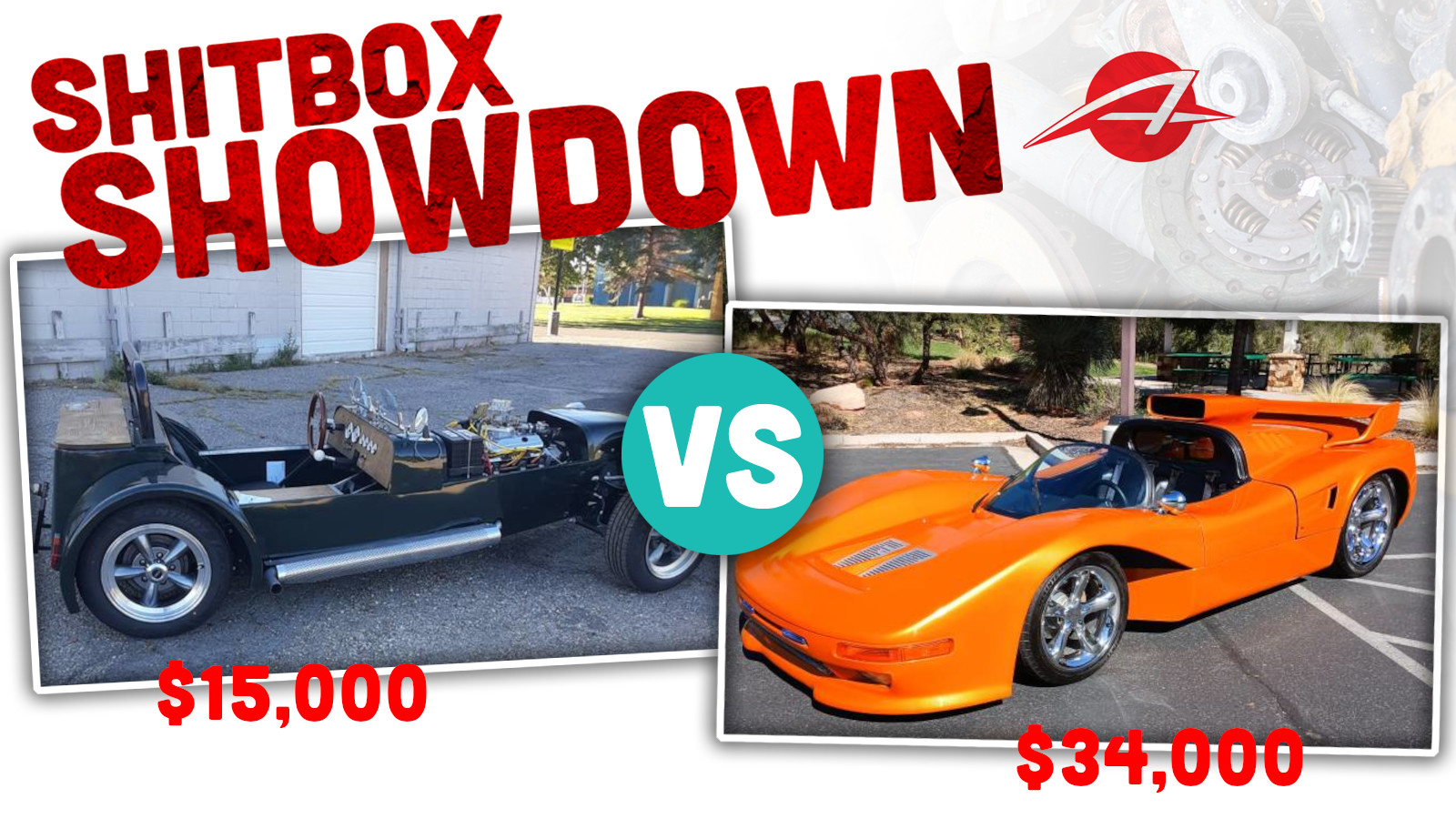
Happy Halloween, Autopians! Today we’re going to look at a couple of homebuilt cars. One of them isn’t what it claims to be, and the other has been made into something rather different from how it started out. Which one’s costume is more convincing? That will be up to you to decide.
Yesterday we looked at two cars that were kinda-sorta like cars featured in scary movies, and I confess that I was surprised by the outcome of this one. The red Plymouth Valiant seems to have won this, um, duel. Judging by the comments, I thought the big Oldsmobile had this one sewn up. I have no way of knowing who votes for what, of course, but it’s always interesting to me when the overall tone of the comments don’t match the final vote tally.


I think I’d take the Valiant, too. It’s just such a nice, honest old car. And it would be a hell of a lot easier to park than that gigantic Olds. Sorry, Ash; you’re on your own against the Deadites, it looks like.

You don’t see a whole lot of kit cars being built these days. The phenomenon seems to have reached its peak in the 1970s, and since then, the supply of dirt-cheap VW Beetles has dried up, and nobody wants to mess around with fiberglass anymore. There are still a few kits around, but more upscale and expensive, like the Factory Five kits. You don’t find many cheap kit cars like the ones that used to be advertised in the back of Road & Track.
One of these looks like it’s the last gasp of a kit car manufacturer that made cars more potent than your typical VW-based kits, and the other doesn’t look like it was a kit at all – it’s all home-built. Unfortunately, the seller isn’t being completely honest about its provenance. So we have a slightly underhanded trick, and a sweet and speedy treat. Let’s check them out.
“1965 Lotus 7” – $15,000

Engine/drivetrain: 2.8 liter OHV V6, five-speed manual, RWD
Location: Newton, KS
Odometer reading: 200 miles
Operational status: Runs and drives well
The Lotus 7, introduced in 1957, is probably the purest form of driving fun that there is. It’s a featherweight tube frame with an aluminum skin, a simple suspension system, a small engine, and that’s about it. It was originally built using Ford components, and sold by Lotus in the UK as a kit for tax reasons. Because it’s so simple, and was originally sold unassembled, it has become one of the most copied cars of all time. Dozens of companies have offered Lotus 7-like vehicles, and lots of enterprising folks have taken it upon themselves to build their own from scratch. This appears to be one of those scratch-built cars, commonly known as a “Locost,” because it can be built cheaply.

A great many engines have found their way into the front ends of 7s over the years; the original used Ford four-cylinder engines. But almost anything will work, as long as it fits, so you can get as wild with the power as you want. This one uses a GM 2.8 liter V6, modified a bit, and driving the rear axle through a T5 five-speed manual. The seller describes it as “scary fast,” and has put only 200 miles on it since it was completed. They’re selling it now because they’re getting too old to drive it safely.

Here’s where I’d normally talk about the interior, but cars like this don’t really have much of an interior. There are seats, and a steering wheel, and a dashboard, but the floor is bare metal and there are no creature comforts whatsoever. This one doesn’t even have a proper windshield, just two little Brooklands-style windscreens sticking out of the top of the cowl.

The traditional body for a 7 is aluminum skin attached to the steel tube frame, along with a removable aluminum hood and a fiberglass nose, and this car appears to follow that. I don’t think much of the giant hood scoop, but I guess it’s necessary to clear the high-rise intake on the V6. I’m not fond of the wheels, either; usually I like this style, but they don’t belong here. But all that can be changed if you want.
1985 Manta Mirage – $34,000

Engine/drivetrain: 400 cubic inch OHV V8, four-speed manual RWD
Location: St. George, UT
Odometer reading: 3,900 miles
Operational status: Runs and drives well
Manta Cars was a kit-car manufacturer in Costa Mesa, California, from the mid-1970s to the mid-1980s. Its most famous and popular model was this car, the Mirage, a tube-frame mid-engined sports car styled to look like a McLaren. The seller has this car listed as a 1967 model, but obviously that’s not right; Manta didn’t even come into existence until 1974. I found an older post about this car from the last time it was for sale, however, and it’s listed by the previous seller as a 1985 model, which sounds right.

The Mirage is mid-engined, and typically powered by a Chevy small-block V8 mated to a Corvair transaxle. This one has a 400 cubic inch motor that the seller says is pushing 400 horsepower – a hell of a lot for a two-thousand-pound car. It’s a good way to make lots of power, but I’m sure the eagle-eyed among you have already noticed some foolishness about it. It has eight Hillborn-style velocity stacks sticking out of the top of a rectangular air filter, which sits on top of a perfectly normal four-barrel carb. I bet if you look down those stacks, the openings don’t even go through to the air cleaner. I think they’re just stuck on top. The photos from the old ad show it with a normal round chrome air cleaner, which I think looks better, and more honest.

It’s tight quarters inside; there are two seats, but you’d better know each other pretty well. Those door sills aren’t going to be easy to get over, so you have to be limber too. The Mirage has weird two-piece doors: the removable center top section has small gullwing doors that open upward, and the lower Countach-style scissor doors flip forward. This one includes the top and gullwing doors, but they’re not shown in any of the photos.

I gotta admit – the kid in me absolutely loves the way this car looks. It’s like a Hot Wheels car come to life. It’s absolutely ridiculous, and that makes it wonderful. The orange paint is a Lamborghini color, and the wheels come from a Plymouth Prowler. The rear wing and engine scoop look custom, and I think the front end is too. You certainly won’t see another one like it. Whether or not that’s a good thing is a personal choice, but I kind of love it.
Building your own car is not for everyone. It’s a metric shit-ton of work, and the results are not guaranteed. And taking on someone else’s project, even complete and running ones like these, is also a risky proposition. But the great thing is, since there’s really nothing saying how they “should” be, you can turn them into anything you want. Which one would you take on?


Nope
At initial glance it was a really hard decision. I probably would have gone for the Manta as have wanted on since I was a kid. But this one? I don’t like the body modifications at all and if you want velocicity stacks then get a new manifold and the real carbs and scoops. I went with the Locost.
I was wondering how the two would go head to head on a track? I think the Lotus 7 would take the manta on a curvy track. Now, on a drag strip? I have no idea…
It will take thousands to un-ruin that Manta. I’ll take the ‘Lotus.’
This would be a neither day for me, but sure I’ll play along. Mirage. It just looks less janky.
My college roommate grew up in the UK, and when his family returned to the US his father brought along their Caterham Seven. Riding with Mr Veit in the Seven was one of my favorite car experiences ever. We’ll take the ersatz Lotus.
Sorry for not commenting yesterday Mark, didn’t really have anything clever just smilied some of the other good Valiant comments. Maybe in a different battle , but for those two I just think the Olds looks like something Jack Lemmon would drive in a movie where he’s selling vinyl siding door to door.
Manta today since it’s memetopia coin not real dollars. Plus for real dollars I’d rather have the faux T-casket from a couple weeks ago for the same money as the locost.