

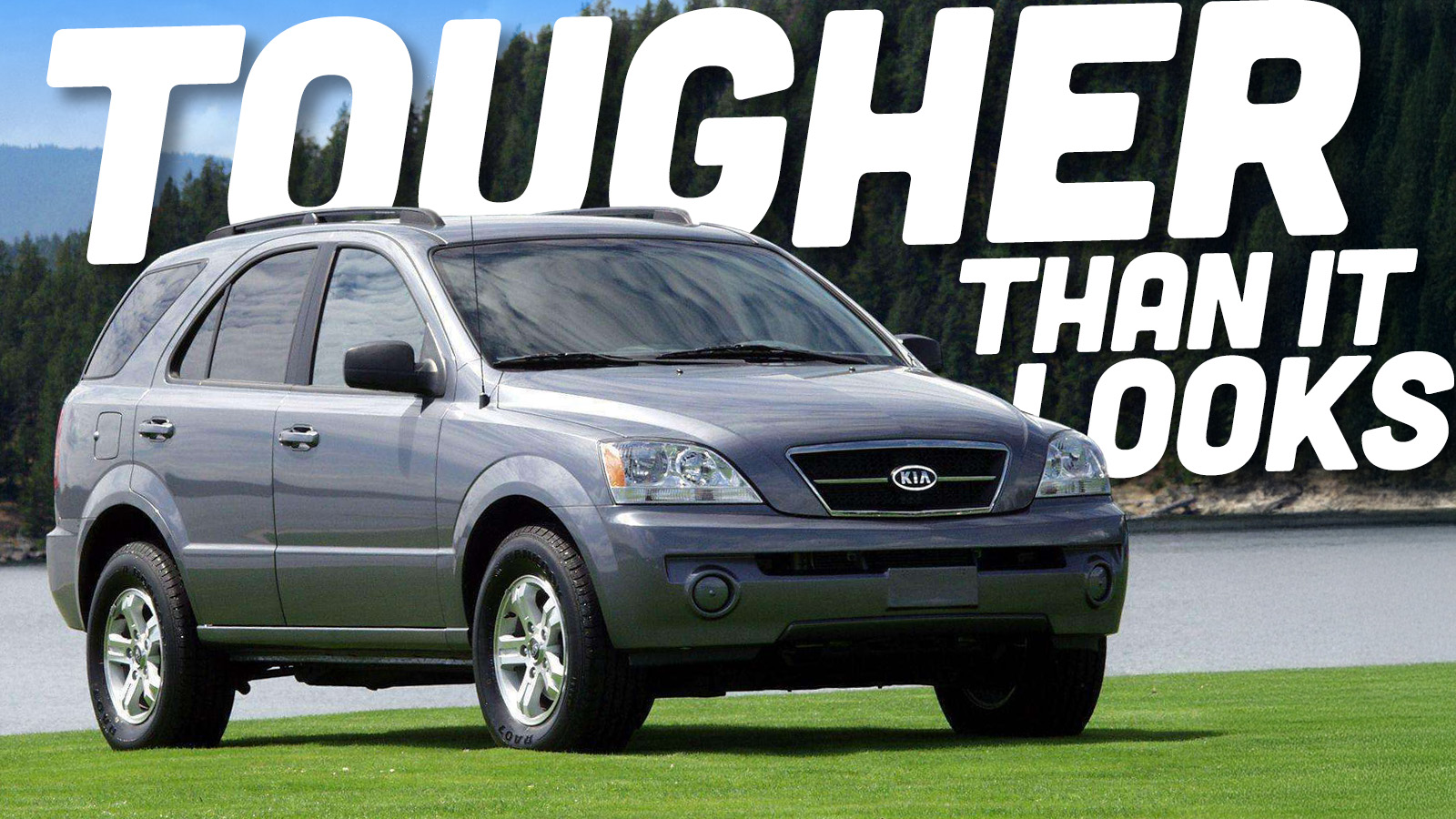
Kia has come such a long way in the past three decades. It’s gone from the brand that you went to because you were scraping the bottom of the barrel to perhaps one of your first choices. Back in the 2000s, Kia liked to experiment, and one of its vehicles was weird, even by the standards of the day. The 2003 Kia Sorento looked like the cousin of a Lexus RX300, but it was also nothing like the Lexus. Under its soft body was a surprisingly rugged truck platform with much of the gear that you’d expect from a Jeep. Here’s a look at the kind of SUV we don’t really have anymore.
Most of today’s crossovers and SUVs have designs that get right to the point. The Jeep Wrangler and the Ford Bronco look about as tough as you’d expect them to be on a trail. Meanwhile, you will not mistake a road-going crossover like a Volkswagen Taos or a Toyota Corolla Cross for vehicles that are supposed to conquer the desert. The stealthiest SUV on the market is probably the Lexus LX, because it looks soft, but is a burly body-on-frame SUV beneath the gaping grill, metallic paint, and leather.


The 1990s and 2000s were a bit of a weird period in this regard. The original Toyota RAV4 had some mild off-roading chops despite its friendly looks. The Volkswagen Touareg and Porsche Cayenne both looked like soft-roading crossovers, yet they were technological marvels capable of way more than their appearance let on. Other oddballs from the period include the Suzuki X-90 and the Geo Tracker. All of these vehicles looked less capable than they actually were. Some of them even ditched old-school body-on-frame designs for unibodies.

Then there’s Kia. Do you remember the original Kia Sportage? Today, it’s a perfectly fine, if not forgettable, crossover. But when it launched in the 1995 model year in America, it was a body-on-frame SUV with available four-wheel-drive, but the looks of something softer. It even had a quirky three-door variant that looked like an alternate reality Toyota RAV4. Now, Kia wasn’t exactly alone in making a compact body-on-frame two-door SUV with cute looks; the Tracker had that going on, too. Yet, I bet many buyers didn’t know what was under the sheet metal unless a salesman told them.
Kia brewed up something even wilder to kick off the 2000s. On the surface, it’s easy to dismiss the original Kia Sorento as a low-budget Lexus look-alike. Well, yes, it was low-budget. But like an underrated book, the original Sorento was far more interesting than its cover would have you think.

Rising From The East
The Sorento was born during a time of struggle for Kia.
In 1997, Kia, South Korea’s second-largest car manufacturer, was circling the toilet of bankruptcy after racking up $10 billion in debt. The South Korean government knew something had to change, as the nation’s economy was suffering from its worst recession since the Korean War in the 1950s. Ideally, Kia wouldn’t just be saved from certain death, but would be injected with engineering knowledge and technology to turn the brand around.
Kia’s creditors preferred Ford, which held a nine percent stake in the company. Yet, Ford didn’t bid high enough in the auction for Kia. The automaker’s savior was Hyundai, which purchased 51 percent of Kia and its sister company, Asia Motors, taking on $5.3 billion in debt in the process. Hyundai said it was its mission to bolster Kia’s finances and reputation.

Turning Kia around would be no small task. As Forbes wrote, both Hyundai and Kia had astoundingly poor reputations in the late 1990s and the 2000s, from Forbes:
Sadly, in the case of Hyundai and its partner Kia , the reputation for worse-than-average quality has, yet again, been reinforced. Actually, worse-than-average isn’t even accurate. In J.D. Power’s most recent long-term quality survey, which came out in July on cars sold in 2000, Kia scored dead last. It averaged 509 problems reported per 100 vehicles. Lexus, which topped the survey, averaged a mere 163 problems. Okay, okay, so back in 2000 Kias weren’t so hot, but in 2003 they rock, right? Wrong again. In J.D. Power’s 2003 Initial Quality Survey (that’s a 90-day survey of new, 2003 model cars) guess who ranked dead last? Bingo.
As Forbes wrote, while Kia couldn’t win on reliability, styling, or performance, it instead offered rather ridiculous warranties and priced its cars far lower than other companies dared. Kia famously offered a ten-year, 100,000-mile powertrain warranty. This warranty was marketed so hard that I’m sure at least some of the people reading this story right now know about the warranty, even if they’ve never owned a Kia. Here’s a weird commercial:
Just how cheap were Kias? In the 2000s, some dealerships advertised wild deals like getting a free Rio compact if you bought a Sedona minivan.
But the selling points of rock-bottom prices and long warranties only went so far. Eventually, Kia would also have to sell cars that people might want to buy for a reason other than a discount price. This was, after all, a similar path Japanese brands took in the decades prior. People got hooked on affordable cars, then Honda, Toyota, Nissan, Subaru, and Mazda kept buyers coming back with desirable vehicles.
One of the ways Kia would achieve this was through the launch of an SUV, but one that was built to be more than just cheap.
Chasing The Luxury Brands

According to an interview between Media Auto reporter Jang Jin-taek and a Kia Senior designer who was involved in the Sorento project, the development of the Sorento began in the late 1990s, before Kia was purchased by Hyundai. The Sorento was originally supposed to be a successor to the Sportage, but it never got to that point. Instead, development was halted in 1998, reportedly due to fears that a new Kia SUV would cannibalize the Hyundai Santa Fe, which was due to enter production in 2000.
Development resumed in 1999 after Kia figured out a new plan. The Sportage would become a compact crossover with a platform mate in the Hyundai Tucson. The SUV that the Kia team was working on now worked toward greater ambitions. Namely, Kia wanted to chase prestige brands by making a premium SUV.

Per the Media Auto interview, the Sorento was penned by five to 10 designers with direct instructions from Kia executives. Allegedly, those executives weren’t afraid to take some inspiration from what was happening in Europe and Japan, namely, the BMW X5, the Mercedes-Benz M-Class, and the Lexus RX300 (above). Apparently, this is why the production Sorento looks an awful lot like a Lexus RX300. Here’s the interview, if you’re curious:
However, as the designer in the interview claims, Kia’s designers tried their hardest to make the Sorento as unique as possible within the constraints of management’s demands. One area where designers wanted to have their own way was with the D-pillar windows. Management wanted the rear windows to follow the trend set by the M-Class and the RX, but designers wanted something sharper.
As Media Auto claims, the Sorento’s design was controversial even at home in South Korea, but, apparently, Kia’s designers really wanted something unique, rather than derivative.

While the Sorento looked like a discount Lexus RX, it was vastly different underneath. The production Sorento is a mid-size SUV with a highly modified frame from the Kia Bongo cabover truck. Being body-on-frame is different enough — the RX300 was unibody — but Kia says it worked pretty hard to make the Sorento feel like a much more expensive SUV. From Kia UK’s press release:
Sorento represents a new level of international integration for Kia with components and expertise sourced from top automotive names around the world. The list includes suspension tuning by Porsche, four-wheel drive system components from Borg Warner (manufactured in South Wales), shock absorbers and self-levelling suspension from Sachs, ABS and fuel injection systems from Bosch, and air-bag technology from Autoliv.
The Sorento was styled with the sophisticated European consumer in mind and marks Kia’s first foray into the prestige 4×4 market in Europe. Consumer clinics conducted, prior to the launch in Europe, indicated that the Sorento would compete successfully in terms of interior and exterior design compared to the best cars in the segment. The fact that in European countries prestige badge 4×4 cars have been traded-in for Sorento confirms these earlier research findings.

Kia believes that customers in the UK for Sorento will be conquested from a wide variety of cars and not just other 4x4s. The car will either be a second car in a household that probably has a premium badged first car, or be the principle car in the household where the premium looks of the car and high specification will be the prime motivators. Sorento is expected to generate broad middle market appeal for a vehicle of its type and only be dismissed by prestige ‘brand sheep’.
That bit about the Sorento having Porsche suspension tuning is wild. But it’s also not unheard of, as Porsche has a history of offering its engineering services to other companies.
Looks Like A Crossover, Built Like A Truck

What’s also interesting is what vehicles Kia targeted in each market. Here in America, Car and Driver noted, Kia saw the Sorento as a competitor to the Jeep Grand Cherokee, Nissan Pathfinder, and Toyota Highlander. However, unlike all of those SUVs, the Sorento — which is named after Sorrento in Italy — was a body-on-frame truck with a crossover’s body. As a result, Car and Driver noted, the Sorento had off-roading gear that was much closer to a Jeep Wrangler than a Toyota Highlander. From Car and Driver:
The Sorento’s three main rivals employ unibody construction, but Kia follows the GM and Ford approach and mounts the body to a rigid frame of fully boxed section side rails and nine crossmembers. The suspension has independent control arms in front and a coil-spring, five-link live axle in back. And as evidence of progress in the weight-loss department at Kia, this four-wheel-drive Sorento weighs 4538 pounds, 324 less than our last front-drive Sedona EX minivan and just slightly more than its competitors.
In the off-roading department, Kia targets Jeep, not the soft-roaders. Four-wheel-drive models boast a proper low-range transfer case, a standard Eaton limited-slip rear diff, skid plates, tow hooks, a full-size spare, and 8.2 inches of ground clearance. Two transfer cases are offered. Standard Sorentos in LX or EX trim get an electronically selected part-time unit with a fuel-saving rear-drive setting that disconnects the front half-shafts via vacuum-actuated dog clutches inside the front differential. EX four-wheel-drive models equipped with the $1800 Luxury package (leather, automatic A/C, a six-disc CD changer, and more) get a BorgWarner Torque-on-Demand all-wheel-drive system that sends 100 percent of the torque to the rear until computers sense or predict slippage and then an electromagnetic clutch engages the front axle, splitting torque 50/50.

Weirdly, despite having work truck bones, the Sorento sort of sucked at doing body-on-frame things. The towing capacity was only 3,500 pounds at launch, which was pitiful. When Sorento production began in 2002, Volkswagen had a mid-size SUV on the market that had a unibody that could tow more than twice the weight of Kia’s new old-school SUV.
All American Sorentos had the same heart. The Sorento has the 3.5-liter Hyundai V6 that powered the Sedona minivan of the same era. The mill produces 192 horsepower, plus 217 lb-ft of torque. Since this engine normally lives in a minivan and not an off-road SUV, Kia made a few changes to give the SUV a better chance. These changes included a variable-intake manifold for better low-end torque and short ratios in the four-speed automatic transmission.

Car and Driver noted that the Kia was the slowest SUV of the competition, hitting 60 mph in 9.5 seconds, or 0.7 seconds slower than a Highlander. The good news, at least, was that its 18 mpg highway fuel economy was on par with the competition. The other good news was that, per Car and Driver, the Sorento’s wide stance and Michelin Cross Terrain tires meant that the SUV handled well for a truck-based SUV and scored class-leading grip at 0.74 g.
The Sorento Wasn’t Perfect, But People Loved It

The Sorento hit the market for the 2003 model year with a strong response in both the automotive media and the marketplace. I already gave you a snippet of the Car and Driver review above. Something I noticed in most reviews is that reviewers praised the amount of seating space in the Sorento, but the interior was a mix of good and unimpressive. Here’s Car and Driver again:
The dash is well laid out and molded in grains and textures that GM should emulate. The EX’s low-gloss fake-burled-wood trim is unconvincing and less desirable than the black plastic in the LX model.
The Sorento ups the ante for the competition with standard curtain airbags, headrests, and shoulder belts for all passengers, plus seatbelt pretensioners, three-stage front airbags, LATCH child-seat anchors in the rear, and an eight-way-adjustable driver’s seat in all models. EXs add a sunroof, remote entry, HomeLink, and a richer-sounding 10-speaker Delco stereo.

Many reviewers also mentioned that the Sorento looks a bit like the aforementioned RX300. The review by the UK’s Fleet News said that not only did the Sorento look like an RX300, but that the Kia’s design was better than the Lexus. Fleet News was also unimpressed with interior materials:
The Sorento interior is not as elegant as the exterior, the main let down being the tasteless wood-effect plastic. Otherwise the cloth trim on the entry models feels a little hard wearing, and some of the switches are not as pleasant to the touch as those in a Freelander or an X-Trail.
Here’s the wonderful John Davis review from MotorWeek:
What’s also interesting is that your understanding of which cars were the Sorento’s competitors could vary wildly depending on which review you read. Forbes believed that the Sorento’s competitors were the Honda Element, Honda Pilot, Honda CR-V, Nissan Murano, and Toyota Highlander.
There was also some uncertainty about the build quality. Car and Driver tested two Sorentos; one was tight without any rattles, while the other had nothing but annoying interior noises. Then there was the resale value, which was still so bad that Kia didn’t even have a lease program.
But like many Hyundai and Kia vehicles of the 2000s, Kia made up for the downsides by pricing the Sorento at a rock-bottom $19,995 ($35,660 today) for the base LX, or $22,795 ($40,653 today) for the fancier EX. Of course, that price came with Kia’s famed warranty.

Clearly, a plasticky interior, unknown reliability, and rattles didn’t seem to dissuade reviewers too much, because the Sorento began raking in awards. Kia says the Sorento won 4×4 Magazine‘s “Car of the Year 2004,” Diesel Car’s 4X4 class winner, MotorWeek‘s “Best Midsize SUV” in its Driver’s Choice awards, “Best SUV under $25,000” by the New England Motor Press Association, and a “Best in Class” Vehicle Satisfaction Award from AutoPacific.
Kia then actually sold the things, moving 94,783 units worldwide in 2002, and while I cannot find if Kia published 2003’s numbers, the automaker expected to sell 175,000 of them that year. It does appear that the Sorento did become the volume seller and image-booster that Kia hoped it would be. I do see some complaints online about reliability, or lack thereof, but it seems these were so cheap that people bought them anyway.
A Cheap Off-Roader Today

The off-road gear was pretty legitimate, too. I have seen first-generation Sorentos still running Gambler 500 events two decades later, and while they may not be better than Jeep’s best, they do way better than their looks would have you believe.
The original Sorento seems to be a somewhat forgotten bit of history nowadays. I think a part of that is because it was weird, but not exactly impressive, valuable, or desirable. I mean, you can easily buy a running example of these for only $2,000.

The Sorento also had quite the glow-up in its second generation. Remember when Kia’s cars began to look rather smashing, pretty much all of a sudden? That was thanks to Peter Schreyer, and the second-generation Sorento, which hit the scene in 2009, was one of those eye-catching vehicles. Gone were the truck underpinnings, and erased were the wannabe Lexus looks. The new Sorento was such a step forward that I cannot blame anyone for forgetting where the Sorento started.
But those first Sorentos were sort of oddballs. They looked like a Lexus, drove like a truck, wheeled like a Jeep, and had a tantalizingly low price. As it turns out, vehicles like the Sorento, as well as Kia’s work with the Optima, Rio, and Spectra, were just what Kia needed to get itself where it is today. So, if you’re looking for a sort of weird and stupidly cheap beater to drive through the woods, maybe pick this forgotten Kia.
Top graphic image: Kia



We had a second generation 2011 Sorento SX 2WD and it was one of the most reliable and ‘perfect fit’ vehicles we have ever owned. Gas, tires, oil – it asked us for NOTHING.
Kia went from trashy to classy faster than any automaker in the history of making cars.
We replaced the Sorento with a 2016 Ford Explorer Platinum. We should have kept the Kia – and our next SUV will most likely be Korean.
We’ve got a 2012 that we bought new, and it’s got almost 270K on it now. I really appreciate that car. I can’t stand the Kia dealerships, though.
In this era there were a whole host of decent offroad-oriented SUVs. Nowadays you’ve got the Jeep, Bronco, and 4runner, Land Cruiser….arguably the Jeep GC and Lexus LX too.
Back then you also had the Mitsu Montero, Isuzus, Nissan XTerra, the Suzuki Grand Vitara, probably more I can’t think off the top of my head. Unfortunately cash for clunkers wiped so many of those out, they’re hard to find nowadays.
When I worked at the Ford dealership back in the day I was shocked when I saw a traded in 2003 Grand Vitara. I was like damn this a real deal little off roader with the little 4H/4L shifter and the solid rear axle.
I’ve never driven one but they seem like great little budget offroaders. Globally they have a strong reputation but they’re so overshadowed by the sea of other midsize SUVs and mall crawlers in the US that they’re quickly forgotten. Personally I think they’re pretty handsome, especially with the rear mounted spare.
I can’t imagine putting up with 18 mpg highway for that thing.
My sister had one of these and I remember that it gulped fuel. No way was it getting 18 mpg. It was reliable though until she rolled it. She walked away without a scratch, so it was pretty sturdy.
Even my 2006 Tucson with the 2.7 v6 would only manage like 22 on the highway, 19 overall. It was disappointing. But I bought it as an old beater, for old beater things, what could be expected.
Yikes! This is the second mention of a rollover in the comments for this story. We had a ’94 Jeep GC V8. On the freeway. it could get 20 MPG, driven gently. I have never come close to rolling anything on four wheels besides a skateboard.
It was 2005. Most any SUV adjacent thing got like 20 mpg at best, so 18 isn’t exactly horrible.
Ha, my mom had a 2003 GMC Envoy and for the 10 years she drove it it averaged 16 MPG from its Atlas I6. Although it did have a lot more power than this Kia.
Definitely expected this to be about the Borrego from the headline. But I never knew that the first Sorento was BoF so very interesting.
Same for me, I assumed it was the Borrego too.
I also thought it was going to be about the Borrego but recognized the photo was for the Sorento. In the depths of my mind I remembered it being BOF like the Explorer of the day – though the Borrego was a better competitor to that for its short life – but I wouldn’t have remembered it ony own without reading about it.
Ok… I’m 68 and don’t know what the BOF acronym you’re all using means, but I want to. And I grew up in Yolo County in CA, which has to have an annual budget for replacement signs. You know, because kids.
Actually, now that I think about it, they used to get blasted with shotguns. Now they get stolen for “influencers'” posts. I don’t think I have ever been influenced.
Sorry, body on frame. Traditional SUVs are all body on frame whereas crossovers are usually unibody.
Thanks! Always or almost always fun to learn something new.
Never knew all that. Sounds like a good cheap wheeling rig. Probably will wipe the smile off a dude-bro’s face when it gets up the same trail their $80k Rubicon got pinstriped on.
The early Sorento has a torque-optimized N/A V6 engine (originally 3.5 liters, later 3.8 liters), a proper frame an available manual transmission, part- or full-time 4WD with a two-speed transfer case, and short front and rear overhangs. I’m surprised it’s not more appreciated as a basis for offroading and/or overlanding rigs.
These Sorentos were quite rough around the edges. Sure they could hold their own while jungle-bashing or off-roading, but as a daily commuter driver (which I assume was what most people who bought it use it for) it was unrefined and had a somewhat poor ride quality.
It got a whole lot better when it went to unibody.
My father in law drives one of these daily in the countryside. Uses it for light farm work as well. He got it used 15 years ago from another farmer who had used it intensively. My father in law also still uses it twice a year to drive 1000km on the Autobahn to visit us. This is only possible because he can have everything fixed cheaply in Poland but the reliability and strength of the car surely also help.
I never really thought they looked like Lexus but they seemed decent enough for a cheap car its all the little things that brake. I had several as rentals they weren’t amazing but definitely a car that was ok comfort wise and felt not the best it worst quality. I thought it felt a bit higher quality the Hyundai of the era. If the price was right I wouldn’t hate to have one now as a beater. At one point I remember Kia dealers giving you a free rio if you bought one. A car and SUV for around $20k crazy times.
Owned two of these BL Sorentos. A 4WD EX and currently drive a 2wd LX. The EX was exactly as capable as a Jeep. Immediately after purchase, I had it fitted with off road tires and took it into a blizzard in some mountains. It was flawless and totally reliable in conditions that ate other cars alive. It was taken out by somebody running a red light. Eventually got another one after realizing I really liked the first one and there aren’t any truly comparable cars out there. The current one is not as capable offrowd but my gosh is that engine fast. This one hauls tail like nothing else I’ve ever owned. It’s fast. Supposed to be the same Lambda II engine as the first one and another Hyundai NF Sonata I owned. But this particular engine is wildly more powerful somehow. The car as a whole has almost 250K miles and it’s nearing the end. Too many random parts are dying. But 18 years is not bad. I would buy another one instantly.
Kia would also go on to offer the Borrego in 2008, which was also BOF and even had a V8 available 😀
It only lasted a few years here, though it lasted longer in Canada, and they still make it in South Korea for the local market.
The Borrego lasted exactly one year in the US, every single one is a 2009. Always fun to try bet people that you can guess what year their Borrego is.
You’d have to find one first.
They may not be a common sight, but they are not uncommon either.
…and they sound ridiculous straight-piped.
I love that you weren’t stuck in the base model penalty box if you wanted a manual with leather being an option.
One of my parent’s co-workers had one of these not too long ago. It was a stick, and I always thought it was pretty cool! I think it eventually became too much to maintain, even for a handy guy, though. Can’t say I’ve seen many on the road since then
Used to work at a Kia dealership. These things had so much body and brake dive it was hilarious.
Look like a Lexus ’til a real Lexus roll up.
I had one as a rental – it was (relatively) dire, like everything Korean until much more recently. As I have said about the Stinger – it would impress a Camry driver, but not a BMW driver.
My high school guidance counselor had one of these in gold…I was just coming into my automotive awareness at that point and I have a memory of being surprised how quickly the paint faded and discolored. I know before I graduated the front quarter panels were already a different shade than the rest of the car, and the thing was only a year or two old by that point.
I remember test driving this when my dad wanted to replace his 80’s Caravan with something that had a similar seating position / entry way. (lots of back problems from ruptured disks 20 years ago). Ended up cross-shopping it with a new Caravan, RAV-4, CRV, and Forrester. Bought the Forrester, but I remember this thing being rather ugly, somewhat cool but quirky in a non-endearing way, and the ride / handling / comfort / noise just abysmal by comparison. Knowing it’s body on frame now sort of explains it.
Great history, and now I get the headline – when I first saw it, I thought “it just looked like a Lexus, period; it wasn’t softer looking than that blob!”
Autopian version of clickbait?
I had one of these. A base model 2WD with a stick. It was actually a pretty good vehicle. The only major problem I had with it was a front wheel bearing going bad.
And the front passenger door mechanism broke and the door wouldn’t open. Didn’t bother me too much because I was usually just hauling kids, and they all sat in the back seat.
Other than those issues, I really liked it. And it got a pretty shocking 19-20mpg driving around town!
My neice had one just like the top picture for her first grown up car. She bought it new, put over 200k miles on it and became a Kia fan for life. She’s had a Sportage, a Seltos and currently drives her second Sportage. I’d say that Kia’s strategy worked.
Now hold on a second…. Are you somewhat implying I can buy just the cab and body of a Mazda/Kia Bongo van and through some hardships drop this onto the first-gen Sorento?
Sold.
Next Autopian project vehicle??
They could also be had with a manual transmission!
Filed to the part of my brain that might remember when next I need “an car”. Sounds like a secret gem.
Did not know these were body on frame with a low range.
Kind of an odd but interesting combo. Underpinnings similar to a 4Runner but without the clearances and truckish looks, and missing the build quality and over-the-road refinement of the RX300 it’s aping.
That was some nice history. I remember the first Sportage being the car that lit everyone’s interest in Kia. I think I remember a time when they had to halt production because they couldn’t afford to pay for tires. Talk about digging yourself out of a hole!
We had one when I was a kid (and the free Kia rio you got when you bought one, no joke). It was one of the cars I learned to drive in and we drove it cross country several times. Pretty comfy and aside from the tail lights constantly going out, it was reliable right up to the 200k mile radiator crack that went unnoticed until it was too late. I always thought one would make a good cheap expo truck