

One of the greatest applications for present-day electric vehicle technology is buses. School buses and transit buses run defined routes that are within the range limits of EVs, and it’s always positive when passengers don’t huff diesel fumes. Unfortunately, Vermont’s Green Mountain Transit hasn’t been feeling those benefits because its New Flyer XE40 buses have been a total nightmare. These buses currently can’t be used in the winter because they cannot charge under 41 degrees, and they can’t charge inside due to fire risk. This seems like a failure on EVs, but it isn’t. Let’s dig into this.
Green Mountain Transit, known as GMT, provides public transit to the people of northern Vermont. Like many transit operations, GMT is interested in electrification. In theory, an electrified bus can be cheaper to run over time while also emitting less emissions than a pure internal combustion-powered bus. A fully-electric bus, specifically, doesn’t have diesel emissions equipment that can fail, engine oil that needs to be changed, or filters that need to be swapped out. Again, in theory, an electric bus is one of those things where everyone wins. Not everyone is like me and enjoys sniffing diesel fumes.


GMT kicked off its electrification initiative with the acquisition of two Proterra Catalyst BE40 electric transit buses. These buses had proven themselves enough that in 2024, GMT ordered five more electric buses. These new orders were New Flyer XE40 electric buses from Canada. Reportedly, GMT spent $8 million on these buses through mostly federal government and Volkswagen Dieselgate settlement funds.

Unfortunately, Green Mountain Transit’s buses haven’t lived up to their promises. In November 2025, less than a year after they were put into service, the five New Flyer buses were sidelined due to a battery recall. As it currently stands, the buses cannot charge at temperatures under 41 degrees, and since the defective batteries have a fire risk, they cannot charge inside a building, either.
Some folks are understandably fired up about this. A fair number of political news outlets have covered this story, but with a bizarre angle. There is a real and big issue going on in Vermont, but the blame is being unfairly leveled at electric vehicles. These buses do appear to be piles of crap, but it’s not because they’re electric or because it’s cold outside, as these outlets are claiming.
Electric Buses Aren’t New

If you’re not aware of your American geography, Vermont, which is a part of New England, is a pretty cold place. The northern part of Vermont, where GMT operates, is known for its heavy snowfall and blisteringly cold temperatures that sometimes get as low as the single digits. This is part of what has fueled the weird coverage about the failures of these buses. The implication made by some publications seems to be that electric vehicles don’t work in the winter.
However, there are electric buses running in the real world that work fine.

Back in 2021, I reported how the Tok School in Alaska runs a 2020 Thomas Built Saf-T-Liner C2 Jouley in the dead of winter. That bus made headlines because it was so reliable that it didn’t miss a single day of school, even when it picked up kids in -40 degree temperatures. According to Tok Transportation’s co-owner, Gerald Blackard, when it was 40 degrees below zero, the bus used a little more than half of its battery charge to keep the interior at 45 degrees Fahrenheit. Driving the bus in the same temperature used a little more than 40 percent of the battery. On a warm day, the bus has up to a 138-mile range. That’s great for a school bus, considering that the average school bus in America runs only 31.73 miles per driver shift. It’s just one example of EV buses working in the cold just fine.
Vermont has been running electric buses since before GMT picked up its New Flyers. When the state of Vermont received its settlement money from the Volkswagen Dieselgate scandal, it decided to invest that money into electric transit buses and electric school buses. That project kicked off in the summer of 2019. In 2023, the Department of Environmental Conservation published a 387-page report detailing what happened with the electric school buses and transit buses deployed across the state. If you have a lot of time, feel free to read it. Otherwise, I’ll zoom in on the findings for the transit buses:
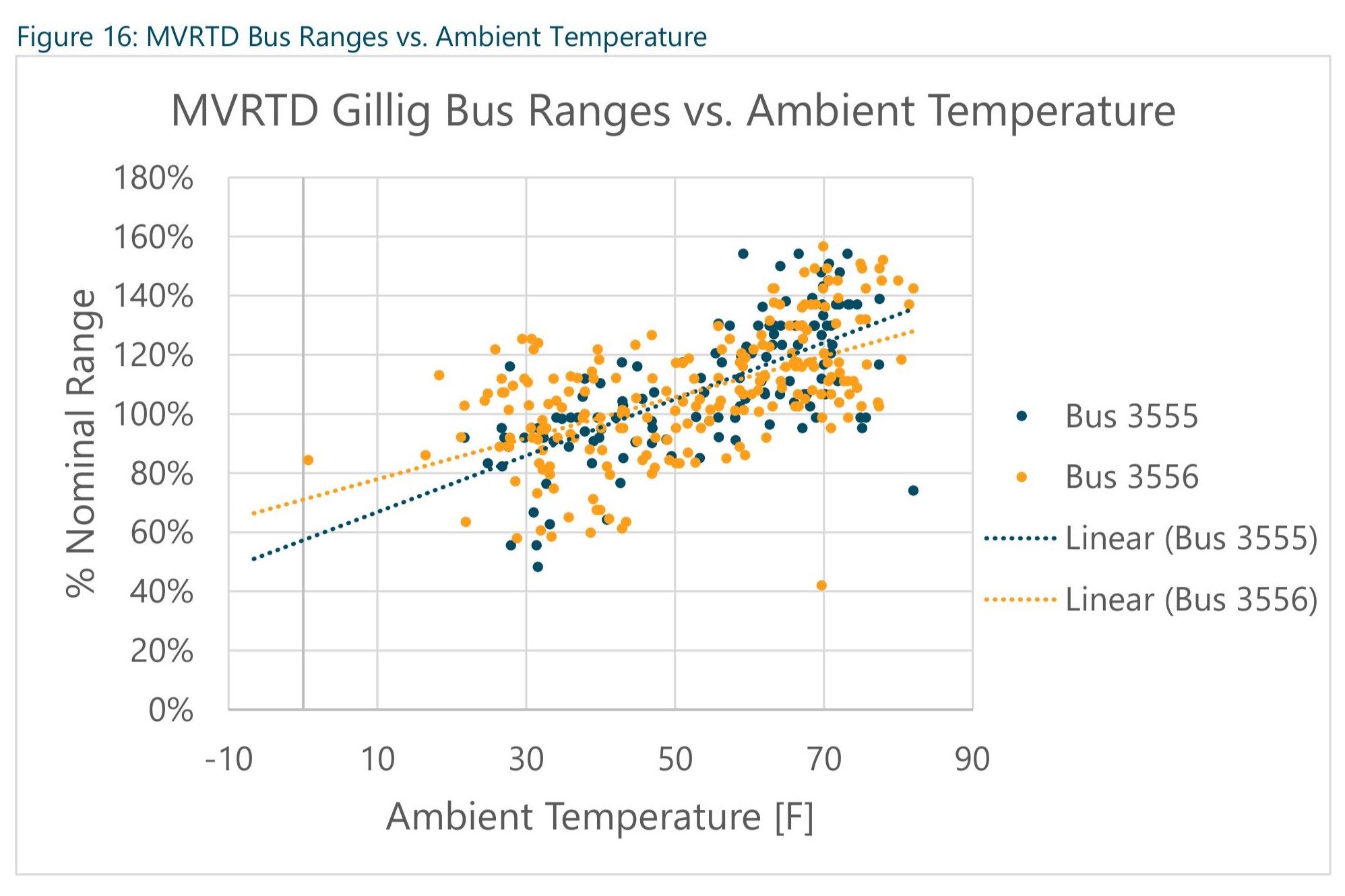
As transit buses, the MVRTD electric Gilligs run mostly during daylight hours and experience average route temperatures slightly higher than school buses which travel exclusively in the morning and afternoon. These are also sufficiently more complicated vehicles, which makes it difficult to compare them with school buses. That said, a familiar pattern emerged in the transit bus data.
Figure 16 shows that ambient temperature affected nominal range. Only a few data points were captured on the colder end of the spectrum. Interestingly, the vehicles appear to have reached their nominal 150 miles of range at ambient temperatures near 45 degrees Fahrenheit. As temperatures rose above 45 degrees Fahrenheit, the buses regularly achieved real-world ranges higher than the nominal 150 miles, often reaching more than 200 miles of range. The linear regressions indicate that the buses generally lost a little less than 1% of range for each degree Fahrenheit of daytime daily average temperature drop.
In short, yes, the buses do perform worse in winter. However, the buses were still usable for their jobs, and Vermont clearly believed that buying more of them was a good idea. There’s even a bus manufacturer in Canada that specifically makes buses for cold-weather operation. One of them was even sent to Vermont. It’s also notable that the two electric transit buses from Proterra, which do run in the cold, are not included in this big headache.
Alright, so if electric buses work, why are Vermont’s New Flyers such a big fail?
The New Flyers Fall
On February 7, Vermont’s the Center Square published an article titled “Vermont EV buses prove unreliable for transportation this winter.” This story has taken off like wildfire and has been covered by all sorts of political publications. The story comes out swinging:
Electric buses are proving unreliable this winter for Vermont’s Green Mountain Transit, as it needs to be over 41 degrees for the buses to charge, but due to a battery recall the buses are a fire hazard and can’t be charged in a garage.
Spokesman for energy workers advocacy group Power the Future Larry Behrens told the Center Square: “Taxpayers were sold an $8 million ‘solution’ that can’t operate in cold weather when the home for these buses is in New England.” “We’re beyond the point where this looks like incompetence and starts to smell like fraud,” Behrens said. “When government rushes money out the door to satisfy green mandates, basic questions about performance, safety, and value for taxpayers are always pushed aside,” Behrens said. “Americans deserve to know who approved this purchase and why the red flags were ignored.”
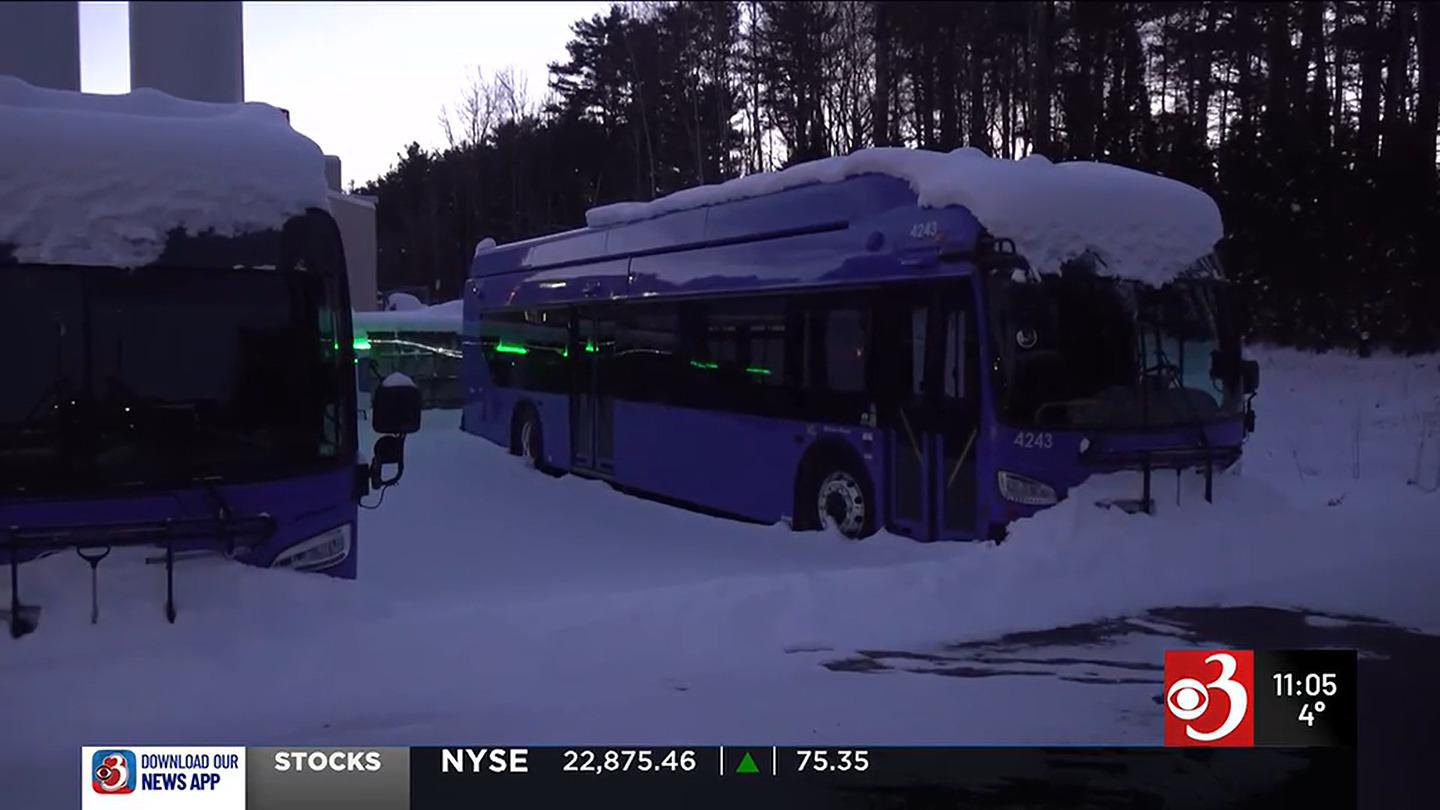
Here’s a news report from WCAX-TV about this issue:
Whoa, that’s huge! What’s going on here?
The five electric buses in question here are New Flyer XE40 units from New Flyer of NFI Group Inc. of Canada, the largest independent manufacturer of buses in North America. The publication misidentifies them as “SE40” buses, which do not exist. Anyway, these buses come from the New Flyer Xcelsior CHARGE NG family of all-electric buses. XE40, in this case, means it’s 40 feet long. GMT’s buses are equipped with 520 kWh battery packs and are rated for 258 miles of range in regular conditions.
The buses themselves are an old design. The New Flyer Xcelsior has been around since 2008 and has been a staple of transit fleets all over America. These buses are available in 35-foot and 40-foot lengths as well as 60-foot articulated buses. New Flyer is also flexible in powertrains, selling them with everything from diesel engines to fuel cells.
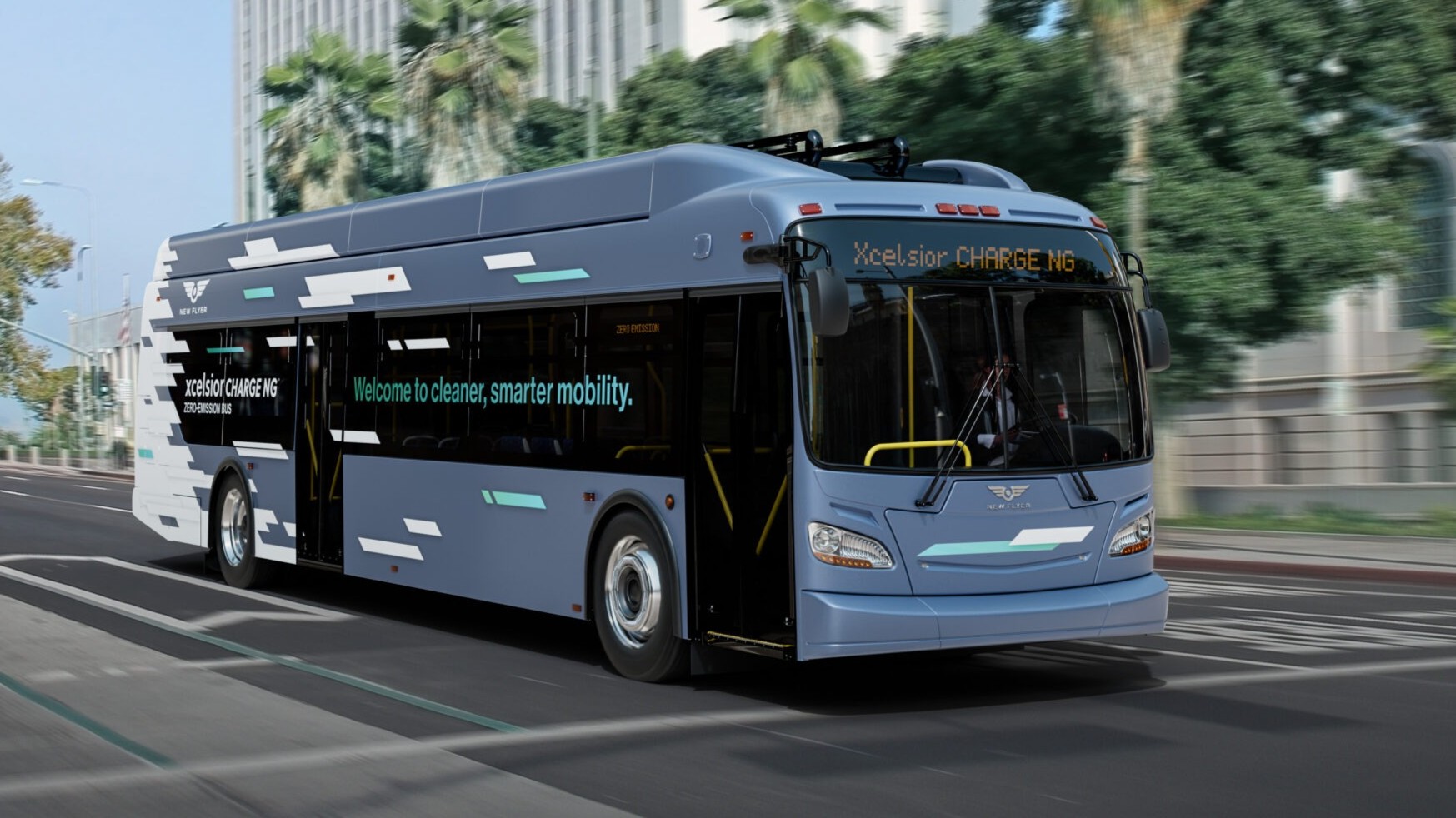
The Xcelsior CHARGE NG is New Flyer’s second-generation of electric transit buses, and these are the ones causing a rather large headache for their operators.
These buses utilize a Lithium Manganese Cobalt battery system and Siemens ELFA3 traction motors. The HVAC system, which is mounted in the roof, is all-electric. The bus also has an electric heater, an optional diesel heater, and a charge port that’s interoperable with automotive-style chargers.

What’s interesting is where the batteries are. Modern transit buses are built with a monocoque design and ride really low to the ground. Where do you hide 520 kWh of batteries? They go on the roof!
Something that’s also pretty wild is that New Flyer also developed an on-route charging system that allows the bus to get 6-minute rapid charges while at bus stops.

But for all of these promises, it sounds like New Flyer screwed something up. In September 2025, New Flyer recalled 655 Xcelsior electric buses built from 2021 to 2025 that feature Freudenberg Gen 3 HE (High Energy) batteries. The defect, as noted by New Flyer, is:
New Flyer has decided that a defect which relates to motor vehicle safety exists in certain New Flyer buses equipped with Freudenberg (Freudenberg Battery Power Systems, LLC [Xalt Energy MI, LLC]) Gen 3 High-Energy battery systems. The cells in the high voltage battery system in these vehicles may experience a short circuit or other cell fault posing a risk of fire when battery cells are charged to full, or nearly full, capacity.
Description of the cause:
Cause is short circuit or other cell fault in the high voltage battery cells. Precise cause of the battery cell short circuit is unknown.Identification of any warning that can occur:
If the vehicle is powered on, temperature warnings would be visible on the drivers display. Without the vehicle on, visible smoke from the affected battery may be noticed.

That’s a big yikes. What’s worse is that this wasn’t a precautionary measure. The recall was issued after two buses had smoke emanating from their batteries, and an additional six buses suffered from battery fires.
New Flyer did not issue a Do Not Drive order for the buses. Instead, New Flyer says to park the buses outside in case they catch fire. The company also instructs its customers to charge their buses in a certain way, from the recall:
Interim remedy: Customers are recommended to avoid charging vehicles above a state of charge of 75%, remove buses from the charger once charged and park vehicles outdoors after charging. New Flyer will deploy a vehicle program update to limit the maximum State of Charge (SOC) to 75%, moderately reduce the charging current, and install enhanced post-charge battery monitoring and alert system. The post-charge battery monitoring and alert system will monitor the bus automatically for up to 2 hours after a charging session for any thermal anomalies. If any thermal anomalies are detected, the vehicle will automatically activate its hazard lights and audible buzzers to provide audible and visual alerts to anyone in proximity.
Additionally, New Flyer says to refrain from charging the buses in temperatures below 41 degrees Fahrenheit. New Flyer’s charging systems can handle temperatures down to -40 degrees, but due to this defect and recall, New Flyer doesn’t want its customers charging in winter weather.

This has left Green Mountain Transit in a tough spot. It could charge the buses inside of its warm depot, but the fire risk means that’s not a chance worth taking. But it also can’t charge the buses outside because it’s the middle of winter and temperatures are below 41 degrees.
Now, we return to the Center Square‘s report:
General manager at Green Mountain Transit (GMT) Clayton Clark told The Center Square that “the federal government provides public transit agencies with new buses through a competitive grant application process, and success is not a given.”
“From 2020-2024, the [Federal Transit Administration’s] priority for grants had been low or no emission vehicles, with grant requests for diesel buses often not awarded,” Clark said. “This was part of a concerted effort of the previous administration to accelerate public transits’ migration to replace diesel buses,” Clark said. “To be competitive for a grant, GMT…saw electric battery buses as the pathway to get the most new buses,” Clark said. “Green Mountain Transit’s priority is new buses, regardless of the type.”
Clark informed The Center Square that GMT’s “electric battery buses are 90% paid for by federal and Volkswagen settlement funds.” GMT received five New Flyer SE40 city buses in spring 2025, these buses being a part of “a three year grant cycle for 19 total electric battery buses,” Clark said. “In September 2025 we ordered 7 additional buses with a 2027 delivery date (but will be delivered with different batteries [than the recalled ones]), and 7 more slated for delivery in 2028,” Clark said. “This is the primary source of new buses for the next three years, as we have only 3 diesel buses anticipated.” “Canceling the federal grant for electric bus purchases would result in us losing the grant funds,” Clark said. “It would not give us an opportunity to use the funds differently.”
Sadly, the problems for the transit agencies with these buses might not end anytime soon. GMT indicates that New Flyer will be replacing the batteries in these buses, but the timescale is “within 18-24 months.”

The Center Square‘s piece frames the failure of these buses as a prime example of why EVs are unreliable and, additionally, cannot be trusted in the cold. But to come to this conclusion ignores all of the other times when EVs do work. Green Mountain Transit itself says that these five buses were working just fine until they were recalled. The only reason why the buses are parked is due to a failure on the manufacturer’s part. It wasn’t due to the cold, and it wasn’t specifically because they were EVs. It was because this particular EV is defective.
Let’s put it another way. General Motors is dealing with a huge scandal after nearly 30,000 of its 6.2-liter V8 engines failed. The conclusions being drawn from this bus situation would be like concluding that all V8s are bad because GM screwed up. Instead, the reality is that GM is struggling with that one V8, just like New Flyer seemingly screwed up with this electric bus.
As I said earlier, buses are technically one of the best applications of today’s battery tech. A city bus travels on defined routes, goes back to the same depot every day, and can benefit from regenerative braking and slow speeds. Manufacturers can even just pile on tons of batteries to get a decent working range.
Of course, all of that requires the buses to work right, and that’s the whole problem going on in Vermont. Hopefully, GMT is able to get this sorted out soon enough, because having buses parked, regardless of what powers them, is unfortunate for the people who rely on public transit.
Topshot graphic image: New Flyer


We’ve got 4 or 5 gillig ev busses here and theyre doing great afaik, and our local school has three freightshaker c2s and low and behold, theyve been fine.
Coldest weve been is negative 10 and they still ran exactly as they should.
Last i heard, theyre looking into bendy busses that i believe will be ev as well.
Just cause you have this ONE instance.. they must all be defective.
Better not tell these fearmongers what happens to diesel fuel when it gets cold.
The writer gives a perfect example of how EV busses are performing beyond expectations in even colder Alaska, never failing one single day of service, and everyone ignores it.
This seems similar to all the press about EVs catching on fire. Yes, ICE vehicles have caught on fire for over a century, but those fires are different, and new is scary. New, different systems = new, different, and therefore SCARY failure modes. Scary sells.
If the busses had unintended acceleration tendencies or came equipped with under-rated tires it’d still be a story and a scandal but wouldn’t garner the same pearl-clutching headlines.
The broader debates around use of government (taxpayer) funds, determination of “public good”, etc. I will leave for other commentators.
Vermont is so open and spread out, electric busses, regardless of the weather, are stupid. Even up in Burlington, its one street that has action, the rest of the town is super spread out. Sure the averages work, but I really don’t think this was something that was killing their communities and needed to be done. I live on the border, and they are really not doing well, and haven’t been for decades up there. My cousins kid had a substitute teacher FOR TWO YEARS IN A ROW. They are shuttering schools left and right and making kids ride on school buses hours everyday. Any state bus program is honestly way down on the list of things they need to be doing to rebuild their state. There’s lots of smart, hardworking people up there I regularly cut checks to. However….
You can’t fix stupid, and there’s lots of stupid people in government. There’s also lots of greedy people who do short sighted things knowingly for money. These two things often combine to result in situations like this, but people don’t ever seem to learn.
This is for a municipalities bus system. Looks like a perfect use case for an EV bus.
No, actually thats the opposite of true. A poor town needs a reliable, proven platform with readily available super cheap parts. Anyone with half a motor-brain needs to be able to work on them. You do not want brand new tech without any parts or service available and about 3 people in the state certified to work on them. This is exactly what they didn’t need.
I am responding to your claim about busses needing to travel vast distances. As I rightly pointed out, EV range is perfectly sufficient for a vast majority of municipality use cases, even in the vast state of Vermont.
Regarding your other claim, EV buses have far fewer systems that require regular maintenance and many of the systems remain the same. In any case, as technology changes so does the skill needed to work on them. It’s all learnable.
The problem here isn’t EV busses – the problem is bad development on the part of the manufacturer. As Mercedes points out, this can effect chevy v8s too.
It’s funny how people are acting like a failed bus program has never happened. It would actually make for an interesting article. A history of failed transit system bus purchases or something like that.
It seems like every 3rd of 4th batch of busses the local transit authorities near me end up having some sort of egregious issue. “Oh yea, the frames just kind of develop cracks…” or “The engines catch fire” or other issues, regardless of power source.
Thank you for the detailed, factual breakdown, Mercedes.
There are so many anti-EV people and bots out there which will twist anything negative about any EV into a political narrative.
I do feel bad for the Vermont towns saddled with these busses. Taking 1.5-2 years to replace a faulty battery pack is unacceptable and should result in some form of significant monetary compensation, or even a buyback so other buses can be purchased.
I do think it is very weird that these busses have over 500 kW battery packs and in excess of 200 miles of range. That seems very excessive for public transport needs and is probably contributing to the lead time for getting those batteries replaced. I would bet money that half the battery size and range would be more than sufficient! That battery is almost seven times larger than the one in my Ioniq 5!
I have long felt that using EVs for public transport, school buses, and local delivery trucks makes eminent sense. Most of my Amazon deliveries now come in a Rivian vans, and they’re so silent that I never hear them approach. I would love it if our garbage and recycling trucks were electric too.
In the winter, they need all that extra battery capacity for heating the air rather than propulsion. It’s better for battery health to have lower capacity utilization anyways.
I’m just not sure they need that much excess battery capacity for heating the air. I mean, even if the bus lost 50% of its range in the winter, that’s still over 100 miles of range, which is a lot!
Especially depending on the battery chemistry, full charge and discharge cycles are not as bad for modern batteries as they were in the past. I know someone with a 2019 MY who has a 200-mile round trip commute and has almost fully discharged and fully charged her car 5+ days a week for the last 6 years. That car has 240,000 miles on it now with the original battery and can still make that 200 mile round trip on one charge in the winter.
No. Not for range. For heating the passenger compartment. It’s a massive space with doors opening constantly. It doesn’t have to be 70deg, but it needs to be warm enough to sit without freezing.
100mi of range is pretty low for a (non-school) bus, My guess is that they’re using NMC cells since LFP cells have only become more available in North America fairly recently. Plus, LFP wouldn’t be able to handle subzero Fahrenheit particularly well. NMC is the chemistry that really likes when it’s not charged very high, and while LFP inherently has a much higher life cycle, it still likes staying under 80%.
I suspect that the size is due to the available pack options, maybe there was a smaller 320kWh option available but it wasn’t quite enough for them, so the next step up was the 500kWh+ unit they’re using. From what I’ve seen, there may even be an option in the ~750kWh range available.
This is a perfect storm of bad.
GMT itself is very close to going belly up. Very few people ride the bus here in northern VT. First, there just aren’t many people, and second, there’s a whole lot of ‘rugged individualism’. We don’t like to rely on others.
And now this significant investment has been shackled with poor construction at a time when we’ve had our coldest winter at least since 2019.
It’s a shame, EV buses should be a great fit, but it has not worked out in this case.
There is not a reality I can see an electric bus being a good idea there. Please explain how you think they would be good for the area. Please keep in mind your towns current state, and then let me know where electric busses stand on the priority list.
IF (a big if) you’re going to have a transit line in northern VT, the EV buses work well because
A) GMT buses have a lot of down time
B) There aren’t many routes
C) traffic is mostly predictable
It’s pretty easy to schedule around activities. Add that to the fact that diesel in VT is consistently the most expensive fuel at >$1 above gas, and electric rates aren’t too bad.
Public transit in VT is never going to break even, so it is a ‘public good’ project no matter what fuels the buses. It may as well actually try to look good.
There’s a whole lot of mental gymnastics going on in this article to argue this specific problem isn’t directly related to these being EV buses. You compared it to GM V8s… What would the story be if GM told owners they couldn’t fill up their gas tanks when it’s below 41 degrees? And even when it’s about 41, they can’t fill them not than 75% full?
Also, 8 MILLION dollars for 5 buses wtf. This sounds like a dumb government decision to waste taxpayer money [shocking] on an ill suited product.
8 Million for 5 buses really isn’t much more than an ICE bus, especially considering lifetime fuel costs; they’re just expensive vehicles. It’s also not terribly uncommon for ICE vehicles to have major recalls that impact operability significantly, just not always directly related to fuel storage. If the argument you’re making against EV buses is that unforseen recalls could cause problems, you could make that argument for just about any vehicle.
Google says (I know, I know) that a new 40 foot transit bus costs:
Diesel ~$450-800,000
CNG ~$800,000
Hybrid ~$780-830,000
BEV ~$950-1.4 million
Throw in a charging station + building upgrades, training? Yeah, 1.3 million each is about what an EV bus costs.
When the Fed is paying for 90% of an EV it’s now a $130K bus. Seems like a great deal for Vermont.
You mean like how Ford told people they can’t use their block heaters this winter?
It’s just one example that I could think of in recent memory. Someone else mentioned Ford’s block heater problem. It’s common for a recall to tell an owner to use their product a certain way, or not at all, until it’s fixed or replaced.
The point is that the technology in itself isn’t the problem as is being reported; it’s the fact that the manufacturer poorly implemented it, making a huge steaming pile of crap. The bus could run in the cold if it wasn’t junk.
And I say that as a huge supporter of diesel! I have no skin in the EV game at all.
Expecting nuance and objectivity from the press? Do you expect them to live up to your (Mercedes and Autopian) high standards for quality?
Another outstanding story from Ms Mercedes. <3
Nuance-schmuance!
These buses are not suitable for purpose: a cold weather climate for much of the year.
They are also defective: Battery pack fire issues.
Both problems are directly related to the fact that they are electric buses that cannot be used, as supplied, in cold weather.
> These buses are not suitable for purpose: a cold weather climate for much of the year.
I didn’t get that from the story, quite the opposite, in fact. Mercedes reports that the average bus shift is under 32 miles. This means a 150-mile battery could lose ~80% of its range and still perform its duty. The study reports 1% lost for every 1 degree below 45. So these buses could perform as needed unless it’s about 35 below. Picking Burlington as an example, that doesn’t happen:
https://www.currentresults.com/Yearly-Weather/USA/VT/Burlington/extreme-annual-burlington-low-temperature.php
The issue is 100% because the buses are defective, not because they’re electric.
That 32 mile figure was for school buses, not transit buses. Transit buses typically average over 100 miles per day.
“The issue is 100% because the buses are defective, not because they’re electric.”
Which is exactly what I thought I was saying, by pointing it the two reasons why these particular buses are not suitable for use in Vermont!
The way I read it, it sounded like you meant being electric was a reason it wouldn’t work in Vermont, even if not defective. Sorry if I misinterpreted that.
Translation: “I’m anti-EV and have the reading comprehension of a first grader, so I’ll believe what I want even if it’s directly contradicted by the facts laid out in the article.”
Anyone who has owned an EV knows that they’re fantastic in cold weather. Instant heat, cabin preconditioning, lower fuel costs, etc. etc.
Electric buses work just fine in cold weather.
Definitely NOT “anti-EV” It just doesn’t look like these particular EV buses are suitable for the conditions in which they have been deployed.
If they can’t charge them indoors, because they might explode and can’t charge them outdoors because it is too cold, I still maintain that these particular EV buses are not suited for purpose.
I think it’s fair to say defective buses are not suitable for conditions in which they are deployed. A gas-powered bus in Santa Barbara, CA with its perfect weather would be unsuitable if its engine was seized.
You must have missed the part about electric school buses from Thomas Built working great down to -40F.
You also must have missed the part about Proterra electric transit buses working fine at the same transit service that has the defective busses.
(BTW – the Thomas Built Jouley uses Proterra batteries)
That’s why I said THESE buses are not suitable. I’ll agree that the other buses are fine and a good idea. I do agree that EV buses are an excellent idea when they are suitable buses for the environment in which they will be used. The New Flyer buses, the only ones I am referring to, are not suitable for Vermont conditions
No amount of splitting words and backtracking will save your ass at this point.
I don’t need to save my ass. Maybe if you had some better reading comprehension skills to apply to my original post where I specifically said “These buses” and specifically called out why they are unsuitable for use you would actually see the point I was making.
Whoa, that’s too much nuance for my brain to comprehend.
/s
In theory, EV school buses make sense and I see the argument. However, my best friend is a school bus driver and our school district purchased a couple EV buses last year, and in practice they’ve not been great. For one thing they were something like 2x as expensive as the standard diesel Blue Bird buses the district normally purchases. Charge times (admittedly due to a failure to invest in good infrastructure) are longer than overnight so there’s been some issue getting them charged long enough to run a full day’s worth of routes. As a result, I think all the EV buses have been relegated to backup duty…none of the drivers seem to like them at all.
I’d be curious to know why the bus drivers don’t like driving them.
I talked to a bus driver in India at Kempegowda airport. They have primarily (exclusively?) switched to using electric shuttle busses. He loved them and would never want to go back to diesel or CNG because they’re silent, powerful, ultra smooth, etc.
The charging complaint is absolutely legitimate if overnight charges aren’t enough. That sounds like the school did not properly plan and install a charger with enough output. Even with a bus battery, a 50 amp charger should be more than enough to re-charge overnight.
Curious about the driver’s reaction to electric buses as well. I haven’t driven school buses but I’ve driven electric semis back to back with diesel and the electric trucks are SO much nicer to drive.
Seems incredibly stupid to declare EV buses as unusable (by the district, not you) because they didn’t buy powerful enough chargers? That’s like saying diesel buses are unmaintainable because you didn’t buy enough motor oil. Just buy more oil! Or acquire better chargers, in this case, it shouldn’t be that hard to get a service upgrade if needed.
It may be for a larger facility like a bus garage. Especially if they are maxed out on their present service because they installed what they needed decades ago.
My local school district has to replace their 50ish full size buses with electric by 2030. The issue is the local grid won’t support the demand from charging that many buses. Back when the garage was built 30ish years ago the surrounding area was far less developed than today. Farms have been replaced by businesses and housing. Any excess grid capacity was used powering those structures. Stringing new conductors and upgrading the local substation to handle the new demand won’t be cheap since there’s now more getting in the way.
Thanks for the detailed reporting!
My local suburban and rural school district has propane powered buses. Great for young lungs to not breathe in diesel fumes and the mechanics not having to worry about expensive diesel emissions systems. They have until 2029 or 2030 to switch to electric buses. The grid in that area near the transportation depot would need upgrades to handle the buses. So it’s a multi year endeavor. My position, even as an EV advocate, is to keep the propane buses as long as possible to let local grid upgrades and battery tech mature to avoid things like this.
I agree. The last thing anyone should do is rush to switch to EV buses without the infrastructure in place to charge them. That will just turn casual skeptics into people vehemently in opposition to electrifying the fleet.
Thanks for the nuanced take, as always. I’ve always thought fixed route systems with a common depot to be the ideal use case for electrification.
Yes, the trolleybus was invented over 100 years ago. I don’t understand why the buses must have a large battery. It’d be enough if they could drive a couple of miles in case a line is down.
The numbers on the batteries for the busses in the article are 520kwh. A gallon of diesel is about 40kwh, but diesels are only about 30-40% efficient (on the other hand, the waste heat produced by a diesel can be used to heat the bus, while EV’s will have to use heat pumps or electrical heating, which offsets the higher efficiency of EV motors).
So a 520kwh battery is roughly equivalent to 30-40 gallons of diesel once you factor in EV motor efficiency and HVAC efficiency. On the other hand, you can’t run an EV battery down to zero without losing long-term efficiency, and topping it up depending on battery tech from 80 to 100% may also take substantially longer.
Average bus route is 30 miles, which even with the size of those beasts should be doable with 60-100kwh, so I’m left wondering how much of the inefficiency is expressed in climate control, start-and-stop inefficiencies (no idea how good the regen is on a bus operating at slow speeds), battery chemistry limitations, or charging infrastructure.
All that written, the people who bought the busses should have done some math based on extant data (to wit: what is the maximum number of kwh used on the worst day of the year – IE, the coldest day with the longest route with the most delays, based on previous diesel consumption), in conjunction with the efficiency curve of these busses (different motors are differently efficient at different temperatures) and the charging math, baked in an extra 10-20% for bad cells / degeneration over time, and called it good.
The real story here is that a lot of school infrastructure decision-makers are not good at math or put too much trust in the EV bus salesman to do the math for them. The technology can work very well for this use case, but ya gotta do the math.
I thought the same thing – 520 kWh seems so freaking huge and excessive for how these busses are intended to be used.
It’s like HVAC technicians who want to dramatically oversize heating needs for that one day every century where it gets down to -20 for a few hours.
The 30 miles number is for school buses, not transit buses which go 100-150mi/day. I’d assume they’d try to keep charge between 20-80%. With the type of medium charging speeds they’re likely running, the charging likely doesn’t slow down much above 80% like in DCFC.
BUSted.
That’s a total bummer, but stuff like this inevitably happens, especially with it being new-ish technology, rushed fleet orders, and of course our current political climate.
The good news though, is that we as a nation have a very forgiving short term memory, even when mistakes like this are downright scandalous (see Ford/firestone, the Goodyear G159 controversy, Hyundai/Kia GDI engines, Takata airbags, etc.)
6 actual fires is not a good look, and hopefully they get this crap sorted, but this won’t be the end of electric buses.
Yes, but the Ford/firestone, g159, etc were not also at the center of a political firestorm, misinformation, and willful ignorance campaign as EVs are. I have a feeling my one uncle will be bringing this crap up for 20 years.
Did you see Alex Jones’ analysis of the F-150 Lightning? Apparently, it can’t drive faster than 25mph and has less power than a 1928 Model A, and we all know he’s America’s trusted expert on electric vehicles and frog sexuality.
> we as a nation have a very forgiving short term memory, even when mistakes like this are downright scandalous
This is somewhat different, as EVs have been weaponized politically, and EV bus manufacturers don’t have pockets as deep as Firestone or Ford to ~bribe elected officials~ make the issue go away.
Edit: ninja’ed by Westboundbiker.
Woo! My time to shine!
We also have 4 of these buses up in my Canadian Transit Authority of [REDACTED].
They’re all XALT equipped and are actually ELFA 2 Gen 3 systems. We’re using ours again. The solution was to warm them up inside, then plug them in outside once the systems were all back within temp range.
We also have 60 other XE40s, but they use ABS batteries and are on the ELFA 3 platform. Which have their own issues. We’ve changed out many packs with few miles on them.
Overall though, they definitely are a TERRIBLE implementation. They’re, as you said, pieces of crap.
We have NovaBus LFSe+ as well, and it has a far superior system using BAE Systems’ Hybridrive platform (which includes full BEVs) and German made AKASOL batteries.
As always, hit me up if you wanna talk electric transit buses, my work life is all but consumed by em these days.
Hmmm… I’m wondering if the TTC is affected by this recall. they have good number of those XE40s
https://cptdb.ca/wiki/index.php/Toronto_Transit_Commission_6000-6203
But I haven’t seen any mention about the NFI electric buses the TTC has being affected by this recall anywhere
The XALT batteries were used in early series, I would hazard a guess that they have more of the American Battery Solutions equipped buses.
Which, again, have their own issues of just random pack failures.
Very cool! It seems rather obvious to warm up the buses inside, then charge outside, now that you mention it.
I don’t know if buses are anything like motorhomes or vans with wheelchair conversions, but quality and implementation can vary wildly, and many companies produce actual garbage and charge an arm and leg for it (regardless of the powertrain).
New Flyer rushed to get their EV bus on the market, and cobbled a lot of systems together to make a product.
Nova uses a complete solution from BAE, and as a result, is easier to run, maintain, and troubleshoot. Their support is stellar as well.
This guy gets it. EV buses are not crap. ICE buses are not crap. But New Flyer buses are absolute crap.
I have a feeling that the recall timeline is directly related to XALT shutting down two of their facilities in Michigan.
And the battery pack, likely, was manufactured directly by XALT (if not the entire pack, they would have been responsible for the battery modules to build the full pack) so it makes it that much harder for NewFlyer to come up with a quick fix.
(excluding NewFlyer’s other issues)
We’ve been told by New Flyer that they’re going to retrofit the buses to ABS batteries.
But they’ve promised us lots in the past.
The GMT logo still looks awful, almost a decade since the rebrand. Burlington is chock full of underemployed graphic designers and THAT’S the best they could come up with?!?
Apparently, New Flyer also makes a version of the bus with A123 batteries instead of the XALT ones, which, I guess l, aren’t affected. I’m assuming government funding rules is what caused them to purchase busses with American batteries vs the Chinese ones
I worked in Burlington, VT during the winter of 1966-7. We got a -25 Degree F morning – I hitchhiked to work.
I live on the NY side of the Vermont border (basically). Single digits has been a good morning these past couple of months. Negative teens has been a regular occurrence.
I still believe in EV buses and EVs as vehicles for specific routes. This particular bus obviously, and unfortunately, is just a POS with POS batteries.
I’m just shocked Stellantis didn’t build these. Maybe they used the same battery supplier.
So basically ” Defective batteries ” is now ” Woke , Green New Scam Buses .”
So basically ” Defective battery ” is now ” Woke Buses .”