

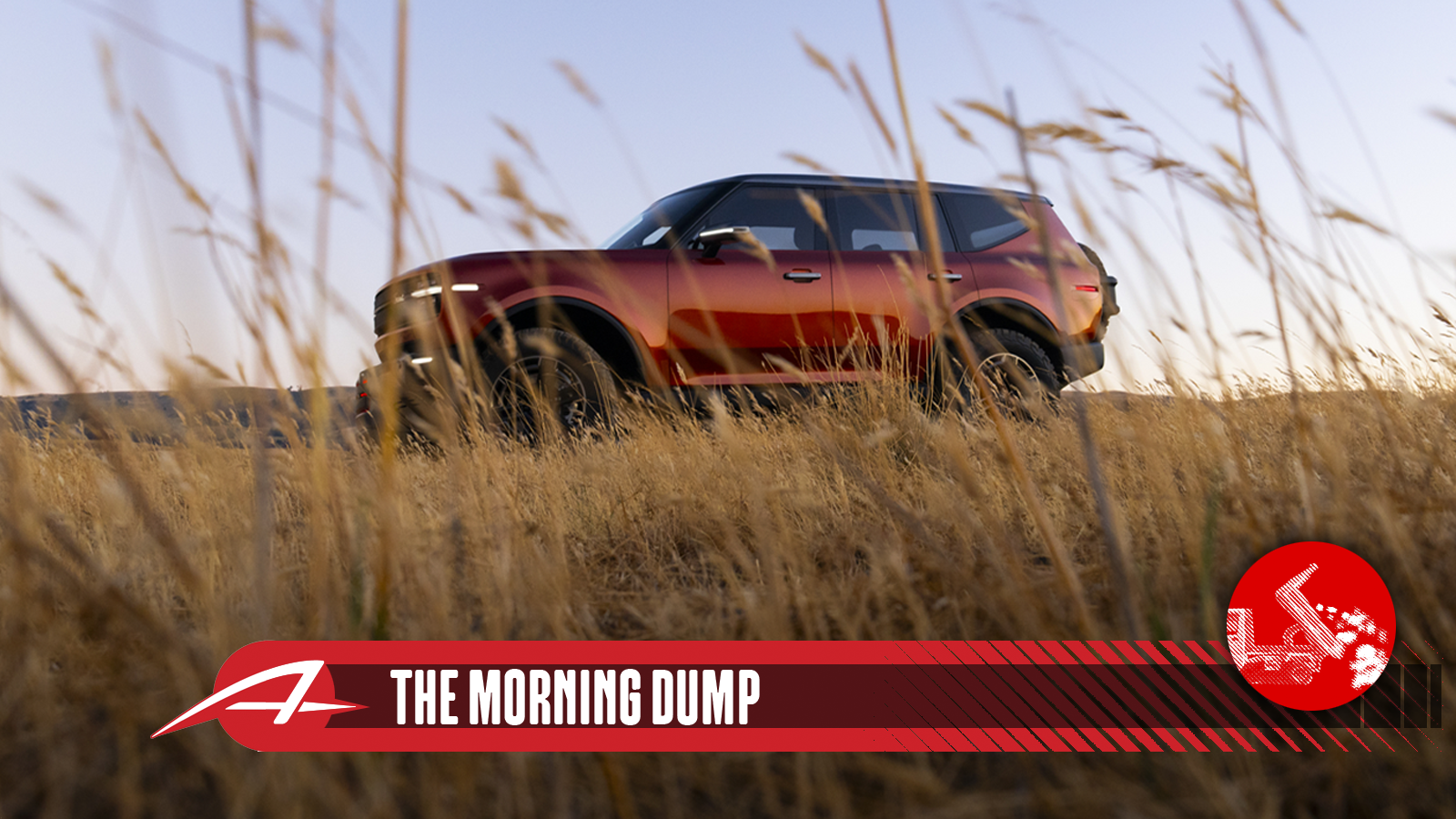
I end up in a large number of conversations about the eventually-to-be-relaunched Scout brand. Or, well, I end up in a lot of conversations, proportionally, when you consider the company has produced exactly zero trucks, and won’t sell any to customers for a couple of years. New reporting shows that there are a lot of people around VW who question if it’s worth all the effort. The CEO of Volkswagen is not one of them.
As mentioned in yesterday’s Morning Dump, Tesla’s positive earnings don’t seem to be moving the needle on the company’s share price as the huge investment being promised in the name of AI and robots seems like it’ll eat up a lot of cash flow. The timing is curious, as gas prices are up and there’s new evidence from an interesting source that EVs are becoming more popular.


There’s a new mantra in the world of Chinese cars, and it’s specifically targeted at the world.
Volkswagen Stakeholders Have Their Doubts About Scout, Volkswagen Leadership Seems Pretty Gung Ho

There are two groups of people who appear to be excited about Scout: Enthusiasts and VW CEO Oliver Blume. That’s not a bad mix of people, honestly. It’s hard to say how well an EV-anything or an EREV is going to perform in the United States, but the truck and SUV look legit. David flew out to look at it and ended up pre-ordering one, and he knows a thing or two about a thing or two when it comes to off-roaders.
That doesn’t mean everything is hunky-dory in Scout-land. Volkswagen is dramatically cutting back on production in the face of challenges in Europe, the US, and China. This means the attention and investment in Scout is being looked at suspiciously in some circles. There are the dealers, who view VW’s plan to not use dealers as an existential threat. There’s the market itself, which has looked skeptically at EV trucks. And then there’s the matter of delays, with the Scout project being pushed back to 2027-2028, which is so far away.
Manager Magazin adds some more color to the doubts flying around Wolfsburg:
Doubts persist even within top management. And the employee representatives on the supervisory board are already grumbling. Why invest billions in a project with uncertain success when new rounds of cost-cutting are underway in Germany? The works council, led by Daniela Cavallo (51), has requested an in-depth investigation by the supervisory board.
The most entertaining tidbit is that various big consulting agencies (BCG, McKinsey, et cetera) were asked to pitch VW on its massive transformation plan. That’s a juicy contract and, coincidence or not, the company that said to delay Scout a few years apparently didn’t get the contract.
What does Blume think about all this? In an interview with the magazine he said he still was planning to go forward with Scout and the factory in South Carolina but, boy, wouldn’t it be nice to share that platform?
You’re also discussing the future of your plants in North America. You’re negotiating with potential partners about collaborating on your Scout pickup truck project. How far along are you with those discussions?
There’s a lot of interest. These are great cars that fit perfectly into this market. Partnering with others would be a way for us to minimize risk. We could share the investment with other companies, and the partners could, for example, use our platform. However, we haven’t made a decision on that yet.
Obviously, one of those partners needs to be Audi, which could build a Defender-competitor on the platform. Not all VW dealers are also Audi dealers, but maybe enough of them are that this might also placate some percentage of the company’s dealer network. That’s left pocket-right pocket, though, and it seems like Blume wants a company to help minimize the risk that isn’t the same company.
My question is: If Volkswagen doesn’t find a partner will it still go forward with the plant, or delay again? How badly does VW want this?
Tesla Will Invest $25 Billion In AI, Robotaxi, Optimus

What do Tesla investors really want at this point? It’s hard to follow, and I follow this stuff professionally. Earnings and revenue weren’t great last year, but the stock price rallied in December with a promise of big investments in AI. Last quarter, earnings were actually positive and the company announced even more money to get spent on robots, AI, et cetera. From the company’s call yesterday, here’s CFO Vaibhav Taneja:
On free cash flow, we ended the quarter with just over $1.4 billion. As Elon mentioned, we are in a very big capital investment phase, which is going to start now and would last a couple of years. So based on that, our current expectation for 2025 — 2026 is over $25 billion of CapEx. And just to remind you, we are paying for 6 factories which were going to go into operation. Some have already started, some would go into operation later part of this year. We’re further increasing our investment in AI-related initiatives, including the AI infrastructure to support Robotaxi and the launch of Optimus. We’ve already started placing orders for the research semiconductor fab in Austin and for solar manufacturing equipment. While this may seem a lot and will have the impact of negative free cash flow for the rest of the year, we believe this is the right strategy to position the company for the next era. We’ll make such investments in a very capital-efficient manner.
It’s still early in the day, but the market reaction has been negative in the short term (the stock is currently down about $15-17, or about 4-5%). Why? Here’s one asset manager talking to Bloomberg who makes a lot of sense:
The revised spending plan shows the heavy cost for Tesla to achieve its goals, said Dec Mullarkey, managing director at SLC Management. It’s “sobering up the assessment of free cash flow potential for the year.”
Some of that investment is in building out a semiconductor fab, which is a tough business with a long horizon for returns. Though, maybe, robotaxis has a longer horizon for returns? Or space data centers? Humanoid robots? If you’re in Tesla for the long haul, none of this really matters, which is probably the answer for why the company can trade so far above its earnings.
Rideshare Drivers Are Renting More EVs As Gas Prices Rise

The average gas price in the United States is up over $4.00 a gallon, and that number is starting to flirt with $6.00 depending on where you live. Suddenly selling your gas-powered car for an EV maybe doesn’t make economic sense, although if you’re replacing your car it’s something to consider.
There is one group of people who are especially price-sensitive and can be a lot more flexible with the cars they use: Rideshare drivers. Not every Uber or Lyft is owned by the driver, with many renting as Reuters reports:
At Hertz, which rents cars to Uber and Lyft drivers on a longer-term basis than traditional rentals, requests for EV reservations increased nearly 25 per cent in March compared with February.
The strongest uptick in demand for EV rentals has occurred on the West Coast, where gas prices tend to run highest, according to Ms Doria Holbrook, executive vice-president of Hertz’s mobility division.
At Turo, a peer-to-peer car-rental service similar to property-rental site Airbnb, EV bookings increased by 11 per cent in the last three weeks of March compared with the prior three-week period.
On March 31, the day US gas prices eclipsed US$4 (S$5.11) per gallon for the first time since 2022, EV bookings on Turo were 47 per cent higher than on the same day in 2025, the company said.
It’s not clear if that’ll impact the larger market, but it does show that there are some drivers who can react quickly to increased fuel prices.
‘In China For China And The World’

Chinese consumers have quietly been influencing car purchases outside of China for years. This meant that, for a while, automakers started building longer wheelbase sedans that would eventually wind up in Europe and North America. Then, non-Chinese automakers realized they were getting their butts kicked by local brands that understood the market better, so they hired Chinese engineers to build cars for China specifically.
You can probably see where this is going, and Automotive News spells it out quite well:
International automakers doing business in the world’s biggest auto market are shifting the local development and manufacturing strategy from “in China for China” to “in China for China and the world,” a trend in the spotlight at this week’s Beijing auto show.
The new approach leverages China’s advances in software-defined vehicles, automated driving, battery charging and other technologies in vehicles prepared for outside markets.
Legacy players from Ford and Mercedes-Benz to Nissan and JLR initially adopted local engineering and technologies to stay competitive in China. But they and others are quickly learning that what wins in China can also win worldwide.
My how the turns have tabled.
What I’m Listening To While Writing TMD
Ready for some mind-altering electronic music? Of course you are. Here’s Joseph Branciforte & Jozef Dumoulin with “ITERAE.” Full disclosure: Joe is a buddy.
The Big Question
Which automaker/brand should pair with Volkswagen to build a vehicle on the Scout platform?
Lead photo: Scout



For the record, the absolute last thing I want to be talking to/dealing with/served by when I go out to eat or to a bar, is a faceless robot.
and you know damn well the robot will still flip an iPad around and go “it’s just going to ask you a quick question…..”
It will also expect a 35% tip.
Keep shorting $TSLA? Check and double check.
VW doesn’t need to partner with another company for Scout. Vehicles like the Bronco and Wrangler sell well here – I don’t see why the Scout wouldn’t be popular, assuming it doesn’t suck.
It would make sense to pivot away from this being primarily an EV, though. Ordinary buyers seem to find hybrids acceptable, so selling this primarily as a hybrid would make a lot of sense. I also think a reasonably-priced well-executed EREV version could legitimately be a hit, but given those aren’t much of a thing I’m not sure I would count on that.
Elon is nothing but a carrot on a stick, and we are all the donkeys. Hee-haw!
I love the Scout, but I never really believe it would be real. It could definitely be a strong contender for my next vehicle, but I don’t hold out much hope for it actually coming to fruition.
I would love a Scout that’s not built by VW.
Or it’ll be so far off the mark (specs, timing, cost) that’ll be DOA (see ID.Buzz)
Based on the price and battery size of the ID.Buzz, a theoretical EREV Scout would be like… $80-$100,000.
Obviously VW is about the worst automaker to try and pull this off, but it would be an uphill battle under any brand’s purview.
Scout arrives in 2030 with a 1.7 gallon gas tank and 50 miles of all electric range for $100k. Profit?
I think it’s safe to assume that any vehicle championed by DT, or the commenters of this website is a questionable fit for your average driver, and probably not a viable product.
I don’t care for Scout. VW has ample SUVs that they’ve thusfar refused to bring across the Atlantic.
I don’t feel like VW tries very hard to understand what they want to do well.
But, then, I’m biased as I don’t like the SUV-ication of the roads; it feels a perpetual race between armor and weapons. No one wins. Just put a 6MT back into the GTI/GolfR – and bring over the Golf R wagon.
Hmm – Rivian is the obvious choice, but regardless of a partner or not, assuming the E-REV design is solid, there needs to be a lower-cost, small to mid-sized main-stream CUV and sedan developed without the ‘adventure’ 4-wheel drive. Take the E-REV skateboard and come to market with an efficient single-motor vehicle that has at least 80- miles battery-only range to cover daily commutes + side trips, and an ICE/generator combo + gas tank to go a combined 500 miles. Make it MSRP under $40K ($35 is even better!) – and get out of the way.
The US market is missing the boat when it comes to E-REVs. Something for those who don’t have a 220 outlet waiting at home and/or don’t have access to a ICE vehicles for longer drives.
If one can find a common 120v outlet, E-REVs (and PHEVS) can easily get topped -off overnight without the added expense of dedicated 220 level-2 circuits. Depending on where you live, going pure EV is still not as convenient as going ICE on road trips, so an E-REV is the perfect vehicle for a single-car owner. Not everyone cares for a large pickup or off-road beast.
We need something like the Mazda 6E with its range-extender option for the US. Scout + someone could make that happen, maybe even VW itself.
I think the Scout is a body-on-frame so while it can be considered a skateboard chassis, I don’t think it would carry-over well to a smaller vehicle intended for road use only. Too many compromises on weight and space vs a unibody skateboard.
Perhaps they can still use the technology. E-REV bits.
VW is already using Rivian’s EV and software tech: Rivian and Volkswagen Group Technologies
The problem with smaller EREVs is that it becomes even harder to fit and justify the cost of TWO primary power sources into a compact vehicle. Cars don’t sell in a vacuum, they must compete with the rest of the market and their own model lineup.
PHEVs are already a contentious value, sitting near the top of the price ceiling of their respective market segments. They can compete on power and user experience, but to use the RAV4 prime as an example, you’re looking at up to 8 years to pay off the cost vs. a regular hybrid without some government incentive.
A EREV adds more battery, which WILL move the cost needle even further. All of a sudden, your RAV4 is selling for Volvo, Lexus, BMW money. Ignoring that nobody would buy it in the first place, how long is the payoff now?
I don’t see how an EREV solves any particular user experience issue.
You still need a proper 240V changer at home if you want to make the most of the (not insignificant) 50-100kwh battery. 120v isn’t going to cut it.
You still need to take it for oil changes, so forget about savings on maintenance costs.
EREVs are what people who aren’t ready for EVs say they want, but wouldn’t buy, even if it were available. $60,000 RAV4-level vehicles and $100,000 mid-trim trucks (in today’s money) will remain niche lifestyle vehicles at best. Just buy a regular hybrid, or keep your gas car as a second vehicle if you can justify multiple cars.
A proper EREV smallish battery should get 50-80 miles overnight off 120 at 15 amps (1.5 kw or so) 10 hours charging = 15 kWh . If the EREV gets 4 miles/kwh that’s 60 miles in 10 hours; 68 miles in 12. Covers most daily commutes all battery, no expensive 220 circuit needed, and no range anxiety. A EREV is less complex thann a PHEV with a trick transmission, and the ICE could possibly go months before being needed so less maintenance .
I think the complexity issue isn’t that different from a plain hybrid, for example,the maverick hybrid, and the escape PHEV are extremely similar with the escape, having just a larger battery and a built-in level one t/ two charger
Chicken and egg right now we don’t really know how a proper erev would sell in the US because we don’t have a freaking proper erev for sale in the US.
50-80 miles is attainable with an improved PHEV. Volvo’s PHEV SUVs do 30-40 miles out of a 20kwh battery. You could be describing a slightly better plug-in hybrid with a next-gen battery.
The Scout EREV is targeting 150 miles of electric range, with a massive 60-70kWh battery. The RAM is supposed to have a 100kwh pack. Totally different ballgame.
The point of an EREV (as it has been described to me) is having a large enough battery to perform like a pure EV in as many driving situations as possible. Where as, a PHEV is all about having JUST enough battery capacity to cover daily, real world driving needs.
Personally, I think the vehicle you describe is very reasonable and would sell fine, but it doesn’t match up with the EREVs actually coming to market, and fits more within the definition of pre-existing hybrids.
I don’t really think it is a chicken or the egg scenario. There are hard limits to how much consumers will spend for a compact, entry-level CUV for instance. EVs have already proven that consumers won’t pay $60,000 for something that would otherwise cost $40,000, even if it does pay off in 5 years. Toyota’s new EVs aren’t anything special, but they are actually selling because they offer acceptable specs for not far off the cost of their hybrid RAV4 options. Cost matters, and we can look at the cost of vehicles or similar size, features and battery pack to extrapolate what an EREV would cost. Spoiler: they’re going to be expensive.
EREVs aren’t this secret thing ‘automakers don’t want you to have’. The economics don’t make sense other than large, luxury pickups and SUVs that would otherwise need 200kwh batteries to perform as a full EV.
I’ve never heard that PHEVs and EREVs were designed for different use cases. In the US it seems that the PHEVs just barely have enough battery only range, and the upcoming E-REVs, being behemoths, seem to have way more than necessary, but I think that’s just the manufacturers putting E-REVs into the high margin vehicles because they can.
I think the EREVs in China are more in line with typical consumer needs. We have an 25 Escape PHEV in the stable. The power is limited in electric-only mode but it’s sufficient for city driving, though like all PHEVs you only get full hp/torque when the ICE and EV are both running. My main issue is the limited 40 mile battery range. If it was 60-80 it would cover many real-world daily runs + 1 side trip. Instead of improving the Escape PHEV, Ford dropped it from the line. Too bad. It was a steal as they are/were blowing them out (25′ new $54K sticker for $27K)!
E-REVs of course have the advantage of none or simplified transmission & 100% power and torque available at all times, regardless of battery only or battery + range extender running. Maybe the next-gen Lightning will be available as a 2WD, smallish battery, so there’s hope. Maybe even the upcoming 30K Ford skunk works might show up with an E-REV option, but I’d much rather see a smaller CUV and sedan EREVs.
I think it is ridiculous that the upcoming Rouge E-REV can’t be plugged in. Probably has a very small battery. A swing and a miss!
I just completed a 5000 + mile lap of California to the Midwest & back. While I wasn’t actively looking for an EV charger, I didn’t notice a single charger at a gas station, rest stop or restaurant. Approximately 30% of the mileage was on non-freeways where gasoline was a bit scarce, again, no EV chargers (but the roads were far superior to California freeways).
Sometimes they’re a little off the beaten path and you normally won’t see them advertised with big signs like the gas stations.
There are plenty of websites and apps that not only show charge stand locations, but have reviews and also provide trip planning with recommend charge stops, charge levels and timings. A Better Route Planner (ABRP) is a good one, as well as PlugShare.
We only charge at home, so I never had to use them, but it seems as long as you stick to the major interstates there’s charge stations now (assuming they’re working – and not over-priced).
Tesla investors are like crows, they like shiny things. That thing might be self driving, or crypto, or AI, or robots, you guys like robots! Right? Tesla seems disinterested in making cars and at times seems to treat the fact that they still have to make cars with contempt. They also seem stuck in a mode of trying to throw buzzwords at investors to decide what the direction of the company should actually be.
Still think it’s a long-term game of hot potato…
I think crows are better thinkers and have better memories so you’re really doing a disservice comparing to our corvid friends.
You’ll never shift the paradigm with that non-positive beliefing. Let’s try to focus on how to decision on actualizing real results, taking action that changes minds and touches hearts. If we can come together, nothing can stop our outperformance.
Elon Musk has been very public about the fact that he is bored with running a car company and wants to turn Tesla into a robit company so he can run a robit company instead. Its part of why the Model 3, Y, X, and S were all left out on the market so long that competition caught up to and surpassed them, especially in China, and why they don’t replace vehicles they discontinue (S,X, Roadster), since the goal is to not make vehicles at all one day
Very interesting to me that Musk is tearing out his “luxury” assy line and putting in Optibot manufacturing in its place at Fremont. When there’s probably a dozen states that would have filled his pockets with grants/abatements/incentives if he did a greenfield or brownfield startup factory for Optibots.
Just wait ’til he replaces the Cybertruck production line to start stamping out T-1000s.
This is lower investment cost (people and staff), he won’t have enough to invest in his wish list. He’s not really confident that he needs another plant to produce robots, at all.
Any maker without a body-on-frame pickup or SUV platform in the US market. Those that come to mind are:
TBQ: Case-IH. Don’t even have to change anything, just sell Scouts at CIH dealers. Make sure a few are Farmall Red. Rural exposure achieved.
If Sterling can sell badge engineered Rams, and International can sell badge engineered Chevys, then anything is possible.
I fully support your plan. Just avoid John Deere.
As someone who spent a couple of formative early-childhood years in a IH Travelall, I approve this message.
That song is not for me, as the last time my music sounded like that I had to replace the CD, but I am curious to know what “live editing” means. Thanks for sharing, always good to hear something new.
Will say for the third time. What if Scout were to partner with Rivian? There has to be some overlap there
To me Rivian makes the least sense. What would Rivian gain from this partnership? They already have their EV platform developed. Plus, an EV/EREV Scout would be an obvious competitor to Rivian’s current lineup. Partnering with Scout would give them additional risk with no real reward, unless Rivian decides to pivot to building EREVs instead of BEVs (I have never heard this floated as a possibility).
It might make more sense to partner with Honda. Honda on some level wants to sell EVs in the US, but not enough to follow through with the grand EV plans they had. A Scout-Honda partnership would allow Scout to exist as an EV/EREV and allow Honda to sell EVs/EREVs with less of an investment.
VW already uses Rivian’s software and EV tech: Rivian and Volkswagen Group Technologies
Scout may very well already have Rivian bits in them.
It wouldn’t diversify the financial risk.
Based off my experience trying to buy two cars at my local VW dealership, Scout ditching the dealership model is a great idea. The TLDR from my personal experience, unless you are buying something off the lot, they don’t want your business.
Scout should partner with Ram to resurrect the EREV Ram 1500. Scout supplies the batteries and powertrain. Ram designs a chassis (with help from Scout) that mates to their existing cab and bed options. VW quality meets Stellantis quality… What could possibly go wrong!
Unless a cancellation happened that I was unaware of, RAM’s EREV is still coming. They just canceled the pure BEV.
“Volkswagen Really Wants To Make Scout Happen”
I really wish they would replicate the original IH Scout and offer it as a base 2-door pickup model and make it configurable as a 2-door or 4-door SUV for people who want those.
On second thought, I’ll probably just end up getting a Slate. 🙂
I do not see a 2-door selling in any kind of meaningful quantities in the US unless there is a massive cost savings. Most people are going to require 4-5 seats and 4-5 doors.
Maybe I’m exposing a bias, but I see a lot of pickups in my area tasked with tradesperson work with only one occupant inside. I think there’s a sizeable market for pickups as tools with company logos on the doors and tailgate.
Maybe tradesperson sales are not enough to sustain a market. Maybe it is.
But tradesmen trucks are generally bottom of the barrel pricing, pricing that an electric vehicle will not be able to compete with. Just ask BrightDrop how that’s going.
Hopefully Slate offers a competitive trades-people small truck.
I agree. Doesn’t anyone remember all those little regular-cab S-10s, Rangers, Nissans/Toyotas with the cab-height toppers that were used by locksmiths, painters, handymen, (handy-people?) florists, plumbers, electricians, auto-parts stores, delivery drivers, etc.?
They started out with logos on the doors, but by the end of the ’90s and into the 2000s, there were those see-through wraps on the topper glass with all kinds of logos and phone numbers.
I’m still driving my 2010 GMC canyon regular-cab, base-model, 5-speed pickup with hand-crank windows and a cab-height topper which replaced my similarly-configured 1995 S-10. Before that, I had a 1984 S-10. Before that I had a 1967 C-10 regular-cab, 2wd, three-speed (on the column) manual pickup.
I have absolutely no desire for a truck with a back seat or more than two doors.
If you live where we get winter, nearly ALL company trucks are double cabs at a minimum. Even if they’re not hauling passengers, a lot of tools want to be inside the cab where they don’t get destroyed (I mean actual tools, not people).
Vans are better for trade use with the exception of landscaping. Vans are weatherproof, secure and can accommodate shelving and similar buildouts.
Yes, I am biased.
I took this comment to heart, as I spent some time out in the carport yesterday. I live on a fairly busy highway (8,000 vehicles/day) and every single ‘tradesperson’ truck that went by (at least 50 of them, during the multiple times I was out there throughout the day) was a crew-cab behemoth with only one person in it.
But then I got to looking at every crew-cab truck that went by. (which was about 70% of all vehicles driving by, as I live in a rural northern area and it seems a lot of people drive a 4X4 pickup) And guess what? Just about all of them only had one person in them.
Most vehicles that were driving past my house yesterday that had more than one person in them were small crossover SUVs like the Equinox, Trailblazer, Escape, Compass, etc.
Not only that, but, unless its a single cab pickup truck, 2-door vehicles aren’t a choice for anyone who’s employer uses a fixed + variable mileage reimbursement plan, the fixed portion becomes taxable income on something with less than 4 doors, unless its a pickup. So, anyone in traveling sales or other position with a lot of driving who gets reimbursed that way isn’t going to buy one
I believe my original comment, and subsequent comment were about a single-cab Scout pickup truck.
Who should partner with VW on the Scout? Navistar of course.
So long was we’re not bringing back the Maxxforce engine line, I’m cool with it. I replaced more EGR coolers than you’ve had hot meals during my tenure with them.
The wheezy old IH V8s that always had leaking exhaust manifolds would be appropriate.
Ultimately, I expect Scout to be a huge miss. VW couldn’t organise an orgy in a whorehouse if it’s in the US, so why would this be any different? I doubt the Jeep/Bronco/4Runner crowd is going to get all hot and bothered by an EV or EREV. And the guys who bought the orginals like my great-uncle sure aren’t going to give this the time of day. He ordered one of the very last Scout IIs made new, then had it very expensively restored 20 years ago. Big time hunting/fishing outdoorsy dude even at damned near 90.
Volkswagen owns Navistar, that’s how the whole Scout thing came under their umbrella in the first place
But they need to put the old International Harvester logos on it and sell it at Navistar dealers.
It would make more sense, the whole turn a model name into a brand name thing is more of an FCA/Stellantis idea, not sure they’re the ones anyone really wants to copy
Only if you want lessons in how to do things poorly. Sigh.
TBQ, I don’t know if the geometries match up at all, but what about Ineos? Bring an EREV version of the Grenadier and Quartermaster to market. Honestly, depending on the delays, I’m thinking about trading my Bronco for a Grenadier.
I think this is VWs last chance, and they should be dumping money into the Scout program to try and move the timeline up. The VW brand isn’t worth anything in the US, so why try to salvage it? Being early to the EREV game would be huge for them. I wonder why they can’t lean more on Rivian to share a platform. I understand a lot of engineering needs to happen to make the R1T into an EREV, but surely they could sacrifice the gear tunnel for a small ICE generator. I think the potential EREV market is huge because it has all the upsides of electric, but you can market it as a go-anywhere overlander.
Making an Audi version is a decent idea to placate VW dealers; I wonder if that will pan out.
The Scoput Name is theirs because of the international connection. I applaud the Scout 2 SUV throwback design, but I think they really miss the boat on the Electric/Hybrid drivetrain bottleneck. I do think there are some that are fine with either, but the crowd is still somewhat limited. I think the diesel experience of navistar should be proven through a revival of well designed, long lived fuel sipping diesel motors for a basic non electric Scout as well. VW makes the Amorak, put a spin on that with some blockier scout styling and maybe bring back the 2.5 – 5 cylinder without a turbo and that could be built in Illinois to avoid tariffs. I would take a dead reliable small truck like that.
A dead reliable truck like that already exists, it’s called Tacoma, Frontier, and (perhaps) Ranger, and Colorado. VW needs to carve out a nice niche, not jump into a market already dominated by Toyota. Who do you know who’s going to buy an Amorak over a Tacoma?
The Anorak is a rebadged Ranger and the current Tacoma is not dead reliable like the older ones.
I see hand-wringing online about the new Tacoma and 4Runner regarding the blown 4-banger and the cab electronics. Do any numbers show the new platform is less reliable than the second and third generation?
https://www.carcomplaints.com/Toyota/Tacoma/2025/
https://www.carcomplaints.com/Toyota/Tacoma/
Evidently 2016 were utter crap.
I suppose it is anecdotal evidence, but I rarely heard any complaints about the last gen NA v6. other than it being a bit sluggish on road.
I would buy an Amorak, if it had the 2.5 NA 5 cylinder over the turbo Tacoma. I feel like it is a longer life motor. the Tundra motor issues are more the reasoning here. and if they made it look a little more like the scout, then the styling would be preferrable to me as well.
If you want something that is dead reliable, then you should go ahead and cross VW off your list.
I agree with this to a point. I did have the SE Passat with the NA 2.5 which I believe was a taxi motor in Germany. it ran very well with very few problems. the worst being a knock sensor replaced under warranty somewhere under 30K miles.
TBQ. I think they should join forces with Slate which is another way to spell testla.
It figures that a guy named Mullarkey would make more sense than the CEO of the company of which he speaks.
Never noticed this. All this time I thought it was only Stellantis (STLA) that was hoping people would buy their stock by accident.
Thanks for the like
VW and Honda should buddy up. Honda could use a more butch EREV that doesn’t drink gas like a frat boy drinks Natural Ice while VW could use some tutelage on making reliable vehicles. Although Rivian may have a thing or two to say about that.
I know there are a lot of people waiting for a EREV that will the size and shape of the Scout. Offer it to everyone and see who would be in, Toyota, Nissan, Jeep, GM, Ford, Volvo, everyone.
I’m waiting for Tesla to go full Allbirds and just say they are completely pivoting to AI and Bitcoin
The completely forgettable shoe company pivoted to AI and crypto? Somehow, I don’t find that surprising.
They pulled an Elio
This announcement would probably result in a single-day jump of infinity% for Tesla stock.
This whole delay with Scout is getting interesting. Who will be the first with an EREV pickup/large SUV? It’s between Ford, GM, RAM, Scout, and I think that’s about it. It sure seems like everyone is standing around waiting for someone else to take the dive to see what happens. I’m waiting for this as my next vehicle purchase.
VW just needs to place their Scout body on the Rivian skateboard for the EV. They’ll need to do something else with the EREV but Rivian seems like the obvious choice since they already have a working relationship.
Why does my car need to be software defined? F that BS!
They could use the R2 platform, and have something that is cheaper and higher volume, especially since the R2 is beating them to market. Both companies could get some economies of scale. There’s already a nice precedent of giving up and just using Rivian software, so they could just give up and use their EV platform as well.
A non-software defined R2, with the EV tech, but with all the extraneous electronics stripped out would be pretty cool.
Non software defined, basically a Slate concept but bigger. I could dig that.
The economics of renting a car to then press into service as a rideshare driver seem like something that couldn’t possibly work out well in the long run.
Faux taxi services in general are only something that works out well for the app platform owner in the long run.
I’ve thought the same thing. I’ve also seen people advertising their vehicles on Facebook Marketplace with a per/week rental price for Uber drivers. Which sounds like a terrible idea for everyone involved, both financially and in terms of liability.
That stressed me out just reading it. I’m sure the longer term rates are much more favorable than daily but STILL.
The same is true for areas that use 3rd party delivery services for Amazon.
I looked it up and the real-world rates are like $250-$300 per week. You’d have to gross a lot of money per week to make that worth it.
It would depend on the price. What if it were $600/month? That’s $20/day.
And it would require the unlimited mileage.
On one hand, you avoid any costs of depreciation caused by excess mileage. On the other, you’re taking an already questionable income source and taking a portion off the top of your earnings.
I guess if you live in an area approaching $6 gas and you’re not in a place you can afford to buy another car or switch out one where you’re upside down, maybe this makes sense. Or you are aware this is just a short term issue and you want to preserve your current car and wait it out.
The variables involved make it tough to track but I can see a scenario where this makes financial sense, especially if you’re just looking for a short term solution to the problem.
Ok, I had to look it up because I was curious about this. I don’t know if any of my assumptions hold up in reality or not because I don’t really know how far the average trip is or the mileage on the cars being used.
However, here are some assumptions:
25mpg for combined hwy and in city trips.
Average trip is 10 miles per
Gas is $6/gal
That means that each trip would cost $2.40 in just gas.
Hertz will rent a Tesla M3 for just under $35/day for a long term rental
That means you need almost 15 trips average of 10 miles each and you break even on the gas cost. Assuming unlimited mileage on the rental.
Of course there are other fees when booking and you probably want to add insurance (hopefully you have a CC that includes insurance but do those work on long term rentals?).
Short answer; it’s plausible this could even out but it really depends on the details.
People who are good at economics generally don’t drive rideshares. The whole business model is predicated on people not understanding that they’re subsidizing the company with their maintenance and depreciation.
I’ve often wondered about this but never seen a good analysis. I talked to a fellow in Vancouver Canada who thought he was doing OK but that was with a Prius V with 600,000 miles operated 20/7/365 by him, his brother, and another relative. And they did most of their own maintenance and repair.
Impressive Toyota durability – guy drove like Earnhardt at Talladega.
I think you hit the nail on the head there, some cars have depreciation so low and such high reliability that you could come out way ahead.
On the other extreme you could be driving a Dodge.