

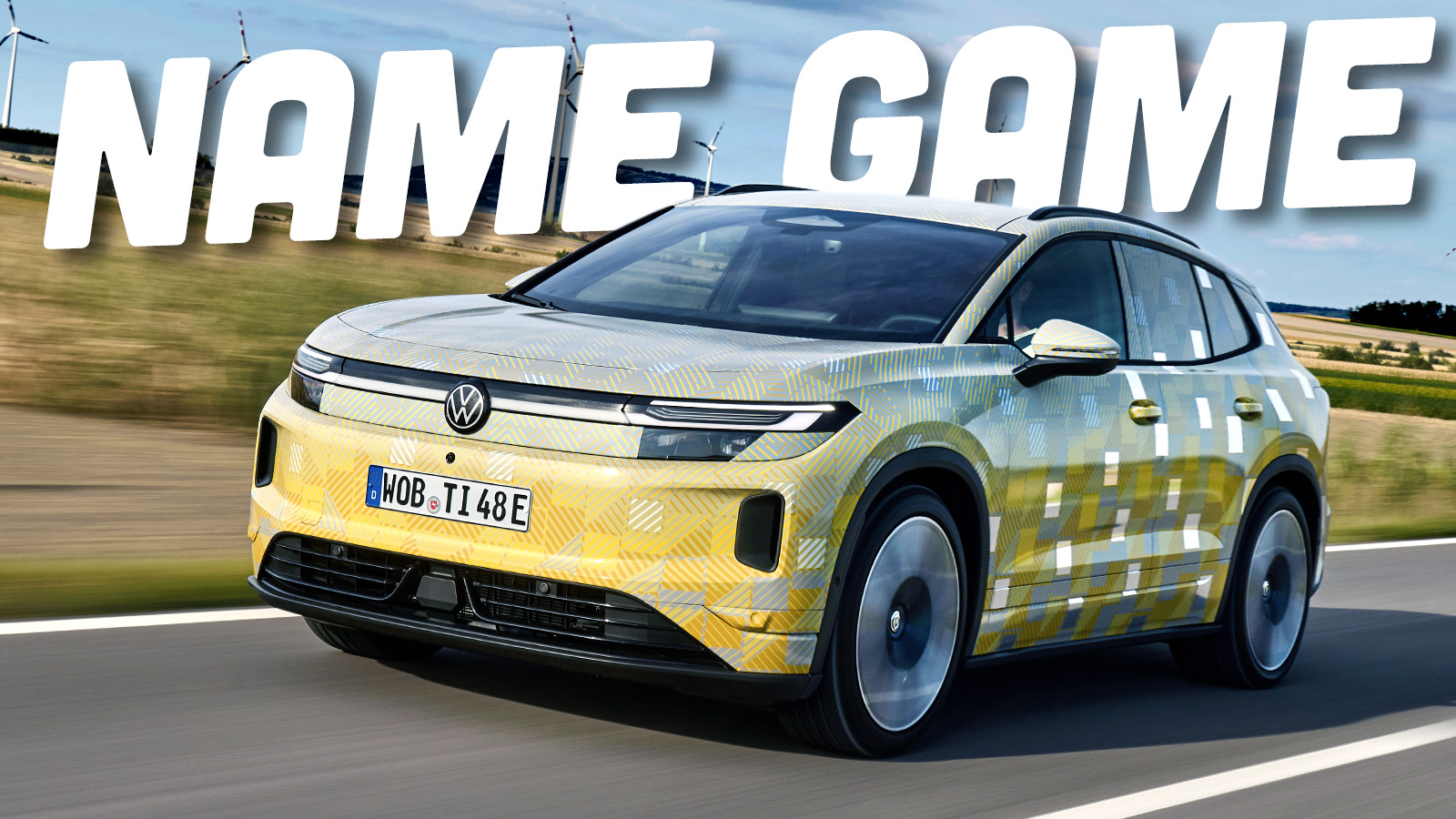
The progress of erasing the numerical model designation in VW’s model portfolio has taken another step: the Volkswagen ID.4 will be replaced by the VW ID.Tiguan. With the ID.Polo and the ID.Cross freshly launched, following the ID.Buzz which is either sold or not sold, there will be four electric Volkswagens with a “proper” name, once the ID.Tiguan will officially debut next month. I’m putting “proper” in parentheses as the name Tiguan is famously a portmanteau of a tiger and iguana. I have no idea what the hell that looks like. [Ed note: It looks like this – Pete]
As well as the name, Volkswagen confirmed today that the ID.Tiguan will be sold in North America. Sales in Europe will begin in early 2027, with U.S. sales to be confirmed at a later date.



VW’s photo pack of the new ID.Tiguan shows it wearing moderate see-through camouflage, so design-wise there isn’t much to reveal other than final detailing of the light clusters front and rear.
View on Threads
No interior photos have been shared yet, but if the ID.Polo is anything to go by, expect quiet, cloth-lined competence from door panel to door panel, with a smaller screen ahead of the driver and a larger one in the center, like on the other ID-Cockpit cars.

The design looks slightly less Moomin-like compared to the outgoing ID.4 and ID.5, with a larger “grille” between the headlights and a more pronounced jaw in some of the photos, likely depicting the R-Line version. The mid-section swoop, designed to disguise weight and beltline height on the predecessors’ sides, has also been deleted in favor of straight lines.
20 Years Of The Tiguan Name

Volkswagen has been building Tiguans for 20 years, so revising the nameplate of the EV equivalent is for a good reason. The first-generation Tiguan crossover was unveiled in November 2006 at the Los Angeles Auto Show, but it took VW a couple of years to bring it to the States and Canada as a 2009 model-year car.

Conversely, VW also sold the first-gen car for longer in the States than in Europe, as the second-generation Tiguan succeeded it elsewhere in 2016, but it was available as the Tiguan Limited on the North American market through 2018, when sales of the second-gen (above) began.
The first-gen Tiguan was also sold in China until 2020, and the second-gen car is still being made there, while elsewhere the third-generation car was rolled out in 2024. Or perhaps we should say “cars,” as the North American third-generation Tiguan isn’t the same car as the European one.

The American Tiguan is based on the larger, originally Chinese Volkswagen Tayron, to offer more interior space thanks to a longer wheelbase. Visually, the cars look much the same.
As the ICE-powered Tiguans have only just been launched, they will continue to be sold for the foreseeable future alongside the new fully EV ID.Tiguan; the regular Tiguan is also currently the best-selling Volkswagen globally. VW has built some 8.3 million Tiguans, and last year Tiguan and Tayron production surpassed one million units.
VW sold 197,000 Tiguans in Europe in 2025. It wasn’t the best-selling VW there, nor the best-selling crossover, as the smaller VW T-Roc took both of those positions with over 211 thousand units shifted. Behind the Tiguan was the VW Golf, which had almost identical figures to show for itself with nearly 195,500 cars sold. The best-selling cars in Europe were small, as the top seller was the Dacia Sandero with nearly a quarter of a million sold (great news!), and its close sibling, the Renault Clio, followed close behind. In the States, VW sold a little under 78,000 Tiguans, the first full year for Tiguan’s third generation.
The ID.4: 86’d

ID.4 production was discontinued in the U.S. in the spring of 2026. It was VW’s sole EV built in the United States, and the Chattanooga plant now focuses on building the new Atlas instead.
While VW moved a commendable 38,000 ID.4s in 2023, sales soon dropped partly due to a door-handle issue that caused a recall and a stop-sale in the fall of 2024. That specific issue was water entering the electric door handle circuit boards, causing doors to unlock or open inadvertently. The handles were fixed, but sales never recovered to the same level, especially since EV incentives were nixed. In 2025, VW sold some 22,400 ID.4s, and half-year sales for 2026 have been just 2,205 cars.
Buyers also had a hard time getting used to the ergonomics, with touch-sensitive capacitive controls and glitchy digital displays compared to competitors. Behind the wheel of an ID.4 just wasn’t a great place to be, no matter how VW tried to improve the experience.

Now that the ID.Tiguan will replace the ID.4 with a new look and a new, familiar name, it’s interesting to see how it will sell, especially in different parts of the world.
Volkswagen counted ID.5 sales together with the ID.4’s figures, for a total of 80,123 sold in Europe. That represents strong growth from 2024 (~64.7k sold), but it’s about a hundred thousand fewer cars than the Tiguan on the Euro market.
In Germany, with the currently active “ID.Kaufprämie” (ID.Cashback) of several thousand Euros, the ID.4 costs almost the same as the Tiguan with the 150-horsepower, 1.5-liter gasoline mild hybrid engine. Around 40k Euros buys either, for which you get the 58kWh, 190-horsepower version of the ID.4 as long as you pick one from VW’s factory stock. The WLTP range for that is around 265 miles.
The North American version relies on the 82kWh battery pack with an EPA rating of 291 miles. Available stock from 2025 remains for sale at a handsome $12,500 discount, which VW calls a “customer bonus,” and 2026 cars have $6,000 on the hood.

No specifications for the ID.Tiguan have been announced other than a WLTP range up to 585 km (363 miles), but those battery pack sizes are likely to be offered for it too. Since the North American ID.4 only got a big battery, it’s likely that the ID.Tiguan also won’t get the 58kWh one.
VW’s CEO, Thomas Schäfer underlines the importance of the Tiguan name, noting the sales numbers from the 20 years so far.
“More than 8.3 million Tiguan vehicles produced demonstrate the strength and trust associated with this model name,” says Thomas Schäfer, CEO of the Volkswagen brand, Head of the Brand Group Core and Member of the Group Board of Management. “The Tiguan represents a versatile, premium vehicle and embodies the essence of True Volkswagen. With the ID. Tiguan, we are carrying this product promise into the electric future.”
Note that on its model page for the outgoing US-market ID.4, VW also proclaims that “the future of driving is here – and it’s electric.” That might well be true, but the future of the ID.4 is Tiguan.
The numerical nomenclature, seemingly to be phased out, will serve Volkswagen until the eventual ID.Golf and ID.Passat reach the market, and the ID.3 got the “Neo” version just recently to bridge the gap.
Images: Volkswagen


People hated the Mustang Mach-E being called a Mustang, but it gave it recognition and identity in the marketplace. Besides that, no one was going to not buy one because of it being called a Mustang. When I’ve explained this to people, I then ask, “what’s a VW ID.4?” and their shoulders inevitably shrug. Exactly. VW has realized the opportunity and given it a recognizable name.
Can anyone at VW make good decisions anymore? I know there must be some talent within that giant company. Heck, if GM can pull off some success, VW should also be able to do so.
Even if they just did COLORS like they used to do in the 90’s. That alone would draw people in. Retrofit some old dashboard buttons, sell some car-sized vehicles and lower priced ones. Make snarky ads about how in a world where everything comes as standard, they can bring back the “base model”. OK, I know that last one might not sell. Americans are soft these days and won’t tolerate lack of features.
I think the shaping and styling is much nicer looking than the blobby ID.4. Hopefully the interior is imprived, too.
Man, VW group really can’t do naming right, can they? “ID.x” should never have been something they used, and then they just used numbers.What does “ID” even stand for according to VW? OK, we’ll that’s dumb, but couldn’t have these cars had some personality with a name? Like I dunno, a portmanteau of something mildly offensive? A reference to a native nomadic tribe? Or maybe just name it after a tradewind? What about “coalhuffer?”. Or “Forgetaboutdiesel”.
Remember how Audi decided they’d throw out 30 years of brand recognition by changing the name of the A4 to “A5” because some dumbass suit decided that “even numbers are EV, odd numbers are combustion?” How’d that work out for them? Then the “e-tron” was just “e-tron” and then “Q8-e-tron” even though this had nothing to do with the Q8? Let’s not even discuss the plug in hybrid Audi A3 e-tron and how that doesn’t fit into that naming scheme. God man, sometimes you just can’t lead these guys to water and expect them to not somehow forget how to drink.
And then there’s Porsche… the “hey, let’s throw out our most affordable combustion sports car lineup because the EU says it doesn’t meet cybersecurity standards and it’l cost a few billion to redevelop”. And then proceed to spend ten times as much as revising the 718 platform to meet said standards on a brand new EV platform sports car that apparently has about zero demand. You really just have to hand it to these business schools that teach these guys about how to be absolutely delusional about their numbers and spreadsheets and not see the market for what it is.
They should name it the Titanic, as in rearranging the deck chairs…
I am no branding or marketing genius but am I crazy in thinking that it’s unnecessary for every brand to have an EV sub brand? Like why can’t the EV alternative to a Tiguan just have another model name? Why does it need this silly “id” prefix??
Save reason they have names like TSI and TDI. It is to clearly tell the different powertrains apart.
Yeh but it’s not a TDIGolf or a TSIGolf, that’s like secondary badging like back when they had EFI on the back. And to that point why not just call it a Tiguan EV. That would make more sense and follow your logic which I agree with more clearly.
VW started with using e-Model. To me that made a lot of sense. Keep the long standing model name recognition and then let the buyer know it is electric.
I don’t know why they decided to going with ID.number. That never made sense to me. However, now that they have spend years using the ID brand for EVs I guess is makes sense to use ID.Model. Personally I don’t care if the engine designation is a prefix or suffix.
Part of the problem with car names is that whatever is picked has to work for every current model and future planned model. That can be difficult.
I said it on the article about the cat being discovered, but NAME IT TILCAYO YOU COWARDS. Tilcayo is the perfect VW name, and ID.Tiguan is terrible. Hasn’t the entire market already realized that consumers don’t want their EVs to shout that they’re EVs, this sort of naming convention is insanely dumb.
So. Dumb.
No one wants it.
I just cannot understand why they think they have to do it!
The whole eye dee dot something naming is as cringe as if they were called something with www or @.
[ADDED] – Just tought of Norm. Again 😉
Yeah, that naming convention isn’t doing them any favors. But it’s probably small potatoes compared to the whole “we remember you’re the dieselgate jerkbags” and “so far your EVs cost too much and fall short on range” issues.