

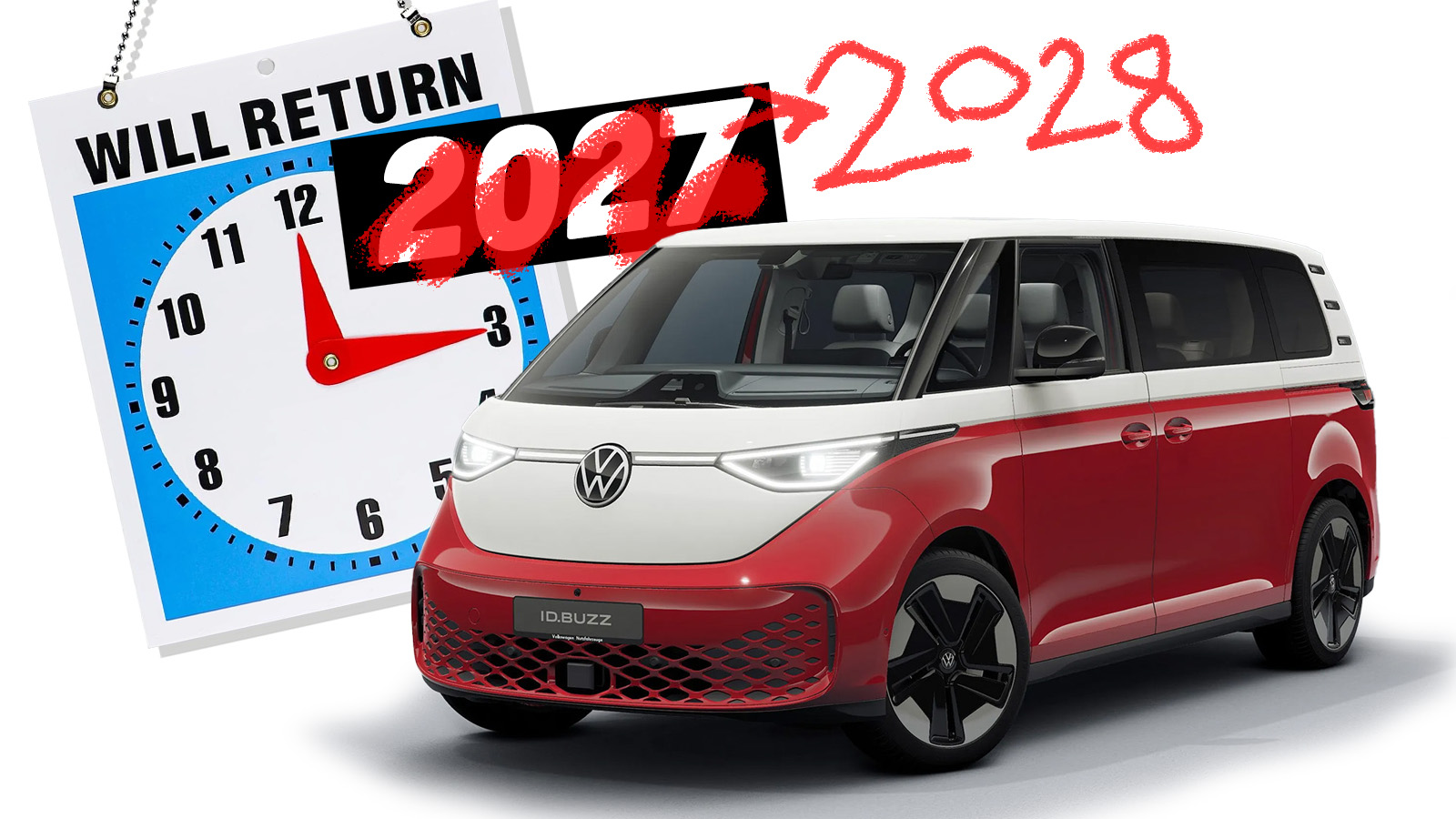
Remember when Volkswagen said they were going to delay the return of the ID.Buzz to America until 2027? Well, they’re still going to do that! In fact, they’re going to do that so much that they’re going to take another year, so now the ID.Buzz won’t be back for sale in America until 2028. That’s according to Automotive News, who spoke with VW. There will be some changes when the ID.Buzz gets back here, but I’m not really sure they’re going to be the right changes, sadly.
I really wanted the ID.Buzz to be something cool and be successful; a world with more two-tone colorful modern VW buses roaming around everywhere, diluting the never-ending sea of grayscale SUVs would have been a positive development for humankind. But that’s not what happened.


Here’s what VW told Automotive News:
The ID Buzz, built in Germany and launched in the U.S. in November 2024, has faced multiple hurdles. It was the most expensive vehicle VW sold in the U.S., with a range of just over 200 miles, features that have limited its appeal, analysts say.
It has also been subject to high U.S. import tariffs since spring 2025, two embarrassing recalls and the elimination of the $7,500 federal tax credit toward an EV purchase.

So, yeah, I think our pals over at AN hit the nail on the head there by noting it’s the most expensive VW you can buy in America, and that the range isn’t exactly great. Both of these are absolutely counter to what a modern VW Microbus should be: the bus should be accessible to as many people as possible, families and young people without a lot of money, like the old bus was, and it’s an ideal road trip vehicle, something that a range of around 200 miles does not support.

I found this out when I tested an ID.Buzz on a road trip early last year; it was appealing in so many ways, but the range was an Achilles’ heel so prominent and un-ignorable that it may as well have been wearing Achilles’ sandals. In real-world driving, a range of 200 miles actually means something closer to 150 miles, because of finding charging stations, charge time limitations and so on, which means at best you’re able to drive for stretches of about two hours before you have to stop for a non-insignificant length of time.

And, yes, this is a vehicle that starts at $60,000. A re-born Microbus should have started at, say, $40,000 or so, which would put it on par with a Toyota Sienna or a Kia Carnival or other stylish minivans. Sure, the ID.Buzz is all electric, but should that have been the case, too? If any vehicle is crying out for an EREV, I’d say it’s the ID.Buzz.
Anyway, VW was trying to sell off all the current ID.Buzzim in America, and they’ve almost done that:
The 2025 model year sell down appears to be nearly complete. Cars.com lists just 38 new vehicles nationwide with a majority being either single-tone silver or black.
I’m not surprised the all-silver and all-black ones didn’t sell. Who wants a bus in those boring colors?
When the ID.Buzz returns it’ll have some new software, a NACS-type charging port, a camping-friendly edition, and the ability to be used to power a home or other electrical equipment with vehicle-to-load capability. Those are all great, sure, but unless that software update includes a patch to drop the price by about $20 grand, I’m not sure it’ll be what the Bus needs.
VW should have more details about the ID.Buzz’ 2028 re-launch in the coming months, and I hope VW can pull a miracle out of the back of this thing. I still believe in the idea of a modern Microbus, and it’s hard to see how much VW fumbled what should have been a fantastic halo car that injected new life into this iconic brand.


Look to the Kia PV5 and upcoming PV7 as an example of where VW should have been aiming with their reborn bus. The PV5 has already become quite successful across a wide range of uses and demographics in Europe. It’s not particularly powerful or luxurious, but the price is right, and the range is where it needs to be with that in mind. Beyond that, it is a capable and spacious commercial vehicle with a sharp futuristic design. Apparently it handles pretty nicely in the corners as well.
Chasing the nostalgia market exclusively (20 years late) was never going to be a success for VW in North America. They should have focused on building the kind of van that would have also found appeal with tradespeople and delivery companies, to drive volume and remain competitive. As it sits, they have a niche luxury vehicle that only appears to a very narrow demographic.