


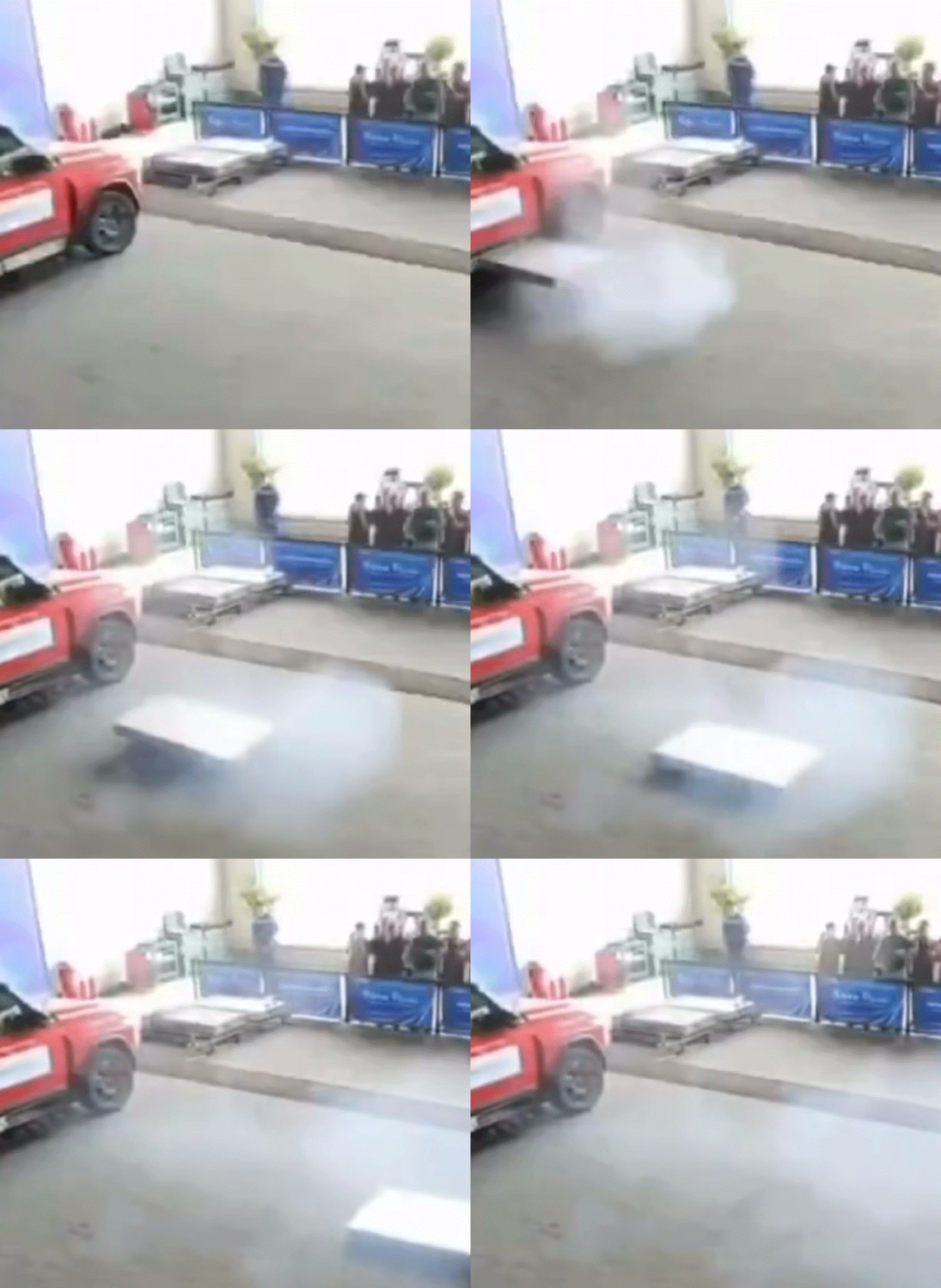
Almost precisely one year ago (we’re off by just one day), Thomas reported on a novel solution for dealing with an EV battery that has caught fire: explosively yeet the thing out from under the car with sufficient force to propel it a safe distance. And what happens to anyone and anything within range of the flying, presumably on-fire battery? You can see the problem here.
So can Stellantis, and based on a new patent, the auto conglomerate has a conceptually similar but much more elegantly conceived solution to safely rid an EV or hybrid of a battery experiencing a thermal runaway or otherwise in need of quickly parting ways with the vehicle.


Instead of ejecting the battery to who knows where, Stellantis’ plan calls for dropping the battery wherever the car is stopped, and then simply driving away from it.
It’s easy to imagine how a hybrid could drive away from its street-deposited, smoking battery using its engine (provided it’s coupled to the drivetrain, and not merely powering a generator), but how would a purely electric vehicle drive away from its decoupled battery? The answer is the vehicle’s 12-volt battery.
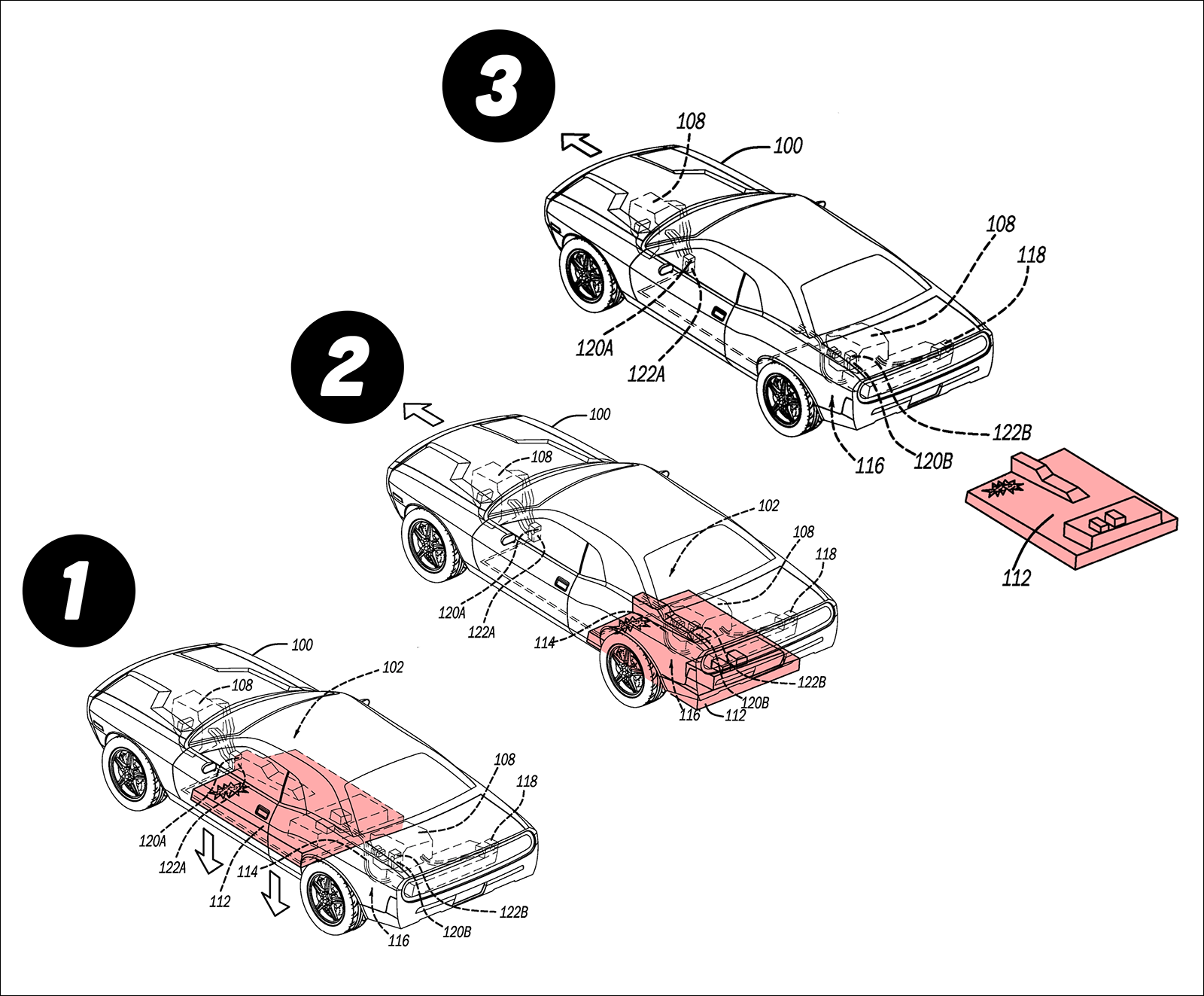
With a typical EV running off of anywhere from 300 to 900 volts, clearly the idea is not to provide any meaningful drivability via the 12-volt battery. The system is designed only to put safe distance between the car and the primary power battery. How far? Instead of that being up to the driver, the system would “[Command] to propel the vehicle a predetermined distance away from the decoupled battery,” per the patent.
As for how the battery parts way with the vehicle, the patent describes two scenarios. Both begin with the driver activating the system via a switch, with options listed by the patent as “an electrical lever, a mechanical lever, a physical button, a touchscreen button, and a toggle switch.” Obviously, “touchscreen button” is the worst option.
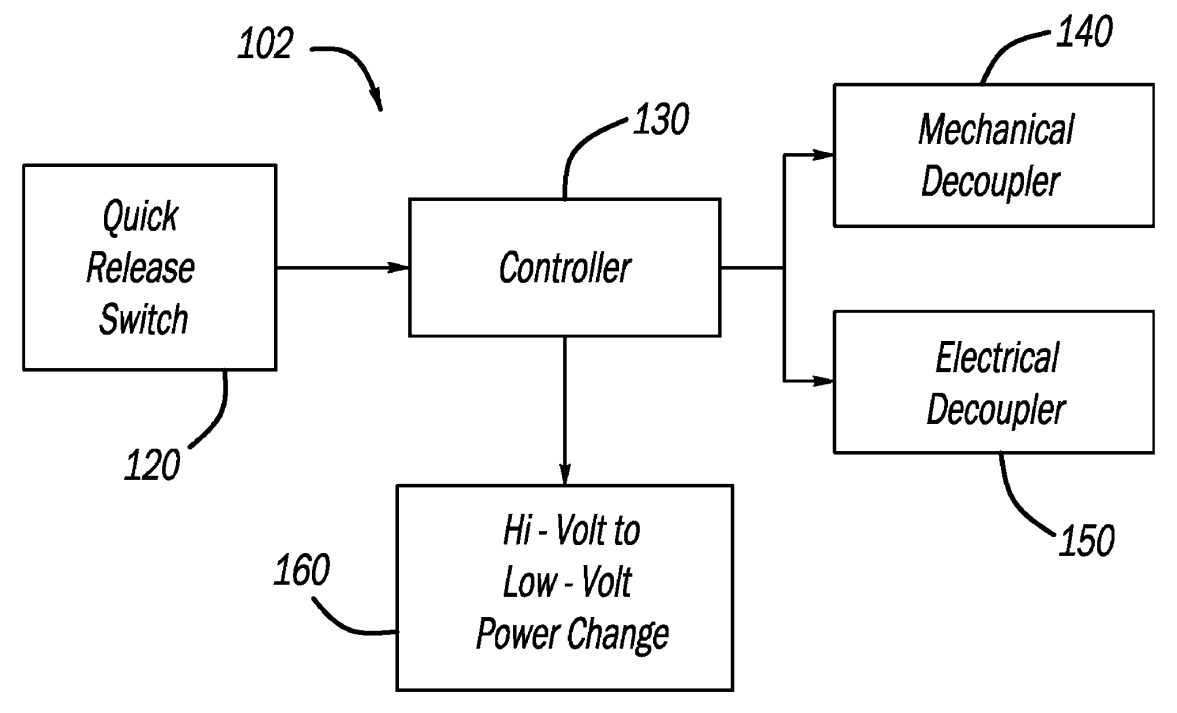
Once activated, the “controller” switches the vehicle to 12-volt power and decouples the primary battery. To eject the battery from the car, two systems are proposed. The first is a “castellated frame” connection as depicted below. Sliding the frames out of registration frees the battery to drop from the vehicle.

The other, more exciting solution is to mount the battery using explosive bolts (“pyrotechnic fasteners”), which can be detonated to free the pack when things go awry (it’s not completely unheard of in cars, though this is usually used for pedestrian protection or convertible roll bar ejection). Should the system ever be green-lit for production, I wonder if both systems might be employed; the “castellated frame” as the first mechanism, with the explosive bolts as a backup in case the mechanical release fails.
It all seems perfectly reasonable and feasible, and far safer than the “fire the battery like a torpedo” concept. Only time will tell if we’ll see electric vehicles with BATTERY EJECT switches under flip-up covers, but if any automaker wants to drop the battery and drive away, they’ll need to contact Stellantis for a license first.
Top graphic images: Stellantis, Deposit Photos


Instead of ejecting, the high voltage battery from the car just eject the passengers instead
We know it’s proven technology. I recommend the F 35 ejection seats
It’d be much cooler with some self-sealing stem bolts.
That said, 12v drivetrain ain’t new. A long long long time ago I had a $500 Datsun that one day decided not to start. It would crank and crank but just wouldn’t fire. I couldn’t find a busted fuse or anything and it was going to get dark soon so I put it in gear, cranked the key, and let out the clutch. I drove it all the way home on the 12v battery and the starter motor. I’m pretty sure I invented the hybrid drivetrain a decade before Toyota released the Prius.
I can foresee some nasty pranks, little kid mischief, and spilled Mountain Dew mishaps engendering some unfortunate and expensive events unless the jettisoning controls are biometrically specific to the driver.