


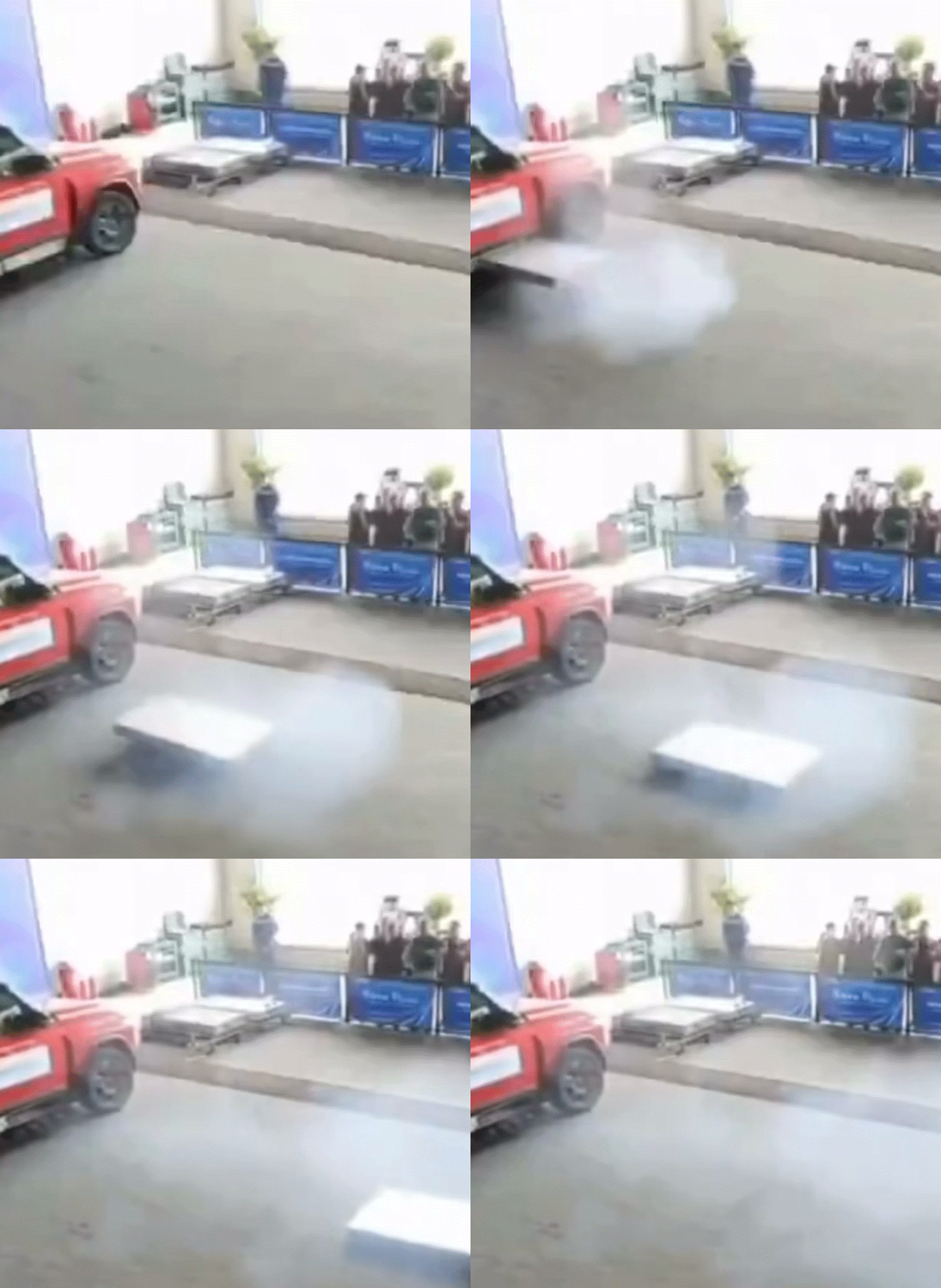
Almost precisely one year ago (we’re off by just one day), Thomas reported on a novel solution for dealing with an EV battery that has caught fire: explosively yeet the thing out from under the car with sufficient force to propel it a safe distance. And what happens to anyone and anything within range of the flying, presumably on-fire battery? You can see the problem here.
So can Stellantis, and based on a new patent, the auto conglomerate has a conceptually similar but much more elegantly conceived solution to safely rid an EV or hybrid of a battery experiencing a thermal runaway or otherwise in need of quickly parting ways with the vehicle.


Instead of ejecting the battery to who knows where, Stellantis’ plan calls for dropping the battery wherever the car is stopped, and then simply driving away from it.
It’s easy to imagine how a hybrid could drive away from its street-deposited, smoking battery using its engine (provided it’s coupled to the drivetrain, and not merely powering a generator), but how would a purely electric vehicle drive away from its decoupled battery? The answer is the vehicle’s 12-volt battery.
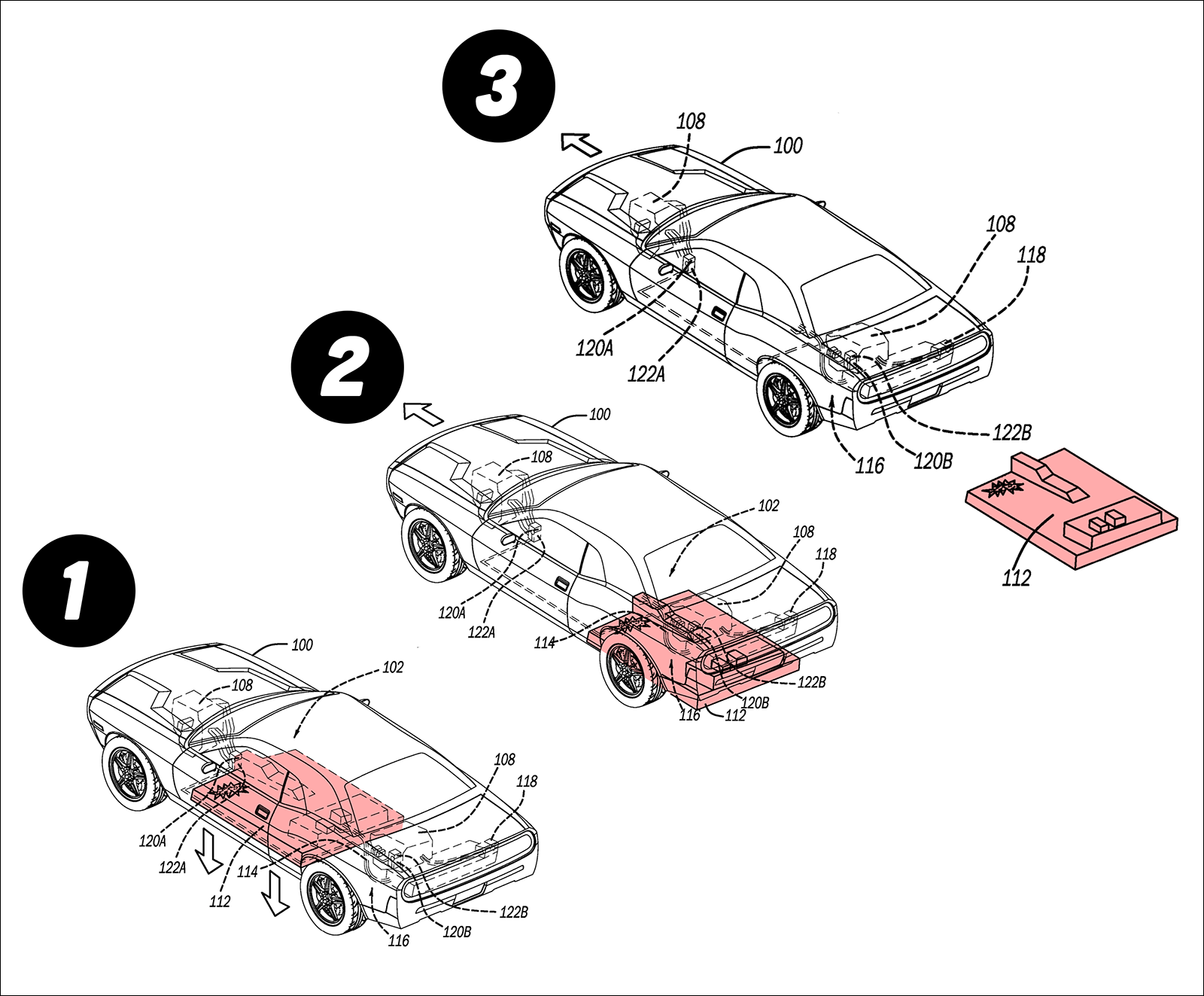
With a typical EV running off of anywhere from 300 to 900 volts, clearly the idea is not to provide any meaningful drivability via the 12-volt battery. The system is designed only to put safe distance between the car and the primary power battery. How far? Instead of that being up to the driver, the system would “[Command] to propel the vehicle a predetermined distance away from the decoupled battery,” per the patent.
As for how the battery parts way with the vehicle, the patent describes two scenarios. Both begin with the driver activating the system via a switch, with options listed by the patent as “an electrical lever, a mechanical lever, a physical button, a touchscreen button, and a toggle switch.” Obviously, “touchscreen button” is the worst option.
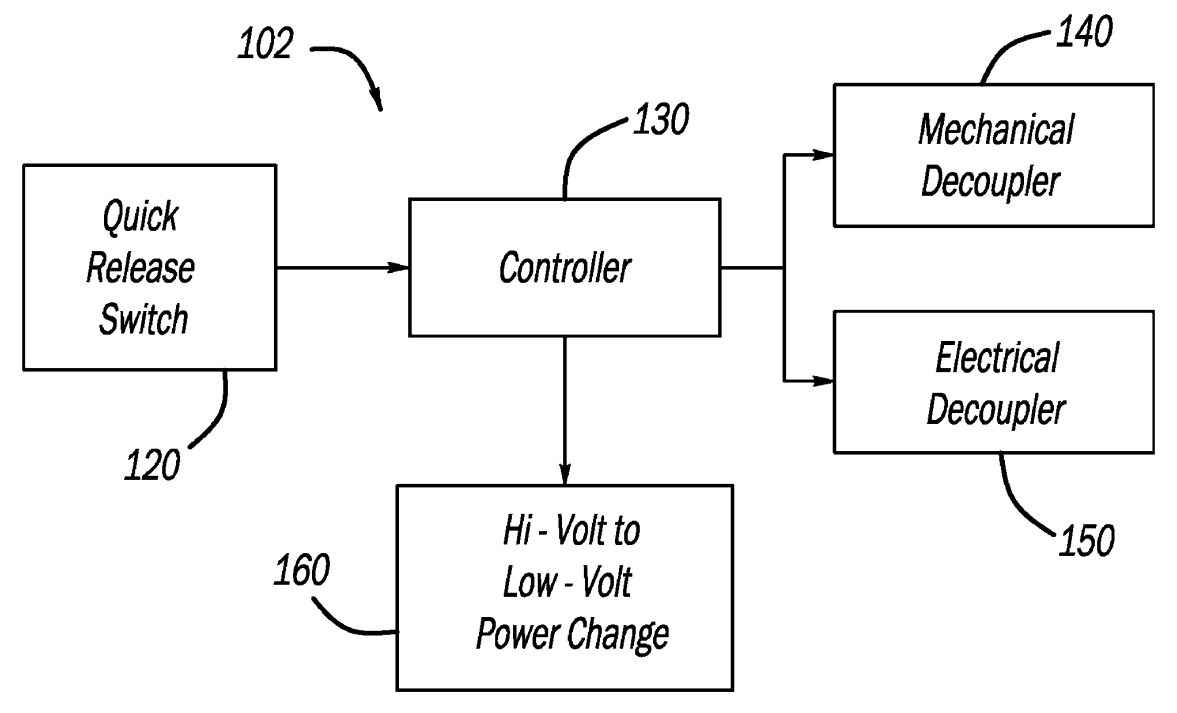
Once activated, the “controller” switches the vehicle to 12-volt power and decouples the primary battery. To eject the battery from the car, two systems are proposed. The first is a “castellated frame” connection as depicted below. Sliding the frames out of registration frees the battery to drop from the vehicle.

The other, more exciting solution is to mount the battery using explosive bolts (“pyrotechnic fasteners”), which can be detonated to free the pack when things go awry (it’s not completely unheard of in cars, though this is usually used for pedestrian protection or convertible roll bar ejection). Should the system ever be green-lit for production, I wonder if both systems might be employed; the “castellated frame” as the first mechanism, with the explosive bolts as a backup in case the mechanical release fails.
It all seems perfectly reasonable and feasible, and far safer than the “fire the battery like a torpedo” concept. Only time will tell if we’ll see electric vehicles with BATTERY EJECT switches under flip-up covers, but if any automaker wants to drop the battery and drive away, they’ll need to contact Stellantis for a license first.
Top graphic images: Stellantis, Deposit Photos


Do the electric door handles still function when the battery has been sharted?
They may not work BEFORE the battery is pooped out.
He said ‘shart’, not ‘poop’.
Sharting and pooping are not the same thing. Here is a link that explains the difference between a fart, a shart and full-on pooping.
https://en.uncyclopedia.co/wiki/Shart
Picture the look on the EV driver behind the Charger that drops his battery. Then drives over said flaming battery, igniting EV number 2! Get me some marshmellows!!!
Do we have ‘ejection’ systems for an ICE and the 15 gallons of highly flammable volatile fuel? They catch on fire more, in total percentage, than EV cars.
Yes, you are correct about the fire rates. The ease with which each type of fire is extinguished is considerably different. A battery fire is very difficult to put out, and removing the combustibles around the battery can make that safer and easier. A fuel fire is relatively easy to put out with water.
Rusty tank straps on your 67 Impala? The Pinto didn’t eject the tank, just the contents.
Or they could use less flammable batteries like China’s mandating, LFP, Sodium, but sure, exploding bolts sitting under the car for years of driving on America’s wonderfully smooth roads should be fine.
I want to know what 12 years of salty slush will do for it.
Would this be the automotive equivalent of explosive diarrhea?
I can see the meeting…
“sir we are having serious quality issues, our batteries are starting on fire”
“How do we fix it?”
“Its too expensive to fix. How about we just drop the battery in the middle of the road, patent it, and call it a feature”
“Brilliant, I like this guy”
Only at Stellantis
My smoking hot charger just dumped it’s shit.
Just when you thought your dwindling faith in Stillantis had reached its lowest, they blast off the bottom.
Your Future EV Might Use Its 12-Volt Battery And Exploding Bolts To Drive Away From Its Flaming Main Battery
Great. Now loop in the horn to honk while it’s dumping that flaming battery on the neighbor’s driveway.
I suggested half of this years ago, using the 12v battery to propel you away from the ejected battery is new.
You’d need a fail safe so it doesn’t eject itself in your garage, presumably burning your house down afterwards.
Well, for that to work the car would have to be over the pediatric ICU, and the roof would have to be very weak specifically where the battery drops, but not so weak that it can’t hold the weight of a full EV on 4 small contact patches.
Explosive bolts just detach, they don’t launch stuff, unless said stuff is held under lots of tension.
This is the most ridiculous thing I’ve heard in a while. EVs are twenty times less likely to experience a fire compared to ICE vehicles because there’s no, like, highly flammable liquid circulating throughout the vehicle (source: https://ev-lectron.com/blogs/blog/ev-fires-vs-ice-fires-safety-comparison-and-analysis).
Not to mention that pretty much every EV on a skateboard platform uses the battery as an integral member of the chassis.
I guess the Stallantis engineers don’t have any actual vehicles to design, so they’re killing time?
I do wonder how much that data is skewed by clapped out ancient cars from an era where EVs just meant golf carts. In hasty searching I couldn’t find any data that limits it to gas cars from the last 15 years or so that EVs have been a real thing.
That’s kinda besides the point though, it’s not like we shouldn’t have airbags because motorcycles exist. EV fires are not a non-issue, and the bigger problem is they are less predictable and more dangerous.
You’re right about the stressed member though, by the time battery chemistry is good enough to be make batteries small enough for this to be feasible, they probably won’t be dangerous anymore.
I kind of liken the EV battery fires to airliner crashes – flying is safer than driving, but when there’s a plane crash, it’s frequently really bad.
I think it would be especially interesting to combine this with the battery as a stressed frame member.
This is required.
https://youtube.com/shorts/Ri4ujb4UYCQ?si=iW16tH8B4yGPFOmN
What seems to be the problem?
My car dropped its battery in the middle of the road!!
Oh. They all do that. Warranty claim denied.
Need an ejector too. How is it going to drive away if the battery catches fire when charging. Having it so it can launch though most garage doors or can open the garage and then launch would also be a nice touch.
*when the engineer tries to explain the feature of the car to the 7th test driver
“You see that little red button there? Whatever you do, don’t touch it.”
“And why not?”
“Because you’ll release this section of the floor, and engage and fire the battery ejector.”
“Battery ejector? You’re joking!”
“I never joke about my work, 007”
Perfect. So the car is autonomous (or semi-autonomous if you’re still allowed to steer it). It goes the prescribed distance, stops, and blocks an intersection and the fire trucks can’t get through. No manufacturer liability there!
Are battery assemblies still being designed as structural members of the chassis? If so it is going to be that much more of a challenge to keep that aspect while making it also easily separable.
There definitely are some EVs where the top of the battery is the floor of the cabin and at least the front seats are bolted to the battery.
Yeah, that would make for the wrong kind of ejector seat.
You would assume they would have secondary structural components for any cars designed for this, it ain’t going far so you can set a factor of safety close to 1 and be fine.
Except this is Stellantis…
Hope the Charger that’s about to go up in flames is not parked at a curb between two other cars. Looks like it might be difficult maneuvering over the flaming version of that rather lumpy battery/control assembly on 12 V.
Charger has explosive diarrhea all over the highway. Great future headline there.
Coming soon to a high-speed police chase near Arkansas…..
Good news: Stellantis is not planning to launch a pallet of fire towards bystanders! Yay! Lowest bar to clear!
I am curious how this would function in a scenario where that 12V battery is unavailable. This is not an outlandish thought. Barring “factory/mechanic fucked up and accidentally left a bolt in the battery compartment” scenarios, a car crash is going to be the most common use case for something like this. And we know that electronic doors, which are powered by 12V batteries, will trap people in a car after a crash due to loss of power.
sounds like those nukes from Need for Speed LOL
prank kids, weapon/defense shit, crime, etc
Instead of ejecting, the high voltage battery from the car just eject the passengers instead
We know it’s proven technology. I recommend the F 35 ejection seats
The exhaust note from those rocket engines would sound so sweet reverberating around in a tunnel at full throttle. Looking forward to the first influencer video to show this off.
It’d be much cooler with some self-sealing stem bolts.
That said, 12v drivetrain ain’t new. A long long long time ago I had a $500 Datsun that one day decided not to start. It would crank and crank but just wouldn’t fire. I couldn’t find a busted fuse or anything and it was going to get dark soon so I put it in gear, cranked the key, and let out the clutch. I drove it all the way home on the 12v battery and the starter motor. I’m pretty sure I invented the hybrid drivetrain a decade before Toyota released the Prius.
Doesn’t have to be an old car… I “drove” my RX8 the last 75 feet to the gas pump after running out of fuel making the turn into the gas station once. (Not my fault the gas station 20 miles ago on the last exit was closed or that there was a wreck on the other friggin side of the road that somehow caused a huge delay.)
Old enough to at least have a key I reckon. My BRZ with the push button ignition probably wouldn’t do it, any modern automatic would probably throw a fit too.
Quite a few older cars didn’t have a clutch-lockout.
Startles you when you forget, though.
10 points for the Star Trek reference. And I don’t have a Boolean algebra chart in front of me, what does your username decode to?
It’s a number of regional significance where I grew up, comes from a song.
I can foresee some nasty pranks, little kid mischief, and spilled Mountain Dew mishaps engendering some unfortunate and expensive events unless the jettisoning controls are biometrically specific to the driver.