


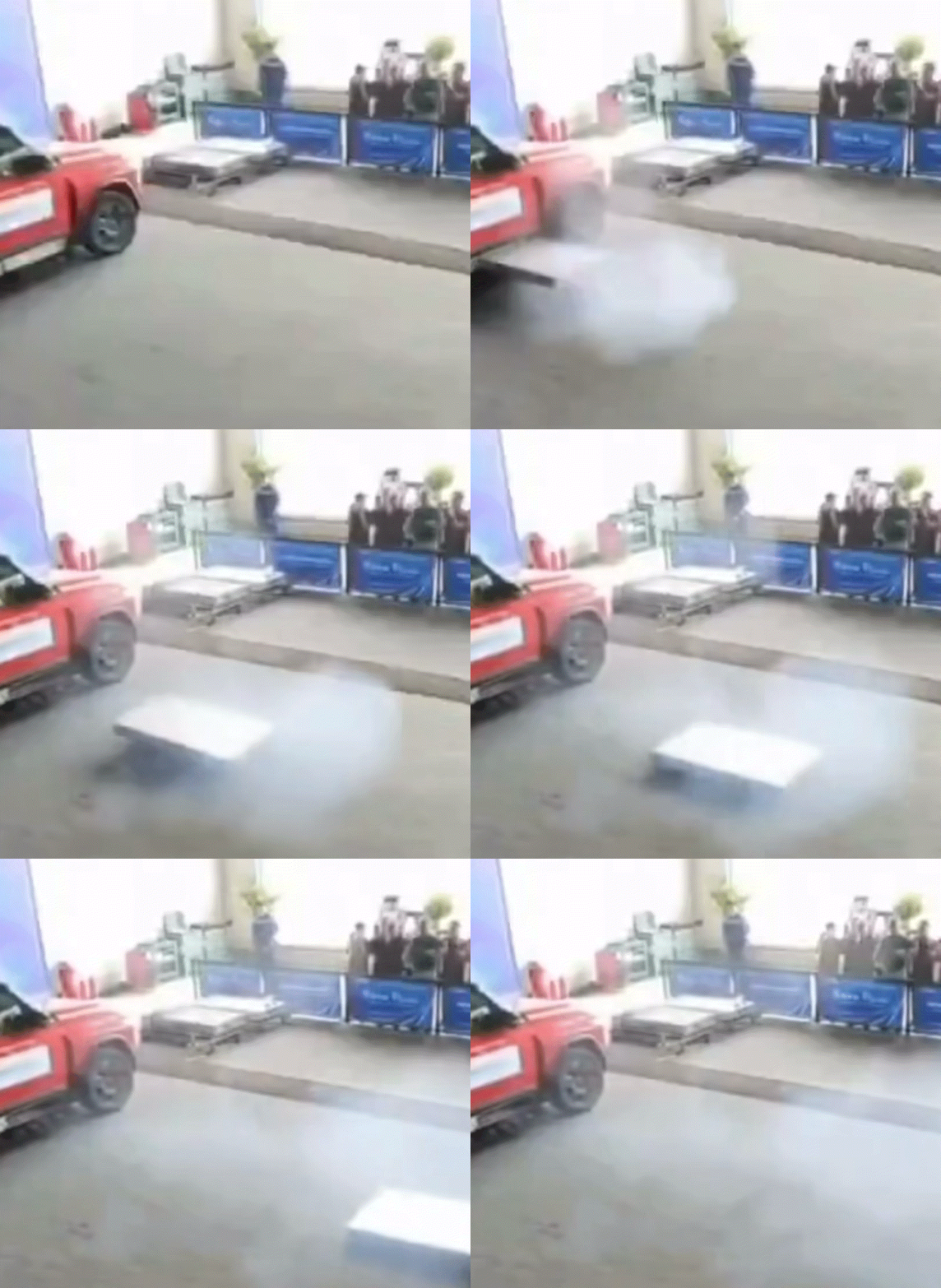
Almost precisely one year ago (we’re off by just one day), Thomas reported on a novel solution for dealing with an EV battery that has caught fire: explosively yeet the thing out from under the car with sufficient force to propel it a safe distance. And what happens to anyone and anything within range of the flying, presumably on-fire battery? You can see the problem here.
So can Stellantis, and based on a new patent, the auto conglomerate has a conceptually similar but much more elegantly conceived solution to safely rid an EV or hybrid of a battery experiencing a thermal runaway or otherwise in need of quickly parting ways with the vehicle.


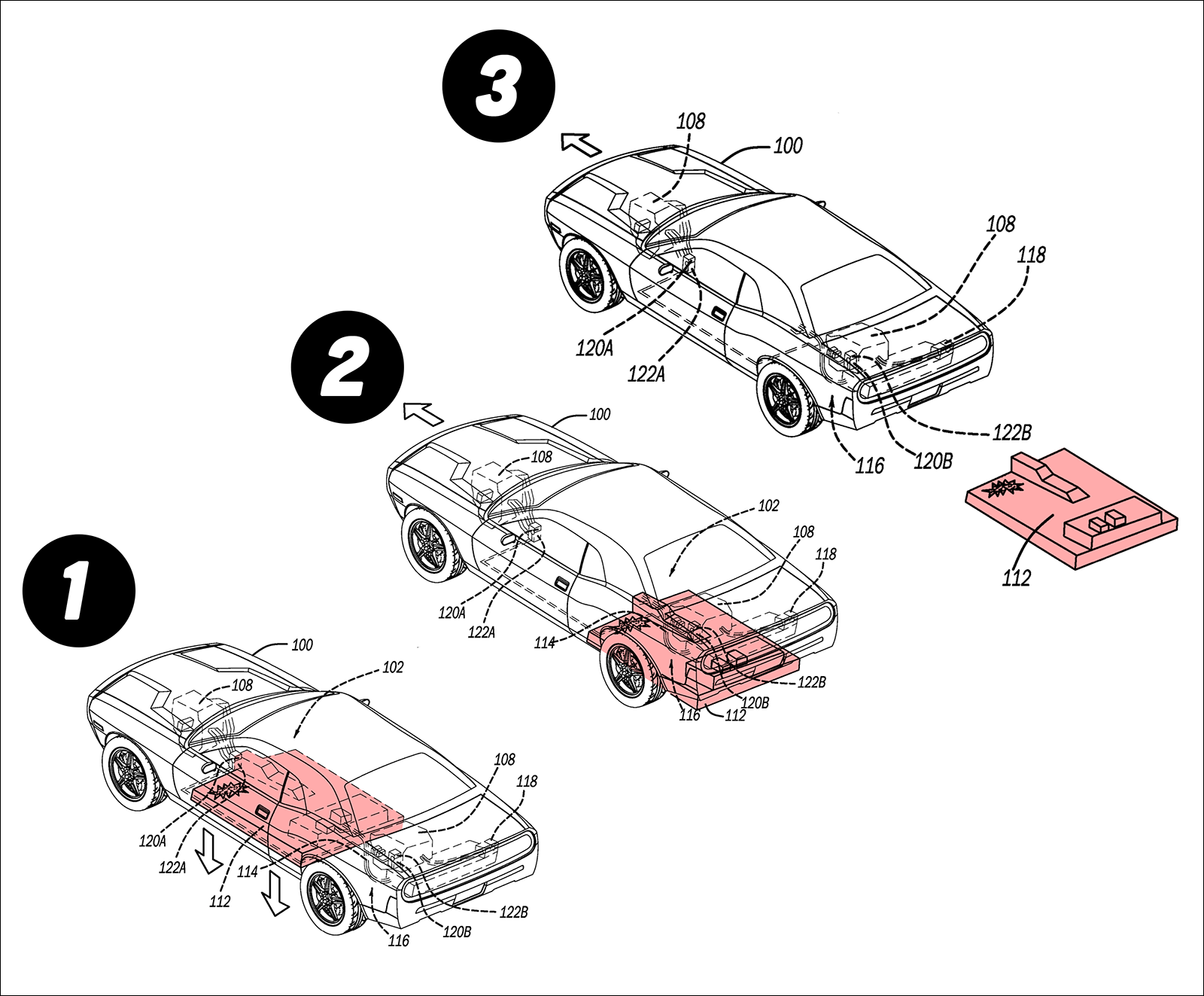
Instead of ejecting the battery to who knows where, Stellantis’ plan calls for dropping the battery wherever the car is stopped, and then simply driving away from it.
It’s easy to imagine how a hybrid could drive away from its street-deposited, smoking battery using its engine (provided it’s coupled to the drivetrain, and not merely powering a generator), but how would a purely electric vehicle drive away from its decoupled battery? The answer is the vehicle’s 12-volt battery.
With a typical EV running off of anywhere from 300 to 900 volts, clearly the idea is not to provide any meaningful drivability via the 12-volt battery. The system is designed only to put safe distance between the car and the primary power battery. How far? Instead of that being up to the driver, the system would “[Command] to propel the vehicle a predetermined distance away from the decoupled battery,” per the patent.
As for how the battery parts way with the vehicle, the patent describes two scenarios. Both begin with the driver activating the system via a switch, with options listed by the patent as “an electrical lever, a mechanical lever, a physical button, a touchscreen button, and a toggle switch.” Obviously, “touchscreen button” is the worst option.
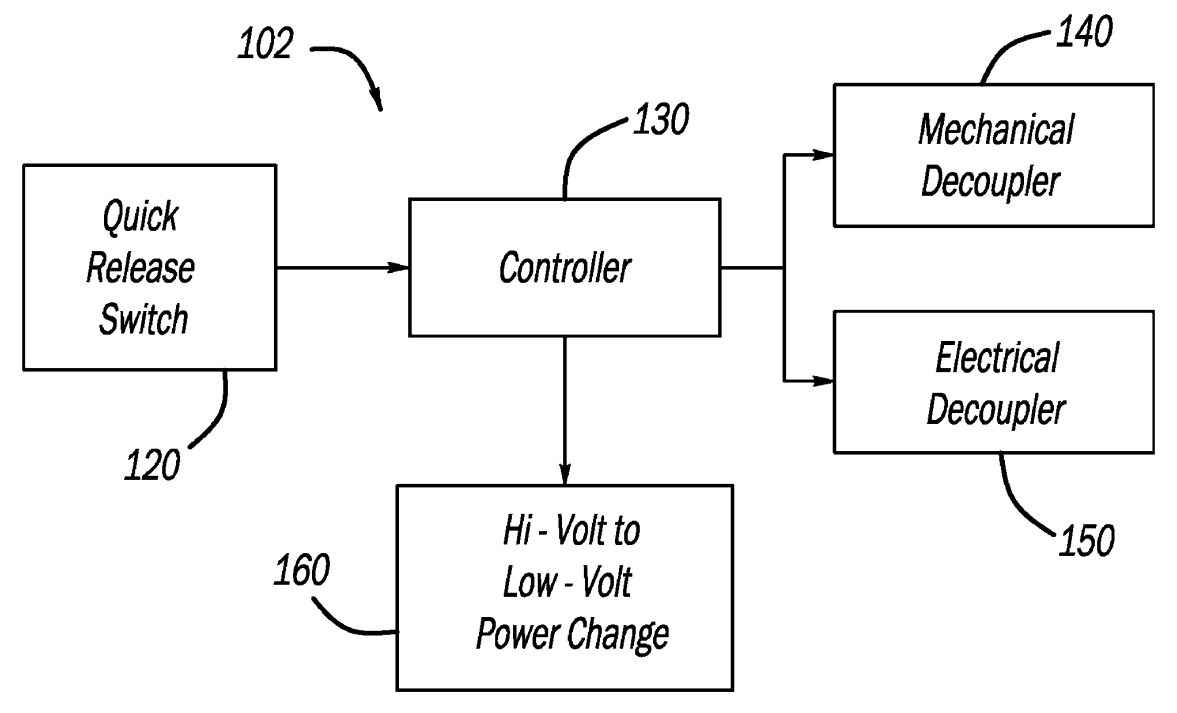
Once activated, the “controller” switches the vehicle to 12-volt power and decouples the primary battery. To eject the battery from the car, two systems are proposed. The first is a “castellated frame” connection as depicted below. Sliding the frames out of registration frees the battery to drop from the vehicle.

The other, more exciting solution is to mount the battery using explosive bolts (“pyrotechnic fasteners”), which can be detonated to free the pack when things go awry (it’s not completely unheard of in cars, though this is usually used for pedestrian protection or convertible roll bar ejection). Should the system ever be green-lit for production, I wonder if both systems might be employed; the “castellated frame” as the first mechanism, with the explosive bolts as a backup in case the mechanical release fails.
It all seems perfectly reasonable and feasible, and far safer than the “fire the battery like a torpedo” concept. Only time will tell if we’ll see electric vehicles with BATTERY EJECT switches under flip-up covers, but if any automaker wants to drop the battery and drive away, they’ll need to contact Stellantis for a license first.
Top graphic images: Stellantis, Deposit Photos


Airport fire fighters do one thing. That is they create a path for passengers and crew to escape a burning plane. They make no effort to save the plane, because once it catches on fire, there is no saving the plane.
This is the opposite of that. If the battery is on fire the rest of the car is useless and separating it from the battery won’t materially change the fire-fighting effort.
“Nobody wants EVs!” – Stellantis, working on everything but designing and building EVs people want.
This is a terrible idea.
For one thing, I can see a situation where the ejected battery causes a new set of problems… like other cars/people running into it or getting hit by an overheating/burning battery… and the problems associated with THAT new problem this could/would create.
And being Stellantis, I could see situation where this stupid system malfunctions. Like you it a bump and the charges go off… and now your car is fucked for no good reason.
Nah… if a battery pack goes into a runaway condition, just have the car shut down and have emergency venting and have a big message on all screens to GTFO of the car.
Better for them to deal with the root issue… make reliable, safe and durable battery packs. And stick to Lithium-Iron-Phosphate packs if they want to be really paranoid about it.
The more I think about this, the more terrible it strikes me (pun intended if I was standing next to it).
Hey what’s this button do ?????
This from Stellantis?!? Can’t wait to see the recall reports on this move. Seems like a great idea, but from a company that just can’t quite do electronics right? Nah, I’m ok.
Shaxs, when he ejected the warp core.
OHMYGODOHMYGOD GIVE ME THE APOLLO-ESQUE LEM DETACH COVERED SWITCHES
Keeping attention on the important stuff.
I like it
So, if an ev without a battery is basically worthless. Since the value of an EV is almost entirely tied up with the battery.
This means, in case of a battery fire, my vehicle is basically worthless. And by pushing the button to drop the battery, ma vehicle now is, still, basically worthless.
Tell me why I should push this button instead of getting myself and other occupants out and maybe taking a second to retrieve quick to grab stuff?
Hey, with this state of mind – you absolutely shouldn’t. Let it burn.
To hell with the firefighters having to put out a burning vehicle vs a burning battery.
I understand your point.
But I am not sure this is the best sollution to helping the firefighters.
A long time ago I was into fire fighting and fire prevention and that sort of stuff. I would rather see a way of sectioning the battery or creating fire barriers and that sort of stuff. Then, add a way for firefighters to cool down the thing.
Having a battery that is detacheable from the vehicle needs this battery to be concentrated in its own seperate strong holding container, which is not necessarily easy to firefight.
For example, all reactors I have worked with (both chemical and nuclear reactors), had a final resort ‘couple water hose here’ type of deal, where the mobile firefighters just focus their water supply and the design diverts the water to where it is needed.
I’m not a firefighter by any means, but my understanding is with EVs their only shot is with fire suppressing blankets after the fire is initially put out given the tendency of batteries reigniting themselves even after the initial fire is extinguished.
In this scenario, I think an isolated, easily accessible battery pack would be way more straightforward to deal with.
I don’t think for a second a car that has gone through this procedure would be salvageable or repairable, and I don’t think it was ever the goal.
I have read about the fire suppressing blankets on EVs. Yes they would be easy to implement on the ejected battery.
But I fail to understand how the blanket alone can deter thermal runaway. The only way to be sure the battery will not spontaniously combust due to thermal runaway is by making sure ALL parts of the battery are below a certain treshold temperature. And since it is generating heat in this state, putting a blanket on will not be sufficient.
It might be easier for the firefighters to close in to a covered battery and to start dousing it with water, but I still think activating an emergency cooling system would be vastly superior to having the average global citizen decide it is time to jettison the battery.
https://www.evengineeringonline.com/what-is-thermal-runaway-and-why-does-it-matter-for-evs/
My understanding is the blankets are just for containment and delaying, not replacing a standard firefighting procedure.
In all cases, it looks much more easy to my untrained eye to fight a fire on an easily accessible self contained module, as opposed to a whole vehicle.
There have been occurrences of EVs catching fire again once towed to a lot after being extinguished. So blankets are now sometimes used on lots as a precaution. And covering a pack is easier than covering a vehicle. Dealing with it in any way is easier than dealing with a whole vehicle. Which, remember, will also have to be dealt with. But at least will no longer threaten the whole impound lot.
Not to mention NYC preccints where crashed/burned cars are often parked on the sidewalk in front of the preccint 🙂
This is the street parking at the Vernon-Jackson subway station in Queens, in 2020. Not far from the preccint. Two crashed, one burned.
These are parked maybe a 2 minutes walk from the preccint. Used to be a time they were parked just in front. Temporary storage for unprocessed vehicles. This is before towing them to an impound.
You guys need to understand how patents work in big companies.
Some manager say “we gotta innovate”, pushing a shitty KPI on his underlings (i.e. number of patents).
To promote that strategy, engineers get a bonus for each patent they get through the patent office (500€ where I worked).
Nowhere on the system is it asked of the patents to hold any technical value or real life feasibility.
In the end of this process, the engineers get a bit of cash, their manager gets to brag in front of his boss about X patents this year, and his boss get to say he “pushed foreward the R&D objectives of the corporate leadership, securing our position as an industry leader in the global market”.
Most patents are junk, but they are useful junk for some middle manager to push his career forward. I’m pretty sure this one is no exception.
Can confirm, this is exactly how it works for me. I have a number of patents, all acquired for the same reason you describe. None of them are innovative or useful in any way, all of my useful things are held as trade secrets instead.
The more time goes by, the more I think the whole patent system needs to be scrapped/completely overhauled.