


I’m not sure how much you keep up with news outside of your local area, but if you’re interested in what’s happening, let’s see, 16,096,612,181 miles (and counting) from Earth (give or take a few hundred feet depending on your elevation) then boy do I have news for you. Just yesterday the Voyager 1 spacecraft, launched from our planet way back in 1977, just passed the point in space where it would take light one full day (24 hours) to reach it from Earth.
That’s far. It’s by far the furthest, farthest-flung far thing ever built by human hands, and this is a milestone absolutely worth celebrating. In almost 50 years of travel at speeds of almost 38,000 mph, Voyager 1 has covered enough distance that it would take light – the fastest anything in the known universe, at least without getting into weird quantum stuff I don’t exactly understand – a full day of travel to reach.


What I’m saying is that if light wanted to leave Earth to catch up with Voyager 1, even light would need to pack a lunch, at the very least.
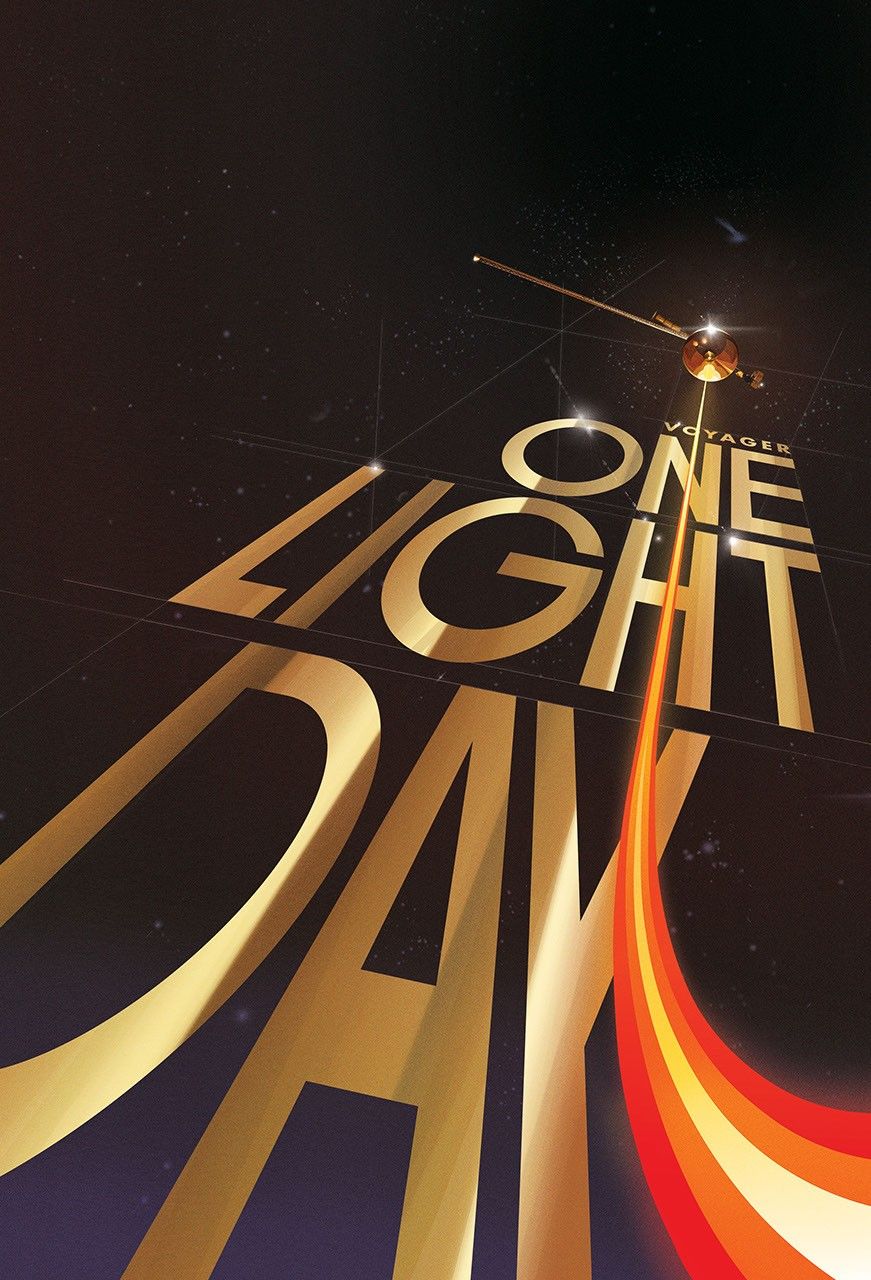
NASA is, as you can imagine, quite proud of this achievement, and they absolutely should be. They held a mission update yesterday about the achievement, and to give an update about the status of the spacecraft and where it is and where it’s headed yesterday:
They also released a lovely commemorative poster (shown up there above the video) which has another side full of facts about Voyager’s achievement:

From our perspective, the poster makes an interesting comparison: were you to get in your car and drive at 65 mph, it would take you 28,250 years of nonstop driving to reach where Voyager 1 is. And that’s not counting bathroom and refueling breaks. Also, if you decide to make such a journey, I hope you like the people you’re driving with, because you’re going to run out of stuff to listen to after about 800 years, which seems to be the leading estimate of how much recorded music humanity has produced.
I guess if we add podcasts onto that, maybe we can get another century or so, maybe two if we count true crime podcasts. But after that, you’re going to have to figure out what to talk about for the remaining 25,000+ years. And there’s not a hell of a lot to look at out the window.
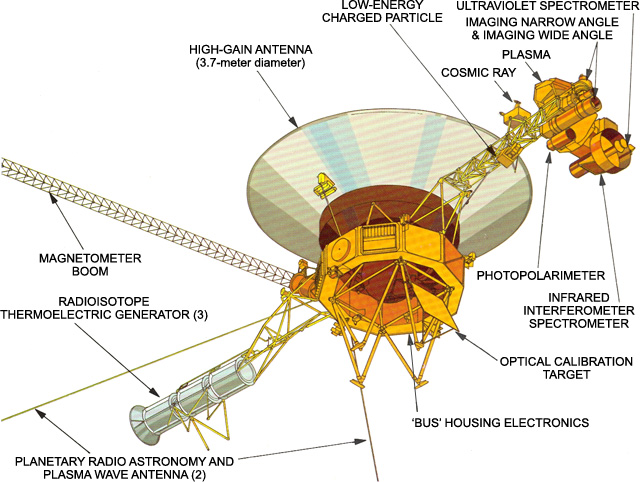
I think everything about this is incredible. The machine itself, for example. It’s been operating nonstop for nearly half a century, and even though its three Multi-Hundred Watt Radioisotope Thermoelectric Generators provided about 470 watts of power at launch, they lose about 4W of power every year, so now they’re down to 200W.
This means that most of Voyager’s instruments have been shut down to conserve power, but there are still two active instruments: the Magnetometer (MAG) and the Plasma Wave Subsystem (PWS), along with the necessary equipment to keep the probe alive and in communication with Earth.
Is Voyager 1 actually out of our solar system yet? That’s actually a trickier question than you’d think. It’s far past all of the planets – its historic flyby of Jupiter happened in 1979, and then Saturn and its moon Titan were studied by it the next year, and then the heliopause – the point where particles from the Sun (the solar wind) are overtaken by cosmic rays in density – was crossed in 2012, which NASA considers to be the solar system’s boundary, and the entry of Voyager 1 into interstellar space. Here’s NASA’s list of milestones:
March 5, 1979: Jupiter flyby – closest approach
Nov. 12, 1980: Saturn flyby – closest approach
Feb.17, 1998: Became the most distant human-made object after overtaking NASA’s Pioneer 10
Jan. 1, 1990: Voyager Interstellar Mission (VIM) officially began
Aug. 16, 2006: 100 astronomical units reached
August 2012: Voyager 1 enters interstellar space
Some scientists, though, consider the Oort Cloud – a spherical shell of comets and other cold, remote stuff – to be part of the solar system, but considering that the Oort cloud reaches almost to our closest stellar neighbor, Alpha Centauri, I personally would consider Voyager 1 to be in interstellar space.
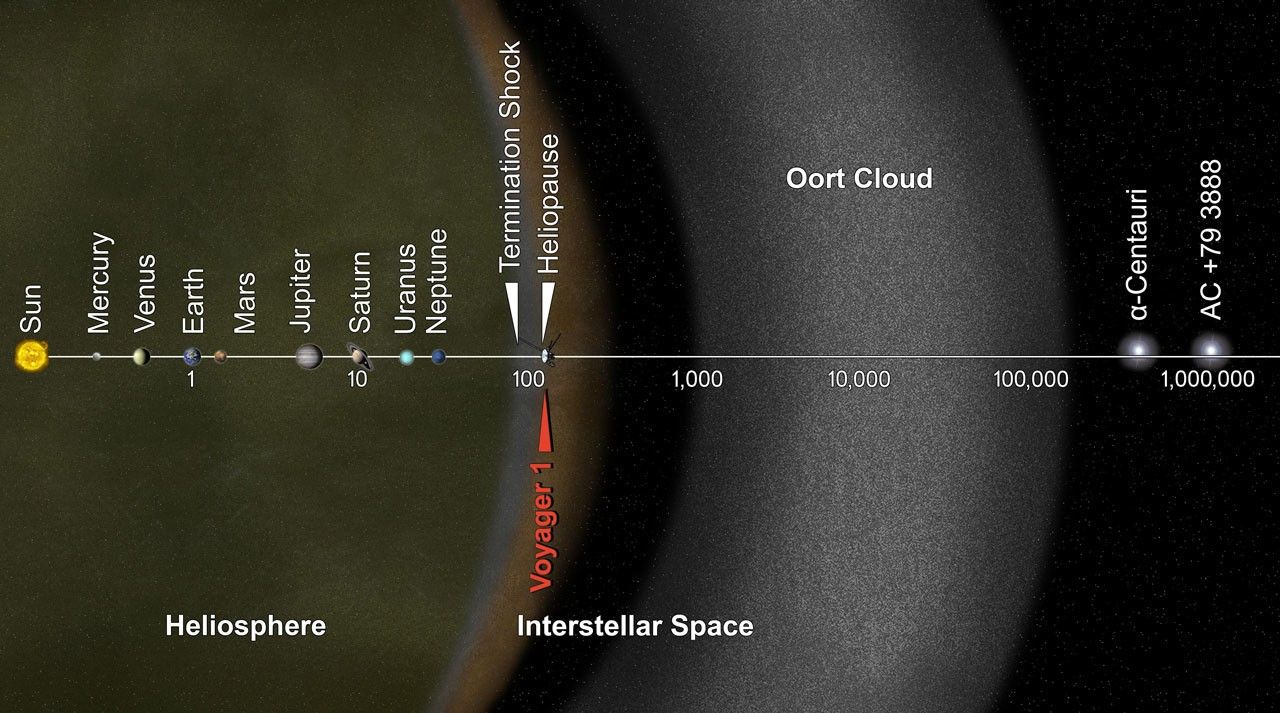
That image above is from 2013, by the way, so Voyager 1 is even further out.
The Voyager probes may be the most lasting mark humans make on the universe. The two probes are expected to last at least a billion years, and will (eventually) get close to other stars in the galaxy, though they were not targeted at any particular stars when launched.
In case there is intelligent life somewhere out there that is roaming around space, should they happen upon either Voyager, they’ll find on the spacecraft a golden phonograph-type record. Even if they’re not into ’70s-era vinyl, there are instructions on the record for how to construct a machine to play it, at least in a schematic way.
If they figure it out, here’s the music they’ll get to listen to:
There are also 115 analog-encoded images on the record as well (116 if you count a simple circle used for calibration), though I suspect the process of decoding them will prove trickier. But still, if these aliens are out there in spaceships, they can figure it out!
These images show scenes of everyday life on Earth:

…some of our architecture and monuments:

…some give information about our biology:

…and then there’s one of a dude eating what looks like a grilled cheese sandwich:

Also, who eats a sandwich like that? Bite one side, then flip it around to eat the other side? What kind of weirdo eats a sandwich that way? You start on one end and stick with that end. Ice cream lady is a little performative, but fine, and don’t get me started on Cap’n Water Pitcher there. This is the message we want to send the aliens?
It’s too late now. Unless we make some major propulsion advances pretty soon, we’re not likely to catch up with either Voyager to update that sandwich-eating picture to something more reasonable, so I guess we just need to live with our choices.
Still, one light-day away! It’s incredible!
Top graphic images: NASA


I hope we send something with faster propulsion after it so we can update that file with a pic of everyone’s favorite 21st century food – shower spaghetti!
I was thinking wheelbarrow of shrimp
I feel like we need to have ELO or Billy Thorpe or someone like that record a concept album to commemorate this.
I don’t think Billy Thorpe is available 🙁
As Fermi’s paradox predicts, Voyager 1 will be discovered by a life form that worships sandwiches. That photo of the guy consuming one guarantees that Earth will be annihilated to avenge the threat to their beliefs. Thanks, science!
The people who built this thing, this monumental achievement of human endeavor, looked it over, called it a day and then went out and struggled to start their Oldsmobile Cutlass Supremes and Ford Gran Torino Broughams.
Well, let’s see. Voyager 1 & 2 were designed and manufactured at JPL in Pasadena, CA in the early to mid-70s. I’m sure there were some Beetles, Mustangs and maybe a Corvette or two. Probably some other “foreign” cars more exotic than a Bug. I have a cousin that did press relations for JPL, but this was way before her time and she’s not a car person, so that’s no help.
That aside, it’s amazing that Earth can still communicate with these devices and even send commands to fire thrusters that still worked as recently as 2025 (I think). You think some web pages (cough, cough) take a long time to load. Imagine if you clicked on a link and it took over a day for the request to even get to the “server” before it even got started on the request and then another day for it let you know that it had received the request.
That aspect of communications was one of the things that really started standing out to me during the original Star Trek series as a kid.
Heck, the round-trip time of a signal from a satellite uplink to a geostationary satellite (22,240 miles/35,790 km under best case conditions) is nearly half a second. That alone can explain some of the awkward pauses you see on TV when an anchor tosses to a very remote reporter or when they try to communicate in a dialog.
“What I’m saying is that if light wanted to leave Earth to catch up with Voyager 1, even light would need to pack a lunch, at the very least.”
And a snack!
But is it really bad to want to leave humanity behind, listen to the music more than once, maybe copulate with your passengers then eat them when they become boring? Actually you die first so freeze dried travel
A light lunch?
Nah… a Full Lunch… plus a granola bar.
Bull of Heaven’s 310: ΩΣPx0(2^18×5^18)p*k*k*k:https://archive.org/details/310Px0218x518pkkk
Is allegedly 3.343 quindecillion years long. You’d need a whole lot of true crime to replace that.
Jeez, it took 49 years to travel one light day? Typical malaise era vehicle.
Kinda hard to stomach these updates knowing that Klingon Captain Klaa is going to destroy it for target practice in 2287.
I believe that was Pioneer 10 he destroyed. Otherwise the timeline would’ve been totally screwed as Voyager would not have returned as V’ger and Illia and Decker would not have had star nookie and bonded with V’ger to explore the universe. Consequently, Stephen Collins would not have been able to molest the Astro Baby from 2001, which I think helps explain the ending of that film.
That was Voyager 6 that turned into V’ger.
Yeah, you’re right. Forgot that they fictionalized it. Although, why? Were they afraid NASA would sue for copyright infringement?
Maybe they were hoping NASA would make more?
Like Doritos.
“other stars in the solar system” (milky way)
Don’t You Dare put other stars in our solar system!
I have watched every NOVA program ever produced (bound to a few missed) And the thing that ticked me off as a young-en was the arrogance with which they(bell bottom Carl inc.) would state as FACT, what was clearly”to the best of our understanding” – the age of the universe- then change it by billions a year later.
There was opposition to sending the gold plated “Eat at Joe’s” menu, myself included, but rock star Sagan knew best.
oops! fixed it!
I am immensely proud of NASA and, by extension, their subcontractors that built Voyager. You can complain about what deep space missions cost, but damn it, look at the returns. Sure, they’re expensive to build and launch, but here we are nearly 50 years later, still getting useful science from the machine. There is no fixing it. There is no backup. Voyager 1 is out there all by itself.
Still working. Lots of bits don’t work like they used to, or not at all. But Voyager 1 is still working. Still phones home with updates. And we can still hear it.
That’s a lot of return on the initial investment.
I sent a text message around to my family to congratulate Voyager 1 for having achieved such a milestone, and the response was pretty good from my science-oriented offspring – I raised them so I imagine my own enthusiasm rubbed off at some point – but the rest were kind of meh.
Anyway. Tip o’ the cap to the many brilliant, stalwart folks at NASA who keep an ear open for Voyager’s faint voice, and to Voyager itself. If a machine can have a soul, I think it has earned one.
Kinda reminds me of a GM product with 300,000 miles on it.
Kind of goes with the saying that a GM product will run poorly longer than most cars will run period.
I’m not particularly a fan of GM, but there is something to be said for how many older Buicks, Oldsmobiles, and Cobalts are out there running on nothing more than hopes and dreams.
This is why I’m an unapologetic fan of the Duke. It doesn’t do anything great, or lots of things even especially well – but for a basic engine never intended for more than merely modest applications, it just goes. If you’re one of the lucky folks that sheared a tooth on the timing gear, replace it with the metal one and put up with the ever-so-slightly louder one…for the rest of your life.
“Your car lost timing? Isn’t that, like, really bad?”
“Maybe for somebody else, sure. Me? New gear, set the timing, good to go.”
Yeah, as I’ve grown-up I’ve developed an appreciation for things that are really good at what they were intended to do. Your example of the Iron Duke is a really good example. At its core, it’s a pretty solid, basic engine. Most of the defects I can think of were cost-cutting pieces bolted ot the engine (that always goes so well…).
If GM hadn’t GM’d it up so badly, I could see a world where it would be viewed as the “American 22RE”.
“I hope you like the people you’re driving with, because you’re going to run out of stuff to listen to after about 800 years”
I feel like after 75 years or so, you can recycle old material and have a fresh audience
Science rules!
“Science rules!”
Not while the Republicans are still in control!!!
Any snapshot of a singular time in our culture’s history would return some odd things when looking back on it 50 years later. But the coincidence that we happened to have developed this and launched it during one of the weirdest decades in our history is… unfortunate? I don’t know, maybe it’s for the best.
We’re never getting visited if this gets found by anyone out there.
All the decades have weird. How about now?
I’ll let you know in 50 years…
I initially thought the guy on the right pouring water at his face was playing a really loud note on a dark colored saxophone. Then I did a double take and thought I saw a xenomorph, then I questioned why the ice cream lady was hand feeding the balding guy a sandwich.
I have lived on Earth over 40 years…I can’t imagine what an alien will think of that image!
Suggestion for a site improvement: Make it so that the embedded pictures can be clicked to zoom in or see a high res version (either in place or as a pop-up). I know the poster was linked but there are often cases where the article says “look at the weird thing this car had” and I just can’t because I can’t see a higher res version of the embedded picture and my 45 year old eyes are tired.
Brother I’ve been complaining about this for months, months I say! The annoying part is that sometimes they do have the images embiggen themselves upon clicking. How do they decide? I assume Torch is letting an Apple II pick at random.
You can always right click/long press and open image in new tab, but in this case it wont help, it’s not uploaded full resolution.
You gotta click the link to view in from nasa, (which still isn’t great resolution tbh)
I’ve been around long enough to have witnessed (not in person) every mission. The Voyager is a great accomplishment, but my favorite is the Cassini mission to Saturn.
Now that you mention it, I was too young for Sputnik but well aware of Telstar.
I remember the Sputnik announcement interrupting after-school children’s television programming,
“One Light Day,” sounds like a shitty theme song for a sporting event.
I keep hearing the song “One Fine Day” in my head when I see the graphic/poster.
I keep hearing Les Mis
Or a new ad campagn for feminine products.
I remember catching a nova episode on the first major hiccup in power delivery for the voyager in like 1992. It was like a best of hits album mixed with a eulogy.
35 years later and it’s still kicking. Love this thing. Makes me wish I’d become a scientist or something. Stay in school kids.
+1
Sputnik and A. Einstein inspired me to become a physicist. Ended up working in materials science and engineering for my career.
One of my college professors was involved in the making of that audio record. We saw a copy of it on our JPL tour.
I believe the sandwich is being eaten like that to show non-human mouths what happens when we take a bite. So the image shows the three main ways mammals consume energy, licking, biting, and drinking.
That was my take, as well, but I’d argue that “shoveling” is more common than licking; but then we’d have to argue about utensils, even if demonstrating use of tools could be favorable.
That said, ol’ ET might not grok WHY we consume if they can’t identify WHAT we consume, and while you’re at it, who’s to say those bozos aren’t pictured drawing those items from their face-holes rather than inserting?
What a herculean task, to picture humanity in a still image.
They should have included an 8mm film of Nathan’s hot dog eating contest.
So it also means that if Voyager 1 could see earth it would only be seeing 1 day in the past
But by the time the image came back it would be two days, like blinking but vvvvvvvvvvvvvvvvvvvvveeeeeeeeeeeeeeeeeeeeery Sllllllllllllllllllloooooooooooooooooly.
That’s a loooooot of Grace Hopper style nanosecond wires to get out that far.
I have been excited about this for days and have been nerding out on Voyager since I was a science and space kid in the 1970s.
I really miss the days when we funded, supported and trusted science and the space program.
Yes to this. My dad worked on Apollo stuff and the Saturn rockets
Well, only another 200 years before it comes back as V-GER.
That was set in motion on Tuesday when NASA asked everyone to send Morse code into the night sky, flashing: V G R.
When we look around at the troubles that people inflict on themselves and each other, it is good to remember that sometimes people can do something really cool.
The international cooperation to reduce chlorofluorocarbons for the health of the ozone layer was inspirational. Gives me hope humanity can once again come to our senses, and rectify our mistakes.