


Ninety years ago, the world was introduced to a new kind of transport aircraft. The Douglas DC-3 reshaped commercial aviation forever. It was also one of the vital vehicles that helped the Allies win World War II. Countless examples of this world-changing aircraft continue to work hard into the present day, and I got the rare chance to take flight aboard one of them. Being a passenger in a Douglas DC-3 changed my life, and not for the reasons why I thought it would.
This year’s EAA AirVenture Oshkosh Fly-In was my favorite air show yet. OSH 26 saw me getting in aviation history more than I ever have before, and I learned so much about how to be a better pilot. If you’re even mildly curious about aviation, I highly recommend visiting an AirVenture, even if it’s only for a day. It’s like the Disney World of planes.


As I walked the grounds this year, the DC-3 Society non-profit organization reached out with an offer of a lifetime. Every year, a close-knit group of DC-3 owners gathers at AirVenture, and this time, to celebrate 90 years of service of the DC-3, they opened their aircraft to the media. A handful of us got to take part in a formation flight above Wisconsin, and honestly, it was such an incredible time that it remains one of the high points of my life. Yet, what I did not expect was how experiencing one of these planes in real time changed how I appreciate history.

Commercial Flight Used To Be A Grueling Experience
Back in the early 20th century, air transportation was highly experimental, and not always particularly comfortable.
Early generations of transport aircraft could not fly above bad weather, and subjected their passengers to harrowing rides through storm cells. Early radial piston engines often had questionable reliability, leading to frequent engine failures and subsequent forced landings. Worse, aircraft engineers didn’t yet have a full understanding of exactly how metal ages and reacts to its environment. Some airliners, like the Fokker F-10 of the 1920s, even had wooden wings. Structural failures were more common back then. If all of that wasn’t bad enough, navigation was primitive compared to today.
Even when commercial aviation worked well, it wasn’t exactly a refined experience. Engines were deafeningly loud, cabins shook and rattled, and there were few airports to even safely land a plane. Flying boats were dominant because they didn’t need runways or land-based infrastructure. None of that even addresses the fact that, for many folks, flying was a luxury and a novelty they could not afford.

Sometimes, transcontinental flights weren’t even possible. Transcontinental Air Transport (TAT)–one of the predecessor companies to Trans World Airlines–formed in 1928 and flew the Ford Tri-Motor in its coast-to-coast service. The Ford Tri-Motor was an icon in itself that made flying more accessible to the public, but TAT didn’t even fly them across America. Instead, passengers would board a train in New York, then ride through the night. Those passengers would fly aboard Tri-Motors during the day, then ride in a train again by nightfall. TAT would repeat this process until passengers got across the country.
Commercial aviation had an even bigger problem going into the 1930s. Many early airlines made money by flying mail in addition to passengers, and the federal government also subsidized the airlines. According to the National Air and Space Museum, however, the government began pulling its subsidies in the mid-1930s. Flying passengers alone simply wasn’t profitable, as the era’s air transports were too small, too costly to run, and too slow. Flying was also too inefficient due to outdated communication and navigation equipment.
America’s First Modern Airliners

The only path forward was a dramatic improvement in aircraft design. The federal government tried to motivate the airlines by offering bonuses to those that flew at night, updated their radios, flew faster, and flew aircraft with multiple engines. The first aircraft manufacturer to respond to this new era was Boeing, which introduced the 247 in 1933 with United Air Lines.
The Boeing 247 – often credited as being America’s first modern airliner – was a major step forward. It featured an all-metal, low-wing construction, powerful supercharged engines, controllable-pitch propellers, wing de-icer boots, and a 10-passenger capacity. Notably, the 247 was such a revolution in air travel that it was 50 percent faster than a Ford Tri-Motor. A Boeing 247 could cross the whole country in only 20 hours.
Boeing’s success began a sort of race between aircraft manufacturers to create the best airliner. One firm would quickly emerge as the undisputed leader for the remainder of the propeller era: the Douglas Aircraft Company.

Founded in Santa Monica, California, in 1921 by Donald Wills Douglas Sr., the Douglas Aircraft Company (originally the Davis-Douglas Company) excelled at pushing propeller aircraft technology to its limits.
One of the company’s earliest feats was the first circumnavigation of the planet by air, which was completed in 1924 by aviators Lowell H. Smith, Leslie P. Arnold, Erik H. Nelson, and John Harding Jr., flying two Douglas World Cruiser aircraft. However, the Douglas Aircraft Company’s greatest claim to fame is completely revolutionizing air transportation in the pre-jet age.

When United took on a fleet of Boeing 247s, competitor Trans World Airlines needed its own next-generation airliner to compete. It put out a bid to the five major aircraft manufacturers to do better than Boeing, and the winner was Douglas. First flown in 1933, the DC-1 prototype bested the Boeing 247 with a faster operating speed and a 12-passenger capacity.
It was also the basis for the 1934 Douglas DC-2, which seated 14 passengers.
The Legend Of The Douglas DC-3

But the prop-driven aircraft to rule them all was the iconic DC-3. The National Air and Space Museum gives an excellent primer on the DC-3:
The development of the Douglas DC-3 was brought about by the commercial airlines demand for an economical passenger-carrying airplane. Up to 1934, airline passenger craft were too slow and carried too few passengers to be really profitable. United Air Lines had ordered sixty of the new Boeing 247s, the first truly modern airliners and had effectively tied up production. The 247 carried ten passengers at 160 mph and made all other transports obsolete. The other carriers were thus forced to find another plane if they wished to be competitive in the passenger-carrying business.

In 1933 the Douglas Aircraft Company designed a new passenger plane, as ordered by Transcontinental and Western airlines, to compete with the Boeing 247. The first model, the DC-1, was soon succeeded by the DC-2 and the start of quantity production. American Airlines, at the time, was using the slow Curtiss Condor, which was fitted with sleeper berths. American needed a new airplane able to compete with the DC-2 and the Boeing 247, but one with sleeping accommodations.
In 1935 C. R. Smith, president of American Airlines, made a direct request of Douglas to build a larger, more comfortable plane which could lure the luxury trade.” On December 17, 1935, the Douglas Sleeper Transport (DST) made its first flight. The original plane was designed as a luxury sleeper with seven upper and seven lower berths and a private forward cabin. The day plane version, known as the DC-3, had twenty-one seats instead of fourteen berths. The design included cantilever wings, all-metal construction, two cowled Wright SGR-1820 1,000 hp radial engines, retractable landing gear, and trailing edge flaps. The controls included an automatic pilot and two sets of instruments. The original design was so satisfactory that the basic specifications were never changed.
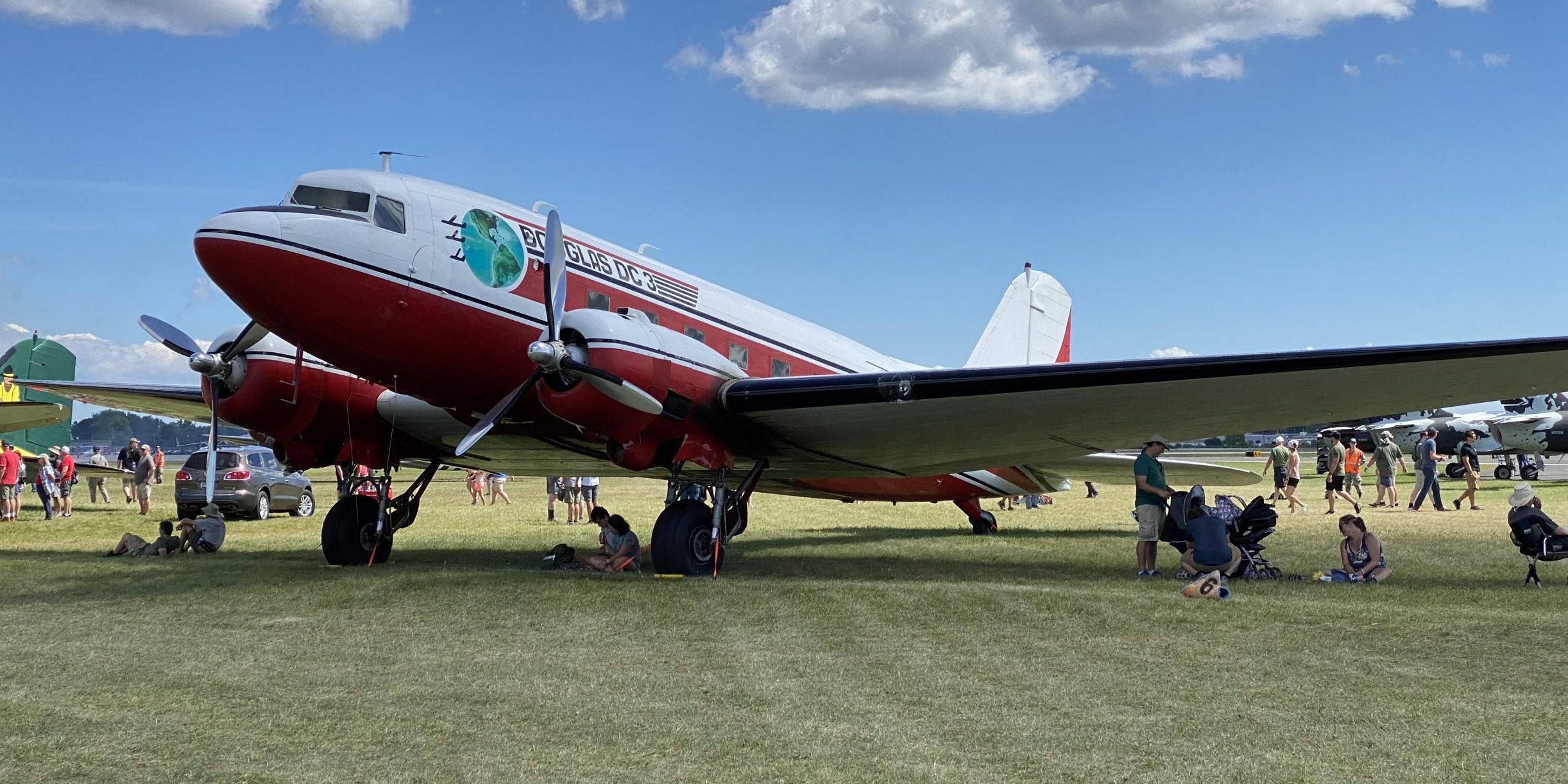
The impact of the DC-3 was immediate and world-changing. On June 25, 1936, American Airlines launched non-stop Douglas Sleeper Transport service between New York and Chicago. A month later, the airline switched to DC-3s. By a year into service, Smith uttered a line that cemented the DC-3’s place in the history books. “It was the first airplane in the world that could make money just by hauling passengers.”
As we established earlier, airlines were essentially mail carriers that happened to fly people. But with the DC-3, airlines could make money doing nothing but flying people, and without subsidies. The DC-3 also brought the dream of flying to more people, as its economical operation and 21-passenger capacity meant that ticket prices could be lower while still making airlines money.

The benefits of the DC-3 couldn’t be ignored, and soon enough, airlines around the entire world placed orders. KLM was the first European carrier to adopt the DC-3 in 1936, and it was followed quickly by operators in Belgium, France, Sweden, Switzerland, and beyond. By 1938, 30 international airlines were flying DC-3s. Even United Air Lines (later renamed United Airlines), which was still flying Boeing 247s, couldn’t ignore the power of the DC-3 and had to buy some to remain competitive.
The DC-3 Helped The Allies In WWII

Civilian production of the DC-3 ended in 1943 with 607 units produced. But the DC-3 was truly everlasting, because its use as a military aircraft saw production exceed 10,000 units. I’ll let the DC-3 Society explain the DC-3’s incredible military career:
In 1941, a modified version of the DC-3 was chosen by the United States Army Air Forces (USAAF) as its standard transport aircraft. It could carry 6,000 pounds of cargo or 28 fully outfitted soldiers. If used for medical transport, it could hold up to 14 patient stretchers and three nurses. Although many different variations were made and used during World War II, the C-47 is most recognized because of its important role in the invasion of Normandy that would spark an end to the War in Europe.

With the start of World War II, production switched to the C-47 for the duration of the War with 10,174 built for US operations. The planes were manufactured in factories in Santa Monica, CA, Long Beach, CA and Oklahoma City, OK. This famous airplane had seven basic versions that were built with at least 22 designations for the USAAF. The United States Navy version was known as the R4D, the Canadian a C-120, and to the British and Australians it was a Dakota. To many GI’s it was simply known as the Gooney Bird. C-47s carried cargo, flew passengers, dropped paratroopers, parachuted supplies, towed gliders and flew critical supplies over the Himalayas into China. In every theatre of World War II, the C-47 transported manpower and materials. During combat missions, C-47s would fly in “serials” of up to 50 planes, which delivered a defined package of men and materials to the target. Each plane had an assigned location in the formation and would get a chalk number written on the side to make loading simpler. When dropping paratroopers, C-47 squadrons would fly in a “Vs of Vs” formation. Each plane would fly in a three-ship V formation and each V would then fly in a nine-ship V. An eighteen-ship squadron would be two of these nine-ship Vs in trail. A tight formation was important to ensure that the troops landed as one unit in the drop zone.
Towing gliders, the C-47s would fly in a column formation. Each tug would fly in a two-ship formation with the #2 plane echeloned to the right with the next two tugs behind. The formation consisted of two columns with 300 feet lateral separation between. Near the landing zone, the columns would separate 2,000 feet so that the glider landing patterns from the columns did not interfere. A truly remarkable feat! The C-47 was known to be one of the most vital pieces of equipment that helped win the War, remaining in service far after fighting ended in Europe and the Pacific. The aircraft is also acclaimed for its role in the Berlin Airlift and the Korean and Vietnam conflicts.

The DC-3 was built in a mind-boggling number of variants. The most famous, of course, is the C-47 Skytrain, but there were dozens of different DC-3s. There were glider versions of the DC-3, turbine versions of the DC-3, and even a wacky triple-engine DC-3 variant. Japan and the USSR even had their own flavors of DC-3. When production finally ended in 1950, a total of 16,079 Douglas DC-3s had been built across all variants and licensed copies.
After the war, thousands of these aircraft became military surplus. Most examples were converted into airliners, while some were used for business transport and some became private aircraft. It’s not possible to get an exact number of DC-3s still in operation, but it was estimated that 300 of them were still flying as of 2017, and close to 150 still fly today. That alone is almost hard to comprehend. This design is at least 90 years old now, and there are people still keeping them flying. These planes aren’t just doing exhibitions, either. In parts of the developing world, DC-3s are still working hard hauling cargo and people.
The DC-3 Society

The Douglas DC-3 is one of my favorite aircraft. I suppose that isn’t a particularly groundbreaking statement, as in terms of fame, the DC-3 is perhaps the second-most famous plane of all time, behind only the majestic Boeing 747. Anyway, where I’m going with this is that I’ve known a lot of this history for much of my life. But I have never experienced it. That changed in July when the DC-3 Society graciously let me fly in one of its members’ aircraft.
The DC-3 Society started life as the D-Day Squadron. In 2014, C-47 Placid Lassie, which was built in 1943, flew to Normandy to honor the 70th anniversary of D-Day. That flight was a life-changing experience for owner James Lyle and businessman Eric Zipkin. When the aircraft was in Europe, Dutch historian Hans den Brok found the aircraft’s last surviving radio operator from World War II, Ed Tunison. Mr. Tunison got to ride aboard Placid Lassie once more above Normandy.

After this flight, Lyle and Zipkin realized that these flights evoked a feeling that you could not get in a history book. They were also disappointed that only two DC-3 variants were a part of that flight. In 2017, the Tunison Foundation was formed to preserve the history of Placid Lassie for generations. The D-Day Squadron was a part of the Tunison Foundation, and its mission was to assemble as many C-47 and DC-3 owners as they could find to continue D-Day anniversary flights. The Tunison Foundation, along with the D-Day Squadron, sought to use these aircraft as sorts of flying museums of living history.
The non-profit organization has since grown past this original idea. Now called the DC-3 Society, the organization honors not just the veterans who flew aboard these aircraft, but also serves as the outfit that gathers DC-3 operators from around the world. Among other things, one of the DC-3 Society’s goals is to keep as many of these beautiful aircraft flying as it can.

On Friday, July 24, the DC-3 Society arranged a formation flight of three aircraft above Oshkosh, Wisconsin. The lineup included N345VJ (above), the executive transport of Vaerus Jet Sales, which is a 1946 DC-3 that had been completely renovated and given the interior of a modern private jet.

She was joined by N2805J, a 1944 AC-47 “Spooky” gunship (above). This aircraft was restored to look like Spooky 71, the gunship that Airman 1st Class John L. Levitow was aboard during a mission in the Vietnam War. The aircraft’s fuselage was blown apart by an 82-millimeter mortar, injuring the entire crew in the cargo compartment. An injured and bleeding Levitow spotted a magnesium flare smoking among spilled ammunition, and managed to eject it from the aircraft before it ignited, saving the crew.

Finally, the last aircraft in the group was Placid Lassie (above), the 1943 C-47 that launched the DC-3 Society. She cost the military $109,683 and was one of the C-47s that flew into battle during D-Day over Normandy on June 6, 1943. Placid Lassie flew to Normandy twice that day, and in the days that followed, it supported the war effort by flying supplies into France for the 101st Airborne.
Placid Lassie also took part in Operation Market Garden, Operation Repulse, and Operation Varsity. In each case, the aircraft either delivered supplies, towed gliders, or deployed paratroopers into battle. After the war, Placid Lassie was converted into a passenger airliner and flew for an unnamed airline that failed in 1949. She was then taken on by West Coast Airlines, which flew passengers from Boeing Field in Washington to destinations around the Pacific Northwest. In 1968, Placid Lassie was retired from passenger duty and served several cargo operators until 2000.
Placid Lassie was parked in 2000 by then-owner Dodson International Air after the aircraft experienced engine issues. In January 2010, British businessman James Lyle teamed up with aircraft restoration specialist Clive Edwards to bring Placid Lassie back to the sky.
Flying In A DC-3

Placid Lassie was the aircraft I got to take a ride in. Just being in the presence of this piece of history stopped me dead in my tracks. This aircraft was there on D-Day and had been flying all around the world for longer than half a century. It had carried countless troops, passengers, and pieces of cargo. I can only imagine the stories its fuselage could tell.
The Placid Lassie of today wears her WWII livery, and her interior is about as it was during wartime. That means nothing in the way of comfort, sound deadening, or luxury. The main difference between the cabin of Placid Lassie of today and her cabin from WWII is the addition of seats from a Boeing 727.

The adventure began with simply climbing into the back of Placid Lassie through the door that soldiers jumped out of 82 years ago. Then, I had to walk uphill to find my seat next to a tiny rectangular window.
The engine starting procedure of any old DC-3 is a show, but witnessing it from inside the aircraft was something else. During engine start, the radials send vibrations that reverberate throughout the entire airframe. Look out the window, and you’ll see smoke, a little dabble of oil, and a whole lot of noise as the engines puff into life.

Once started, the engines rumbled at a low idle as the crew warmed up their internals. There’s a whole 60 gallons of oil to warm up here, and it takes a while to wake it up. But eventually, the smoke cleared, the engines smoothed out, and we were ready to roll. The DC-3s gathered a crowd as all three left in a line for runway 27 at Wittman Regional Airport.
The takeoff run was unforgettable. The radials didn’t so much accelerate as they escalated, their rumbles converting to a full thunder. Placid Lassie gained speed as her triple-blade propellers chopped through the air, eventually lifting the horizontal stabilizer. Then, the pilots gently pulled back on the controls, taking us airborne. Here’s a video of the take-off run (click here if you cannot see Instagram embeds):
View this post on Instagram
My immediate observation about the DC-3 was that it would probably turn a car NVH engineer into a nervous wreck. The noise is loud enough to warrant earplugs. What’s amazing is that it isn’t just mechanical noise from the engines, either. You can hear individual parts of the aircraft rattling and buzzing with the vibration of the engines. Anything not totally bolted down is going to squeak, scrape, and rattle. At takeoff thrust, the aircraft is too loud to hold a conversation without yelling.

Once we got to our low cruising altitude above Wisconsin, Placid Lassie’s pilots pulled back on the throttles, and the media onboard began to leave their seats to experience the aircraft and take pictures of the two other DC-3s in the formation. Placid Lassie was still loud and harsh, but at least now it was possible to hold a conversation. Our crew joked that we had it better than those in the gunship, as that aircraft didn’t have windows in the gun ports. Everyone in that aircraft had to deal with everything we had to, plus non-stop wind buffeting.
Despite the sensory overload, there was something graceful about these DC-3s. They were remarkably smooth in responding to control inputs and felt confident in the sky, even in imperfect winds. I thought beyond the noise and vibration and could see why DC-3s dominated commercial aviation for so long. I have no doubt that the airline versions were a little kinder to their passengers, too.

I spent much of my time of the flight obsessing over every detail of the DC-3. I loved studying every square foot of fuselage, and thinking about what it must have been like to look out of those tiny windows to see a city below. I also made my way to the flight deck, where I watched Placid Lassie’s pilots have a genuinely fun time flying her in the formation.
One of my favorite parts about her interior is the dome just behind the flight deck. Back in the day, this dome would help with nighttime navigation, spotting other traffic, and with coordinating formation flights. Today, it makes for one of the coolest ways to take a picture of a DC-3.

Once I had enough of an overload looking at Placid Lassie from the inside, and snapping shots of the gunship and the VIP transport, I was overcome with emotion.
The DC-3 Changed How I View History

These aircraft aren’t just machines; they’re living memorials. Eight decades ago, this very aircraft took off into the sky, full of teenagers who, until that point, had probably never left America before. They were flying to a foreign land in the dark of night in a noisy tube filled with the other teenagers they had become friends with. When that door opened, they had no idea if they, or their friends, were going to make it home. Many of them didn’t. I could only imagine the terror some of these young men felt flying into a bloody world war.
Here I was, many decades later, looking through the same portholes that many of them did before parachuting into the unknown. That was a powerful feeling. History books tell us how terrible wars are, give us estimated death totals, and explain the atrocities committed by those with poor intentions.

Yet, the words of a textbook just cannot match getting to feel just a little bit of what those actually involved had to go through. I could watch a million videos, and none of them could come close to matching this experience. This plane is as much a piece of transportation as it is a time machine, and I see why the DC-3 Society brings veterans along in these aircraft during anniversary flights.
Eventually, the DC-3 formation flight came to an end. Our pilots performed a buttery landing, taxied us back to the Warbirds section of AirVenture, then shut down the engines. My ears were so overloaded that I continued to “hear” the engines for another 10 minutes. The pilots joked with me that there’s a reason many old Air Force pilots are nearly deaf.

The Tunison Foundation excitedly gave us details about the aircraft. Placid Lassie is powered by a pair of Pratt & Whitney R-1830 Twin Wasp 14-cylinder radials. These mighty 30-liter powerplants require 56 spark plugs, make 1,200 horsepower each, and consume 100 gallons per hour of fuel. They provide thrust to an airframe held together with roughly 500,000 rivets. It costs about $2,000 per hour to run a DC-3, and the average DC-3 that comes to AirVenture might fly 100 hours a year. That’s $200,000 a year just to fly the thing.

The DC-3 flight changed how I look at history. Whenever I write my stories, I try to picture what those involved were thinking about. But I don’t often think about what those people were experiencing. What you experience and how you experience it is an important part of your life, and that sometimes gets lost in historical pieces.
Raw numbers and descriptions don’t really do it justice. I could read a million stories about history, but nothing I read would prepare me to actually see and feel something like someone else might have. I think that was the true power of flying in Placid Lassie.
Something You Have To Experience

This plane also changed my life. I have a new bucket list item. I’ve flown a Cessna 172 and an Extra 330LC. Soon, I’ll also fly a T-33. But one of my holy grails will be to take control of a DC-3. The people who keep these old birds alive have further inspired me to follow my own flying dreams, no matter where they might lead me.
So, I’m forever thankful for the DC-3 Society. Not just for giving me this opportunity, but also for working to preserve this history. The DC-3 Society is ensuring that nobody forgets one of the most iconic planes and the roles it played in winning a war and making the world feel a little smaller. Hopefully, this mission continues for generations to come.
If you’re interested in history, I highly recommend trying your best to try to experience it yourself. It could be as simple as a ride on a train, a tank, or a plane. Just put yourself in the seat of someone in the past. It might give you a different perspective on history.
Top graphic images: Mercedes Streeter


