

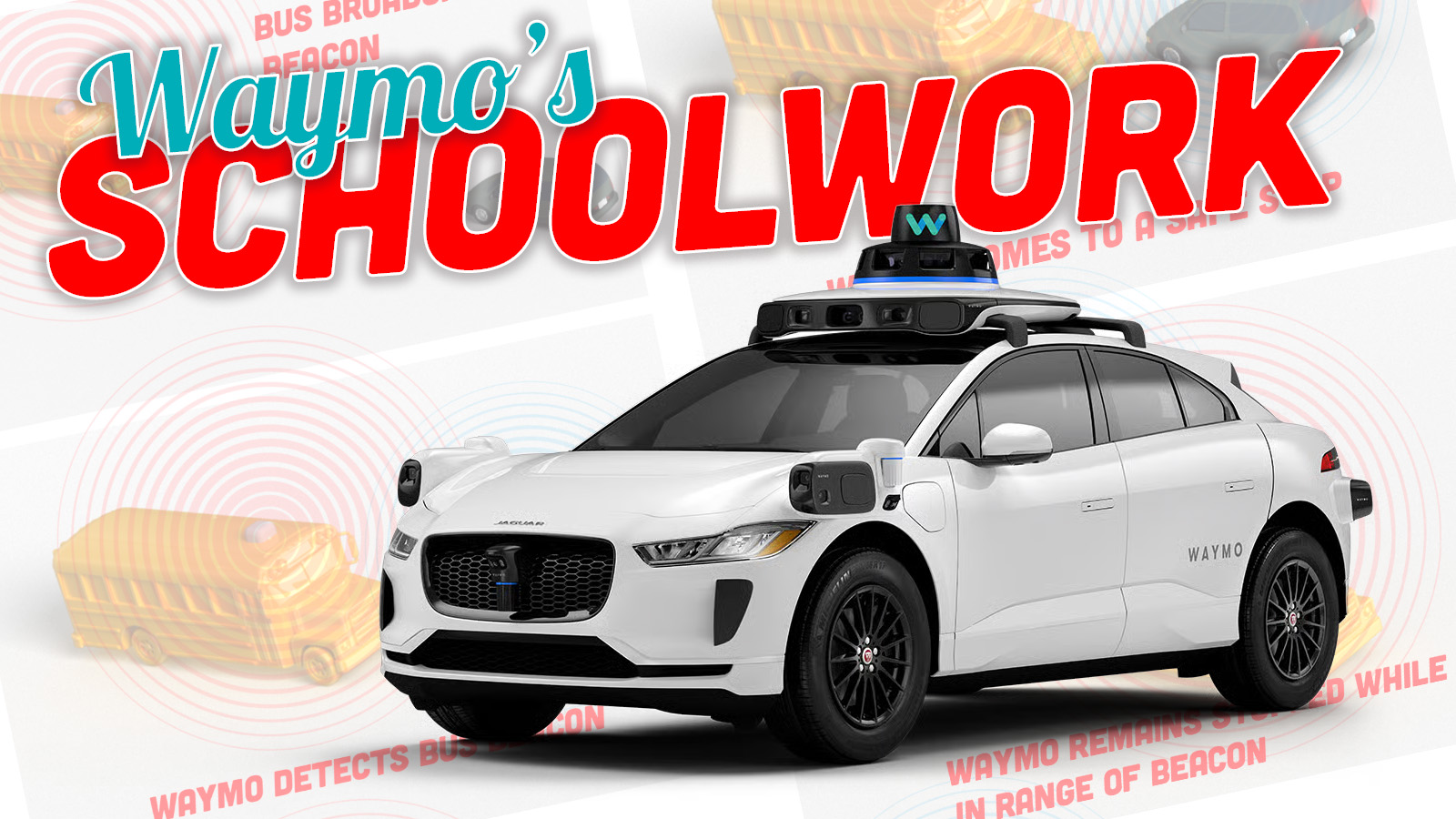
Remember when there were all those reports of Waymo automated robotaxis getting confused by school buses, possibly the most consistent and distinct – both visually and regarding the sorts of behaviors demanded by them – categories of common vehicle on the roads? Sure you do. We covered some of these incidents, but there have been a surprising number of similar events, especially in Austin, Texas. There’s an NHTSA investigation pending about Waymo’s school bus-related difficulties, and Waymo has attempted to fix the issue on two occasions, but so far it doesn’t appear that any significant improvements have happened.
The most recently recorded/documented event of a Waymo robotaxi was from January of this year, in Austin, and that’s on the heels of 24 instances where the Austin Independent School District’s buses own cameras have recorded Waymo vehicles driving past them while the flashing lights and the stop arm were deployed, the sort of driving violation that would be a serious offense for a human driver. In a number of the videos, children can be seen walking on the road, either entering or exiting the bus.


Austin Police Assistant Chief Travis Pickford noted to local Austin news station KXAN in January that, when it comes to humans making similar driving violations compared to the Waymo automated vehicles,
“The data we collected from the beginning of the school year to the end of the semester shows that about 98% of people that receive one violation do not receive another. That tells us that the person is learning but it does not appear the Waymo automated driver system is learning through its software updates, its recall, what have you, because we are still having violations all the way up until last Monday.”
So, the Waymo vehicles do not seem to be learning from their mistakes. In fact, a letter from the Austin Independent School District notes five events that happened after a software fix was deployed by Waymo. The district has requested that Waymo vehicles simply cease operating in the hours when school buses will be making their rounds, but Waymo declined to do that. Still, I do believe it is entirely Waymo’s responsibility to solve this issue immediately if they wish to continue operating in cities that also have school buses.
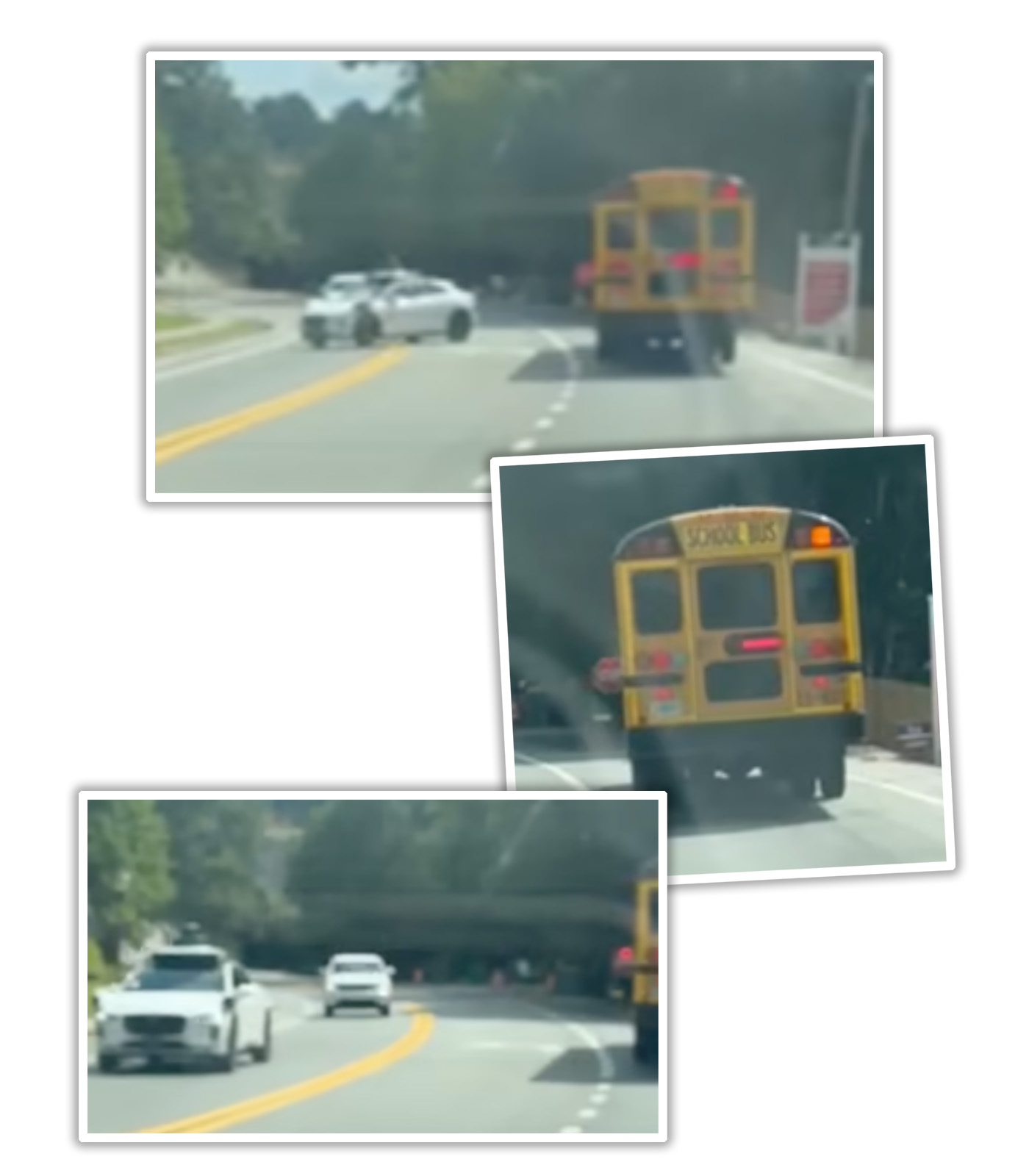
I don’t see any reason why anyone should be hesitant about this. It’s Waymo’s problem, not the problem of the cities they operate in, their school systems, bus drivers, or students. Just like with a human driver, it’s up to Waymo to take action to insure these sorts of potentially dangerous incidents stop happening. If Waymo’s software is unable to solve this problem – a problem that involves children walking on the road surrounded by cars, it’s worth remembering, and a situation that is, let’s be honest here, one of the most clear-cut and obvious common driving situations a human or robot can encounter – then other means must be taken to solve it.
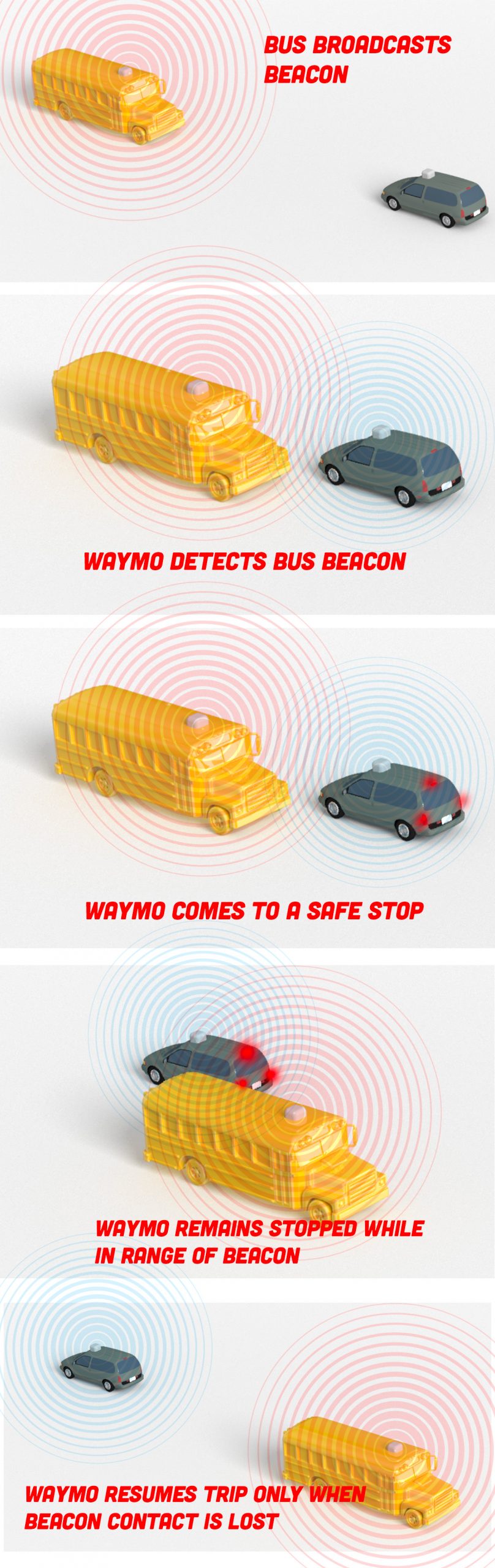
So I have an idea. Maybe not the most sophisticated idea, but maybe something that can get us thinking. Waymo has already demonstrated that a software fix alone is, at best, difficult, and not a solved problem. Okay, fine. Then maybe we need to add a little bit of hardware into the mix. What if we equip all active school buses with some manner of “beacon,” a device that broadcasts a short-range wireless signal – it could even be a Bluetooth-type signal, since I just learned that it’s possible to broadcast those with a range of about a kilometer, which would be plenty.
When a Waymo approaches a bus close enough to “hear” the beacon that gets activated when a school bus is approaching a stop, not all the time, of course – and the distance would be calibrated to approach what would be an ideal distance for someone to interact with a school bus, I’m not sure what that is, but maybe it’s, say, 300 feet? I don’t know, but someone will. Anyway when that happens, the Waymo will come to a careful stop, turn on its hazard lights and do nothing until the bus leaves, and its beacon signal is no longer received.
Once the bus is gone, the Waymo resumes normal operation. That’s it. Just keep it simple: school bus signal heard, stop and wait, school bus signal gone, continue. There’s no special coding beyond a very basic conditional, which I’ll rough out in the language I assume Waymo uses, circa 1983 Applesoft-like BASIC:
10 IF BEACON="ON" THEN GOTO 30

20 IF BEACON="OFF" THEN GOTO 40

30 STOP DRIVING

40 KEEP ON DRIVING

50 GOTO 10
See? Easy. And Waymo should pay for every now-nonexistent penny that this project would require: designing the broadcast hardware for the buses and the receiver for the car, adapting their software to use the receiver and act accordingly, installation of the hardware on the buses, and so on. This is Waymo’s problem, not anyone else’s and if they want to keep sharing the road with school buses and kids, then they need to actively do something to make sure their vehicles are capable of sharing those roads, which, as of this writing, they do not appear to be.
School buses are not exotic edge cases. They’re part of the everyday landscape of the road. Waymo needs to address this issue and solve it in a simple, straightforward, and obvious way. If they want to keep developing software fixes, great. But they need something more fault-tolerant, something so basic and simple it simply can’t fail. A system where the buses make their presence unquestionably known to the Waymo robotaxis would work, as long as the robotaxi has no ability to ignore the signal and behave accordingly.
It’s not ideal for Waymo, and it’ll cost them some money, but I don’t care. Unless you work for Waymo, you shouldn’t care, either. That’s just the cost of doing business, and if Waymo doesn’t want to fix this issue, they are free to pause operations until they’re ready.
We’ll wait.


Shouldn’t you have a line “35 GOTO 10”?
Otherwise you go straight from line 30 to line 40 and start driving again immediately after coming to a stop.
Rf does seem like a simple solution. Especially as cheap as they have gotten. Some of the busses have hot spots now I believe Google was paying for some at somepoint. Allowing kids to do their work on Chromebooks. Becons from those hotspot could also be used.
I do question if the thing can see railroad crossing signs. Also many busses have a white beacon light on top maybe they could use that in some way.
is that a mercury villager/nissan quest waymo? if so thank you, i love it, it has brightened my day
if not that’s fine you can’t stop me from pretending it is
Think it’s a Jag i-Pace. Thanks for playing.
i’m quite clearly referring to the illustrations with the bus at the bottom of the article
Ohh – Ford Windstar.
I’m no Luddite, but I’m not an early adopter of tech either. I like tech that just WORKS and and actually HELPS ME. I’m utterly baffled by appliances connected to the “internet of things”. WHY?!? I open my fridge daily and can see if I need milk!!! If I do laundry, I still have to manually move the stuff, add soap and empty the lint trap. I have about the simplest old-school washer and dryer on the market. And they work, every single damn day. If they don’t, I can usually fix in an hour and one run to the appliance parts store. I run a normal digital thermostat with a timer (that I don’t use). It costs me less to hold a steady temp than yo-yo multiple times a day. I loathe Rolls Royce solutions to Chevrolet problems.
I feel for those that spent thousands fully wiring their homes with Cat5 and fiber in the ’00s; only for WiFi to become prominant a decade later. My dad just ran a single Cat5 wire outside from a basement window to an upstairs bedroom window. It has since been removed…
Ok, I’ll stop yelling at the clouds if you get off my lawn.
NoMo.
“GOTO considered harmful” – N. Wirth, 1987
🙂
A human driver would lose their licence after repeated school bus violations.
What happens to humans who violate these laws repeatedly? They lose their licenses and eventually will end up in jail. Do the same to Waymo – if they do it more than once, remove their permission to operate. If they keep doing it, shut them down and/or charge their board with crimes.
There should be a law where any traffic violations are charged directly to the CEO as if they were the driver. All the problems would be solved, easy peasy!