

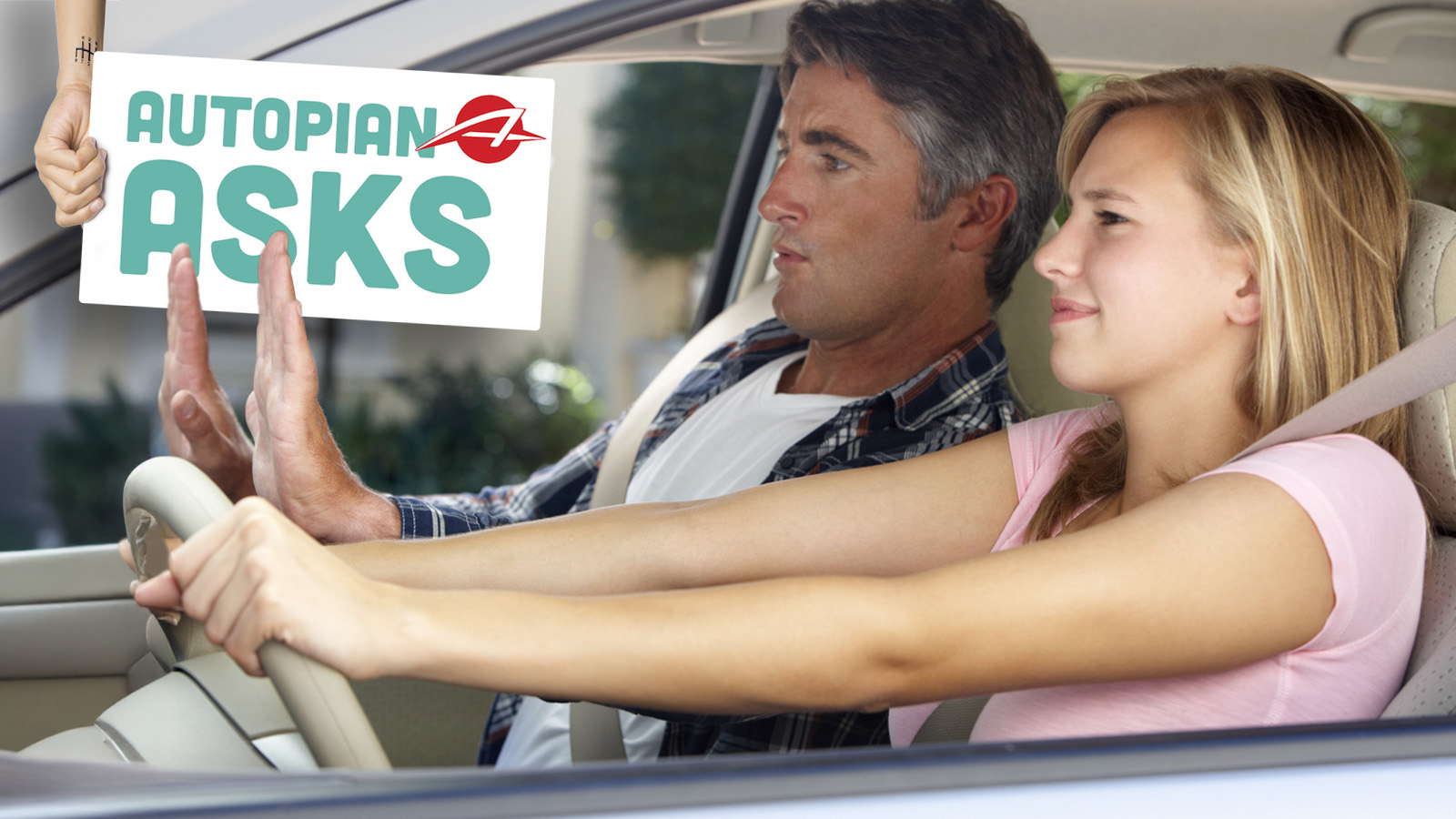
My niece has reached driving age, and honestly, it’s so exciting. Weirdly, perhaps the most surprising part is that she’s into it; a lot of today’s teens don’t really care about driving and don’t really want to get good at it, either. Thankfully, both her dad and her aunt (me) are car fanatics. This means the poor kid is bombarded with advice.
I feel like I have four favorite tips that I like to give to new drivers, regardless of age.


My first, and perhaps my favorite bit of advice, is to look farther than your vehicle’s hood. It sounds silly, but a lot of folks don’t really look ahead and only look at what’s going on directly in front of their bumper. This is risky because conditions can change ahead of your vehicle, and you want to be aware of your surroundings so you can react to them. An overloaded truck that might spill an end table onto the highway, a bicyclist who might swerve unexpectedly, an Altima that might suddenly Altima … the sooner you spot these things, the more time you have to anticipate what might happen, and the more prepared you’ll be to react.
With that in mind, I think it’s also important to have an escape plan. By this, I mean you should scan your surroundings for hazards and places to go if conditions go downhill. Is there sufficient room to change lanes? Is the shoulder safe to enter if needed? A good driver is always ready to X when Y happens, if it happens.
My last two pieces of advice are tied together. I’ve noticed some self-taught drivers develop bad habits, primarily inconsistent speed (instead of holding, say, 50mph, they accelerate to 50, let off the gas and drift down to 40mph, then surge back to 50, and repeat) and braking with their left foot. The latter makes it easy to accidentally confuse the pedals and cause an accident, and the former wastes fuel and may give passengers seasickness.
[Ed note: I once had a ride home in a Town Car from a driver who was not only unable to maintain speed as Mercedes describes, but he couldn’t hold a line, either; he constantly drifted out of lane and corrected, and on/off ramps were navigated by tugging the wheel to direct the car away from the outside barrier, letting the car get close to it again, and re-tugging. Instead of maintaining a constant radius, an off-ramp might be twenty straight-line facets, with the Town Car wallowing like a rowboat the entire time. I have never been so nauseous in my life. – Pete]
Admittedly, my lovely wife pumped her gas pedal a lot when I met her. I remembered myself feeling sick and not knowing why. Then, I saw that the engine revs were constantly going up and down – the car had a CVT – and then looked at the gas pedal. Then, we watched a marathon of Canada’s Worst Driver (an episode is embedded above), and, amazingly, it made a night-and-day difference. Honestly, if you’ve never seen Canada’s Worst Driver before, I highly recommend it. The show is great edu-tainment.
Those are just the pieces of advice at the top of my head. How about you? What would you teach a new driver?
Top graphic image: DepositPhotos.com



Get in the habit of using your turn signals every time you should be using them and double checking your lights are on when they should be (rain, snow, etc), not just when getting dark.
From most to least important:
– It’s not personal, even if some people act like it is.
– On multilane roads, stay out of blind spots. If possible give ’em room to swerve into your lane.
– When you come to a stop, ease off the brake at the last moment to soften the suspension rebound. (Do people call this the “limousine stop”?)
– When you’re stopped, watch through the car in front of you for the brake lights of the car in front of them, and let off the brake when they do. Be ready to stomp those brakes again if the idiot in front of you doesn’t notice though.
– Assume any merge should be a zipper merge, also assume everyone else is going to be an ass about it anyway.
Also – don’t be a traffic vigilante in a zipper merge (alternatively stated – some jerks are going to go as far as they can in a lane they know to be closing, going right past everyone that’s waiting patiently. Don’t stick your car partially or fully into that lane in an effort to force them to wait). It’ll make you liable for any accident (I swear, officer, I was just driving along, obeying all applicable signs and laws, when this person pulled into my lane unexpectedly!!).
Yes, their behavior sucks. But understand that they’re being an ass and you don’t have to take part.
Yeah, there’s a balance between “use all the lane and merge at the absolute last minute” vs. “merge as early as possible and STAY IN LINE” and like Joe Bob Briggs I lean toward “use all the lane” while trying not to be a dick about it.
Corollary: use the on-ramp to get up to speed, not the freeway after you merge. Being timid and running out of ramp and having to merge at 40mph is dangerous.
You would think drivers would remember after a few hundred times but noooo…
There’s also a difference between using the full lane in light or moderate congestion and using the full lane when there’s a half mile of traffic at a dead stop. It’s like roundabouts – I know in theory using the full lane is better than the alternative, but the way people execute it (at least, where I live) makes it feel much worse.
Either way, blocking a lane with your car is the wrong thing to do.
I’ve been know to simply pretend the person trying not to be late for the hearing deciding child custody or their kids birthday party, or needing to get to the hospital ASAP.
Years ago I used to get pissed at drivers like that. The years have taught me there’s no need for bent sheet metal, and you have no idea what might be going on in someone else’s life.
And even if they are just being an ass, Ishkabibbel, I love your insight about not having to participate. Brilliant.
Wait, isn’t the entire point of a zipper merge that both lanes go as far as they can and then only at the bottleneck point merge like an actual zipper, ie alternating one car from each lane?
If you ask me, it’s the people NOT using the entire lane who are doing it wrong and slowing everyone down as a result.
I’ve done the let up on the brake at the end of a stop for 50 years, but modern cars, particularly DSG/DCT transmissions are not always cooperative. The car may surge forward as you lessen pressure on the pedal. It was certainly a lot easier with a manual transmission.
Assume that every other driver is an idiot and will do something stupid, drive defensively and don’t tailgate. Learn to use your mirrors and don’t rely on the backup camera only.
Lots of good stuff here. . .if I was going to add anything, I might add this:
When the snow starts flying, test the road at low speed to see how slippery it is. As I start out, I like to touch the brakes hard at the first slow stop. Do I slide, and how much? How much power can I use to get going again? Not all snows are the same. Some are really slippery and greasy, others light and fluffy and forgiving.
Also, take your teen driver to an empty parking lot and let them play in the snow. It may save them someday. And, it can be kinda fun.
I suggest a parking lot without light poles. Just saying
Great advice – I’d reinforce the importance of choosing a safe place when testing traction. When I was a freshly minted driver, going to work in a fresh, unpacked snow, I tested my traction by giving the steering a slow, gentle wiggle while at the top of a long hill. Despite low speed, that wiggle served only to break traction and the car proceeded to slide while turning, ever so slowly, maintaining the forward momentum I had at the top of the hill. Mercifully it slid in a straight line down the hill, by the time I reached the bottom I was perpendicular to the road and I came to a stop when my front tires finally exited the road surface on the opposing side. There was a tree-filled ditch on my side of the road, and had there been traffic I would have hit any oncoming car(s) with the passenger side of my car. I was extremely fortunate and the only damage was to my underwear.
I still employ the traction test, but I try the brakes first and I choose the circumstances carefully (bottom of a hill, no oncoming traffic or turns, empty intersection, etc) to minimize risk should the test reveal extremely low traction.
A better way to test traction is to accelerate vigorously (and very briefly). If it is slippery, the drive tires will break traction and the smart driver will immediately let off the skinny pedal and the car will snap back into line (mustang drivers would do well to remember this).
Don’t speed.
Put down your fucking phone
I’ll be teaching one new driver in less than two months and another in about 2 years.
Tip 1- Stay cool. You are going to encounter drivers with aggressive or annoying habits. Don’t let them distract you, and never try to retaliate. Remember that you may never even see this person again and that you can’t know who has a gun.
Tip 2- Put the phone down. Humans really aren’t great at multitasking. Don’t get into the habit of letting something that can wait until after you stop become a distraction while you drive.
Tip 3- Ride the coast-er. Coasting to a stop when you can is better for your fuel mileage and your brakes. It also gives the distracted driver behind you more time to react sp they hopefully don’t rear-end you.
One slight addition to Tip 3- I suggest gentle pressure on the brakes when coasting to a stop, so the person behind sees the brake lights come on. I love coasting and I can’t count the number of times the person behind me doesn’t realize I’m slowing down.
I had a new driver (friend’s son) in the car recently and he was left foot braking, with all the attendant stops/starts/uncertainty one would expect. I immediately told him to plant his left foot on the dead pedal and not to move it. His driving quickly improved. Is this something that kids are taught in Driver’s Ed now? If so, WHY??
Agree – I ride, and motorcycles need much less stopping distance than cars, so even though I’ll almost come to a stop on my own, I’ll still trail the brake(s) to provide a little more visual signal. And when stopped and see someone coming up on me, I’ll flash the brakes just to be sure they see me.
When I used to ride I learned not to tailgate. When the idiot in front of me stomps on the brake and the idiot tailgating me doesn’t notice, I need space and time to stop without getting hit.
I actually started doing the flash in the last couple years, thanks to someone here on the site (maybe you?)!
This reminds me not every suggestion is usable in every situation. What works in one situation might be dangerous in another. Sometimes you need to speed up, sometimes you need to slow down. And make sure you need to hit the brakes before hitting the brake.
In addition to what everyone else has said, I’d add:
If you’re the first car in a line at a red light, and it goes green, wait a second before proceeding: where I live, it’s quite likely that someone will run the light on the cross street, and they’ll be going extra-fast when they do it because they will be trying to beat the very last photon to come from the green light in their direction.
On the freeway, watch not just the car in front of you, but also the car in front of that one.
In modern cars with thick A-pillars, move your head a little to make double-sure there aren’t any pedestrians in the blind spot when you start moving after pausing at a stop sign.
Huge upvote for #2. And I’d add you can even help people with their plans. Say if someone is trying to merge, you can make or maintain distance for them. They made it safely? 200 points for you!
Remember that your driving licence is a privilege, not a right.
And understand that your driving licence is freedom, independence, flexibility.
With a driving licence (and a car) you can go exactly where you want, exactly when you want, and with whoever you want (or alone, if you want)
And with your licence comes rules. Break those rules and you may (and should) lose it. Then you’ll be back to taking the bus.
Drive for yourself, and for others.
Example if you think that car nosing out from the upcoming side street may pull out in front of you, then assume he will and plan accordingly.
Slow down,be patient,and keep your distance.
I’ll add another: Don’t drive with less than half a tank of gas, especially for road trips and or in the snow. Sometimes the gas station you were planning on going to is out of commission for some reason, or in the snow there’s a non zero chance you will get stuck and need to have enough gas to run the heat all night.
In such a situation make sure to dig out around your tailpipe so you don’t die of Carbon Monoxide poisoning. I’d also keep some bottles of water, snacks, and tons of quality blankets in the trunk. A winter sleeping bag for each passenger can also do the trick.
Also having half a tank of gas when you want to fill up allows you to skip sketchy gas stations when on road trips and or in areas new to you. You’d be surprised how many bad situations you can avoid by avoiding sketchy places.
Question: will you allow a concession for cat-pee’d on car covers in a pinch?
I’ll add a few more:
#1. never drive if under the influence ( call your dad. Really. he’ll pick you up or pay for the Uber, no questions asked and won’t tell mom! At least not the first time)
Be patient! Chill out and wait instead of doing something stupid like trying to do a bad pass or pull out on someone.
Use your eyes not just your mirrors
and/cameras. turn your head and look before lane changing and backing out.
This is one I so heinously obliterated back in the ’80s. “Road Sodas” after work, on the way to the bars, on the way home from the bars. It was terrible, and a lot of people were doing it, especially when a bar beer was 3 or 4 bucks (plus tip) and a six-pack from a liquor store was $1.25.
I read recently that the entire alcohol industry is down due to people just not drinking as much. Maybe this isn’t the worst thing that could happen.
Learn to set your mirrors, and then use them! Don’t completely rely on the backup camera.
If someone is waiting to pull out into the road that you’re on, watch the front wheel of the other car: it’s easier to determine whether that person is stopped, is rolling forward slowly, or has actually started to pull out.
Never let the fuel tank be less than 25% full.
Replace your wiper blades *before* they fail.
Use the non-freezing / low-temperature version of windshield washer fluid during the cold months. Use the better bug+sap washer stuff during warmer months. The basic blue water generally isn’t super helpful.
+1 assume everyone else is an idiot.
+1 leave yourself an out / be aware of everything surrounding you as you drive.
I’ll add another.
Check twice for motorbikes before you pull out onto the road.
And of course, avoid the classic blunder; Never get involved in a land war in Asia.
Or South America.
We’ve learned that lesson and now exclusively bomb boats at sea off south American coasts.
Mindset is paramount. Embrace discomfort. You control your destiny You are stronger than you think. You are unstoppable. Make everyone else suffer now and live the rest of your life as a champion.
Say it with me…
“BIG! ALTIMA! ENEEEEERRRRGGGGYYYYY!”
My advice to the woman in the article lead photo is to move her seat up or the steering wheel back. Arms straight out like that means she doesn’t have good control of the wheel.
The classic piece of advice I would give to a new driver is to always be able to see the back wheels of the vehicle in front of you – if you can’t, you’re too close. (This is obviously not for driving at speed, but more city driving.
“Assume everybody between the sidewalks is an idiot.”
It was a simple one-liner that emphasizes paying attention.
Someone near the edge of the road looking to cross? They might not wait for the walk sign. The person in the lane next to you? They might change lanes without checking their mirrors. Maybe they’ll run a red light, maybe they’ll get distracted by their phone, maybe they’ll check their GPS too late right before the turn. Don’t just assume everybody will do the smart/safe thing. Keep an eye on your surroundings. Do this and you can avoid or at least anticipate a lot of unsafe moments.
Glad I’m not the only one. By the time I clicked post, this was the third of a total of six comments with essentially the same advice! Watch out for those morons!
> Assume everybody between the sidewalks is an idiot
And yes, that includes you (the driver, not That One Guy (except when he’s driving, in which case the rule obtains)).
Assume every other driver is ignorant, arrogant, clueless, selfish, and distracted.
When driving in slippery conditions remember the Rule of 3
You do 3 things when Driving
Accelerating
Braking
And Turning
The Rule of 3 is you’re only allowed to do one at a time when driving in slippery conditions.
So no accelerating while turning, and no braking while turning. There are obvious exceptions of course like when you’re turning from a stop light or stop sign, but whenever possible you follow the rule of 3 in slippery and or wet conditions.
Also in generally it helps to not be in a rush, being in a rush has killed a lot of people.
Edit: Also I’d highly recommend she take one of those teen driving courses they host at race tracks, my dad did the same for me when I was a teen and I got a lot more confidence in my driving ability and a much better understanding of my car.
Also if you can’t afford quality tires you can’t afford a car.
Well done! I never thought of it this way, but it’s exactly what I do.
Most people who drive in slippery conditions often enough learn it inherently, I was lucky enough that my dad knew how to explain it to me in an easy way to understand. It still took a bit of learning on my part, but that simple explanation did most of the legwork for me.
I was going to say the driving course at the track, whether for teens (which tend to include more vehicle knowledge/maintenance info) or otherwise. Getting to feel what it’s like to brake at the limit, break traction, and so on has served me very, very well after being gifted one of these courses when I was 17.
Glad to hear I’m not the only one here who took one of these courses as a teen!
Calm down. And let it go.
No one wins when someone gets upset and makes it personal.
I tell all my Nieces and Nephews who are learning to drive the same thing: Just assume other drivers are about to do something incredibly stupid at any given time.
Do not use your phone.Learn your way around without navigation.Take defensive driving course(s).Know the limits and capabilities of your vehicle.ALWAYS adjust your driving to weather conditions/situations.Humility, you are not as good of a driver as you think you are.Situational awareness!!!!!!!!
Knowing where north is (or your favorite of the other three directions) at all times, or being able to figure it out from the terrain (e.g. the ocean is west almost everywhere in California) is surprisingly useful, e.g. if you miss your exit or there’s an unexpected closure.