

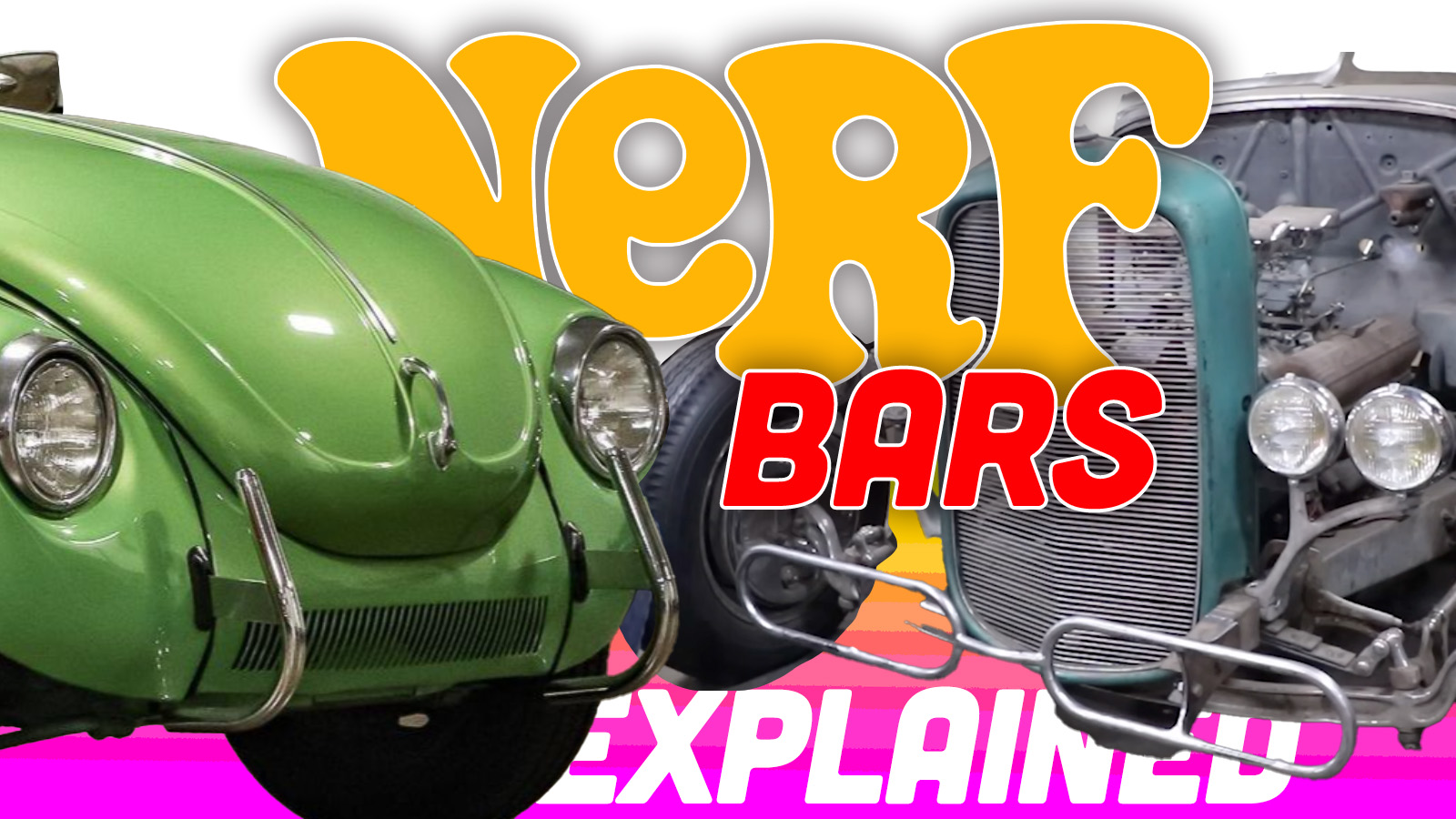
I first encountered nerf bars, like most of us, as a child. I remember seeing them on otherwise bumperless Volkswagen Beetles, a pair of jaunty angled bars that seemed to offer, at best, symbolic protection in case of a wreck. But they did look oddly cool, and later, when the JC Whitney catalogs started to populate my mailbox with a near crabgrass-like determination, I learned the name for these peculiar bumper-replacements: nerf bars.
Of course, to my young mind, the name nerf conjured up images of squishy footballs and squishy three-lobed boomerangs and satisfyingly squishable spheres of brightly-colored foam. Of course that nerf is a different nerf, a trademarked Nerf™, and while the name comes from nerf bars – I’ll get into that more in just a bit – Nerf also made up a sort-of-backronym for the name: “Non-Expanding Recreational Foam.”


So the squishy Nerf toys get their name from nerf bars, the ones found on cars, so let’s get into what those are in a bit more detail. Here’s an example of the first ones I encountered, in the context that I saw them the most often: a JC Whitney catalog:
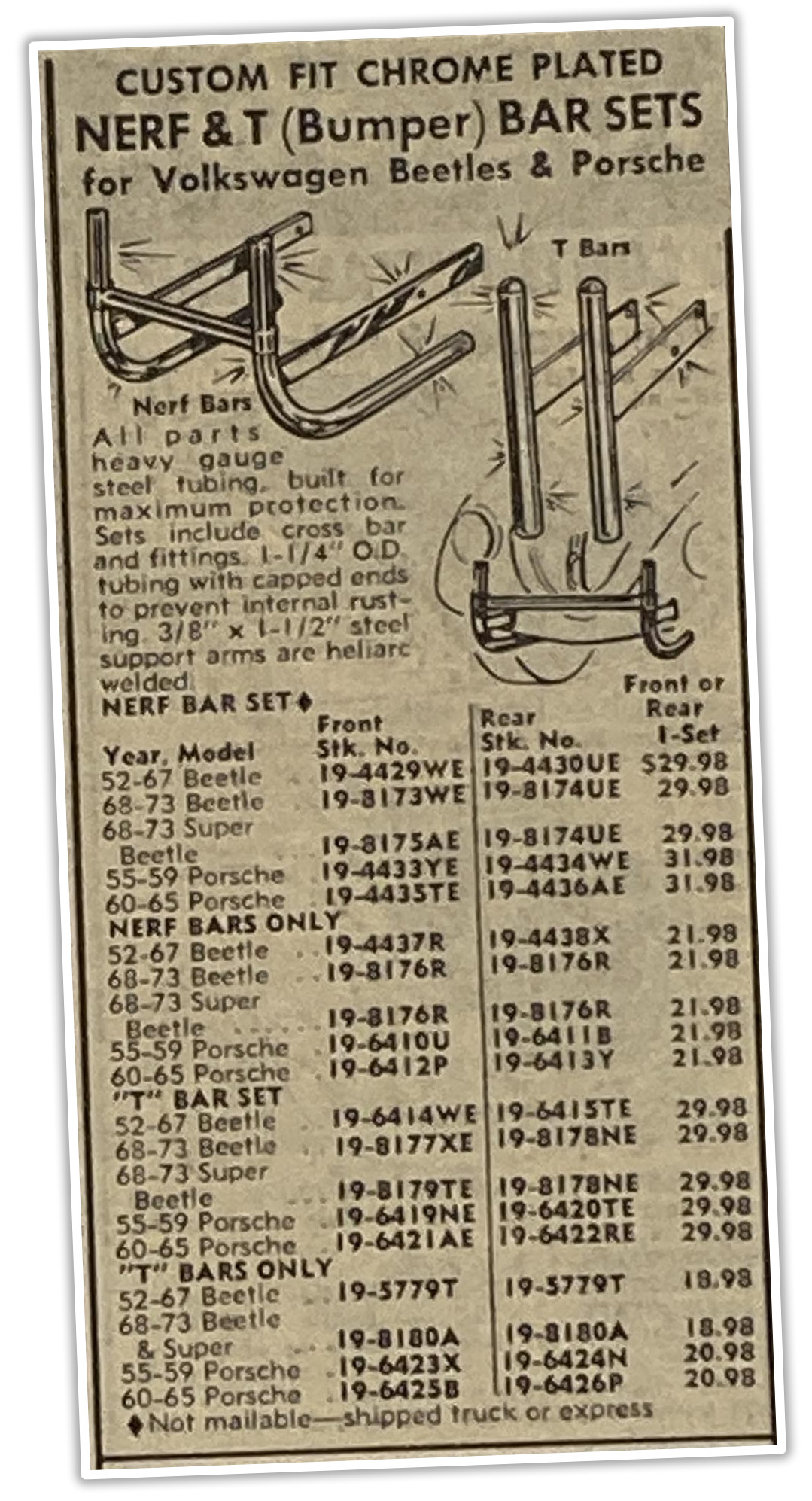
I see there’s a distinction made there between the somewhat more protective nerf bars and the more minimal T-bars, but for the most part, both were in the category of nerf bars. But, when it comes to categories, nerf bars themselves did have three main sub-categories.
The ones most commonly encountered on the street were part of the Hot Rod Nerf Bar sub-class. These were usually chromed bars and tubes, offering some protection but usually more for looks.
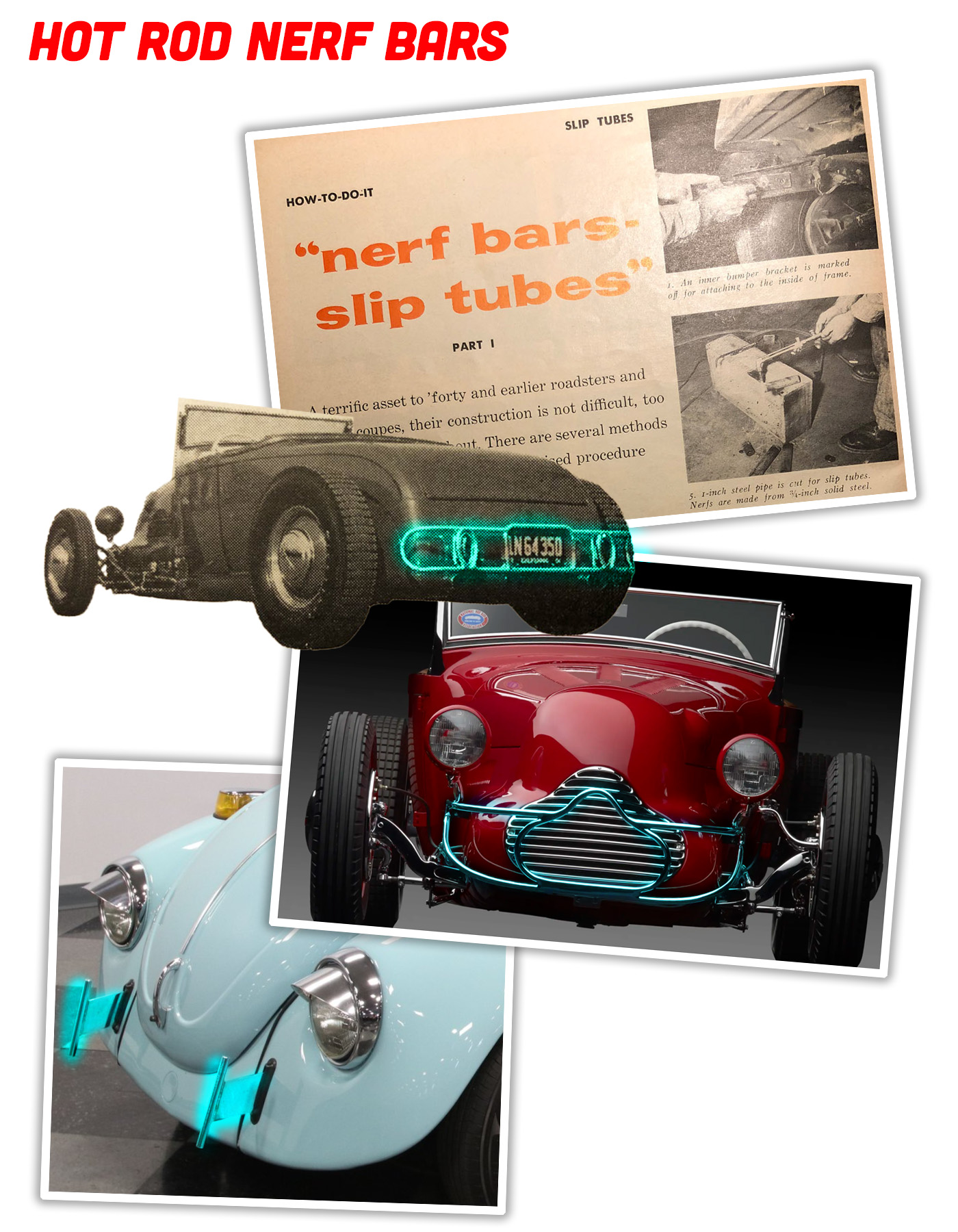
Interestingly, these chromed nerf bars go way back, and have some interesting pedigree; that scan of that article up there of how to make nerf bars is from the May 1955 issue of Hot Rod, scanned and put online on the Jalopy Journal. That article was written by none other than the famous/infamous customizer George Barris!
Nerf bars of similar chromed looks but more robust and complex construction were also seen on race cars, perhaps most noticeably on the “midget” race cars that began in the 1930s, featuring fast and tiny race cars.
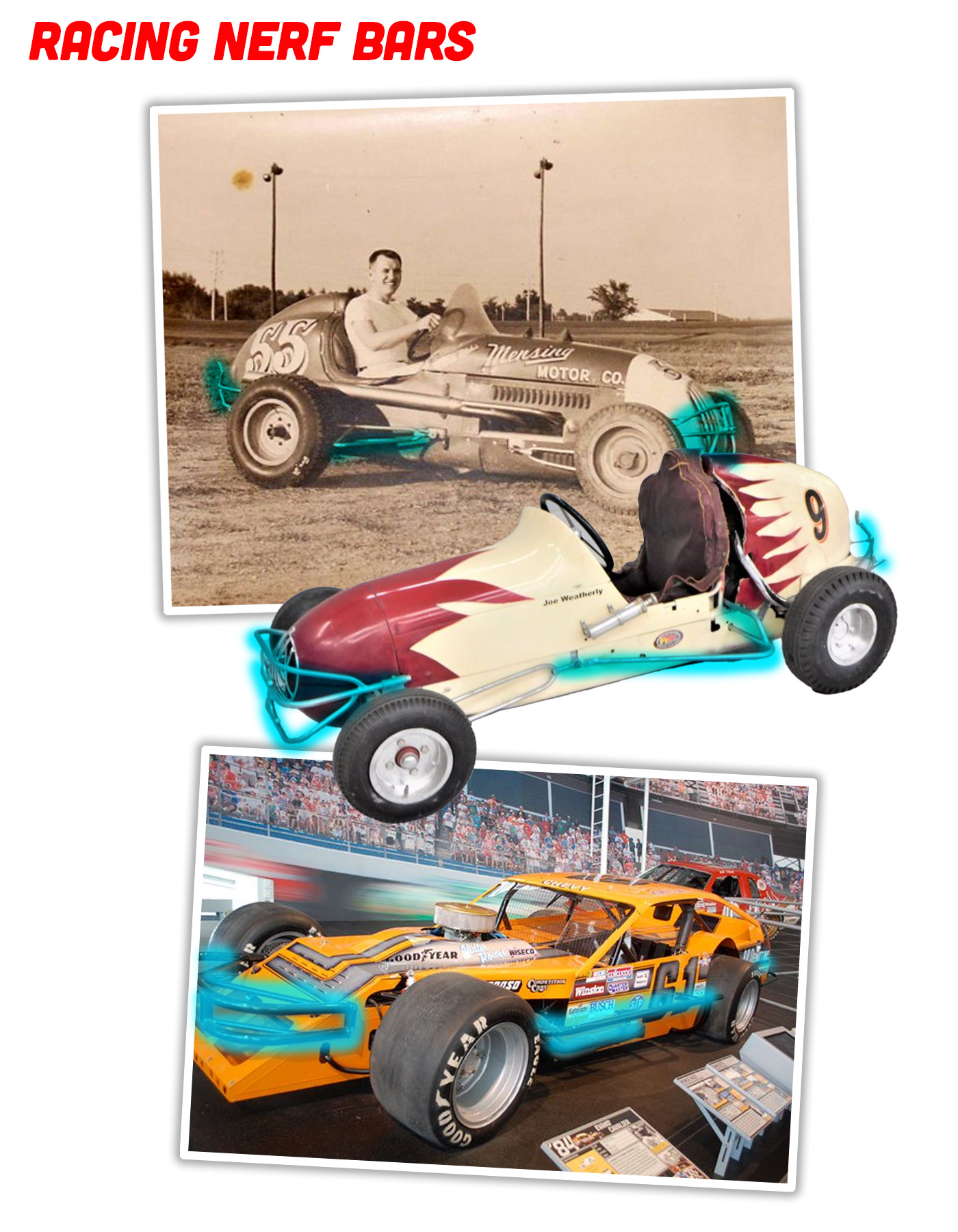
On race cars, the bars were for pretty much what you’d think they’re for: to offer some protection from when race cars made contact with one another, intentionally or not, a process known as “nerfing.”
And, here we get to the etymology of the term “nerf bars.” The use of “nerf” as a verb for making contact with another car had been around since the early 1950s, and usually had a connotation of an intentional contact, intended to push another car out of the way or knock it off course/balance.
Nerf bars, then, became protective elements used for either offense or defense, depending on location. Front-mounted nerf bars were for pushing/nerfing, and the ones on the sides and rear were to protect the car, and especially to deflect impacts from tires contacting one another, which could cause a real loss of control and, from there, big trouble.
Some have suggested the word nerf has origins in the French word nerf, which means either a nerve or a more general sort of nerve/guts/chutzpah kind of thing. I suppose that’s possible, as it takes chutzpah to drive your car right into another car to get some kind of advantage, but I’m not really sure how many francophiles were part of the 1950s hot rodding scene. I mean, maybe there were a bunch?

Nerf bars are also used on off-road vehicles, where they tend to be much beefier and less likely to be chromed. They tend to be tubular protective bars and often double as side steps on many off-road-focused vehicles.
That top picture of me standing on a Mahindra Thar I included to show which bars of that big cage setup I think qualify as nerf bars. The ones that are sort of roll bars don’t; nerf bars aren’t about protecting in a rollover, but more about deflecting outside impacts, from other vehicles or terrain.
I hope this clears some things up: nerfing is to hit/contact another car, nerf bars protect from such impacts, and Nerf the toy was named for these nerf bars, not the other way around.
Glad we got that sorted.




I’m not convinced nerf bars aren’t totally useless in anything above a few mph impact.
honestly, before i skimmed this article, i was guessing that back in the days, people would hit shit and say “nerf!” and that became a nerf bar thing. A little disappointed that it’s completed not what I thought it would be.