

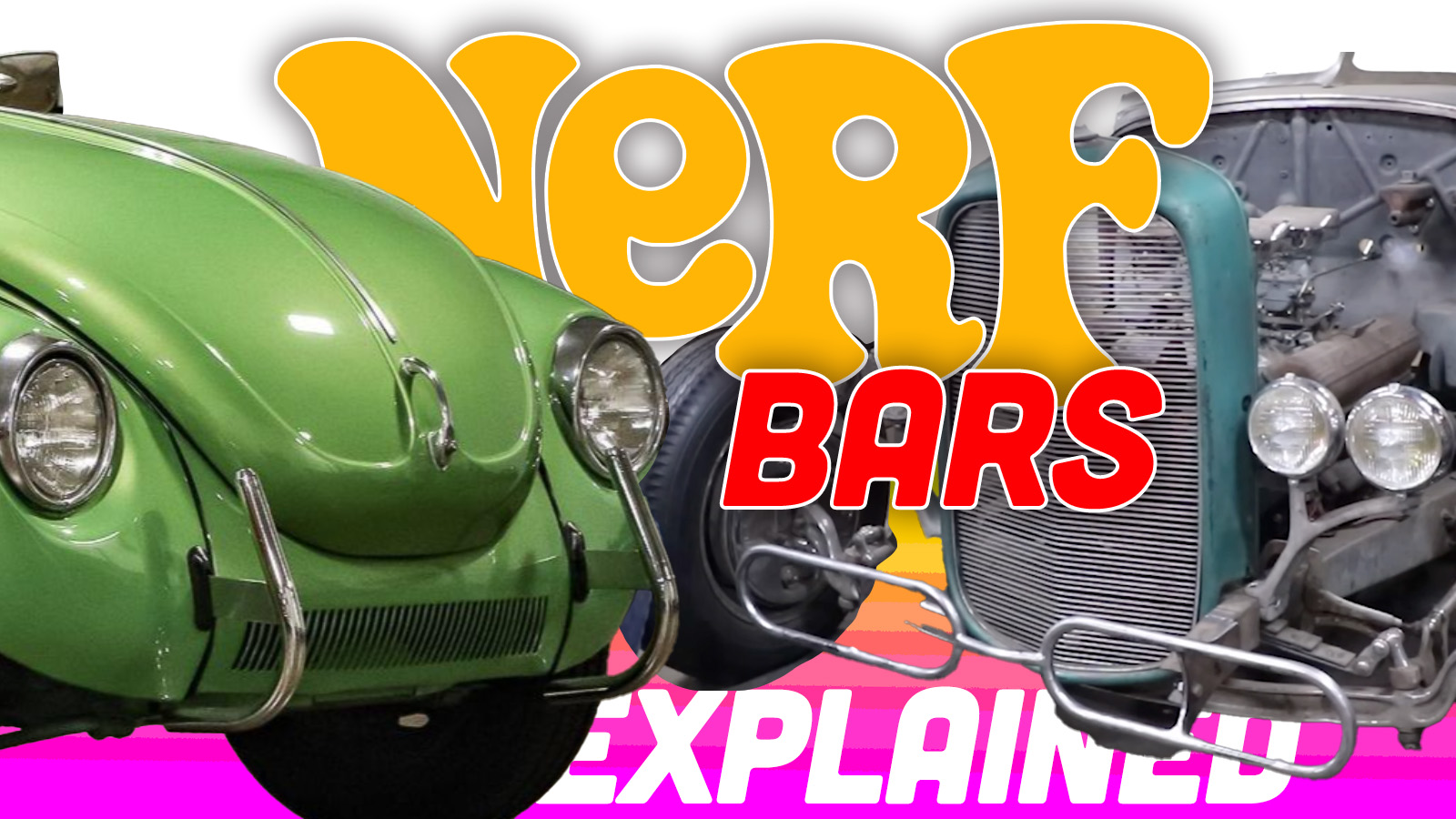
I first encountered nerf bars, like most of us, as a child. I remember seeing them on otherwise bumperless Volkswagen Beetles, a pair of jaunty angled bars that seemed to offer, at best, symbolic protection in case of a wreck. But they did look oddly cool, and later, when the JC Whitney catalogs started to populate my mailbox with a near crabgrass-like determination, I learned the name for these peculiar bumper-replacements: nerf bars.
Of course, to my young mind, the name nerf conjured up images of squishy footballs and squishy three-lobed boomerangs and satisfyingly squishable spheres of brightly-colored foam. Of course that nerf is a different nerf, a trademarked Nerf™, and while the name comes from nerf bars – I’ll get into that more in just a bit – Nerf also made up a sort-of-backronym for the name: “Non-Expanding Recreational Foam.”


So the squishy Nerf toys get their name from nerf bars, the ones found on cars, so let’s get into what those are in a bit more detail. Here’s an example of the first ones I encountered, in the context that I saw them the most often: a JC Whitney catalog:
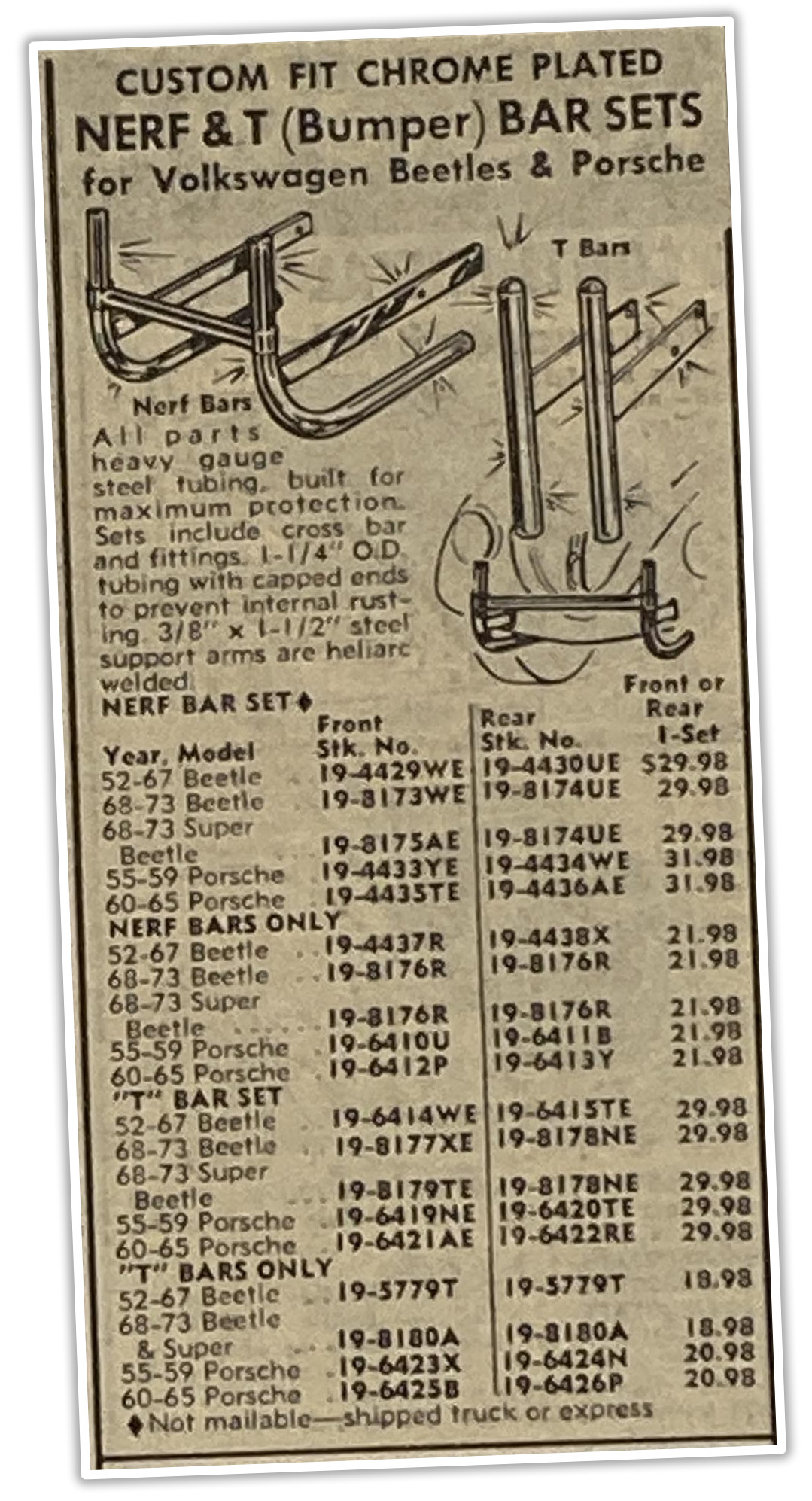
I see there’s a distinction made there between the somewhat more protective nerf bars and the more minimal T-bars, but for the most part, both were in the category of nerf bars. But, when it comes to categories, nerf bars themselves did have three main sub-categories.
The ones most commonly encountered on the street were part of the Hot Rod Nerf Bar sub-class. These were usually chromed bars and tubes, offering some protection but usually more for looks.
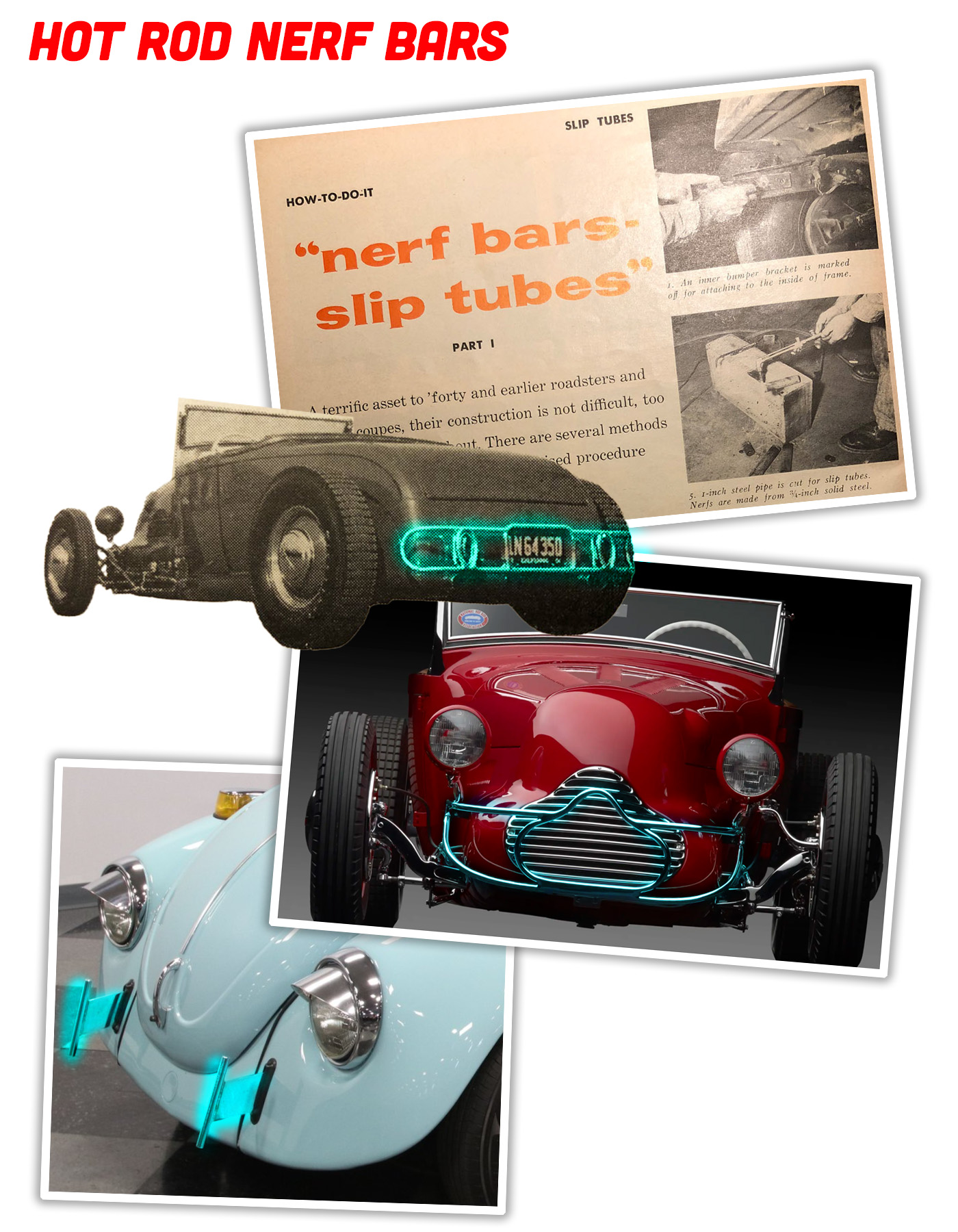
Interestingly, these chromed nerf bars go way back, and have some interesting pedigree; that scan of that article up there of how to make nerf bars is from the May 1955 issue of Hot Rod, scanned and put online on the Jalopy Journal. That article was written by none other than the famous/infamous customizer George Barris!
Nerf bars of similar chromed looks but more robust and complex construction were also seen on race cars, perhaps most noticeably on the “midget” race cars that began in the 1930s, featuring fast and tiny race cars.
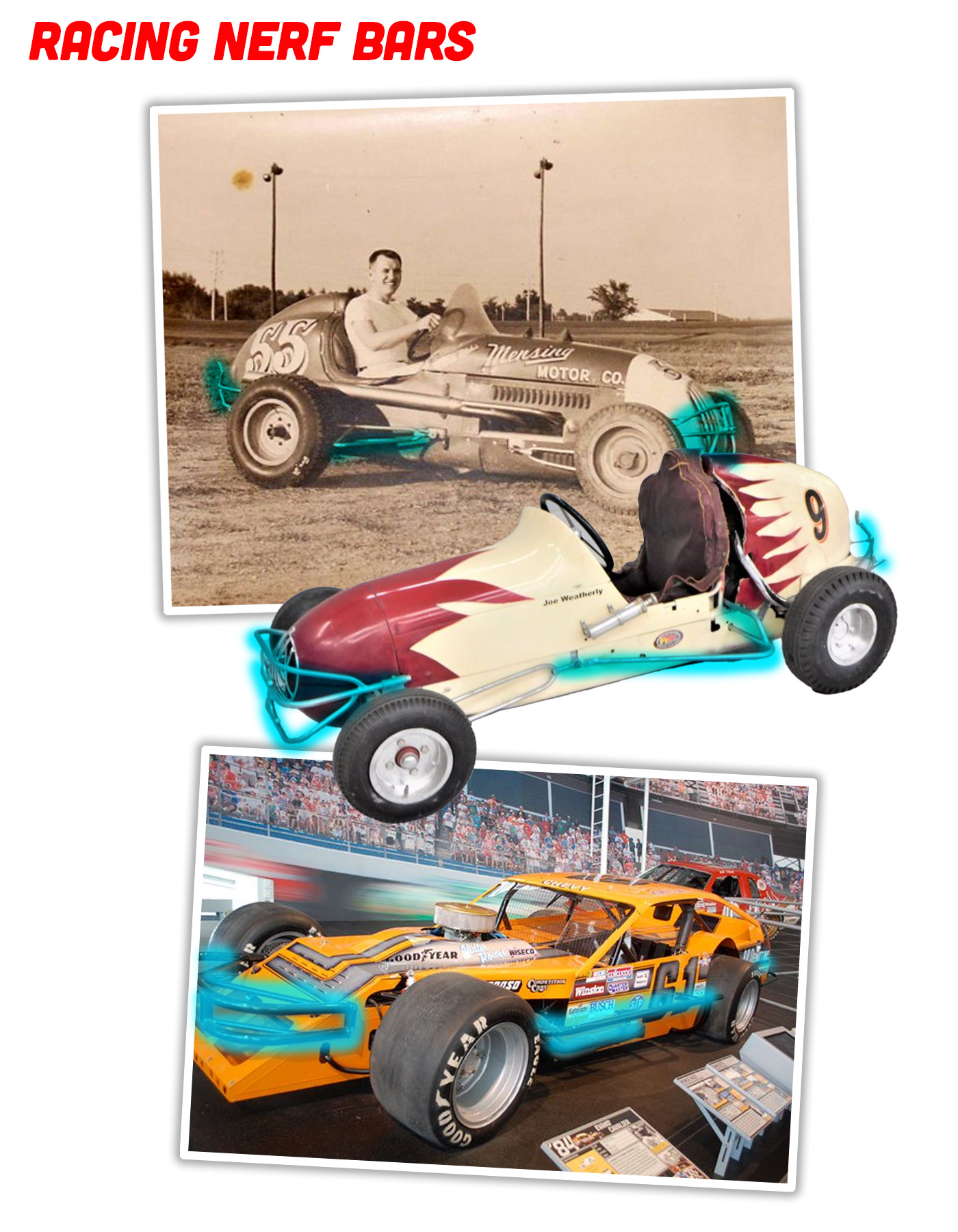
On race cars, the bars were for pretty much what you’d think they’re for: to offer some protection from when race cars made contact with one another, intentionally or not, a process known as “nerfing.”
And, here we get to the etymology of the term “nerf bars.” The use of “nerf” as a verb for making contact with another car had been around since the early 1950s, and usually had a connotation of an intentional contact, intended to push another car out of the way or knock it off course/balance.
Nerf bars, then, became protective elements used for either offense or defense, depending on location. Front-mounted nerf bars were for pushing/nerfing, and the ones on the sides and rear were to protect the car, and especially to deflect impacts from tires contacting one another, which could cause a real loss of control and, from there, big trouble.
Some have suggested the word nerf has origins in the French word nerf, which means either a nerve or a more general sort of nerve/guts/chutzpah kind of thing. I suppose that’s possible, as it takes chutzpah to drive your car right into another car to get some kind of advantage, but I’m not really sure how many francophiles were part of the 1950s hot rodding scene. I mean, maybe there were a bunch?

Nerf bars are also used on off-road vehicles, where they tend to be much beefier and less likely to be chromed. They tend to be tubular protective bars and often double as side steps on many off-road-focused vehicles.
That top picture of me standing on a Mahindra Thar I included to show which bars of that big cage setup I think qualify as nerf bars. The ones that are sort of roll bars don’t; nerf bars aren’t about protecting in a rollover, but more about deflecting outside impacts, from other vehicles or terrain.
I hope this clears some things up: nerfing is to hit/contact another car, nerf bars protect from such impacts, and Nerf the toy was named for these nerf bars, not the other way around.
Glad we got that sorted.



I’ve known of nerf bars since my RC days in the early 90s! Bought a set of aluminum tubular nerf bars for my Tamiya Hornet to replace the flimsy plastic stock ones.
40 years later and my brother is still salty I had a hornet to his inferior grasshopper
ha amazing!
Nice write-up! You have a talent for answering questions that we always had but never took the time to research.
Learn something every day at The Autopian. 🙂
Being a guy of a certain age, I watch a lot of police dash and bodycam videos, so I’ve seen many Explorers and Tahoes and even a few Durango black-and-whites sporting push bars in front. I especially like the ones that extend left and right to the sides of the vehicle and wrap around the front corners a little bit. They come in handy when performing a PIT maneuver, sparing the police car the worst of the impact.
I even thought about maybe getting something like that for my first-gen XC90… just for looks, not for actually bumping anyone. 😉 I’ve never seen such bars on any Volvo, let alone an old XC90, but surely someone somewhere in China probably makes them. I have a metal-cut off blade for my chopsaw, and one of those little Harbor Freight welders, so theoretically I could even make it myself though I’ve got no way to cleanly/carefully bend tubing.
Plus, I’m old and lazy, and they’d look silly on my Volvo anyway.
Still… 😉
PS: love those prices on the nerf bars in the J.C. Whitney catalog. 🙂
I put a Setina police push bar on the front of my late-model Durango for deer smashing when the available brush guard options fell short. Never hit any deer with it, but it came in handy providing assistance to disabled vehicles that were blocking traffic.
Of course, I know that brand from their logo on backseat liners for cop cars. 🙂
We have deer here too, but they tend to stay up in the hills mostly so I don’t think they get hit as often as back east. Still, yours is a good suggestion to keep in mind. 🙂
I was hoping to see more details on the history of offroad nerf bars. For example when was the term first recorded or published the use of these offroad? When did 3rd party parts companes start selling offroad nerf bars? When a truck like an F-150 has factory-installed tubular side steps that look like nerf bars, are those really nerf bars?
I think you are missing a big part of why we know its from the French word. Who were hot rodders back then? They were generally ex military because so many had serviced during WWII with many in Europe and landing on beaches in France and being stationed there post war. They would have head nerf as part of a common idiom and used it. They then brought it back to the US and used it with a little change in meaning and pronunciation.
The first generation Honda Accord had optional performance bars that bolted to the top of the bumpers. The perfect bars and a cargo cover were the only options on our 77 Accord (no AC, no tape deck)
I was told back in the day that nerf bars were for people concerned the cops would hassle them from driving around with no bumper. Nerf bars “technically” qualified as a bumper so the driver would not get a fix-it ticket.
“Of course, to my young mind, the name nerf conjured up images of squishy footballs and squishy three-lobed boomerangs and satisfyingly squishable spheres of brightly-colored foam”
Hmm…
“In 1971, the non-profit organization Consumer Reports, known for testing products of all kinds, performed a test on the Nerf Ball. Their results were summarized with the following statement:
1971 The Official Nerf Ball is tested for flammability against the standard set by the 1969 Child Protection and Toy Safety Act. The Nerf Ball failed, bursting into flames about two seconds after contact with a lit match.
The Nerf Ball failed Consumer Reports’ test, although it is unknown if any action was actually taken.”
And
“Their next idea would be a caveman-themed game, revolving around hiding coins and throwing soft, foam rocks at opposing players. When it came time to test-play their game, however, they found far more fun in pelting each other with the faux rocks, than with following the rules they developed, and that they were doing so without hurting each other or damaging anything around them”
How much more fun would that game have been with those “rocks” ON FIRE?! Your cosplay Dungeons and Dragons wizard could cast actual fireballs!
I had nerf bars put on my first Mini back in the early 80’s. It was primarily to protect the rear as the bumpers of the car are set too low, and as drivers around here would tend to push the car behind/in front of them while parking, I would end up with the rear trunk being all dented. The nerf bars solved this problem, and I thought looked really cool!
https://imgur.com/T3bE1h8
I haven’t seen it mentioned, but 3/8X1-1/4 tubing is pretty stout stuff. Like push bars for starting old time dragsters stout.
I am more confused than ever. How does this compare to a copyright protected nerf football?
Those colorful foam protectors on certain Mopar sports cars look like they could be made of Nerf.
No references to the the use of “nerf” in video games?
I’ve always assumed that came from the toy. When devs ‘nerf’ a weapon in a game they make it less lethal, like a nerf gun.
I have no idea where the antonym, ‘buff’, comes from.
I thought likewise. I was just a little surprised the video game context didn’t also get a mention. But then again, I don’t recall Jason writing about any games from the the past two or maybe three decades.
I’m going to guess “buff” as increasing power or effectiveness of a weapon or a class comes from its use describing a muscular physique, a decade or two before ”swole.”
Someone who works out at the gym is buff. Just like Death Knights when Wrath of the Lich King launched. Death Knights were stronk.
You’ve got some nerf claiming that Nerf toys are named for nerf bars. Enerf, I say.
All this nerfing is making me nerfous
Peter, that perfect font choice in the top shot takes me right back to my childhood!
(I made this topshot, but thanks!)
Sorry Torch and thank you! I can see my burnt orange football with the molded-in laces and small chunks missing in my mind right now.
On a quad you can add netted nerf bars below the footpegs which help keep your feet from going under a tire if your foot slips off the peg.
All the nerf bars around here have disappeared. I don’t really care. They only ever sold shitty light beer and deep fried things in those baskets lined with checkered paper.
At least the tail light bars usually have some decent bar rail vodka. You just have to watch out for the guys that want to fight you all the time.
Pedestrian safety: Not Everyone Requires Fibula
“It’s got safety tubes, but I ain’t scared.
The brakes are good, tires fair.”
So given the origin of “nerf” with hot rods, why did George Lucas, noted car nut (see American Graffiti) who must have known the term, include it as part of Leia’s insult to Han? Lucas has a long history of making up names and names for things, so why did he write “nerf herder” when he could have created a new animal (ie womprat)?
Edited to add: Sorry, DT, I’m referring to a line from a movie called Star Wars. ZING!
Are you calling David scruffy-looking?!
HA! I wouldn’t dare. Heck, he’s shown us plenty of photos of himself in disarray, and I don’t think I’ve ever seen one with more than a couple of days’ worth of stubble, so I’m certainly not talking trash about his appearance.
Who’s scruffy looking?
Maybe it’s like measuring the Kessel Run in parsecs: maybe “nerf herder” doesn’t refer to WHAT is herded, but rather the method? So maybe herding by nerf means that instead of employing skill or technique, you just bump into the critter in question until it retreats from you and goes where you want it to be; so, it’s the dumbest way to control the animal–only one step up from inanimate object (“fence”)–and therefore an insult.
Okay, I’m done, thanks for humoring me.
Wow, someone who finally understands the usage of parsec in relation to the Kessel run.
The whole Kessel run-parsec explanation as usually given is a stupid justification invented after the fact because his fans can’t accept Lucas might have made a silly mistake.
I’ll double down on it. Lucas probably did use the wrong term. But, he inadvertently that better describes what is going on. A shorter run will be a faster run.
Personally I’ll die on the hill that “The Kessel Run” was nothing more than a name when the movie was actually made. Everything came later as canon was filled in after the fact, including the whole notion of the Kessel Run being a test of navigation. Early Star Wars canon was a contradictory mess riddled with holes, and everyone involved was making stuff up on the spot. Minutiae like that just didn’t exist in any definitive form.
At best I’ll allow that Lucas originally intended Han was deliberately using a nonsense term to judge how gullible Luke was. The answer to Luke’s question doesn’t make sense even if you do accept the later canon–telling someone the distance of your route doesn’t indicate how long it took you to travel it. Han might have been able to navigate a shorter route because he traveled very slowly and cautiously!
Of course, this is mostly debate for personal entertainment. The question has been decided whether I like it or not, I just enjoy griping about it.
Late to this party, but in ’77 I got the Star Wars novel for Christmas. Originally Lucas called them “Time Parts.” Changed to parsecs for the movie.
They were called nerf bars, because nerd bars just sounded badly.
nerf bar = taverne mousse
Did I miss something? How are we making the jump from nerf bars to foam toys?
the toys are for intentional collisions with other people?
I certainly used to nerf my Nerf right into my brother’s head
Once while youthing, an acquaintance acquired a go kart, which after a while he let me have a turn. This being my first encounter with such a machine, I asked what the tubular steel between the tires on each side were for. “Roll bars,” I was told. It won’t surprise you to find out they actually were nerf bars (and I have the scars to show for it).
Is “adulting” the opposite of “youthing”?
You must be kidding.
I thought (back in the ’70s?) that some states (California?) had a legal requirement for licensed vehicles to have “bumpers” and that nerf bars proved the bare minimum to meet the “letter of the law”.
Yeah, not unlike how some motorcycle gangs such as the Hell’s Angels in the 60s & 70s got around legal requirements for motorcycles to have side-view mirrors by simply taping dentist’s mirrors to their handlebars.