

Thank you all for being such good sports about the weird modified cars last week. This week we’re getting back to more typical fare, and keeping it cheap. Each day we will look at two cars from one manufacturer, starting today with Honda.
On Friday, I asked you to pick which of the week’s weirdos you wanted to see as a model kit. The van seemed like an obvious choice, and in fact it won. And I absolutely love the idea of putting a mural of Cookie Monster on the side of it; that’s perfect. The Corvette came in a close second, as I thought it might.


As an avid model builder, I have to think of this from the other side: which one of these would I pick up off the shelf at a hobby shop? It’s a toss-up between the van and the Corvette; it would depend on which one looked like it had better detail – and fewer chrome parts. (Why do they always put the alternator and the air cleaner on the chrome tree? Drives me nuts.)

Honda has a good reputation for reliability and durability, second only to Toyota in most people’s minds. This makes a used Honda a good proposition, but not always a cheap one. If you’re shopping at the low end of the market, you’re going to end up with something that needs work, or has a bazillion miles on it, or sometimes both. One of today’s cars needs a little work, and they both have a bazillion miles on them. But the prices are right. Let’s see which one is a better value.
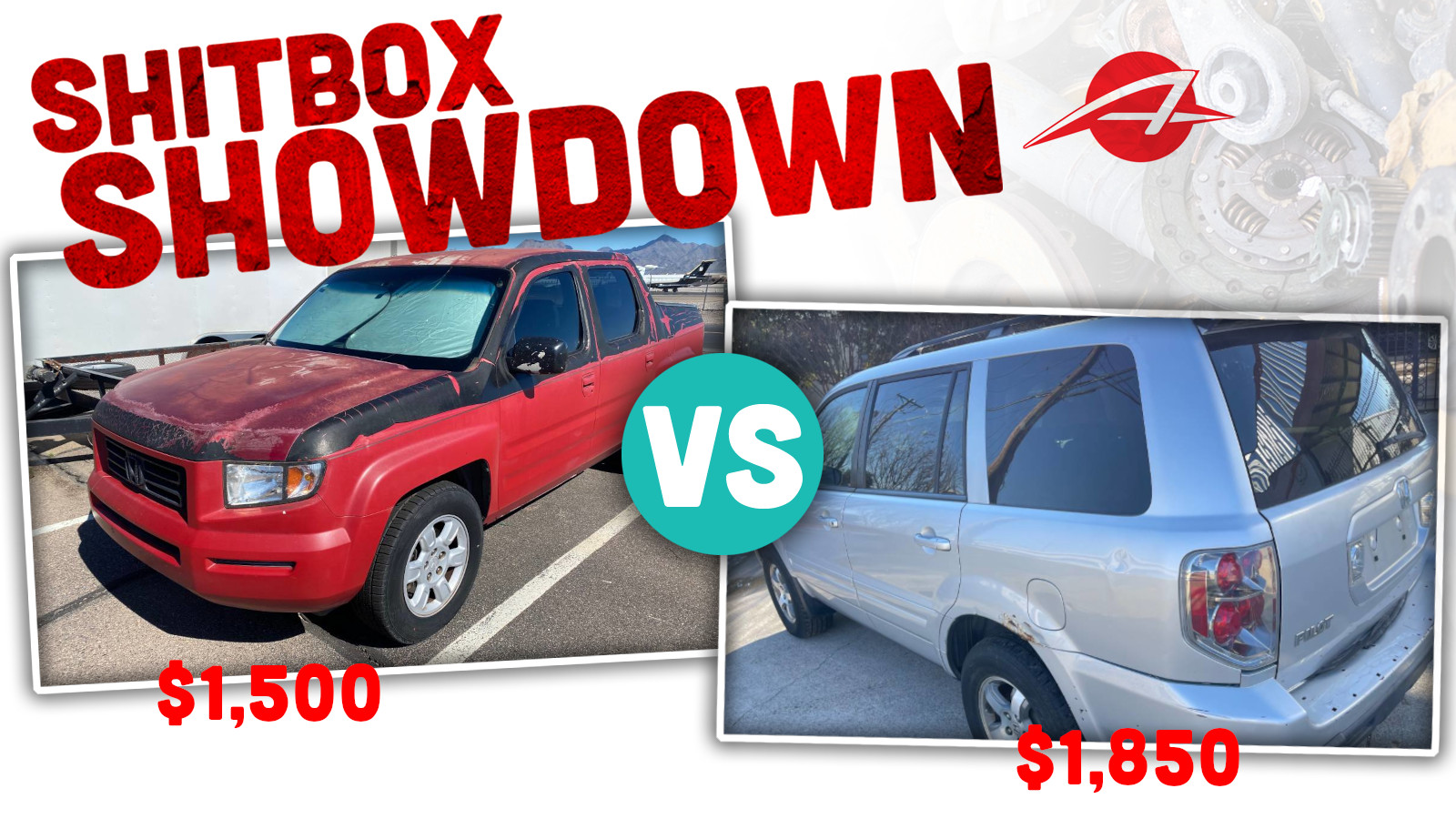
2006 Honda Ridgeline – $1,500

Engine/drivetrain: 3.5-liter OHC V6, five-speed automatic, AWD
Location: Scottsdale, AZ
Odometer reading: 310,000 miles
Operational status: Runs and drives well, but needs wheel bearings
For a long time, there was one segment of the automotive market that Honda’s clever engineering and fine build quality hadn’t yet invaded: pickup trucks. That changed in 2006 with the introduction of the Ridgeline. But in typical Honda fashion, this truck has almost nothing in common with traditional pickup design; structurally it’s closer to a Civic than a Silverado. It’s not a Honda for truck people; it’s a truck for Honda people.

The Ridgeline uses a transversely-mounted engine and an all-wheel-drive system that operates in FWD mode until extra traction is needed, then the rear wheels kick in. The engine is a 3.5-liter V6, and the transmission is a five-speed automatic. This one has a ton of miles on it, and it has had a lot of recent work – everything except for the wheel bearings, strangely. I do see that it has new CV axles, and that the spec for the axle nuts is 242 foot-pounds of torque; there’s a chance that the wheel bearings were fine before the axles were replaced, and someone didn’t torque the nuts enough. The bearings, unfortunately, are the press-in type, so they’re cheap, but require lots of labor. Factor that into your calculations.

Mechanical stuff can be replaced on a high-mileage car, but there isn’t much you can do about the soft parts. I can tell just by looking at this interior that its most comfortable days are behind it. That driver’s seat looks hammered. The headliner is falling down as well, and it looks like it is held up with thumb tacks. On the plus side, the air conditioning is in fine shape.

The top half was wrapped years ago, and it was left on too long. I don’t think you’re getting it off now without sanding. But it’s a cheap truck, so who really cares how it looks? It shouldn’t be rusty, if it has lived its whole life in Arizona; it just looks like crap.
2008 Honda Pilot – $1,850

Engine/drivetrain: 3.5-liter OHC V6, five-speed automatic, AWD
Location: Farmers Branch, TX
Odometer reading: 292,000 miles
Operational status: Runs and drives well
Along the same lines as the Ridgeline, and sharing the same drivetrain, is Honda’s biggest SUV: the Pilot. The Pilot came out in 2002, and I still remember how strange it was seeing something this big with a Honda badge on it. But that’s just the way things were going, and now the first-generation Pilot doesn’t look all that big. It is a three-row SUV, however, with plenty of space inside.

The Pilot also uses Honda’s 3.5-liter V6, five-speed automatic, and automatic all-wheel-drive system. This one is still under 300,000 miles, but not by much. The seller says it is “ready to drive” and has good tires, but doesn’t elaborate. Honda had some serious issues with this transmission earlier on, but this is a later, improved design that’s supposed to be more robust. At this mileage, I would imagine that any failures that were going to happen have already happened and been fixed. But check the fluid and make sure it’s nice and pink.

The Pilot is a little fancier inside than the Ridgeline, and it’s in a little better shape, too. The seller tells us it has “AC and heat,” which I assume means they work, because of course it came with them. It has two different phone mounts stuck to the dash; I guess that’s a sign of the times. Technology changes, and new stuff gets stuck to old car interiors to keep up.

It has some dings and scrapes outside, and a few signs of that old Honda nemesis – rust. Even the mild Texas weather can’t keep it totally at bay. It looks like it’s confined to the rear wheel arches, but take a peek underneath to make sure.
These are both old, tired, and pretty well used up – but they also both still run. And they’re cheap. Obviously, they won’t last you forever, but they should have a bit of life left in them. Since they’re mechanically more or less the same, it comes down to condition. Would you rather deal with the Ridgeline’s wheel bearing issues or the Pilot’s potential rust?



I’d prefer a pickup, but that Ridgeline is just way too ratty…looks downright unsanitary. I’ll take the Pilot.
I gave up trying to get the bearings out of Honda knuckels years ago. It’s an exercise in misery even with a press (at least on rust belt cars). I just buy the whole knuckles now with the bearings installed. I’ve doen a few of them this way now and it’s easilly worth the extra cost. Are they the same quality, probably not, but they still seem to get over 100k and it saves my sanity.
That asside, thet Ridgline is, uh… spent. I don’t put alot of stake in my personal pride, I’ve been married for 30 years and have 4 kids so there isn’t really much left anyway, but I still have some and riding around in that would burn the last shreds of it away. I’ll take the Pilot.
The rust on the Pilot is Nebraska/Iowa rust (judging by the Superior Honda of Omaha emblem on the hatch) and it’s parked outside a collision shop (on the Dallas side of 635).
Even if there’s an element of “I don’t know what they did” to the Ridgeline, it still seems like there aren’t *more* questions, and its fasteners should be easier to turn.
Wow, throwback prices! Two vehicles that aren’t total projects for under two grand. Is this the aughts or something? The pilot’s in better shape, so I’d take that. Also, I’d have to buy a bigger torque wrench to do those bearings, so that’s part of the cost.
Neither. Gross. Though at least the Pilot wouldn’t be completely embarrassing to have parked in your driveway.
On a cheap car, new tires are king. That makes me think the Pilot has been better cared for.
An ex-wrapped vehicle screams rode hard and put away wet.
So Pilot it is
Nobody has commented about the potential for timing belt failure in the next mile on either of these? It’s a neither day for me. OK Pilot I guess.
This could be an either or both day.
I have a ’17 Accord with a descendant of the engine in these two, and in that application, it just wafts along unless goaded. The MPG is a bit rough in stop and go traffic, but on the open road, I’ve seen upper 30s/ow 40s.
A J35 doing Low 40s? Did the 6spd auto and later revisions of VCM really improve that much from the 5 speed? My ex-boss used to own a 2011 Coupe 5AT and the best he got was about 29.
On the freeway at 70-75, 40 is doable. I can feel the VCM cut in and out on gently rolling terrain. But at those speeds, the mileage gets pretty sensitive to head and tail winds. A 10 mph headwind = 80-85 wind resistance and upper 30s. A similar tailwind and it’s 41-42 mpg. And it’s thirsty in town.
The car I had before it was an ’01 Jetta TDI 5M and worst tank I got was 38 mpg. That tank was almost all cold starts and short school runs. On similar freeway trips, it got right around 50 mpg. But without a sixth gear, it was starting to get a little unhappy at 75.
As a former 2012 Ridgeline owner, I can say I loved that truck, but not the 17 MPG. I’m sure the Pilot is not any better, but…
“Take Me to the Pilot”
All I recall is the real-estate agent agent having a pilot. Handed like a town car and rode worse than a f450.
It’s a both kind of day. But if I had to choose one the Ridgeline. They both had some strange transmission problems when they were newer but so many on the road now for so many trouble free miles. Either one seems like a deal. The Ridgeline especially I haven’t looked in some time but that really seems quite a good price.
Once my friends become grandparents, they buy three row vehicles, and the Pilot is a popular one.
My grandparents has a succession of Ford WindTurds, but they left the third row seat in the back of the garage where it belonged. Giant station wagon with easy access for their two spoiled dogs, and plenty of room to take the trash to the dump once a week Oops, I mean “Transfer Station”.
I think the only time that third row was ever in the first one was when I borrowed it to cart a load of us to Boston for my best friend’s bachelor party. And in the second one only when it went to meet it’s well deserved fate during cash for clunkers.
Your grandparents didn’t have to deal with modern car seat regulations!
IMHO, it usually makes more sense to just take two cars.
I can usually pick one, but not today. Maybe tomorrow.
I’ve grown fond of the first-series Ridgeline and even though this one’s been beaten to within an inch of its life, I think I’ll pick this one.