

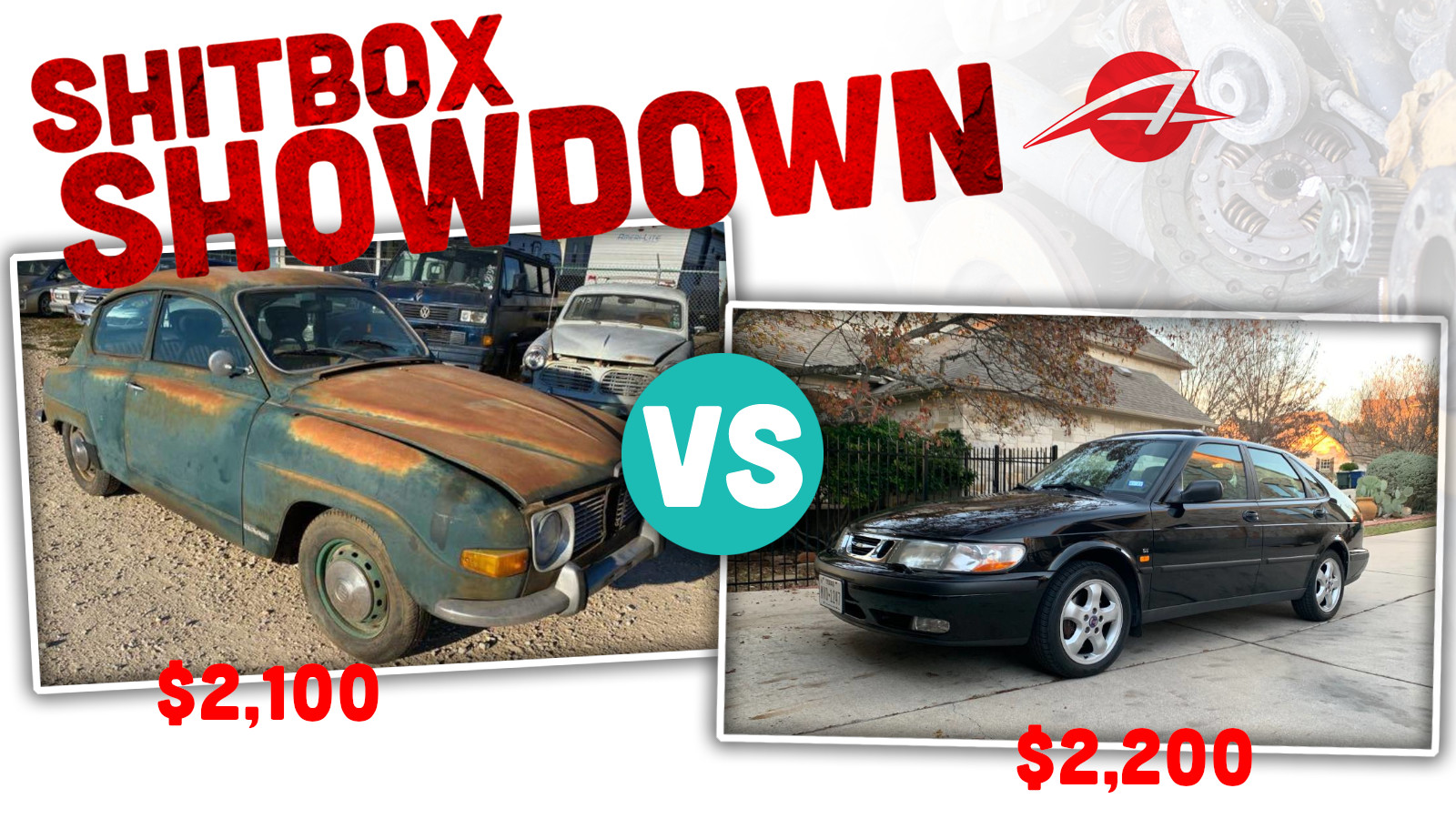
I believe – though I’d have to go back and check – that no Saab has ever lost a Showdown. And that’s not going to change today, because both cars we’re going to look at are Saabs. One is a V4-powered oddball from way back in the day, and the other is a turbocharged hatchback from the GM years.
Yesterday was all about Cadillac, and it will surprise no one that the big Eldorado took an easy win. And I was thinking about it earlier today – it’s actually a pretty good deal. I mean, it’s only about 83 cents a pound!


That DeVille is a pretty nice car, but I think I’d look for one a couple years older with the 4.9 liter HT engine. I had a 1989 DeVille with the 4.5 and I liked it quite a lot; I sold it because I was commuting and 15 MPG just wasn’t cutting it. Between these two, though, the Eldorado is an easy choice.

Who doesn’t love Saab? Well, lots of potential buyers, or else the company would still be around. Enthusiasts all seem to at least love the idea of Saab, with its oddball and often brilliant designs and its spicy turbocharged engines. But it seems like most non-car-people didn’t quite know what to make of the Swedish airplane company’s strange front-wheel-drive cars. They got less and less weird as time went on, to the point that one of its final models was literally just a Chevy Trailblazer. It still didn’t help. But long before those days, there were these two. Let’s take a look.
1971 Saab 96 – $2,100

Engine/drivetrain: 1.5-liter OHV V4, four-speed manual, FWD
Location: Kyle, TX
Odometer reading: 80,000 miles
Operational status: Was running a year ago
This rusty little jellybean represents the first step in Saab’s de-weirding. Originally, Saabs were powered by three-cylinder two-stroke engines, but in 1967 they switched to a four-stroke engine like everyone else, albeit an unusual one: a V4 from Ford of Europe.

The V4 powers the front wheels through a four-speed manual transmission with a column-mounted shifter. This one isn’t currently roadworthy; it was running a year ago, but old gas has gummed up the works. It will start on starter fluid, but won’t stay running.

Inside, it’s dirty, but it’s actually not in terrible shape. A good cleaning and some seat covers would help a lot. Most of the little bits of trim are still there, which is important, because you’d have a hell of a time tracking down anything that’s missing.

The paint is pretty much gone, but it looks like it only has surface rust. Repainting it would still be a lot of work, but at least there’s no welding involved. It’s complete except for, unfortunately, the center of the grille. I’m sure some Saab enthusiast has a stack of them in the loft in their garage, and will happily sell you one for way too much money.
1999 Saab 9-3 – $2,200

Engine/drivetrain: Turbocharged 2.0-liter DOHC inline 4, five-speed manual, FWD
Location: Austin, TX
Odometer reading: 115,000 miles
Operational status: Runs well, but needs brake and suspension work
The great-(great?)-grandchild of the 96 is this car, the first-generation 9-3. It looks just like the 900 that preceded it, but under the skin are a bunch of changes to improve safety. Luckily, GM’s interference in Saab was minimal at this point, and the car still has the character and weirdness that Saab fans love, including the ignition switch in the center console.

Saab embraced turbocharging way back in the ’70s, and never stopped. This 9-3 has a turbocharged 2.0 liter four-cylinder powering the front wheels through a five-speed manual. Several versions of this engine with different power levels were available; I think this is the middle version, making 182 horsepower. The engine runs great, but the car’s brakes and front end need work before it’s roadworthy. The seller says the brake pedal starts out OK then goes soft, which sounds to me like a bad master cylinder. It also has a vibration in the steering wheel at certain speeds, which could be a lot of things. The bad brakes mean you should probably tow it home.

The interior is in decent shape; there’s some wear on the driver’s seat and the steering wheel rim, but not bad. All the power features work, as does the air conditioning, which just had the compressor replaced. It also has a removable refrigerated drinks cooler that was apparently a factory option, but it doesn’t work right now. I assume the hula girl on the dash is included, if you ask nicely.

The outside looks really good in photos. The seller says it has some dings and scrapes, but they must not be bad at all. The paint is nice and shiny, and it has factory alloy wheels – sadly not the trademark Saab three-spokes, but sharp-looking nonetheless.
It’s a crying shame what happened to Saab. We need more weird cars around. Luckily, the brand has a loyal following dedicated to keeping the cars on the road. I’m sure you could find plenty of help fixing up either one of these. Which one would you rather put back into service: the rusty old V4, or the sleek black modern turbo?


I only just voted on this, mostly because I’m feeling particularly Saab-nostalgic this morning. Other than being a five-door instead of the nicer looking three-door, this particular 9-3 is almost identical to one I didn’t buy at the start of the pandemic, and I’m still kicking myself about it.
I talked a friend into buying a ’77 99 and eventually bought a used ’88 9000 turbo. I loved Saabs of the late 70s and 80s and then they kinda lost their way, got Borged and let’s just say the assimilation didn’t go well. Sadly.
I still regret selling my ’86 900 Turbo. One day I might be able to find a replacement.
The 9-3 is an objectively better choice.
I still voted for the 96. First, someone out at the coast has one in good s running shape, and it is so cool. Second, a V4? That’s just cool. And it’s an engine configuration I haven’t owned. (Current family fleet: I4, Boxer 4, I6, V6, V8…) I’m imagining it with new paint, a deep cleaning, and a little mechanical work – it would turn heads as a weekend runabout for sure.
On the other hand, I’d take the 9-3 over most of the shitboxes on other days.
You would think that the 9-3 would be the better choice financially since they are about the same price and it is in way better shape but you would be wrong. I don’t have any reason for saying this. Just wasting your time. 96 all day 🙂
“The paint is pretty much gone, but it looks like it only has surface rust”
The rust thru hole in the rear passenger fender would indicate otherwise.
Well Mark I have to say you are incorrect in that a Saab will lose today. I think you missed a perfect opportunity to call today’s challenge The Sabbath, or have two black Saabs and of course choose the Black Saabeth.
So wanted the both option
I know, I know – it makes no rational sense but that 96 just speaks to me.
96 all the way.
Damn, I accidentally voted for the 9-3.
The 96 and clearcoat , tidy it up inside and be that guy.
The 96 could be fun but the 9-3 a way nicer place to be. I do like patina and the 96 has quite a look. 9-3 to drive more 96 for weekends.
I still miss my Saab. You never forget your first car.