

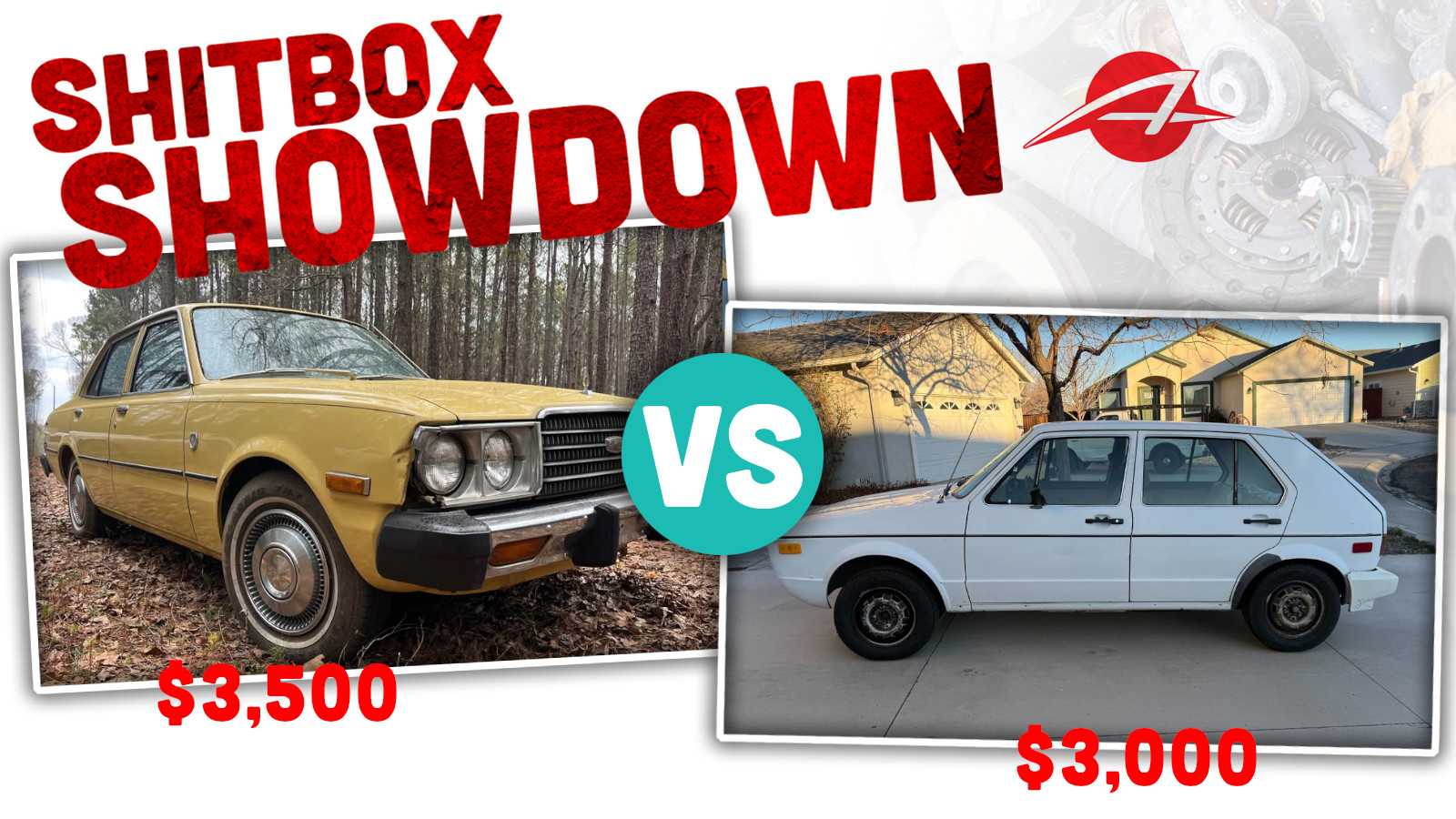
You remember the old fable of the tortoise and the hare, right? Slow and steady wins the race. Today, we’re looking at two slow and steady cars from the ’70s, but in this case the “hare” might actually be the slower one.
Yesterday we looked at two right-hand-drive imports from Japan. Lots of you liked the idea of the Ford Ka, but it didn’t translate into votes. I think that little Mitsubishi was just too cute to pass up, and that’s before the benefit of 4WD and a much more modern engine design.


I have to agree. I really like the Ford Ka, but it feels like it’s not worth the money, especially when you can get a US-market Aspire that has the same basic vibe to it for a lot less. That Pajero, however, feels special enough to be worth some extra dough.

A rising tide lifts all boats, they say, and that seems to be the case with old car prices. In these days when bona-fide classic cars are fetching five, six, and even seven figures, everything more than forty years old is suddenly triple the price it used to be. It sucks, but that’s the way it is. You can save a little money by picking something that needs a bit of work, and that’s what we’re going to do today.
1978 Toyota Corona – $3,500

Engine/drivetrain: 2.2-liter OHC inline 4, three-speed automatic, RWD
Location: Zebulon, GA
Odometer reading: 200,000 miles
Operational status: “Runs and drives but not well”
Here once again we have our old friend the Corona, Toyota’s family sedan offering before the Camry. This is the car that helped make Toyota’s fortunes in the US, way back in the early 1960s. By the time this Corona was built in 1978, the nameplate was in its fifth generation, though still using the same basic rear-wheel-drive layout. It was a common car in its day, but the vast majority of them were recycled into toasters or snow shovels decades ago, making this a rare sight on the road today.

Toyota’s 20R four-cylinder engine needs no introduction. It’s the engine that powered countless Toyota pickups, not to mention an army of RWD Celicas. It’s a reliable and durable engine, not known for high-revving antics, but just about bomb-proof. This one is backed by a three-speed automatic, which slows forward progress a bit. It has been sitting for a while, the seller says, and while it still starts up and drives, it needs some work. It might be as simple as old gas, or it might need some more extensive cleaning and reconditioning to bring it back up to snuff.

You can tell Toyota was really trying hard to appease US buyers, with a bench seat and a column-mounted shifter like it’s a Malibu or something. The interior is in reasonably good condition, but the carpet could use a cleaning and there’s a crack in the top of the dash.

Most of it is in good condition outside, but there is a pretty good wrinkle by the right headlight, and the plastic headlight surround is broken. The windshield needs replacing too; it’s a spiderweb of cracks. It looks rust-free and complete, though.
1979 Volkswagen Rabbit L Diesel – $3,000

Engine/drivetrain: 1.5-liter OHC diesel inline 4, five-speed manual, FWD
Location: Fernley, NV
Odometer reading: 92,000 miles (probably rolled over)
Operational status: Runs and drives well, but needs an alignment
Volkswagen’s great shift from rear-engined air-cooled cars to front-engined and water-cooled began in the early 1970s, with the introduction of the first-generation Passat, which came to the US as the Dasher. A year later, the first-generation Golf arrived here, sold under the name Rabbit. Beginning in 1978, Volkswagen built Rabbits for US consumption in Westmoreland, Pennsylvania instead of Germany – unless you ordered one with a diesel engine. This ’79 Rabbit L diesel is a German-built car, therefore retaining the round headlights, smaller taillights, and nicer interior trim so prized by discerning Volkswagen enthusiasts.

A normal gasoline-powered Rabbit was not exactly a performance car, but the diesel engine slowed things down dramatically. This car’s naturally aspirated 1.5-liter diesel engine makes just 48 horsepower and 59 pound-feet of torque, giving it a 0-60 time longer than most Mark Knopfler guitar solos. It’s enough to climb Pikes Peak, though, as my dad proved in a Dasher diesel back in 1981, and it can flirt with fifty miles per gallon if you’re careful. This one shows just 91,879 miles on its five-digit odometer, but I imagine it has gone around at least once. It runs and drives well, but it just had a bunch of suspension work done and hasn’t yet been aligned. It will probably drive even better after that.

The seller says the seats are “very worn,” but honestly, they look better than I’d expect. The padding seems to have been beaten out of them, but the vinyl is holding up pretty well. It has a dash cover that’s probably hiding a multitude of cracks. I had no idea those dash covers were so common until I started writing this column. It seems like about every fourth car I look at has one.

Outside, it’s rust-free, missing its front bumper, and wearing the rear bumper of a later Cabriolet. The seller says the car comes with “many goodies,” but I don’t know if that includes a front bumper. No matter; my ’79 Scirocco didn’t have a front bumper for about half the time I owned it, either. It’s refreshing to see a Rabbit still at its stock ride height, too. Far too many of them have been lowered.
So from the sounds of it, you could drive either one of these home, and then plan to do some tinkering to whip them into shape. Neither one needs anything major, though, and with a little work, you could have an interesting conversation piece for Cars & Coffee. Who needs a fast car anyway? Just kick back and take it easy in the slow lane for a while, let everyone else jockey for position. Which one of these would you take?


I’ve been in a Rabbit diesel. I voted Toyota.
I owned one of those 79 Rabbit diesels. I’ll never forget it – it was so slow it could not get out of its own way, and after a cold start it sounded like someone was shaking a coffee can full of acorns.
My best memory was of getting a boost from a Lincoln Arc Welder on the back of a pickup truck one very cold (-20) winter morning. I think the starter motor turned the engine over at about 1,500 RPM – it started pretty quickly, with a cloud of blue smoke coming out the back.
Can you still get a windshield for that Corona? This is a neither day for me.
Rabbit for me, although no car ever “just needs an alignment”. There is something that is worn, bent or incorrectly adjusted that leads to “needs an alignment”.
That NA 1.5 is horribly choked on the exhaust. I had an 85 and a 91. Remove the stock exhaust and take the “toilet bowl” and open it up to 2-1/4″, then install a 2-1/4″ exhaust back to the rear axle, and then you can drop it to 2″ to go over the axle and out the rear. This single mod changed my 1.5 NA from a buzzy engine that felt like it was going to fall apart at 90 kph into one that would comfortably cruise at 120. When I first got it I drove up Highway 6 out of Hamilton, and that hill caused me to downshift from 5th to 4th, to 3rd,with speed dropping from 80 kph to 50, and blowing black smoke out the rear like a coal roller. After the exhaust mod I could run that same hill staying in 5th, 90 kph bottom to top, and virtually no smoke. 58 mpg without breaking a sweat, and I beat on that thing.
The Toyota has survived in its environment – the dirt, scarcity, and the emptiness of our South.
I’ll have the Corona. $3,500 deposit.
I’d take the Rabbit, having owned a 1982 Rabbit diesel. Great utilitarian car, great fuel mileage at 53 mpg highway on my commute. Fairly comfortable except for the noise from engine, road and wind, top speed I achieved was 83 mph. Merging onto a highway or passing required significant planning. Smoked like a WWII destroyer laying down a smoke screen when started up on a freezing morning, but it always started.
Both are good options, but living in Tennessee and all the highway driving/uphill driving I do means that Rabbit would not be pleasant to daily. That Corona is also kind of charming, to me.
Both options are solid, but I’m a sucker for the obscure. Gimme that Corona!
Bemusingly, I owned both of these vehicles back in the day.
My 78′ Corona, sort of like my sharona, was a wagen and a rich brown.
My diesel Wabbit was a 2 door and I did an in-car engine rebuild on it. That was during my VW mania era which included air cooled and a couple of oil burners.
The Wabbit gave an honest to dog 58mpg on the freeway and had the dealer installed extended range tank. Calif to Texas in two tanks baby!
The Corona was brown.
I liked the Wabbit better in every way and luckily Fernly NV is a good half day drive, or I’d drag that POS home and make costly mistakes again.
You wouldn’t just flirt with 50 mpg in that Rabbit, you could easily hit that on long highway drives…
M M M M My Corona!