

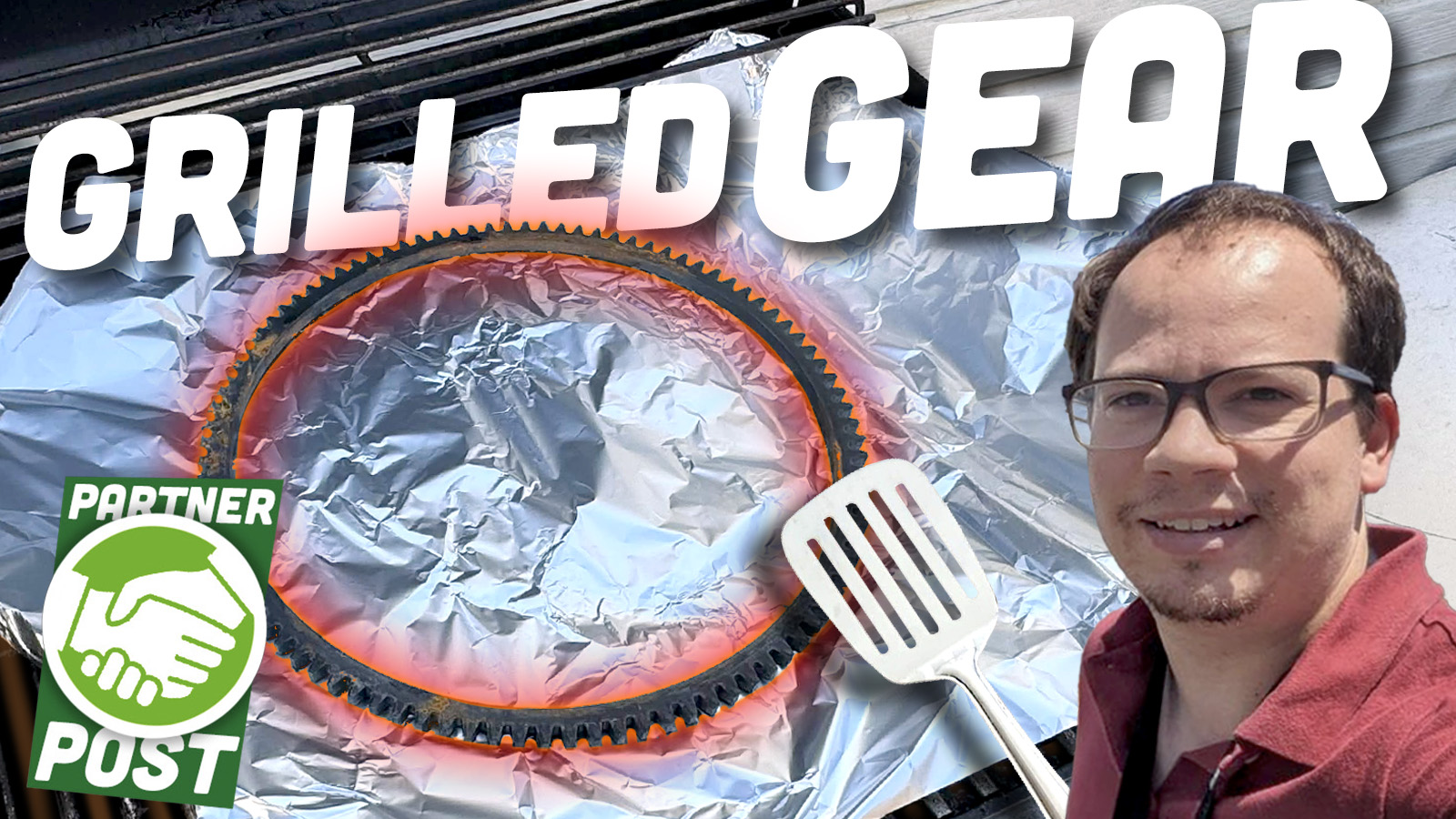
You may think of your freezer and grill as places where only food goes, and where nasty, oily car parts very much do not belong. But, having now rebuilt a transmission, transfer case, and engine, I can tell you that this is just not true. A grill and a freezer are must-have wrenching tools; here’s why.
Let me just get straight to the party trick.


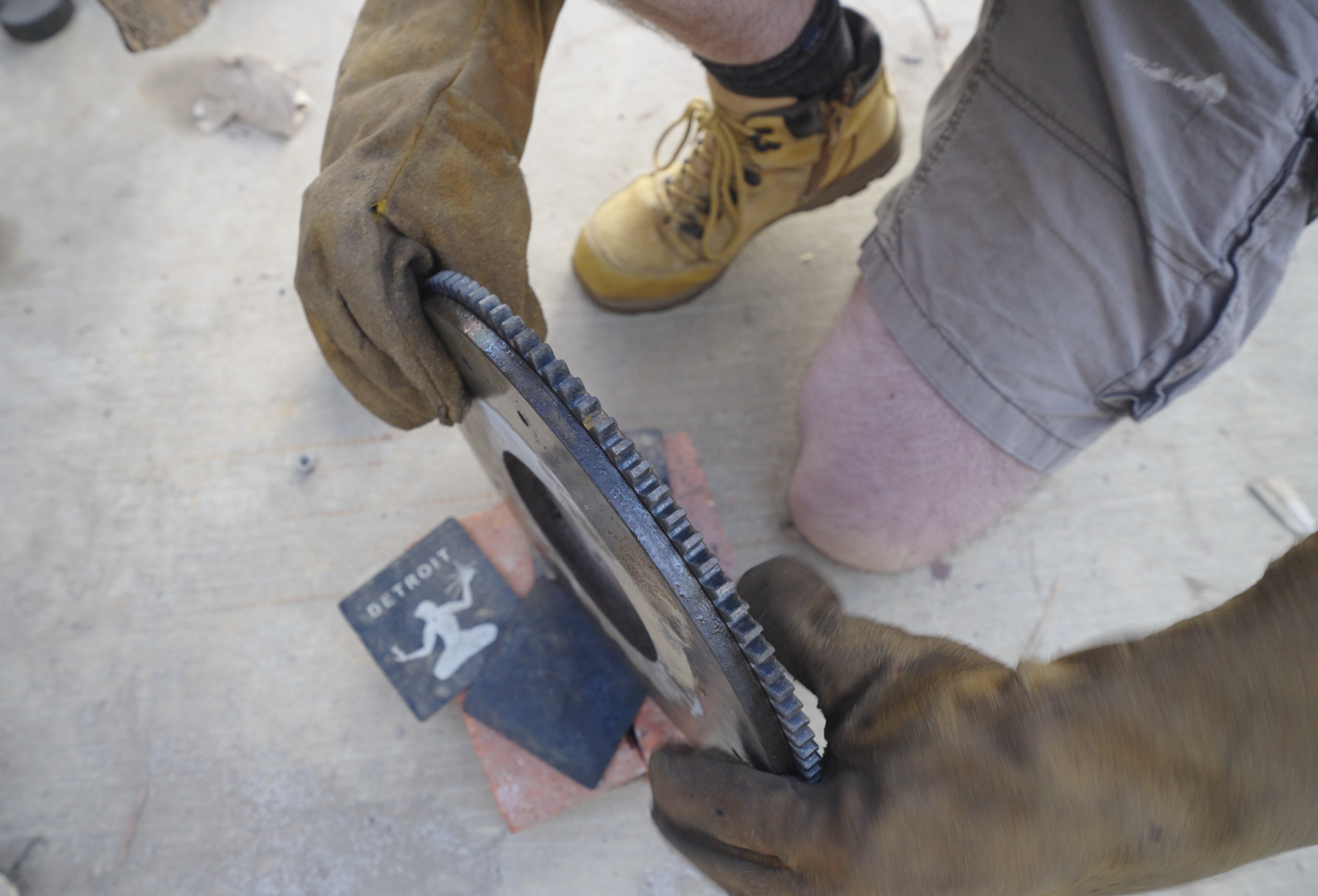
Watch as Laurence takes a flywheel ring gear off the grill and simply drops it onto a flywheel we had placed in the freezer:
View this post on Instagram
I had just brought my flywheel back from the shop, who had machined it nice and flat. They had offered to remove the ring gear and install the new one I’d purchased on eBay (see below), but I decided I wanted to try something I’d read about on online forums.

For years, I had known that installing a ring gear required heating that gear up, so I Googled it, only to find that people had just used their grills to get the ring gear up to temp. So my Australian friend Laurence did just that:

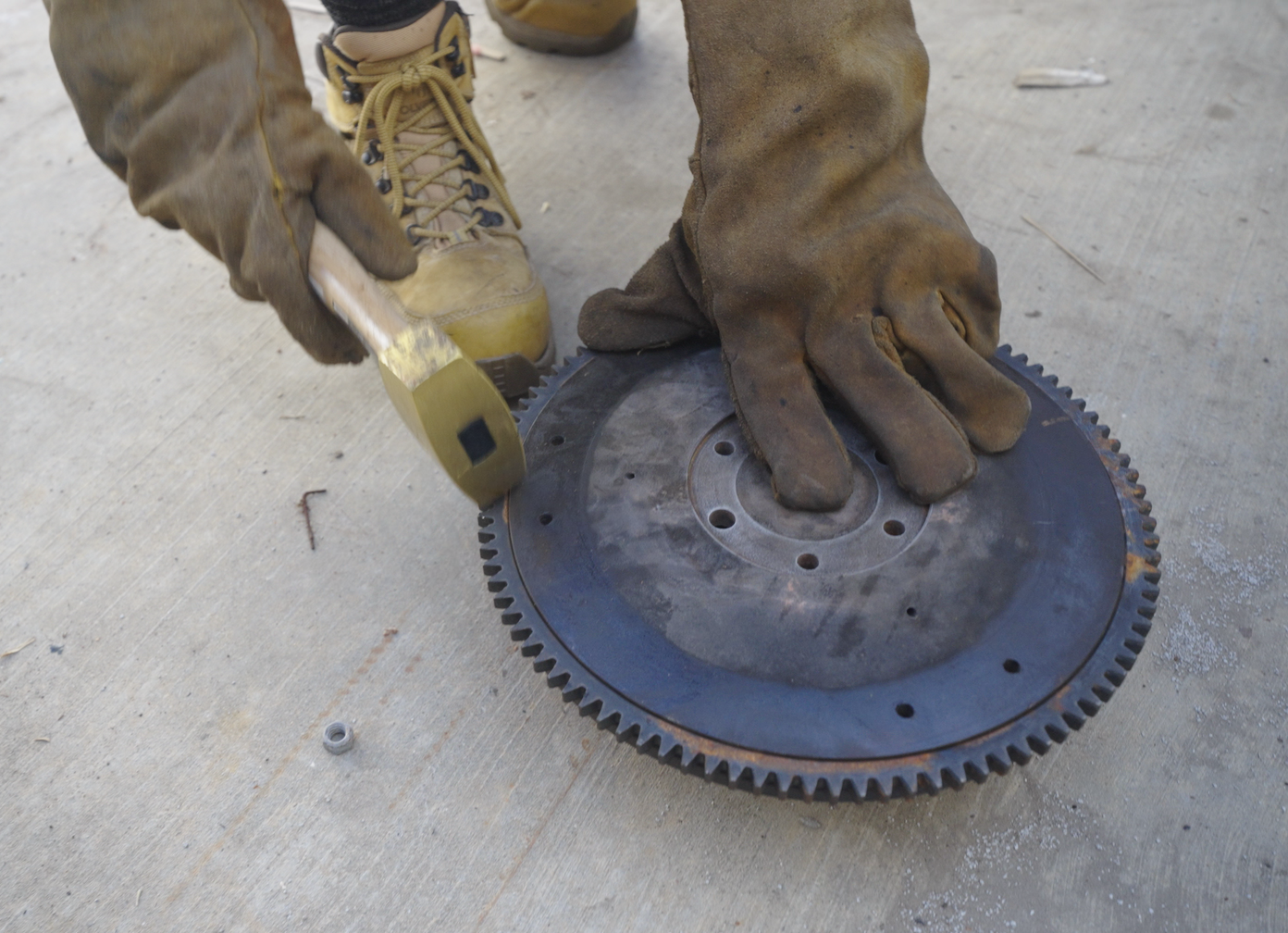
We had banged my flywheel’s old ring gear off with a punch, and then we’d placed the heavy flywheel in my auxiliary freezer in the garage, with Laurence’s placement of the heavy flywheel only slightly denting the freezer’s interior. The new ring gear was on the grill at around 400F.
With a huge delta in temperature, the contraction of the flywheel and the thermal expansion of the ring gear made it so that Laurence could simply drop the ring gear onto the flywheel:

This is just one example where thermal expansion came in handy. It was also useful when my friend Brandon and I rebuilt the Jeep’s transmission — specifically when banging a new bearing onto a shaft: 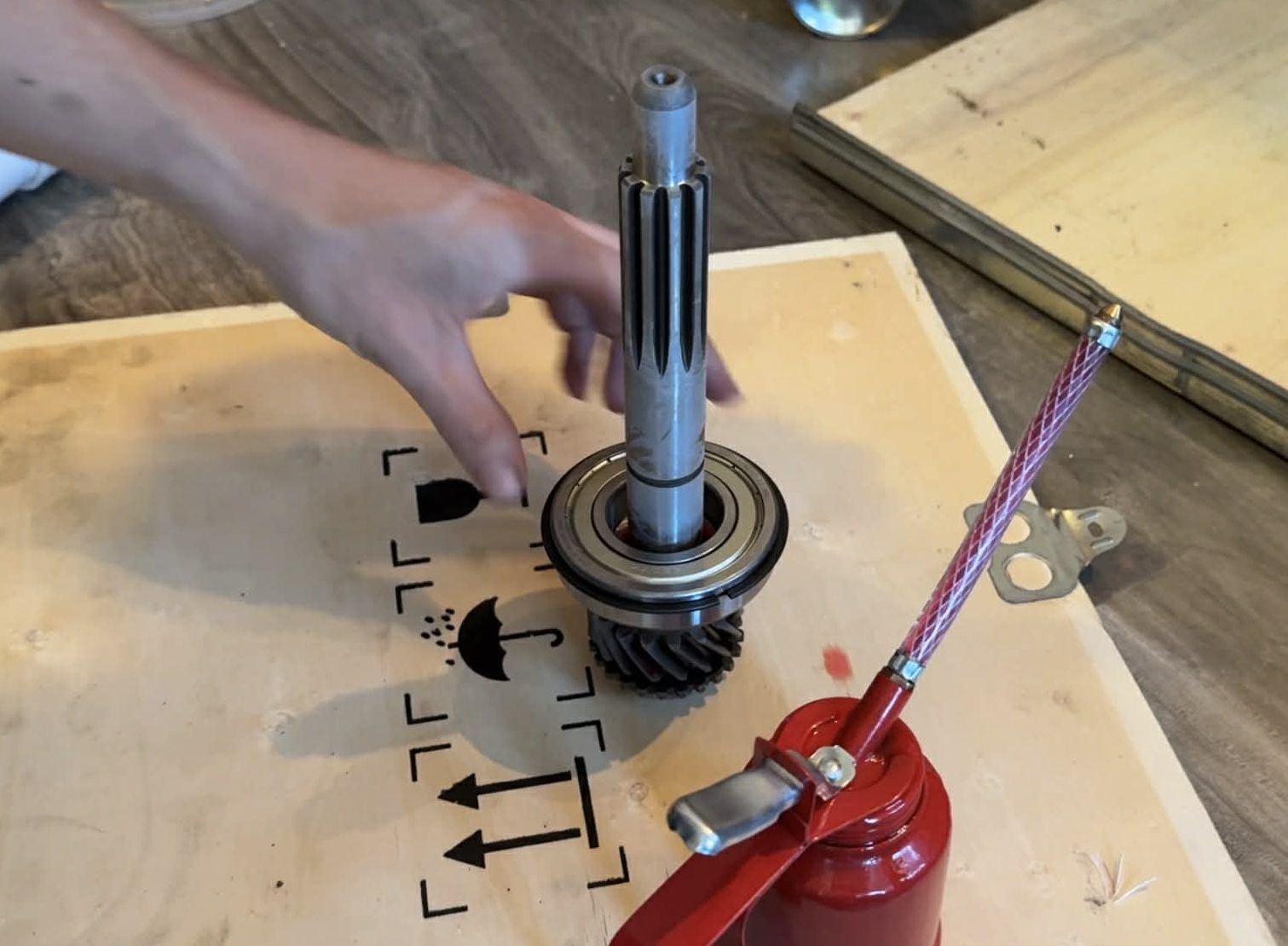
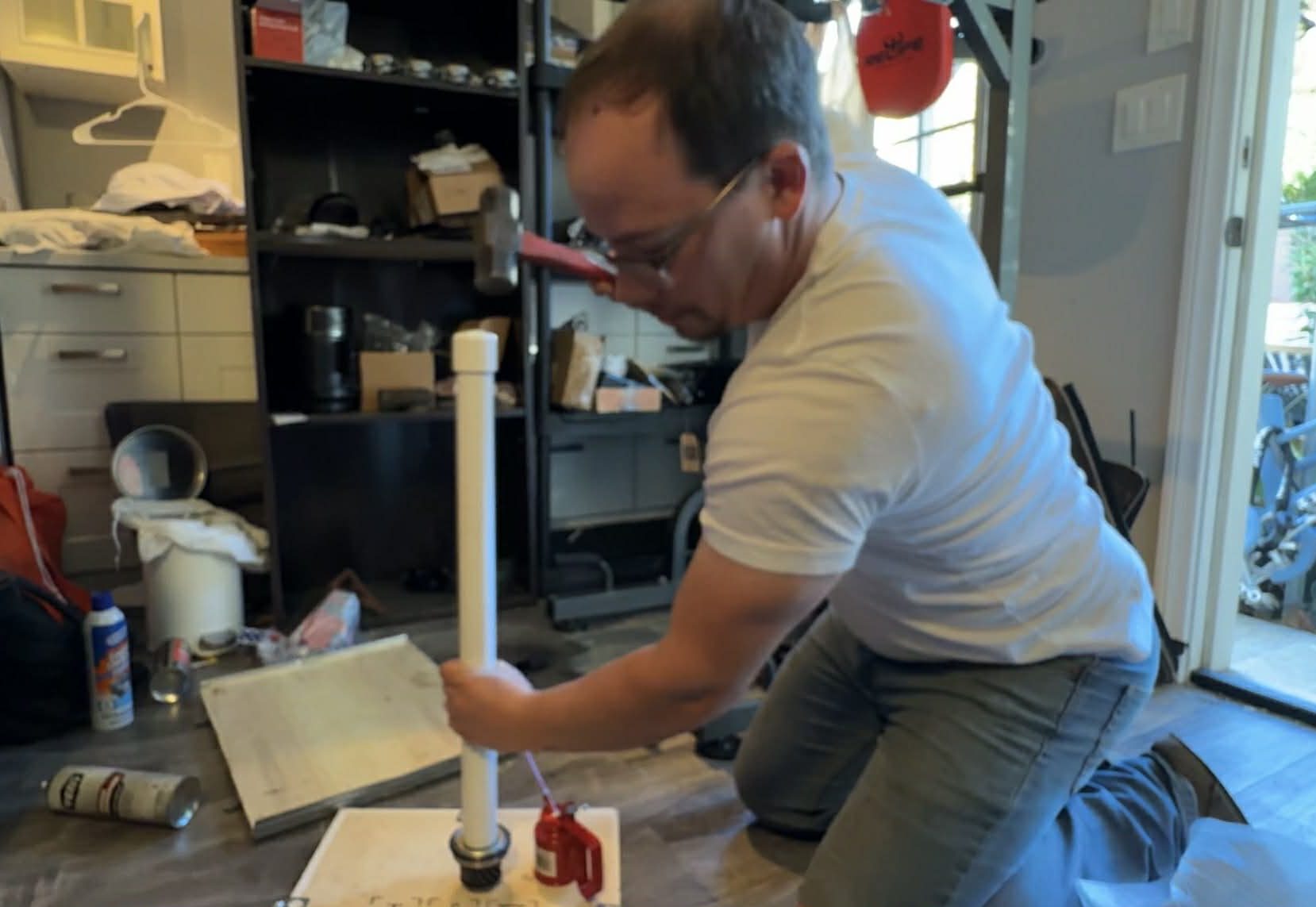
I also froze the transfer case main shaft to get a new bearing on:
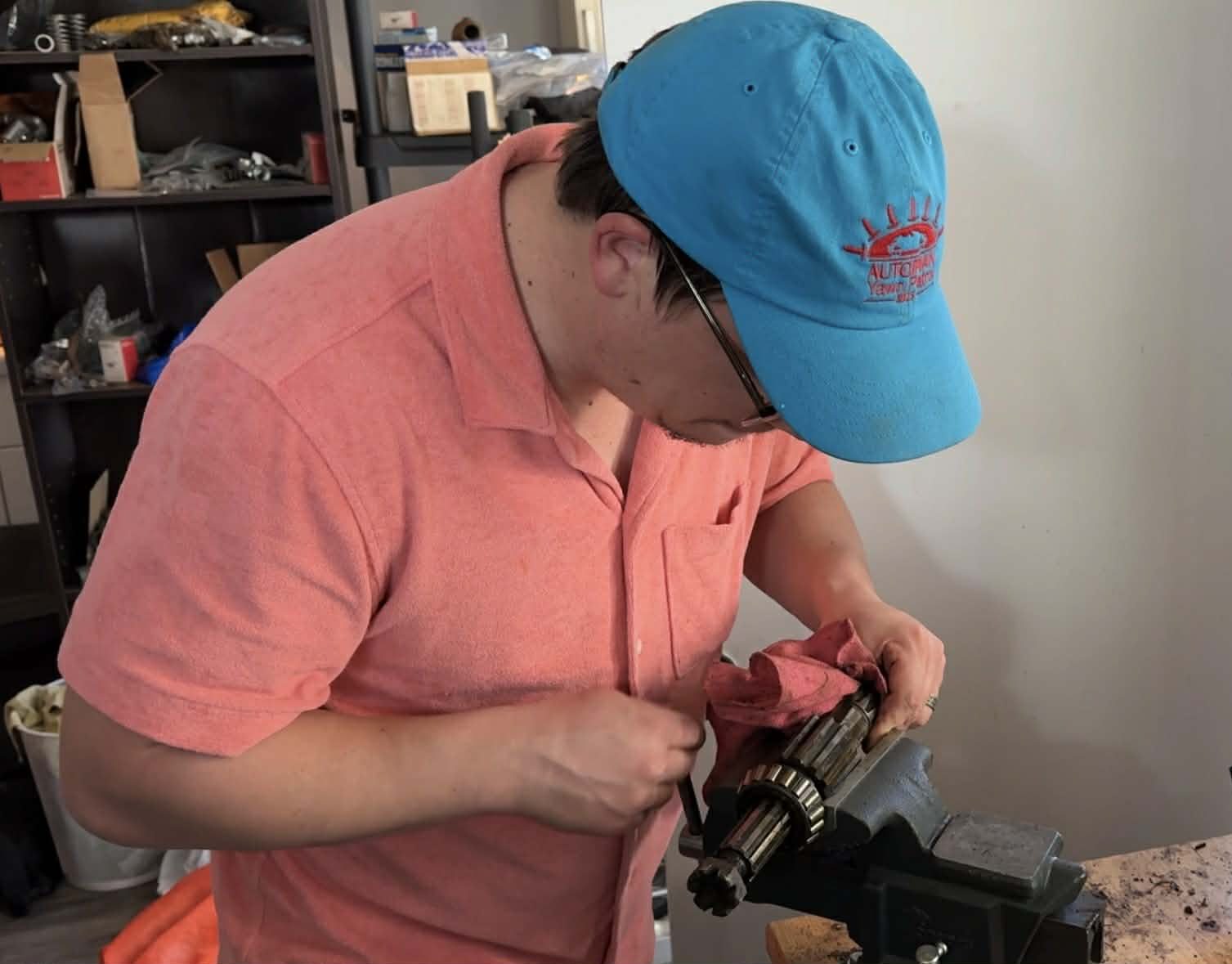
I froze my piston wrist-pins so that they would more easily slide through my pistons and into my rods (which feature a slot that you can wedge open a bit wider using a flathead):
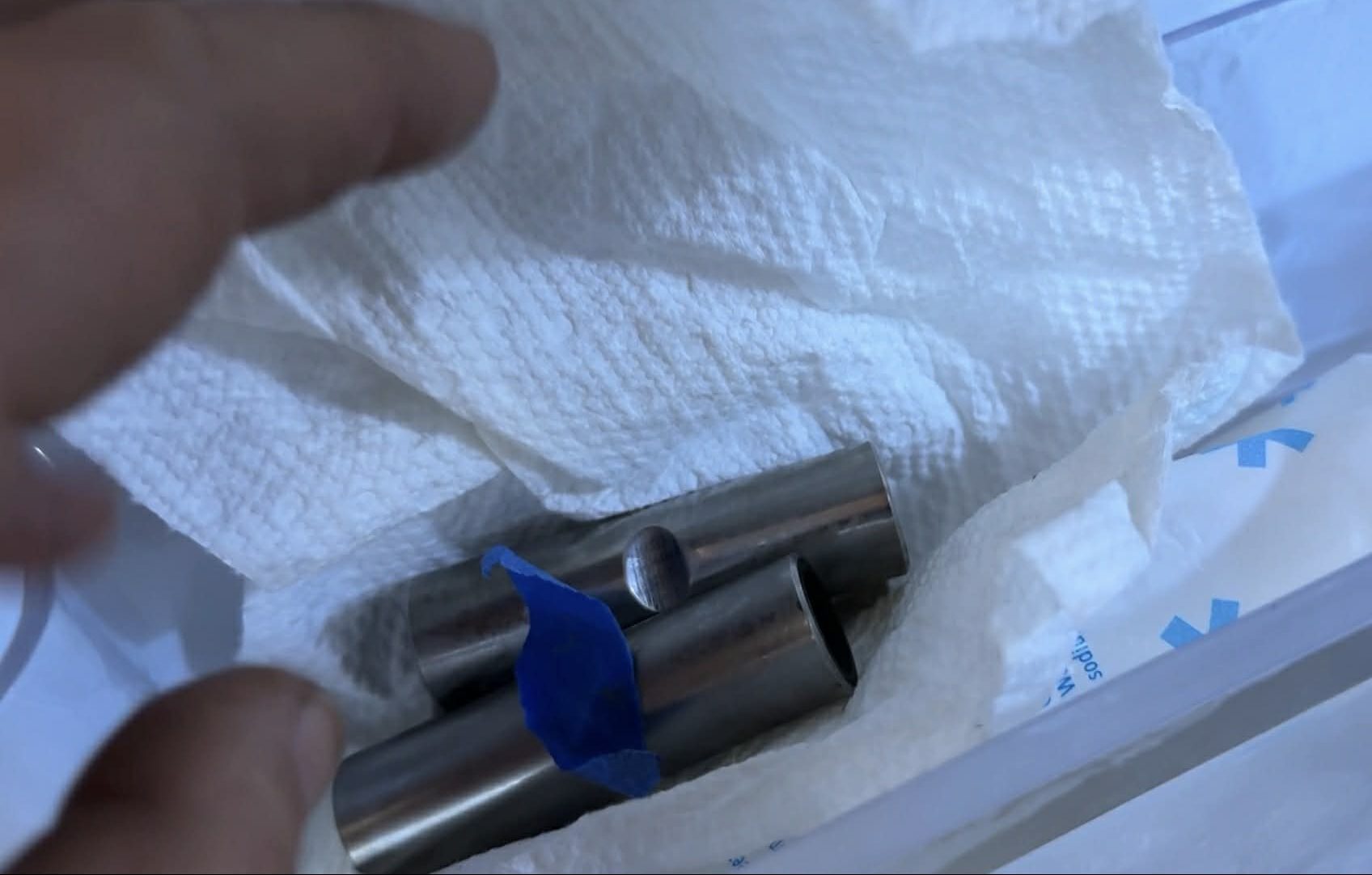

And I froze my steering box’s new bronze bushings before pressing them into the casing:

If you’re curious about the material science behind thermal expansion, here’s how Caltech defines the phenomenon:
Thermal expansion occurs because a material’s atoms vibrate more as its temperature increases. The more its atoms vibrate, the more they push away from their neighboring atoms. As the space between the atoms increases, the density of the material decreases and its overall size increases.
Back in engineering school, I did a lot of thermal expansion-related math problems in my Material Science and Strength of Materials classes — specifically, using this equation:
Change in Diameter = Initial Diameter * Alpha * Change in Temperature
Alpha is a material property called the coefficient of thermal expansion, which for steel is typically around 11 or 12 x 10^-6/C, and for Bronze (a common bushing material) is around 18 x 10^-6/C.
For fun, let’s just say I have a one-inch (0.254 meters) steel rod onto which I have to press a bronze bushing, with the bushing being about 0.001″ smaller to maintain a press fit. If it’s 77F outside (25C), and I heat the bushing up to 450F (232C) and freeze the rod to 3F (-16C) then I can calculate how much smaller the rod gets by plugging into the equation above:
Change in diameter = 0.0254 meters * (12×10^-6/C)*(-16C-(25)) = -1.25*10^-5 m. That’s about 0.5 thousandths of an inch of shrinkage.
And I can calculate how much the 0.999-inch bushing expands when I heat it up to 450F (232C):
Change in diameter = 0.0254 meters * (18×10^-6/C)*(232-25) = 9.6*10^-5 m. That’s about 4 thousandths of an inch in expansion.
That’s gone from being a 1-thousandths-of-an-inch press fit to a 4.5 thousandths-of-an-inch slip fit. When both materials reach room temperature again, they’ll be joined together with that initial 1-thousandths-of-an-inch press fit, but at the moment the bushing leaves the grill (or torch or whatever) and the rod leaves the freezer, there’s 4.5-thousandths of gap that will make slipping that bushing onto that shaft an absolute breeze.
This is the power of thermal expansion — a mechanic’s best friend.
[Ed note: David mentioned the idea of building a brand new WWII Jeep to the team at eBay, and they loved the idea so much they said, “How can we help?” Their financial support and David’s Jeep-obsession are the fuel behind this crazy build. – MH]
Top graphic images: David Tracy; Superutensil



Anyone else here trying to divine the true use of the room David has taken over for a workshop? I see a counter and coat hanger, so possibly laundry. But also some sort of weight machine, so gym? The bench vise threw me off, for a sec. But I guess when a dishwasher can be a parts cleaner, and a BBQ a part heater, any room can be a shop.
I can’t tell you how many times I heard sighs for the amount of sawdust in our woodshop/laundry room. It did lead to funding for a garage build though, so sometimes these things just work themselves out.
Lots of older homes in SoCal have washers and dryers in the garage. It keeps the heat from the dryer out of the main house, which was good because lots of older homes in the area weren’t built with central A/C, and it never gets cold enough that you have to worry about water lines freezing in an uninsulated space
I am not a mechanical engineer, so when I have heated up steel for specific tasks I was told to heat it slowly and not to get it over specific temps (usually 450F or higher?) as it could affect its heat annealing or tempering strength. So when I see this it makes me cringe with the really warm and cold parts coming together quickly, how that might weaken both pieces. I am guessing I am wrong about this and the steel needs to be very hot (like 600+F, specific alloy dependent) to be of any worry?
In this vein, I definitely use my space heater to warm up rubber hoses to get them to go over tight fittings., and use the sun to warm my serpentine belts for install.
It looks like standard low-carbon steel is annealed at 1600F, (which actually seems low from my now ancient experience), but the bigger issue is strength drops quickly starting at about 700F. From the first phase diagram I found online (my handbooks are not handy) it looks like you shouldn’t change the metallurgy below about 800F for any of the states of low-carbon steel.
Thanks! I was definitely way low with my temperature values. My quick google searching didn’t help but that seems to be because I don’t know what question to ask.
Your numbers work if they are Celsius and not Fahrenheit. ;-).
https://www.instagram.com/reel/DUfvLSyiEI_/?igsh=dzNncWJpYnc5ajFx
It took a very smart scientist to come up with the equation for what every male ever born knows: Cold = shrinkage, Hot = expansion
Reminds me of the days of spinning-platter hard drives. I got more than one drive to function long enough to extract some files by putting it in the freezer.
I spent the early part of my career as a computer tech and I used that trick all the time. My co-workers thought I was nuts until they realized it had a startlingly good success rate.
Should have been in the A+ manual.
Seeing David hammering (David had a hammer in his hand) on a bearing with a piece of pipe made me cringe. If you have not befriended a local garage (who, if they & you are nice, will usually just let you use it yourself) a small press from Harbor Freight is less than $200 – and the usefulness of a small press is worth the garage space as long as you doing a project or two a year.
Yeah, though this is a WWII-era Jeep specifically designed to be pretty much 100% serviceable in the field. So with what David is doing it’s like the Ritz-Carlton or at the very least a Motel 6 compared to pup tents in the mud, lol.
Never have thought of using the BBQ but wife was wondering why I have a disgusting toaster oven in the garage- its for heating parts not food !
The talk of using cast iron pans and hot plates has me thinking a portable induction cooktop might be a useful garage addition.
Induction cooktop is an interesting idea – I’m not sure how well it will work depending on shape and size of the part, but there are induction heaters used for mounting very large bearings in industrial applications.
That’s not a great idea. The nice thing about an oven or grill is that the air temperature is what heats the part, not surface conduction. If you do surface conduction, the part won’t heat evenly.
And ANY type of electric heating element, whether resistive or induction heating, is an especially terrible idea, because neither of them provide any kind of temperature feedback or control, and neither of them put out energy uniformly, they cycle on and off.
I was caught up on the idea of minimizing space while maximizing heating efficiency and hadn’t considered your very good points. It’s why I asked, thanks!
Hmmm… I suppose, that if you wanted to minimize space, you could get a large, lidded cast-iron pot (a cheap, rusted-out one that you wouldn’t cook in), put that on the induction stove, and put the part inside the pot on some non-conductive standoffs, with a multimeter temperature probe to measure the air temp
It would also work on aluminum and copper parts, which can’t be heated using induction.
Yeah, I was thinking most car parts this would apply to tend to be ferrous but I’ve played the heating/freezing game with dirt bike engine cases that are aluminum.
Induction probably has more drawbacks than advantages…
I put new brakes on my old Wrangler TJ. I was going to be thorough and I bought all new parts, including rotors. Only problem was that I couldn’t get the old ones off. After many frustrating attempts I gave up; I needed to get it back together because it was my daily driver. I recounted my experience to a colleague on Monday and he replied; “Did you try heating them up? I use a torch.” (duh. And I have a torch for plumbing)
Soon afterwards I was involved in an accident and the Jeep was proper totaled. I still have the rotors in my garage somewhere. I’m forced to live with the shame.
Light lenses + dishwasher = perfection.
I just got the old but perfect working dishwasher that a friend replaced in his new house to install in my new garage. 🙂
SCORE!
Nice! “Put another shrimp (prawn) on the barbie!”
Thanks again Laurence for traveling so far to help David. Righto!
Cheers, it was great to see DT again and get some good progress on the WWII Jeep project!
Local mechanic here. There’s two rules:
-When things get hot and heavy, expansion is inevitable
-Never work a dry hole (unless directed by the OEM, see: CAT C15 rear main seal)
Welp, that’s going to be in COTD
i d stop at 3406E
I’ve put motorcycle engine cases in the oven and bearings in the freezer many times.
You gotta get good with a torch! Watching my boss use a torch to get the cam bearings out of a Viper V10 block was true artistry.
I once had to do a front wheel bearing at a 24 hour race with no press. Sent the crew to get the new bearing with a cooler of ice, got the part threw it in the ice for the drive back. Heated the knuckle with MAPP gas, the new bearing fell right in!!!
cool story
When I got a job as a boat mechanic, I told my boss at the interview that I didn’t know anything about boats, but I taught myself to work on all kinds of stuff my whole life, from bikes to SMT pick and place machines and I even rebuilt an engine in my kitchen. He stopped me right there and said, “I only use my oven to heat power heads to get liners in. When do you want to start?”
When Delmar (not his real name) gets old enough to talk…
“Mom! Dad has his stupid Jeep parts on the grill, in the freezer and in the dishwasher again!!!
Where’s all my freezy-pops?”
Don’t forget “and he told me used oil is a great clothes dye!”
David, I am fascinated to see a photo of that steering box with a 0.254m sector shaft!
I think this article is the closest David is going to get to writing a romance novel.
Starting with:
I froze my piston wrist-pins so that they would more easily slide through my pistons and into my rods
Power drill the yippee bog, with the dude piston?
That did hit my “okay what’s this a euphemism for?” button.
Is this not a romance novel?
We actually use both big propane torches (for big parts), induction heaters (bearings) and liquid nitrogen (for small stuff) to do shrink fits at work. Never put a cold thing into a hot thing, though that probably works okay if the cold thing isn’t cryogenic. I’d hate to see what happens when something that’s been soaking in liquid air touches something that’s cherry red.
Yep, very common in industrial maintenance. The only drawback is you get ONE chance to get it right.
I love the ‘ol welding bead to a bearing race to shrink it and make it fall out of the hub.
Then I can save all my energy for driving the new race in.
Using heat and cold is a great way to get interference fit parts together, but just make sure you have everything correct before you drop the parts together, unlike me. I was changing the rear gears on my Mustang and used this method. Dropped the pinion bearing on the shaft and was SO happy when it fell right into place, only to realize in a split second that I forgot to put the shims back in place. Immediately tried to get the bearing back off to no avail. Ending up destroying the bearing trying to pull it back off and ending up having to take it in to a real shop with a press to fix my mistake.
I feel your pain, I’ve destroyed TWO pinion bearings in the last three months.
The temperatures equalize VERY quick between the pinion shaft and the bearing race.
The Ford 8.8 is unforgiving for slight setup imperfections, I was unable to get mine set up right after two attempts. Lots of wasted money and time. I bought a used axle instead.
Yep, that is a very handy phenomenon! No galling, no scoring, no deformation from impacts, no swearing…
Wait, skip that last one: there’s always swearing (happy, angry, or otherwise) 🙂
Australians will barbecue anything, won’t they? 😉
(Actually, I’m proud of myself for knowing exactly what you were doing just from the headline.)
Used to built the 3208 CAT diesel at the plant. One job was to install the cam sprocket to the end of the camshaft. Yep, the cam gear was placed in the 600 degree for a minimum of one hour. Heavy gloves and, Bobs’ your mothers brother…
I’ve used both grills and freezers as tools to heat or cool parts in order to make them fit on my recumbent trike. When the metal isn’t precise enough, things that are supposed to fit don’t. I recall putting my spindle bearings in the freezer for a few hours because the spindles normally wouldn’t fit to the frame without them, as an example.
Mmmmm… Ring gear on the barbie! What sauce pairs with that?
HP Sauce for maximum performance!
Came here for an “on the barbie” comment, was not disappointed.