

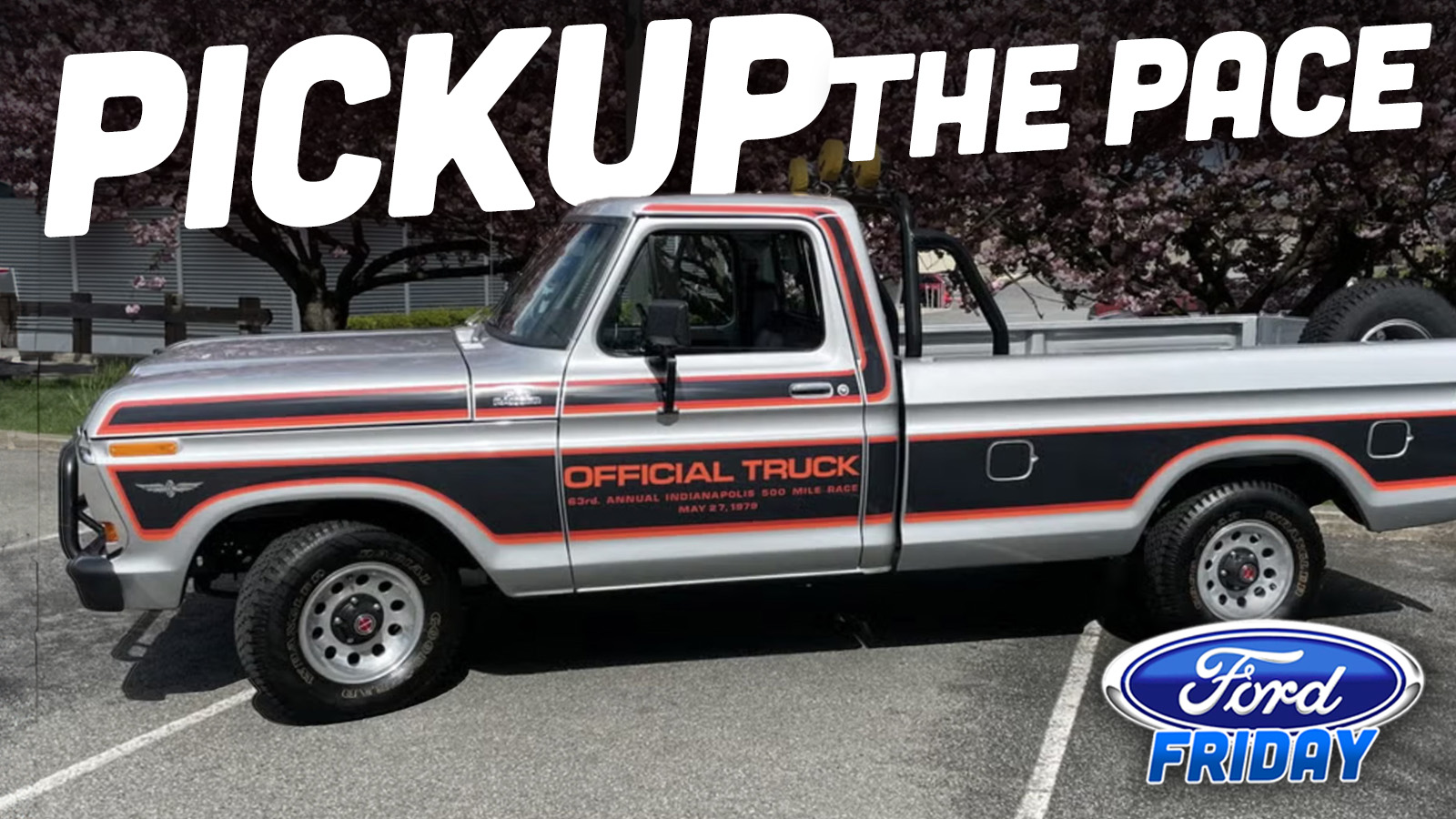
You’re probably all well aware the cars that act as pace vehicles for races like the Indianapolis 500 are very different from the official pace-car replicas offered to customers. The “real” pace cars get engine and braking modifications that allow them to safely keep ahead of the competition and quickly get out of the way when the flag goes green. In general, replicas of such track vehicles at dealers are largely stock minus their pace-car stickers and other cosmetic changes. During the malaise era, that meant pace replicas were an order of magnitude down on performance compared to the real things lapping with the Indy cars.
The situation was so dire that in 1979, it’s possible Ford’s replica of the actual Indy pace car Mustang could have been slower than the replica “official trucks” F-series pickups used for anything that called for a truck at the 500. Today, the “Indianapolis Official Speedway Truck Package” Ford F-series trucks remain elusive reminders of how strange things got in those dark days; it’s also a pretty cool pickup to revisit.


Lil’ Red Express, Baby You’re Much Too Fast
No matter how bad things might get with regulations and rules, there’s usually a workaround to explore and at least create a legal product that’s palatable. However, you’d better be ready for some rather odd products.
In the seventies, stringent smog and corporate fuel economy restrictions were changing the landscape of s0-called performance cars. As Jason pointed out in a post years ago:
Muscle cars, one of the most uniquely American categories of cars, were not transitioning to the new and, let’s face it, somewhat grim realities of the 1970s. The 1973 oil crisis was the first big blow to the thirsty, V8-powered brutes, and, later in the decade, more stringent emissions standards were making it harder and harder to build high-power engines that met the mandated requirements.
By 1975, when the catalytic converter became common, muscle cars as we knew them were all but dead, replaced with anemic pretenders like the pitiable Mustang II.
The truth was the carmakers just hadn’t yet figured out the complex problem of making a high-power engine that wouldn’t spew hydrocarbons into the air like an open hydrant in a ‘70s movie that took place in New York in the summer. It’s a tricky problem, and the result was that there really weren’t any fast, powerful muscle cars being built in the late 1970s.
Ah, but there’s always a loophole. Notice how Jason says there were no longer any powerful “cars” left? He didn’t say “trucks.” Vehicles with a gross weight rating of more than 6,000 pounds weren’t under the same scrutiny of emission controls and CAFE fuel economy requirements as cars. The idea was for the government to take it easier on commercial-use vehicles, but it became obvious to some clever souls that a heavier pickup truck might just happen sneak below the radar as well.

Under the hood, Dodge put in a four-barrel 360 police interceptor V8 breathing out through vertical semi-truck-style exhaust pipes. Lil’ Red Express trucks got a stepside bed with real wood inserts, and they were all painted fire-engine-red; if that still wasn’t enough to stand out, Dodge put gold ‘Li’l Red Express Truck’ decals on the side doors. It looked like a five-year-old’s dream of a truck, but thankfully, the fun didn’t stop with the looks.
Its 225 horsepower doesn’t sound like much today, but back in the malaise, it was serious power, as Jason wrote:
For some perspective, a 1978 Chevrolet Camaro Z28 made only 160 horsepower, a ‘78 Ford Mustang Cobra II made a grimace-inducing 88 horsepower (okay, to be fair the 302 V8 made 139 hp), and a Dodge Charger, with a similar V8 and transmission to the Li’l Red Express, made only 140 horsepower.
In fact, a Car & Driver test of the Li’l Red Express in 1977 found that this goofy cartoon truck got to 100 mph faster than a same-year Corvette and a Trans-Am; a testament to how strange things got at the time. Ford didn’t make anything that so publicly flaunted this kind of performance loophole, but that didn’t mean you wouldn’t be able to possibly find a way to check option boxes and build something similar. What if you didn’t want a sleeper, and instead wanted to make your presence known to stand out from neighborhood landscaping pickups? Well, for 1979, you were in luck.
Not Exactly Something You Want To Rob A Bank With
I’ve made no secret in earlier writings about my general disdain for pace car replicas. Admittedly, I’m not the kind to draw attention to myself, but my bigger issue is taking a great-looking sports coupe like the ones that might be chosen to for an Indianapolis Pace Car and covering the lovely shape in a Halloween costume of billboard graphics. Still, I have a soft spot for some of the cars made to pace Indy in the late seventies. The black-and-silver 1978 Corvettes were tastefully done, but my all-time favorite has to be the first year Fox Body Mustang that paced the 1979 race with the still-underrated Sir Jackie Stewart behind the wheel. You can just hear him talking about “hoo eet greeps tha roood”.
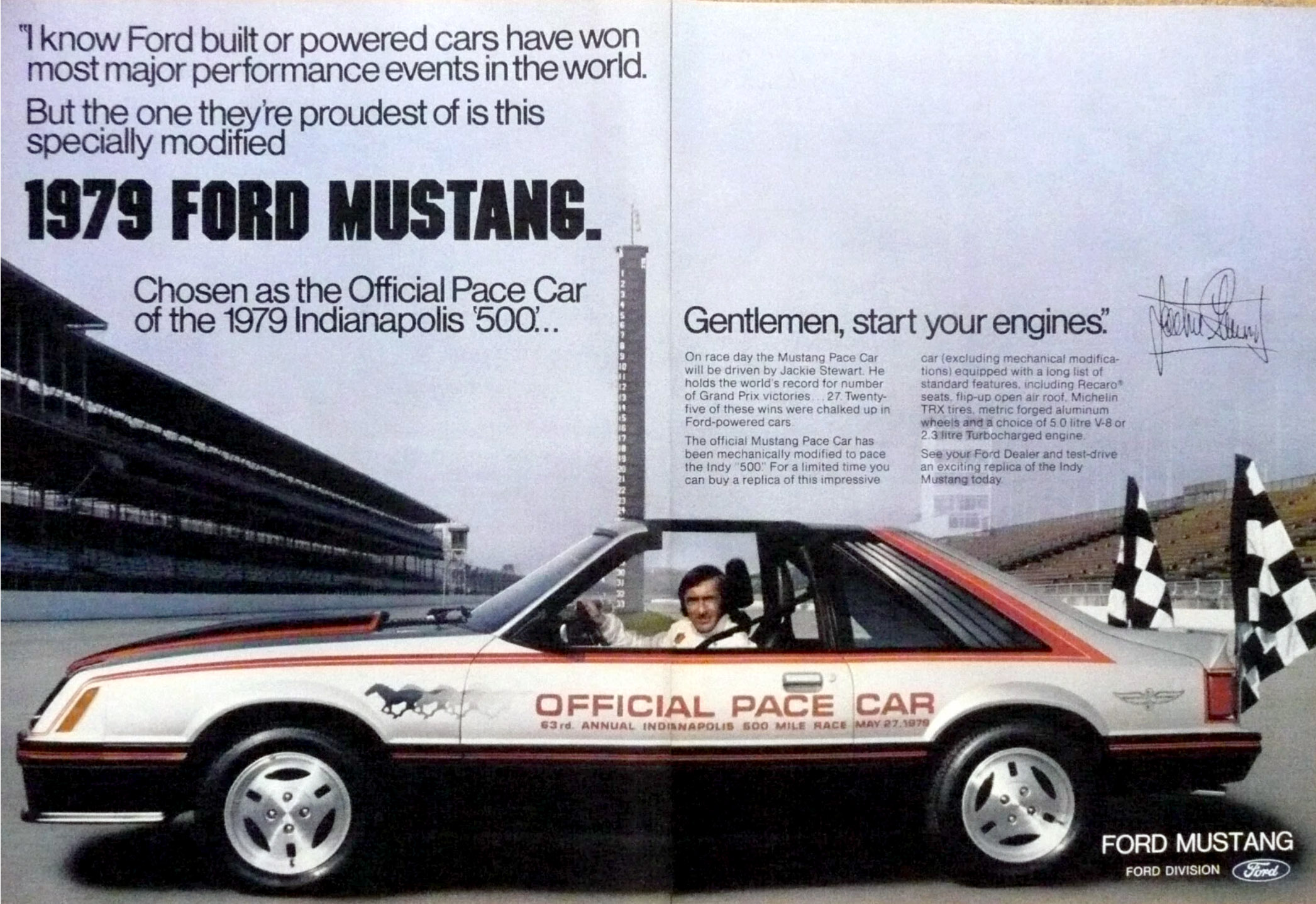
In a light pewter with black accents and very subtle orange graphic stripes, it balanced perfectly on that tightrope of being eye-catching yet not too gaudy – just a fantastic looking car on those awesome (and later hated) metric wheels. Mind you, back in this time period, the actual placards that read OFFICIAL PACE CAR in bold type were shipped separately for new owners to apply; I’d leave mine in the trunk, thanks.
As expected, the motors of the actual pace cars were far from stock. The 5.0L V8 engines were modified by Roush Industries with a new intake, carb, valves, and even Boss 302 camshaft, connecting rods, and crankshaft. The three “real” pace cars reportedly generated something on the order of 260 to 270 horsepower; plenty to provide the 90 to 110 MPH acceleration set as a requisite for actual pace car duty.
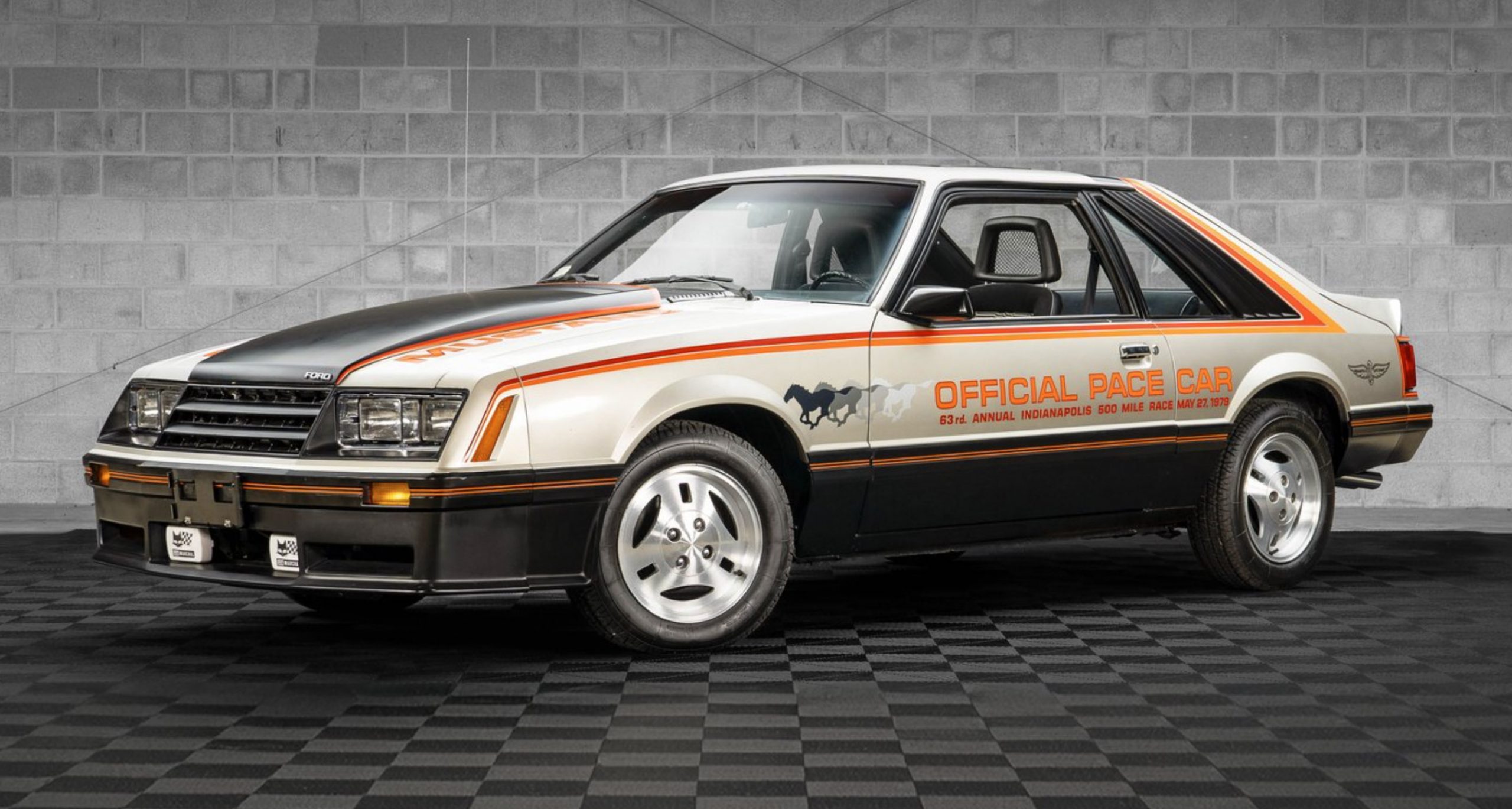
The 5,103 “street” replicas obviously had nothing close to this kind of output. The replicas could have been purchased with one of two drivetrain options. The turbocharged Pinto four produced a mere 132 horsepower; as with most carbureted turbo engines of this period, it’s considered All Bad today, and you’re not likely to find a properly functioning one (unless replaced by later, far better working units from the likes of a T-Bird Sport Coupe or Merkur XR4Ti). The 302 V8 was the better choice, but at only 140 horsepower, it was still a bit of an embarrassment; so bad, in fact, that you’d probably be amazed at some of the cars even of the time that could shut it down. Or, well, trucks that could.
Eff-One-Indy
Ford F-Series trucks have really never been about flashiness. These workhorses quietly moved off of dealer lots in insane numbers to be the number one pickup (if not vehicle) in the country for years straight. They’re driven by the non-nonsense guy at work who simply knows how to get things done; no matter how early you get to the office, there’s his F-150 in the parking lot.
Every now and then, though, Ford slips one through that has something extra. From the “Free Wheeling” package trucks of the seventies up to the Lightning performance trucks of recent years, they’ve occasionally offered F-Series that might not have been as whimsical as the Lil’ Red Express, but they still had some flair or packed a punch. The 1979 Indianapolis edition was one that could offer both.

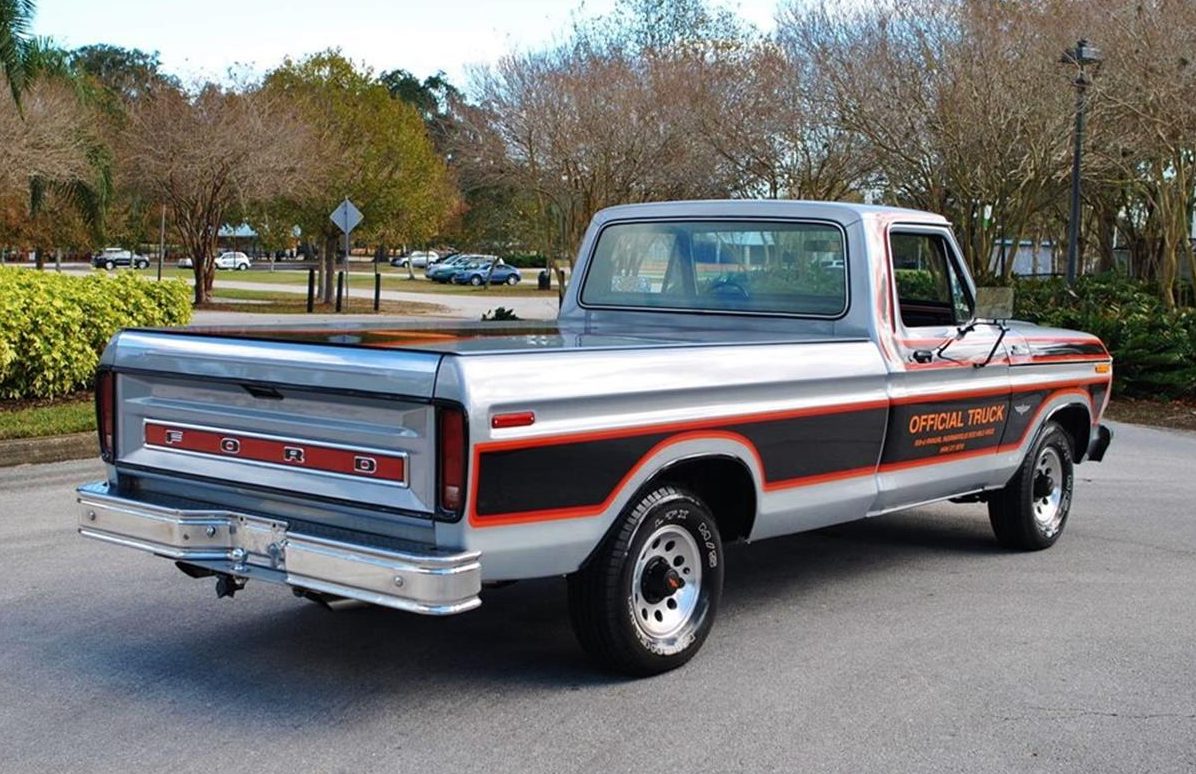
Admittedly, the Indianapolis was an appearance package, but it was quite an appearance package. Offered on F-100, 150, and 250s with the Ranger trim, the full scope of the package can be read below – but essentially what you see in the pics is what you get, including the aluminum wheels and what was called a “GT” bar instead of “roll bar” to keep Ford’s lawyers happy.
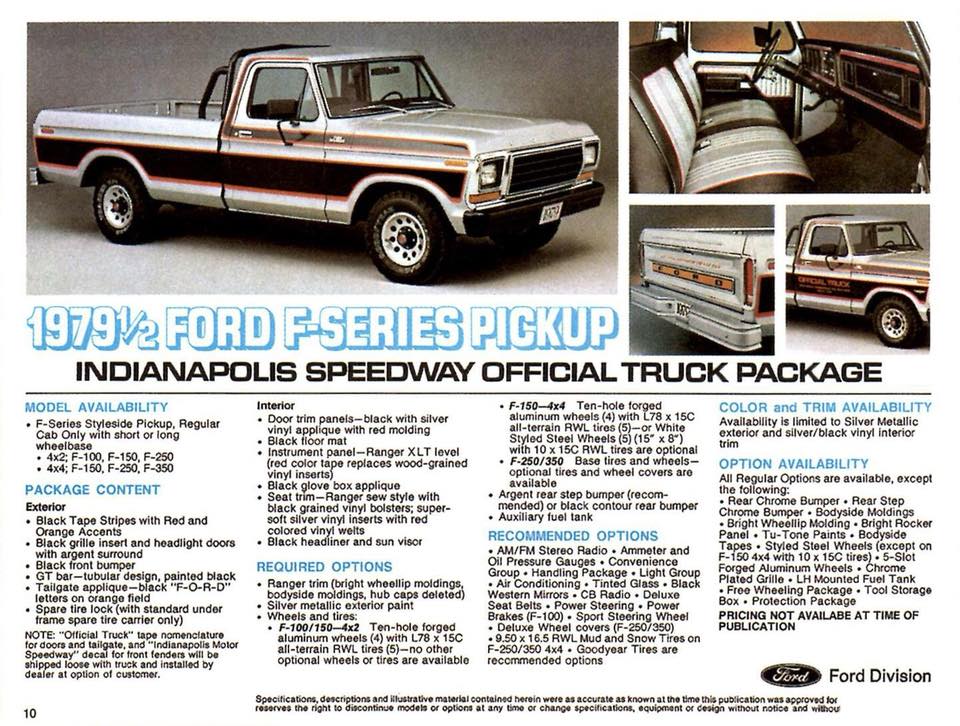
According to a Ford fan site, the actual number of trucks made is not verified other than the F-150 figures, but despite being available across the whole range, it’s pretty rare, with approximately 6300 made in total (no accurate records of the F-350 4WD seem to exist):
- F-100 2WD: 645
- F-150 2WD: 4,225
- F-150 4×4: 583
- F-250 2WD: 468
- F-250 4×4: 62
- F-350 Wrecker: 367
Wait – a wrecker? Yes, I couldn’t believe that one either, and they really made 367 of these things? If that’s really true, why?
Most examples I’ve seen have the aluminum wheels, but they were not usable on the F-250 and -350, requiring more standardized rolling stock to be used. Here’s an F-250 Indy truck listed not too long ago that inexplicably had chrome wheel covers off of Grandma’s LTD. Who would do this?
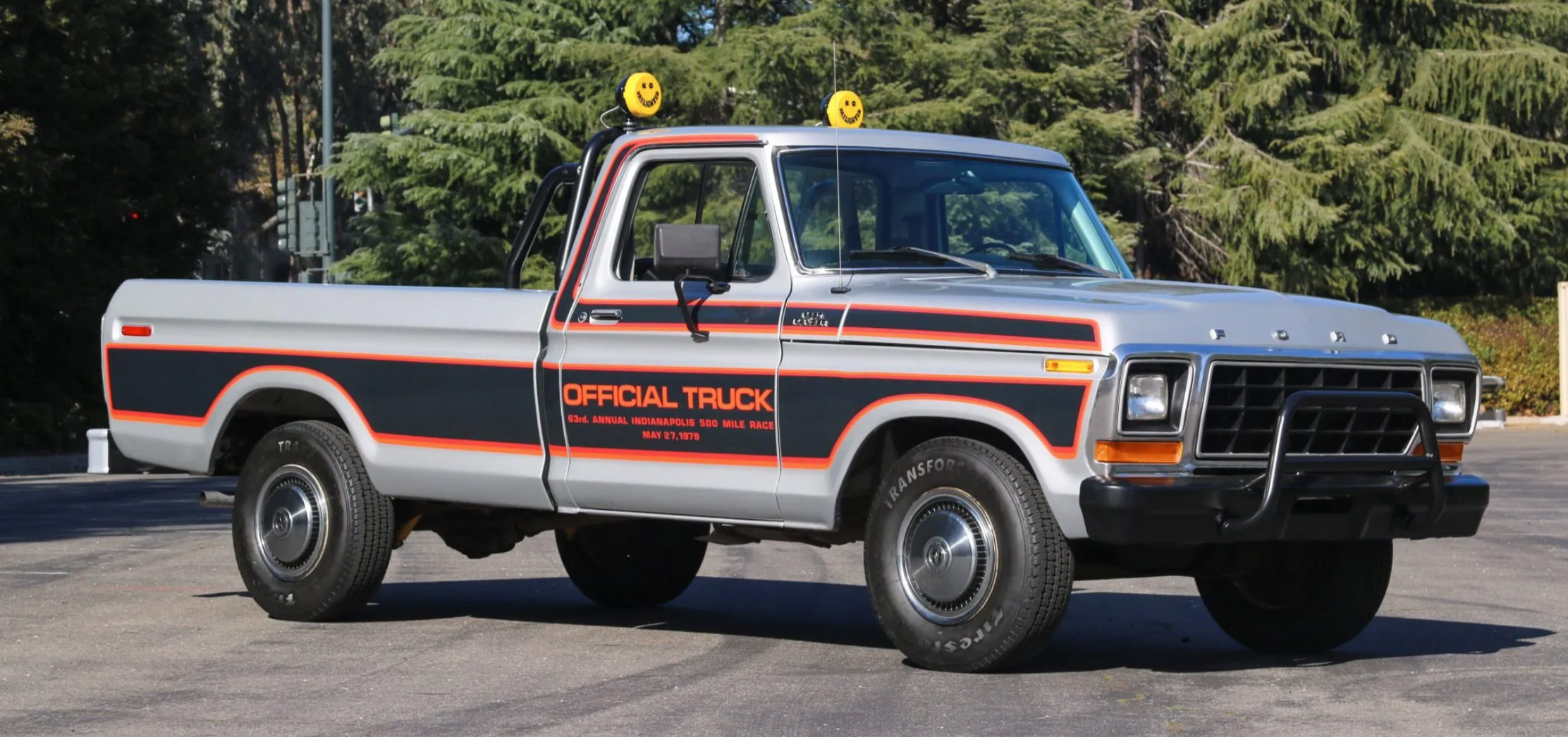
No chrome rear bumper was available, adding to the monochromatic look (again, spoiled by those damn wheel covers).
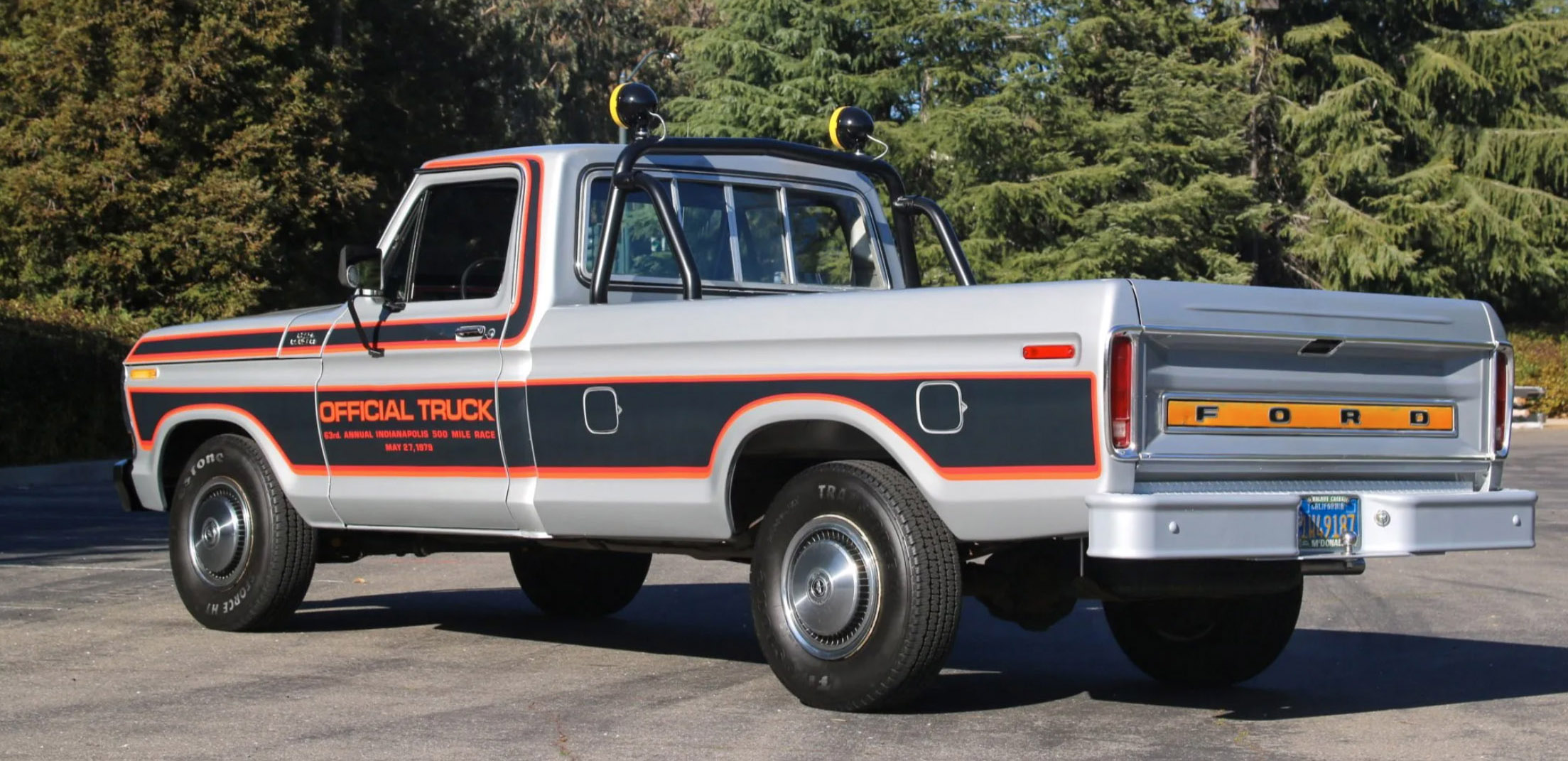
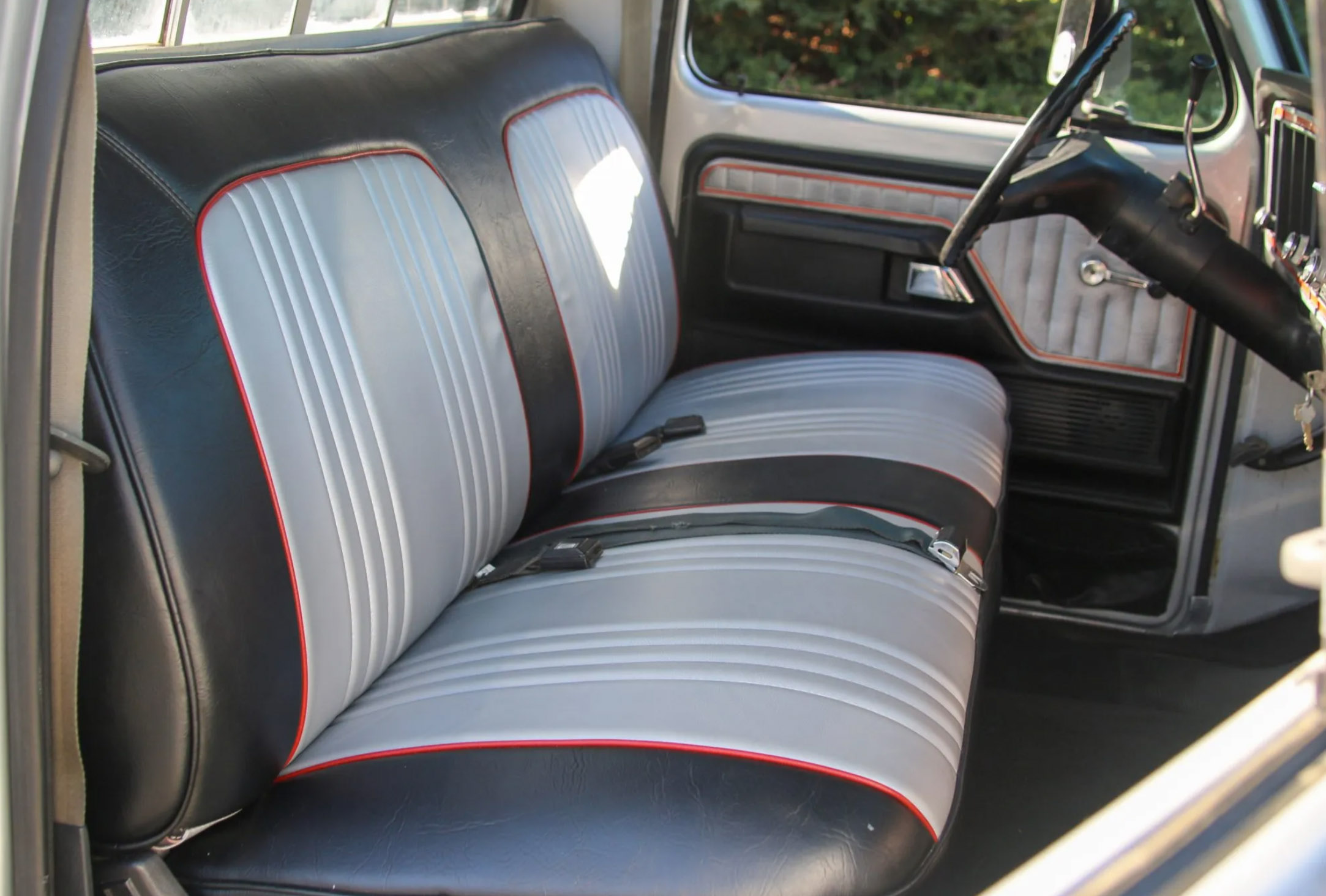
Inside, the Indy package went much further than many of these tape-stripe customs typically did. Special upholstery covered the bench seat, and all the fake wood was completely replaced by racy-looking red accents (similar to the trim on the “Freewheeling” package trucks). Subtle changes, but they changed the overall feel of the cabin.
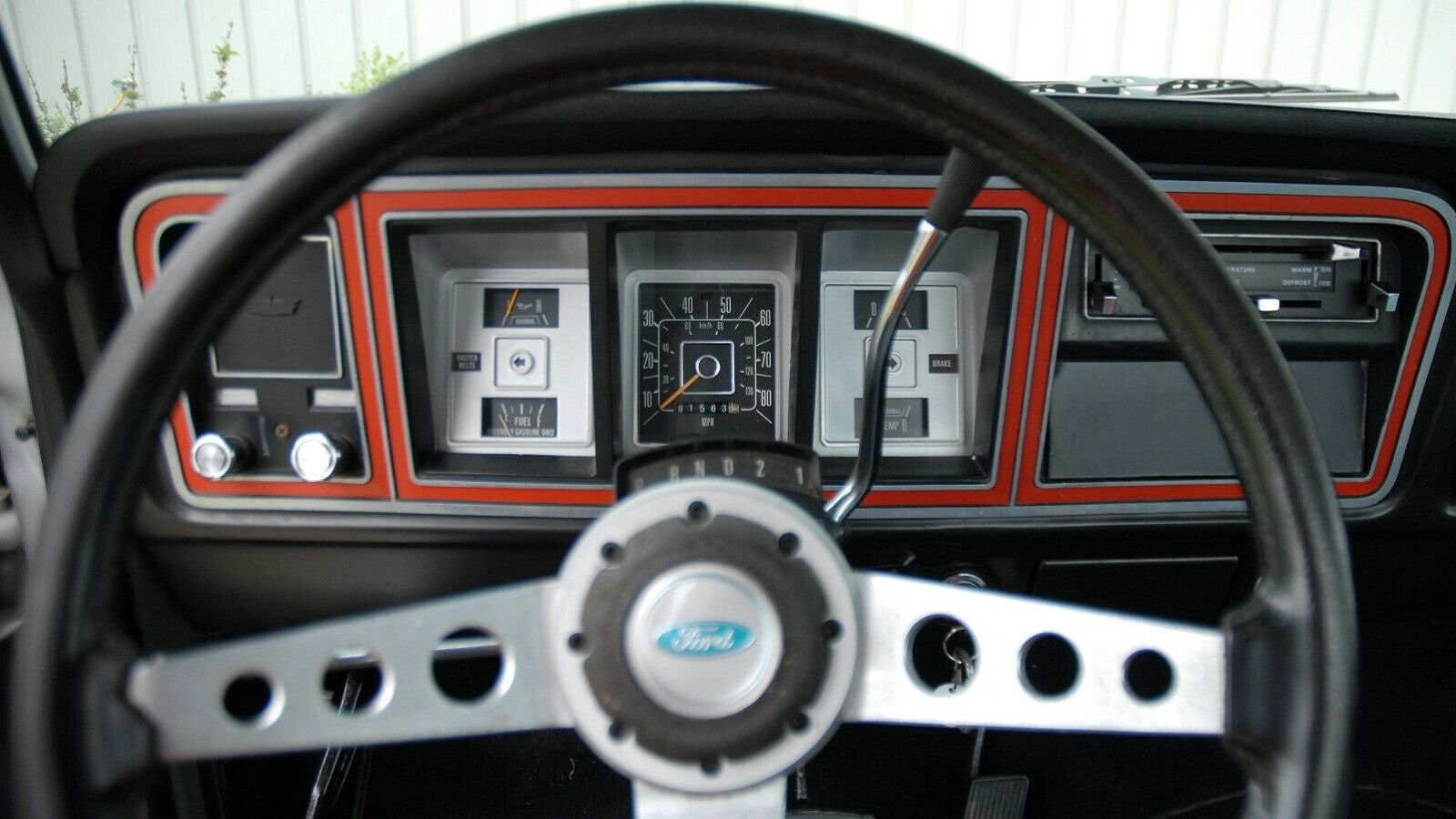
It really needs the sport steering wheel on the “recommended options” list to finish off the look; it’ a design that was over ten years old in 1979, and it really shows.

Full instrumentation, but if you wanted a tach, you’d have to grab a Stewart-Warner catalog and a steering column bracket. Note that the switch that’s usually the rear defroster on any Ford from the seventies up to the mid-eighties actually switches fuel tanks here.
Still, the big discovery I made in exploring the Indy truck turned out to have little to do with the special edition package at all.
Maybe The Truck Should Have Paced The Brickyard Instead
Remember how the Lil’ Red Truck was able to skirt the rules and add a high-powered motor? Well, the 1979 F-Series appears to have quietly snuck in a sleeper drivetrain to the usually straight-laced Ford.
Looking at the specs in the brochure and online, it would seem that as long as you stayed with 2WD, you could have purchased a half-ton F-150 with Ford’s biggest and most powerful motor: the 460V8.
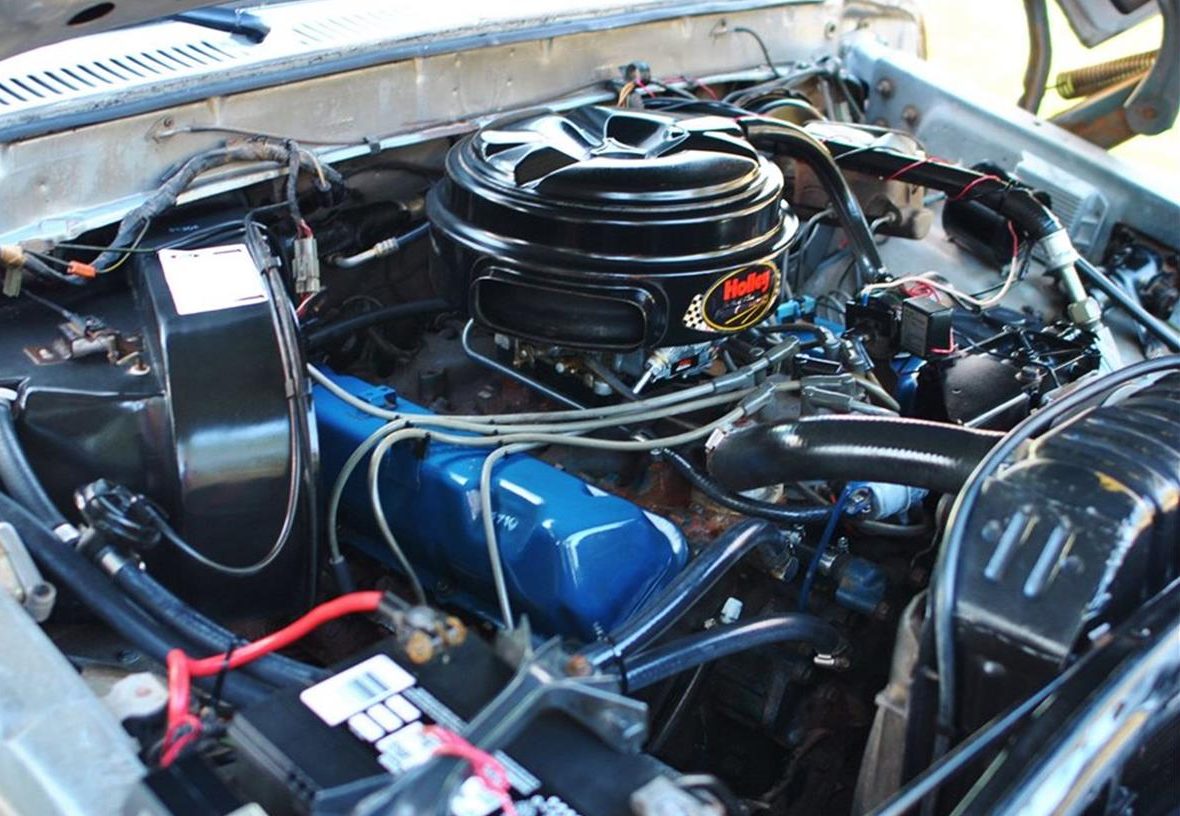
Being the malaise era, this engine pumped out a rather embarrassing 220-240 horsepower, but that’s still on par with the 225 that Lil’ Red Dodge was making. That same spec sheet also doesn’t appear to rule out the option of a manual transmission, and I’m sure that a variety of axle ratios were available. The one in the pictures just above and below was available a while back with the 460 specified, but just a column automatic.
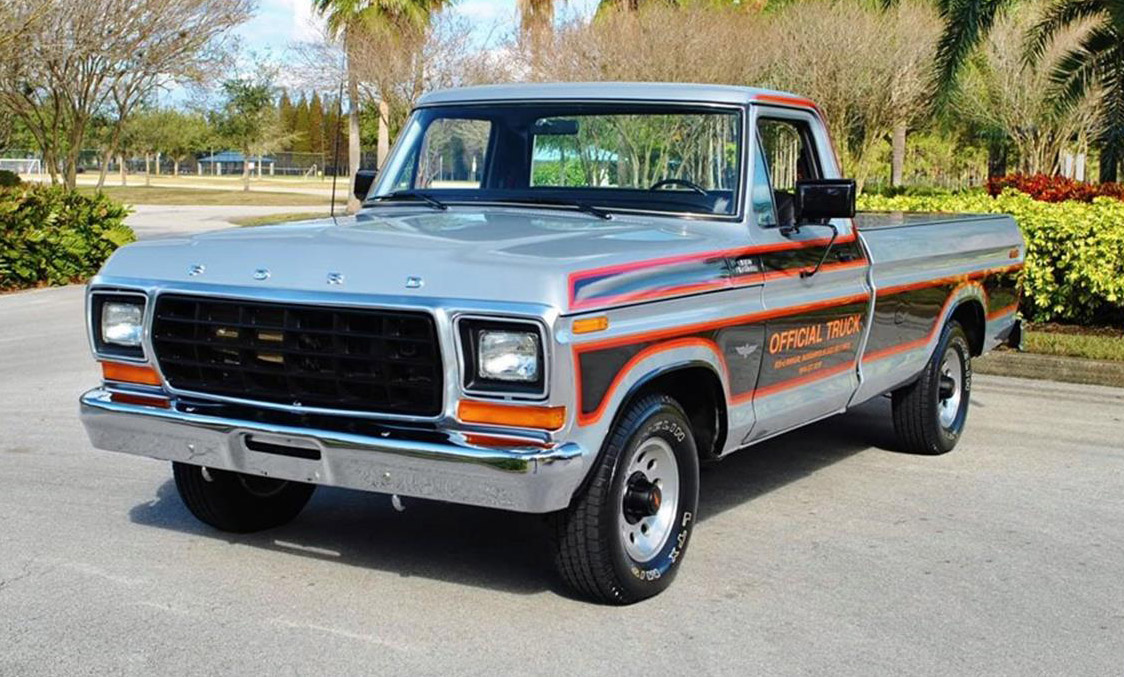
It’s essentially impossible to find zero to sixty times of an exact year and specification of truck (especially what axle ratio is used), but if we look online at those pesky calculators, we can generously estimate the Indy F-150’s weight at around 4000 pounds, so that would give us a time in the range of 7 seconds for the 460-packing pickup. That’s remarkably quick for any 1979 American car.
The Mustang Pace Car Replica? With the turbo, it would likely fail before the end of the track run, but the five-point-oh V8 using all of its 140 horsepower calculates out to around eight seconds. That’s in line with the few contemporary eight-cylinder Mustang tests I’ve seen online, though some are closer to the ten-second range. If not significantly faster, it’s certainly clear that, depending on the driver and conditions, a drag race between these two totally dissimilar machines would be close, and as long as it can hook up, I think that if the truck would win.
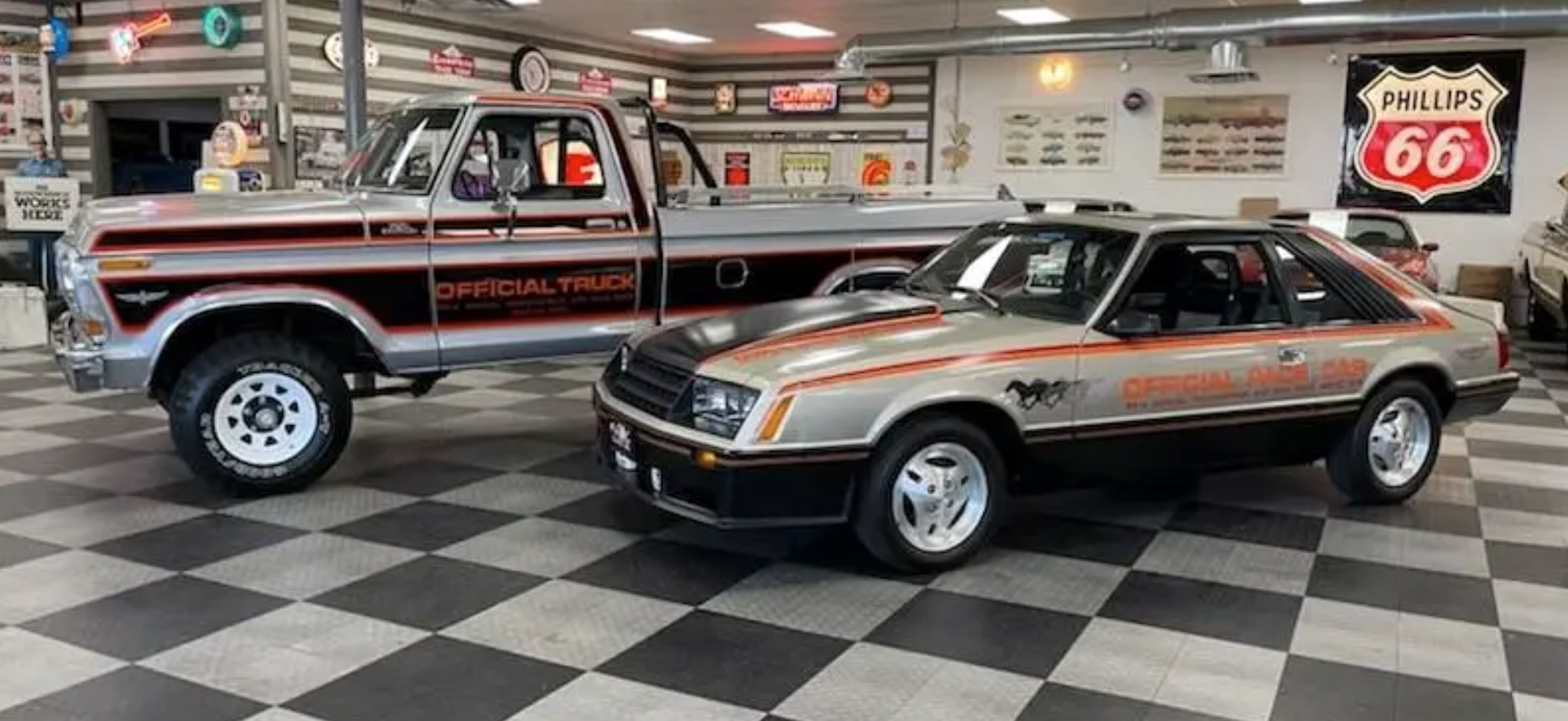
Am I kidding myself, or could this be true? Could you have specified an Indy Ford F-Series to not only compete with the vaunted red Dodge Express but also beat the replica of a Mustang sports coupe driven by the “Wee Scott” around the Brickyard? Whatever the case may be, if you’ve got a “Pace Truck” so equipped, we want a ride.
The Last Hurrah Of The Great “Dentside”
For 1980, the EPA got wise to this ruse and raised the GVR rating to 8000 pounds, effectively closing the loophole. Also, 1979 was the very last year of this much-loved F-Series after a run of over a decade, if you count the fifth generations that came before that were fundamentally quite similar. Even bone stock as workaday models, these props from a country music video are the essence of what an old American truck is all about.
I would guess that about 95 percent of you Autopians (and 100 percent of the writers) lack the means to go shopping for 1970 Boss Mustangs anytime soon. As you’ve probably figured out by now, the whole point of these Pontiac Pthursday and Ford Friday posts is to find left-field choices for us less-than-wealthy souls that will still draw a crowd at your local car show and be entertaining to drive there (and in this case, be unafraid to fill up the bed with mulch). The 460-powered Indy truck example shown in this article was listed for just under $24,000; I’m not sure what it sold for, but that seems like a bit of a steal for a great-condition, under-100,000-mile truck of any kind, much less a Holy Grail.
Regardless of performance, the Indianapolis truck was a fine send-off for this much-loved pickup style. For me? I’d still take that slow-poke Fox pace car, though.
Top graphic image: Bring a Trailer


“Dodge put in a four-barrel 360 police interceptor V8 …”
Ahem, isn’t “Police Interceptor” a registered trademark of FoMoCo?
If you’ve ever driven a Dual I-Beam F-series from this era, you’d know the last thing you want in one is a ton of power.
It’s a nonstop wrestling match to keep them going in a straight line, they turn like two shopping carts with a shipping container on top, and stop like the brakes are made from potatoes. Blasting to 60 in under 7 seconds in one of these would be poo-inducing.
I do remember the cool TV commercials Ford ran during space missions of that era. One involved having poles extending from the center of the left front wheel and another mounted to the cab. They’d drive the truck over a stretch of track with 4x4s and lined with very touchy flares of some sort. While the front wheel rod was causing all kinds of mayhem down low, the cab-mounted rod left its flares unmolested.
Here’s one from YouTube:
1970 Ford Truck Commercial – Featuring it’s Twin “I” Beam Suspension
That’s a good one! I guess it’s a little bit better than a beam axle. They were also way overbuilt and pretty much invincible, so I gotta give the ol’ Twin I-Beam a little credit.
Fun fact, that 6,000 pound GVWR emissions loophole is why the F-150 exists. The old F-100 was just below 6,000, like 5,800 or something, so Ford introduced the F-150 in 1975 with a GVWR of 6,200. I think all they did was put stiffer springs in it and maybe change gear ratios but everything else was the same. The F-100 stuck around until the early 1980s but was offered as a lower tier model with less and less options as the years went on.
“The truth was the carmakers just hadn’t yet figured out the complex problem of making a high-power engine that wouldn’t spew hydrocarbons into the air like an open hydrant in a ‘70s movie that took place in New York in the summer.”
So what about gray market imports during that time?:
“From 1976 to 1988, individual Americans were actually able to obtain cars conforming to World Forum for Harmonization of Vehicle Regulations standards and “convert” them to vehicles compliant with U.S. regulations – this was known as the “grey market,” in that it was a legal activity parallel to officially sanctioned manufacturer efforts”
Living in the heart of Silicon Valley I recall seeing no shortage of 911 turbos, Lamborghinis, Ferraris, Panteras and other supercars from that era. I don’t imagine ALL those owners managed to find shops willing to sign off on an unmodified or poorly modified car to get through CA smog.
“It’s a tricky problem, and the result was that there really weren’t any fast, powerful muscle cars being built in the late 1970s”
Except Honda shamed GM by doing exactly that:
https://www.jalopnik.com/when-honda-gave-gm-one-of-historys-most-amazing-smackdo-1576732771/
Thanks, that is a great story. I also appreciate reading some of Jason’s work on the old site.
That said, now I remember why I don’t go there anymore. My God the Ads! It’s more ad than content.
I used to think the same about the whole Honda vs. GM thing with emissions. Until I saw a vacuum diagram for the CVCC system: https://www.autoweek.com/car-life/but-wait-theres-more/a1860746/run-away-screaming-1985-honda-cvcc-vacuum-hose-routing-diagram/
It’s ugly but that diagram is for the’84-87 models, nearly a decade later when standards were even tougher. Which is why most car makers, including GM were already moving over to EFI.
Pretty close to my ’78 California FJ40.
That looks scary, but in typical Honda fashion, worked flawlessly. I owned a 1987 Civic that had that exact house routing that I bought with 200K miles that I drove for years including across the country. The car was 25 years old by then. The vacuum lines never acted up and it passed CA smog (as in run it on a chassis dyno and measure tailpipe emissions). Paid $500 for it, as it had been previously owned by 2 college students, so it had not been babied.
Eventually, I let the car sit for years (gave it to my dad in ill health, who didn’t drive much). When he died, I had a new timing belt for it, but I thought: let me drive this to work (50 miles round trip) before spending the time to change the belt. The teeth came off the belt on that drive and pistons and valves collided.
That was such a great car – an 1800lb 4 door sedan with a stick shift that had lift off oversteer when you went full hooligan on it.
My dad had a salvage titled ’87 Corolla he had picked up cheap with a carburetor and a rats nest of vacuum hoses that decidedly did NOT work well. Unfortunately the fault was a very intermittent cutout on acceleration that affected one or maybe three cylinders, cutting them in and out so the already leisurely acceleration was unpredictably borderline dangerous with a badly stuttering engine.
I could never prove it was a vacuum leak, maybe it wasn’t but that rats nest of tubing, the intermittency, my lack of skill and my dads unwillingness to pay someone competent to fix it ensured it was an issue for as long as my dad owned that car.
The timing belt part of this story makes me sad.
That’s amazing..
I had a friend in high school who managed to get a bright yellow ’75 CVCC Civic five-speed during his senior year. Good Lord! That was such a fun car to thrash. A spirited engine, great shifter and handling that, up until the limit, felt like it was on loan from a go kart. Then it would safely transition into relatively benign understeer until you stopped asking too much of the front tires.
Unfortunately my only HS story regarding one of those was tragic. A group of kids went off campus for lunch and on the way back decided to “get air” on a hill. What they didn’t know was there was a garbage truck stopped just on the other side out of sight. The CVCC flew into the back of the truck with predictable results. One of the kids killed was my lab partner who was nice to me despite being pretty and popular.
I appreciate the performance of those early CVCCs but I wish they would have had better crash protection.
I’m sorry for that memory and your loss. Sadly, freshman year of college, my friend was out with his girlfriend one evening and got T-boned on her side of the car. She died and he was unhurt. I’m sure the Civic was sturdier than the ’68 Datsun 510 wagon I was driving at the time. But that’s not saying much. People in crashes in some of the cheapest cars available now walk away from crashes that would have been fatal 30 years ago.
Thank you. TBH I had only known her for a couple of weeks so my memory of her is very limited. I am sure your friend felt the loss of his girlfriend much more.
Totally agree that cars today are way, WAY safer than their predecessors. My favorite recent(ish) example is the modern(ish) Altima, the direct descendant of the Datsun 510:
https://www.motorbiscuit.com/woman-receives-minor-injuries-when-semi-truck-flattens-her-altima/
Of course YMMV so I wouldn’t go around brake checking fully loaded semis in an Altima hoping to cause a similar horrific crash and fake an injury (while actually being OK) for a big, fat payout.
As I feel compelled to bring up the graphics, for me, a great compromise for both would be to leave off the “official…” door decals but keep the small Indianapolis Speedway decals.
Tasteful, and the people you’d actually want to impress would get it.
Not to be difficult, but those wheel covers don’t look bad at all. I still have a soft spot for fender side pickups.
I was picking up a car at used car dealership/ personal museum and had to drive around back. Sitting there was a 79 extended cab srw with some massive exhaust pipes and two lp tanks absolutely filling the bed.
I asked the guy as I was leaving about it. Said it was an old friends 460 powered tow rig. It had two holset turbos and ran on propane. He ran the two 100 gallon propane tanks so he could tow across the Rockies without stopping to fill up.
I bet it was fast in its day.
Not a Ford or a Dodge but when I was a teenager my best friends dad drove a mid 70s Chevy half ton with a 454 4barrel. We would sneak that thing out after he would pass out on the couch. That truck was a BEAST!
Dad had a Chevy Silverado with the 454 in the 70s and it to was impressive on the speed. My brother could lay down a long track off of a red light. Dad always wondered why he was going through tires so fast.
I borrowed a coworker’s 1/2 ton Chevy of that era, the gas pedal seemed to be stuck or stiff, until I really pushed it and OMFGBBQ!!!!!
Turns out it had the 454 with Dart heads and an intentionally strong set of springs on the throttle..
I might be an outlier, but I kinda dig the wheel covers in this application.
I had one of these for a brief time in the early 00s. It was rescued from behind a farmer’s barn in central Illinois.
It was fun but definitely not quick. That engine ran completely out of breath at 4000 rpm. It was pretty neglected though.
I did find some comparative specs for a 1978 with the 460.
1978 Ford F150 Ranger Lariat
2WD 4560lbs F150
460 4bbl automatic 3.25traction-lok
17.8@79 1/4 mile
0-60 9.8
The truck absolutely would’ve beat the Mustang in a drag race (at least stock) – Car & Driver reports a 17 second 1/4 mile for the Mustang, Car Craft did a comparison test of big block trucks where they got a 460-powered F-250 to do 16.32 seconds (and yes, the lighter F-150 might break 16 seconds).
https://www.73-87.com/7387info/articles/77bbb01.jpg
https://www.73-87.com/7387info/articles/77bbb02.jpg
https://www.73-87.com/7387info/articles/77bbb03.jpg
https://www.73-87.com/7387info/articles/77bbb04.jpg
https://www.caranddriver.com/features/a15141682/archived-1979-ford-mustang-and-capri-feature/
Great, now I’m shopping old trucks again.
You’re welcome.
Too bad you can’t get an F-150 today with a Godzilla. Maybe Trump neutering CAFE will bring it about.
Didn’t Mercedes drive one a few years ago?
Are you thinking of the FP700?
https://www.theautopian.com/i-drove-the-absurd-base-f-150-with-a-warrantied-700-horsepower-supercharged-v8/
If so, it’s a Coyote motor with a supercharger, not the Godzilla. Still an awesome truck, though.
That’s it. Thanks for the clarification.
You can even get one in California. Just gotta drive it around the block stock first.
Opportunity for a Ford F1 special.
Make mine a F150. 2WD. 460. Love it
“Here’s an F-250 Indy truck listed not too long ago that inexplicably had chrome wheel covers off of Grandma’s LTD. Who would do this?”
Those aren’t off an LTD.
Those are Ford “Deluxe Wheel Covers”, as called out on page 19 of the 1979 Ford Trucks brochure and shown elsewhere therein.
https://xr793.com/wp-content/uploads/2016/11/1979-Ford-Pickups.pdf
Dad’s 1973 F100 Custom came with them, and his 1980 Ford Courier XLT had similar hubcaps.
Aluminum wheels were only a required option on the F100/F150 Indy package.
They were not a required option for the F250 with the Indy package – and back then, hardly anyone chose aluminum wheels for their new F Series.
They were just too expensive.
I know, but those wheel covers look like polished wingtip Floorshiems on Indiana Jones
Kind of the point.
Local guy has a big block 70s era Camaro.
Tubbed with massive custom wheels in the back inset to stock width.
Base level Camaro hubcaps on all four wheels and a stock looking exhaust.
Not unrelated, all leather black shoes with black rubber running soles are a thing for secret service, military contractors and old school geologists that still walk the ground in a jacket and tie, and outperform the kids that never leave the esri platform on their laptops.
I would be surprized if an Indiana didn’t take a similar approach.
I know they were around in the 30s and 40s, as it comes up in books of the era.
I’ll tell you what, though, Florsheim sells a pretty stylish and decent quality shoe for the money
They’re no Allen Edmonds, but at least respectable
My family has a ’78 F-250 with a 400 and a four-speed. I don’t know what rear-gearing it has, but up to about 70 it’s a quick, quick truck.
Yep, I had a 78 F-150 4×4 with a moderately built 400 and a 4 speed. It could roast it’s 35″ tires for city blocks. It was also passing cars while going up I-40 in NC (steepest section near Asheville) while towing my 300ZX on a trailer.
We used ours to haul various truck campers (70s vintage, so H-E-A-V-Y) and my father always said it got 11mpg, empty or loaded. He’s currently doing a engine out rebuild an a refurb, I can’t wait to drive it. Last time it was on the road was ~20 some years ago.
Yep, 11 sounds about right. I sadly flipped the truck while braking for some deer while towing a boat (boat survived) and I replaced it with a 88 F-250, 351W and C6 AT. The 88 had less power and got the same 11 mpg no matter what, and was a lot less reliable. Now I’m in a 14 Ram 1500 Hemi, and I’d say the power is about the same as that 400 in the 78, but mpg is so much better, I get up to 20 mpg on the highway, 15 around town, and only dip to the 12 range when I’m towing my big boat (~7k lbs.) I have the low 3.92 gears as well. Plus leather seats and AC are really nice, too!
Glad you’re okay!
When my dad ordered our ‘78 he special ordered it. He didn’t trust the automatics so went with the four-speed and you couldn’t get AC with that transmission.
So. Many. Hot days sitting in the middle of the bench seat sweating on trips to the Outer Banks from Upstate New York.
Nice, I used to drive my truck to the OBX all the time and pull people from out of state out of the sand. I don’t really fish, I just like to drive around on the sand. Went last year and they have basically ruined it from how it used to be.
I take my Grand Cherokee down to drive on the sand, this year I’m taking my Tundra. RI also has beaches that you can drive on as well, in fact sometimes I detour and drive on the beach for part of my commute.
You just highlighted on of the main problems. You used to be able to drive on the beach at one of the access points, and then drive 10 or so miles down the beach, get back on Hwy 12, drive around a little town, then get back on the sand. So you could drive from the S border of Pea Island NWR all the way to the lighthouse largely on the sand. Now each access point is blocked off from the next one, so you can’t journey all the way down, you can access the beach, drive N and S of the access point for a mile or two, but have to drive back to the same access point to exit and go to the next on on Hwy 12. Plus there is the $50 price for the access permit, it used to be free.
I guess I didn’t realize that it was blocked from one entrance to another, we usually go to Frisco to camp and head out to the beach for the day. Reminds me, I need to get some reservations in for this year…
Yeah, the section south of the lighthouse has a longer stretch you can drive on, but a lot is behind the dunes. You used to be able to drive on the beach from the lighthouse to past the ferry terminal.
This is not a complaint, has anyone else noticed the propensity of o and Zero to be flipped in articles ’round here? Is this some kind of code? I swear I saw the inverse earlier today of a 0 being replaced with an o, but I can’t remember where and I’m not scrubbing back through every erticle.
Is this some sort of cipher? Do I find out who the Zodiac killer was if I figure it out? Or is this a plea for help from DT being trapped in his driveway until he finishes the WWII Jeep?
Did anyone win the DT jeep-palooza? I only guessed 12 hours.
As of 3 hours ago he’s still going…. I think we should start calling him David The Tank Tracy.
Probably an A| Canary trap/barium meal test:
https://en.wikipedia.org/wiki/Canary_trap
Actually the 1973-79 F series are more closely related to the 80-96 version than the 67-72 version. The basic chassis carried through to 96 with changes to the stamped I beam suspension and the eventual switch from the Ford 9″ rear to the 8.8. The wheel base increased in 73 with the cab gaining 3″ of leg room, doesn’t sound like much but makes a big difference.
The Twin I-Beam started in ’65, and the cab has much more in common with the “dent-sides” than the bull-nose, so I’d say they’re still more in-line with the older trucks.
Having owned all three, I’d definitely say the 78 is closer to the earlier ones than the later ones. In fact I’d say the dent sides are the last of the old hard working trucks, while the next gen is the first of the modern ones, especially in the interior.
I’ll add in that by just changing the brackets on the seats, you can swap front bench seats between any year 67-96 and they fit perfectly.
A lot of hold over design on trucks.
Some receivers fit a ridiculous range of years.
Similar with many suspension parts.
With the 55 speed limit and low horsepower cars, is it any surprise that pickup truck became popular?
I had a 79 Lil Red Express I bought from a friend while in the Navy, around 1990. I loved that stupid loud thing. Of course I regret selling, like most of my vehicles.
TIL about the Ford Indy truck, and not caring about Fords, trucks, or Indy, I still think it’s pretty cool. Definitely the only one at C&C.