

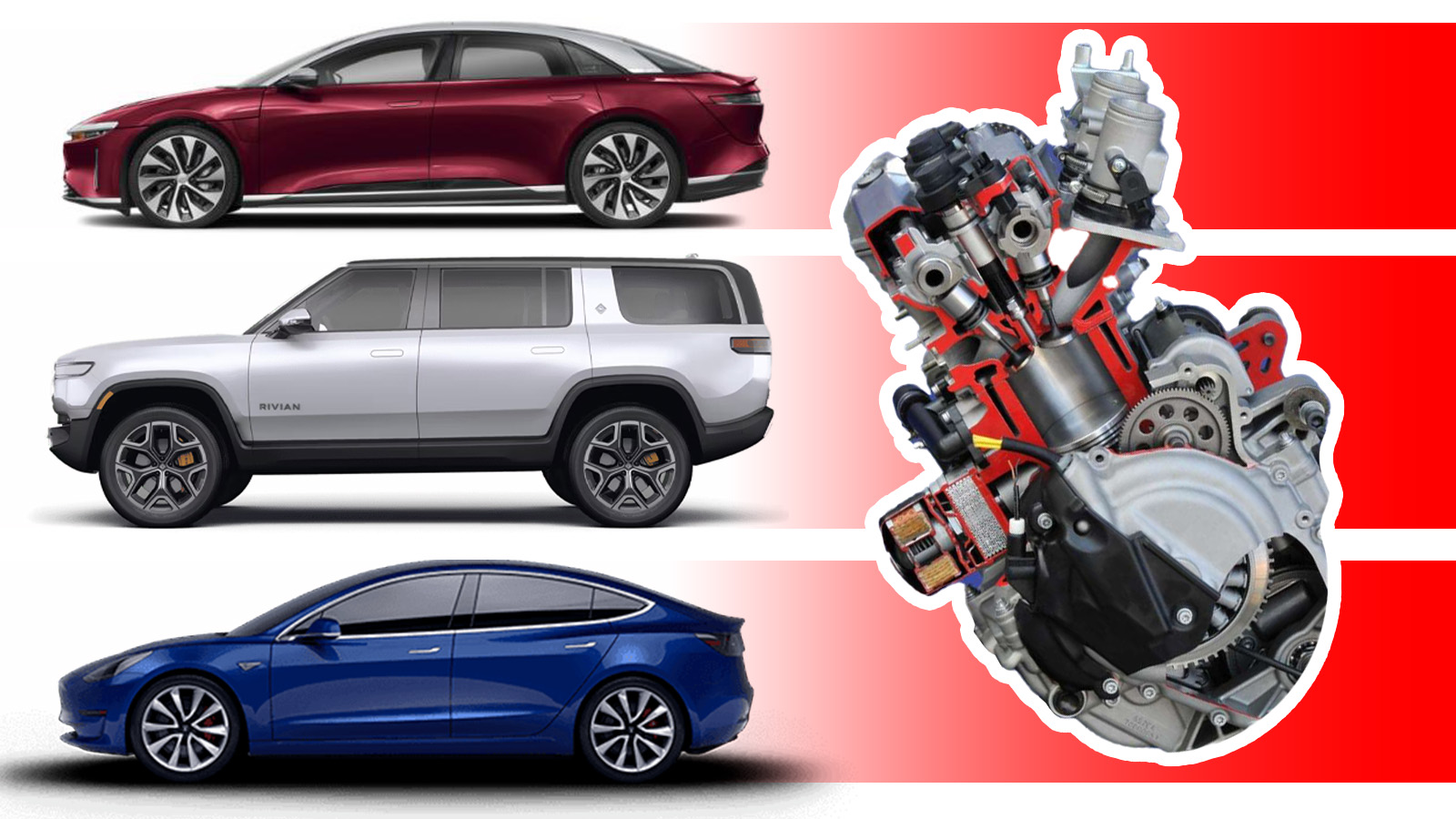
You could argue that an “electric car company” is not something that needs to exist, and that car companies should simply be Car Companies, not tied to any particular powertrain. But electric car companies do exist in the U.S. in the form of Tesla, Rivian, Lucid, Polestar, and Slate, and the reason why is pretty obvious: “Electric” was the hottest new term of the last two decades, and a necessary one to raise enough capital to get a new company off the ground. Pitching a hybrid car company to a group of investors would have been as fruitful as the messages I used to send on dating apps. But now it’s 2025, and that hot “electric” term is now lukewarm at best.
A few months ago, I was at a Rivian event in which I asked a representative if the company would ever offer a gasoline range extender. The answer was an emphatic “no.” I asked the same question at a Lucid event and received the same answer. “The future is electric,” is the refrain I typically get from folks when I ask this question. To which I respond: “What’s your point?”


Telling me what the future is doesn’t seem particularly relevant. We could all be driving flying cars in the future, but if you started selling only flying cars today, you’d be a fool. This reminds me of 2022, when GM announced it would skip hybrids because the future is electric. More specifically, per the Detroit Free Press, Mary Barra said:
“GM has more than 25 years of electrification experience including with the plug-in vehicles like the Chevy Volt …From that experience, our vision is for an all-electric future. Our strategy is focused on battery electric vehicles as they represent the best solution and advance our vision for an all-electric future.”
I remember thinking upon reading that: “Sure, the future may be electric, but you’re selling cars now, in the future’s past. Right now, people want hybrids.” As expected, GM backtracked on its plan to offer only EVs and to skip hybrids, and is now going heavy into the hybrid game (while still offering a solid array of EVs).
Too Many Companies Are Splitting Too Small A Slice
The future is electric, but today is not electric. Toyota understood this because they understand consumers, though they got dragged by journalists for not going all-in on the new hotness. But sales numbers bear out that hybrids are the answer, and what’s more, automakers like Rivian and Lucid losing absolute metric crap-tons of money on electric vehicles — and other car companies like Ford deciding it’s worth losing $20 billion to cut many of its electric vehicle programs altogether — goes to show that the market just isn’t there for fully electric cars.
Of course, there’s Tesla, a company that managed something amazing. Lightning in a bottle, you might call it. It was an American company that came out of nowhere, developed its own charging infrastructure, created electric cars that were generations better than anything up to that point, and offered the cars at a rather competitive price. They also had a larger-than-life CEO who was admired by most of the world at the time, and also, they made loads of money by selling ZEV credits to automakers running afoul of CO2 compliance. That credit system is likely gone in the United States, thanks to the new presidential administration.
I get the impression that many companies saw Tesla’s success as proof that a sustainable EV company can exist. But in my eyes, to try to replicate Tesla’s model is silly. Tesla is one-of-one. An outlier. I tweeted this thought over a year ago, suggesting that EV companies should hybridize ASAP:
My suggestions to EV-only automakers: 1. Be careful looking at Tesla and thinking “I want those sales numbers.” You are not Tesla. Don’t try to be Tesla. Tesla is an anomaly. And 2. Get on the range extender bandwagon as soon as possible. Transition back to BEV-only later. https://t.co/1b7H2jmfN0
— David Tracy (@davidntracy) October 25, 2024
You know who replied to that tweet? None other than Ford’s own Jim Farley, CEO:

Now it’s nearly 14 months later, and Ford announced that its departing fully-electric F-150 Lighting is being replaced by a range-extended F-150 Lightning.
Ford Will Add A Gas Engine To The F-150 Lightning To Create A 700-Mile EREV
Naturally, EV-diehards are not thrilled:
This is what happens when you make sh*t products. This has nothing to do with making EV’s; this has everything to do with making bad EV’s. https://t.co/f3kxBlR6Ul
— phil beisel (@pbeisel) December 16, 2025
Hybrids are not the answer Jim
The future is all-electric and autonomous
You should’ve taken Elon’s offer to license Tesla FSD years ago…
Not looking good for Ford https://t.co/vPdl8fBtc5
— Dalton Brewer (@daltonbrewer) December 16, 2025
This going EREV will almost certainly be better for the environment than the BEV.
100K people trading their 15 MPG F-150 for an EREV truck has more value than 25K people trading their Tesla for a BEV truck.
— David Tracy (@davidntracy) December 16, 2025
You can see my opinion on the matter in the reply above.
This seems like a smart move on Ford’s part. The truth is that fully-electric pickup trucks make little sense for the mass market, and if you don’t believe me, just listen to what the former CEO of Lucid (an electric car company that refuses to offer gasoline engines) told me when I interviewed him last year:
“But let me tell you the reality is, and it’s me saying this, that it is not possible today with today’s technology to make an affordable pickup truck with anything [other] than internal combustion.”
This is just reality, which is where major corporations have to live.
With Fully Electric Vehicles, America’s Love For Big Cars Gets Expensive
America loves large cars, and large cars typically have what’s called in the industry “a high Vehicle Demand Energy” (VDE). This is the energy needed to move the vehicles down the road, and though it can be affected by powertrain (because, for example, a gas engine requires more cooling, which can lead to more drag; an electric vehicle is heavier, which can lead to more rolling resistance, etc.), this is more about the vehicle in which the powertrain is placed than the powertrain itself.
America’s taste for large vehicles means we tend to drive cars that require lots of energy just to go down the road, and if that vehicle is, for example, a pickup truck (like a Chevy Silverado EV) or SUV (like a Rivian R1S), you’re going to need a massive battery to achieve the range that the average American wants. Both the Silverado EV and the Rivian R1S offer batteries over 140 kWh, with the former offering one over 200 kWh.
Add a big trailer to those vehicles, and even those giant batteries won’t be enough to overcome not only range issues, but recharging issues, as infrastructure still isn’t good enough, and pull-through chargers for trailer-pulling pickups just aren’t very common even in 2025. When it comes to towing, EVs are simply the wrong tool for the job, as I wrote last year.

With Lucid and Rivian losing billions of dollars annually as EV demand remains softer than expected (though we do have some early signs that Rivian is turning things around, with a few quarters of positive gross profits, though net profits remain elusive), there’s an obvious question worth asking: Should these companies build cars that appeal to more than just a small electric sliver of the American car market-pie?
Rivian thinks the upcoming R2 and R3x will be enough. I have no doubt that they’ll sell relatively well, but I do have doubt about whether they’ll bring Rivian to sustainable net profitability. After all, the world already has cool, small electric SUVs like the Hyundai Ioniq 5 and the Chevy Equinox EV. And sure, you could say the world has lots of great hybrids, but the sales figures are on a different level. With hybrids, there’s more than just a sliver of the American market “pie” to share.
EREVS Are A Compromise That Can Minimize The Most Important Compromise
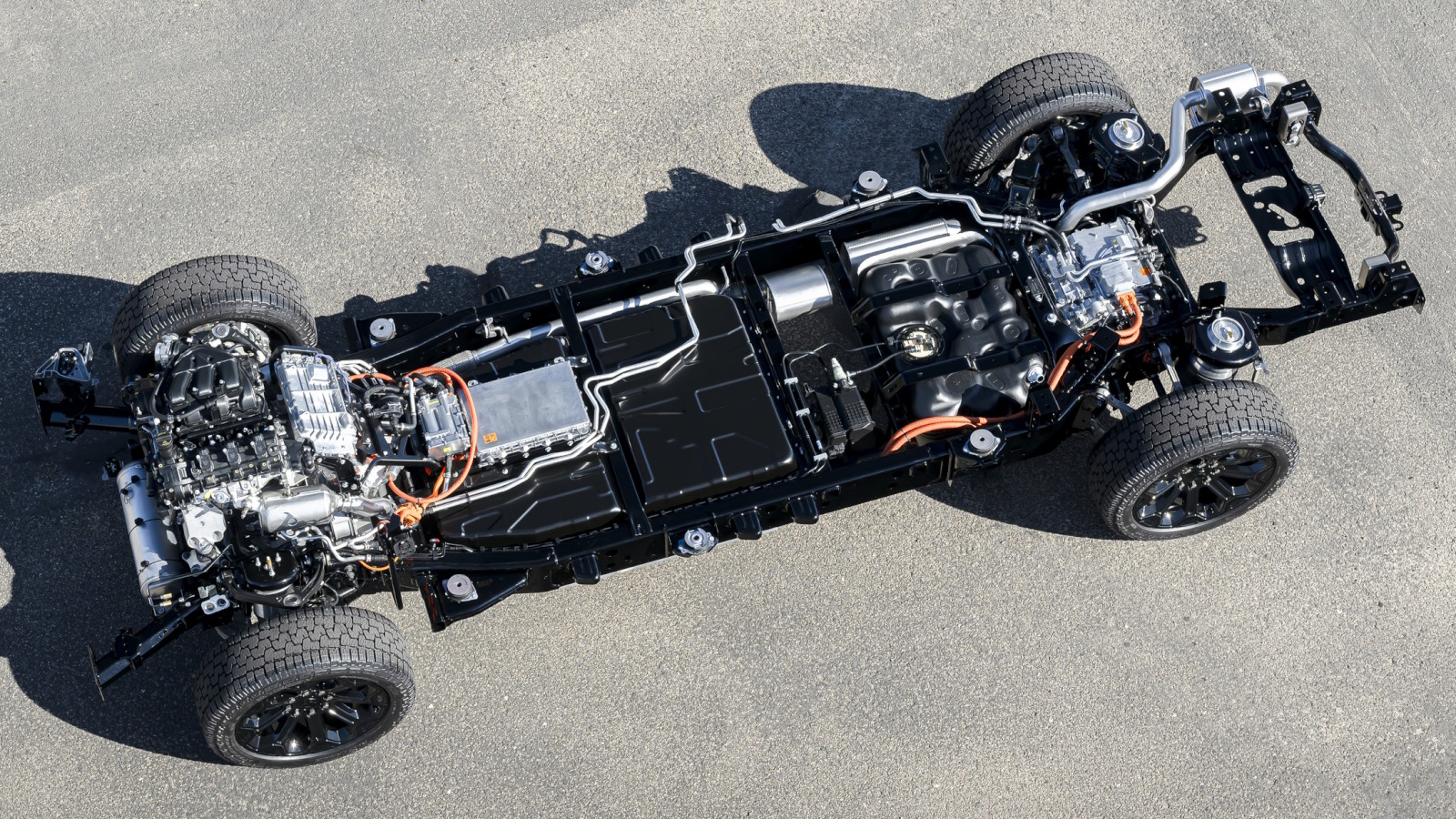
America wants hybrids; when Scout offered its vehicles as fully-electric or range-extended hybrid models, the majority of pre-orders were for the hybrids. And for good reasons. Though some EV purists call hybrids “compromises,” in truth, every car is a compromise, and a hybrid’s main advantage is that it’s actually a compromise-minimizer. If you think about the compromises that actually matter in the car world, it’s not compromises to packaging or complexity or even vehicle performance — what matters, big picture, is minimizing compromises to the way a driver actually uses their vehicle, while keeping the biggest compromise — cost — down. And in this way, hybrids are less of a compromise than BEVs.
I live in California, where the infrastructure is better than pretty much anywhere stateside. Still, charging a BEV can be an inconvenience compared to filling up a gas car, and what’s more, it can actually cost as much or more. I’m not saying charging a car here is bad — if you leverage the right apps, and are smart about planning, you can really get a lot out of driving a BEV (and you can save money on driving) — but the compromise is nonzero. It’s not about charging infrastructure or charging times or poor towing range — more than anything, it’s about cost.
Americans want to drive big cars, and they want to be able to not have to worry about range anxiety. This RA term is one that lots of EV journalists have historically dismissed. “Nobody needs 300 miles of range. 100 is just fine!” many say. In fact, here’s a Facebook reply to our story on Ford ditching the BEV Lightning for an EREV:
The Lightning is an excellent vehicle that won’t sell because truck buyers think they’re going to tow a trailer 500 miles every weekend. They won’t, and the range of an Lightning would actually meet their needs 99% of the time, but people stupidly make buying decisions based on that remote possibility that they might need extra capability someday.
The Gas Generator Doesn’t Have To Be Great Or Expensive

Are EV Car Companies EV-First or Environment-First?
OK, So There Are Some Huge Branding Problems

One topic I cannot ignore is the branding of it all. If a company has built its identity on a powertrain, things get tricky if they want to offer a different one. Rivian is all-electric, anti-gas. Lucid is the same. Tesla is the same. Since their inception, they’ve been no-gas, all-electric companies, largely because none of these companies would exist otherwise. How, then, can you maintain brand integrity if you offer a gasoline range extender?





Great article. Interesting that Farley’s reply came at a time of peak sales for Mach-E and Lightning.
Whether it’s therapy, healthcare, teaching, or consumer sales, there’s one important rule:
You have to meet people where they are at.
This is why I fully agree with DT on the EREV game.
So, a gasoline range extender was considered for the Model 3 early in development, in order to hit the original MSRP target. However, Elon Musk ended up canceling the idea due to the progress Tesla was making on reducing battery costs, and concerns that the brand identity was too heavily based around pure EVs
I think the window is rapidly closing on EREVs. They’re already only relevant for the largest vehicles or those who need to tow. They will always be niche, as they should be.
EV demand is slowing in the US but the world is forging ahead, even emerging markets. EVs aren’t the future, they’re now. They are grabbing market share hand over fist in most areas that aren’t the US.
Plus, the best part of an EV powertrain is the simplicity and refinement. I would hate driving an EV knowing I’m dragging a dirty powerplant that will generate noise and vibration whenever it turns on.
The U.S. market is a huge deal and can sustain (and has sustained) multiple car companies by itself.
And competing with Chinese BEV companies for the BEV markets in other developed nations won’t exactly be easy.
This sounds like a golden opportunity for Dongfeng and their new (claimed) 48% efficient ICE mentioned a few days ago. They may not be able to sell cars here but what about their range extenders to those who can?
I don’t understand why we didn’t start with this version of hybrids in the first place.
Being able to be fully electric for most of the vehicle’s life makes so much sense.
I had a 2011 lexus 200h that I really liked, but couldn’t get it to stay in battery drive mode for long enough to really have any effect
That being said @JimFarley please make a Hybrid Transit
I think it’s worth pointing out that a lot of this discussion is around large vehicles like pickup trucks and three-row SUVs. EREVs for crossovers (vastly more popular than pickups) will be obsolesced by more efficient EVs, better charging infrastructure, and faster charging times before they can even be brought to market.
My 2025 ideal powertrain for each car class is (@Matt morning dump question idea?):
Tier 1 (Trucks and 3 row SUVs): EREV or conventional hybrid (EV if it works for you)
Tier 2 (Crossovers and midsize SUVs): EVs with the occasional tiny EREV for the truly outdoorsy types (Wrangler, Outback, Land Cruiser, etc.)
Tier 3 (Small crossovers, sedans, hatchbacks): EV only
Of course that’s what I think it *should* be based on technology availability. What it *is* based on cars available to purchase is a totally different story.
This is correct, and as battery tech and charging times improve, EVs start making more sense in Tier 1 and 2 applications.
EREVs are great for trucks and towing, maybe large 3 rows. For everything else, EV only is already better and still improving.
There’s no point in investing in a mid-size EREV crossover or anything like that. Pure complexity and cost for a problem that doesn’t exist.
Anyone who is betting on better charging infrastructure in America probably ought to take a hard look at how we’re doing at maintaining the infrastructure we have.
My mom recently roadtripped a BEV from Michigan to Nebraska and it was a miserable, never to be repeated experience. BEVs are great in cities and will likely be awful for rural/sprawl areas for decades to come.
“In cities with high fuel prices (where I live in LA), driving electric daily is awesome.”
IS it?
Looking at SCE residential and EV rates for LA county it looks like you pay as much for power as I do in PG&E land:
https://www.cpuc.ca.gov/RateComparison
At $0.33-40/kWh you’re paying about as much for electricity as if you paid $3.39-4/gal for gas* (not including any charging losses). You aren’t that much better off filling up with wall juice than you’d be with dino juice and maybe worse off if you have to use more expensive public chargers or surcharge power.
Am I missing something?
* yeah I know your car calls for premium and yes it’s more expensive. I assume you being the heroic cheap bastard you are ignore that fearmongering noise like everyone else does.
I do ignore that lol. My car is rather efficient at 4mi/kWh, but it’s not just savings that makes it great, it’s the whole experience.
I’m sure the convenience of home/work charging is amazing. If you could not though I think you’d have a very different opinion of the EV experience. As it would be if you lived in a colder climate.
Come to think of it there was that LEAF you had too…
Yep. If I can’t charge at work or home, I’m not buying a BEV or EREV, I’m buying a standard hybrid.
And you haven’t even factored in the depreciation.
If you’re not charging at home, cost can rival, or sometimes exceed, the cost of a tank of gasoline.
In some areas even if you ARE charging at home, cost can rival, or sometimes exceed, the cost of a tank of gasoline.
Wait, rates go higher than that? Those rates are already double what I pay, even before the exchange rate.
Yes. We also have TOD surcharges for *REASONS!* which can double the cost of the electricity.
Serious question that I don’t know the answer to. Does an F-150 fit in a standard garage for easy charging? Seems like I see most parked in the driveway or street. I know people do charge them when they are in the driveway, but this would seem like a sticking point to get people to charge it overnight. Do they fit in a garage?
If your garage is 21 ft deep then barely.
My garage is almost exactly 19 feet long. My 2015 Dodge Ram with the quad cab (not crew) and short bed fit into my garage if I bumped the wall before closing the door. I couldn’t walk in front of or behind the truck, but I could get it in the garage.
When they came out with the 2019 versions the truck was ~3 inches longer in the same configuration. I opted not to upgrade as it would no longer fit in my garage.
If you have a deeper garage, a standard 7 foot height door is plenty of height and width, but length is a consideration.
EVs are the future, but that future is still a decade or so off given the cost, weight, and energy density of current battery tech. Solid state batteries are the technology that will make the EV pretty much universal by then. Until that point, EREVs are the most practical solution – your car can be entirely electric virtually all the time but a motor that runs at a single, maximally efficient speed can keep those batteries going for far more miles if needed.
And mechanically they’re far simpler than hybrids.
We’re tantalizingly close, despite the efforts of this administration to kill the EV industry. The basic concept is sound and the technology has advanced enormously in the past decade.
I love how the Ford / GM vs Toyota / Honda comparisons completely miss the completely different product portfolios that lead to very different technical approaches to meeting fuel economy regulations. (Which is the only reason any legacy company is building EVs or hybrids)
Ford and GM are at their core Body on Frame truck companies with the overwhelming majority of their revenue coming from North America. It is far easier for them to sell one EV to cancel out 20 trucks and meet regulations than to make the majority of their products hybrids.
Honda / Toyota are much more global companies who mostly make unibody sedans and crossovers, which are much easier to hybridize. They also sell into markets with much higher fuel economy standards than the USA so they have that hybrid technology already and at scale.
Two realities / two solutions.
No thanks, if I wanted to burn gas, I’d buy an ICE vehicle.
You’re probably still burning gas, just at the power plant instead of your car. (Small subset of people may actually charge with solar/pay extra for solar/wind/hydro power)
Much less gas due to the inherent efficiency of EVs, even if the fuel source is 100% dirty.
It’s also much easier to regulate and control the emissions from several power plants far from population centers than millions of cars driving around people.
Is that so?
“More than 60% of energy used for electricity generation is lost in conversion”
https://www.eia.gov/todayinenergy/detail.php?id=44436
That’s just the conversion from chemical to electrical energy. Add in the transmission, charging etc losses and a modern 40% thermally efficient ICE is looking pretty good.
If you’re going up the chain that far for electric cars, you have to do the same for ICE for a valid comparison. Plenty of inefficiencies and energy use in pumping, refining, and transporting oil based fuels.
Not so. Those are the just the power plant CONVERSON losses which is directly comparable to the conversion losses of a car’s ICE alone.
“With Lucid and Rivian losing billions of dollars annually as EV demand remains softer than expected ”
Lucid is losing billions, but with Rivian, they have steadily been improving their cost structure and have been reducing losses. And if the R2 vehicles are successful, that should result in them starting to make money.
Also, the companies that should offer gas range extenders should be the companies with experience making gas engines and already have them in production.
In my opinion, it would be a huge mistake for Rivian, Tesla or Lucid to offer this because they have no experience building gas engines… let alone meeting all the safety and emissions requirements surrounding an ICE.
Oh I’m definitely not suggesting they develop their own gas motors. And yes, I was sure to note that Rivian is looking better (a few quarters of gross profitability)!
I think the category problem here is that the number of people for whom a 100-mile AER “EREV” is meaningfully different than a 30-mile AER PHEV is basically zero. BEV trucks are a product whose time hasn’t come, I can acknowledge that. But they just need to be PHEVs.
with how well the Rav4 PHEV sells it’s baffling that toyota hasn’t made a Tacoma PHEV yet
Agreed. People like the RAV4 Prime so much they pay a price that isn’t remotely justified by fuel savings, because it’s so convenient.
I think that’s the sleeper benefit of BEV/PHEV/EREV: fewer or no gas stops. I have reverse range anxiety about my gas Sienna now because I’m used to my i3 and Prius Prime starting the day with a full battery, it sucks to have to plan around having to find a gas station and think about fuel prices and everything.
Yeah, in the winter when the engine runs in my Escape PHEV it’s so frustrating to have the gas go away just from around town driving. Gas is for road trips only!
If you just use ONLY the seat heaters and the heated steering wheel the engine shouldn’t run in the EV NOW mode and probably won’t run in the AUTO mode. Just turn off the fan/heater/ac.
The seat heater and heated steering wheel won’t defog the windows though. Nor will they help snow melt off the windshield if you’re driving while it’s snowing.
Yep. We’re probably a lot farther south than you are.
There’s an electric ptc heater on the coolant circuit, the engine doesn’t need to run in EV now mode at all in winter in my 2025 Escape PHEV, but the all electric range is pitiful trying to run the HVAC at ~70 f without running in HEV mode at temps below 30f, like below 25 miles of AER vs 37+ in the spring through fall when it’s ac season and the electric ac compressor is used.
But at least my Escape PHEV has an electric heater on the engine coolant/ heater circuit as my 2023 Hyundai Tucson PHEV turbo hybrid AWD has no electric heat besides the seat heaters. Therefore either I have to bundle up warm and hope the windows don’t freeze over or the engine runs and it is far less efficient than the Atkinson cycle 2.5L in the Ford, though sadly only the Lincoln Corsair GT gets AWD using the Toyota style rear electric motor vs the standard Escape HEV or the Tucson PHEV with the mechanical AWD.
I bought the Escape when they had 13k+ of rebates over their employee pricing program as an upgrade over a 2020 Escape HEV AWD though.
Weird, my 2025 Escape PHEV runs the engine aggressively during the winter.
In auto EV it will run the engine immediately if the climate demand was high enough, but in EV now it may say engine is enabled for performance but doesn’t automatically turn it on upon start. I find myself running more in auto EV if I need more heat or range though but it burns more fuel etc.
Like with the C-Max Energi, it will do that in cold temps if you have the heat and rear defroster on.
In really cold temps, it will also be using more energy to keep the battery pack above freezing temps as you can’t charge lithium batteries if they are below freezing temps.
Your experience with your Escape PHEV matches my experience with my 2017 Ford C-Max Energi… But with less EV range.
Due to the lower capacity battery, I only average around 22 miles of EV range in ideal conditions (though I’ve gotten as high as 25 miles using hypermiling techniques) and around 10 miles when it goes well below freezing WITHOUT the heater on.
And with the heater, lights and rear defrost on, I’ve seen as little as 7 or 8 miles of EV range.
But still, my overall fuel economy average since I bought it in the summer of 2024 is about 3.3L/100km… or about 71mpg (US gallons).
Congrats!
We just got our (daughter’s) 25 Escape PHEV from a local dealer. It was actually a courtesy car with 500 miles. Sold as new. Had a dealer sticker of over $42K. We walked out paying $25.5 before taxes and license. Too good a deal to pass up!” Another dealer 250 miles away had one with 11 miles on it for $27,9K (also a good deal) but we went local.
I checked autotempest (great site!) a few days ago and there’s still a few killer deals out there on them if you look far enough.
We also considered the Kia/Hyundai PHEVs but I will admit I prefer the rock-solid 2.5L FOMOCO engine. It’s a very reliable and efficient work horse.
it sucks to have to plan around having to find a gas station and think about fuel prices and everything.
That’s what Gasbuddy is for:
https://www.gasbuddy.com/
Isn’t there an advantage when it comes to packaging an EREV vs PHEV on an existing EV platform? I understand that there are numerous manufacturers making PHEVs so it isn’t uncharted territory, but a range extender is just an onboard generator/charger, which sounds like a simpler solution to me than adding another source of propulsion and requiring modification to the drive line for existing platforms. I think David is arguing that manufacturers should add an EREV option to their existing EVs.
Maybe! But the only extant example of doing it that way is the i3.
Nissan’s ePower is also a series hybrid – just with a small battery.
Which I think is part of why DT loves the i3. In theory I think they are superior to a PHEV because you can nix the transmission, and the combustion engine can be tuned to run at peak efficiency in a very narrow power band, but one drawback of the i3 is that once your battery is fully depleted you cannot just switch to combustion power like a PHEV would allow.
At the end of the day a PHEV or EREV would be a better solution for the majority of cars on the road vs traditional combustion engines!
one drawback of the i3 is that once your battery is fully depleted you cannot just switch to combustion power like a PHEV would allow.
The solution to that is to make sure the battery never gets that low unless it’s an emergency.
I think it’s a good thing. Electric trucks weren’t good at the truck stuff that people think they do all the time but don’t. And even with a half sized battery an EREV is going to be zero emissions for driving to work, Target or the gym for virtually everyone who uses an F-150 as a commuter car.
But so is a regular PHEV. We don’t need a new category of vehicle for what you’re talking about.
Right – a plug in hybrid is a hybrid with more battery, and a EREV is an electric car with more engine. Both cost more than a regular hybrid and probably won’t pay for themselves in the fuel savings.
Would I be down for a small, nicely packaged, generator that could drop in the bed of my truck of the trunk of my car when I need to go on a longer trip with my EV? Something easy to store that I don’t need to drag around 99% of the time? Something that would work as a backup during a power outage? Maybe something you could even rent or share with your buddy who also has a Ford EV? That sounds like something I could get on board with. But once you integrate all those systems into the vehicle itself we’re really just back to a hybrid framework with some different technical specs.
I mean, Ford’s $20B write down is just a numbers game of writing down the capital loss of their investment in that joint venture with SK and whatever they did with their Lightning factory. They’re just going to spread this out over several years to offset their tax exposure.
The idea that EV companies should invest massive amounts of money to hybridize their lineups is kind of silly. They won’t sell more vehicles because the who idea behind those vehicles is that they are electric. If Rivian started selling EREV vehicles, people wouldn’t buy them, and they would have had to invest heavily in entirely new manufacturing capabilities in order to do it.
I was thinking a similar thing, why would especially Tesla and Lucid put in all of the time, effort, and money to reengineer their vehicles, set up new supplier bases, and have expanded capability for maintenance of vehicles they sell to put in range extenders? I could maybe see the Rivian R1’s being a candidate for EREV options, but even then they were never meant to be volume sellers, so probably not worth the investment.
David, I agree with you. My comments are US-focused, not globally due to the current (and hopefully) near-term noise in our country. From my many years in the OEM and service worlds, working in advance manufacturing, manufacturing, product planning, product strategy, service & parts, and as a technician, I see the EREVs as a necessary evolutionary technology to bridge us to the EV future.
Where I don’t fully agree is with your BEV-only brand loyalty concern. Yup, Tesla is a mass producer OEM, no question. Again, in my US-only comments, I don’t see the risk of critical levels of customer abandonment from the BEV-only companies if they were to offer EREVs in addition to maintaining their BEVs. Give the customers a choice. Like car enthusiasts at this site, or car enthusiasts in the real world, we’re a very small percentage of the total customer base.
This feels right, I suspect for every EV purist Tesla/Rivian/Lucid would lose by offering EREVs they would gain several EV skeptics who have real or imagined needs that the range extender satisfies
I just figured it was a challenge worth mentioning, that’s all. Certainly not insurmountable.
TLDR, That’s a lot of words behind a concept that’s yet to be proven for this vehicle type in North America, and doesn’t offer more electric daily driving mix than a good PHEV. This EREV idea will work as intended for $70,000-$100,000 super trucks, but forget about affordability.
If these range extended pickups come to fruition for something even approaching the ‘more affordable than electric’ pricing that this site bandies about, I’ll replace my 2.7 Ecoboost lariat with one when it ages out.
Sadly, we all know that isn’t how this is going to go.
Look, I’m all for grabbing the low hanging fruit when it comes to electrification vs the moonshot. Someone explain to me how this EREV tech actually saves money or fuel over a PHEV with an 80 mile range.
I see PHEVs and EREVs as crossing on a venn diagram, but the issue I have with PHEVs is that in electric only mode, they are limited in power. Especially for something like a pickup towing, the PHEV would likely need to run the engine quite a bit, where the EREV should be able to keep the engine off unless it needs more range.
Say if someone is towing a trailer uphill 20 miles, the EREV could do it all on electric, but the PHEV, depending on its setup, would likely be down on power significantly in EV mode, so would need to run the engine to make it up the hill.
I don’t have any personal use case for large vehicles and towing and such, but if I did, I would take an 80 mile EREV that could tow 40 miles EV only over an 80 mile PHEV that would need to run the engine anytime higher power was needed.
Yeah, I hate the power limitation of a PHEV. You end up paying a ton of money, particularly for “premium” PHEVs (Land Rover etc) and you have under 200hp. No thanks.
I agree with a lot of the comments here regarding the practicality of EREVs. I’m confident they have use cases in areas where BEV range is a limitation. But the bigger barrier to light duty electrification is affordability and infrastructure. $5 billion dollars in federal funding to fund charging stations is moving forward in all 50 states (and DC and Puerto Rico) and EV charging station installations are still being installed by the private sector while becoming more standardized and reliable. Now we just need affordable EVs. EREVs don’t do that and actively work against the infrastructure buildout.
The time for EREVs was 10 years ago, when battery technology was in its infancy and vehicles like the Volt and i3 were sold. Battery technology and infrastructure has come far enough that the increased cost and complexity of an EREV doesn’t make any sense for most people.
I think that EREVs still make sense for large, heavy vehicles, particularly commercial vocational vehicles, but for smaller passenger vehicles certainly seem silly at this point. The i3 REx in 2014 made sense when batteries were much more expensive, but at this point, a 40 kWh EREV vs. a 60 kWh BEV doesn’t seem at all worth saving a couple thousand dollars and few hundred pounds in batteries to add in the extra complexity as you say.
On the other hand, for a large pickup truck that is actually regularly used for towing, being able to downsize a 200 kWh battery to 60 kWh seems worth the tradeoff for adding the engine, fueling system, exhaust, etc- for now anyway- if the low cost LMR batteries or similar are commercialized by the end of the decade at the 400 Wh/kg numbers that are supposedly possible, then that 200 kWh battery might only weigh a bit over 1000 lbs, and there might not be large cost and weight savings for the EREV even in a large pickup truck.
I would just get a hybrid over and EREV. Toyota and Honda have great and incredibly efficient hybrids that don’t rely on super large and expensive batteries. I think the market for EREVs is actually smaller than pure EV. If you have home level 2 charging, live in a populated area, and don’t tow things, an EV is a VERY low compromise vehicle (I’ve got one and love it).
Honda’s hybrid system is actually a pretty interesting mix between hybrid and EREV. It doesn’t have a traditional transmission, the gas engine runs a generator that powers an electric motor for low to mid speed driving with a clutch that can connect the gas engine directly to the wheels for high speed, kind of seems like the best of both worlds. idk why they don’t offer plug in versions, since the electric motor is already sized to fully power the car all they’d have to do is upsize the battery.
Yeah, I think it’s a great system! I’m an engineer, so I generally gravitate to simpler solutions.
I’m a mechanical engineer so I’m always a little sad when the clever mechanical solutions go away, but I’ve also done enough transmission work on my cars to last a lifetime so I’m happy to see them fall by the wayside
As a fellow engineer, I think what you meant to say is “I generally shoehorn in the most egregiously complicated solution design-by-committee can conceive”
The Maverick/Escape hybrid tech is also extremely interesting. There’s some wild planetary gearing. They call it an E_CVT and it couples the ICE and the electric motors (there’s actually 2 of them) all together. The gearing determines if the ICE is driving the wheels, acting as a generator, acting as a compression brake and also controls if the motors are acting as generators or motors. It also controls the gear ration as it’s continually variable.
There’s some good basic youtube videos explaining the basic Toyota design that’s was used as abasis for the Fords.
https://www.youtube.com/watch?v=O61WihMRdjM
A 2-motor hybrid + planetary gearset was first developed in the 60’s but we didn’t have the electronic controls to make it feasible in a production car
Ford and Toyota came up with similar designs independently 25 years ago and decided not to fight over who owned it. (Likely a good idea as it wasn’t a new idea)
That said – Honda has passed them both with their newer 2-motor system that is simpler and more electric focused.
The only difference between the two is whether you have a planetary gearset or a clutch separating the engine from the driven wheels. I like both systems, but the ability for the E-CVT to operate in parallel hybrid mode at lower speeds makes it more suited to light towing or hauling, which is why it works well in the Highlander and Sienna.
The planetary gear is hardly more complex than the clutch pack of the Honda, and they’re probably matched for long-term reliability at this point.
And no shade meant to Honda at all. I used to work there and I love the Honda hybrid. But after a lot of research I do believe the Toyota/Ford hybrid system is superior.
There is a huge difference between how Toyota’s and Honda’s 2 motor hybrids drive. The Honda system is much more EV like because it is more reliant on a large electric motor. The Toyota’s drive like a gas car with a CVT – super annoying NVH.
(I’ve owned 2 Toyota hybrids, my parents have owned 2, and I’ve rented the most recent Camry and Prius hybrids for a week or more)
The limitations (at the time) of an EREV/series hybrid system are the whole reason Toyota and Honda developed their hybrid systems for the Prius and Insight in the first place.
I’d be cool with that. I’m looking for a truck, and hey, Toyota makes a hybrid truck and they really understand hybrids. Oh wait… the standard version is 20/24 MPG and the hybrid is… 22/24 MPG. Well, Ford makes one, right? Oh it *also* gets exactly the same mileage on the highway? What exactly is a hybrid doing for me here?
We have an EV and love it. We don’t even have the level 2 charging hooked up and it’s still great. We also can’t take the EV rock or ice climbing, backcountry skiing, or to remote trailheads. The combo of distance, poor infrastructure, and maybe most importantly going 6000+ ft uphill makes it a non starter. I really hope the Scout is good because it would be a truck that is less of an environmental catastrophe when being used casually.
We have a hybrid Maverick AWD, tows 4000 lbs, and gets mid-40s mpg in town (or better) and mid-30s on the interstate at 75mph. Depending on the battery charge and the engine load it switches to EV mode often, and sometimes runs ICE + EV assist, and sometimes ICE + battery charge. It’s a very seamless hybrid with the truck alternating between ICE OFF/REGEN and EV and ICE + EV and ICE only as needed. Works great.
We also have the same drivetrain in our 25 Escape PHEV. The PHEV has a much bigger battery and gets 30-40 miles ALL EV range. Once it’s depleted it goes into Hybrid mode like the Maverick and gets about the same MPG.
If I could have a magic wand, I’d slap the PHEV system from the Escape into the Maverick, but for a small truck, the MPG and performance is very good.
I’d be interested to see if the EREV pickups will be able to tow up grades with only the on-board generator running (since it’s not connected to the wheels).
Ram has claimed the RamCharger will be able to do this (start at the bottom of Davis Dam with battery depleted and max tow weight behind).
I will anxiously await TFL Truck putting this claim to the test though.
I did a bit of back of the envelope math using TFL’s numbers on the Lightning. When they tested it on the Ike gauntlet they got 0.5 mi/kWh towing the max load so at 70 mph you need to be generating 140kW on average, but there are likely peaks that go above that, maybe even well above that.
The pentastar makes over 250 hp or ~180 kW, so theoretically you could be generating at a faster pace than the average required if you run it at peak power, but I bet it still won’t cover the peaks. For that you need some charge in the battery.
If you start with charge, though, the battery covers the peaks and then you gain some charge back when it drops below the 140kW average.
For reference, other towing tests of the Lightning return 1.2-2 miles/kWh in various conditions. Even the 60kW generator in the Rav4 hybrid is enough to cover that indefinitely (assuming you start with charge for covering the peaks).
Yeah I assume maintaining 70 mph is not part of the equation in the worst case scenario.
China is already eating our electric vehicle lunch. Range extenders aren’t the answer. Consumers can be moved by policy and incentives, and the government should be facilitating the transition instead of trying to stop it.
Next up from the Trump EPA: mandatory leaded gasoline.
It’s what the cars crave!
But does it have electrolytes?
China is eating our lunch but they are doing it with both BEVs and PHEVs. Combined they are over 50% of sales in China today.
Don’t. Give. Them. Any. Ideas.
I have never been an EV evangelist, but choice matters. If OEMs want to continue making EV only options, go for it! If OEMs want to stick with hybrids, awesome! If OEMs want to make ICE-only cars (especially for fun, with manuals), more power to them. What I am saying is that the buying public should choose what’s best for their use case and likes. I truly believe that competition from all means of car production makes for a better automotive landscape (or sometimes worse (thanks, Tesla for all of the dang Ipad-screens in most new cars)).
I really appreciate that you mention how buyers are often non-rational and buy for what they want to do instead of what they actually do. That’s the beauty of cars; they are an extension of our personalities and are somewhat aspirational for the people we want to be!
I will also say that the politization of EVs has been a real bummer, but the concerns are real. To many enthusiasts, an “All EV future” sounds horrible. I, for one, would hate to see automotive enthusiasm kept for only the richest of people. I can imagine that, as time goes on, fewer and fewer gas stations will be available for fill ups, oil will skyrocket, and driving my classic cars will be completely unaffordable. I almost equate it to the horse; once super common, now only the wealthy really get to enjoy them. Maybe my fears are unfounded, maybe they aren’t. Folks like me do not love change.
I don’t read this as EV bashing whatsoever. This is a very thoughtful, nuanced, well reasoned opinion from someone who knows cars, inside out, top to bottom.
I am confused at all the “David is EV bashing” posts here. I certainly don’t see it that way (but then, I’m not an EV guy). I thought it was a pretty level-headed piece on how we get to the all-electric future. The market has proved that the future is *not* today already. The question is how to get to that future without carmakers losing a ton of money (and several going out of business).
We recently got our first PHEV (we have a couple of mild hybrid cars already) for my wife to drive. She makes me look like an EV evangelist – has never wanted anything to do with electric. But I told her that it was much better for the motor if she runs in EV mode for here short trips (the car has about 40 miles of range). So she has tried it. She uses the car as her main vehicle (but not daily as we are retired) and while she’s put several hundred miles on it, she has put any gas in it for nearly two months. We’re both pretty pleased with that, and it certainly has softened her stance a bit. You gotta start somewhere!