

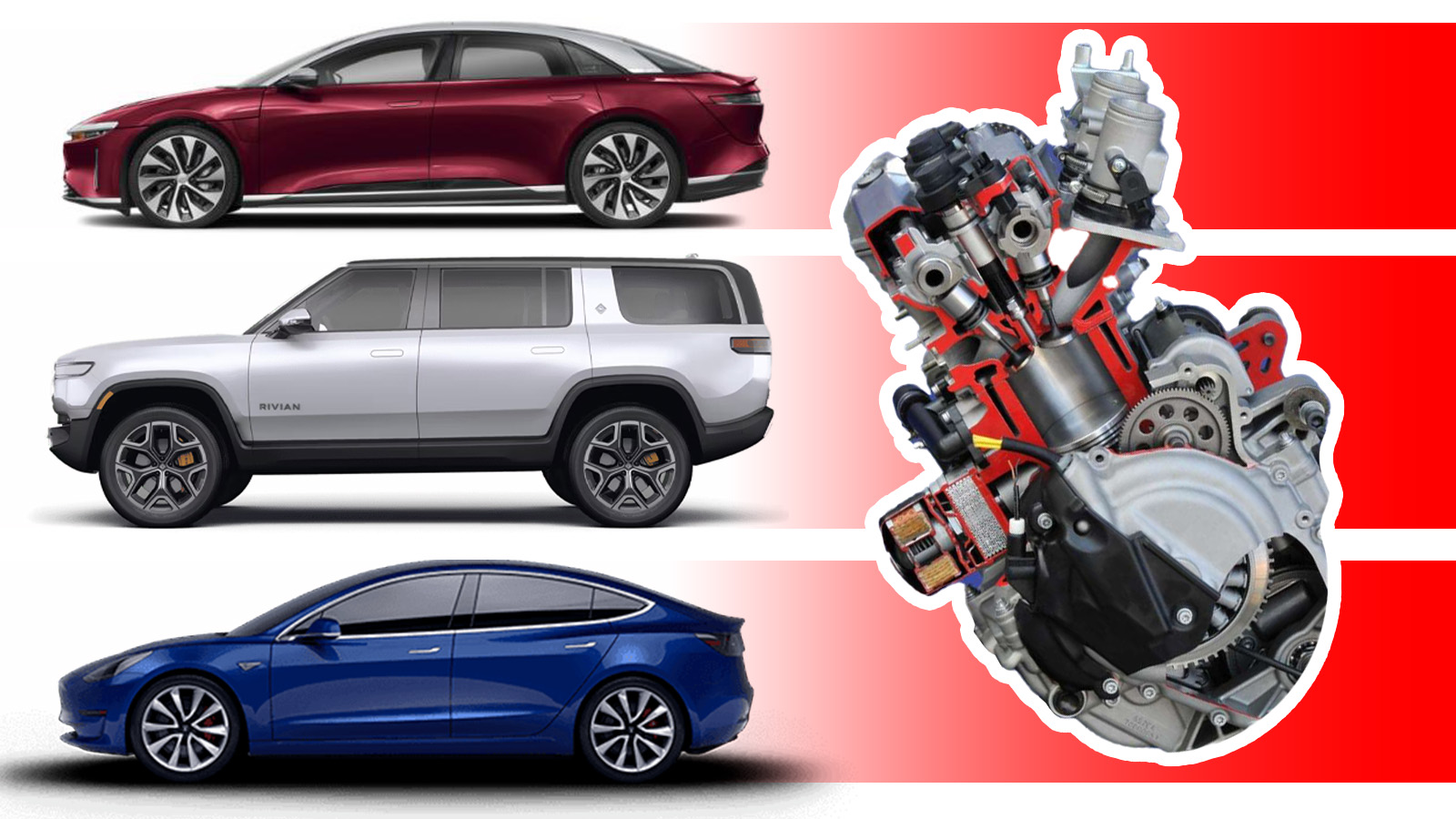
You could argue that an “electric car company” is not something that needs to exist, and that car companies should simply be Car Companies, not tied to any particular powertrain. But electric car companies do exist in the U.S. in the form of Tesla, Rivian, Lucid, Polestar, and Slate, and the reason why is pretty obvious: “Electric” was the hottest new term of the last two decades, and a necessary one to raise enough capital to get a new company off the ground. Pitching a hybrid car company to a group of investors would have been as fruitful as the messages I used to send on dating apps. But now it’s 2025, and that hot “electric” term is now lukewarm at best.
A few months ago, I was at a Rivian event in which I asked a representative if the company would ever offer a gasoline range extender. The answer was an emphatic “no.” I asked the same question at a Lucid event and received the same answer. “The future is electric,” is the refrain I typically get from folks when I ask this question. To which I respond: “What’s your point?”


Telling me what the future is doesn’t seem particularly relevant. We could all be driving flying cars in the future, but if you started selling only flying cars today, you’d be a fool. This reminds me of 2022, when GM announced it would skip hybrids because the future is electric. More specifically, per the Detroit Free Press, Mary Barra said:
“GM has more than 25 years of electrification experience including with the plug-in vehicles like the Chevy Volt …From that experience, our vision is for an all-electric future. Our strategy is focused on battery electric vehicles as they represent the best solution and advance our vision for an all-electric future.”
I remember thinking upon reading that: “Sure, the future may be electric, but you’re selling cars now, in the future’s past. Right now, people want hybrids.” As expected, GM backtracked on its plan to offer only EVs and to skip hybrids, and is now going heavy into the hybrid game (while still offering a solid array of EVs).
Too Many Companies Are Splitting Too Small A Slice
The future is electric, but today is not electric. Toyota understood this because they understand consumers, though they got dragged by journalists for not going all-in on the new hotness. But sales numbers bear out that hybrids are the answer, and what’s more, automakers like Rivian and Lucid losing absolute metric crap-tons of money on electric vehicles — and other car companies like Ford deciding it’s worth losing $20 billion to cut many of its electric vehicle programs altogether — goes to show that the market just isn’t there for fully electric cars.
Of course, there’s Tesla, a company that managed something amazing. Lightning in a bottle, you might call it. It was an American company that came out of nowhere, developed its own charging infrastructure, created electric cars that were generations better than anything up to that point, and offered the cars at a rather competitive price. They also had a larger-than-life CEO who was admired by most of the world at the time, and also, they made loads of money by selling ZEV credits to automakers running afoul of CO2 compliance. That credit system is likely gone in the United States, thanks to the new presidential administration.
I get the impression that many companies saw Tesla’s success as proof that a sustainable EV company can exist. But in my eyes, to try to replicate Tesla’s model is silly. Tesla is one-of-one. An outlier. I tweeted this thought over a year ago, suggesting that EV companies should hybridize ASAP:
My suggestions to EV-only automakers: 1. Be careful looking at Tesla and thinking “I want those sales numbers.” You are not Tesla. Don’t try to be Tesla. Tesla is an anomaly. And 2. Get on the range extender bandwagon as soon as possible. Transition back to BEV-only later. https://t.co/1b7H2jmfN0
— David Tracy (@davidntracy) October 25, 2024
You know who replied to that tweet? None other than Ford’s own Jim Farley, CEO:

Now it’s nearly 14 months later, and Ford announced that its departing fully-electric F-150 Lighting is being replaced by a range-extended F-150 Lightning.
Ford Will Add A Gas Engine To The F-150 Lightning To Create A 700-Mile EREV
Naturally, EV-diehards are not thrilled:
This is what happens when you make sh*t products. This has nothing to do with making EV’s; this has everything to do with making bad EV’s. https://t.co/f3kxBlR6Ul
— phil beisel (@pbeisel) December 16, 2025
Hybrids are not the answer Jim
The future is all-electric and autonomous
You should’ve taken Elon’s offer to license Tesla FSD years ago…
Not looking good for Ford https://t.co/vPdl8fBtc5
— Dalton Brewer (@daltonbrewer) December 16, 2025
This going EREV will almost certainly be better for the environment than the BEV.
100K people trading their 15 MPG F-150 for an EREV truck has more value than 25K people trading their Tesla for a BEV truck.
— David Tracy (@davidntracy) December 16, 2025
You can see my opinion on the matter in the reply above.
This seems like a smart move on Ford’s part. The truth is that fully-electric pickup trucks make little sense for the mass market, and if you don’t believe me, just listen to what the former CEO of Lucid (an electric car company that refuses to offer gasoline engines) told me when I interviewed him last year:
“But let me tell you the reality is, and it’s me saying this, that it is not possible today with today’s technology to make an affordable pickup truck with anything [other] than internal combustion.”
This is just reality, which is where major corporations have to live.
With Fully Electric Vehicles, America’s Love For Big Cars Gets Expensive
America loves large cars, and large cars typically have what’s called in the industry “a high Vehicle Demand Energy” (VDE). This is the energy needed to move the vehicles down the road, and though it can be affected by powertrain (because, for example, a gas engine requires more cooling, which can lead to more drag; an electric vehicle is heavier, which can lead to more rolling resistance, etc.), this is more about the vehicle in which the powertrain is placed than the powertrain itself.
America’s taste for large vehicles means we tend to drive cars that require lots of energy just to go down the road, and if that vehicle is, for example, a pickup truck (like a Chevy Silverado EV) or SUV (like a Rivian R1S), you’re going to need a massive battery to achieve the range that the average American wants. Both the Silverado EV and the Rivian R1S offer batteries over 140 kWh, with the former offering one over 200 kWh.
Add a big trailer to those vehicles, and even those giant batteries won’t be enough to overcome not only range issues, but recharging issues, as infrastructure still isn’t good enough, and pull-through chargers for trailer-pulling pickups just aren’t very common even in 2025. When it comes to towing, EVs are simply the wrong tool for the job, as I wrote last year.

With Lucid and Rivian losing billions of dollars annually as EV demand remains softer than expected (though we do have some early signs that Rivian is turning things around, with a few quarters of positive gross profits, though net profits remain elusive), there’s an obvious question worth asking: Should these companies build cars that appeal to more than just a small electric sliver of the American car market-pie?
Rivian thinks the upcoming R2 and R3x will be enough. I have no doubt that they’ll sell relatively well, but I do have doubt about whether they’ll bring Rivian to sustainable net profitability. After all, the world already has cool, small electric SUVs like the Hyundai Ioniq 5 and the Chevy Equinox EV. And sure, you could say the world has lots of great hybrids, but the sales figures are on a different level. With hybrids, there’s more than just a sliver of the American market “pie” to share.
EREVS Are A Compromise That Can Minimize The Most Important Compromise
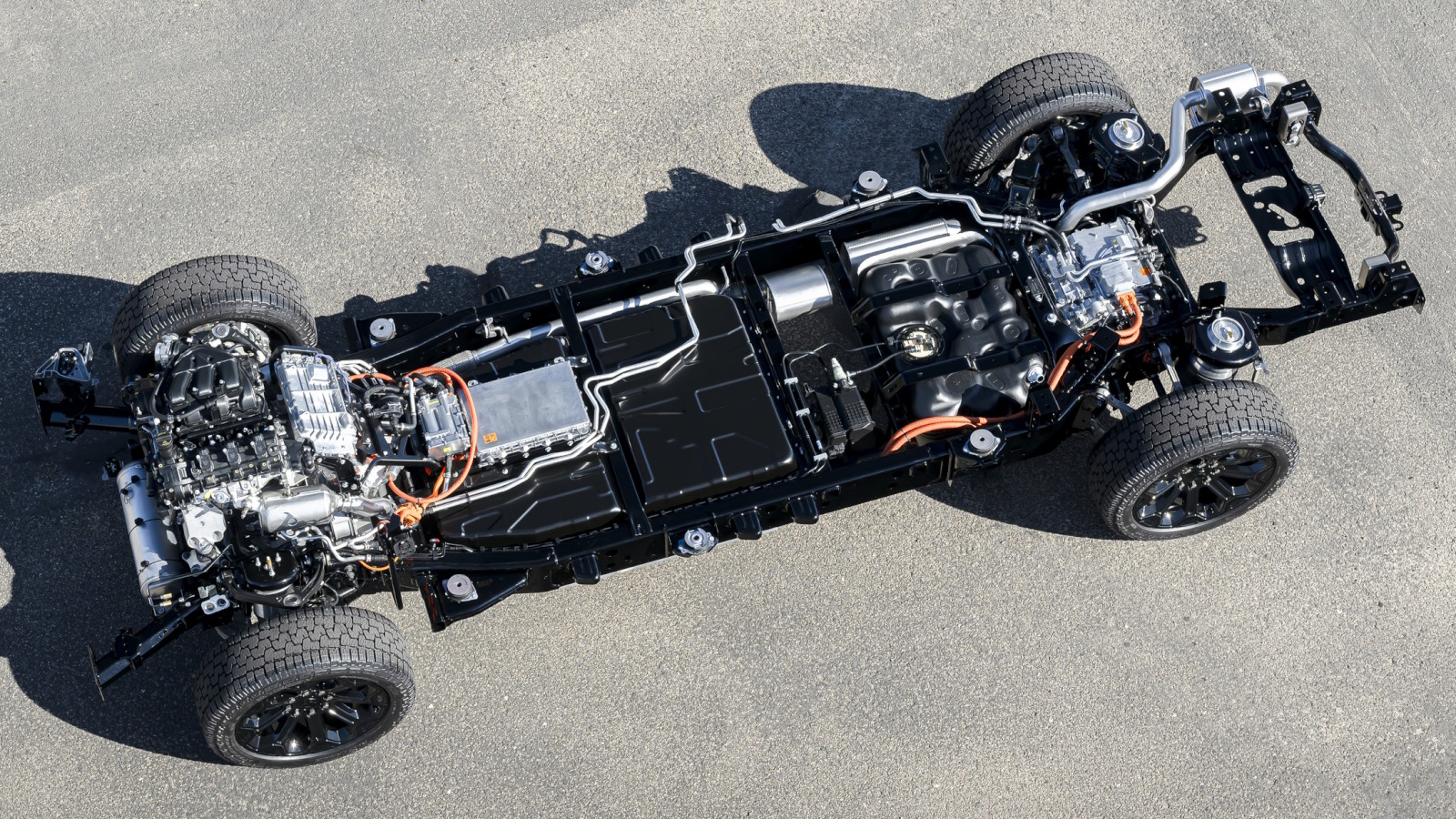
America wants hybrids; when Scout offered its vehicles as fully-electric or range-extended hybrid models, the majority of pre-orders were for the hybrids. And for good reasons. Though some EV purists call hybrids “compromises,” in truth, every car is a compromise, and a hybrid’s main advantage is that it’s actually a compromise-minimizer. If you think about the compromises that actually matter in the car world, it’s not compromises to packaging or complexity or even vehicle performance — what matters, big picture, is minimizing compromises to the way a driver actually uses their vehicle, while keeping the biggest compromise — cost — down. And in this way, hybrids are less of a compromise than BEVs.
I live in California, where the infrastructure is better than pretty much anywhere stateside. Still, charging a BEV can be an inconvenience compared to filling up a gas car, and what’s more, it can actually cost as much or more. I’m not saying charging a car here is bad — if you leverage the right apps, and are smart about planning, you can really get a lot out of driving a BEV (and you can save money on driving) — but the compromise is nonzero. It’s not about charging infrastructure or charging times or poor towing range — more than anything, it’s about cost.
Americans want to drive big cars, and they want to be able to not have to worry about range anxiety. This RA term is one that lots of EV journalists have historically dismissed. “Nobody needs 300 miles of range. 100 is just fine!” many say. In fact, here’s a Facebook reply to our story on Ford ditching the BEV Lightning for an EREV:
The Lightning is an excellent vehicle that won’t sell because truck buyers think they’re going to tow a trailer 500 miles every weekend. They won’t, and the range of an Lightning would actually meet their needs 99% of the time, but people stupidly make buying decisions based on that remote possibility that they might need extra capability someday.
The Gas Generator Doesn’t Have To Be Great Or Expensive

Are EV Car Companies EV-First or Environment-First?
OK, So There Are Some Huge Branding Problems

One topic I cannot ignore is the branding of it all. If a company has built its identity on a powertrain, things get tricky if they want to offer a different one. Rivian is all-electric, anti-gas. Lucid is the same. Tesla is the same. Since their inception, they’ve been no-gas, all-electric companies, largely because none of these companies would exist otherwise. How, then, can you maintain brand integrity if you offer a gasoline range extender?
I Love EREVs, But Even They May Have A Hard Time Selling Over Gas Or Conventional Hybrid Cars
EV Car Companies Are In A Tricky Spot
For a more complete breakdown of Range Extended EVs’ benefits and drawbacks, see my three articles on the topic. Note: I am not an oracle, and many of you, dear readers, are geniuses, so I welcome your thoughts in the comments. Also, for the EV-purists who will inevitably be upset that I like something other than a pure BEV: I also love BEVs. In fact, I love them so much that I wrote positive reviews about the Cybertruck and Fisker Ocean. BEVs are an excellent option for folks who can charge at home/work, requiring less maintenance than an EREV. Neither BEVs nor EREVs are not the answer for everyone, but variety is key.
Top graphic images: Lucid; Rivian; Tesla; BMW





Some formerly office car, plug in hybrids are starting to redeem themselves in the second hand market — seems when people buy them for themselves they read the instructions.
But price is still the sticker. Big effort in France to get EVs below €20,000 but for that you get a terrible, tinny small electric car (all the instant torque and lack of vibration does not make up for a clang when you close the door), and you can get a nicer ICE car.
Add the price and complexity of a little petrol (or diesel) range extender and prices start going up.
I do not own an EV, but want one (someday). EREVs are a serious step backwards, for two reasons: (1) complexity (obvious); (2) emissions. I don’t say this lightly, as I am an engineer. Battery capacity and charge rates will rapidly improve; the backsliding to EREVs is a mistake in the medium/long run, and it will reduce investment in EV tech.
My revelation on this came from switching from a gas mower to a BEM (battery electric mower). Quieter (I can hear the birds when I mow), no fumes, and near-zero maintenance. While ICE (and hopefully EREV) cars have cat converters, they still emit too many pollutants and contribute to global warming. The technology of green energy is available now – from grid-scale generation to EVs – and I am sad about the retrenchment of major companies to EREVs.
I can’t see there being a good ROI on EREV unless you’re a traditional auto company that has a gas motor you can pop in already.
You’re not going to recoup that R&D + marketing money before it’s irrelevant. This might’ve been a good plan in the 2010s, but there’s no point in adding more mechanical complexity for stuff to break (well, manufacturers might like forcing you to come in for maintenance more) when outside a few niche cases, EVs are fine, even on road trips where people worry about range anxiety, but only before they own one.
I almost skipped this article, because I do not care one iota about electrification in vehicles and I’m sick of reading about them. But when I saw in The Morning Dump this article had over 300 comments, FOMO kicked in and I read it. As usual, I found it to be well thought out, and while I may not have agreed with every singe word, nothing in it raised my hackles. I was glad to see an automotive journalist finally say “one of the most important things for any car company to understand is that humans are irrational.” And wow, the comments here bear that out. 🙂 The rest of this screed is directed at the commenters, not the author.
So many people thinking if BEV is right for them, it’s right for everyone and everyone must want one and anyone who doesn’t want one is against them and must be silenced if they cannot be assimilated. That’s some MAGA-type thought processing at work right there. You are irrational.
And I am irrational. I’d buy a Hemi Ram over the Hurricane 6 even thought it costs more and has less horsepower and torque and comes saddled with a stupid “badge of protest” (I’m thinking a heat gun & plastic scraper will take care of that). And I don’t want batteries as part of my propulsion system, ever. No matter how objectively good they are, and that a BEV or EREV would meet my needs for 99% of my driving, and even if I had access to home charging or my small town had chargers (currently not a single one) or there was one within walking distance of my work, I. Don’t. Care. I don’t WANT one. I want the rumble of a big cross plane V8, not the whine of a dental drill. I want the smell of hydrocarbons, not ozone. I want presence, and soul.
You do you. If you don’t tell me I must have some sort of electrified driveline, I won’t tell you that you simply must have LS/Coyote/Hemi or die.
All of this goes away if you just tax gas here in the US like you do in Europe.
Once you can’t afford to fill up an ICE Pickup, the BEV Pickup looks way more attractive.
This is one of those obvious common sense things that most people in the industry have totally missed cause they were too close to all the Tesla hype.
I remain amazed that GM had the audacity to say “we’re skipping hybrids” and half the car journalists out there criticized Toyota for simply knowing the market. But that whole COVID era was a strange time.
Yeah everything felt upside down so I can get why it would be hard to make big billion dollar decisions, and why it would be confusing to cover those decisions too. I am especially baffled by the number of folks in the comments below that seem to still disagree with EREVs being a significant step in the process. It seems like a willful ignorance of the basic market proven fact that Americans buy cars based on edge case possibilities/capabilities, not what they actually need. EREVs match up to those edge cases better than EVs do in the US market. As a fan of small cars I really wish more Americans bought only what they need but at this point I don’t have any illusions as to how the average American consumer thinks, haha.
I’m very tired of this hybrid/EREV stuff, and that isn’t going to change.
The EV backlash won’t last forever, and takes like this will age poorly.
Right now, BEV companies losing billions should consider offering other options. Build platforms that provide choice to a wider variety of consumers. Things could change — policy and battery costs — but now and honestly for the past several years, this is the logical move.
Scout reservations indicate that this is where demand is. But… unfortunately Scout is multiple years out.
It’s also possible EREVs will face the same struggles as BEVs, and people will keep wanting to buy cheaper gas cars. I think that’s totally fair, as there is an affordability crisis at hand.
It’s a fairly lukewarm take if you think about it, and that’s by design. I’m not here to write spicy hot takes that age like milk.
I agree. The last thing I want is MORE complexity in my favorite vehicles – particularly from Stellantis. A RAM or Jeep EREV? No thank you. I’m ready to move on from my 40 years of Wrangler/CJ ownership to a pure BEV version. I want the simplicity, the clean smooth power, the ability to “fill up” in my garage.
This article claims people don’t want EV’s. That’s not true. If it was, the US (and the Big Three, so to speak) wouldn’t be so terrified of Chinese EV’s. The real test of DT’s philosophy here would be for the US to allow Chinese EV’s in the market – I’d be fine with charging a certain tariff to discourage dumping – and see if Americans avoid them. My guess? At the prices we’re seeing them go for in other countries, it’s likely we’d not be able to get enough of them.
Maybe it’s the same? I have an efficient, nearly maintenance free motorcycle for daily use and a 86 VW Westfalia for those couple times a year that I need to travel long distances or carry crap home from Home Depot. This has reliability and very inexpensively served me well for the last dozen-plus years. Why do people need to have perpetual $800 a month payments?
EREVs won’t work in America, having owned two.
Because an EREV is really two drivetrains, the *right* way to design one is to design them to work together to deliver the performance that people want; something like a half-sized electric drivetrain and a half-sized gas drivetrain that work together. Maybe 2/3-size of each. However, because people are stupid, they’ll get themselves into a situation where one of the two drivetrains is crippled (dead battery, no gas, etc.), and then expect a half or 2/3 size drivetrain to work like a full-size drivetrain and make a viral video out of the failure that their stupidity caused. This is exactly what happened with the EREV that sparked David’s love of EREVs, the BMW i3. People sued BMW because they thought they could use the i3 for all use cases with a dead battery and only a 34hp range extender running. Stupid.
So, what does a manufacturer do? They build their EREV with a full-size BEV drivetrain AND a full-size engine, making their EREV much heavier and more expensive than a BEV (see RAM’s EREV that weighs 1400 lb more than a BEV Lightning).
That’s stupidly overdesigned for almost any use case because it has to be idiot-proof instead of optimized, and this is what makes EREVs hard. It requires an informed consumer, and for people to not *purposely* try to break stuff to create viral videos by using things in stupid ways. Unfortunately, that’s basically the most popular type of video on the internet, so anything that’s not stupidly overdesigned is going to go viral as a piece of crap that’s under-designed and everyone’s uncle on Facebook is going to be posting about it.
Fair concern!
EREVs are good for getting people comfortable enough to buy an “EV”, then make them realize during their ownership that they didn’t really need the Range Extender, so they make the right choice with their next vehicle (BEV).
Certainly SOME people need an EREV (or other non-BEV), like people frequently towing long distances, but a massive percentage of people who already drive trucks, for instance, would be better off with a BEV than their gas truck. The Pros and Cons weigh out far in favor of the BEV for many use cases.
I agree with this take. EREVs are a gateway drug to BEV life.
I can charge at home and at work, and yet I would never give up my i3’s range extender. I don’t want to rely on the charging network, and I don’t want to miss my meeting if I forget to plug in overnight.
Nobody wants a 150 mile BEV. A 150 mile EREV, though, is fantastic.
I owned two i3 REx and my last i3 was a BEV, so the people moving from from an EREV to a similar-electric-range BEV is slightly above zero, but I totally agree people aren’t usually going to move from an 150-eMile EREV to a 150-mile BEV.
But, like with tons of i3 owners, many of them will move to longer range BEVs with their next purchase, realizing that their EREV’s range was usually sufficient, and they like the electric part of the experience better than the REx experience on the occasion that they need more range.
So, I agree with most of your points, and understand your love of the i3 REx formula, and think some will stick with EREV long term, but still stand by my claim that many EREV owners will decide to go BEV with their next vehicle after experiencing an EV and the rarity with which they’ll use the REx.
“ Why All DVD player Should Start Offering DVD-VCR combos” – Also, David maybe?
If nobody’s buying DVDs, then yes!
Let’s allow Chinese-built EV’s into the market, with whatever safeguards need to be made against pure dumping, and see if “nobody’s buying EV’s.”
The Big Three are terrified for a reason. If nobody wanted EV’s, there would be no reason to be afraid.
I am surprised and disheartened by the Autopian’s anti-BEV turn lately. I just don’t see how EREVs aren’t the worst of both worlds. Heavy and maintenance intensive.
What maintenance? EVs have practically zero, and gasoline engines have 10k oil changes and pretty much nothing else until 5 years/100k miles. Brake fluid is the same 3 years for EVs or ICE. Maintenance is really nothing on most new cars these days. I have had a V6 gasser, 4 cyl turbo diesel, 4 cyl / electric PHEV, 4 cyl turbo and now BEV all in the last 15 years. The PHEV had the least maintenance after the BEV. Longer oil change intervals than regular ICE was the key to that.
I am looking at the Scout EREV as a future replacement after thinking I would never go back from EV. It would allow me to have an EV for 99% of the time and give me the freedom of a gas powered car when I want to head north and ski – and not spend an 30 extra minutes of the day charging. It would allow for thought-free long distance travel to the places I want to visit which have practically no EV infrastructure.
For everyone else, they are a bridge to EVs. They also would consume less of the materials used to make batteries, the weight is about equal when removing battery cells and replacing with a small generator. They take advantage of the energy infrastructure and economy that already exists without stressing the electrical grid too quickly and to continue to use the gasoline infrastructure that exists already. There is a pretty good balance of crude oil use – split between fuels and for other industrial uses like plastics, etc. This is the better hybrid we have been waiting for.
I’d be surprised, too, if it were real. Saying you like hybrids doesn’t make you anti-BEV. We’ve been extolling the virtues of BEVs for years and will continue to do so.
Yeah, I think I’m done here. I’m a gearhead (Jeeps, VW’s, and Saabs) and I can’t wait to get my first BEV. I’m just waiting for one of my ICE vehicles to die. I’ve been without a car payment for a few years and unfortunately, I’ll need to be forced into one. DT’s take here is sad. With all the electronic gremlins in today’s vehicles, not to mention all the engine recalls from even seasoned automakers, the LAST thing I need is TWO powertrains and more complexity to manage each of them.
It’s not sad, it’s level-headed and a very mild take. There’s literally no reason for anyone to be upset by this article, except that there’s been a strange politicization of pretty much everything these days. Alas…
I have nothing against EREVs or their premise. Afterall, it’s very much a “have your cake and eat it too” concept. EV for commuting, gas for distance and ultimate range. Perfect!
But then there’s the combination of providing enough expensive batteries for the EREV concept to work, AND a gas engine/generator. And we just haven’t seen anyone actually bring these to market yet in an affordable package. Are you telling me that the RAV4 PHEV, which is already 45k to start (if you’re lucky) is going to not be eye-wateringly expensive when we add more battery to the equation? Forgive me, but with the sort of insanely expensive nonsense manufacturers have been hyper-fixated on, I just don’t have a ton of faith someone is bringing me a cost-competitive vehicle with an EREV powertrain. Great for all the wealthy folks lining up for EREV Scouts (let’s get real, those are going to be wildly expensive) but it’s not going to be great for me.
Honestly, I’d rather have a PHEV, with a traditional gas powertrain with some legit battery jammed under the backseat to handle half to most of my commute, or a pure EV that packs a smallish gas tank worth of range. I’m just skeptical that a car with a solid amount of EV range AND a gas generator isn’t going to be too expensive.
Yeah, that’s one of my concerns. Compared to gas cars, EREVs will be a premium, but hopefully not as big a premium as a BEV with similar range.
If someone can bring to market EREVs that manage to hit a similar price point to hybrids/PHEVs? Count me the hell in. I just need to see it.
I have no expertise to lead me towards an understanding how how expensive one of these powertrains will be. Will manufacturers eventually simplify the gas generator to the point where it’s far less expensive to produce than a typically more complicated gas powertrain with a transmission and all that? You’d think so. May that cover the cost of the additional batteries? Maybe?
Time will tell. It might take a couple of (vehicle) generations to sort that out.
I think it’s unreasonable to expect that two separate drivetrains will be cheaper than a BEV, especially since battery costs continue to fall.
Can’t see them taking off outside a few niche cases since they’ll cost so much more.
There’s only a single drivetrain. For larger vehicles, if you can go from 200kWh to, say, 65, it should be cheaper (for now).
Aside from vehicles that will be towing, EREVs are a waste of time that will go under utilized my most consumers, unless you have a super short electric only range like 40 miles. I’ve been driving EVs for 7 years now and have only ever needed fast charging, or in other words times I could have actually used a range extender, for road trips and those only happen a couple times a year, so most of the time I’d be dragging around a high maintenance dirty ICE for nothing. As far as not needing a “300 mile” range, that number drops significantly when you’re driving actual interstate speeds or when it gets cold, but the real anxiety comes from the lack of chargers in every town like you have for gasoline vehicles.
What we really need now, is a temporary generator that can be plugged in while driving and fits into the trailer hitch of a vehicle that you can just pickup from your local Uhaul. Extra range when you need it and only when you need it.
I generally don’t like the idea of EREVs, but a hitch attachment generator seems to alleviate my concerns of hauling around crap I don’t need when I don’t need it, and adding unnecessary failure modes to my vehicle. Having a charger port that can operate in motion by the back of the vehicle seems reasonable.
I’m a current or former owner of almost every propulsion type: gas, hybrid, PHEV, and BEV. Anyone who does not own a BEV cannot fully comprehend just how much it improves the car ownership experience in numerous small ways.
If you can charge at home (which a majority of owners can) you never have to visit a public charger, except on road trips. You get home, plug it in (doesn’t have to be every day either – ours charges about once a week) and in the morning your “tank” is full. Awesome!
You don’t have to visit gas stations. No more sitting in line waiting to breathe gas fumes!
No more oil changes! Don’t get me wrong, I diy all my maintenance, and like a lot of folks on this site, I even enjoy it. But it’s hard to argue against the reduced maintenance load of a BEV. The scheduled maintenance for mine for the first 60,000 miles is literally tire rotations and cabin air filter. That’s it!
Though cold weather range reduction really sucks for road trips, the instant heat from a BEV is hugely underappreciated. Most can silently preheat the cabin before the owner ever gets in. But even if not: hit that ‘start’ button, crank the heat, and the effect is instant. No waiting for the thermostat to open for coolant to start flowing through the heater core.
EREVs can help in edge cases like towing, no argument there. But that ICE adds complication, increases maintenance burden, and reduces available cargo space (the ICE has to go somewhere!). So the benefits need to be weighed against the drawbacks. They are far from the universal solution the Autopian seems to think they are.
Neither BEVs nor EREVs are universal solutions. Variety is the answer.
I think the use cases for EREVs are a lot more niche than you think they are. Just applying current technologies with the actual urgency they deserve would have BEVs being best case for almost all US drivers.
If only the car market were rational.
Completely agree when it comes to purchasing, but I think people get very rational about what they keep around when a vehicle doesn’t actually fit their lifestyle. I’m pretty sure this is the case when I see 1 MY old BOF SUVs for sale, where someone bought one thinking they needed the capability or liked the aesthetic, but then realized that the extra fuel expense and ride quality compared to a CUV isn’t what they want to deal with. This could play out the same for EREVs, where they like the convenience of plugging in and leaving with a full charge every day, but hate having to make a special trip to fuel up the ICE motor or have it serviced for the few trips they take a year and end up trading it in for a BEV.
It’s the same with BEVs. Ultimately, people should have options.
You’re right only if you’re referring to Norway.
Anyone still hating on EVs outside of edge cases (like towing) needs to rent a modern 800v architecture BEV for a road trip.
Unless you’re some kind of road trip warrior, you’ll want to stop for food/bathroom/rest breaks about as often as the car. And by the time you’ve used the bathroom, grabbed some food, and stretched your legs, the car is ready to head to the next stop. We’re talking around 15 minutes 10-80% SOC.
Time your next road trip stop in your ICE: between filling up the tank, visiting the bathroom, and grabbing some food, are you really any quicker?
I don’t drive anywhere in my EV that requires fast charging because every time I’ve tried it’s a shit show. The infrastructure here in Appalachia is still terrible. Even if ABRP shows I can actually make the round trip without adding significant detours, I’ve had such terrible luck with the chargers actually working that it’s not worth the risk.
I do share your pain. I don’t own one of those magical 800v EVs I just sang the praises of, and I road trip to family in Appalachia all the time. Two years ago my car couldn’t have made the trip at all (at least not without a painfully slow L2 stop). Only recently with supercharger access for my brand can I use chargers located in the right place geographically to make the trip a 1 stop affair. I’ve blown ABRP estimates and had to detour, and I know without well located backup chargers I would have been in deep trouble. But the charger network will only continue to get better.
One of my assumptions when I bought my EV was that infrastructure would catch up to my needs, but I’m actually becoming concerned that the charging situation is going to get even worse in the near term.
Do you have access to Tesla Superchargers, now? or no?
I do, but the coverage still isn’t great. For example, if I want to go to Snowshoe in West Virginia (which I like to do for mountain biking in the summer), it’s 141 extra miles round trip. That’s if I rent a bike when I get there instead of carrying mine. That’s 60% more distance and almost 4 extra hours vs driving my ICE.
I haven’t looked at the map recently for WV, but I know it’s historically been an especially bad area for charging infrastructure, so I believe you. The areas of Appalachia I’ve been to haven’t been too bad, especially when I’ve had Tesla access, but I can see not every route in/out of WV having ideal charging infrastructure.
I ride my $3500 motorcycle from SF to LA around once a month for work. It takes, literally, one minute to fuel up. The whole trip, door to door, is around five hours. Ironically, that’s exactly how long it took me the one time I flew/Ubered. However, it’s less than $100 to ride the bike but over $400 to ride/park/fly/Uber the trip and I can come and go whenever I need, plus I have “free” transportation in town as long as I need. Yeah, sometimes I do need to stop to pee but that only takes a couple minutes too.
Tesla’s still tend to have the fastest trip-time of the “affordable” EVs (Taycan is faster), but looking specifically at charge time, the 800V Kia/Hyundai cars charge really fast on the right chargers!
I agree for a LOT of people and a lot of trips, modern BEVs just aren’t going to take meaningfully longer to travel with. If you’re a road warrior stopping for an actual 5 mins every 5 ours or something, sure, but most people aren’t actually traveling like that.
My scorching take – trying to apply logical arguments to personal automobiles is a flawed stance from the start.
For the overwhelming majority of vehicle owners, what they choose and purchase is much more of an emotional and aesthetic choice than it is what vehicle they can purchase that meets the specific needs of their life within the their budget.
Agreed. It’s been said that almost all car purchases are emotional, not logical. If it was logical we’d all be buying 10 year old beaters and paying to keep them safe, repaired and insured. Buying NEW isn’t usually the smartest financial move, but we all do it anyway sometimes.
100%.
Correct. If it were rational, 40% of gas F-150 owners would instead own F-150 Lightnings. But then, if we take it a step further, a slightly different 40% of truck owners would buy cars, instead, and the Mirage would be a best-seller if sales were purely rational.
It’s pretty simple ; if you have to tow heavy stuff -all the time- then go for an ICE truck. Simple. If you are going to tow 3 things 5 times a year ; rent a truck for that occasion while saving tons of money driving a full EV truck. In the EV truck you will have plenty of torque ‘n power and fuel savings, maintenance savings and other benefits.
Use the savings to buy some solar panels for on your roof, shed, barn, backyard, and charge your truck or a (home) battery with it for even more savings and more ‘off the grid’ options in case there is an electric grid issue. Get an EV which can deliver power back your home. V2G or V2H (vehicle to home). Basically allowing you to heat your home and run your lights from your car’s battery. It can’t be more self sufficient ‘American’ than that.
If you really cannot get a rental, buy a small electric generator. Put it in your car/truck when you are going the distance. Use it to charge your car/truck when you really need it. There are 10kW generators available for less than $1000. They won’t fast charge your truck, but they will charge it if you’re in the desert or in the mountains and out of juice. When not needed, put the generator in your garage so it doesn’t add weight to the car. And in emergencies you can even use it to power your house (or friends). Try to do that with a regular gas car.
On top of that, adding ANY ICE engine to an EV will make it absolutely way more expensive than it is now. The engine, cooling system, fuel tank, converters, dials n gauges and ECUs, safety systems, SPACE (where you going to put a small engine, let alone a full 2.0 liter engine, they’re not the size of a shoebox!), etc. And then the ADDED maintenance is going to make the yearly costs just more expensive. The generator would have to be smaller than the size of a tire (!) to make any sense in a large truck, but even a normal sized tire hardly fits in a regular “large” passenger car.
Just electrify the shit out of all cities and villages so there IS a decent charger every mile in the whole of the US. How hard can it be – all HOUSES also have electricity, don’t they?
Well, two points here…
One, I think the idea around EREVs here is that you recoup some or all of the cost of including the range-extender by drastically reducing the size and complexity of your battery, which is the most expensive component of your EV architecture, so the cost difference may actually not be as bad as you might think.
Two, I, too, would love it if American infrastructure could be updated and upgraded such that everyone can have a fast-charging station in their home, but that’s a fantasy on the order of saying “I think every American should just be given a dragon on their eighteenth birthday, and then they can just ride it to work and save gas that way.” Infrastructural spending has always been a difficult sell at almost every level of government, the current federal and about half of all state administrations are currently composed of some kind of hate-demons set free to roam the earth in human guises who think that anything even slightly to the left of “we should bulldoze protected land to build a reserve where the wealthy can hunt the unhoused for sport using assault rifles fired from private helicopters” is unbridled communism, and any attempt to raise taxes at all to pay for something like additional electric charging stations or increased grid capacity will be widely mocked and ridiculed by a corporate-owned mass-media machine specifically designed to impede exactly this sort of thing. That’s all before you even get to the practical challenges involving materials, construction, and the sheer size of this country (why is there so much Texas? There’s entirely too much Texas, it’s like a 200 kwH battery, we’re only using, like, a sixth of it, tops!), so there’s a lot to consider here.
It’s not impossible, mind you, but it’s going to take an enormous amount of time, money, effort, and political capital; none of which anyone here is likely blessed with in abundance.
I think by converting several lampposts to low speed chargers would already be a giant but cheap step in the right direction. Electricity is already everywhere. We just need to add the outlets. And people can bring their own cables so we don’t have to worry about copper thieves.
Yeah, think J3400 standardized bring-your-own cable charging for the US. They’ve had it Europe for awhile, I think.
Better still, buy a $5000 Corolla and use the $70,000 you save from not buying a pickup to be a real American.
I doubt the people who need a truck to offset the size of their procreation organs will listen to your advice.
I know you are right David, and I do agree an EREV truck is probably more optimal, it just doesn’t make sense to me as an EV radical. This is mainly from a reliability and maintenance factor of two powertrains in one and losing one of the key things that makes an EV so great, no maintenance. I’m not afraid to admit I’m biased though and like I said, it is probably the right answer for the time being.
After hearing the news I was explaining the “American consumer over buys” reasoning to a friend over the phone who’s a Lightning owner. What you said is the truth of the matter and I even referenced your article talking about what lucid said. We both did agree it did make sense but it didn’t make sense for either of us. It will appeal to more people. Especially ones who have the “what if” view point when it comes to road trips and towing or, in a family members case, give reassurance when off-roading (a family member is a Scout REX reservation holder to replace her bronco).
During that phone call we discussed our ideas on what the powertrain set up will be. He has a background in mechanics, particularly Japanese hybrid powertrains and this is what we concluded. A NA engine, particularly an Atkinson cycle would be ideal. It will need to be able to tow something up I-70 at 0% SOC so it’ll need a large generator and maybe something larger than a 4 banger.
The Wagoneer REEV is the closest match to what ford wants to do that we know is heading for production in the next year. That has a 92kWh pack with 150-200ish miles of EV range with a 130kw generator mates to a 3.6 pentastar.
After comparing those production specs we both theorized that the Lightning REEV will have an 80-100 kWh battery pack with a modified 3.5 NA engine from the transit.
I’m very curious to see how the Lightning develops and matures, it just feels like a step back to a bunch of people in the EV community. If it’s anything close to the Wagoneer powertrain, I don’t know how it’ll be cheaper or greener than a pure EV.
Thank you, Preston, for a great comment!
We are also thinking that in order to do the 0% SOC up I70, it will need a rather large reserve of battery. I don’t recall the math we did for this number, but we estimated a reserve of 30% going by the Wagoneer REEVs alleged figures. This is because we’re unsure if a generator could realistically produce enough electricity to power a truck traveling 65mph towing a trailer up a 7% or steeper grade with no battery charge. It can probably supply enough to drastically reduce the draw but we won’t know until it’s revealed. At this point it is just hyperbole speculation. The vehicle we based this off of, a Wagoneer REEV, has yet to be provided to journalists, the EPA, or the general population. We are not engineers, and we don’t have any knowledge in development, and we could be very wrong.
When yall get a Wagoneer REEV to review tho, I really hope you can get an engineering deep dive into the challenges they encountered in development.
Look at the old Chevy Volts. They had a “mountain mode” which kept a larger portion of the battery (20% in that case) in reserve because the gas engine only produced half the horsepower needed for acceleration, making up the difference in keeping some charge in reserve (first gen volts often gave a reduced power message if you drove around parking lots without the gas engine on for too long while the engine charged the battery)
I would imagine that the Lightning would, in normal mode, run down to near 0% and keep a small portion of the battery in reserve for acceleration (and recharge the reserve while cruising or regenerative braking), and then they would have a tow/haul mode reserving a much larger portion of the battery
That allows you to go the GM route of only needing a gas engine that generates 50% of the horsepower needs to save money and boost efficiency.
With Ram putting such a large engine in, I imagine theyre trying to cover a larger percentage of the horsepower draw. Instead of using the GM strategy.
Ill be interested in what Ford chooses to go with
We used to own a regular hybrid and then a PHEV, and in both I’ve experienced 0% SOC, pedal-to-the-floor, unable to maintain the speed limit up a mountain on the interstate. It’s not fun!
Me too, I look forward to seeing their solutions and how they do this.
I’m pretty sure the RAM and Wagoneer are going to automatically hold back a big chunk of battery for this same purpose (save you when you try to tow up a mountain with a dead battery), perhaps even “secretly”. It’s why, IMO, the battery is nearly as big as a Lightning battery that’s rated at 240 miles of range, but the RAM is only rated at 145 miles electric range. The Lightning has 65% more range (240 vs 145), but only 20% bigger battery (~110kWh vs 92kWh).
I’m guessing the range hit is from carrying the gas engine around as well. A pure EV will alwsys be more efficient than an EREV. I’d be absolutely shocked if they hold half the battery in reserve by default, especially when you can just have a tow/haul mode for when you need that much reserve
I was just thinking after reading some comments people made to my post and it dawned on me that Volts and the ELR could couple the engine to the wheels as well FWIW. It’s highly debated and discussed and controversial on those forums, but it has that ability in a rare circumstance.
They could rarely in the first gen. Second gen drove the wheels much more often. The first gen often cut your power if you drove your battery reserve too low, something they fixed with the second gen by directly driving the wheels more often. The clutch system in the Volt was brilliant engineering that I am surprised every EREV maker isn’t adopting. I imagine thats more to do with packaging constraints and drive shafts etc
I agree, this seems the likely outcome. And when it happens, people will yell about how expensive the EREV Lightning 2 is. It will HAVE to be expensive to accommodate both drivetrains, even with battery pack reductions. David keeps saying that diversity and options are key, but I wish Ford had heeded that and kept the EV-only Lightning as an option. It’s already a fantastic truck for many, and the EREV can appeal to the towing edge cases. Killing the EV-only model seems like a shortsighted bow to the political climate.
You’re 100% right with both of these claims.
That said, it’s a stupid, unoptimized design because consumers will show up at the bottom of the pass at I-70 with a dead battery (0% SOC), like you said, instead of turning on the Range Extender way in advance so they’d have plenty of battery buffer for the ultra-high-output portion of their drive.
So, in order to design for the dumbest user, the Wagoneer and RAM and Lightning EREVs will have two approximately full-sized drivetrains instead of an optimized combination of two smaller drivetrains to help keep weight and cost more palatable. Now, you end up with a RAM EREV with a battery nearly as big as the base BEV Lightning and a normal sized engine and apparently it weighs 7500lb, which is 1,400 more than the base Lightning and 500 more than the heaviest Lightning with the bigger battery.
Sure, this will make sense for the most extreme users, but it will be extreme overkill in weight and cost and capability for 98% of people, which will limit its addressable market.
They need to do something like use the cameras or bed scales to spot when someone is towing and put a warning on the screen like “TELL ME WHERE YOU’RE GOING so I can tell you how to accomplish your trip in a smart way and you don’t show up at the bottom of a mountain pass with a dead battery like a moron.” Then they can use a smaller battery or a smaller engine or both and make a truck that is more optimized and priced competitively for more people.
More than likely it will detect a trailer, and if fully charged, will reserve about 30% of the pack for towing and probably start the generator VERY early. I’ll be curious about the “fringe” (in my opinion more likely) case where someone hooks up a trailer after using the truck without ever plugging it in. I’m using the statistics from PHEVs for this thought. It will at some point, even with the generator running, hit a 0% SOC while going up a grade, maybe while towing as well, and it will need to perform flawlessly. That’s where I think the problems are going to come.
I doubt more than 150 hp is needed to tow something heavy. Trucks have been towing tons and tons of cargo with 200 hp for decades. A small 3 cylinder engine with a turbo can easily reach 150 hp, would have a very small package size and would use very very little fuel when running in it’s optimal range (e.g. say 1500 rpm) when (re)charging the battery.
The Toyota make everything a hybrid logic always made a lot of sense to me battery production isn’t such a huge issue anymore so they may have lost that argument but still if you are trying to make a car that most Americans will buy hybrid seems to be the place to be right now. Perhaps Rivian could partner with a 3rd party like kymco for and do it like a dealer installed accessory. I think the Chinese market has some kind of aftermarket rex for some vehicles. Doesn’t have to be hard.
Rivian has a partnership with VW, who have no shortage of small engines at their disposal. The latest of which is a tiny 700cc, 80hp thumper.
A Ducati engine as a rex? Would be interesting. The little 1.2l diesel from VW would be pretty amazing. Or maybe they can partner up with Mitsubishi for a little diesel like everyone else did. Givien the normal history.
Much of the debate here is about use cases, and how they are handled. Let me illustrate with a thought experiment: you have local travel, commute, suchlike requirements for let’s say 80% of your vehicle needs. For the other 20%, you want to haul a camper, carry big loads, and/or go on long trips. The obvious solutions is two vehicles: a nice BEV of your choice, and a 1-ton Behemoth(c) Truck of your choice. The trouble is, in most jurisdictions, you have to keep both licensed and insured for the entire year, so many people are forced into combining multiple functions into a single vehicle.
Why not instead do vehicle licensing and insurance according to a fractional-year system? Say you want 80% of a year under license/insurance for your BEV, but only 20% of a year for your Behemoth(c)-of-choice? Ah, but The System won’t allow that! Your Behemoth(c) is going to sit in the garage being laved with insurance costs and exorbitant licensing fees.
Why don’t we start a movement for allowing fractional licensing and insurance? No specific periods need be required, just X number of days per year, calculated at your yearly renewals. Easily monitored by any number of techniques.
Then, buy your new BEV and your 10-year-old Behemoth and let them inhabit the garage according to your needs, getting the best of both worlds, with no unnecessary complexities, at the lowest possible cost?
I wonder how people would have solved this dilemma in the long long ago.
You mean, before we had to have licenses and insurance? 😉
And the sheriff was family.
Something something with horses, hay and grass.
The solution is pretty simple–just base registration fees on mileage. That also allows you to replace the gasoline tax with a mileage tax since EVs don’t pay gas tax
Mileage and weight. No reason a Miata should pay the same as an EV Hummer.
The problem with that is proving the mileage, I for one and not installing anything in my car that let’s the govt. track how many miles I drive. Mostly because it also let’s them correlate or capture a whole bunch more data.
Like an odometer?
Here in CA recording mileage is part of the smog check. I expect other states have similar state mandated inspections whether for emissions or safety and mileage is recorded there too.
My state has NO inspections, at all. They don’t even look out the window to verify that the car you are registering exists.
In fact my last few renewals were done at a kiosk in a grocery store. Don’t even remember showing any identification to the machine.
Many other states like mine do have such inspections and nobody is going to make an odometerless car that only can be sold in your state. So the mileage will be measured whether you like it or not but in your state nobody will see it but you. And probably your insurance company.
But that’s OK, they’re a private, for profit company who only have your best interests at heart. And they will only share (sell) that data (again for a profit) to other like minded privately owned corporations that will also respect your privacy by filling your in box with spam.
Yeah my insurance has no visibility into what my mileage is either, unless I put one of their dongle into it. Which I will never do. My vehicles have no connectivity.
Not yet anyway. Its not infeasible that in the future such monitoring might be required as a condition of coverage. If your car has no such connectivity you get to do it the old fashioned way, bring it in to a local inspector.
Don’t like it? Hope you can afford the higher rates.
This would be SO much better than the “EV fee” lots of states add to registrations now. I’ve math’d it out, and in my state and with the number of miles I drive my EV in a year I am paying over double per mile compared to the gas tax of a comparable ICE vehicle.
I did this two years ago, with insurance anyways. The state only cares if I have insurance while I’m operating the vehicle, so in the summer I kept the insurance policy active on both my Civic and my Wrangler. Once the winter set in, I dropped the policy on the Civic, and parked it in the garage. When things warmed up again, I re-instated the policy on the Civic, and dropped the policy for the Wrangler as it was just gonna sit most of the summer.
This type of insurance already exists. I know people do this with RVs, i.e. they come to a mile amount agreement with their insurance company and you the consumer get a lower insurance cost as a benefit and the insurance company manages their risk by you driving only the agreed upon miles (or less).
People do this all the time for lower use classic cars and tow vehicles as.well.
I had a prediction back in high school (maybe 2007?) that we weren’t going to jump straight to EVs, that we’d need to have lots of regular hybrids, then plug in hybrids. I was pretty into EVs as a teen, not that there were very many at the time.
Not so long ago I thought I was wrong, that we really were just going to make the jump to EVs. But now it’s the Year of the Hybrid, and I can’t help thinking that if a weird high school kid thought of it, surely someone making actual decisions did too? I’m no fucking genius and certainly not as a teenager lol
I think EVs are hitting that plateau where everyone who wants one has one already and it takes a long time to sway general public opinion. Especially because of…well you know. Politics. So there’s an arguably sizable number of people who won’t ever buy an EV just because of that.
I don’t see Tesla or Lucid doing anything with a gas engine, but I think we will see more of it from the OEMs. From an environmental standpoint, it was genius for Toyota to make the RAV4 and Camry hybrid only. That’s so much gas being saved right there, and no one had to adjust their driving habits at all. Someone who loves their hybrid will be more open to a PHEV/EREV down the line, maybe then a full EV if that’s better for their use case.
Bear with me here: a good ICE powertrain will last any EV, but a bad ICE will die long before an electric motor or battery back dies. I can only imagine how unreliable an ICE made by Tesla would be- this is the company that can’t figure out how to make cars that can be driven in rain without losing their rear bumpers.
I think it’s surprising nobody has built a diesel EREV yet.
It could have a small diesel like those trailer reefer units.
Diesels are perfect as emergency use generators.
They’re very efficient in a narrow but constant RPM constant load scenario.
Also, the fuel won’t go stale. They tolerate sitting for months very well, and also less fuel wash-off into engine oil when ran for short periods.
My guess is its cost. Diesel engines are more expensive to make, and the pollution controls add significant cost and complexity. As a Volt owner, I can also attest that in cold weather the engine will run for short periods even if the battery is charged just to warm things up, which doesn’t play to a diesel’s strengths.
The Volt’s ERDTT is more because GM didn’t want to bother putting an electric heater capable of actually heating everything. It was a cost cutting move. Since they had a gas engine sitting there, they decided to just use that for heat.
If you have a diesel and worry about cold, you can just design a heat pump or heater capable of operating on battery power alone
Volvo made V60 PHEV, which was bag of shit. Also Audi and Mercedes have dipped into that, and they were a bit miss too. Issue is that while the diesel is quite fine with cold starts (fuel doesn’t seem to dilute the engine oil as much as gasoline ones do here in cold). But they still have tons of issues like modern diesels do and as they only have relatively small batteries for phev, they die quickly (that 3000 cycles is and was still a thing, 30km of EV range x3000 cycles is about 90tkm before battery is dead).
The Chevy Volts and Prius have proven that battery size doesnt predict short lifespan, as both have small batteries and both run hundreds thousands of miles and 10-15 years on original batteries. The Europeans just had really poor batteries
PHEV batteries are not same as regular hybrids. Same 3000 cycles apply to all makes and models in PHEVS and EVs alike. Regular hybrid batteries are different chemistry and they are never fully cycled (20-80%) so they do not suffer same degration. You can google the 3000 cycle thing, all battery manufacturers spec their batteries to this.
The Volt limits battery use to about the 20-80% range to extend longevity.
Chevy Volt batteries are EV batteries. They’re lifepo4 and cycle just like an EV battery. You’re misunderstanding what counts as a “cycle.”
Prius batteries being NMH, if anything, means they would have a *shorter* life span than comparable EV batteries, and yet they last a long time.
PHEV and EREV makers intentionally set a good portion of the battery aside so it isn’t fully charging and discharging. At least they do if they’re competent. Since they’re not fully cycling, it vastly expands the life cycles.
Nissan with the early Leafs and some of the European manufacturers just used bad batteries and had poor thermal management systems.
BMW proved with the i3 just how dramatically an automaker can improve their battery over years
Chevy proved with the Volt alone that PHEV batteries last a perfectly long time
Chevy Volt isn’t sold in my woods so had to google it.
It seems to have 18kw total battery capacity, which half is in use. And as it’s got the other half as buffer, so one 50is km charge is half of cycle. And 3000 cycles is 50*2*3000, so about 300tkm of pure ev range. So still fits the math, and seems like a great vehicle.
The prius and other regular hybrids do not ever experience full cycle and they operate in very small band of charge, which preserves the batteries. But it’s not really the same usecase.
Such a bummer that Toyota doesn’t make an AWD phev wagon version of the Camry or Lexus ES or GS. 250 -300 hp, 20kwh battery and EV power to all wheels, would make sweet daily. At the moment they have pretty much no sedan sales on my side of the pond, as these sort of vehicles (especially here in north) are mostly sold as wagons. Man they would eat the germans wagon cake instantly.
The Volt only holds 5kwh in reserve
Dunno about that, I just saw that 50% thing in wiki. Interesting setup if so. If not, still quite nice reserve.
Compare that to germans with <10kwh battery that can drive about 30km on average. It meas about 90tkm of pure battery range. And they’re pretty much giving them away after 3-5 years and toasted batteries, as the batteries cost about 15k and they aren’t repairable. Good luck with those in 10 years as no new ones are available and no old ones available either. Perhaps aftermarket helps, but wouldn’t hold my breath.
in the other end of the spectrum Tesla and VW has identical modules in the battery that can be replaced with similar aged but working modules (apparently you should not put new ones in old battery as BMS cannot handle the voltage difference). Top has screws and not glued permanently together unlike some manufacturers (Volvo, and some chinese), so it’s relative easy to handle. Not that this should be an issue unless fast charging is predominantly used and cars have 300t+km in the meter. This has been seen here in Nordics with taxis.
Slate did a Q and A recently, and I asked about getting one in their truck, where I think it would add a lot for people who want the truck but don’t want an ev. Unfortunately they declined to answer that inquiry.