

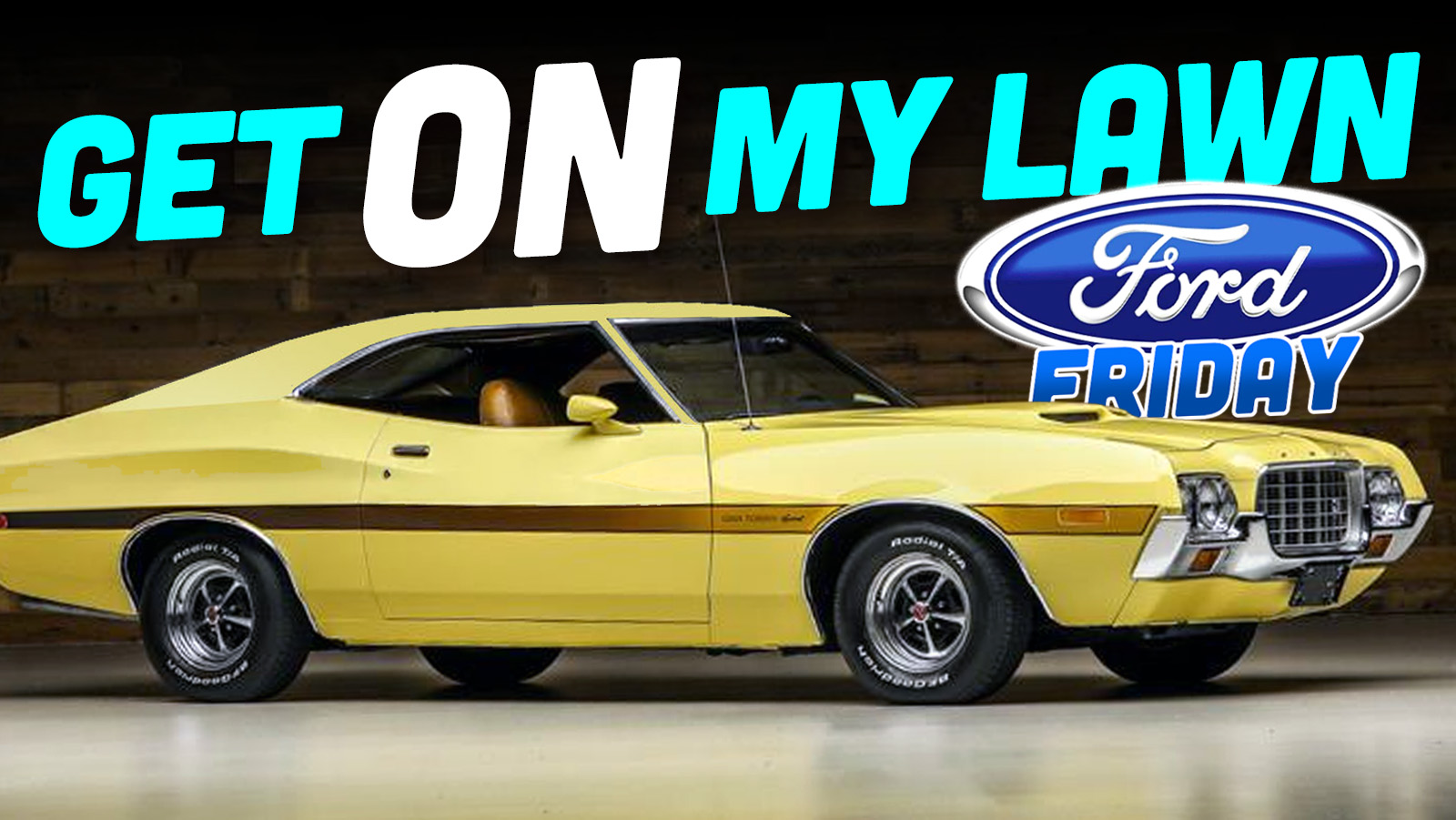
What can you say about a car unknowningly introduced literally months before the world it was designed for came crashing down? You have to feel for the poor Ford Torino Sport, aware that it was designed with sensibilities attuned to a different time.
It’s especially sad when this particular car might have been a rather fully sorted example of a long line of underrated muscle machines from underdog Ford. The third-generation Gran Torino Sport had but a few weeks to enjoy basking in the sun before the storms set in, and if not for an appearance in a famous movie, I’d venture to guess that almost nobody would have even remembered that it ever existed at all. We need to revisit this Cobra Jet-powered coupe and discover how special it really was.


Challengers Make Way For Cordobas
Exactly when the so-called “malaise” period of American cars ended is a subject of much debate; some say as early as 1982, while others extend the period all the way up to just before OBDII in 1995. However, almost everyone agrees that the 1973 introduction of 5 MPH front collision standards, increased emissions controls, and the first oil crisis is when the dreaded malaise era began. If you look back on the cars of 1972, you’ll see that it really was the last hurrah for the remaining muscle cars.

Plymouth’s Roadrunner had its final year of production before the uglier ram-bar bumpers and conventional nose prevailed, but the most famous last gasp was probably GM’s mid-sizers, including the “alright alright alright” Chevy Chevelle Malibu SS454. This was the last year of the iconic fastback body style before being replaced by GM’s 1973 “Colonnade” series of cars, which many commenters over the past few weeks have expressed their contempt for.
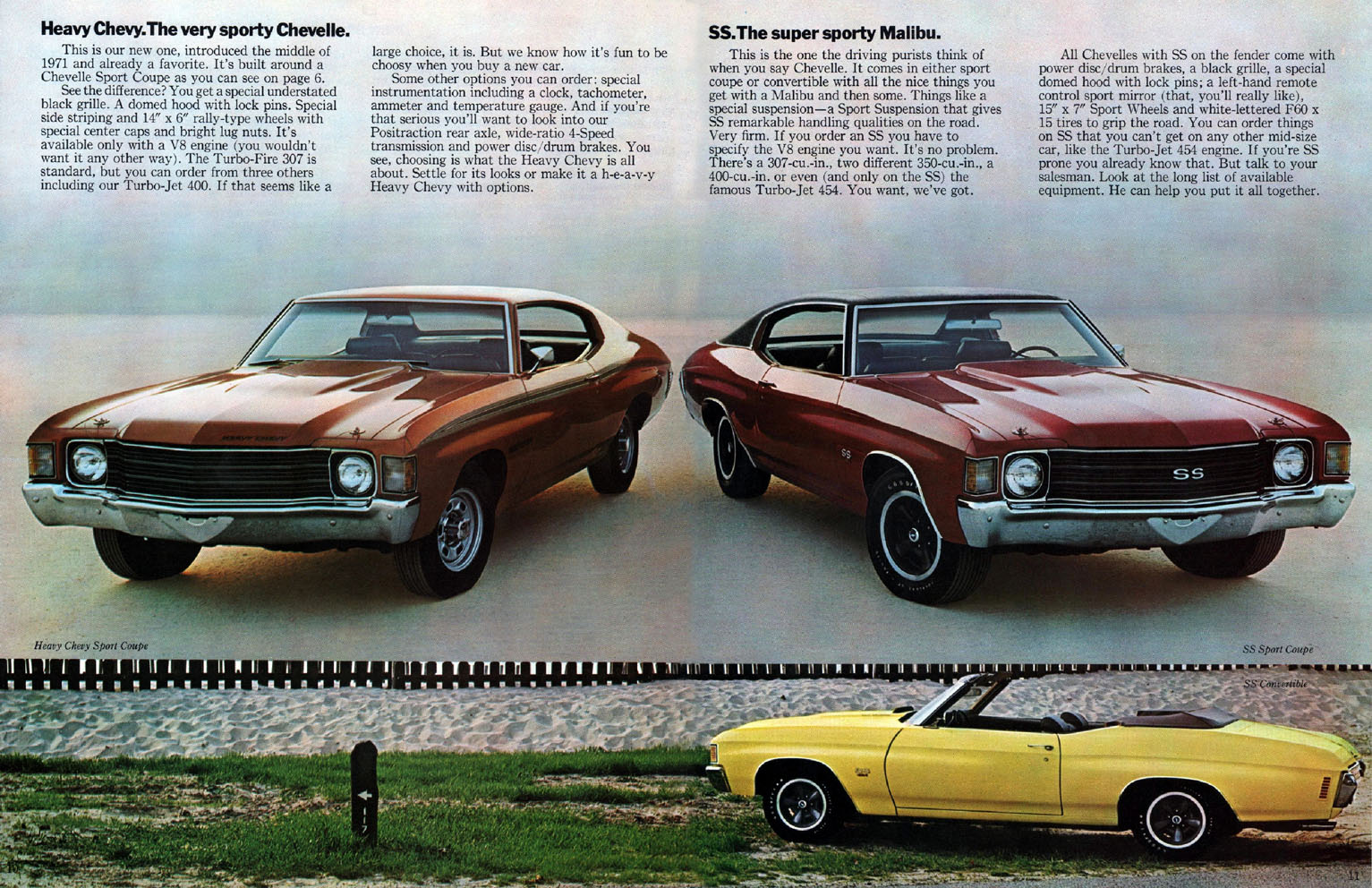
Ford’s second-generation Torino had only been on the market for two years at the end of 1971 and included the vaunted GT model that was arguably the first to truly challenge GM’s A-body juggernaut.

For 1972, however, Ford introduced a brand-new Torino that, in some incarnations, looked like a car designed by people who had no idea what 1973 had in store. Hell, they probably really didn’t have a clue since things would hit so fast and heavy so soon after.
Before The Clock Strikes MalaiseNight
First of all, on the third generation Torino Ford seemed to miss the memo that was going around much of the Big Three at the time that said fastback cars were dead. Everyone was going to notchbacked “personal luxury” style two-doors, but Ford still offered a “SportsRoof” version of its mid-sized coupe with the new 1972 generation, the lineup of which included the Torino, Gran Torino, and Gran Torino Sport, the last of which we’ll concern ourselves with here.
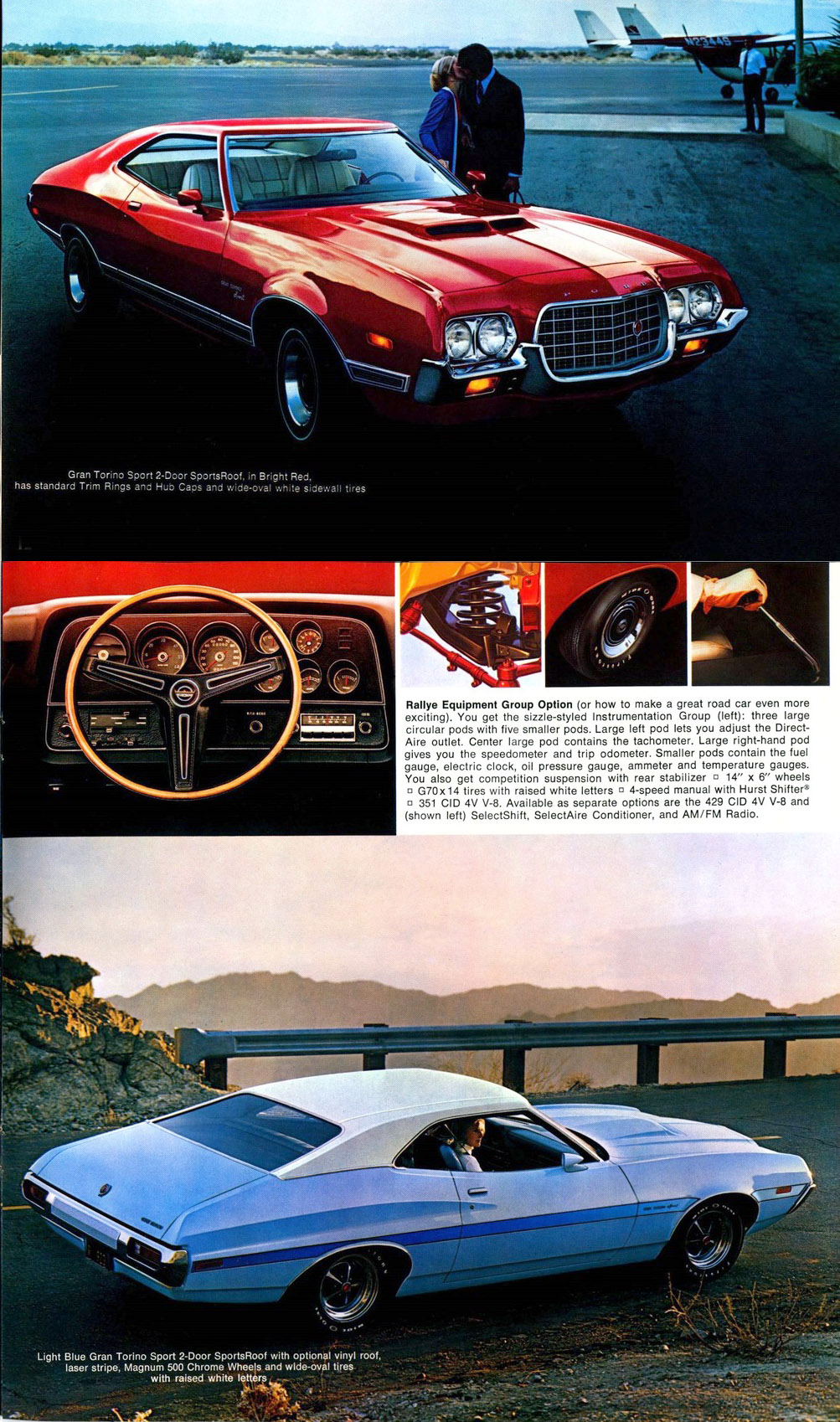
The 1972 Torino also packed some big changes in that it switched from unibody to a body-on-frame design that was offered for the first time in two different wheelbases. This meant the coupe models sat on a shorter wheelbase that allowed designers to take advantage of making a proportionally better product; certainly, it was an attractive and muscular-looking thing with a Coke-bottle flanks flaring at the rear.
Ford did get on the bandwagon of moving mid-sizers to more luxury-oriented buyers, and thus the “Cobra” models were dead for 1972. Thankfully, the Gran Torino Sport replaced that legendary model and featured a slick hood scoop and optional ram-air option.

Also shocking is how the 1972 Torino appeared to have been designed with no regard for the upcoming bumper regulations. The large eggcrate grille in the oval opening up front obviously stood no chance of passing the 5MPH no-damage crash regulations scheduled to arrive a few months after the car bowed, and the thin rear bumper with small recessed taillamps looked to fair no better.

Gran Torinos could be ordered with a variety of V8s, though oddly enough, the largest engines were not the hot tickets. The 302 and two-barrel were the smallest offered, while at the other end of the spectrum were the two-barrel 400 and four-barrel 429. Those largest examples were actually designed to be lazy, low compression, low revving motors with ample torque but no “performance” aspirations.
No, if you were a surviving muscle car fan, the only motor choice for you was the four-barrel Cobra Jet 351. It might not have been the biggest displacement, but Ford let it breath though a special intake manifold and exhale through dual 2.5-inch exhausts for the maximum horsepower of any ’72 Gran Torino. With a modified camshaft and 750 CFM Motorcraft carb, this Q-code engine produced 248 horsepower, a figure that isn’t as bad as it sounds when compared to earlier cars since Ford switched to SAE net instead of the insane gross numbers from earlier years. The thing could still move; Car and Driver tested a 351 CJ, 4-speed Gran Torino Sport SportsRoof with 3.50:1 gears and sprinted it to sixty in a quick 6.8 seconds.
The body-on-frame design obviously played a part in the reviews that lauded the ride of even the “competition suspension” versions of the Gran Torino. This was noted as a big improvement over earlier sports Torinos that seemed to follow the often-lambasted American attitude of reducing roll and pitch by stiffening things to the point that a car had essentially no suspension at all.
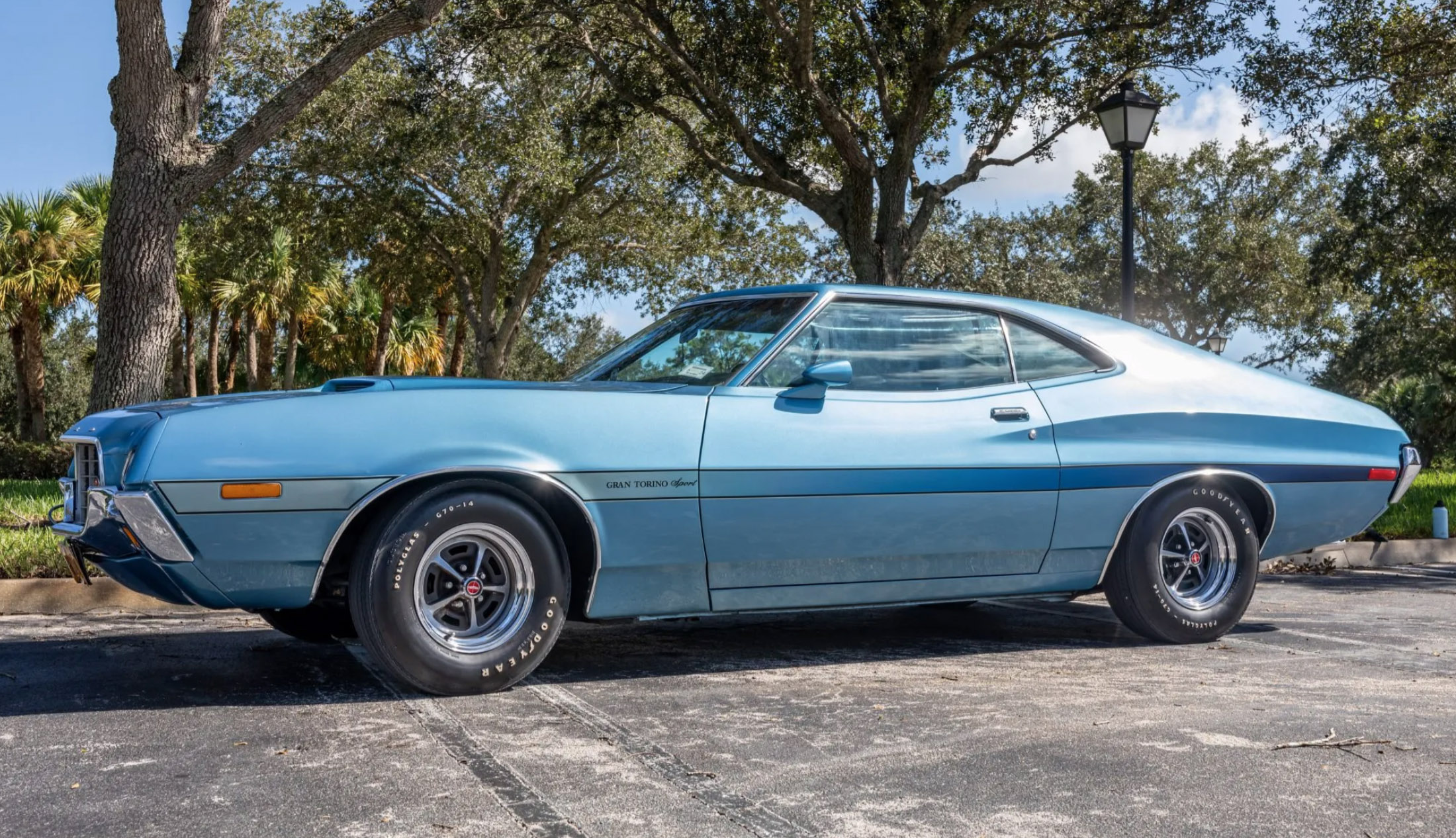
Ford sold over 90,000 of the Gran Torino Sports, but a mere 2,091 were built with the 351 Cobra Jet and a 4-speed manual. In some ways, considering the times, I’m surprised that many left the factory so equipped before the Ides of 1973 set in.
So, was it all just a one-year flash in the pan of a last gasp? Well, not quite.
Do It! Do It!
As the first true malaise year began, the 1973 Gran Torino would not get away unscathed. The 5MPH front bumper regulations required a heavier-looking, more conventional front end with a “ram bar” and traditional grille that seemed a bit at odds with the fastback body. I also prefer the far better integrated hood scoop on the ’72.

In the rear, the clean bumper sprouted rubber protectors to withstand the 2.5 MPH rear collision standards.

Surprisingly, the Cobra Jet motor was still on the options list with only two less horsepower than the year before. Sadly, the ’73 somehow tipped the scales at several hundred pounds more, which further dulled the performance. Car and Driver tested a similar car to the Cobra Jet they’d run the year before and found the run to sixty taking nearly a second more.

Regardless, that’s still fast for the heart of the malaise era. The GranTorino was still a nice-looking car that the buying public seemed to gravitate to; 1973 was a rare year when the Gran Torino outsold the Chevelle/Malibu by over 100,000 cars, again likely due to the public’s general dismissal of the Colonnade style.
Despite strong overall sales, the number of customers who opted for a Cobra Jet equipped Torino Sport continued to dwindle. Sources vary, but only around 1,120 to 1,486 of the Q-code coupes were sold in ’73, and it’s suggested that a mere 197 came with the four on the floor.
Famously, the one in the show was so underpowered that to get wheelspin they geared it so low that top speed was around 50 MPH. The stars reportedly hated the looks of the car almost as much as they despised driving it. It’s hard to believe this car was fundamentally the same as the truly sporting initial 1972 model.
The Gran Torino soldiered on until 1976, when it was transmogrified into the “mid sized” LTD II that was built through 1979 and oddly offered alongside the new Panther-body “full-size” LTD that was smaller on the outside, had more interior space, and was generally a far superior modern car.

In all, a rather sad but inevitable end for Ford’s last traditional pre-Fox-body mid-sized car. The ’79 LTD II needed a bumper sticker that said “I used to be cool.”
“What the Hell Does Everybody Want With My Gran Torino?”
No, the third-generation Gran Torino coupes might not be held in the highest regard by Ford collectors, but that just makes the earliest examples more affordable for the rest of us.
Today, good examples of the first 1972 Gran Torino Sports with the Cobra Jet sell for an average of around $24,000; don’t be picky about what V8 is under the hood and you could get one for far less. Ask for a low-mileage perfect creampuff or restomod, and you could be looking at $40,000 or more, but those are rare to find. The mint-colored, mint-condition one below was listed a while back.

Many are equipped with the vinyl roof, which I’m not nuts about, but could tolerate as long as it isn’t covering hidden rot.

The Mustang-style console and bucket seats are rare and desirable options, since most came with column shifters and bench seats.

Full instrumentation with a tach was optional, though the for-sale example shown here had a rev counter stuck to the steering column.

The asking price for the one above was around $37,000; I don’t know what it sold for, but the text in the ad is sure quick to point out that if it were a similar year SS454 or Road Runner, you’d be looking at an asking price of at least $15,000 to $25,000 more.
You don’t let cushy Buick Regals taint your opinion of the Grand National, do you? Well, in the same manner, don’t let the Broughamtastic or cartoonish “striped tomato” Gran Torinos of the later seventies blind you to the legitimate muscle car qualities of the earliest third generation cars. You might worship the 1970-71 examples, but the ’72 is physically and visually more compact, more spacious inside, and offers a better ride and handling balance than the earlier car.
Despite the appearance as a hero car in a Clint Eastwood film, it’s still a pleasingly elusive car. Looking back, with the imminent approach of the gas crunch malaise era and “personal luxury car” craze, there was no logical reason for Ford to offer the Cobra Jet-powered SportsRoof third-generation Gran Torino at all. The fact that it somehow slipped past the product planners in Dearborn was a small miracle. The fact that it’s still sort of slipped under the radar of price-hiking MecumBoomers is a small victory for enthusiasts with limited cash. Is it the last Ford muscle bargain?
Top graphic image: WorldWide Auctioneers




I have a soft spot for these as I learned to drive on a ’72 4-door Gran Torino with the 302. There must have been issues with it, though, as I remember my dad saying something about really needing to get rid of that car shortly before it was replaced by a Honda Accord. Still, I’d be thrilled to have a good example with the Cobra Jet and the bucket seats.
I never understood the vinyl top on a fastback, always thought it was weird. Seen a Maverick Grabber recently with a vinyl top. That yellow 73 is someone’s fantasy Cobra version as the shaker scoop wasn’t offered on the 72 and up Torino’s.
My parents bought a 1979 Mustang with a vinyl top, that never made any sense to me either. ~10 years later when the vinyl was peeling they had the vinyl top scraped off and the roof painted silver like the rest of the car.
The first nail in the coffin for the stop light queens was the insurance companies. The mid ’60’s muscle cars were death traps, with all that weight over the front wheels and single circuit drum brakes. Lots of oversteer, poor stopping. Made worse when these cars, that were rode hard, got to the second owner who couldn’t afford to take good care of the car. Lots of bad accidents.
Don’t sleep on the 400, either. Sure, the 2bbl stock one was low on HP, but it weighs a lot less than a 385 series big block (429/460) and with a few simple parts everyone knows (timing set that fixed the cam timing, a cam, 4 bbl intake and carb, and suddenly you have something that has gobs of torque and will pull strong until it runs out of air (same heads as the 351C 2bbl.) The one in my 78 F-150 could roast it’s 35″ tires for blocks, and pull a 7k lb trailer up the steepest section of I-40 in the eastern US while passing cars struggling to make it up.
I have never heard of a model going from unibody to body on frame architecture. There most likely are other examples, but this is the first I’ve heard of one. Seems like a step backwards.
I was not a big fan of Ford’s design language back then and I was buying the occasional edition of CAR or evo and lamenting the cool-looking stuff we would seldom see over here.
I did like the 1970 Chevelle SS and Old 442 cars along with Mopar’s performance-oriented Satellite and Road Runner models.
58-61 Lincolns were enormous unit-bodies. Big torsion issues. Went back to BOF in 62
The Ford Thunderbird switched from body-on-frame to unibody Twice, with the fifth generation reverting from unibody to body-on-frame as the car got larger, before switching back to unibody again with the 8th gen in 1980.
The first generation was built on an existing frame, then the second through fouth generation Thunderbirds were all unibody cars, only for the fifth generation Thunderbird to switch back to body-on-frame construction, although weirdly this time around it wasn’t an existing or shared frame, the Thunderbird rode on its own specific platform shared with nothing else. The sixth and seventh generations were also body-on-frame, but this time shared platforms with other cars. Finally, the Thunderbird switched back to unobody in 1980 with the introduction of the Fox platform, and remained unibody until Ford ended Thunderbird production.
Both forms of vehicle construction were seen as having their pros and cons, and automakers used both for different models depending on their specific needs.
You’re killing me Smalls! All those pix of 72 Gran Torino’s has me jonesing for another one!!! Had white 72 with the 351. Found GT hood with scoop for $25 at pick and pull! Had dual exhaust installed. Vroom! Had 2 72 Rancheros, a copper metallic one with 302 auto..43k original miles. Later had a metallic emerald green 72 Ranchero with 351. Had a custom paint job that looked dark green or blue depending on the light. IMHO the 72 was the best looking. Once they put the safety bumpers on it ruined the “jet nose” as I call it. Just looked mean!!
Get off my lawn.
As one of our few resident fans of decals/striping, I’ll note the laser stripes on these look even cooler in person; pictures never do them justice. They’re a pretty creative take on body decals, moving away from the usual solid stripes of the day.
It’s not very well known but there’s a fine movie from 1972 called, “Fear Is The Key.” It starred Barry Newman and opened with a very long car chase featuring a 1972 Gran Torino Sport. I loved those cars.
“Yes, you’re playing the funky theme song in your head right now.”
Okay I just observed something in that intro… so the baddies are chasing Starsky and Hutch. And then the baddies block them in a parking lot (and not very well)… only to get their own asses kicked?
They just sit in the car and wait for Starsky and Hutch to drag their asses out of the car, beat them and arrest them… instead of, you know, being ready with their guns and turning Starsky and Hutch into Swiss Cheese by shooting them as they run to them.
I have a hunch that the baddies just wanted to come to the strip club with Starsky and Hutch and that was it!
It was an unlawful arrest!!!
I mean… maybe they were just good ‘ole boys… never meaning no harm!
Makin’ their way the only way they know how… just a little bit more than the law will allow.
Maybe they were fightin’ the system like true modern day Robin Hoods…
And what was Huggy Bear up to that day?
We had friends who had a 1972 Gran Torino Sport – White with a Black vinyl roof and black interior.
He was a KC-135 pilot, who eventually went to work for United.
They were the ones who replaced their cars with His and Hers silver Twin-Stick Dodge Colts.
I grew up in the way-back of a ’73 Gran Torino station wagon with the 400. I remember my father (who was from a “GM family”) expressing his disdain for the Colonnade body style, the wagons especially. I have to wonder, if my parents had gone wagon shopping a year earlier, would they have picked a ’72 Malibu over the Gran Torino?
I always loved the look of the ’72, and was too young at the time to know why they messed it up. Personally, I’d have a ’72 Gran Torino wagon with the 351 and ram-air hood. Same wheels, paint and stripe as Clint’s, of course. And a matching Ranchero, because why not?
If we ever get a proper Mustang sedan from Ford, it better be called the Gran Torino or Gran Torino Mustang
It would probably end up the other way around, Mustang Gran Torino. At one point, Ford talked about Mustang and Bronco as sub-brands, which is how we ended up with the Mustang Mach-E and Bronco Sport.
I think Gran Torino (or even just Torino) would be a great name for a Mustang-based sedan.
My only hesitation with Mustang Gran Torino is people might abbreviate it to “Mustang GT” lol. Either way, gimmie a Mustang sedan Ford!!!
Just don’t call it the Striped Tomato.
https://youtu.be/d8SWEDuILBk?si=lvSoXc137APVgfZ7
According to brochures I saw browsing the Ford archives online, 1973 was the year “Life Guard” side-impact door beams were introduced. That would have contributed to the weight gain of the 1973 versus 1972 models.
Yes, that’s true. I should have noted that; that easily added more weight than the revised bumpers.
I’d love to have that green Torino, but sadly I have not the funds for such toys (I’ve got kids and old Jeeps to feed!). It is truly sad what happened to the Torino in ’73.
Yeah, that was about all you could do with the ancient Falcon-based spring-over-upper-A-arm front suspension the previous generation was saddled with. Stiff springs, a giant sway bar, heavy shock valving, and basically everything you could do to keep the suspension from moving were the only solutions to keep them from handling like a shopping cart with a couch on top. If you were super fancy, you could do the negative wedge ball joint and lower the control arms to reduce positive camber gain while cornering.
I had a friend in college who had a ’71 (I think) Gran Torino and was very, very gay (really cool guy. We’ll call him “Lawrence”). I had just bought my 1968 Cutlass and showed it to a mutual friend and she immediately screamed “IT’S A LAWRENCE CAR!”
So, for at least one friend of mine, every muscle car was considered exceedingly gay. As a straight guy, I could do nothing to correct her since I figured letting her go through life with that perception would be fun.
Not that there’s anything wrong with that.
When you said “one movie”…this is what came to mind…
https://youtu.be/DzIa17PUzKo?si=YN5e0FVqK6JxDjj5
Oops. I just posted about the same movie. Not many people know about it.
I don’t even know what the movie is about, I just know the chase scene and that barge at the end…”Banana Torino”
Good buddy of mine had one of these when we met. Dark green, with a more modern 460 swapped in but carbureted. It was a neat car. That dude used to mock me for playing with “half engines” in my imports, and now drives a Focus ST and a Kia Stinger as his dailies. How the v8 has fallen 😀
A good friend of mine had an ultra rare 71 429 super cobra jet. It was a beast of a car. Handled like a wheelbarrow but most everything from that era did. It burbled nicely.
My buddy had a ’72 Gran Torino. I don’t think it was anything special as a trim etc. Just a neat old car with stump pulling torque.
The 429/460 engines were torque monsters. Helped another friend put one in an 70 Maverick he was building as a bracket car. Took a fair bit of massaging to get that beast into the Mav.
Oh! I sense an article and a poll on when did the Malaise era finally end! (Or did I miss one already?)
Even if it’s been done before, let’s do another one!
Watched the S&H opening and then rewatched it on mute with Sabotage playing. Much better.
Watch it on mute with the sublime James Taylor Quartet cover of the theme song playing instead, and it’s even better.
https://youtu.be/jmVCBjarUU0?si=wZyBDkdDjipyNcPd