

Most recalls are pretty boring. I sift through a large number of recall reports for my job here at The Autopian, and many of them—these days, at least—are software-related bugs that can be fixed with a simple update.
Sometimes, though, recalls can be a fascinating window into the world of car design. Faults or malfunctions that no one could have anticipated are uncovered due to a combination of parts that no one ever thought to test together.


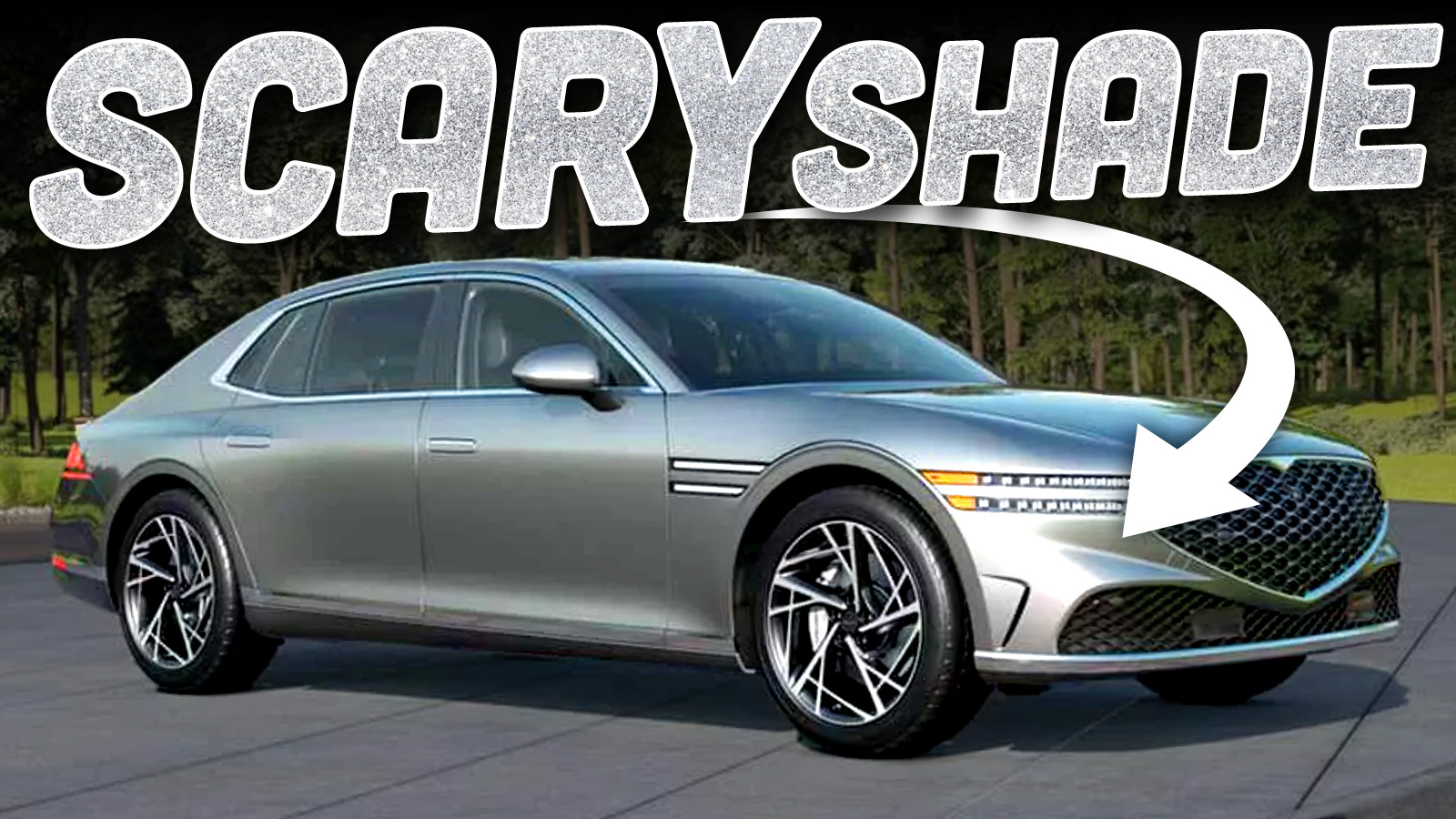
That’s exactly what’s happened here, going by this recall from Genesis. The company’s big-boy G90 sedan has been recalled due to a phantom braking fault in its assisted driving software. But the problem only occurs in cars painted a specific shade of silver.
It’s All In the Reflections

Hyundai, Genesis’ parent company, began tracking this issue earlier this year when it started getting reports of phantom braking from owners. Specifically, the car was hitting the brakes on its own when the driver tried to get the car to change lanes at low speeds, even if there wasn’t a car in the adjacent lane. From the report:
The subject vehicles are equipped with Highway Drive Assist (“HDA”), an advanced driving assistance system that allows semi-autonomous driving on limited-access highways with continuous, direct supervision by the driver. The vehicles may falsely detect another vehicle entering its lane of travel and apply the brakes without warning when HDA is enabled at speeds below approximately 12mph or when HDA is enabled along with the Lane Change Assist (“LCA”) feature, activated by the driver moving the turn signal lever to the desired direction to change lanes.
Even at 12 mph, a sudden application of the brakes still creates a dangerous situation. Not only is it jarring for the driver, but the unexpected stoppage of movement in traffic could cause a rear-end collision from the car behind.
It wasn’t a faulty sensor or rogue software that was causing the issue, as is the case with a lot of these phantom braking incidents. Hyundai soon discovered that the aluminum used in its Savile Silver paint was screwing up the radars in its front bumper:
For vehicles in the Savile Silver exterior color, the front corner radar signals may reflect off the Aluminum content in the silver bumper cover paint and pass through the front bumper beam. These signals may be registered as an object in the opposing lane and can potentially affect Highway Driving Assist (HDA) operation.
In the grand scheme of recalls, this is pretty funny. This is basically the equivalent of an animal seeing itself in the mirror and scaring the bejeezus out of itself.
So What’s The Fix?

Replacing the paint with a version that’s not mixed with aluminum is the most obvious answer, but it’s definitely not cheap. You can’t just repaint the bumper cover, because it would look different than the rest of the car without that aluminum flake. So you’d have to repaint the entire car.
Instead, Hyundai is taking a more clever approach. Affected models will have their bumper beams—that is, the metal bars that hide beneath the painted bumper covers—replaced with a version that’s been “sealed to prevent radar transmission through the structure.”
Once Hyundai learned the Savile Silver paint was the issue, it stopped using it on production cars (the paint is available on much of its lineup). But once this new sealed bumper beam is incorporated into production, it’ll restart. So if your silver G90 on order is delayed, now you know why. Current owners should be getting notified about the fix at the end of next month.
Thankfully, there have been no reported crashes or injuries related to this issue. It would be pretty embarrassing to have to tell your body shop the car scared itself into getting rear-ended.
Top graphic image: Genesis



Duh! Caption obvious here. Buy a car that has an actual color and not grey scale.
I knew there was a reason why you should buy a car with some color.
AMEN!
Well, people have driven the vehicles without those technologies for one hundred years.
Semi-related, but my coworker has a Cupra Leon Sportstourer rental here in Italy. Like many modern cars, it has adaptive highbeams, but they seem to have multiple zones they can dim. Well when driving down the highway at night, it kept thinking the reflections from the roadsigns were oncoming lights, so they would constantly dim and brighten. More distracting than anything.
I’m pretty sure that when the sun is at just the perfect angle, our ’17 CX-3 sees its shadow and activates the blind spot warning.
> an advanced driving assistance system that allows semi-autonomous driving on limited-access highways with continuous, direct supervision by the driver
AKA “full self-driving.”
About five years ago, I had a rental Nissan Rogue that braked itself to a stop along the Charles River in Boston and fortunately, there were no cars around me. It startled me. I had no idea why it did that. Sunny day. It only did it once and as a precaution, I turned it off and restarted it. Unrepeatable. I even tried going through the same spot again. But it didn’t misbehave.
Rouges do that for shits and giggles.
I nearly shat. I didn’t giggle.