

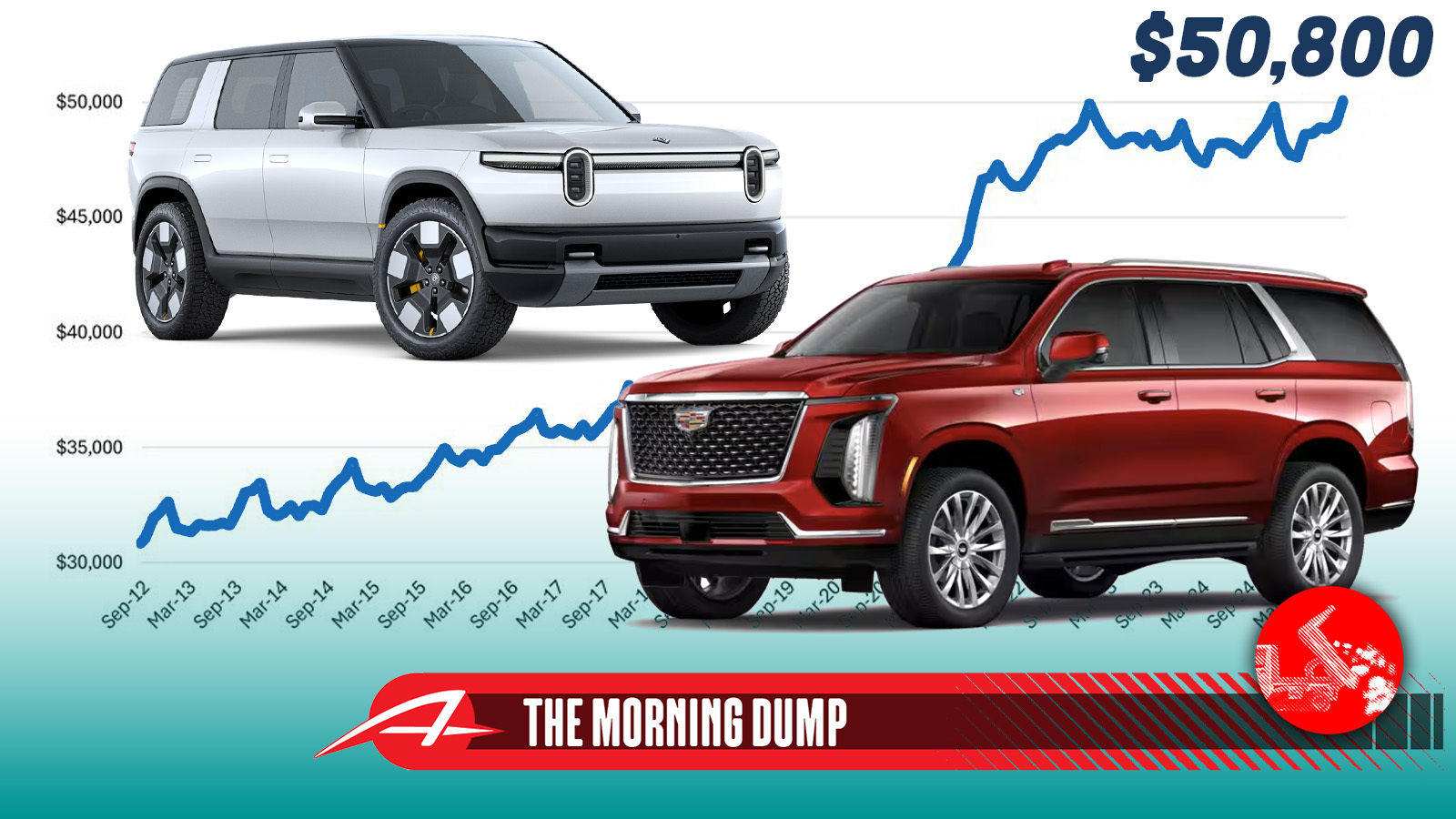
The day has come. The day I’ve long expected and, in some ways, feared. The average transaction price for a new car finally eclipsed $50,000. This isn’t a surprise, and it isn’t purely a sign of cars getting more expensive. It’s more a reflection of who is actually buying cars and the realities of the modern economy.
The Morning Dump today is going to focus on the world we live in now, versus the world automakers wished we lived in. I’ll start with the big $50,000 number, which does have a little to do with electric vehicle sales. It’s not like those sales are making people money, as GM is going to take a huge hit due to the loss of EV momentum.


While everyone dreams of alternative fuel sources, Brazil is one of the few places where that’s actually happening. It’s one of the reasons why BYD is expanding in the country. And while we’re talking about the boys from Brazil… Mercedes has a new vision for its brand.
Is It The Car Or The Buyer?
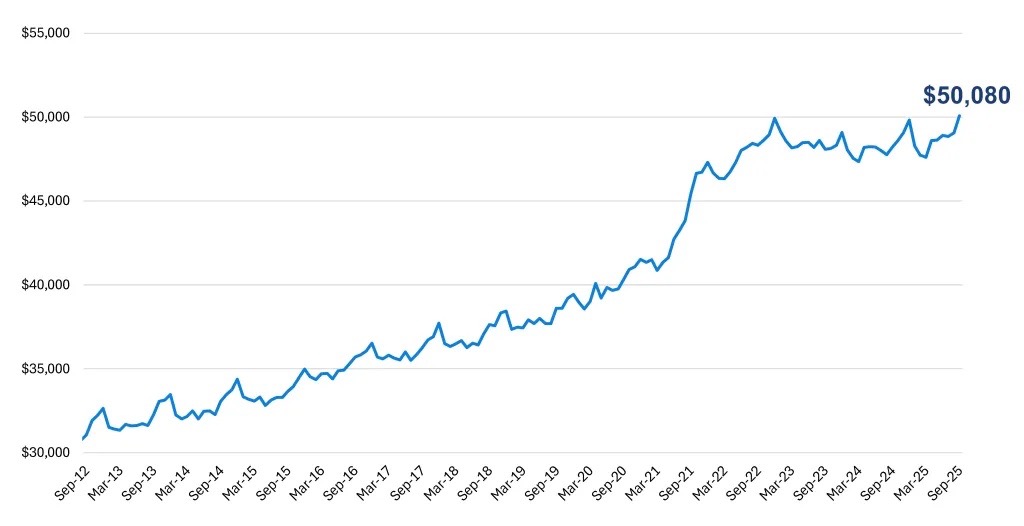
The Average Transaction Price (ATP) chart from KBB/Cox Automotive has almost hit the $50,000 mark twice before. The first time was back in 2022 at the height of pandemic supply shortages. The second time was about a year ago. Finally, for the first time ever, the number eclipsed the $50,000 mark in September.
The number has been hovering close enough to the $50,000 mark that it’s not particularly important that we’ve crossed it. What’s the difference between $50,080 and $49,760 to the average car buyer? ATP essentially takes the total revenue of cars sold in a given period and divides it by the number of vehicles sold, giving you a price that’s more accurate than the average MSRP because it takes into account what the vehicle transacted for after all of the various offsets.

What’s interesting to me here is that this is not merely a reflection of the lack of affordable cars. That’s a part of it, sure, as are perhaps the first impacts of tariffs. A major reason why the average car was more expensive is that a record number of EVs were sold in the United States, and EVs are more expensive (the average ATP of an EV was $58,124 last month). This means that it’s possible there’s a drop in ATP next month.
I’m more interested in what this means about the average buyer. Car sales are still robust even as cars get more expensive. This means that people buying cars are either stretching their budgets (that’s happening) or are merely rich enough to afford a new car.
“It is important to remember that the new-vehicle market is inflationary. Prices go up over time, and today’s market is certainly reminding us of that. While there are many affordable options out there, many price-conscious buyers are choosing to stay on the sidelines or cruising in the used-vehicle market,” explains Erin Keating, Executive Analyst at Cox Automotive. “Today’s auto market is being driven by wealthier households who have access to capital, good loan rates and are propping up the higher end of the market. Tariffs have introduced new cost pressure to the business, but the pricing story in September was mostly driven by the healthy mix of EVs and higher-end vehicles pushing the new-vehicle ATP into uncharted territory.”
I think I’ve referenced this before, but it does remind me of the debate between two jazz musicians (played perfectly by Wesley Snipes and Denzel Washington) in Mo’ Better Blues. Does the audience not come because they don’t care, or do they not care because you’re not playing what they like?
To put it in automotive terms: Are only wealthy buyers entering the market because they’re the only ones with money, or are carmakers not building the kind of affordable cars people want? It’s probably some of both.
The modern economy provides great income growth for some people and for stockholders. The best way to have money is to have money, because the new increases in wealth will be coming from efficiency gains due to AI. If that’s the case, where does the average worker end up?
Some call this “jobless growth” or, the “K-Shaped economy.” From CNBC:
Consumers in the top 10% of the income distribution accounted for 49.2% of consumer spending in the second quarter, marking the highest level since data started being compiled in 1989, according to Mark Zandi at Moody’s Analytics.
The so-called “K-shaped economy” has performed well so far, at least according to broad economic measures such as GDP and consumption. Yet the growing dependence on a small sliver of consumers at the top carries risks.
Zandi said a deep and prolonged decline in the stock market, which is driving almost all of the wealth gains at the top, could send wider ripples through the economy.
“The economy is being powered in big part by the spending of the extraordinarily well-to-do, who are cheered by the surging value of their stock portfolios,” he said. “If the richly (over) valued stock market were to stumble, for whatever reason, and the well-to-do see more red on their stock tickers than green, they will quickly turn more cautious in their spending, posing a serious threat to the already fragile economy.”
The economy depends on AI adoption to continue at an increasing pace, and for wealthier individuals with stocks to keep spending money. How long will that last?
GM Takes $1.8 Billion On EV Production
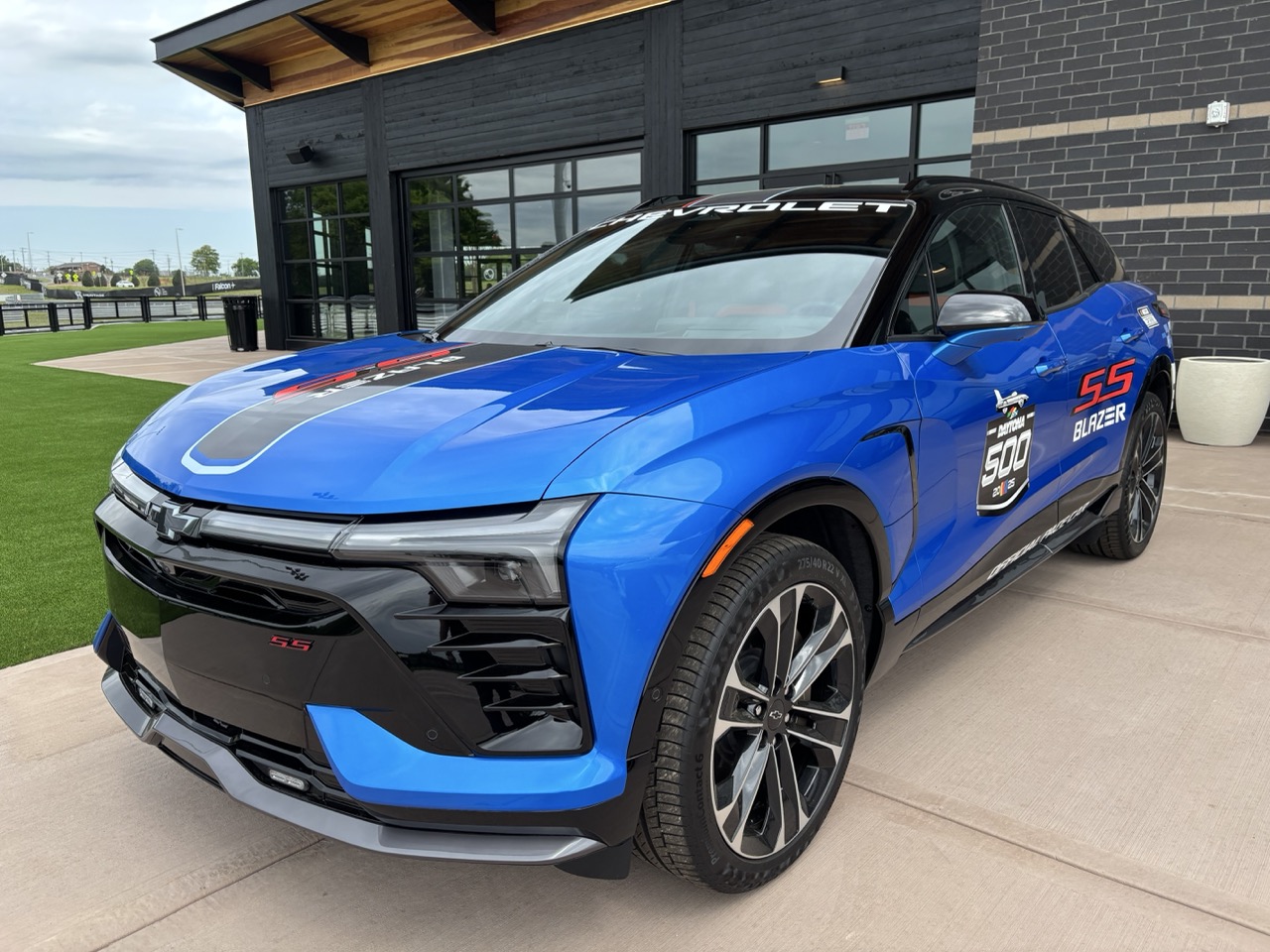
I’d argue that General Motors is the best-positioned EV company in North America that isn’t Tesla, but that doesn’t mean that all the churn in the electric car market isn’t taking its toll on the automaker.
A recent filing, reported on by the Detroit Free Press, shows that GM plans to take a $1.6 billion writedown from EVs split between $1.2 billion for unused equipment and $400 million for supplier cancellation fees:
“General Motors Company made significant investments and contractual commitments in the development of electric vehicles to help the company’s vehicle fleet comply with emissions and fuel economy regulations that were scheduled to become increasingly stringent,” read the filing. “Following recent U.S. government policy changes, including the termination of certain consumer tax incentives for EV purchases and the reduction in the stringency of emissions regulations, we expect the adoption rate of EVs to slow,” the filing continued. “Our strategic realignment of EV capacity does not impact today’s retail portfolio of Chevrolet, GMC and Cadillac EVs currently in production, and we expect these models to remain available to consumers.”
This equipment will probably be used eventually, but not at the pace initially expected, so GM has to adjust its books.
BYD Launches Ethanol Plug-In Hybrid In Brazil
Brazil made the use of sugar-based ethanol a major part of its path towards energy independence after the gas shocks of the 1970s. The country’s vehicles use a mix of gasoline, bio-diesel, and ethanol to power their vehicles.
Now it looks like the world is getting its first flex-fuel engine-powered PHEV in the form of the BYD Song PRO. From a press release:
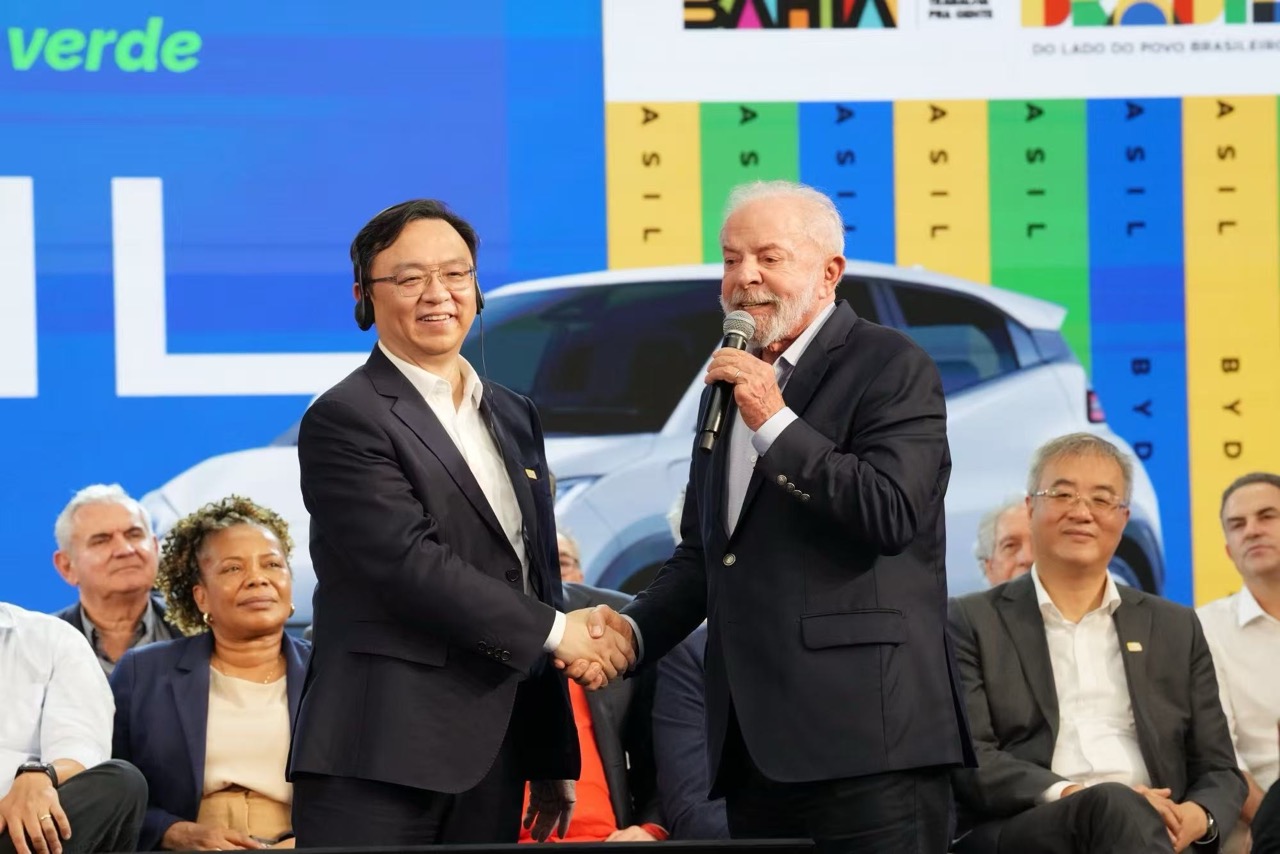
BYD founder and CEO Wang Chuanfu said: “After two years of effort by more than 100 Chinese and Brazilian engineers, today our 14 millionth vehicle rolls off the production line equipped with the world’s first plug-in hybrid engine dedicated to biofuel. This is not just a technological breakthrough – it is a green and sustainable solution tailor-made for Brazil.”
He added: “Two years ago, on a visit to Brazil, I realised the potential of ethanol. We then decided that we would bring our plug-in hybrid technology, but with a flex engine developed by and for this country. The car we are delivering today to President Lula is proof that BYD not only invests in Brazil but also co-creates with Brazil unique solutions for the world.”
Brazil is a great place for BYD to expand, as it is arms-length enough with the American government to not be concerned with the fallout from having a BYD plant in the country. Additionally, a flex-fuel vehicle like the Song isn’t going to be sold here anytime soon.
Look At This New Mercedes… Thing
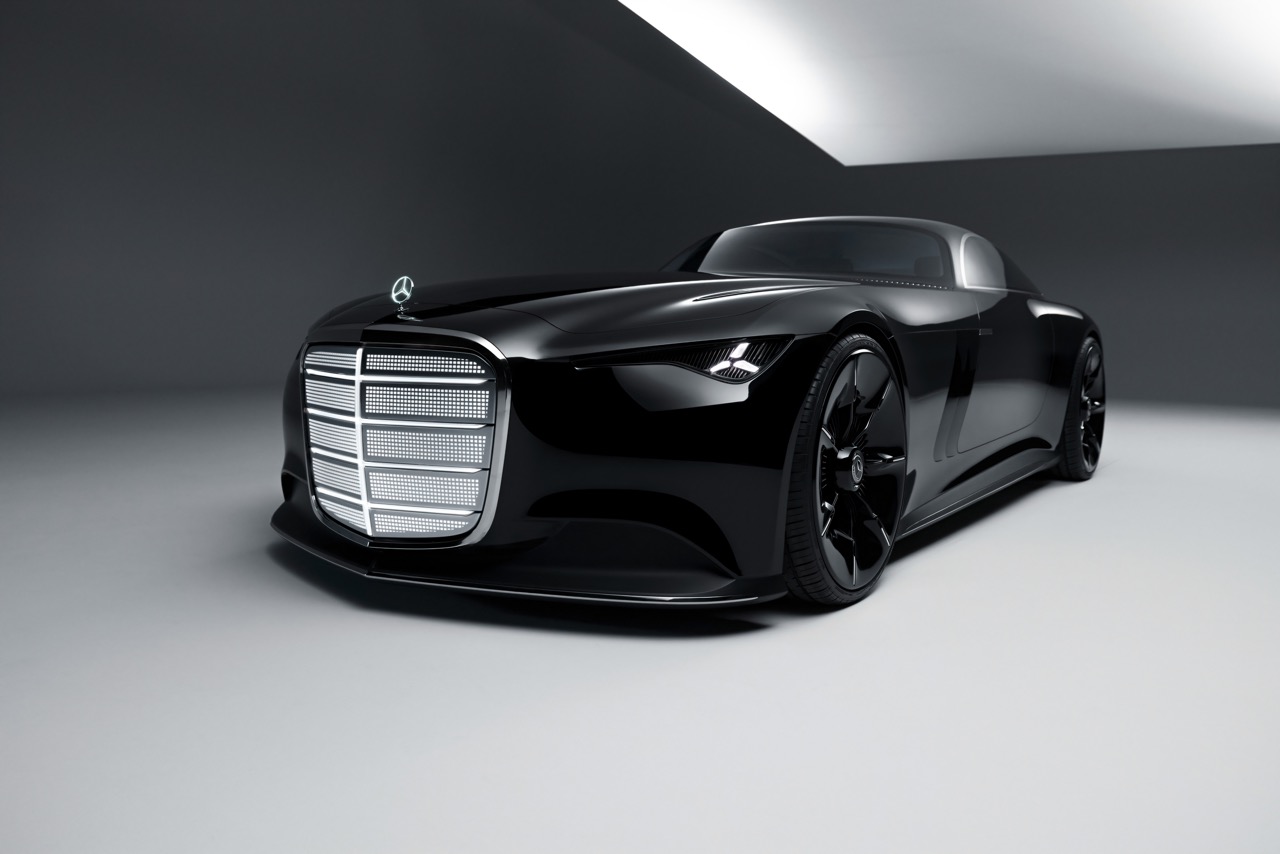
No one buys electric coupes yet, so the fact that every automaker has to show a big EV coupe now is amusing to me. Whatever, this Mercedes-Benz Vision Iconic does look cool.
It’s very Art Deco, with that big throwback grille. This is an EV, so it doesn’t necessarily need a big radiator, but it’s pleasingly dramatic and contrasts well with the deep black paint.
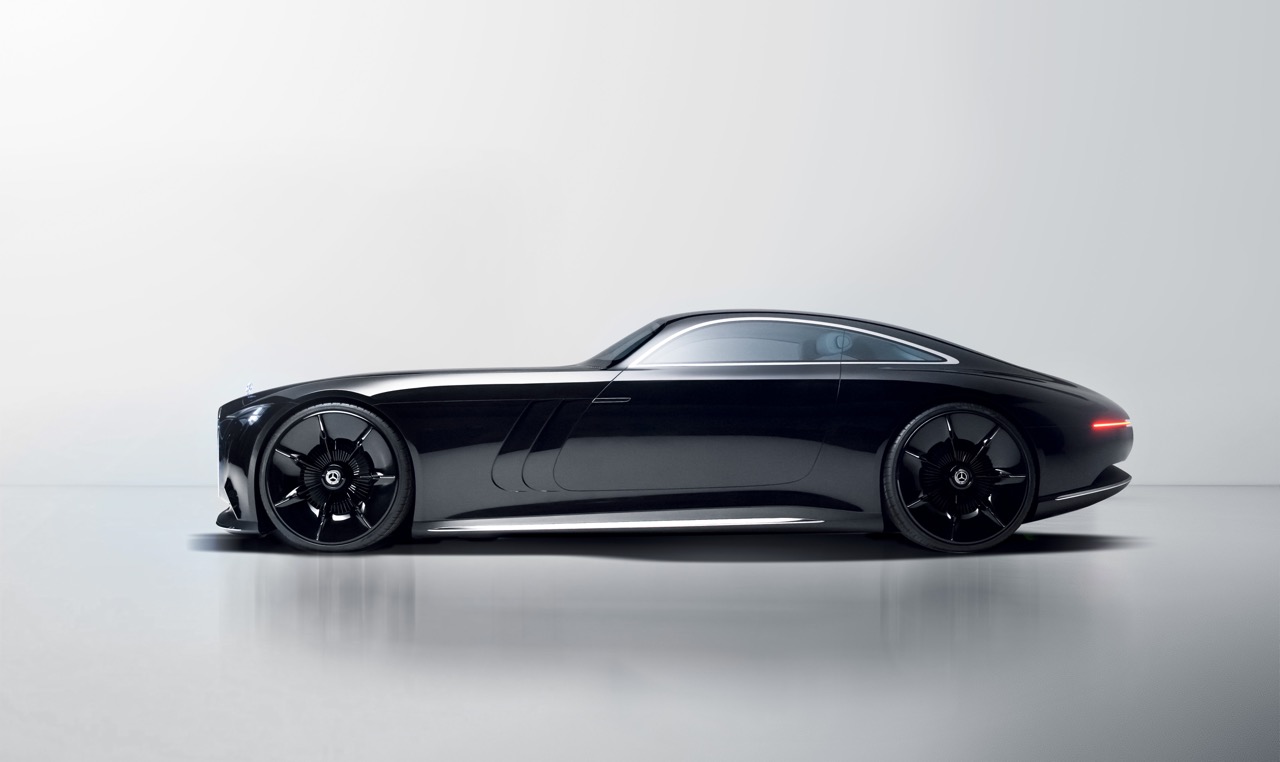
Does it have some crazy concept crap? Yes, it does, which is good!
Mercedes-Benz is researching innovative solar modules that could be seamlessly applied to the bodywork of electric vehicles, similar to a wafer-thin paste. The photovoltaic-active surface could be adaptable to various substrates. When applied to the entire vehicle surface of the Iconic Vision, additional range could be harnessed from the sun, depending on geographical location and local conditions. As an example, an area of 11 square metres (equivalent to the surface of a mid-size SUV) could produce energy for up to 12,000 kilometres a year under ideal conditions. The coating does not contain any rare earths or silicon and can be easily recycled. The solar cells have a high efficiency of 20 percent and generate energy continuously – even when the vehicle is switched off.
Solar paint! I dig it.
What I’m Listening To While Writing TMD
I had to do it. No regrets. Here’s Denzel and Wesley doing “Mo’ Better Blues.”
The Big Question
Is it the buyers or the carmakers?
Top photo: KBB, Rivian, GM


And a totally separate post… I haven’t bought a brand-new vehicle since 2018. (My ex-wife has.)
I was fine buying used cars before that. And I will be now going forward. But with a <70 K miles Accord, that could be a while.
That M-B is the most hideous thing I have ever seen out of their studio. It’s like they said to BMW hold my Wartsteiner and watch this.
Hmm.. looking at the top graph, it looks like pretty much since January 2022 things have already been in the $47,000-$50,000 range. So that’s three years before tariffs.
More or less it seems to just reflect how “everything got more expensive“ since the pandemic.
However, many wages are up as well. I was just driving along the freeway today and they’re begging for ironworkers in the union starting at around 70,000 going up to 120,000 a year..
The Merc looks familiar. I think it was in the homecoming parade at Faber College in 1962. Knowledge is good.
Is that the Red Skull’s car from Captain America?
Who ever says the K-shape economy is going well has lost their damn mind. 80% of economic growth in America in the last six months is either AI businesses or data centers. If you remove them from the economy, we’ve had an economic growth of 0.1%. Which we haven’t seen since **drumroll please** 2009!
This is so fundamentally flawed. Our entire economy is becoming dependent on taking large amounts of cash and dumping them directly into the incinerator of AI. Which does not really work, nor has a wizard in the machine made it profitable. There’s no labor or product here for almost all of us. Our economy is the vibes based google machine.
Naturally, in a time of stagnation. More companies are hooking their wagon to the profitable few. Whose wealth is primarily stored in the vibes. This is just the business model of luxury goods. Which ask the burning garbage fire known as the bike industry how well that works. Unfortunately no one’s left to answer your call at Trek.
This is an obvious house of cards. We’re one AI bubble bursting, which seems pretty likely, from 2009 2.0. So, the obviously this is the right time to commit fully to hunting for whales. There’s a saying in New Bedford, don’t know if it’s in Tennessee; There’s always more whales in the sea, whales are a limitless resource that will power our candles forever.
I said the same thing about social media companies 20 years ago. Meta – then Facebook – was a bubble that had to pop. Today they are the 6th most valuable company in the USA worth $1.8 trillion.
Netflix – a company that used to send me DVDs by mail is the 15th largest company in the USA.
It could all pop – or it could keep going. New market are created all the time.
“Consumers in the top 10% of the income distribution accounted for 49.2% of consumer spending in the second quarter”
This is what happens when you pay one empty suit the salary of 50 laborers to sit around and peruse Oprah’s Favorite Things list. All the while arbitrarily driving up prices.
If the average household income was $150,000 (as it easily could be), these costs would not be an issue. If growth at all costs wasn’t demanded, prices could be lower.
It’s not the automakers fault specifically but they are culpable. Everything corporations (and the politicians they keep in their pockets) have done to weaken labor, drive down wages and create a fragile economy have resulted in these statistics. Cox is hardly unbiased here.
In other words, the same 10% that are doing all the spending created all the problems and profited off them. 90% of us will soon be irrelevant to our own economy.
The “K” in K-shaped economy might as well stand for “Kaput”. They will not stop until America is just a wall-to-wall antebellum south.
“90% of us will soon be irrelevant to our own economy.”
We already are:
https://www.youtube.com/watch?v=T2OHjHPkUzM
I don’t know about easily getting to a household income of $150K. If the entire GDP of the USA was evenly distributed it would be about $90K per adult. (2023 numbers)
Freeze some assets, jail some oligarchs, get the due taxes from the Cayman Island banks. We could get close.
I believe you missed my point. An average household income of $150K a year means basically you have an economy were wages are evenly distributed and everyone make the same.
How do you get someone to do 13 years of training to become a hand surgeon if the checkout clerk at the grocery store makes the same?
No, you can’t just seize and redistribute oligarch money and almost double the median income.
It’s not about equal income, it’s about the ratio between the average employee and the most highly paid one.
Right now, top brass makes 400x more than the average. Raise the average, cap the top and make examples of the ones sitting on billions.
It’s a long term goal (and a pipe dream) but in time such numbers are achievable for a country so wealthy.
If you want the average to be $150,000 you need to top way more people than the top brass. Yes, CEO pay is crazy in the USA but as they apply to median income they are a rounding error.
We absolutely could and should tax those top 1% more fairly. We could close the Social Security shortfall just by removing the cap on wages subject to SS and applying it to investment income as well as wages.
“Is it the buyers or the carmakers?”
It’s buyers, carmakers AND DEALERS… who love to stock mostly loaded/high priced vehicles.
If you want to overpay for a version of what you want with a bunch of crap you don’t need, well yes sir we have one in stock right here.
Oh you want a base or more basic model? Well we can place a factory order for you… maybe… and you’ll have to wait at least a few months.
Oh you need a car now? Too bad… so sad…
As for buyers these days… way too many like to use their vehicles as status symbols. That’s my theory why the entry level BMW and Mercedes vehicles are as popular as they are even though from a cost, reliability, durability and overall quality perspective, a Prius is superior.
And automakers got high on pandemic pricing and are trying to keep the dream alive. And the case of Stellantis, that is translating into falling sales as people walk away when they see Stellantis’ often fantasy-level MSRPs.
Oh and I almost forgot… THE STUPID EPA FOOTPRINT RULE which puts more stringent standards on smaller vehicles and goes easy on larger vehicles.
We can thank George W Bush has his gang of Republicans for that idiocy.
I can’t star this comment enough.
I’m not going to say that cars aren’t getting more expensive because they are. HOWEVER, does the study dig any deeper into how many people over bought and didn’t need what they purchased? There are still affordable and decent options out there (sub $30k). People will over buy justifying things on fringe use cases (I’ll admit I’m guilty of this from time to time).
People are stretching themselves too far to pay for a vehicle.Then they drive that vehicle into the local church parking lot when there is a food giveaway.I guess I’ll never understand.
It’s both. I’ll be honest, I am part of the problem. The new Pilot we just bought was $51,085 after TTL, it was even discounted a decent bit. However, the high trade in value of the CX9, high residual values on Pilots, and significantly better rates for new meant buying it new was better than buying used. Also, we plan on keeping this one for a very long time since it fits our family needs perfectly. I like putting my wife in a nice, new car, she works extremely hard as a teacher on top of being an awesome mother to our children and dealing with my automotive shenanigans.
AVERAGE means next to nothing.
What is the MEDIAN price of new cars?
That’s the important statistic that no one is talking about. Probably because Americans are so goddamn bad at math.
Likely around $47k based on historical data and the current average. It is harder to verify since not all the data is reported in a way that would make it possible to calculate directly.
The difference isn’t huge because even if Ferrari sold 3500 cars at an average of $450k it doesn’t move the needle a huge amount against Ford selling 765,000 pickups at $65k a pop.
Agree, my conspiracy reptile side tells me the median sale price is intentionally not reported as it would be lower number than the average. The manufacturers and the dealers only want the higher number reported so as to convince buyers that they got great value at $40k rather than 35, 30 or even 25K. Mr. I.J. Reilly’s point that trying to determine the sale price where half of the total number of vehicles sold is below this price point, with the other half of the total number of vehicles sold above this price point is difficult to ascertain in a timely manner,
What we need is a graph showing the average ATP over time, along with the average household income of new car buyers along with the overall average household income.
Dang that Merc is attractive.
People complain about new car prices, but cars have often beat inflation. A F150 STX is the same price or even cheaper (with inflation) as a F150 crew cab 4×4 from 2001 and is a much nicer truck.
What hasn’t kept up with inflation: salaries, education, and housing.
Here’s some of that fun anecdotal evidence, with a sample size of three families:
So, carmakers or buyers? I kind of feel like it’s something of a knot between the two with the carmakers keeping themselves tied to where the easiest money is. If I’m a business and I’m seeing that marked-up expensive fancy toys disguised as necessary transportation keep the lights on and the shareholders happy, then that’s what I’m going to build. At one point in time there was this notion of line-workers being able to afford what they build. That’s long gone, along with the overall model of lure people in with a low-margin cheap car, and sell them an expensive one later. Now it’s simply finance it longer if you want it, otherwise GTFO. That “K” is likely to keep stretching and with it are those car prices and monthly payments.
Who is buying these? I’m a senior engineer and make a good salary. The thought of spending that much on a car leaves me in disbelief.
Re the M-B “…Thing”: LOL! I mean, from the side, it looks like a cool, exaggerated concept car except with its nose having unfortunately been lopped off square by a big vertical bandsaw. So not bad for a concept. But that front view! That front view! It is so ridiculous. It makes me think of those idiotic snapchat etc. filters of a few years ago that replaced people’s eyes, nose and mouth with oversized cartoon animal ones.
The median income in the U.S. is less than $40k. I don’t get it.
Median household income last year was $83K in the US.
$83k HOUSEHOLD income. Angry Bob was listing the median income for an individual. There are millions of single person households scraping by on $40k.
I know. I just didn’t want to spend more than 18 seconds looking for individual income and I figured $83K/2 > $40K.
Which is a very expensive way to live. There is a cost to be paid for people deciding to be single instead of pairing up.
Median personal income was $45,140 in 2024
FRED has pretty much anything you can want for economic data
https://fred.stlouisfed.org/series/MEPAINUSA672N
Thanks!
Because you are talking MEDIAN income (which is the correct metric), while these car websites are talking AVERAGE prices (which gets blown out of proportion when some billionaire buys a Bugatti).
Eh, not really blown out of proportion. Bugatti sales are what, 50-75 cars at most a year?
Fair enough but it will shift the numbers up, there’s no doubt about it. Bugatti might only sell have sold 50 or so cars, but they also cost 60X that of a more typical car sold. And there are plenty of S classes and Aston Martins and BMWs as well as tons of expensive SUVs that go for North of $100k that skew the numbers. Just for the Escalades along, they sold 40,000 of them in 2024.
The total market is about 16M new vehicles / year, though.
And 20% of that 16M is luxury brands.
Not to mention the $80K F150s
Re the opening ATP graph: fwiw, if you extrapolate the trend line of pre-pandemic ATP to the present you get about $45k. So 5 years post start of pandemic we are, for whatever causes, still 11% above previous trend in ATP.
Someone at Mercedes must have watched The League of Extraordinary Gentlemen.
Lots of people watched that movie. Most regret it. Sean Connery retired from acting afterwards. We’ve had at least three Spider-man reboots since LXG came out, so it’s ripe for a remake. The premise is sound.
A quintessential two and a half star movie for sure. Some promise, so little delivery.
Peak disappointing Alan Moore adaptation, right here. It’s almost its own film genre at this point.
That Benz is what a retired Batman will drive to the early bird special and back to Wayne Manor to watch “Murder She Wrote.” He will drive it at 40 MPH in the left lane with his blinker on the whole time. He will take two parking spaces when he parks. It will take him five tries to park.
Definitely has a Batman: The Animated Series vibe.
Came here to say this.
It would serve equally well as Cruella De Vil’s car
Everybody Wang Chuanfu tonight…
As a child of that era, I am honored to give you a rec.
And CATL ain’t nobody’s bitch in Green Hornet now.
Big car companies have big car company reasons to cater only to the $50k+ market. I think we will have to look at start-ups to grab the cheaper end of the market, which is wide open. Slate? A Euro small car maker? It would be a Chinese company for sure but ….
One problem is that recalls wipe out the low profit margins on the cheaper vehicles. If the automakers can cut down on those……
The new entry level car in the United States is a USED car. There’s no money to be made selling the cheap stuff, so manufacturers (and their dealers) are relying upon three-to-four year old lease returns to be their new introduction to the brand for younger and lower income purchasers.
We can go on and on about scenarios where manufacturers could product a sub-$30k vehicle, but the bottom line is that it is not profitable to do so. You mention Slate and the Chinese manufacturers. Do we really believe that the Slate truck is going to hit the market at the price the manufacturer has suggested? Also, do we really believe that the current Administration is going to allow the Chinese manufacturers to flood the US market with cheap EVs? Ain’t gonna happen…
As a car person, I can’t help but be jealous of those of age during the 80s and 90s… So many affordable options. Sure, people didn’t understand AIDS yet, but I could’ve legally bought a Suzuki Samurai and an Isuzu Trooper on the same day!
and all kinds of cheap Geo’s etc. I bought a new 1991 subaru justy 4 dr awd 5 speed for $8800 out the door price. that would be less than 21K today.
We didn’t realize how good we had it back then. In 1993 or so I bought my first “real” car, a 1990 Mustang GT for $8,000 and my car payments for 3 or 4 years were like $213 a month. Really fun reliable car, wasn’t extremely fast but good torque and it looked and sounded good.
$213 in 1993 is $478 in today’s dollars. That wasn’t a cheap payment.