


Before the widespread adoption of electric vehicles, storage space underneath the hood of a vehicle, known as the front trunk or “frunk,” was a fairly obscure feature. Because most cars have their engine up front, the average buyer has probably never had that space available to store things. The only way to have a frunk would be to have a car with the engine in the middle or the back of the car.
Now, though, the frunk has become far more mainstream. Because electric vehicles don’t need that space to keep their floor-mounted batteries or compact electric motors, many manufacturers have opted to use it to add storage space. Peek under the hood of most electric cars, and it’s likely you’ll at least find a cubby to store your charging cable.


As it turns out, people might not be using their frunks as much as automakers thought, at least going by Ford’s decision to eliminate the frunk from the Mustang Mach-E’s list of standard equipment.
Now You’ll Have To Pay For That Extra Storage
Ford Authority was the first to catch the news that the Mach-E will not have a frunk as standard. If you want a frunk in your four-door, all-electric Mustang, it’s now a standalone option that’ll cost you an extra $495. And it’s not like you get that level of a discount if you don’t option the frunk; the 2026 model is only $150 cheaper than the 2025 model, which got the frunk as standard. So if you match the two model years spec-for-spec, you’re paying $345 more.
The reason, according to Mustang Mach-E brand manager Teddy Ankeny, is that owners simply weren’t using the frunk as much as the company expected. Here he is in a video interview with the Electric Duo YouTube channel revealing why Ford made the swtich:
Here’s the relevant quote, in case you don’t want to (or can’t) watch the video embedded above:
“[W]e were learning that customers were using their frunk, but perhaps not as much as we had originally intended. And so, in order to kind of preserve that customer choice, we have made it optional for the 2026 model year.”
Personally, I’d think “Customer choice” would mean keeping the frunk standard and letting the customer choose whether to use it, but that might just be me.

It’s a shift in tone for Ford, which touted the Mach-E’s frunk as one of its most interesting features back when the car was new. Back then, there was 4.7 cubic feet of storage space available, and even a drainage hole at the bottom allowing ice to melt through so you could use it as a tailgate cooler. That press photo above of people eating shrimp from atop a frozen pile of ice in a Mach-E frunk is seared in my mind forever.

For the 2025 Mach-E, the frunk shrank by 40%, to 2.6 cubic feet, thanks to the installation of a standard heat pump for the batteries, and lost its signature drainage hole. And now, it’s not even standard equipment anymore.
Maybe The Germans Were Right?
In any case, Ford’s move feels like a case of cost-cutting and trying to squeeze more dollars out of customers by paywalling previously standard equipment. But it’s not worth dismissing the company’s analysis entirely.
There are a couple of reasons I could see someone fully ignoring the Mach-E’s frunk for the entire length of their ownership. The most obvious is that there’s a much bigger, easier-to-access storage space in the hatch that takes just one button-press to open (versus two clicks on the key or two pulls of the interior latch for the frunk). And if I’m carrying a bunch of groceries, I’d probably just go to the rear hatch area if I’m not sure everything will fit in the much smaller frunk.
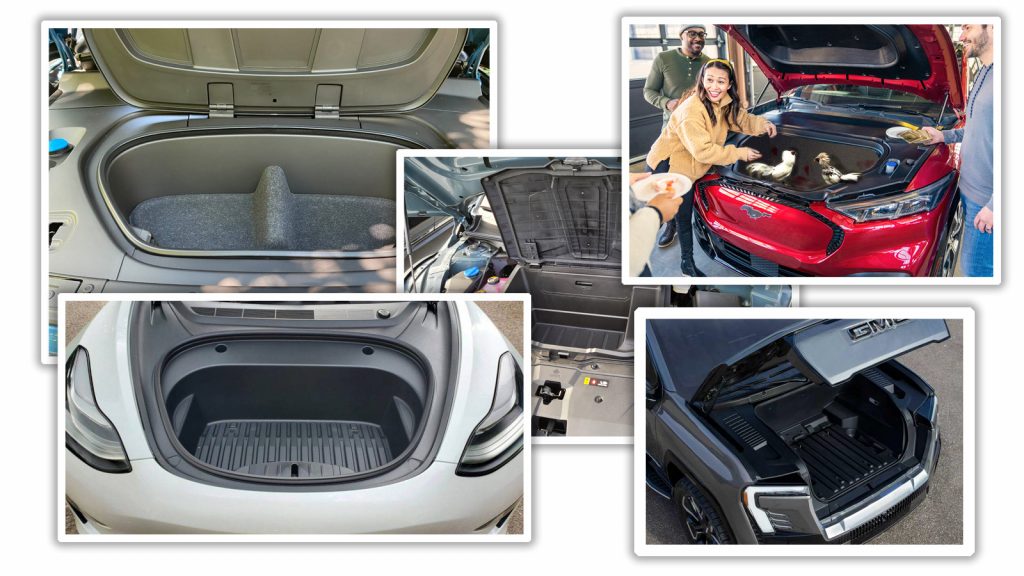
Let me play devil’s advocate for a second: If I’m an automaker looking to optimize cost through design, every inch of the car is under a microscope. And if the folks from the data department are saying people aren’t using their frunks, that allows carmakers to reassess how to use that space more efficiently.
In the case of the Mach-E, designers simply decided a heat pump for quicker charging was more important for customers than 2.1 cubic feet of storage space. Then, for 2026, they figured so few people used the frunk that they wouldn’t mind if it weren’t there at all. And the people who do want one are willing to pay for it. That’s a few extra hundred bucks in my pocket that wasn’t there before, or a couple of hundred bucks saved in parts if the buyer doesn’t choose the frunk.
There’s a packaging angle here, too, at least according to Nissan vice president of global design Alfonso Albaisa, who told Green Car Reports back in 2020 that engine bay space can be used for stuff that was previously inside the cabin, rather than for extra storage:
“The HVAC [heating and air conditioning], all the guts that used to live in the cabin, we shoved them in the engine bay, which has no engine,” said Alfonso Albaisa, regarding its upcoming electric crossover, closely previewed by the Nissan Ariya Concept first shown in the U.S. last month at CES. “Actually if you open the hood on Ariya, it’s full of stuff; that’s what’s given us this completely open cabin.”
All the way back in 2022, my colleague Jason wrote a piece calling out German automakers for not installing frunks on EVs when they very clearly have the engineering know-how to do so. One paragraph stands out with this new context of Ford’s move:
I’ve asked representatives of BMW and Volkswagen about this, right to their faces, and I got essentially the same answer from both companies: what the hell do you need a frunk for when we have so much room in back?

Personally, I couldn’t imagine not using the frunk if I had the option. Sure, it’s usually a small space, but it’s perfect for stuff I don’t want flopping around in the normal trunk area, like charging cables, snow brushes, ice scrapers, first aid kits, and miscellaneous tools. And if my EV were a hatchback, having a storage space that’s truly hidden from view would make keeping valuables in my car, which I park on the street, far less nerve-wracking. In the case of pickup trucks, frunks are even more useful because they provide a lockable, sealed storage space on the vehicle’s exterior that wasn’t there before.
In the case of normal car- and crossover-shaped EVs, automakers think differently, and if Ford’s analysis of how often customers use their frunks is to be believed, the average buyer does, too.
This all leads me to ask: If you have a car with a frunk and a traditional trunk, do you use the frunk? If so, for what? And how often?
Top graphic image: Ford


I don’t get it to be honest. I get the urge to do price segmentation and I don’t even complain about it when it’s logical. But in this case? The frunk doesn’t exist because customers were clamoring for one, but because the technical requirements of some cars (mainly but not exclusively electric cars) and people’s aesthetic expectations (a car has a front with a bonnet and an engine bay) were mismatched, which left an empty space that could be used for something.
If you “remove” the frunk what does that even mean? They leave a fully empty hole with no liner and nothing in it? Is that structurally sound? They put a frunk but they fill it with concrete to spite you? They reroute some stuff to use that space, does that even make sense financially with modern assembly lines?
So if the frunk is an empty space, what happens when you remove it?
The weather tech people could fill this void I bet.
I bet there is a statistical error ford is making here, if they are using data from number of times frunk is open/closed.
The frunk is perfect for storing things you rarely need to use but absolutely need in your car. Emergency equipment, charging cable, jumpers for your friends etc.
Just because it is opened rarely does not mean it is not used.
After seeing the Telo, I can’t help but think of the frunk as a vestigial organ from ICE design thinking. Give me a shorter car with better sight lines, not a long hood just because that’s how you’ve always done it.
They need a long hood for crash safety and pedestrians still.
Not that long when you don’t have a giant chunk of metal up front. With the long wheelbase of an EV, you can still stick the wheels in front of the driver without needing a long snout.
I think a frunk is worse for crash safety because who knows what incompressible object somebody might throw in there. Or if they insist on putting a long front up there, at least give an option for a spare like some older vehicles did.
I HATE that my Bolt doesn’t have a frunk. I don’t often use my “little” 120v charger, but when I do (usually when visiting my parents’ 400 miles away), I have to unpack the rear trunk, remove the floor, and pull out the charger. I’d MUCH prefer to keep that and my tire-changing gloves and emergency blanket in a small, rarely-used frunk.
I don’t have a frunk, but I like the idea of them.
That said, the kind of stuff I’d throw in there would be charging cable/adapter, roadside emergency stuff, etc. I don’t think I’d use it much as a frequently accessed storage location.
The exception is trucks. If I needed a truck, having a big frunk like the Lightning is a fantastic feature. It’s a better version of the closed, lockable storage you get with the in-bed trunk of the Ridgeline.