

In case you’ve been living under a rock, there’s a bit of a conflict going on between the United States and Iran in the Middle East right now. And because of that conflict’s vicinity to the Persian Gulf, where U.S. lubricant manufacturers source nearly half their oil, that supply has been largely cut off.
That is, of course, bad. Representatives for the many lubricant manufacturers in the U.S. predict supplies will be restricted until next year, and inventory won’t last until then. In the meantime, these manufacturers are planning to switch to using a different, potentially less refined base oil to ensure supplies don’t run out.


The American Petroleum Institute (API), an organization that the industry looks to for licensing oils for use in places like engines, transmissions, and differentials, has gone as far as to grant manufacturers emergency licenses to substitute high-quality oil for lesser-refined alternatives.
Meanwhile, General Motors, which has its own licensing program for approving oil for use in its vehicles, is offering far less relief for lubricant manufacturers. And it’s causing a bit of drama.
What Exactly Is Going On Here?
Before I get into the GM drama, I should probably explain how we got here in the first place. To start, there are five different “groups” of oil types that manufacturers use as a base to formulate the engine or gearbox oil you’ll encounter in your car.
Groups I through III go from least refined to most refined. Because it goes through the shortest refinement process, Group I base oil is usually the cheapest, but also not as effective as the next two groups. It’s usually used for industrial purposes or for engines that never see wild swings in temperature or high-stress scenarios, according to Driven Racing Oil.
Group II base oil is refined further to better handle volatility, oxidation stability, and wear prevention, according to Amsoil. This refinement process, known as hydrotreating, removes a bunch of stuff you don’t necessarily need or want running through your engine. From Shell:
Hydrotreating is a vital refinery process that involves the removal of impurities such as sulphur, nitrogen and other contaminants from petroleum feedstocks. It employs hydrogen under high temperature and pressure conditions, and catalysts, to convert oil fractions into clean, valuable products. Hydrotreating technology therefore enables refiners to produce cleaner fuels and plays a vital role in improving the quality and performance of gasoline, diesel and jet fuel.
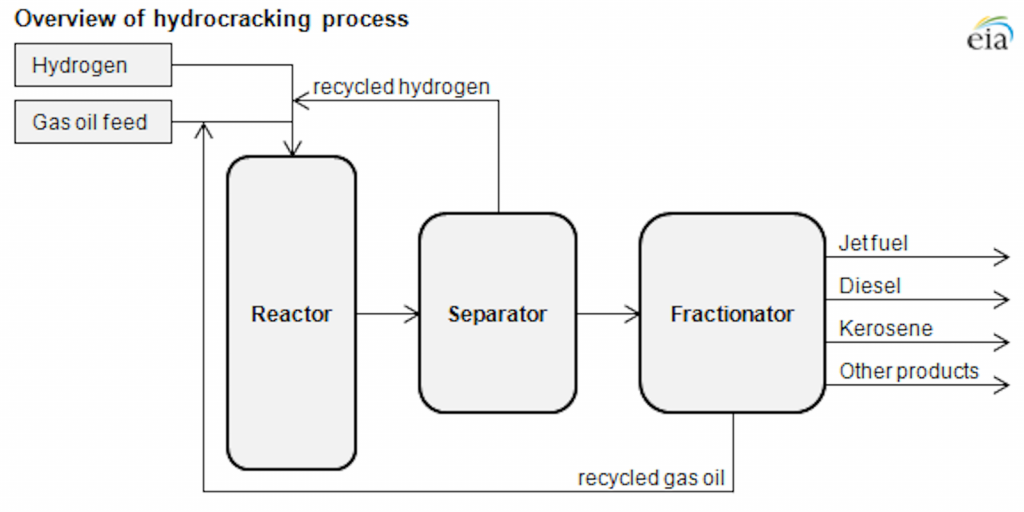
Group III base oil is refined even further through a process called hydrocracking. Similar to Hydrotreating, it uses high-pressure hydrogen and a catalyst to “crack” down hydrocarbons into lighter, unsaturated hydrocarbons, producing higher-quality oil or fuel, per the U.S. Energy Information Administration. Here’s a graphic of the process:
Group III oils are the best of the three for use in automotive applications, since they can resist breakdown under high temperatures, handle tighter tolerances, and maintain their viscosity over a wide range of external temps. For the majority of synthetic blend motor oils, Group III oil is used as a base.
Group IV oils, meanwhile, are fully synthetic and made from something called polyalphaolefins, which is a type of base oil made in a lab, rather than refined from crude oil extracted from the ground. Group V base oils are, according to Amsoil, oils that don’t fit into any of the other groups, and are usually developed for speciality applications, ranging from everything to food processing to cosmetics.
The problem, then, lies in where Group III base oils are refined. According to the Independent Lubricant Manufacturers Association (ILMA), which represents members that produce a quarter of all automotive lubricants in North America, roughly 44% of Group III oil demand in the United States comes from the Persian Gulf region, claiming that supply is “largely offline.” They cite disruptions to producers in Bahrain, the UAE, and a Shell facility in Qatar that, until Iranian rocket strikes knocked it out of commission, was producing around 30,000 barrels a day.
What about the rest of America’s Group III oil sources? Well, the conflict, which has been restricting access between the Persian Gulf and the open seas through the Strait of Hormuz, isn’t making things easy. From ILMA:
Compounding the issue, South Korea—responsible for about 30% of U.S. Group III imports—relies heavily on crude oil shipments from the Persian Gulf. While Korean refiners may pivot to alternative crude sources, lower yields are expected.
Domestic production is not positioned to fill the gap in the near term. New Group III capacity under development by Chevron and ExxonMobil will not come online until 2027, and existing North American producers lack the ability to offset the lost volumes. Re-refined base oil producers are similarly constrained by limited capacity and feedstock availability.
ILMA goes on to say that some suppliers have already declared force majeure—a safety net within contracts that allows parties to free themselves from liability when unforeseen events, like war, disrupt the ability to deliver on promised output. Others have simply begun raising prices above previously contracted amounts to match demand.
How They Plan To Fill The Gap
With Group III base oil shortages looming, lubricant manufacturers are, unsurprisingly, looking for alternatives to fulfill their obligations. To substitute a Group III base oil for something less refined, like a Group II oil, and still have their products bear an API certification, lubricant makers have to get permission from the API, or risk having their licenses revoked.
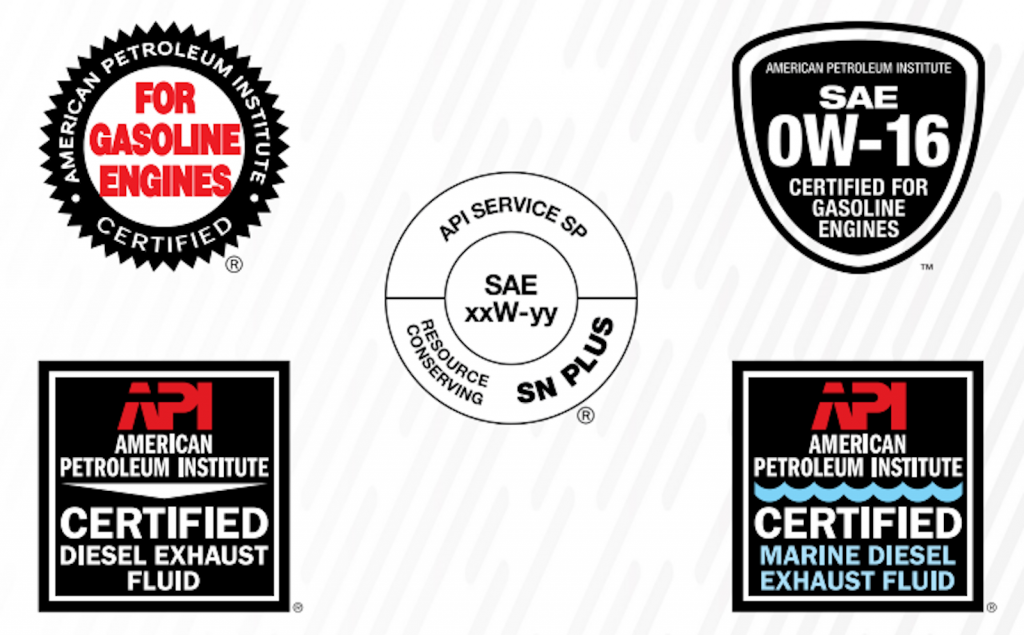
The API, seeing what’s currently going on in the Middle East, decided to activate what it calls an Emergency Provisional Licensing (EPL) program to make this possible. Basically, this program allows lubricant manufacturers to substitute Group III oils for lesser alternatives and keep the API logo on their bottles. Here’s how ILMA describes it:
An EPL permits an EOLCS licensee to substitute base oils or other components that are unavailable due to a force majeure — and to continue marketing those products bearing the API mark — for up to 90 days from an executed EPL Agreement. API may extend this period at its discretion.
And here’s what sorts of events allow manufacturers to declare a force majeure, per the API’s website:
A disruption is defined as a significant industry-wide limitation on the supply of a base oil or additive that makes it impossible for multiple licensees to market sufficient quantities of engine oil without violating the API licensing agreement. The disruption must be caused by an unforeseeable event involving, but not limited to, an explosion, fire, legal action, natural disaster, or act of terrorism that is beyond the control of individual licensees.
Before you start stressing about whether your next jug of oil might not be as effective as before, the API has some strict standards in place if manufacturers want to take advantage of the program. Per the organization’s website, lubricant producers can only substitute Group III base oil for a different product so long as the manufacturers promise that the substituted component “will not adversely affect the claimed performance standards of the licensed product,” and submit sufficient technical info supporting that claim. So in theory, any new oil that’s had its Group III base switched out for something else should work just as well as the previous blend.
This is great news for most suppliers, as they don’t have to panic about sourcing Group III base oil, which is becoming increasingly harder and more expensive to get, for their products. This emergency licensing isn’t a permanent solution—it’s only supposed to last for up to 90 days, subject to extensions by the API—but it’s certainly better than the alternative, which is running dry on product and having nothing to sell to manufacturers, businesses, or individuals.
GM Is Making It A Bit Tougher
Some lubricant manufacturers aren’t getting off as easily. Unlike the rest of the industry, which relies on performance metrics or specific brands for determining which oil to use in their cars, General Motors has its own, in-house licensing system called Dexos. This means that oils have to go through a totally separate approval process before they can be licensed and used in an official GM capacity, such as in factories or at dealerships. Oil that’s received Dexos approval has one of four logos stamped on its bottle:
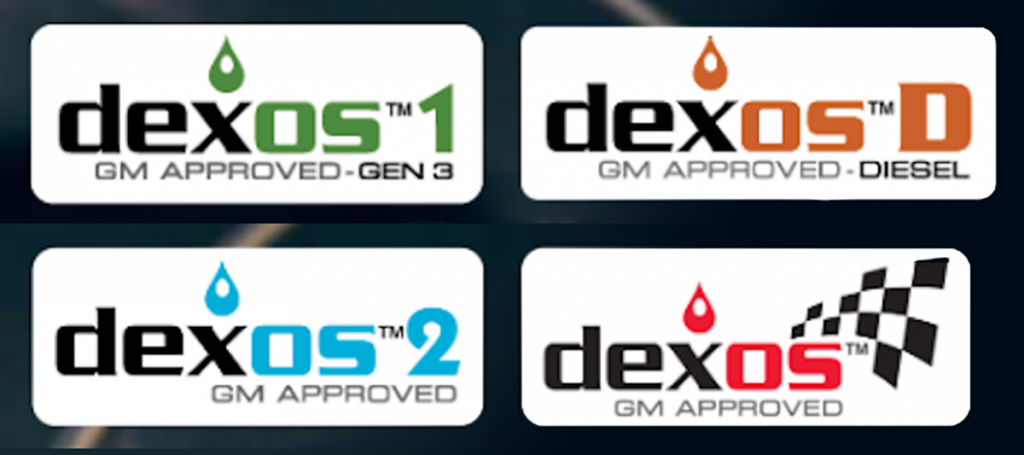
On its website, GM describes Dexos-approved lubricants as “designed specifically for GM engines that improve performance in parameters over conventional oil,” and that the logo “represents high-quality, robust oil formulated to some of the most rigorous specifications in the industry.”
While the API is allowing manufacturers to keep their licensing by providing technical information alone, General Motors is allowing no such relief. It continues to require lubricant makers to submit their new formulations for full evaluation before they can be sold as Dexos-branded, according to the brand’s response to ILMA, which asked for licensing relief last month:
While GM acknowledged the severity and likely duration of current supply constraints, it declined to provide enforcement relief for affected licensees. Here are the key takeaways from GM’s response:
-
No enforcement pause — GM explicitly stated that it “does not intend to suspend license terminations or other enforcement actions.”
-
Expedited reviews available — GM will expedite evaluations of alternative base oils and formulations submitted by blenders and additive companies.
-
Case-by-case evaluation — All submissions will be reviewed by GM on their individual technical merits.
-
Ongoing monitoring — GM will closely monitor the situation and support transitions to approved alternatives, but without relaxing compliance obligations.
Here’s the full statement GM provided me on the subject, which reflected its statements made to ILMA:
General Motors is closely watching Group III base oil supply issues in the Middle East and is reviewing dexos® core and blender applications as quickly as possible. We’re asking additive companies and oil marketers to submit technically justified alternative Group III base oils for our evaluation, and when the right data are provided and all performance requirements are met, the dexos team may consider limited provisional approvals. We’ll keep supporting blenders as they move to alternative dexos® approved core formulations.
According to ILMA, manufacturers usually have a month’s supply before running dry. Formulating a new blend of oil that can hold up to the same standards as before, without the more refined Group III base oil, is already a time and money sink. Adding an approval process on top of that could spell trouble for suppliers. The approval process itself “requires a significant investment of time and money,” according to Caitlin Jacobs, director of communications for ILMA.
This puts suppliers of Dexos-branded products in a tight spot: Formulate new blends and hope they get approved by GM before existing supplies run out, or produce the new blends without GM approval, and risk having their Dexos licensing revoked. Right now, there’s no easy solution, per ILMA’s website:
“ILMA appreciates GM’s response; however, we remain concerned by the OEM’s decision not to provide temporary enforcement flexibility under these extraordinary circumstances,” said ILMA CEO Holly Alfano. “While ILMA will continue to advocate for reasonable accommodations that reflect the realities of the global supply chain for Group III base oils, members should proceed on the assumption that GM’s current enforcement practices for its Dexos licenses will remain in place.”
Depending on how long the conflict in Iran drags on, it’s possible GM could change its position, just to ensure its factories and dealers don’t run out of oil. But for now, lubricant producers will have to make do with the guardrails they have in place.
For what it’s worth, I understand GM’s point of view here, too. If I were a car manufacturer, I’d want to ensure that only the best, highest-quality oil is going into my cars. And if you’re a company as big as GM, it’s probably worth it to have a whole division dedicated to approving lubricants. GM just wants to make sure, first-hand, that the new formulations are up to its standards before issuing an approval.
Top graphic image: GM, DepositPhotos.com



“General Motors is allowing no such relief”
Good! If there is engine or transmission damage due to crappier oils, its going to be warranty claims for GM, so its good they are holding the line.
Also, kind of wild to see an article about this pointless war without mentioning the terrorist country who pushed us into this mess to begin with. Not a peep about Israel.
Or Amerika.
The Axis of Epstein.
Minor point re:synthetic oils. The lab they are made in is a chemical plant at least as big as a refinery. Big difference is that you are building the fluid rather than distilling or breaking apart oil (taking natural gas or other light feedstock and chemically building large molecules).
I just got my every-2-years oil change on the Volt so I should hopefully be good until this calms down.
I bought a service package for eight years’ worth of oil changes in 2021 for my last car. Feels so good to know that the manufacturer has to subsidize my oil changes now.
Considering their issues with engines barfing out their bearings, I don’t blame GM for not wanting to all but guarantee they’re just selling hand grenades in a reciprocating package.
6% of all gm 6.2 V 8 have FAILED. (of the last 600,000 made)
Considering that GM just had that engine recall because they used the wrong oil, I can see why they don’t want any sudden changes.
I just bought enough Mobil-1 full synthetic 0W30 for my wife’s Renegade. Luckily it is rated for up to 12,000 miles or a year. Given how little this Jeep is driven this should last until this mess is over. Hopefully.
Definitely, the Euro Blend and PUP stuff is already tough enough to find. probably will buy up another oil changes worth even though I am not super happy to let oil just sit on a shelf. I guess the sealed nature and synthetic oil I use will help avoid breakdown from disuse I suppose.
That’s my hope as well.
This topic became very real for me yesterday.
We are supposed to start production of a new engine / transmission option in July. It uses a new transmission fluid. That fluid is only made in one factory – the one in Qatar mentioned above that was knocked out of commission.
The transmission supplier has no alternative options and we have no transmission fluid on hand. It was supposedly on a boat – but that boat is stuck. Or so said the purchasing rep for this product launch in our meeting yesterday.
I miss product development
I’m sorry. That sucks.
This is terrible! I’m very sorry
It is what it is. Similar to all the havoc caused by chaotic tariff changes over the last year.
Without giving away any trade secrets, what is it about this fluid that makes it so special or only (currently) produced in one place? I’m genuinely curious.
All the other suppliers only had one Qatar of the additives needed.
I would imagine it’s a fairly average fluid, but different transmission designs sometimes require very specific properties. I bet this fluid isn’t the most or best at anything, just that no other fluid has the exact same properties, and those affect the performance of the oil-bathed clutch packs, torque converter and other components within the transmission that rely on consistent fluid pressure or viscosity to function as designed.
I doubt it is that special either – just the only one that has been validated by the manufactuer.
For our own powertrains validating a new fluid takes millions of dollars and about 18 months.
That checks out, we’re validating a simple engine component supplier change (same specs) due to a supply chain disruption and even that’s a huge resource drain, taking up every engine dyno in the building so we can complete the requisite tests before we run out of product, delaying every other project by months and certainly costing a fortune.
I can only imagine how much more testing it would take to validate new transmission fluid, as it interacts with every single component of the system.
I get that suppliers don’t want to the spend the money to validate multiple oils but it causes headaches for me as I’m responsible for factory fluid fill and storage in our NA plants.
Right now I have 3 very slightly different 75W-90 axle oils because the different suppliers validated with different oils.
No idea – it wasn’t our choice or decision. What I do know is that it is the only transmission fluid that the manufacturer tested and certified for this transmission and application. Factory filling with anything else voids the warranty. This isn’t our only european transmission that is single sourced for fluid.
Purchasing is going to have to scramble and find some – likely buying it in small quantities from European service centers and air shipping it to the USA.
Single sourcing stuff from the middle east. What could go wrong?
maybe tariffs will fix the problem!
Have you guys tried focusing on the DOW instead?
As in the DOW Jones Industrial Average? I have personally prefered the S&P 500 to the Dow as a baseline index but today it is way to top heavy.
Today I look to the Russell 1000 and 3000
If the DOW is over 50k, we can ignore everything else. Apparently.
If only the economy was only 30 companies.
I don’t even know enough about the stock market to know what I don’t know about the stock market.
I’m just trying to keep my fleet running.
The Dow Jones is an index made up of 30 large US companies picked by a committee to represent the broad economy. The companies change over time and the only real thing it has going for it is that it is old. Founded in the late 1800’s by the founder of the Wall Street Journal.
The rest are more straightforward:
S&P 500: 500 largest companies in the USA by market cap.
The problem with the S&P 500 today is that 36% of the total market cap is made up of only the top 10 companies – most of which are tech companies.
Russell 1000: 1000 largest companies in the USA by market cap
Thanks for all your responses related to this article, giving us insight into the disruptions caused by…. well, that’s something I’ll leave out for now.
November can’t come quick enough.
I appreciate the time you made here for writing your comments.
Thank You.
You are welcome. I try to give some insight as to how what is happening is effecting automakers and our suppliers.
Been a crazy year and I’m looking forward to stepping away from it later this year.
With mergers and consolidation we’re well on our way!
I doubt the Dexos is anything more than a GM scam to maintain additional control over their suppliers. On the bright side those suppliers can just make the normal oil for other cars while GM pauses production due to know petroleum products and wait for GM to quit being asshats and then maybe make them some.
The alternative is that GM just has their dealers push their customers to full synthetic.
I’ve never used conventional oil. The extra cost is worth the better performance and protection and the longer change cycles mitigate the extra cost. Nowadays, with most things running undersized turbocharged engines while being overweight, never mind that many people do a lot of short runs and sitting in traffic, I can’t imagine sticking with dino juice.
My replacement rebuild engine supplier insist for its 5 year 50,000 mile warranty that I only use 10w30 conventional oil.
I don’t know why.
I assume it’s an old engine with that weight? I think they do that as that’s what they were originally designed for. Stuff like VVT requires oil also be used like a hydraulic fluid, plus there are higher tolerances, as well as running higher rpm operation, forced induction, and higher compression ratios, which all demand a lot from the oil and are a bit different in their demands than an older engine. I imagine the metallurgy might also be different where it would benefit from different additives that wouldn’t suit older engines, but that’s a guess. All the better for you—it’s a lot cheaper (though I’d stock up!).
Because Synthetic isn’t what you think it is.
In the late 90’s, Castrol won a legal case to allow it to define Group III base stock that it’s sufficiently refined to consider synthetic. How many oil companies shifted their recipies to align, I can’t say – but I have little faith that there’s not some refined natural oil in any given synthetic.
http://xtremerevolution.net/a-defining-moment-for-synthetics-by-katherine-bui-lubricants-world-1999/
That would be a blend, not straight dino, but the greater performance is what I’m concerned with. I personally don’t care what it’s made of as long as it meets the higher standards, though I guess that means this could cause a shortage of “full synthetic”, too. Maybe I’ll add some more to my hoard just in case. I wonder if the oil companies will be looking to change to full group IV now (for $20 qt).
Just look for 100% synthetic, it has none of that blend stuff.
he just said Castrol won the lawsuit 30 years ago to call Group 3 oil “fully synthetic” in the USA. Fortunately, the current performance standards exclude the use of inferior basestocks because they don’t have the low volatility and low oxidation performance required to be marketed as suitable for modern engines
It’s been awhile since I looked into it, but 100% synthetic and full synthetic are not the same. 100% synthetic has to be group 4 only.
So as I read it — both API and GM (sorry, gm) will grant licenses for alternative formulations. API will let suppliers submit test results from their own internal testing, while gm requires that they do the testing themselves.
So any company that wants to cheat can just submit fudged test results to API, while for gm they would have to bribe people.
Can I bribe them to capitalize their initials again?
Their market share has shrunk so much that the logo had to shrink, too.
Believe it or not, the labs that do this testing (there are only a handful) have a keen interest in not fudging results as their competitors are continuously looking for ways to sue them out of existence.
That being said, I’m so glad I don’t work for them anymore because of the influx of emergency work for this nonsense is going to result in a LOT of unpaid overtime for the salaried guys that actually run the labs
Oh I agree that an independent testing lab, or even one within the lube company, is unlikely to fabricate anything. I was thinking more of whoever submits the results to API doctoring them first, if management wants to risk a whistleblower appearing.
So can used oil be used as a feedstock instead?
Only with balsamic vinegar on a nice green salad.
With recycled diced oil filter croutons.
I’d like to hear if others think this is just GM being GM regarding the testing and approval process for the Dexos branding, or are they really concerned about potential risk to oil quality given their recent oil weight changes (spec changes too?) relative to the 6.2L engine failures.
A legitimate reason to hoard oil. Like us gearheads needed another reason to have a stash on hand. Definitely stopping at Costco for 0w-20 this weekend. And some 5w-40 for the toys.
Suppliers are saying a year. Let’s hope so but I keep that much on hand anyhow just by shopping sales plus a free filter. I also keep a few months of TP on hand and that was pre COVID.
Modern oil deteriorates with age, even in a sealed container. Plastic containers are the worst since they permit some oxidation.
Is it because they oxidize?
First I’ve heard that. I’ve used older oils before with no ill effects. Then again my particular engines aren’t the most demanding applications.
I scored 55 gal drums of 5W-30, 10W-30 and hydraulic oil many years ago. Finally getting near the bottom of these. I wouldn’t use it in a modern engine (it’s the wrong weight anyway) but it’s been fine in my older cars and equipment.
If it’s old style non deterrent oil in a steel drum for industrial and ag use in engines with lots of clearance where the oil gets changed the equivalent of every 3000 miles it’s probably fine.
It’s the expensive high tech oils that don’t like sitting around.
I was having a conversation with somebody that turned out to be a petroleum chemist who mentioned that some of the molecules in current lubricant additives breakdown over time whether the oil is used or not.
We were actually talking about paint and how drying oils in paint, undergo oxidative polymerization, which causes them to harden from a liquid into a solid, apparently.
It’s one of those weird things I’m interested in both from an art and art history perspective, and relatives who ran oil refineries.
So anyway, oil wants to do bad things like lose it’s ability to emulsify impurities by being a detergent or turn solid and the additives to prevent that break down over time or even form bonds that heat and use might break down. Apparently this is more pronounced in high performance oils, less so in tractor oils like Dello and Rotella.
I probably messed that up, it was at an art opening and we were pretty well libricated ourselves at the time.
Sounds like holding onto it for a few years is okay but don’t use the old bottle of Valvoline Grandpa has had in the garage since the 2000’s.
If it’s in a glass bottle it probably hasn’t changed much, but it’s worth more as a collectors item.
For the purposes of avant garde oil chemistry, from about 2000 on it gets weird. Getting 0-20 weight oil to actually work takes some serious molecule wrangling.
I was going to grab some just because it’s on sale right now. Even more reason to now.
Really a great time Trump, egged on by Israel, has created not only in the US but the entire world.
Are we great again yet?
I don’t want to miss it when it happens.
An archaic meaning of great is to be pregnant “great with child”
Trump has us about halfway there – we are pretty much fucked.
So there’s that, we are thoroughly fucked, but you probably won’t see that on a hat.
MATF
And if it turns out they’re lying or mistaken in that proclamation, what then? Will the consumer be left holding the bag?
Will the consumer be left holding the bag?
You have to ask?
That’s why I agree with GM’s stance. Sure, they’re having issues and are probably concerned about borderline oil tolerance as is, but I trust the honesty of an oil company to submit paperwork for an altered product about as close as I can get to the stratosphere by jumping on a beach and I’m sure GM does, too. Even if the customer is left holding the bag, a blown engine becomes “never buying another GM product again” for a lot of people. If these oils are truly equivalent, then they should have no problem passing the testing. OK, there’s the time issue, but shit happens—they wanted this dickhead in office and now they got him.
Yup. And that’s the other thing people don’t realize. Automakers themselves are really at the mercy of their vendors and suppliers, including fluids suppliers. If those suppliers eff something up, it’s the automaker whose neck is on the chopping block, at least in the Court of Public Opinion. As far as legally/financially, nominally, the automaker will have to spend the time and money to prove the supplier did something incorrectly and pursue them in court or across contract provisions and penalties. And if something like a fluid has met whatever the (relaxed) legal and industry standards were at the time it was manufactured, then the supplier probably gets off scot-free while the automaker suffers financial and reputational damage because at the end of the day, it was inadequate.
So, yeah, I’m with GM here, too.
It makes compleat sense.
If your Fiat rusts away it’s not the Acciaierie d’Italia steel mill ( or whomever, I picked them at random) that you curse.
Yup. And GM has already proven they can grenade engines just fine on their own. So if there’s another massive wave of failures, GM will blame the oil manufacturers and they’ll blame GM and good luck figuring out where the fault actually lies.
It’s a perfect time to kill the synthetic blends go full synthetic. It really only really effect dealers and quick change places that have been gouging people for years 3x price for oil that cost almost the same.
Now is a great time to buy something like a Model T, a car that can run on 100% corn ethanol and can probably use rendered pig fat as engine/transmission oil
Too bad there is not another option. Oh wait….
Old engines ran on primitive lubricants because that’s all they had.
If you use a modern lubricant in an old engine you get modern wear characteristics. The only problem is that seals will leak because oil is more slippery. The only problem is that some engines require a lot of zinc and other metals, and modern oils tend to not have those because it ruins catalytic converters.
And if you can’t find one for sale, build one from EBay parts.
That could NEVER happen in a million years.
Yes, who even does that?
Won’t someone please think of the children?!?
Trump has the bombing death of 160 schoolchildren in Minab on his hands, as well a couple dozen teachers. The adjacent military compound had been vacated fifteen years before, but the Maven AI targeting program, apparently, was not informed of that.
Well Trump and Hegseth keep bragging about targeting civilians, ending civilizations, assassinating heads of state, and so on, and they hav established that heads of state can be held accountable in other countries.
I don’t know how well arresting Trump would work while he’s still president, but his travel plans might be limited when he leaves office.
Of course Bush and Cheney were never even indicted but International Criminal Court (ICC) has issued arrest warrants for both Russian President Vladimir Putin and Israeli Prime Minister Benjamin Netanyahu. Former Philippine president Duterte was arrested and is in custody, so who knows.
So, if I understand this correctly, it doesn’t have a direct impact on synthetic oil production? Either way, I may as well panic buy now before the dipshittery inevitably gets worse.
You’re not wrong. When the price of conventional oils goes up to match that or exceed the price of synthetic, there will be a knock-on demand for synthetic, thus driving the price of synthetics up. So yeah, if you’re gonna stock up on synth… do it now before the price explodes upwards.
I just found out via Copilot that Dexos AND Mobil 1 use Group III oil stocks to create their synthetic oils. That said, will Mobil 1 lower their standards?
I did this last week. Prices had not gone up yet.
Wow, who would have thought Trump would have contributed so much to the reduction of green house gases. Lot less driving flying and boating going on these days.
On a more serious note. We have the best quality oil anywhere, and we don’t even have capacity to refine it, that’s sorta depressing. Sounds like they are working on it at least. Obviously people have all sorts of opinions, so I’ll try to stay neutral and just say this: Countries need to have their own robust industries when it comes to national security things like gas and power and medical production. We cannot outsource this stuff any longer.
Anyone that can fire off a synapse knew the oil companies needed to be forced to divert some of their exorbitant profits into new refineries decades ago. National Security, and their own.
That actually was on a serious note. He also motivated a whole lot more EV sales worldwide.
Glad my fleet is mostly made up of antediluvian shitboxes that will happily spin along on pretty much anything short of bunker oil.
At least I can always fall back on my two-stroke cars which don’t use… Ah, no, wait a minute…
Older two stroke engines can use castor oil. Some of the motorcycle brands may still make it
Once the Iran ground war starts, gearheads will be buying out motor oil while everyone else stocks up on gasoline and toilet paper.
This could lead us down a slippery slope.
Definitely will bring some friction to the situation
Can’t let this one slide. If supply runs dry, production could seize up.
lube rationing?
And at the bottom of the slope, we could hit a Flashpoint.
Laughs in my Chevy Bolt
just be lucky that blinker fluid hasn’t been affected yet, that’s something that would get us all.
Oh the GM blinker fluid is special, everytime I clean the windshield, the whole car smells like peppermint. Its the good stuff. People pay a premium just because of the smell.
How bout horn fluid?
Yeah I need some to service the power steering in my Fiat 500
Except BMW drivers. Sorry I’ll see myself out.
Ditto, also just changed the oil in the old Jeep for the first time in 3 years, and doubt it cares either.
Oh when you’re due for that reduction gearbox oil change at 150,000 miles and that quart is $50, we’ll see who’s laughing then! (You, it’ll still be you.)