

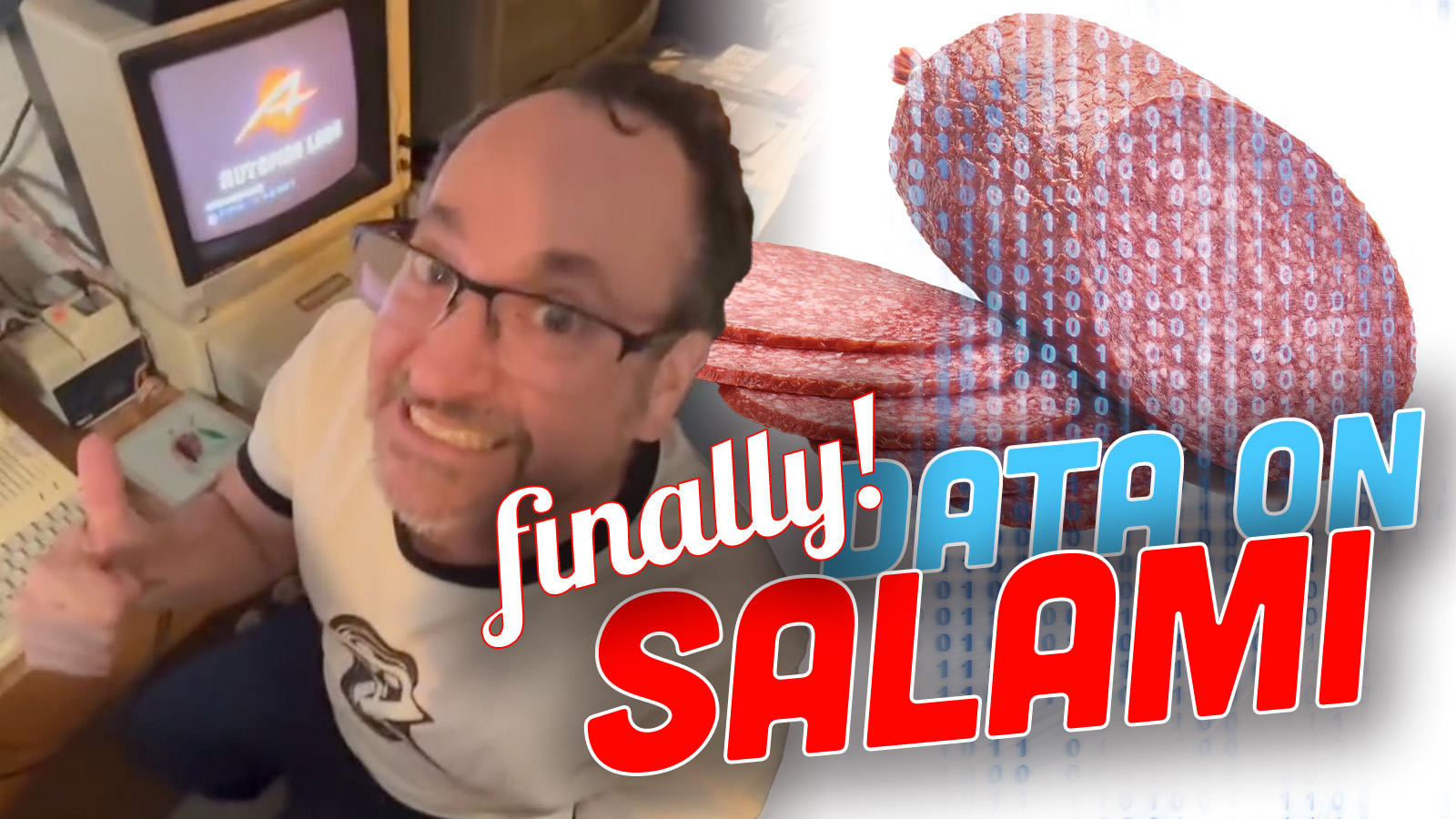
If you’re Italian or of Italian descent, I bet you’ve heard a grandparent or uncle or some relative use the expression “condividi i tuoi segreti con una mortadella,” which translates to “share your secrets with a mortadella.” In Spanish-speaking cultures, perhaps you’ve heard someone say “memoria como un chorizo” (“memory like a chorizo”) when they forget their keys, or how a French speaker may smack their foreheads and say “merguez!” when they forget things. In American culture, there’s a similar expression you’ve probably heard: “tell it to a hot dog.” What all of these have in common is an idea that spans the globe: sausages have no memory.
That may have been true before, but I’m here to tell you, excitedly, that it is no longer true.


Yes, that’s right, I’m proud to announce that for the first time in recorded history, data has been stored to a common, everyday salami, proving once and for all that sausages can have memory. At least memory of a sort. Currently, that memory is pretty limited, just about 256 bytes per a 38mm diameter salami slice, but this is just a proof of concept. Currently, the data density we can store in cured meats is very low, but with future development the amount of data would currently take a salami six feet in diameter and 35 feet long could potentially be stored on a single Lunchable slice.
But that’s a long way off! Let me show you what Autopian Labs has accomplished so far!
View this post on Instagram
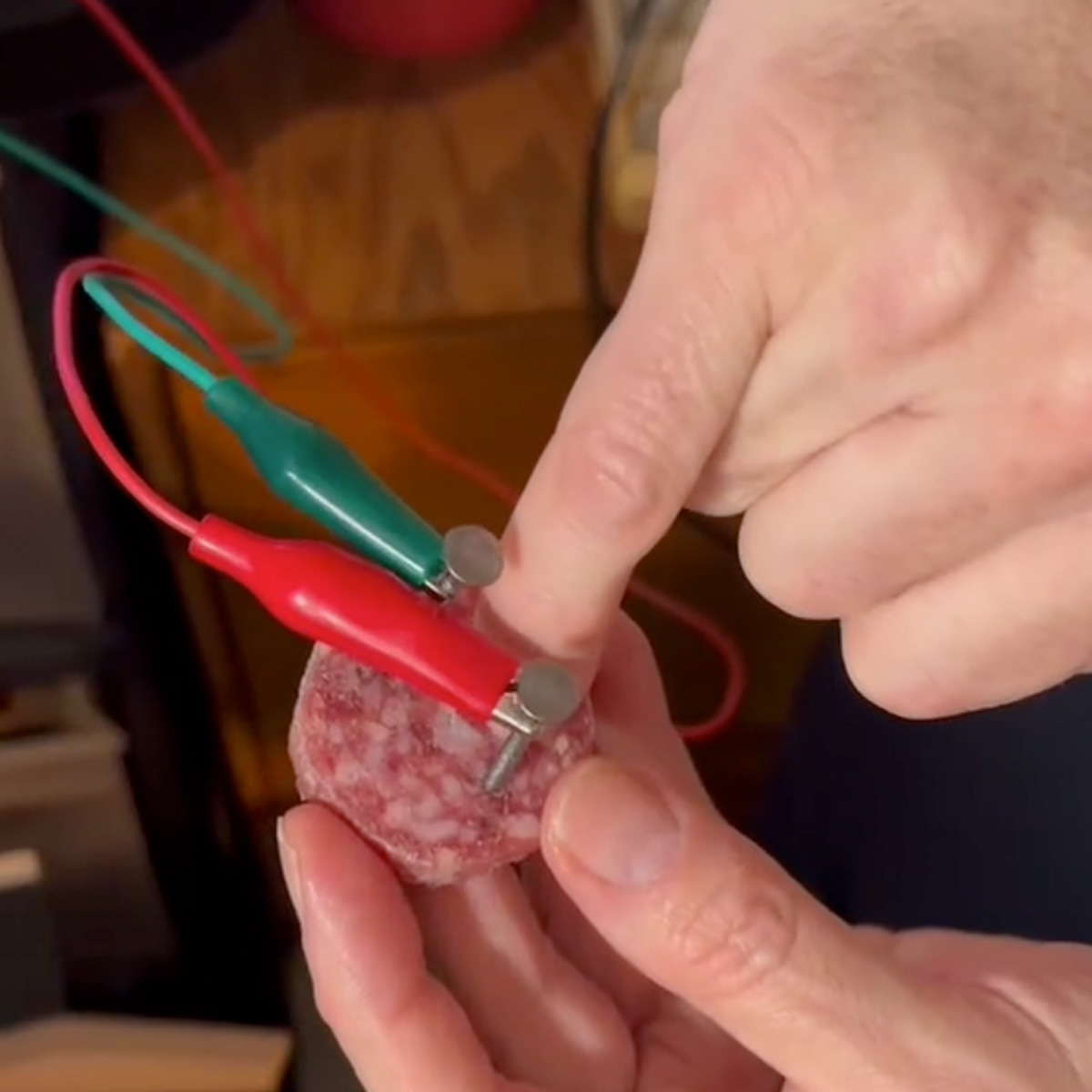
Did you see what happened there? I connected a slice of salami to my Macbook, where a special USB device allowed me to place a pair of probes into the salami matrix, where I encoded the phrase AUTOPIAN IS THE BEST! That’s 21 characters, so basically 21 bytes of storage, stored as ASCII data in the salami slice itself.
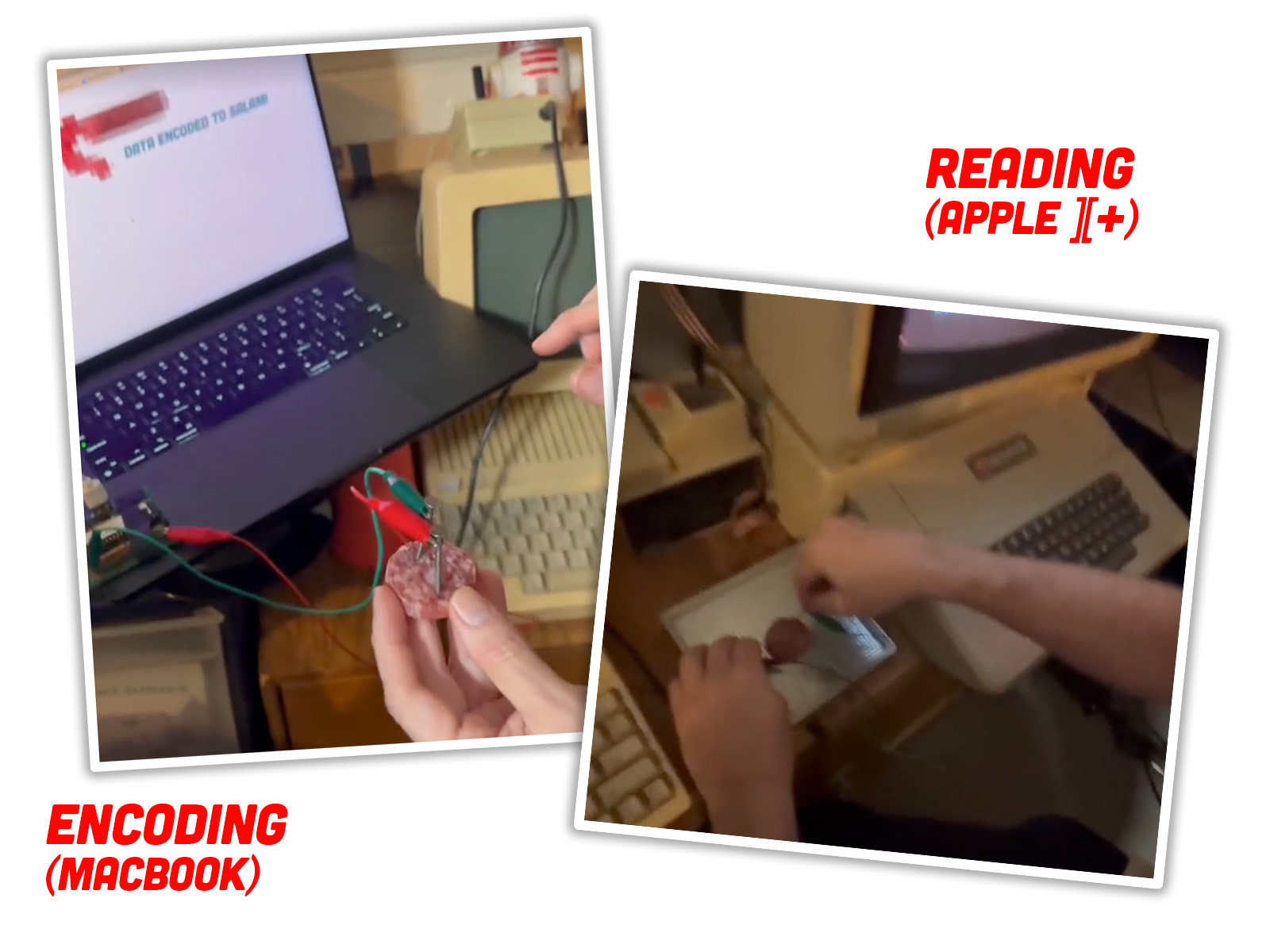
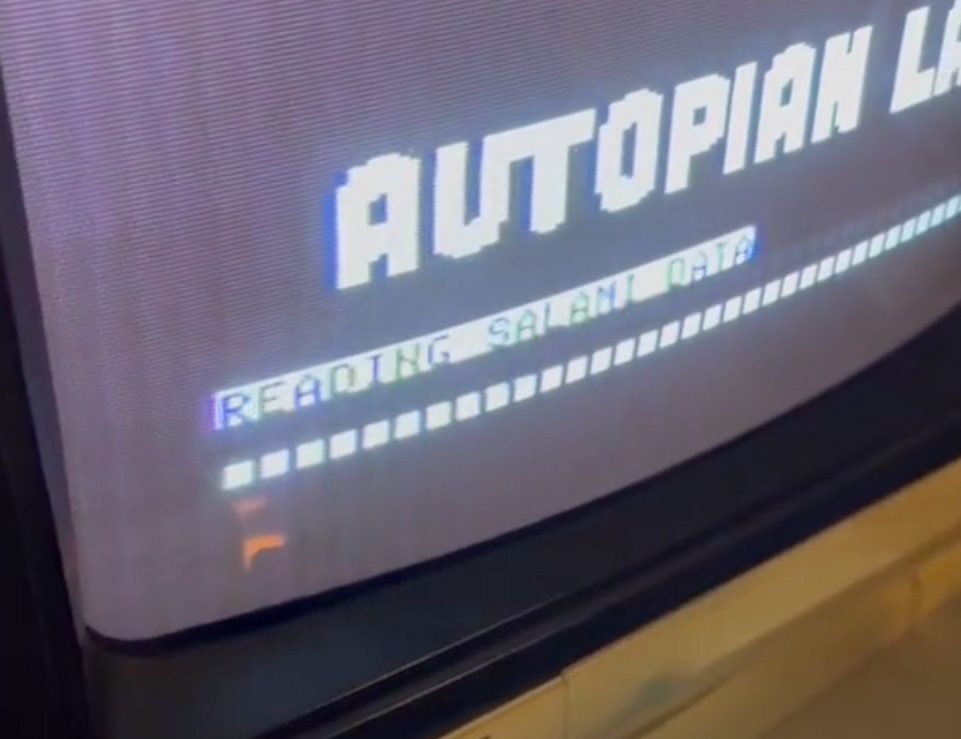
I then took that same slice of salami to another, very different machine – an old, 1982-vintage Apple II plus – and connected it to a similar (but much simpler) device, this one connected to the Apple II’s Game I/O port, specifically the four potentiometer inputs that can read values from 0-255, which is convenient when reading ASCII codes.
I used this same port to connect a DSLR camera for our member birthday drawings, if you recall:

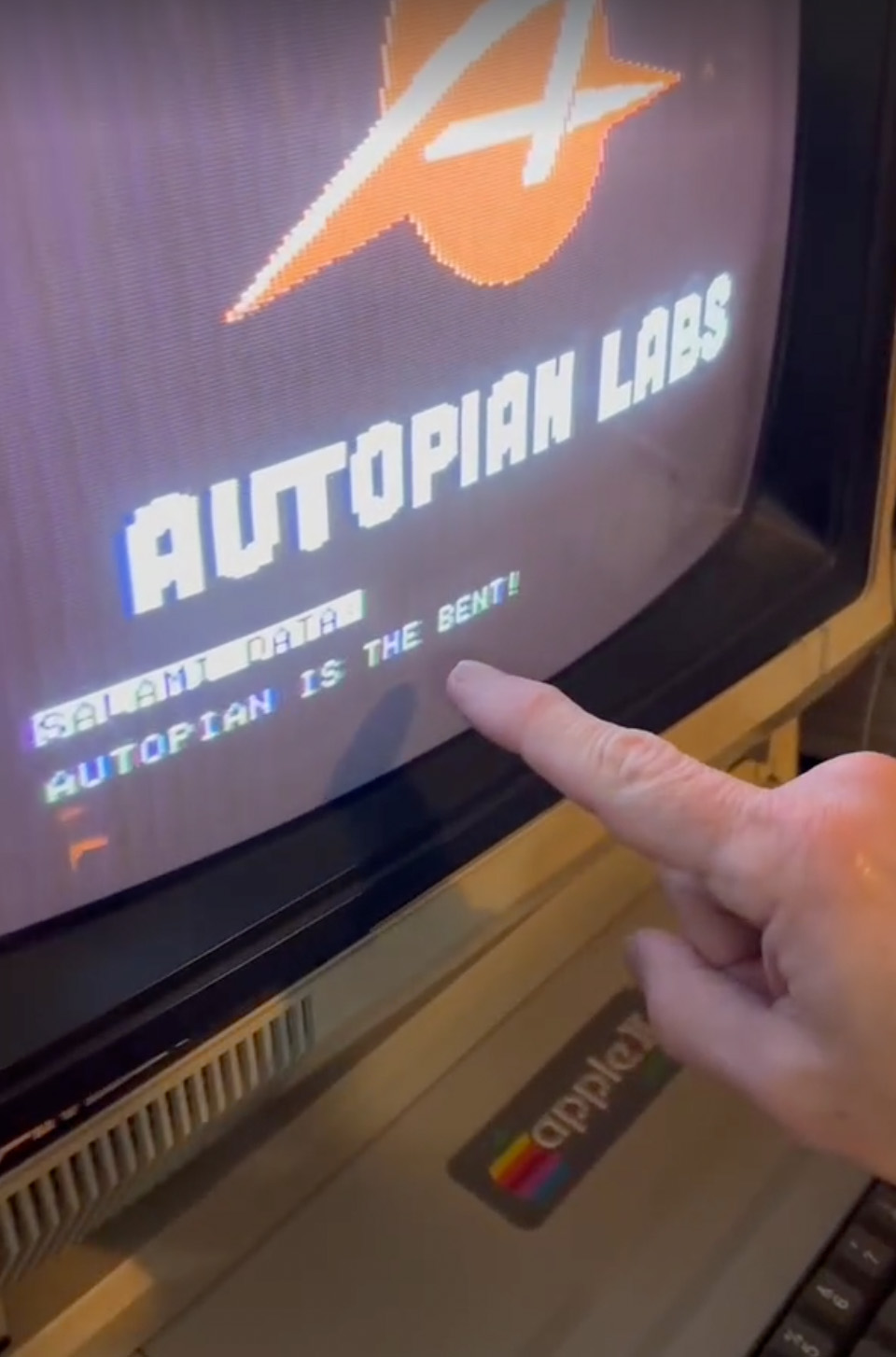
The Apple II salami data reader, despite being an incredibly simple device, was able to read the encoded ASCII data on the salami slice and replay it back to the computer! Well, with one error: the output was AUTOPIAN IS THE BENT! instead of “best,” but I still call that a victory. The character “S” is ASCII code 83, and “N” is 78, which probably hints at what went wrong, but I’m not really sure what that is right now.
The data is encoded onto the salami (or, really any sort of sausage with a pretty coarse granular consistency) in a radial pattern:
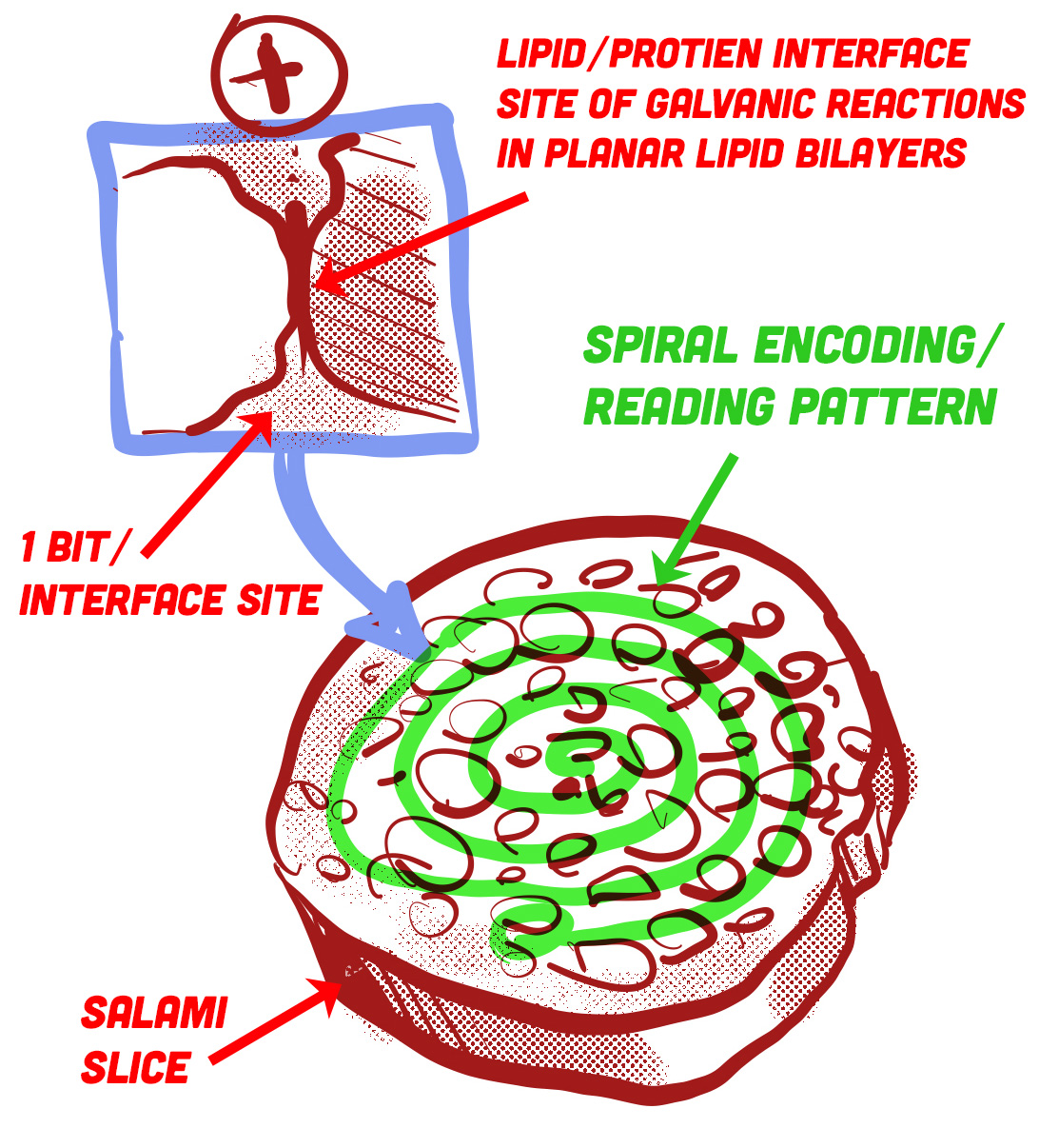
The way it actually works is a little much to get into here in detail, but fundamentally it has to do with the nature of sausage/cured meat construction and all of the points inside the sausage matrix where lipids (bilipids, technically, but whatever) are in contact with other protein compounds. That “interface,” the points where the lipid/protein molecules actually contact, is a point where data can be stored, thanks to galvanic currents and lipid-free radical oxidation.
Sausages with finer matrices of ingredients (bologna, hot dogs, many wursts) will be more difficult to encode data onto and read from, but offer the best possibilities for higher-density data storage than coarser sausages like pepperoni or soppressata, or mortadella. The crude nature of our current equipment means we are currently only able to encode and read from these coarser meats, but we’re hopeful to change that.
We here at Autopian Labs didn’t come up with all of this science, of course. We’re idiots, standing on the shoulders of giants. But if you look at papers like The reactions of lipid’s free radical oxidation, hemocoagulant properties of oral fluid in patients with galvanic currents in the mouth(translated from Ukrainian) and The role of lipid oxidation on electrical properties of planar lipid bilayers and its importance for understanding electroporation and, most relevant to our implementation, Electrode-supported and free-standing bilayer lipid membranes: Formation and uses in molecular electrochemistry I think you’ll get a sense of what we’re doing here. It’s pretty straightforward, really.
Now, we think this is a pretty revolutionary development, especially in an era when AI is forcing computer memory prices higher and higher – some sources suggest memory has increased in price by 500%! If we can adapt computer memory demands, both RAM and storage, to sausage-based media, then every deli in America has the opportunity to become a data center! Every sandwich becomes removable storage! Supermarkets full of cold cuts and sausages and charcuterie could be tasked to data storage on demand!
The meats retain full edibility even after having data encoded, so there’s no waste of food here; once a slice of, say, soppressata is no longer needed for data storage, it can be happily eaten, perhaps with a slice of brie.
Now, while I get that this is not our core mission – we’re still a site about cars, after all – this does have a lot of potential for car ECUs and other automotive computing applications: fragile circuit boards could be replaced with rugged, hard-wearing pepperonis and other durable sausages, for example.
I’m very excited. Autopian Labs is the research arm of Autopian, and we don’t have the resources to commercialize this development, but we are happy to take meetings and discuss development agreements. We anticipate some issues stemming from the fact that I may have made all of this up for reasons I myself can’t even comprehend, but if we can get past that, I’m very excited about what the future of sausage-based data storage may hold!
This is a brave and delicious new world, people!




Sadly, it was just a matter of time before someone actually made Salaminet self-aware.
*Patiently waits for World Cured Meat War III*
Soppressata should be eaten with Fontinella, not Brie.
Alternately, you could use seitan, as it has finer grain than salami but coarser grain than hot dogs. Plus, when you succeed in your seitan-based endeavors you can say “Hail Seitan!”
Or you could use your aquarium though it’s not without its risks:
https://en.wikipedia.org/wiki/Black_neon_tetra#Credit_card_fraud
So maybe instead of fish you could team up with Mercedes & Sheryl with their conures once Mercedes gets home from road-tripping in the CrossCab CrossCountry CabCross CountryCab.
I just pitched this to my boss!
I’ve worked with data most of my career, and this is the kind of breakthrough that I’ve been waiting for.
Next up is building an image sensor from a banana.
We already have an AI potato! Beware GLaDOS!
I think a slice of salami just might be the floppiest of disks.
Store all the great works of literature on sausage, and reimagine Reader’s Digest.
This is the kind of hard driving (get it?) journalism I expect from Autopian.
Well, this isn’t your wurst idea.
After a few
billiontrillion dollars of development, someday we’ll be able to plug into our local delicatessen network and play MeatQuest in VR (Veal Reality).Last year I was given a laser cutter for Christmas. I promptly used it to encode the word “Kevin” on a slice of bacon. That’s 5 bytes on a slice.
Francis: *looks on, weeps a solitary tear*
“Hey Torch! I didn’t have any salami so I tried using this block of meat… all my data turned into advertising!”
“You idiot! That’s Spam!”
COTD, surely
Mechanic peers into engine bay and shakes his head.
“I see what the problem is. You swapped out your bratwurst with one of those fancy Italian mortadellas. It’s meat incompatibility!”
I hate to burst the salami storage bubble after all of you have undoubtedly sunk your life savings into the cured meat-space, but it’s possible that the salami isn’t the actual data storage medium. It’s possible that the nails that Torch plugged into the salami slice are the actual storage medium, and that the salami merely acts as an electrolyte and resistor in the circuit. In that scenario, magnetic domains are being set up in the steel nails and acting as bits to store the data. To test this, try these variations: 1) Repeat the experiment but use a hot dog instead of the slice of salami. 2) Repeat the experiment but use two sets of nails (one set attached only to the data-storing computer and a different set for the data-reading computer). If my guess is correct, then the null hypothesis should end up being accepted in case 1, and rejected in case 2.
Update: I just watched the video and saw that Torch did use two different sets of nails in the original experiment, so my alternative explanation is incorrect!
Complete the experiment by encoding a secret message on several slices of salami, and then have a third-party (I will volunteer) eat the salami on a sandwich made with light rye bread, tomato, onion and aged cheddar, (accompanied by a cold glass of lager beer) and see if the subject can deduce the secret message after ingesting the sandwich. This could open up a whole new world of spy craft – passing secret messages via edible media!
DT: Where’d the payroll data go?
Torch: (chews…swallows…) Uh….
Wait, so when they said General Petraeus was facing charges for something involving him playing hide the salami and giving away classified information, did I misunderstand that entire story?
Mmmm, hmmmm. Oh yeah. That’s the quality Torch-topian content I subscribed for.
I often worry that whatever unhinged thing I’ve just read is peak-Torch, because surely that level of crazy isn’t compatible with coherent communication.
Then he’ll explain some new batshit insanity in a fun and engaging way.
Maybe there isn’t an upper limit? I hope so.
The limit does not exist, hopefully!
Is this even Kosher?
Oh! A Lisa!
> every deli in America has the opportunity to become a data center! Every sandwich becomes removable storage!
I burst out laughing harder than I have in a long time. Thanks, Torch.
TSMC
Transcribed Salami Storage Consortium
I thought that pastrami and swiss tasted like a Haynes manual.
“Reassembly is the reverse of disassembly” doesn’t quite work to turn salami back into a pig.
This is why you don’t buy your pigs at IKEA.
Referring to a packet of ham slices as; “a Peppa Pig jigsaw puzzle” may cause small children to cry.
That’s how they grow up tough.
This is the level of insanity I require. All other car websites are just the wurst.
At this rate, I seriously fear that Torch is just a certain number of membership fees away from going full blown Cave Johnson on us.
I assume this allows for denser data storage than salami punch cards?
Swiss cheese is typically used for punch cards.