

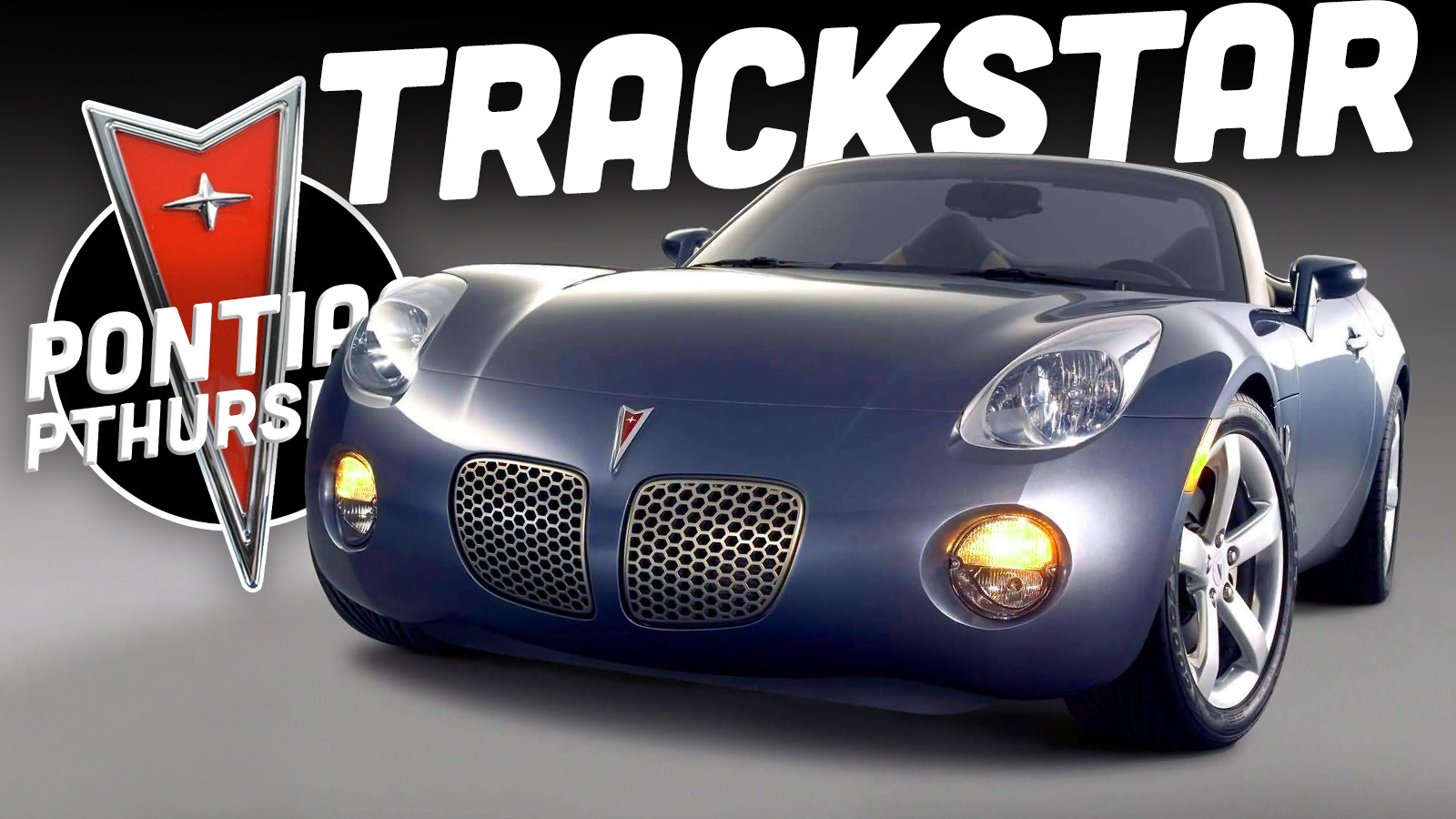
In the pantheon of all-time great genres of car, there’s a golden throne carved out for the homologation special. Cars built to race, but sold to the general public because that’s what the racing bodies required. Think Lancia Stratos, Audi Quattro, E30 BMW M3, and Ford Escort RS Cosworth. Usually, this pedigree results in collectable values, but what if I told you there’s an American homologation special that everyone forgot about, and it wasn’t even the fastest variant of its lineage? I’m talking about the Pontiac Solstice Club Sport.
Yes, the Solstice, GM’s answer to the Miata. It almost feels like a fever dream. Imagine one of the largest car companies in the world whipping up an affordable two-seat sports car today. That feels so improbable, and yet that’s exactly what happened in the mid-2000s. Was it as light or as popular as the mighty Mazda? No, but it did alright in its heyday.


However, beyond the shrink-wrapped looks and moderately impractical top, there’s another side to the Solstice that everyone forgets. It could actually perform on track as a race car, and a dedicated option package was your ticket to wheel-to-wheel glory.
To Race A Car
In an age of ever-more-complex cars and ever-higher bars for racing safety, it’s wild to think that winning race cars often used to be built in regular garages. That’s part of what made the Sports Car Club of America’s Showroom Stock racing just so exciting. Born in the 1970s, this series of classes saw late-model production cars raced pretty much as they came off the showroom floor, with the only alterations being safety equipment. Originally a relatively cheap way into sedan racing, the key thing you need to know here is that it eventually underwent mitosis to become three classes: The swift Showroom Stock A, the reasonably quick Showroom Stock B, and the more affordable Showroom Stock C.
During the mid-2000s, Showroom Stock B was essentially roadster class. Sure, the feisty Acura RSX Type-S, the revvy Toyota Celica GT-S, and a few legacy Firebirds and Camaros also competed, but the field was overwhelmingly populated by more traditional sports cars. The 2005 runoffs—the season finale championship event—saw 23 Mazda MX-5s take to the grid, but it was absolutely dominated by the BMW Z4. Toby Grahovec drove his Z4 to the top of the podium, and other Z4 drivers finished second, fourth, and seventh.
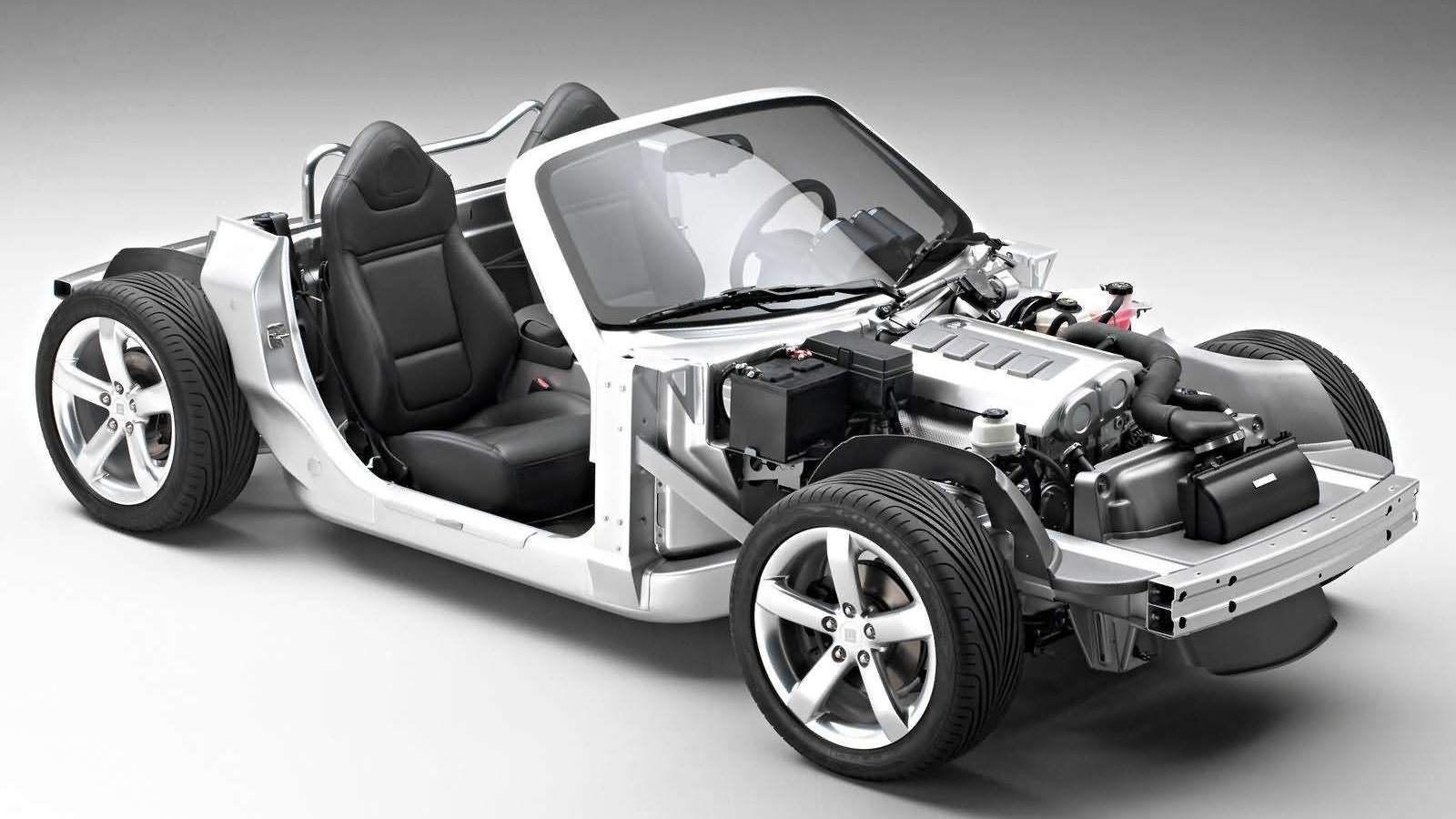
Around this time, General Motors was making big moves in SCCA racing. The Corvette competed in Touring 1, and the Pontiac GTO was the Touring 2-eligible machine of the day, but the company needed something new in Showroom Stock B. The answer would come in the form of an absolute parts bin special. With the engine from a Chevrolet Cobalt, the gearbox from a Chevrolet Colorado pickup truck, the CV axles from a Cadillac STS, and body hardware harvested from just about every GM brand under the sun, the Pontiac Solstice promised cheap thrills on a shoestring development budget. So, did it work?
The Special

You bet. It was a smash hit, with demand massively outstripping supply. Pontiac only planned on building 7,000 Solstices for 2005. The public ordered 13,000 of the things. Sure, the Solstice was obviously built to a price. Extensive component sharing to meet a starting price of $19,915 meant taking a roughly 400-pound weight penalty over a Mazda MX-5, but that didn’t matter much at first. The Solstice looked drop-dead gorgeous, played in a segment that middle-class Americans could afford as a summer toy, and it was GM’s ticket to winning.

In early 2006, a Club Sport option package appeared on the Solstice order guide, carrying the option code Z0K. For a price tag of $1,095, it got buyers a whole lot of go-fast goodies. We’re talking stiffer springs, revised damping, stiffer bushings, bigger anti-roll bars, revised end links, a limited-slip differential, a beefed-up power steering cooler, and anti-lock brakes. All tasty stuff. At the same time, selecting the Club Sport package revoked your privileges of optioning anything else. No air conditioning, no power windows, no power door locks, no power mirrors, no automatic transmission, not even fog lamps. Even though the Club Sport package still featured the standard 177-horsepower 2.4-liter inline-four, it was built to do one thing and one thing only: win in a race-prepped form like the SEMA show car above.
Heroes Get Remembered
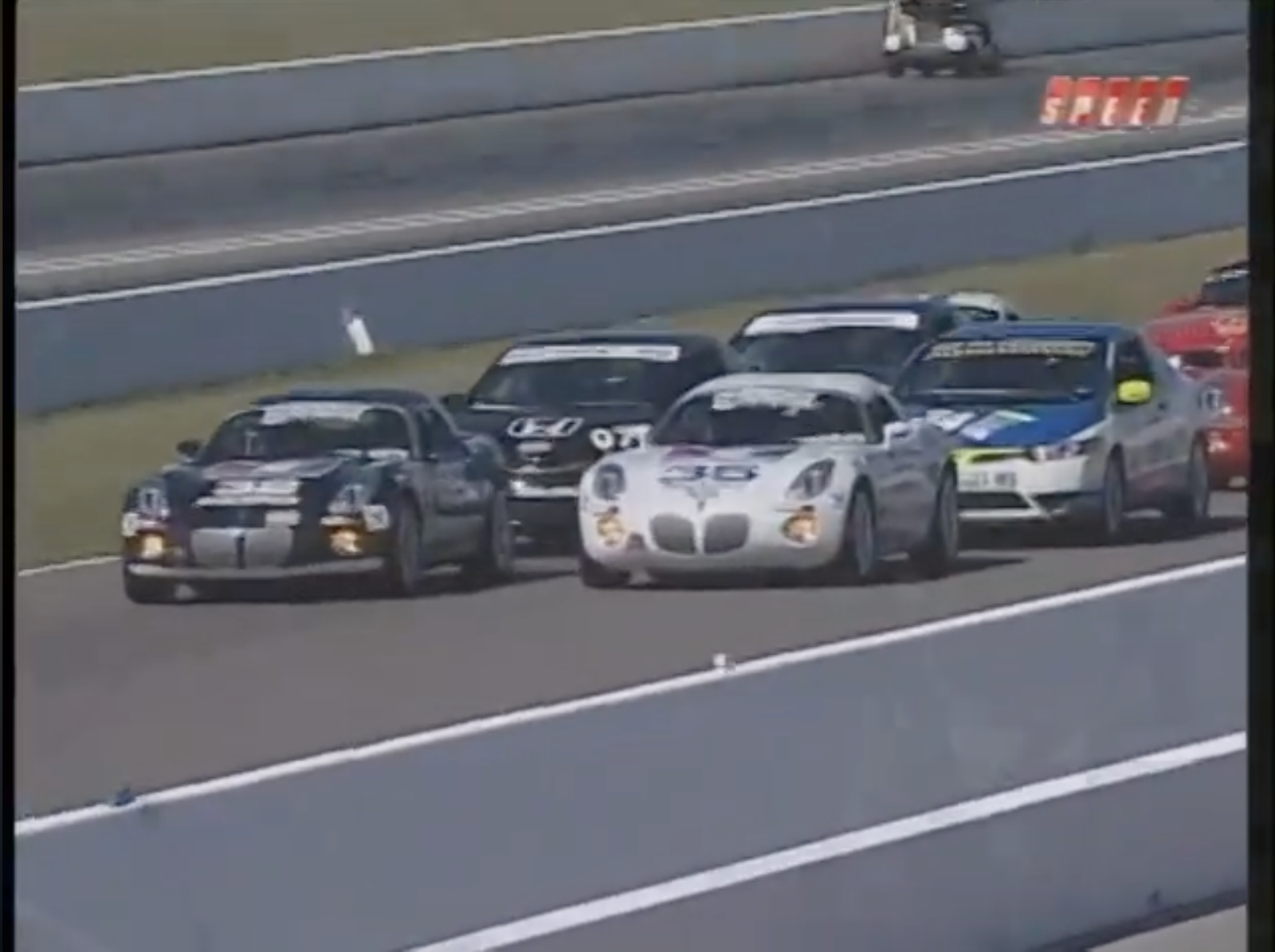
Pretty much no racing program is perfect right off the bat, but the Solstice showed promise by placing third and fourth respectively at the first two rounds of its debut 2006 SCCA club racing season. The breakthrough came at Lime Rock Park on June 10, 2006, when Andrew Aquilante piloted his Solstice to the top of the podium. The Solstice had won its third ever Showroom Stock B race, and that would be a sign of things to come. After a strong showing in regular season events, the Runoffs at Heartland Park arrived. This was the big championship race, the one for all the marbles where the best drivers in all regional divisions battle it out.
Don Knowles, a club racing veteran who won two SCCA Showroom Stock B titles in Saab 900s before making the leap to endurance racing in a massively successful manner, battled for the lead in the opening lap and then absolutely ran away with it in the iRacing Solstice Club Sport. Pontiac’s sports car had done it. It became an SCCA championship-winning car in its debut season, and it wasn’t done yet.
At the end of the 2007 Showroom Stock B season, Kenneth Flory in a Solstice Club Sport qualified second on the Runoffs grid, right behind Michael Scomavacci Jr. in another Solstice. After getting out front on the first lap, Flory drove his Pontiac all the way to the checkered, securing another Showroom Stock B title for the Solstice. Meanwhile, the new-for-2007 turbocharged Solstice GXP wrapped things up in the SCCA’s TT2 class, and with both objectives complete, Pontiac was ready to celebrate.
I Hope You Like Stripes
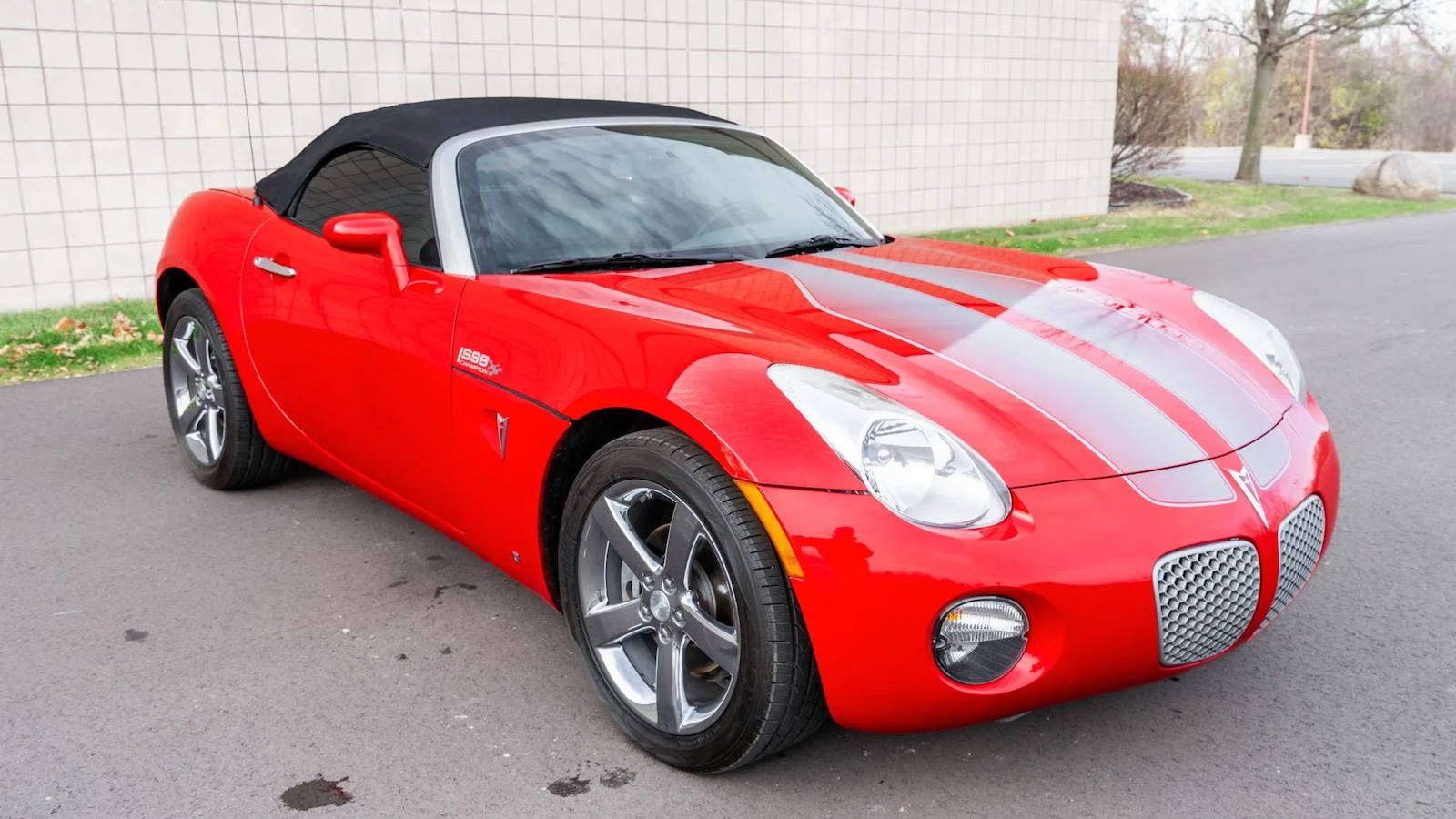
For 2008, Pontiac fired up the special edition machine and cranked out the Solstice SSB Champion Edition to celebrate back-to-back championships. Did it get all the go-fast goodies from the Club Sport? Well, not really. Instead, it was largely an appearance package consisting of gradated stripes, “SSB Champion Edition” graphics, and an embroidered grey-and-black interior, plus a whole host of creature comforts. Air-conditioning, power mirrors, stuff that wasn’t actually available on the real Club Sport car. Maybe that’s why, while Pontiac planned to build 250 examples, only 137 units of this special edition ever existed.

Those who really knew just ticked the Z0K Club Sport box and got the actual SSB-eligible car right off the showroom floor. Some threw on a hardtop, added a rollcage and fire equipment, and went wheel-to-wheel racing. Others used them as autocross chariots, scything through cones in Snell-rated helmets. This little package unlocked a ton of fun, so if you ever see a suspiciously low-spec Solstice up for sale, check the options list for Z0K. You could be looking at a cooler piece of history than you expected.
Pontiac Points: 79/100
Verdict: A dirt-cheap racing-prep package for an affordable sports car that yielded actual results? We build excitement, indeed.
Top graphic image: Pontiac



Its such a pity the trunk is so damn useless in these, like a prowler.
It drove good, felt decent to sit in, had decent pep, still want one to this day, even if the trunk only holds three bags of Doritos..
This article has given me greater appreciation for the Solstice. I thought they were just good looking roadsters for the retirement crowd. A lean racer version from the factory is a bold GM move hearkening back to the ’60s.
They’re legitimately great cars from a platform perspective. Honestly most of the folks that dump on them tend to be s2000 or miata fanbois and had their minds made up before they ever set eyes on it, let alone drove or owned one. Biggest issue with them is interior quality (GM…), and now parts scarcity for body panels and stuff.
As a Miata fanboy I love the Solstice platform. The S2000 is the chassis I detest.
There is a divide in my family. My father and I prefer the styling of the Solstice. My brother prefers the Sky.
6″ 2″. 200 lbs. long legs. Non starter, just like the Miata Grr
GXP owner. You should drive one and see if you fit. I’m 5′ 11” 230, my FIL is 6′ 2″ 190 and both of us drive it.
Thanks for the article, Thomas. If you can do your own work and want to be part of a community, Solstice are cheap fun that you can DD.
Same, I’m 6’0 and my breadth has fluctuated from 230 to 170 during my ownership — never had a problem driving the Kappa. Was my DD for quite a few years. It’s not what you’d an expansive space, but it gets the job done copmfortably enough.
I have seen plenty of people that size and even bigger in Miatas, just need to floor mount the seat.
? I don’t understand. My issue was the seat only moves so far back before it had no more room to move. That coupled with long legs made it impossible to be comfortable enough to drive.
The sliders are limited in how far back they can travel. By mounting the seats directly to the floor they can sit lower and further back allowing for significantly more room. I know someone who is 6’4″ and 300 lbs and drives a NA Miata with that set up comfortably.
I did not know this. I have seen slider rails extended so the drivers seat literally was pushed back to kiss the rest seats of a Mercedes Benz S owned by Kareem Abdul Jabbar who lived across the street from our apartment in Milwaukee about 1 million years ago though.
They also sell floor drop pans as a more extreme option
Very cool! I’d heard snippets about these race solstices (solsti?) before but never got the whole story.
I wish there was a Saturn version, it’s the better looking of the two twins.
The Redline exists. Same suspension as the Z0k but with more power and “luxury”.
I remember the Solstice Club Sport. At the time I had a buddy getting into autocross and had built his LS1 Firebird Formula up to really compete. I got most of this story from my friend, but he thought he put down a great time when someone arrived in a brand-new, stickers still on the window Solstice and beat my friend’s time badly. He was really irritated until he found out that the Solstice owner was an amateur racing driver that bought the car to use in the SCCA stuff. No idea who the driver was, but while my friend wasn’t necessarily angry about it, it did kill his enthusiasm for autocrossing and he only did it a few more times before selling his F-body.
So… bought a muscle car for autocross and then sad when a Miata with 400lbs of ballast is faster?
No. He bought a muscle car for drag racing and found out he didn’t like drag racing, tried to make it good at auto crossing and got beat by Solstice, and then took up golf.
This is the most depressing thing I’ve read all day lol
He’s a finance guy, so the Firebird V8 was more of a surprise than the golf.
Miata is always the answer. Except when golf (no, not that Golf) is the answer.
This was kind of my AutoX journey as well, bought a Scion tC in 2007, not to AutoX, but decided it was the cheapest way to enjoy racing. Wound up classed with Neons, which had less power, but were also lighter, and had over a decade of racing development and actual factory support. It was pretty disheartening to show up, do my best and be embarrassed by a dozen Neons who looked like they weren’t even trying that hard.
This wasn’t what killed it for me though, getting married and having kids did that. My Civics would make good AutoX cars, but I don’t have the time or energy for it these days.
Having autocrossed an ’88 Trans Am a couple times I can attest that it’s not a very good or competitive autocross car so I’m not surprised tbh. Kind of a bummer it killed the fun for him though.
Cool story!
Autopian rocks.
The Club Sport Solstice seems like a racetrack riot but terrible as a daily. The Mallett V8 Solstice sounds way more either place.
https://www.caranddriver.com/reviews/a18201744/mallett-ls2-v-8-solstice-specialty-file/
At the time, I was too broke to buy either.
I’ve owned both a Honda S2000 and a Solstice GXP at various times in my life. Objectively the S2000 was the better car but damn did I love the GXP. Such a weird little car.
I’ve always wanted a Sky Red Line, simply because they look better (to me).
They’re even more compelling now that a GXP is literally 1/2-1/3rd the price of a similar condition S2K.
I wish they’d done a homologation special G3 for some oddball “sub-1-liter” racing class.
on iracing we call it the slowstice. I only raced it once officially and I have 1 win.
I still want a GTP Solstice, though I wonder how many of the V8 swapped Mallet Solstices are out there. I would really like to own one of those.
Hot Rod magazine published an article on swapping a LS V8 into a Solstice. It seemed this was merely months after the introduction of the car. They listed everything from the crate engine to the bolts holding the engine mounts to the chassis w/ GM part numbers (and costs IIRC).
Also happening at GM in 2005: the Opel Speedster/ Vauxhall VX220 Turbo.
Lotus chassis, 220bhp and only 2000lb.
There was an Opel version of this car, the GT, though no RHD version so no Vauxhall version. There was also a turbo version of this car with a bunch more power (260hp), the GXP/Red Line (and I think the GT was only sold as a turbo), but this car is yet another example of the stupidity that is GM. They had a pretty great and pretty sophisticated small sports car that they didn’t sell in the US, but replaced it with a crude parts-bin special. And likely didn’t make any money on either one. The Speedster/VX ended before the GT began, they did not overlap in sales in Europe. The GT did not debut until 2007.
Though I can certainly see why the Europeans turned up their noses at the relatively crude Opel GT vs. the MX5 with only 7500 sold in three model years – the presumably rather more expensive Speedster sold somewhat more. A typical GM half-assed project where maximum effort was put into making it produce big numbers on paper, but zero effort spent on refinement, build quality, or creature comforts. The trunk and roof of these things are a joke compared to the Miata, as is the fit and finish and the feel. But it pulled 1G on the skidpad or whatever, and even in non-turbo form was a little faster in a straight line, so “good enough”.
GM passed the Kappa roadsters around to all their LHD overseas brands. So, basically Opel and Daewoo, with the GT and G2X, respectively. But the Opels and Daewoos were directly rebadged Saturn Skies
Done on the cheap, like everything else with the Kappa platform. Just like the Fierro, they could have been something great, but were ultimately rather mediocre.
I find the Sky to be the better looking of them.
I don’t know what else they could have done, it was destined to be a money loser from the start, the only question was for GM to decide how much they were willing to lose on it. The fact that a niche, RWD roadster was being made as the only product in the cavernous Wilmington plant,built to do 300,000 vehicles a year, was a clear enough sign on its own.
Then they should not have bothered. They had a template as to how to do this correctly in the Miata. GM with all it’s engineering might and resources should have been fully capable of making something every bit as good. And in the Opel Speedster they even had an excellent sportscar product they could have just sold here in the first place. Instead we get another half-assed parts bin special. That didn’t sell because it was ultimately rather crap compared to the Miata, even if it was faster and pulled more G’s. GM NEVER got that the whole package matters more than the individual specs until very recently.
I guess, but that’s a pretty soggy attitude for an enthusiast and I think most people who aren’t outright Miata diehards would disagree.
I’ve spoken ad nauseam about the challenges GM faced in the 2000s, but the gist of it is that GM’s engineering and financial might was blunted by its inefficiency. Things like bloated dealer networks, UAW/retirement obligations and ridiculous management structures meant that it cost GM more than everyone else…to make a worse car than everyone else. That said, the Kappas were pretty cool and we’re better off having had them than not. I do not think that GM was capable of in-house engineering a car as cohesive as the Miata or the S2000, but I truly think the Kappas were the best compact sports cars GM was capable of making back then.
Counterpoints against your argument:
They’re not the best cars, but far from terrible or “not worth trying” (sounds like a dude who bought a miata and contstantly has to justify it). Base to base, I’d go Miata, not a whole lot between them. Build quality is not as good on the GMs but handling, power, and drivability is pretty on par. Redline/GXP is no contest though. When the top is down you’re not really caring about the dash plastic materials.
Nope, just someone with an appreciation for properly built and engineered cars. And that is not the Kappas overall. That was always GMs problem, they could do numbers, but they could never do *feel*, and were the absolute kings of getting something 90% there and completely whiffing on the last 10% to save a buck in costs.
And yes, I absolutely care about the dash materials – it’s what you are literally faced with the entire time you are driving the thing.
That’s what’s so sad about it, it SHOULD have been so much more – they absolutely had the ability to engineer a Miata, they did not have the desire. A crap car that could pull some big numbers is nothing to be proud of.
The Speedster/VX220 was an entire planet away from having any sort of wide market appeal in the United States and were themselves obviously parts bin cars that were significantly more crude than the Solstice and Sky were. I doubt they could have even realistically been federalized. Certainly the Solstice in particular had problems in its execution (many of them related to being rushed to production from what was a styling exercise with as few changes as possible), but sophistication compared to a car that is 70% bare metal interior is not one of them.
The GT sold better in less time than the Speedster did; even though the former debuted right before the financial meltdown that led to GM shuttering the plant the car was built in, wasn’t sold in the UK and was just an export version of an existing car. While Ranwhenparked noted below that the factory that they were built in had tenfold more capacity than the amount of Kappa cars it was putting out, the Solstice and Sky themselves were also quite a bit more successful than GM originally expected (the earlier Speedster having underperformed for GM Europe) and the two of them sold quite a bit better than the NC Miata before GM started winding the plant down alongside the Saturn and Pontiac brands. I wouldn’t be surprised at all if the GM made decent money on it; which was a pretty rare thing indeed for GM that decade for anything that wasn’t Silverado adjacent.
Lotus did eventually make some hay–briefly–in the U.S. with the Series 2 Elise but I’m sure GM itself had zero interest in selling a car in the States that needed an airbag waiver.
Since the GT was only sold in turbo form I doubt its target was Miata buyers. Rather, it was a cheaper alternative to the small German roadsters like the Z3 and SLK.
My girlfriend has an ’08 Saturn Sky Red Line that her mom gave her, originally for the grandchild but she didn’t want it. In 2018 or so, I drove it and rolled the odometer over at 10k miles. The thing still smelled new inside.
It also had the original tires, that I quickly talked her into replacing. It is probably at 14k or so now, probably still smells new. She loves that thing. I think it looks better than the Solstice, now that I know what the difference is between them.
Even me being a Pontiac guy I actually preferred the looks of the Sky over the Solstice. Though I do really like the look of the hard top Solstice.
The Audi Quattro was never a homologation special. Just a regular production car that went rallying.
Also not sure this qualifies as an homologation special. More a package to adapt the car for racing and make it more suitable, but the model itself was already eligible for the racing series.
The regular Quattro was not a homologation special – but the Audi Sport Quattro, the sawed-off short-wheelbase version, sure was, for Group B.
https://www.motortrend.com/reviews/1984-audi-sport-quattro-rally-first-drive-rewind-review
But I agree that this car was not one, just a stripped down package to go racing in with no requirement that a certain number be sold to make it legal to race.
Indeed the Sport Quattro was the Group B homologation special.
Something that I also wondered is why in 1987 the decided to homologate the 200 Quattro instead of the Quattro, since surely more than 5000 had been built by then?
The automotive press destroyed this car.
Was it quite as lightweight or as nimble as the Miata? No. But it didn’t exactly need to be. Automotive media loves to hate on American cars, and with that, it was endlessly compared to the smaller Miata as if every car needs to be it’s copycat.
They very rightly destroyed this car. It was every bit as half-assed as the original Fiero.
When these first came out I thought it’d be a cool little car, then I sat in one at The Detroit International auto show and realize it was not made for anyone taller than 5’10”. I liked the sharper lines of the Saturn Sky better.
I had really wanted a Solstice Coupe as my first new car out of college, once I saved up a bit for a good down payment. GM previewed it as far back as 2002, with the production ready version shown in 2008, so everyone knew it was coming, but it ended up not going on sale until early 2009, and was only in production for a few months before the Wilmington plant closed that summer. They only made like 1100 or so for customers, and good luck finding one at the time. So, I ended up just buying a Mustang instead
How does this only receive 79 pontiac points?
Agreed! This is an actual Pontiac sports car in full sports car spec! at least 90/100
As an 8 time Miata owner, with 2 currently, I have always kept an eye out for a Saturn Sky Redline. They are very cheap and easy to modify and make really good power since they have the same engine as a Cobalt SS. Always wanted to make one irresponsibly fast.
Can confirm as an owner of an irresponsibly fast Sky Redline. It’s fairly easy to get 350hp out of them. Aftermarket is kinda limited–not nothing, but nowhere near a Miata, and also things like body panels are getting tougher to find.
I always put the Redline/GXP as a cross between a Miata and a Corvette. More power, a bit more weight than a Miata (but same footprint, and still great handling) but smaller and more sprightly than a C5/C6. Modified, they’ll hit way above their weight too.
I’ve done pretty much all bolt ons and custom tuned it, sitting somewhere around 320hp and 360ftlbs of torque if I calc’d right. I actually snapped the rear diff brace on a 2-3 shift last year from the torque and a bit of sloppiness on my part. BC coils and PS4S. It’s been fun to tune and I learned a lot about HP Tuners along the way.
I will say, my daily driver Mazdaspeed Miata makes around 350whp so I am a bit biased on the power front, but I think having a lot of the options that fit the Cobalt would open up some thing things. A big concern for me would definitely be the lack of body parts and I have heard that replacement tops just don’t exist.
It’s hit and miss. The Cobalt engine is mounted transverse, to a transaxle vs the Kappas which are longitudinal so a lot of engine parts aren’t swappable (mainly FI/piping etc — HPFP and injectors and stuff are fine). Replacement tops aren’t available new (to my knowledge) but plenty available used. A lot of the powertrain is parts bin GM so pretty availble if you need sensors and stuff, but other things like the torque brace (which I snapped) are hard to come by, even if they mount to a CTS LSD out back and an Colorado AR5 at the front.
The MSM is an intersting comparison…I really don’t know how the availability between the two would line up. I imagine anyone who makes miata parts is going to just go for the regular models since the market is so much bigger (so attention to the MSM is just…not there in context) vs. the Kappas which are small, but bespoke market.
A lot of stuff from the regular Miata’s transfer over, the biggest limitation is in exhaust, intake, and turbo replacement options. Weirdly, the market has started expanding recently on that front which is surprising given the age of the platform. Two or three new companies have started offering stock location turbos options and exhaust options. There have even been some new intakes popping up.
From time to time the manufacturers have offered actual race cars, or near as dammit, from the showroom floor. They’d hedge the bets of course, putting together packages of goodies that were nothing short of racing-specific just in order to homologate the equipment for actual racing. The one that sticks most in my mind is the Torino Talledega, a fire breathing 190mph monster with an MSRP sticker in the window.
I had no idea that the Solstice received similar treatment.