

As you may recall from my last 2CV update, I was still driving it using a five-gallon fuel can in the passenger footwell instead of the actual, proper gas tank, which was not working for some reason. Many of you felt that this was an absurdly dangerous way to drive a car, and perhaps even suggested I was driving some manner of wheeled Molotov cocktail, but I don’t know if it was that bad. It wasn’t great, though, that’s for damn sure, and no rational person wanted to get into the car with me, so my priority this weekend was to finally get the car driving from the properly installed fuel tank at the rear, as the French Dieu intended.
I’m happy to say that goal has been accomplished! Of course, I couldn’t have done it on my own: our old pal Andy, who was so crucial in getting our $800 Nissan Taxi to make it across the country, was a huge help here. Huge! The problem turned out to be a lot trickier (or maybe subtler?) than I had anticipated, so the extra help, of both hands and brains, was critical.


But before I could get to that I had another pressing issue to solve, which was my overwhelming abundance of voltage. You may remember last week when I mentioned that after I fixed the bad connection on my alternator, that alternator was putting out way more than the expected 13-15 volts of rich, creamy electrical power. It was usually hitting 17 volts, which is far too many volts.
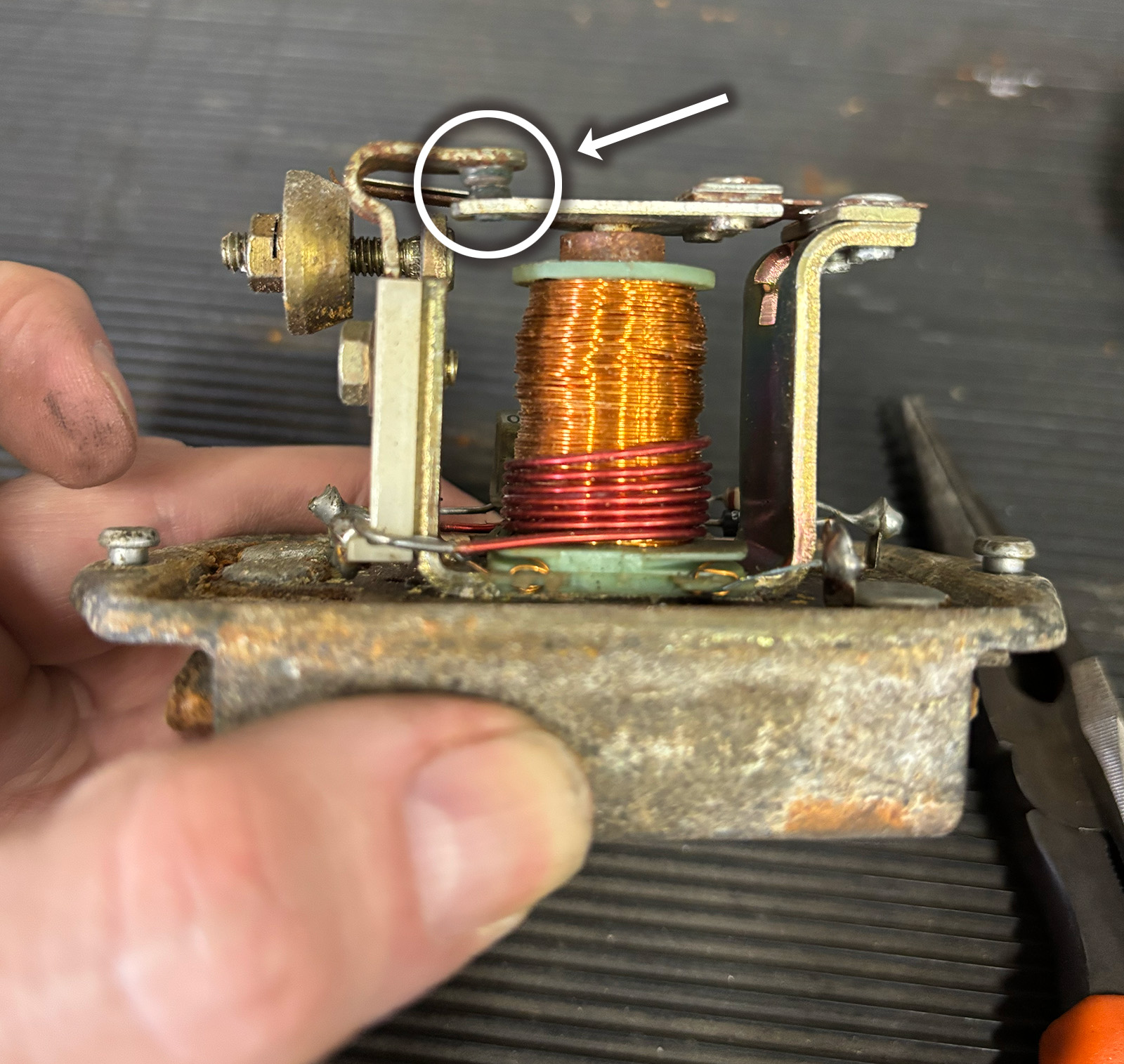
The voltage regulator seemed to be the best place to start here, so I unplugged the ratty-looking unit and sloppily pried off the cover. Inside, it looked like part of the equipment used to reanimate a corpse (based on the work of Dr. Victor Frankenstein as published in The Lancet), especially because my brain now tends to think of parts like these in terms of solid-state devices, which this is very much not.
Essentially, it seems to work by charging the wire in that coil, which, because it’s wrapped around an iron core in there, acts as an electromagnet, which pulls the little contact point up top down, breaking the contact. With the engine running, when I used my finger to break that contact, the voltage did drop to reasonable levels, so I filed down and cleaned that contact, and it seems to be working properly now? It’s reading between 12.5-13 volts, so I think it’s okay? I’ll keep an eye on it.
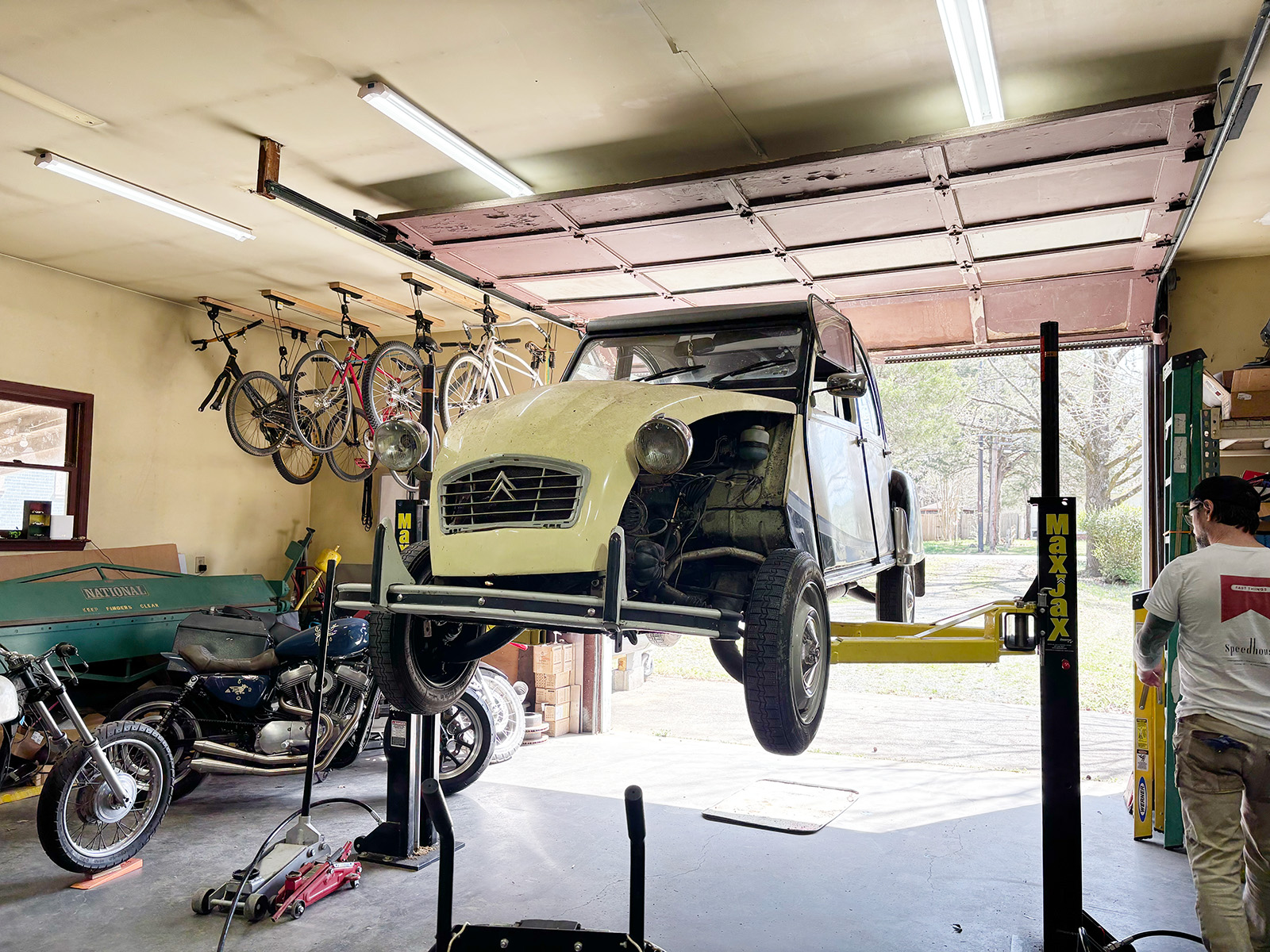
Back to the fuel tank situation. When I got the car from our own Stephen Walter Gossin, he had already dropped and cleaned the plastic tank, but because the car wasn’t running then, I don’t think he realized there may have been any issues with, you know, getting fuel out of it. But it sure didn’t seem to want to provide fuel to the engine, bafflingly. We got the car on the lift – where it very likely was the lightest thing ever lifted by that machine – so we could access the fuel tank, which you can see below, looking like a big ravioli peeking out of a hole:
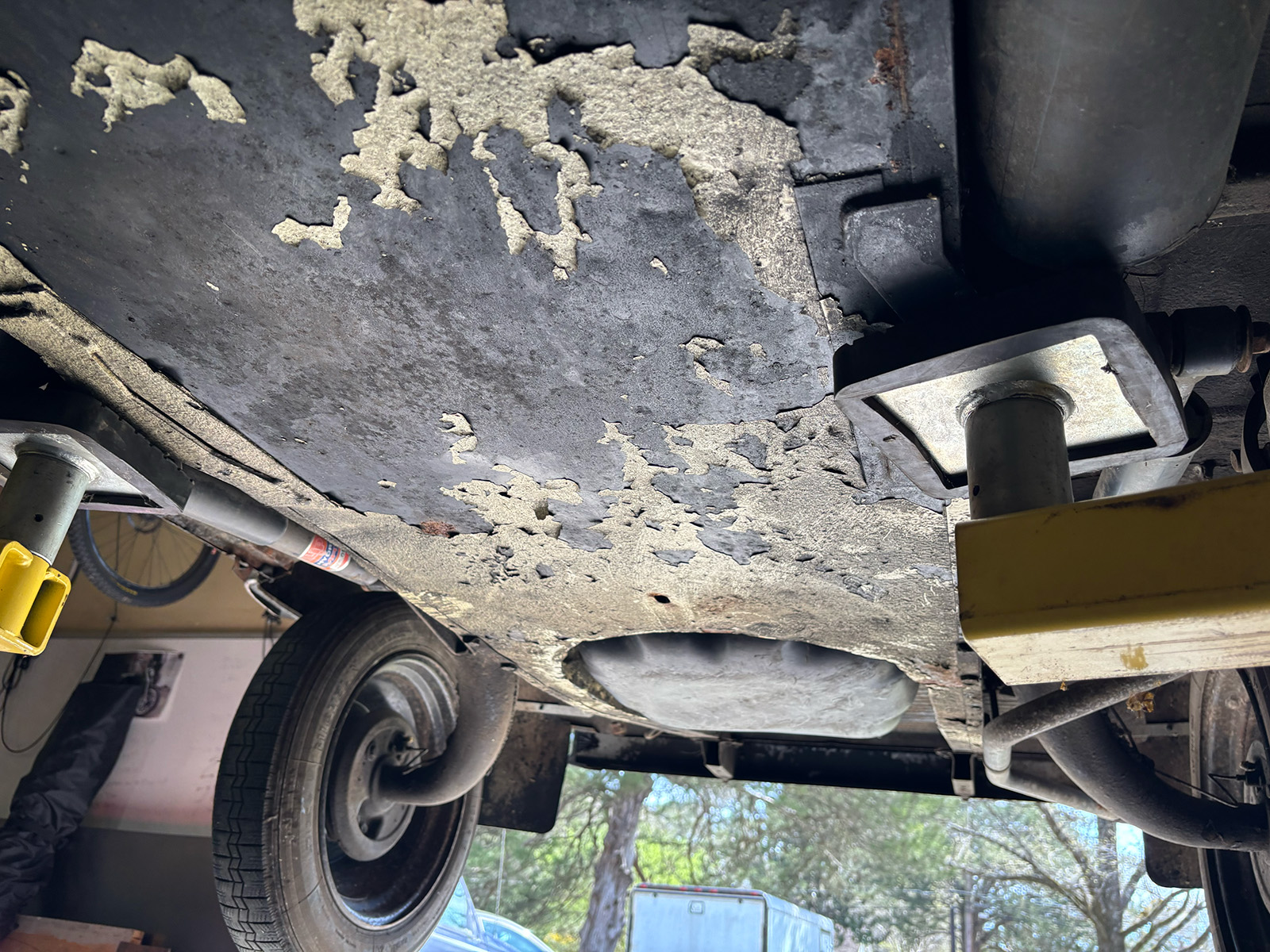
I was happy to see that, for the most part, this car is shockingly rust-free, and even seems to have the remains of some kind of paint under there. Did Citroën paint the underside of these chassis? It may be some anti-corrosion stuff? I’m not sure, but some of it is still there.
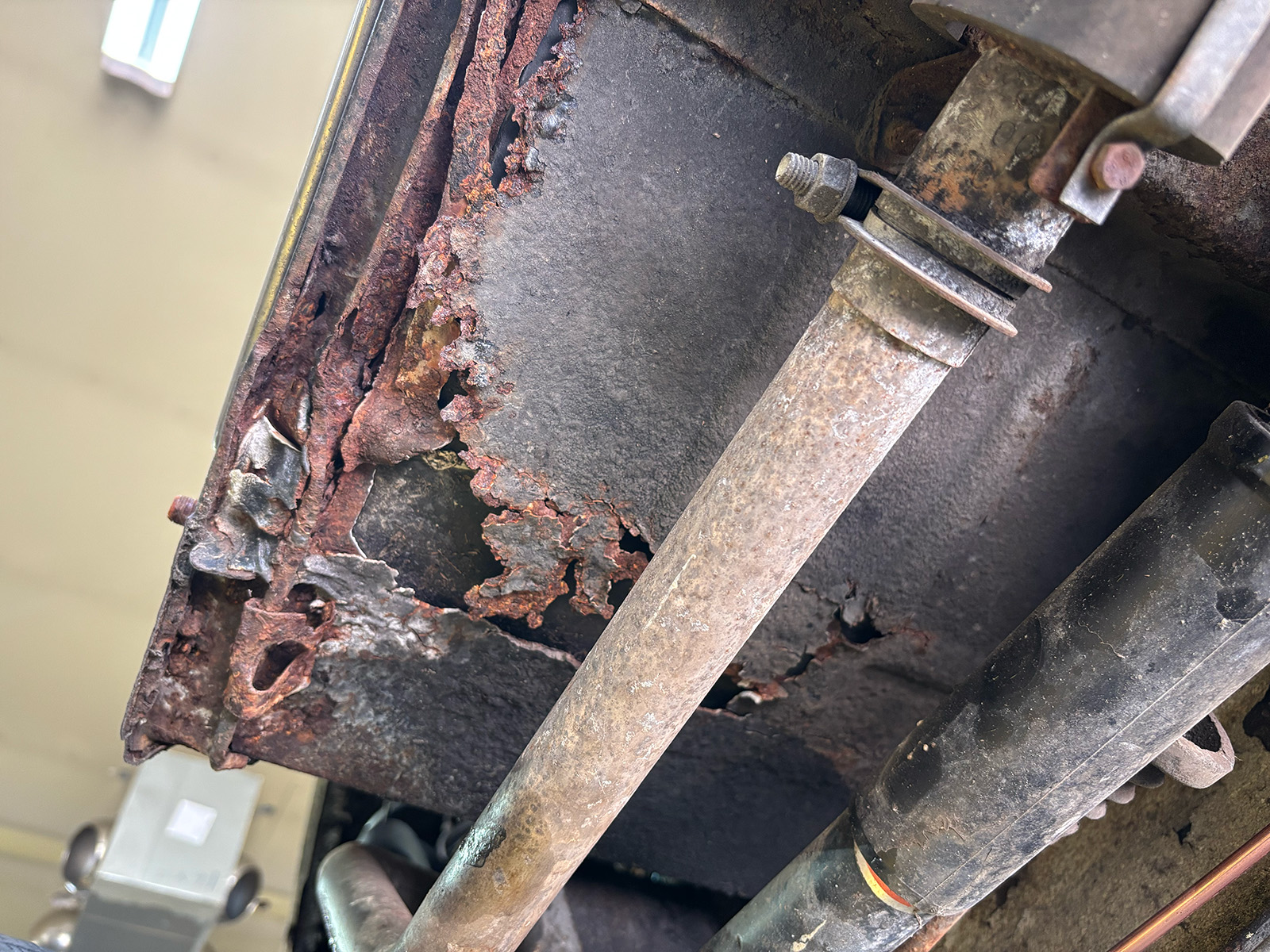
There is one good-sized rust hole, under the driver’s side floor, which I need to address at some point soon. That’s just the rubber floormat you can see through the hole! I guess it may be time to “find” a stop sign or something.
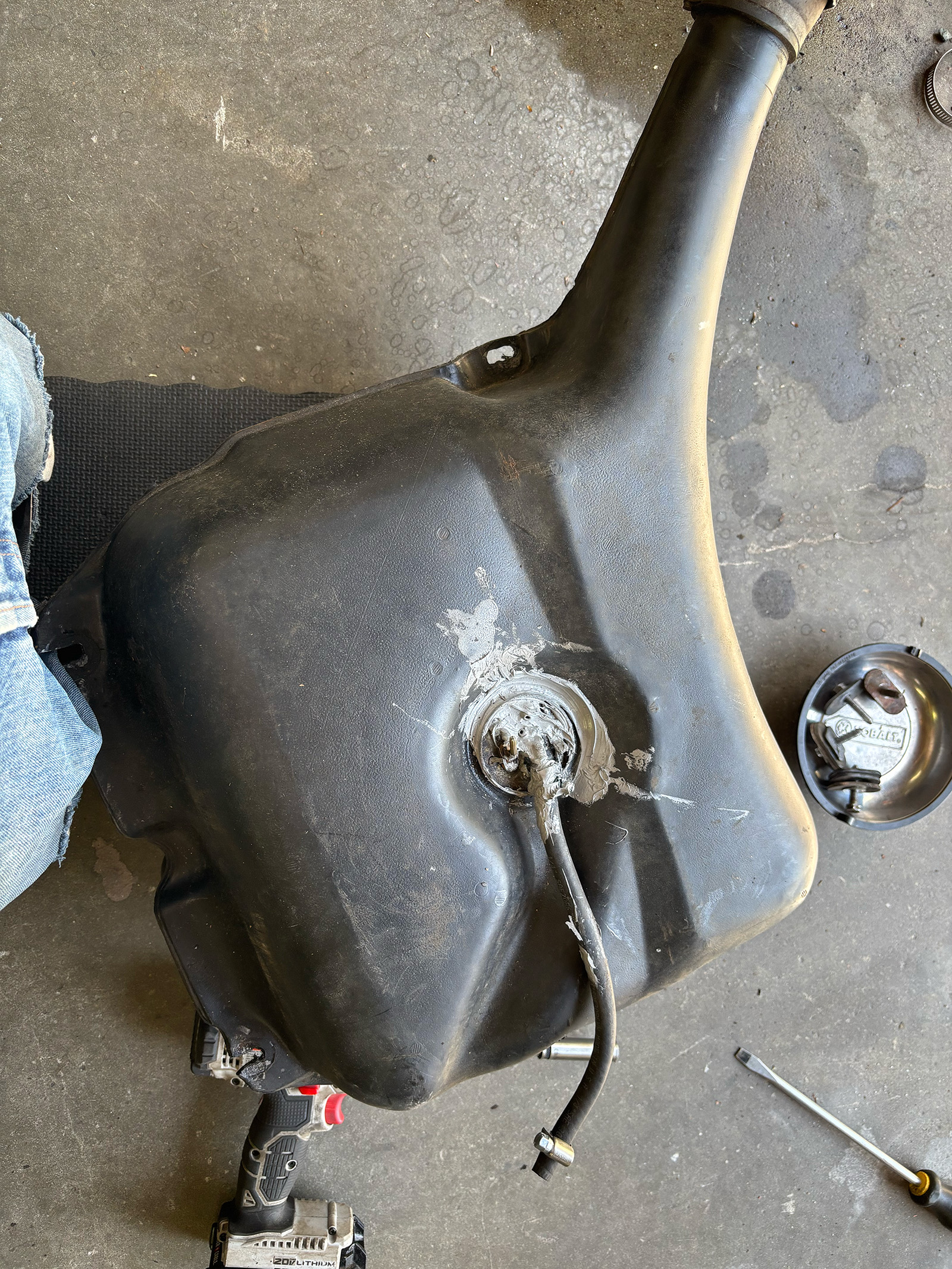
We dropped the hilariously tiny (6-ish gallon?) tank to find that the person who had done such a great job fixing my carb maybe did a little less great job figuring out what was up with the fuel tank, as you can see. It seemed like the tank had some leak in it somewhere, and where the fuel gauge sender/fuel pickup mates to the tank seemed the likely place, so it was well-gunked with gray goop.
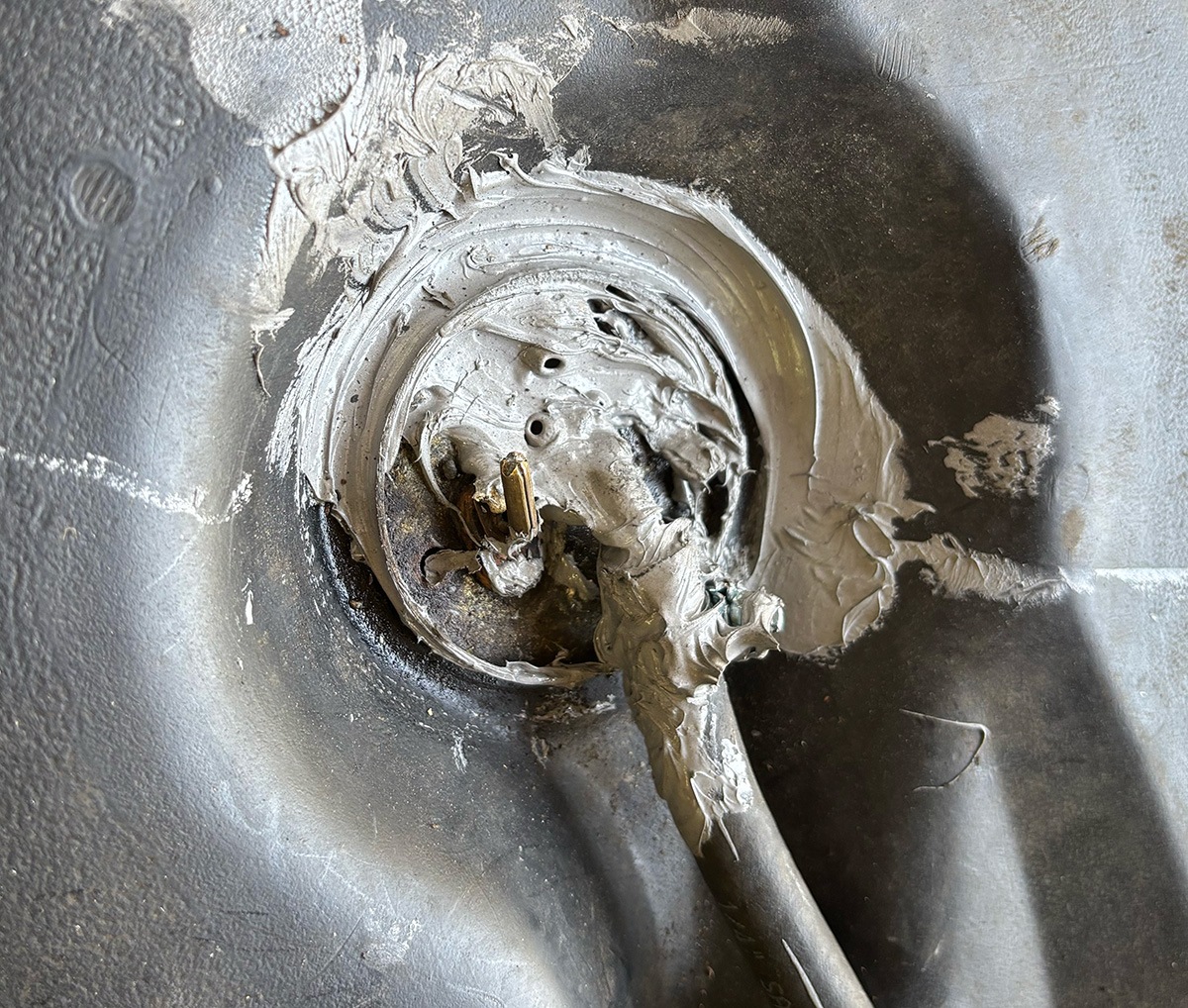
The goop didn’t help. No gas was getting out of that tank! So, we de-goopified the sender/fuel pick-up straw and pulled it out:
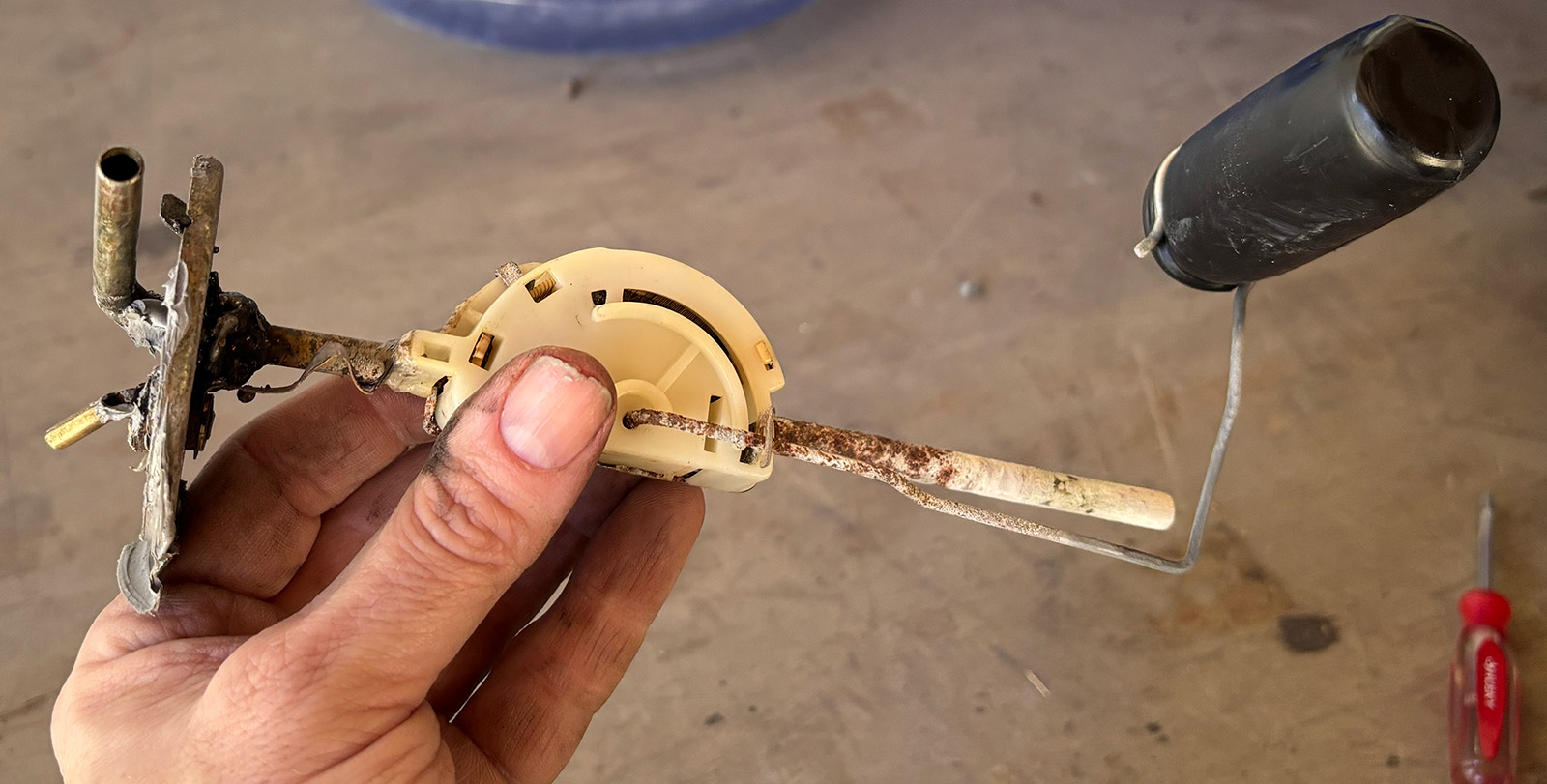
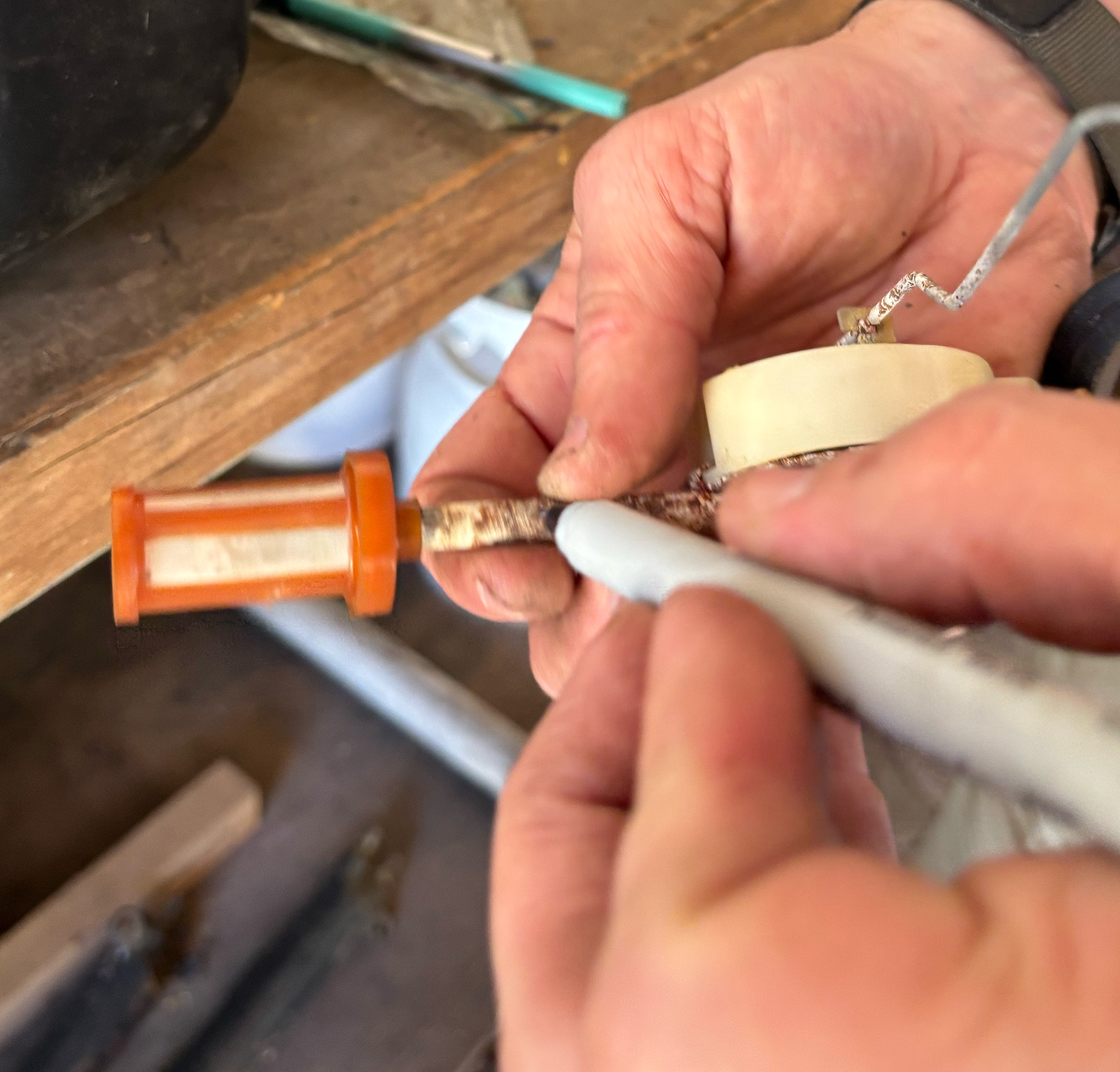
At first, I wondered if the fuel filler at the end of the gas drinking straw was abutting the bottom of the tank, preventing fuel from getting in, but we checked and marked where the filter sat, and there was definitely enough of a gap there to allow fuel to enter.
So now things were getting really confusing; we tried to eliminate the possibility that the newly-installed copper fuel line may have a clog or something by bypassing the line and running the engine from the tank via the same shorter fuel line I was using in the temporary five-gallon fuel can, which should have worked fine, but somehow didn’t.
So what the hell was going on?
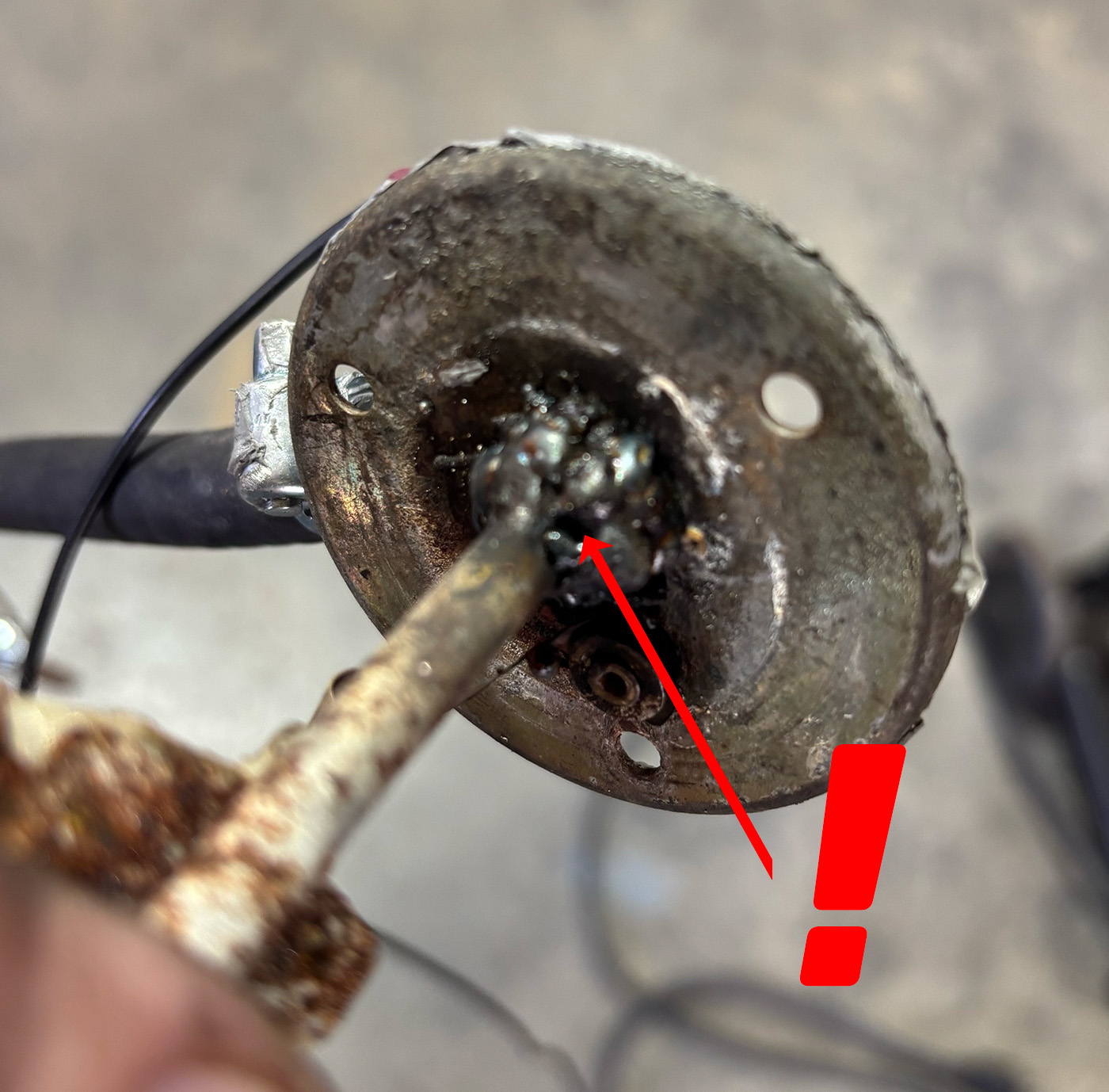
We took everything apart again, and then we saw it: at some point, someone had attempted to do a repair on the fuel sender/pickup and had very clumsily welded the straw back on. I may be being generous with the term “clumsy” as the weld looked like a small, pockmarked meteorite shoved there, and there was a hole in that wad of slag, which seemed to be the root of the problem! Air was getting in the hole, preventing gas from getting in there, hence the engine not being able to, you know, run.
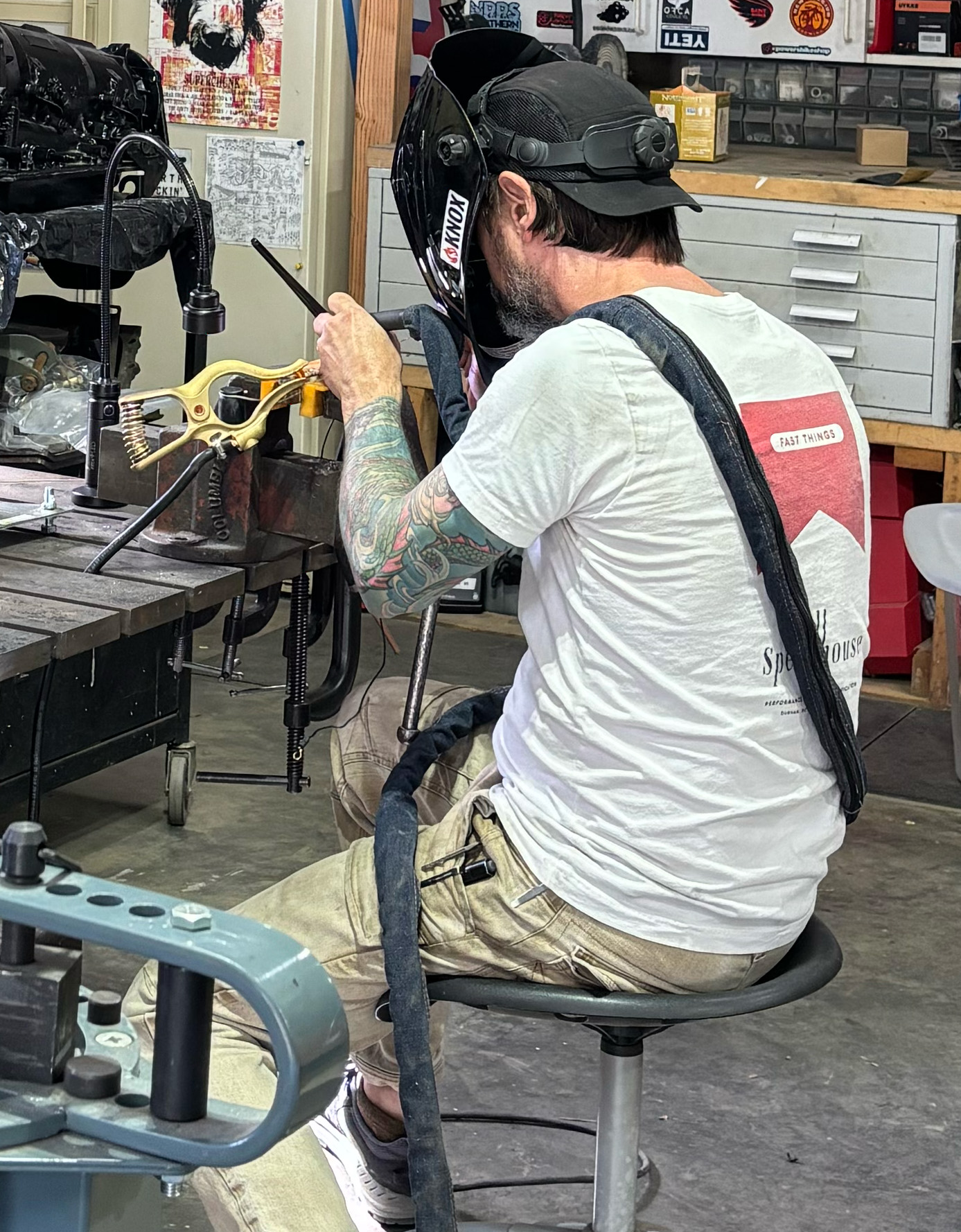
Happily, Andy has a welding setup that he proudly claims could weld tinfoil if needed, so he was able to, with the care and precision of a jeweler, close that little hole in the fuel pickup unit.
Then we put it all back together and it worked! I was able to drive it home using a fuel tank not on the inside of the car! Like a millionaire!
There’s still more to do, but this was a very big step! I actually think now I can get passengers to willingly enter the car! Hot damn!


“as the French Dieu intended”
Since this is a Citroën we’re talking about shouldn’t that be Déesse?
Déesse . . . nuts!
#2705 Sender assembly: 70-90 2CV 12V model (pic.2) – FPS West – French Parts Service
#1070 Regulator; 2CV6 Battery Mount for 3-wire connector, solid state (pic.1) – FPS West – French Parts Service
Here you go, parts available in stock in the US, in Washington state. $100 and you’re totally modernized and repaired.
Here’s the link to the parts catalogue Online Parts Catalog (Click here for parts) – FPS West – French Parts Service
He needs to see if he can buy it off eBay.
He’s definitely familiar with Kenji and FPS West. But I think once the found the issue, the option to be able to drive for a while was to fix the pickup/sender he had and drive home. Kenji is great, but he isn’t Amazon. My parts from home take a week or more
Don’t know if fixing these old parts rather than just getting new ones is driven by the desire to maintain Gallic authentickity, or sensible tight-fistedness against investing in a very old car, but I salute it in either case.
And now that I think of it, “just getting new ones” is probably not all that easy anyway.
As noted elsewhere, for many parts, you can get them in a week or less from the US from an EXTREMELY reputable guy, Kenji at FPS West
Thanks.
I know it’s done out of necessity, but it’s nice to see parts being repaired. I’m especially glad there’s a proper gas tank in there now!
That floor is…something. By any chance, have you experienced an urge to consume spaghetti while in the shower?
For the rust hole, un signe de arrêtt, peut etre?
https://cdn11.bigcommerce.com/s-10c6f/images/stencil/1280×1280/products/2167/4147/FS71091_32__22446.1446589454.jpg?c=2
What’s the penalty for smuggling a sign across the border?
https://upload.wikimedia.org/wikipedia/commons/thumb/b/b1/Stop_sign_quebec_city.jpg/500px-Stop_sign_quebec_city.jpg
re the stuck voltage regulator relay: those contact rivets are typically silver-cadmium-oxide (AgCdO) because it resists welding. very old, common and necessary industrial use of silver.
As you’ve demonstrated, they CAN be welded with enough current.
Once they’ve been separated and cleaned, they should continue to operate normally for manymany make-break (arcing) cycles.
FWIW, the back-of-the-envelope guide for an electric arc forming when making-breaking a switch is A) voltage>20V, B) current >1A & C) thirdly, >0.5 volt-amps. if any of these conditions exceeded then it is not “dry circuit” and there will be an electrical arc and AgCdO is your friend.
You’ve been hanging out with DT too much if a giant rust hole and structural floor mats counts as ‘shockingly rust-free’.
Not that structural integrity matters much in a such a tin can. Even in a collision with a Changli, the 2CV would lose.
Once had a Fiat Strada (like a Golf but Italian and much more comfortable) which suddenly started using a lot new fuel.
Only when I got out of the city and smelt petrol following me around that it clicked that the tin tank was leaking….
Just recently had this experience with a 2007 Corolla. Rust favours no car. They are all a meal of the porous God of metal
Heh – ravi-holey
Now that you can drive it fast enough you should really replace those sketchy tires.
It’s a 2CV I don’t think it can ever be driven fast enough that even worn bicycle tires are too sketchy to use
Oh, this reminds me of a baffling fuel delivery problem I had when I built up a 460 in an old T-Bird. The thing would idle fine, but die under any load. Ended up being an 8” section of fuel hose I used between the new gas lines I ran and the pump. It was sucking so much gas the rubber line was collapsing in and cutting flow. Eliminated that and it ran great!
I can’t weld but I can chew gum and that’s how I temporarily plugged a fuel line air breach. Got me home from the beach. Moral of the story: always have a pack of gum in the glove compartment.
Ha reminds me once upon a time some small fuel hose under the hood had a small hole that was a problem. Since that length of hose was “hozed” anyway I cut it and used I think a short part of a bic pen body to create a splice the two ends of the hose back together. Likewise this was good enough to get it to a parts store to get a replacement hose.
JB Chew.
Getting used to the hot rod look. Keep it that way!
The ladder frame is pretty thin, so any rust on that is fatal: Seen 2 break, on my dad’s Dyane and on my first own 2CV.
1000usd will get you a new galvanized frame (plus postage from France), but it takes a couple of days transfering the whole car to the new one…
That body rust out on the side isn’t so bad, seen a lot worse.
The hard part now is finding a company that will still ship you one. The best known one, Burton, stopped shipping to the US “temporarily” last summer. And if you can find a shipper, I fear the tariff rate on all that non-US steel.
I was thinking of the Club Cassis parts manufacturer.
Should be easier to make than an AE86 or LJ70 body, so maybe from Alibaba or something? 😀
Have you have any luck getting MCC (Mehari Club Cassis) to ship to the US recently?
I’m in the EU (and the only Citroën I have at the moment is my dormant ’67 DS21M), so haven’t tried 🙂
If Torch was insane enough to make the trip, I volunteer my Canadian garage to do the frame swap.
It’d be far from the first time I installed parts on one side of the border to dodge customs fees.
Sometimes with the car moving! Like my buddy’s 240 wagon. Bolted in the wiper motor in the parking lot (under hood), then I re-connected the linkage while we hauled ass down the interstate (accessed by removing the glovebox). I had to work quick, cause it started to rain.
Applause for that one!
I couldn’t applaud at the time, as my arms were elbow deep in the dash and my head resting on top. At least my face didn’t have far to travel if we’d gotten in a wreck.
Legend.
I feel like this is a Torch/David adventure in the making. The guys fly over to France to pick up a new frame and figure out how to put it into their carry-ons for the flight back.
If that guy that had his 2CV breakdown in the Sahara could make a motorbike out of his busted 2CV I have no doubt that Torch an DT could macguyver a hovercraft out of a Citroen and take on the Atlantic.
It’s kind of like a Beetle maybe it floats
It can take a littltle as two hours! As they say, practice makes perferct. A two hour 2CV? Pushed the prove the theory a tad. The thing got a UK mot though.
Starting to get a little worried about the frame also, the bumper attatched to it hanging at an angle, the bit of rust in the seems…
But if only a man Torch’s size drives it a bit now and then, it will probably hold up a few years, until the steering suddenly gets weirdly heavy, and the wheel base magically shortens 🙁
The Berkely sports car is my favorite vehicle in the Autopian fleet. This 2CV is my 2nd favorite.
I love how lightweight, small, and simple it is. If it were a streamliner, it might get over 100 mpg and reach close to 100 mph on the stock engine.
Just don’t take a chainsaw to the gas tank.
I must have done between 150-200‘000 miles with the 2CVs I used to own, and I always tried to drive as economically as possible, since I was a student and had a very limited budget. The car weighs around 600-650 kilograms (1350-1450 pounds), so it’s one of the lightest 4 doors/4 seats cars that ever existed. However the engine isn’t very fuel efficient; even in city traffic where aerodynamics don’t matter much, I didn’t get much more than 40 mpg. Later I drove a 1.6 liter Corolla with a carburetor and a 3 sp auto, and this car got slightly better mileage. The 2CV‘s engine is just very „ancient“.
At ~25 mph, aero drag force will match or exceed all of the others in a 2CV. Its drag is that terrible. 40 mpg in a stock 2CV sounds about right.
Consider the Tryane II, a wood-bodied custom 3-wheeler using Citroen Dyane suspension/transmission and the same 2-cylinder engine found in the 2CV. It could get 90 mpg and top 100 mph. It did lose about 600 lbs over the stock 2CV which helped.
I bet with some wind tunnel optimization, even on the 2CV’s craptastically-efficient engine(you’re right, it does suck in this regard), 100+ mpg can be reached. I say this, because with a highly-efficient diesel-electric powertrain in an even smaller car with better aero, such as a Shell Eco Marathon car, 4-digit fuel economy is possible, which is an entire order of magnitude difference from 100 mpg.
Interesting, it’s a neat little car. I looked at it, unfortunately I couldn’t read the article. A few things: 600 pounds weight reduction is huge, about 40% less than the 2CV. Also its overall dimensions and the frontal area must be considerably smaller, it’s very low and only a 2 seater (the 2CV seats 4 plus luggage). Given that, I can see how it gets such a good mileage.
About the engine: the engine from the Dyane is very similar to the 2CV engine, but it is considerably more modern. It has electronic ignition and produces 5 more HP (34 instead of 29, which is over 20% more). I don’t know if the ignition alone makes it that much more powerful or if there are other modifications, but if given the choice, for a project car, I would take the engine from the Dyane every time.
Man of the People Jason Torchinsky runs a successful and popular website but has not lost sight of tradition and bravely suggests theft of municipal property to mend his car.
When we were young and stupid we enjoyed the irony of using “Neighborhood Watch” signs for such things.
If he doesn’t want to deprive the road of its guardian, I’ve used a piece of 6” galvanized stove pipe from the hardware store. It comes with the longitudinal seam not closed up, so it can be flattened into a ~18×18” square.
Old license plates.
Not sure why no one suggested going to the local non car salvage yard. Guy here sells any chunk of metal for what he would get from the buyer. I got a nice 3×4 corrugated sheet of metal for $10 to use as a ramp to get a electric pallet jack into my storage unit
I had a period of time where I kept stealing signs when I was…hydrated.
I did have a rule, though. Nothing that affected traffic flow. So I had a collection of everything from “keep your dog leashed” to “no parking after XX” to “visitors only”, etc.
I also got a school crossing sign cause someone had sheared it off and it was just laying on the ground.
When I was an engineer in Texas, I always wanted to steal a sign for the road FM666, but never got around to it. It would have been a gift for a friend that like myself, has an interest in devilish/occult things.
I think you need to enlist Andy’s assistance to fix up that hole in the floor. Glad you got the fuel tank issue fixed.
If you’re going to fix the floor with a road sign, do the classy thing and find a Priorité à droite one.
Failure to draw fuel can be frustrating to fix.
My biggest battle in this was my son’s 1953 Kaiser that started and idled great, drove fine around town, but choked at highway speeds.
We installed a glass bowl fuel filter between the pump and the carb, and discovered that flow was fine at low speeds, but when revved up the supply couldn’t keep up with demand and the bowl drained in a minute or so.
New tank, checked the fuel lines by blowing air through them, cleaned the fuel pump’s internal filter, etc. No joy.
We were preparing to install an electric pump (a new Kaiser mechanical pump was relatively unobtanium), and I cut into the metal fuel line where it made a 90-degree angle into the pump. Voila! The elbow was semi-clogged with rust flakes from the old tank, which allowed enough fuel to flow at low demand but restricted flow at high demand.
Made a new elbow out of metal fuel line, put everything back together, and the big Continental six ran great!
The car was still a dog. After daily’ing for a year, and repairing the car after an electrical fire on the interstate, my son sold it in favor of a ‘93 Mercury Capri – his current daily.
https://itisgood.org/auto-biography/#53Kaiser
A good test is trying to blow air back from the carburetor to the fuel tank. Never try it in the other direction
I don’t know why you wasted all that time figuring out the gas issue, when you could have just pulled out the floor mat and ‘driven’ gone under human power.
One of the few vehicles a human could reasonably Flintstone.
Have you seen Jason’s legs? He doesn’t have the calves for that.
He doesn’t now, but he would…
“my brain now tends to think of parts like these in terms of solid-state devices, which this is very much not”
Jeeze. All solid state! Copper wire, iron frame, rust, etc. And a nary vacuum tube in sight.
Gimme fuel, gimme fire, cause it’s passengers I desire
-Torch, singing on his drive home
I wouldn’t have given you cocktail grief had I known you had back up Flintstones brakes.
Success!!!
Maybe it’s because I’ve lived most of my life south of I-10 but my definition of shockingly rust-free seems to differ. Congrats on figuring out that fuel issue though, that’s always satisfying.
As a Canadian, that car is nearly showroom fresh. Salt destroys everything you love up here.
We never have salt on our roads but being close to the Gulf we have salt in the air sometimes so to me a rusty car is one with a little bit of surface rust. Most ppl here would pass on a car with holes in the floors though if you know how to weld I guess that’s not too bad.
It’s always bad. But budget governs all.
I wonder if it is possible just to fiberglass over the holes? No new rust but not a fiberglass expert I’m more of an Idea guy.
You can absolutely fiberglass over it, and it’ll last until the rust eats beyond the fiberglass. It won’t stop the process, though.
Needs a rust converter, the bad section cut out, and a patch panel made.
Honestly, for Torch’s aim, everything painted and a riveted/seam sealed patch would be fine if it’s nowhere structural. I patched the floor of my XJ using a piece of corrugated shed tin, that I hammered flat.
Do Canadians use Salt Away?
Yup! The salt takes all the steel awaaaayyyy
You’re making great progress! This is a fun series of articles.