


America’s market of Class 8 semi-tractors used to be very different. In decades past, it wasn’t just icons like Peterbilt, Mack, International, Freightliner, and Kenworth, but automakers jockeyed for market domination. Ford was once a big player in the semi truck market, and to try to keep pace with trucking innovation, Ford built its most aerodynamic semi in its history. The Ford AeroMax L9000 looked like the future and beat the efficiency of Ford’s previous rigs by 23 percent, but so few buyers cared that Ford didn’t just kill the AeroMax, but its entire heavy truck program entirely.
America’s truck fleet used to be far more diverse, with brands like GMC, Chevrolet, Chrysler, Ford, White, Diamond T, Reo, FWD, and more all roaming the highway. Listing out all of the truck manufacturers that didn’t make it to the modern day would probably add up to the length of a feature article.


A few of those makers, namely the Detroit Big Three, are still around today. Yet, none of them make big rigs like they used to. The 1987 GMC Brigadier and the GMC General were the last semis to be produced solely by General Motors’ heavy truck division. Volvo, which had control of White, would merge with GM’s truck division, creating White-GMC, which built trucks into the 1990s. Dodge left the big truck market earlier in the mid-1970s after bowing out with the Big Horn.

Ford soldiered on longer than its Detroit colleagues, building semis well into the aerodynamics era of big rig design. This new era was a challenge to truck builders who were used to designing very square rigs. The multiple fuel crises of the 1970s forced the trucking industry to adapt. Truckers couldn’t change the fact that the price of diesel had skyrocketed, so the only way to win the battle with the diesel pump was to visit it less often. A fuel economy average of 5-6 mpg became untenable, but truck designers found a way. If trucks cut through the air better, they’d get better fuel economy, and thus cost less to run than before.
While there had been aerodynamic semi-truck designs deeper in trucking’s past, like the Paymaster and NASA’s aero experiments, the 1984 Kenworth T600 often gets the credit for being the first mass-produced semi that was built from the ground up for improved aerodynamics. The T600, as well as NASA’s findings, are often credited as laying the groundwork for today’s slippery semi-tractors.
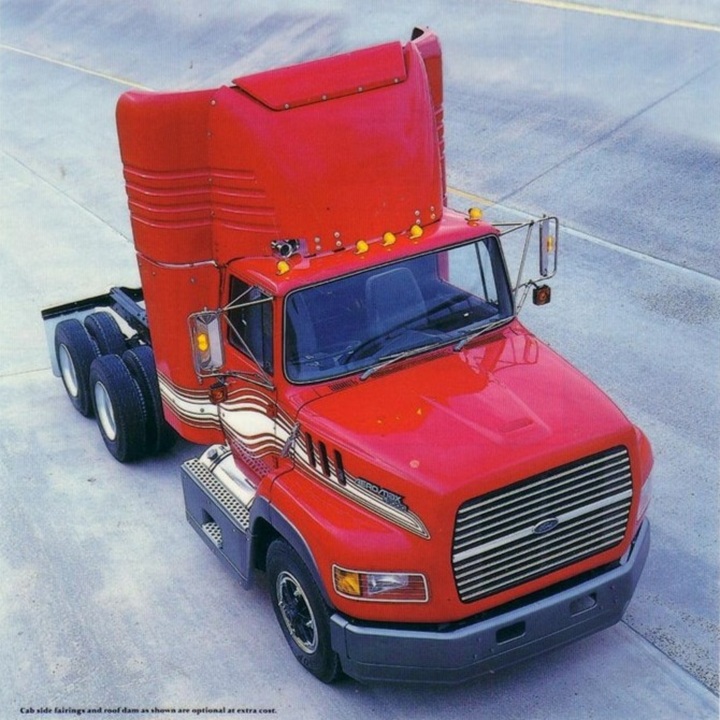
While many truck manufacturers responded quickly to the new aero era, Ford fell behind the curve. It didn’t launch its first true aero semi, the AeroMax, until 1988. Ford’s truck promised big gains — around 1.7 mpg, or 23 percent — but instead of dominating the truck market, buyers looked elsewhere. Ford would fail so hard that it pulled out of the big truck market and hasn’t returned since.
Ford Gets Serious About Big Trucks
While Ford has had commercial trucks since 1917, it didn’t develop dedicated heavy trucks until the 1950s. Ford says that when it decided to separate its heavy commercial trucks from the F-Series line, they would become a part of the C-Series commercial truck unit. It would go on to produce C-, H-, L-, N-, T-, and W-Series models.

As Curbside Classic notes, telling the full history of Ford commercial trucks would be difficult, as the Blue Oval had so many lines in production at the same time. From Curbside Classic:
Over the next two decades, Ford introduced several series of heavy-duty trucks. There’s no easy way to describe this truck ancestry, since Ford produced many of these series concurrently. The 1957 C-series cabovers brought a dedicated heavy-truck cab design, though these were produced alongside conventional F-series heavy trucks. In the 1960s, the H-series debuted, as did the N conventionals, and then the W-series replaced the H. By the late 1960s, Ford was a major player in North America’s heavy truck market, accounting for about a quarter of total production. However, its biggest play was yet to come.
Ford began planning for a new line of heavy trucks in 1963, due to forecasts of strong growth in this segment. The truck took a long time to bring to market, since the line was intended to include everything from urban delivery trucks to extra-heavy-duty long-haul tractors. In a rare move for any vehicle manufacturer, Ford developed both a new product line and a new factory simultaneously. At this point, we can take a brief detour and talk about Ford’s site selection process. As with all major corporate decisions, this involved several competing priorities, and many people involved in the process. Among those people was John Van Vactor. A Kentucky native, Van Vactor left school as a teen in the 1930s to work on a Ford assembly line. Throughout the 1940s and 1950s he rose through the ranks as foreman and production manager at various plants, eventually becoming the manager of Ford’s Fern Valley Road plant in Louisville, which produced both cars and trucks. Van Vactor, who described himself as “virtually self-educated” was unusual among Ford management, who were largely products of elite schools.

He also had a different approach to site selection than did most executives. Van Vactor pointed out that from a human capital perspective, the new truck plant should be in Louisville, where his existing employees had considerable experience building trucks. Explaining that truck manufacturing had many unique attributes, and shouldn’t be thought of as simply car production on a larger scale, he was key in persuading Ford upper management to locate their new truck plant in Louisville. Management was impressed enough with Van Vactor that they appointed him the new plant’s first manager. And what a job that was. At 2.7 million square feet, the Kentucky Truck Plant was the world’s largest truck factory when it opened in August 1969.
The bones of the AeroMax come from the Ford L-Series, which was also known as the Louisville Line, a nod to the Louisville factory.
The Louisville

The Louisville Line was an incredible step forward for Ford. This was a dedicated commercial truck line built in its own special plant. Launched in 1970, Ford was rather proud of its Louisville trucks in its advertising, praising the rig’s deep-dip, electrocoat prime painted-frame, cross-flow radiator, fiberglass hood, quick-release dashboard, easier servicing, and more.
Ford claimed that, with all of these innovations and more, the Louisville Line was the most extensive product change in semi-tractor history. Ford also claimed no other truck maker in history has implemented so many ideas to make their rigs work better and be more comfortable.
This marketing blitz worked. Ford had 4,900 orders for L-Series trucks before they even went into production. The L-Series had a mind-boggling number of variations. At launch, the Louisville Line had 22 different models with 650 variations. L-Series trucks covered everything from local delivery straight trucks to over-the-road semis. The biggest and baddest L-Series trucks weighed up to 80,000 pounds when hauling a trailer.

If you lived in America in the 1970s, there’s a very good chance you’ve seen the face of an L-Series attached to a box truck, a cement mixer, a flatbed truck, a dump truck, or, yep, a semi-tractor. While Ford’s nomenclature for the L-Series seemed a bit random, every letter and number combination had a meaning.
All L-Series trucks had an “L” for their starting letter, which meant “Louisville”. From there, you had models like the L, the LS, the LN, the LT, and the LTL. An LS had a setback front axle, while the LN had a short hood. Tossing a “T” at the end of a combination meant that it had a tandem rear axle. After the letters, a Louisville Line truck then had either three or four digits. Three-digit trucks, like an LN-700, had gas engines. Four-digit trucks, like the LN-7000, had diesel engines.
Engines were wide and varying, too, ranging from Ford gasoline V8s to an array of V8 and straight-six diesels from Caterpillar, Detroit Diesel, and Cummins.
Ford Loses Ground

At first, things were great for the L-Series line. Truckers were scooping them up, and Ford didn’t even feel the need to update the rigs in any meaningful way for the first few years. Ford even expanded the line with the extra-large long-haul LTL-9000 in 1976.
Ford held a 15 percent share of the big truck market when the Louisville Line launched, making it one of America’s most popular truck makers. The decade would bring headwinds to the entire industry with a weaker economy, fuel shortages, and fuel price hikes.
The trucking industry continued to struggle in the 1980s. The Motor Carrier Act of 1980 (MCA), signed by President Jimmy Carter, deregulated the government’s price controls on shipping rates. The idea was that, without the government getting in the way, trucking companies would compete with each other, eventually lowering the cost of transportation.

The Act technically worked as designed. Between 1977 and 1982, truckload shipment rates fell by 25 percent. The trucking industry itself was sent into turmoil. As the New York Times wrote, 72 trucking companies closed between 1978 and 1983. By 1986, the Washington Post wrote, some 4,000 companies and operators were out of business. Yet, despite the shocking loss of thousands of companies, the trucking industry actually doubled in size due to the lack of market entry controls. As trucking became aggressively cutthroat, the wages of drivers suffered as companies tried anything they could to get an edge.
Class 8 truck sales also took a battering, with sales falling by 25 percent through the first half of the 1980s. Trucking companies held onto their existing rigs for longer, squeezing every little drop they could get out of their existing fleets. The standardization of tractor-trailer lengths in 1982 also paved the way for the conventional semi to finally beat the cabover for supremacy.
In building the T600, Kenworth didn’t just make a revolutionary aerodynamic semi-truck, but it gave trucking companies an exciting reason to buy new again.
Going Aerodynamic

The events of the 1980s would put Ford in a difficult place. Truck sales were down, yet Ford’s competition was still holding the line by coming out with fresh designs. Ford’s lineup began to look stale in the face of the era’s new aero trucks. By 1987, Curbside Classic writes, Ford’s heavy truck market share had fallen to 10 percent, and some speculated that Ford might exit the market.
But Ford didn’t give up. Instead, in 1988, it came out with its own aero truck, the AeroMax L9000.

The AeroMax was an extensive overhaul of the L-9000. In Ford’s marketing, it said that, in the past, 50 percent of the power required to get your rig down the road was wasted on air drag. The AeroMax had the same cab as an LS-9000, but that was one of the few external similarities between a regular L-Series and the AeroMax.
To help the AeroMax cut through the air, Ford made dramatic changes to the truck’s nose. Perhaps the most prominent change was the headlights, which were now integrated into the hood and curved with the front fenders. The front bumper was now an air dam designed to direct air around the truck. Even the fender flares were designed to route air over the wheel wells rather than let too much air into them, causing drag.

Other aero measures included rounded mirrors, aero coverings for the fuel tanks, and a smooth fairing above the cab. Ford also added Michelin 11R22.5(G) tubeless low-rolling resistance radial tires to further aid in the mission of increasing efficiency.
The AeroMax wasn’t just about aero. Ford identified some remaining pain points in the trucking industry. Namely, drivers complained about poor visibility out of their cabs. The AeroMax did have the same cab as the existing L-Series trucks, but a sloped-down hood for aerodynamics and a little more visibility. Ford also moved the fuel tanks forward in an effort to transfer more weight to the front axle so that a trucker can better optimize axle loading.

Ford was confident about the AeroMax. It was supposed to help bring production back to the Louisville plant, which was running at half of its capacity at the time. According to Curbside Classic, Ford said: “We plan to be among the leaders in the heavy truck field.”
Ford had some evidence to think so, too. The company contracted an independent agency to run an SAE Fuel Economy Test against a typical Ford LNT-9000 versus what Ford thought most customers would choose for their AeroMax trucks. The AeroMax had a Cummins L-10 10.0-liter straight-six diesel with 300 HP, a Fuller BT-11609A nine-speed manual, a Rockwell SQ-100 SQ-100 with a 3.55 ratio rear axle, and the aforementioned Michelin tires.

The LNT-9000 had a Cummins Big Cam III 14.0-liter straight-six with 300 HP, a Fuller RTF-11609 nine-speed manual, a Rockwell SQ-100 SQ-10 with a 3.9 ratio, and the same tires as the AeroMax.
In the test, the LNT-9000 was loaded down to 80,000 pounds while the AeroMax was loaded to 63,000 pounds. It’s unclear why the AeroMax had a lighter load. Both trucks drove 55 mph for the test. In testing, the AeroMax scored an average of 8.27 mpg while the old square truck scored 6.58 mpg. The 1.7 mpg gain was about a 23 percent difference between the two trucks.

Unfortunately, Ford’s optimism didn’t translate to success in the trucking market. Ford was able to stabilize its 10 percent market share, but found itself unable to gain ground against market leaders International, Paccar (Peterbilt and Kenworth), Mack, and Freightliner.
It’s unclear why truckers didn’t latch onto the AeroMax, but it could have been because Ford’s effort came four years late and didn’t bring anything new to the table. Kenworth was advertising 9 mpg with the T600 four years earlier. When you read Ford’s brochures for the AeroMax, the wording is very careful. It talks about how the AeroMax is the most efficient Ford Class 8 ever built. Even in the fuel economy comparison tests, Ford only compares the AeroMax against other Fords.
Ford Tries Again

Yet, once again, Ford wasn’t ready to throw in the towel. In 1996, Ford launched its first clean sheet truck design in 25 years and the first to be designed specifically for long-haul truckers.
Automotive News wrote about Ford’s big plan:
What’s the highest compliment someone could pay Ford Motor Co. about its new Louisville heavy-duty work truck? That it’s more powerful? More rugged? Comes in nice colors? Try that it is much more comfortable for the driver. At a press preview for the Class 7 and 8 trucks, which will eventually replace the 25-year-old L series design, Ford executives stressed that the Louisville was designed from the inside out. Why? Because driver comfort is key to trucking companies keeping drivers, said John Ochs, a Ford spokesman.
Gang of 67:
So Ford assembled a group of 67 commercial fleet truck owners, not all of them owners of Ford trucks, to serve as a sounding board for the designers and engineers developing the Louisville. In addition, Ford brought in more than 5,000 truck drivers to evaluate designs, sit in interior styling bucks and place gauges and controls to their liking. The Louisville’s cab is four inches longer than the current L series. Seat travel was increased to 7.5 inches for individual seats, 9.5 inches for bench seats. The steering wheel is smaller and the steering column is closer to the windshield. The dashboard has a smoother, wraparound look to it with gauges and switches similar to those in Ford cars and light-duty trucks. In fact, the heating and ventilation control unit was lifted from the F-series pickup. The doors are about 20 percent larger than the L series, to make entry and exit easier. The windows are larger and dip down at the front edge to give the driver a better view of the road. Engineers used a Pontiac Fiero as a target vehicle in working to expand visibility in the Louisville. Because drivers usually customize their trucks with additional lights, citizens band radios and sound systems, designers added receptacles on the dashboard and spare power connections at fuse boxes. Initially, the cab will be built of galvanized steel. But in the future, Ford will offer aluminum cabs.
Stronger and Lighter:
The cab was designed using the resources Ford brings to bear on its cars and light trucks, making it lighter, stronger and quieter. Ford claims the cab will be the quietest in the Class 7 and 8 markets. The Louisville carries virtually the same engine and transmission lineup as the L series, and even the side rail design is carried over. But the user-friendly approach extends under the Louisville’s hood. The hoses, clamps, wiring, fuses and bulbs used are all of standard design and lengths, making it easy to find replacement parts at truck stops and auto parts stores. Wiring harnesses are bundled and routed on top of the frame rails to protect them from road splash, yet are strong enough for a technician to stand on without damage.

Ford had a lot riding on the line here, and it didn’t want to miss. Making an aero truck alone wasn’t good enough. It also had to be lightweight. A different Automotive News piece details that the AeroMax had 450 pounds of plastic composite covering the hood, fenders, grille, cowl panels, roof, chassis fairings, doors, and wind deflector. Reportedly, by weight, the AeroMax had more than twice as much plastic as the average Class 8 truck, and several times as much plastic as the average passenger car of the 1990s.
Yes, the second-generation AeroMax really did have composite doors, albeit with steel reinforcement.

Building a light truck wasn’t good enough, either, as the new AeroMax had to fit modern drivers. Ford admitted that, in previous trucks, it had relied on military statistics on the size of the average male to design its cab interiors. Those statistics were 50 years old by the 1990s. Ford found that male truck drivers had become bigger than they were in the 1940s. Meanwhile, an increasing number of female drivers were joining trucking, and they were often shorter and lighter than male drivers in the 1990s. To compensate for both, the AeroMax was given big seats with a lot of adjustment travel, a dash that’s close and easy to read, and easy-to-climb exterior steps.
According to Automotive News, the astoundingly roomy cab and the stylish, but easy-to-read dashboard earned Ford the highest customer acceptance rating in the company’s history. Apparently, the dashboard was rated higher than even any car dashboard in Ford’s past.

Another part about the AeroMax was that there wasn’t really a “typical” powertrain. Ford offered buyers a choice of 115 engine tunes, 85 transmission variations, and 63 fuel tanks. Engines came from Caterpillar, Cummins, Detroit Diesel, and Ford, while those fuel tanks ranged from 55 gallons to 150 gallons, each. The flagship engine was a Cummins N14 14-liter straight-six with 500 HP and 1,650 lb-ft of torque on deck. Advertised configurations had Eaton transmissions, Rockwell or Eaton axles, Spicer or Rockwell clutches, and Hendrickson suspension.
Ford Failed, Again

Ford spent $500 million ($1,028,700,934 today) developing the AeroMax and more or less bet its heavy truck unit on the success of the second-generation Louisville and AeroMax semis. While AeroMax buyers seemed to like their rigs, the second-generation trucks suffered from slow sales. In the year following the second-generation Louisville’s and AeroMax’s debut, Ford’s heavy truck market share dipped to 9.7 percent.
One problem was that, by this point, Ford had fallen so far behind that it just couldn’t keep up with the competition. Freightliner held 25 percent of the truck market in 1995, and managed to gain its market share to 29.4 percent in 1996. Ford was struggling to exist at all, and the only other major truck manufacturer doing worse was Volvo GM Heavy Truck Corp., which had only 9.1 percent of the market.
Update: A good point made by a reader was that these trucks had so many parts that weren’t from Ford, which cut into profit after suppliers got their cut. Indeed, Ford repurposed its Louisville plant to build far more profitable SUVs.

By early 1997, only a year after the new AeroMax trucks hit the market, Ford was done. Ford sold its heavy-truck business to Freightliner for only $200 million ($411,480,373 today). Basically, Freightliner got a whole new platform for a discount price. Later that year, Volvo ditched White and GMC, rebranding to Volvo Trucks North America.
Ford kept the Louisville plant in the deal, and to build its new Louisville trucks, Freightliner owner Daimler set up shop in Ontario. The new trucks would lose the Blue Oval and would instead be called Sterlings. Daimler positioned Sterling Trucks as a sort of middle child between Freightliner and Western Star. Sadly, Sterling never really found its footing and would cease operations only a decade later.
So, the AeroMax is one of those sad stories of not just failing once, but twice. It’s a shame because it is a good-looking rig, and people did seem to like their interiors. But the market spoke, and Ford lost.
A Fading Part Of Trucking History
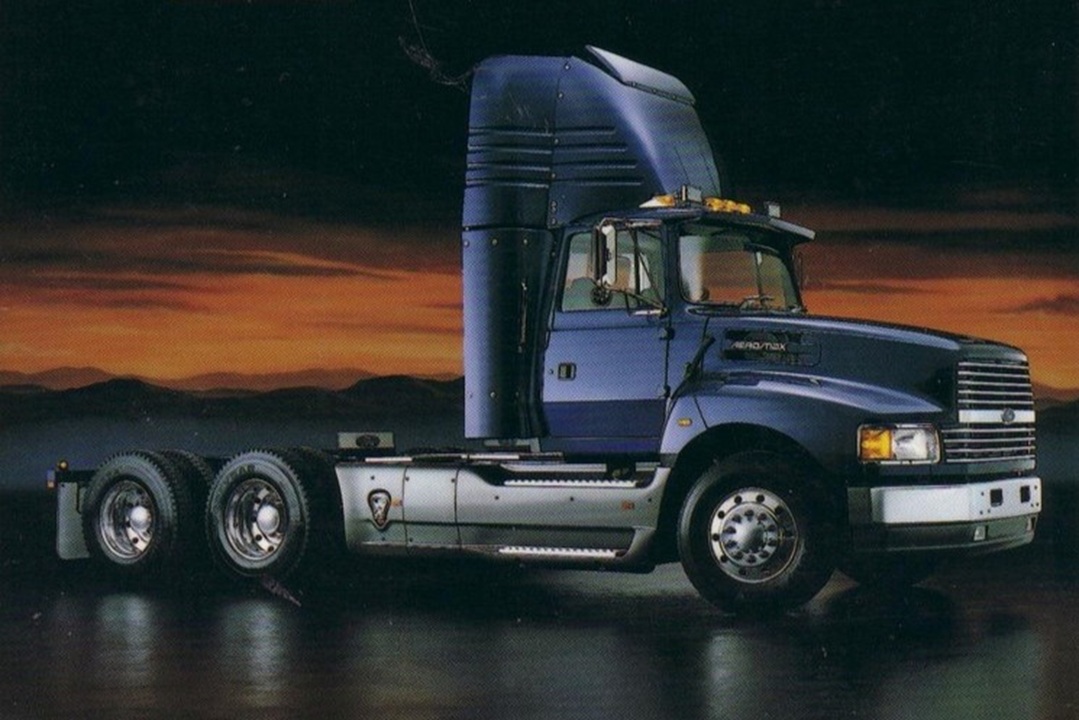
To be fair to Ford, it’s a little unclear if the second-generation AeroMax was going to be a failure in the long term. Ford waited only a year before dumping the rig, and Sterling didn’t really get the kind of marketing power of the likes of Ford or Freightliner. How many people even knew that Sterling existed?
I think the most surprising part of this story is that none of the Big Three has dared enter the heavy-duty market again under their own brand names. Ford basically washed its hands of big trucks and never looked back. Meanwhile, General Motors ditched its locomotive operation, bus operation, and heavy truck units. Sure, each of the Big Three does build medium-duty trucks today, but you will not find a Ford-branded or GMC-branded Class 8 truck on the road now unless you find one of these vintage units. Instead, automakers sometimes invest in truck companies with existing presence, which makes sense in the modern era.
Still, late to the party or not, the Ford AeroMax was such a cool rig. It was a truck built to fit a variety of drivers and could be ordered basically any way an owner wanted it to be. The truck even seemed to get tangible increases in fuel economy. But sometimes even the best efforts by the largest manufacturers end up as a big failure.
All images: Ford


Wtf? Did I just read that when Fords Aeromax was loaded with roughly 23% less weight than it’s other truck, it got 23% better fuel efficiency and Ford patted themselves on the back?
That was my big takeaway too. “It’s unclear why the Aeromax had a lighter load.” I think it’s actually very clear. It’s because it takes less fuel to haul less stuff and what Ford needed more than anything else was to use less fuel.
“extra-large long-haul LTL-9000”
Isn’t that the new model of vibrator that just came out?
“John Van Vactor”
Did he live in a VAN down by the RIVER, by Ford?
I know why REO gave up on semi trucks:
Cuz’ I can’t fight this aero any longer
And yet I’m still afraid to let it flow
What started out as competition has grown stronger
I only wish I had the strength to let it show
…I tell myself that I can’t hold out forever…
That original L-9000 is possibly the best looking Ford of all time. Of any type.
I’m surprised you didn’t mention the Sterling Bullet, the rebadged Dodge Ram. It’s just sort of amusing that the brand that came from Ford would “birth” a Dodge pickup.
The headline.
38 years ago, wow that was a while ago.
Looks at the year the truck came out. The year I was born.
Fuck.
TGIF.
Ford still makes class 8 types of trucks, they just partnered with the Turks to do so for the European cab over market. https://www.fordtrucks.com.tr/en/tractor-series/fmax